Sheer by Vanessa Lawrence Summary, Characters and Themes
Sheer by Vanessa Lawrence is a contemporary novel told through the urgent self-account of Maxine Thomas, the founder of a luxury-leaning beauty brand called Reveal. After a sudden phone call shatters her career and reputation, Maxine sits alone in her apartment and starts writing the version of events she believes no one will ever hear fairly.
Her narrative moves between the glare of public scandal and the private history that shaped her: a childhood steeped in rules about femininity, early experiments with makeup as art, and the long climb from department-store counters to boardrooms. It’s a story about ambition, control, and consequences.
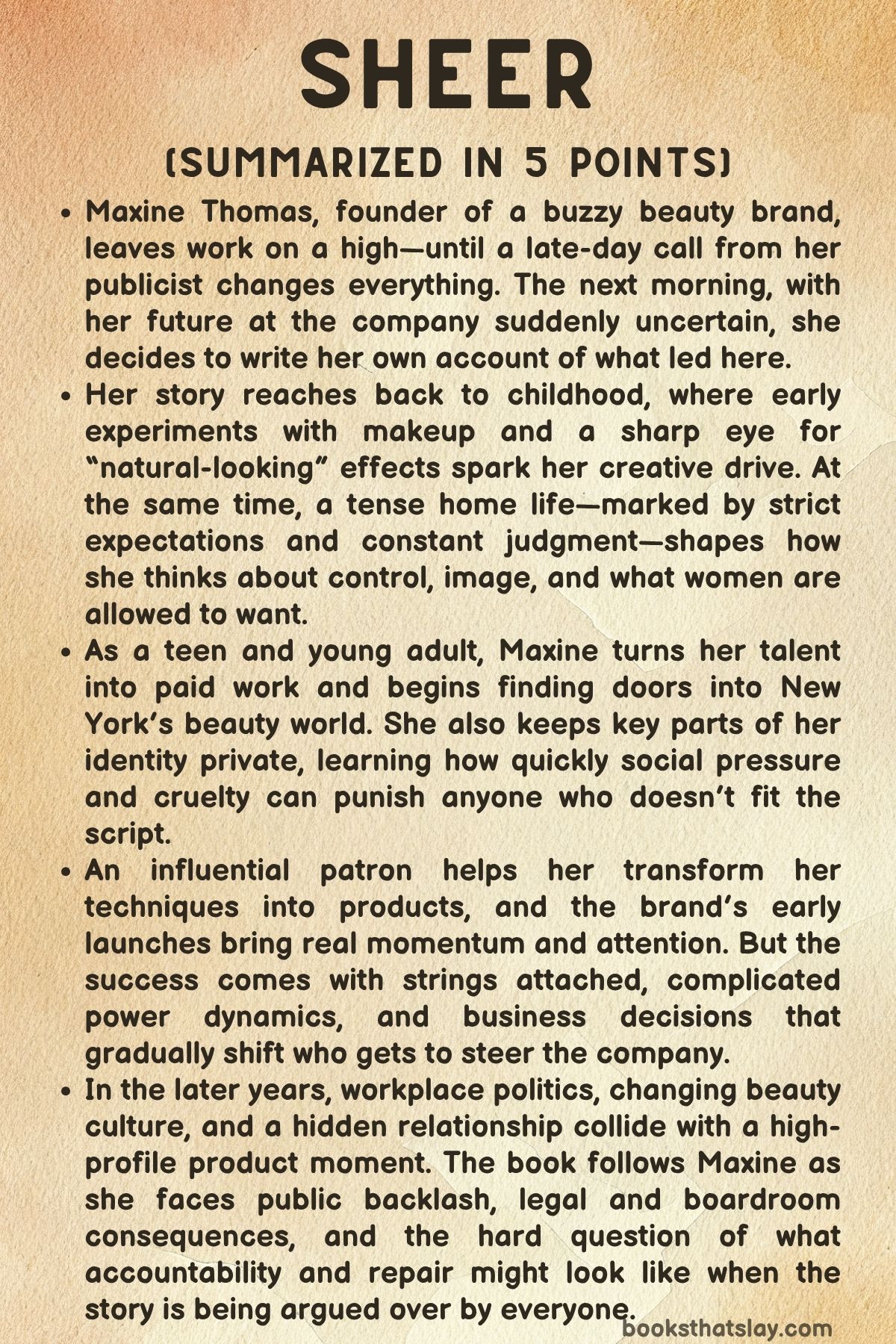
Summary
Maxine Thomas is riding high on a late-summer evening in New York when she leaves her SoHo office early, pleased with a professional win her publicist, Elizabeth Sanders, helped secure. She takes an Uber uptown to her Central Park West building, but instead of going straight in, she chooses a long sunset walk around the Reservoir.
The park is crowded and loud, yet Maxine feels calm, watching the sky change color over the water. Then Elizabeth calls.
Maxine answers as if it’s another routine check-in, but Elizabeth’s voice is unsteady. The message she delivers knocks Maxine off balance: something has happened that will not stay private, something that threatens the company Maxine built and the identity she has worked years to create.
The next morning, Maxine wakes before dawn from sheer habit, starts to reach for her running clothes, and stops. There is no packed schedule to manage now, no meetings to take, no team to lead.
The internet has already turned her name into a headline and a target. She has disabled alerts because the constant coverage is unbearable.
She believes strangers are talking as if they know her, as if they can sum up her life with a few words and a verdict. A board decision is looming, and she expects she might lose control of Reveal.
With nowhere to put her anger and nowhere to speak without being punished for tone, she opens a blank document and begins writing her story for herself. She is convinced two women, Ellen Atkins and Amanda Weston, pushed her toward this moment, and she wants a record of what they did and what she did in return.
Maxine starts at the beginning, returning to a small scene from childhood in Paramus, New Jersey. At six, she sneaks into her parents’ bedroom and tries on her mother’s hot-pink lipstick.
The look feels wrong on her face, too loud, too artificial. Panicking when she hears her mother return, she tries to wipe it off, then grabs a cherry Popsicle to hide the remaining stain.
In the mirror, she notices the Popsicle leaves a thin ruby tint that looks more like her, less like a mask. That small discovery becomes a private rule: the best beauty is not about heavy coverage, but about a subtle adjustment that lets someone recognize herself.
Her home life is tense. Her mother is devoted to routines, magazines, and the endless policing of appearance; her father is critical, controlling, and proud of restraint.
Maxine watches him humiliate her mother over clothes and spending, and she learns how quickly a woman’s joy can be shut down by a man’s judgment. She also learns that her mother enforces the same rules, praising “proper” behavior and mocking anything that feels strange, bold, or unclear.
Maxine, drawn to art projects at school and textures that don’t fit neatly into “pretty,” begins to push back in her head even when she can’t do it out loud.
As a teenager, Maxine’s skill with makeup becomes a kind of power. She and her friends flip through teen magazines and compare themselves to impossible faces.
When a friend complains she’ll never look like a famous model, Maxine takes whatever products are available and creates the “effect” instead: shadow used as liner, lipstick softened into a stain, bronzer blended into warmth, shine placed where it matters. The result astonishes her friend, and Maxine hears the word she has been waiting for: talent.
She turns it into a small business, carefully scheduling classmates before weekends and dances, charging for her work, and requiring clients to buy their own mascara. It is the first time she feels both skilled and in charge.
Privately, Maxine is also learning something she refuses to name openly. She is attracted to girls, but Catholic expectations and the casual cruelty around her teach her to keep it hidden.
A slur tossed at a female coach is enough to make Maxine feel how quickly admiration could become danger. Her secrecy hardens into strategy: she simply avoids dating boys and lets people interpret that however they want.
When her mother discovers the makeup business, Maxine expects pride. Instead, her mother treats it as shameful, equates it with selling herself, and threatens to tell her father.
The business is shut down. The betrayal sets a permanent distance between mother and daughter, and Maxine begins to believe she can only rely on herself.
Her father uses a connection to place her in a supervised job at Macy’s in the Garden State Plaza. On the cosmetics floor, Maxine must wear a uniform and a specific cotton-candy lipstick she dislikes.
The work is loud and hot, and she feels reduced to a script. Still, she learns the machinery of retail and meets Linda, a sharp, overworked coworker who becomes a mentor.
Linda protects Maxine, pushes her toward competence, and warns her about the risks of breaking rules.
Maxine breaks them anyway when a customer asks for a discontinued foundation. She mixes a matte formula with moisturizer to get a lighter finish and corrects the woman’s mismatched shade.
The customer looks fresher, younger, and relieved. The sale is strong, but Linda warns her: if she teaches people to alter products, the company will see it as an insult to the products themselves.
Maxine absorbs the lesson. She will keep her best ideas close until she can build something of her own.
After graduation, she gets into NYU and moves to the city. She wants to study art history, but her father pressures her toward business and marketing because he’s paying.
In the dorms, she shares space with Jeannette, a roommate who organizes her life around men and party culture. Maxine can’t join the easy heterosexual bonding around her, and she feels increasingly separate, as if her real life is happening somewhere off to the side.
Working at Macy’s Herald Square, she meets Caroline Walters, an older, confident woman who flirts, leaves her number, and invites her for drinks at the Plaza Hotel. At work, another employee threatens Maxine with outing her using a slur, and Maxine quits rather than stay vulnerable.
She meets Caroline anyway. The night ends in Caroline’s loft, where Maxine has her first sexual experience with a woman.
In the morning, Maxine does Caroline’s makeup with her fingers and custom mixes, and Caroline is impressed enough to recommend her to wealthy friends. Suddenly Maxine is moving through Manhattan apartments as a private artist, paid for discretion and results.
But Caroline ends the connection when she learns Maxine is much younger and still in college. The fear is not only about Maxine’s age, but about appearances and what people might assume.
Maxine takes a final night and then is cut loose. She does not fall apart in public.
Instead, she keeps working, growing her client list, turning loss into fuel.
Through her private work she meets Ellen Atkins, a Park Avenue socialite with a “business” that mainly serves as decoration in her marriage to a finance husband, Donald. Ellen is fascinated by Maxine’s homemade pigments and custom concealers.
She offers money and legitimacy in exchange for partnership, and they begin developing a product Maxine calls Flush. Maxine’s grades collapse under the workload, and she drops out of NYU to pursue the company.
Her parents are furious; her father cuts off support. With nowhere else to go, Maxine moves into Ellen’s guest room, and Reveal begins in that borrowed space.
In 1999, Ellen presents Maxine with a contract. Maxine doesn’t truly understand the language, but she is young, dependent, and eager to prove gratitude.
She signs without a lawyer, giving Ellen enduring leverage. Maxine becomes the public founder and creative force; Ellen becomes the power behind her, shaping investors and governance from the shadows.
Reveal’s early products take off. Flush succeeds, and a luminous lotion called Glow becomes a breakout hit in 2000, selling out in major department stores and pulling the brand into glossy magazine coverage.
Maxine finally moves out of Ellen’s home, but she never escapes Ellen’s influence. At a promotional lunch with wealthy customers, Maxine’s philosophy of minimalist beauty clashes with their expectations, and she sees how quickly her authority can evaporate in a room full of people who think money equals taste.
The shock of 9/11 arrives as Maxine watches events unfold from a distance, shaken by the scale of it and by a quieter realization: no one is scrambling to find her. Ellen offers her shelter again, but Maxine refuses.
She clings to independence and pushes herself deeper into work, convinced devotion will protect her.
In 2002, Ellen insists Reveal needs more investors and a more controlled public image. She sets Maxine up with financier Chip Adler, who treats Maxine with entitlement and crosses physical boundaries.
Maxine bluffs her way out, then tells Ellen what happened. Ellen admits she kept quiet because Maxine might have refused the meeting, implying money mattered more than Maxine’s safety.
Around this time Maxine hires Elizabeth Sanders for PR. Elizabeth is plainspoken, strategic, and willing to tell uncomfortable truths.
She becomes Maxine’s most loyal professional ally as Reveal expands through the 2000s. Not every launch succeeds: a tinted serum called Whisper is criticized for looking greasy and for limited shades, and it fails.
The 2008 crash increases investor pressure, and Ellen grows sharper, more demanding, less patient with Maxine’s creative control.
After the crash, Maxine hires Amanda Weston, a recent graduate who presents as devoted and eager. Amanda quickly becomes essential, handling logistics and smoothing Maxine’s daily life.
Maxine rewards her with access and trust, and the boundary between professional dependence and personal intimacy begins to thin.
Back in the present, Maxine is trapped in her apartment as the scandal intensifies. Her lawyer, Sandrine, coaches her to stay composed and to present herself through vulnerability rather than anger, because any future arbitration will be judged as much on story as on fact.
When Maxine finally steps outside for a run, she collides with a child and is recognized by the mother, who calls her a racist. A photo hits social media, and the comment threads turn violent.
Maxine realizes her name now triggers automatic hate.
Maxine’s understanding of Ellen shifts when Ellen confronts her and claims she has been the true strategist all along, using her marriage and her husband’s money as tools, shaping the board, and holding power that Maxine never saw clearly. Maxine recognizes how naive she was when she signed that first contract.
Reveal installs Alan Jeffries as president and CEO in 2012 to prepare for acquisition. Maxine is demoted to chief creative officer while remaining the brand’s founder figurehead.
Alan pushes a mass-market strategy: more launches, more categories, more direct-to-consumer sales. Maxine argues for a tighter line built on essentials and loyalty, but Ellen backs Alan.
Maxine is told to comply.
During this period, Maxine begins sleeping with Amanda. The first time happens after drinking, and afterward Amanda returns to work as if nothing has changed.
Maxine reads that as consent and discretion. The relationship continues in secret for years, with rules about public distance and no visible affection.
Maxine frames the secrecy as privacy, but it also keeps Amanda isolated and keeps Maxine in control of the narrative.
As Alan accelerates product churn and undermines Maxine in meetings, Elizabeth warns that influencer culture matters and suggests listening to Amanda’s perspective. Maxine resists until she finally promotes Amanda into publicity, a move that changes their dynamic.
Amanda becomes less available, less responsive. Maxine corners her, pushes for time, and also asks Amanda to model in a campaign for a new “hero” product: a chisel-tipped gel eyeliner called Sly, designed to create a sharp, lifted eye shape.
Sly takes eighteen months to develop and launches in September 2015 to immediate success: major features, sellouts, a crashed website, and a waitlist. Then a backlash begins online.
A small account accuses Reveal of cultural appropriation and the accusation is amplified by a large callout platform. The name Sly and the marketing language around a stylized eye shape are framed as racist and fetishizing.
Elizabeth rushes to Maxine’s office to contain the damage and drafts a statement that includes donations and a defensive explanation, but it doesn’t calm the public.
That night, Amanda goes to Alan and HR and reports that she was the inspiration behind Sly and that she has been in a sexual relationship with Maxine for years, starting when Maxine was her boss. Suddenly the story becomes two stories: accusations of racism and allegations of workplace sexual misconduct.
Headlines explode overnight, and the board moves quickly.
On the morning of the board meeting, Maxine dresses in a sharp black suit and waits near the office, suspended between denial and dread. Sandrine calls: the board has fired her.
Maxine stays at a diner, numb, then sees Amanda at the bar. They argue in raw terms.
Maxine insists Amanda wanted the relationship and initiated it; Amanda insists the power imbalance made true consent impossible and says race shaped the pressure she felt. She describes the toll it took on her body and mind and says she reported Maxine to stop her from doing it again.
After Amanda leaves, Maxine walks through SoHo and decides not to fight the termination. She returns to the only action that still feels possible: writing.
The story ends with Maxine intending to send her account to Amanda, not as a legal weapon, but as an attempt at recognition and a request for forgiveness.
Characters
Maxine Thomas
In Sheer, Maxine Thomas is written as a woman who builds her identity around control—of image, of narrative, of other people’s perception—and then experiences the specific horror of watching that control evaporate in public. Her creative genius is real and repeatedly demonstrated: as a child she learns that a “sheer” effect can feel truer than heavy coverage, as a teen she instinctively replicates beauty “effects” with whatever is available, and as an adult she turns that intuition into products and a brand philosophy built on restraint, texture, and realism.
But the same instincts that make her a visionary also harden into rigidity: she becomes convinced that her way of seeing is the only honest way, that her taste is proof of moral clarity, and that dissent is either ignorance or betrayal. The present-day framing—her waking early with nowhere to go, typing into a blank document, drinking, spiraling, monitoring the internet—shows someone whose inner life is structured like a crisis response team, constantly drafting arguments that will never fully land because the world is judging her on power rather than intention.
Maxine’s queerness, formed under fear and secrecy, becomes a lifelong pattern: intimacy must be controlled, discreet, and on terms she can manage, which is why her relationship with Caroline and later Amanda repeats the same architecture of unequal access and emotional compartmentalization. What finally destroys her is not simply a product controversy or a personal scandal, but the collision of her self-story—artist-founder, misunderstood truth-teller, victim of betrayal—with the unavoidable fact that she holds institutional power and uses it while insisting it is only personal desire or private love.
The tragedy of Maxine is that she is both more perceptive than many people around her and far less self-aware than she believes; she can read faces, textures, and the cultural mood, yet she cannot—or will not—read how her authority reshapes every relationship she enters.
Elizabeth Sanders
Elizabeth functions as the clearest mirror Maxine has, which is why Maxine both relies on her and resists her. Elizabeth is not drawn as a glamorous PR archetype; her plain presentation in the interview signals that she values structure, coherence, and credibility over sparkle, and that makes her uniquely suited to a brand selling “minimal” beauty.
She becomes Maxine’s translator to the outside world, smoothing rough edges and building a consistent story, but she also represents a form of professionalism that Maxine struggles with: the idea that intentions are not enough, that perception is a material force, and that the internet will interpret silence as guilt and defensiveness as contempt. Elizabeth’s loyalty is substantial—she shows up in the apartment, tries to keep Maxine safe, and scrambles to contain Sly’s backlash—but it is not blind devotion; her urgency comes from understanding how quickly narratives metastasize, and from recognizing that Maxine’s private history is not separable from the brand’s public meaning.
When the scandal hits, Elizabeth’s role becomes almost tragic in its own way: she can craft statements, propose donations, and draft strategy, but she cannot replace accountability or erase the power dynamics Maxine refuses to name. Her presence underscores a central tension of Sheer: a founder can believe she is the brand, but the brand becomes a public object with ethical expectations that a single person cannot control once harm is alleged.
Ellen Atkins
Ellen is the story’s most deliberate strategist, a character who weaponizes the very underestimation that Maxine initially projects onto her. She first appears as a Park Avenue socialite with a “legitimacy” business and a finance husband, which invites Maxine—and the reader—to dismiss her as ornamental, yet Ellen’s real talent is structural power: contracts, boards, investors, reputational discipline, and the long game.
Her investment in Maxine begins with seduction-by-opportunity, offering money and access in exchange for leverage, and the pivotal detail that Maxine signs without legal counsel makes their relationship less a friendship than a trap that tightens over decades. Ellen’s worldview is shaped by exclusion: she frames her choices as adaptations to a world that closed finance careers to women like her, and she converts marriage into a ladder, then converts Maxine into a brand asset.
What makes Ellen compelling rather than purely villainous is that she articulates an internally coherent ethic—power is never given, only taken; gratitude is a tool; appearances are the currency of survival—and she is brutally honest about using men as instruments while also insisting she is the real architect. Her confrontation with Maxine is a turning point because it flips the story Maxine has been telling herself: the betrayals are not accidents, and the men are not the only drivers; Ellen has been arranging the board, the investors, even the company’s “professionalization,” so that Maxine remains visible while Ellen remains untouchable.
Ellen embodies the novel’s bleak suggestion that in corporate ecosystems, intimacy and patronage often disguise governance, and the person who seems most supportive can be the one holding the longest leash.
Amanda Weston
Amanda is written as the volatile center of the book’s most painful ambiguity: the space where desire, consent, ambition, race, and workplace power overlap—and where every participant can tell a story that feels true to them. She enters as a young graduate who appears earnest and fan-like, and the narrative shows her competence early through small, practical rescues that earn Maxine’s trust and access.
That access is the key: Amanda becomes embedded in Maxine’s daily life until the line between employee and intimate is no longer a line Maxine treats as real, especially once secrecy becomes normalized as “privacy.” Amanda’s behavior—setting rules, staying outwardly calm at work, continuing for years—can look like agency from Maxine’s viewpoint, but the novel later insists on the structural reality that agency inside a power imbalance is never clean. Amanda’s eventual disclosure to Alan and HR reframes her as someone who has been enduring a dynamic she could not safely control, and her description of not eating, of pressure and drinking, of vulnerability shaped by race, positions her not only as a wronged individual but as someone trying to interrupt a pattern.
Importantly, Amanda is not depicted as a simple opportunist; she argues with Maxine about beauty culture, she defends the democratization of trends, and she clearly has her own mind, but her choices occur inside a system where Maxine can promote her, withhold affection, corner her for time, and define the terms of visibility. As the inspiration for Sly, Amanda also becomes the bridge between the brand’s aesthetic claims and the ethical critique of fetishization, making her both muse and witness.
By the end, Amanda stands as the character who forces the story out of Maxine’s preferred frame—private romance misunderstood by outsiders—and into the frame Maxine least wants: accountability for what power does, even when someone believes they are loving.
Caroline Walters
Caroline is Maxine’s first adult love and her first proof that desire can be translated into access—into rooms, bodies, and a version of adulthood that feels sophisticated and possible. She is drawn with glamour and confidence, but the relationship is also clearly asymmetrical: Caroline controls the rhythm, the secrecy, and the boundaries, and Maxine accepts that control because it feels safer than exposing herself in a world that has already taught her queerness can become a weapon against her.
Caroline’s attraction is both personal and aesthetic; she is impressed by Maxine’s hands-on artistry and quickly turns Maxine into a service for wealthy friends, which flatters Maxine while quietly training her to associate intimacy with utility and referral networks. The collapse of their arrangement is telling: it is not the emotional cost that ends it, but the threat to Caroline’s reputation when Maxine’s youth is revealed.
Caroline’s panic is less about Maxine’s feelings and more about appearances, implying that even in queer spaces, power and image can replicate the same moral evasions Maxine later performs. Caroline’s later reappearance as an online discovery—married, seemingly stable—lands like a wound because she represents the life Maxine cannot access: public legitimacy without scandal, intimacy without catastrophe, a narrative that “makes sense” to society.
Caroline’s function is to establish the template Maxine repeats: a private relationship shaped by secrecy, status, and an agreement not to ask for more—until the shame or the optics become inconvenient.
Linda
Linda is one of the novel’s most grounded presences, a character who demonstrates a different kind of strength than Maxine’s: survival competence. As a witty single mother juggling multiple jobs, she sees Maxine’s talent immediately but also understands the constraints of corporate retail, where rules exist to protect profit and liability, not artistry.
She mentors by redirecting Maxine toward what she can excel at without getting fired—inventory, organization—and she acts as both shield and coach, forcing Maxine into customer interactions she would rather avoid. Linda’s warning after the improvised foundation mix is a crucial early lesson that Maxine half-learns: innovation is valuable, but institutions punish innovation when it implies the product is incomplete.
Linda respects Maxine’s instincts while refusing to romanticize them, and that pragmatism becomes a quiet contrast to Maxine’s later founder mythology. In the architecture of the story, Linda is the adult Maxine needed—someone who can affirm talent while teaching boundaries—yet Maxine’s trajectory pulls her toward patrons like Ellen and lovers like Caroline instead, relationships where guidance is always entangled with control.
Sandrine
Sandrine, Maxine’s lawyer, represents the cold procedural reality that Maxine keeps trying to outrun with narrative. She is practical and tactical, advising Maxine not simply on what happened but on how Maxine will be perceived when she speaks—urging vulnerability over anger because institutions often punish women, especially powerful ones, for displays of force that would be read as leadership in a man.
Sandrine’s coaching reveals an uncomfortable truth at the core of the novel: outcomes are shaped less by objective truth than by the story that can be sold to a board, an arbitrator, or the public. Yet Sandrine is not portrayed as manipulative so much as fluent in the system’s rules, and her presence underscores how small Maxine’s control actually is once governance machinery starts moving.
She also highlights Maxine’s late awakening: Maxine built a company without truly understanding contracts and boards, and now the only language that matters is legal framing, not artistry or intent.
Alan Jeffries
Alan is the corporate logic Ellen installs to finish the transformation of Reveal from a founder-led vision into an acquisition-ready machine. He is less a nuanced individual than a concentrated force: scale, speed, mass-market expansion, trend responsiveness, and direct-to-consumer obsession.
His “download” meeting and his insistence that Maxine “get in line” positions him as someone who views brand philosophy as a sentimental obstacle and product cadence as the only truth investors recognize. He repeatedly undermines Maxine, pushes launches she hates, and reframes her from decision-maker to symbolic founder, which is a structural humiliation disguised as efficiency.
Yet Alan’s power also depends on the board’s desire for numbers, and in that way he is an agent of a larger system rather than a lone villain. His role in the scandal’s ignition is significant because he becomes the channel through which Amanda’s disclosure turns into institutional action; once HR and executive leadership are engaged, the story stops belonging to Maxine.
Alan embodies the modern corporate inevitability the novel critiques: the founder’s identity is valuable marketing, but the founder’s autonomy is negotiable, even disposable.
Chip Adler
Chip appears as a blunt example of the entitled investor class that expects access to women’s bodies alongside access to their companies. His attempt to order for Maxine, pry into her personal life, and grope her thigh compresses a whole culture into a single encounter: money as permission.
Maxine’s response—inventing a dangerous “boxer boyfriend”—shows how trained she is to manage male threat with performance rather than confrontation, and Ellen’s later admission that she withheld warning because Maxine might refuse the meeting exposes the brutal calculus beneath mentorship and investment. Chip is not deeply developed because he does not need to be; his function is to demonstrate that exploitation can be normalized as the cost of capital, and that women like Maxine are expected to absorb it quietly for the sake of growth.
Donald Atkins
Donald is important less for his personality than for how thoroughly he is used as a conduit—first by Ellen and later by the corporate ecosystem around Reveal. He represents institutional legitimacy, the kind that comes from proximity to finance and marriage status, and his role in Maxine’s life underscores how often women’s power in the novel is routed through male-coded structures even when men are not the real strategists.
Ellen’s revelation that she planted ideas in his head so he would believe they were his reclassifies Donald as a figurehead, someone who benefits from the illusion of authorship while being guided. In the broader pattern of the novel, Donald is another example of how public narratives—who is “in charge,” who is “the money,” who is “the genius”—are often manufactured for social comfort.
Maxine’s Mother
Maxine’s mother embodies the suffocating femininity Maxine grows up resisting: propriety, hunger-as-performance, beauty as conformity, and social acceptance as safety. Her routines and magazines create the early texture of Maxine’s world, but her fear-driven morality also becomes a form of betrayal when she condemns Maxine’s teenage makeup business as something shameful and sexualized.
That moment is pivotal because it teaches Maxine that creative labor will be interpreted through the lens of female respectability, and that maternal approval is conditional on obedience to a narrow script. At the same time, her mother is not merely cruel; she is someone trained by her own environment to believe that public judgment ruins women, and she tries—misguidedly—to protect her daughter by shutting her down.
The tragedy is that this protection becomes the seed of Maxine’s lifelong secrecy and emotional hardening, the “wall” she builds that later makes it easier for her to rationalize hidden relationships and to confuse privacy with safety.
Maxine’s Father
Maxine’s father is depicted as a disciplinarian who polices women through criticism, money, and humiliation, and his influence shapes Maxine’s obsession with achievement and self-sufficiency. He controls spending, belittles Maxine’s mother, and turns family life into a performance where women must anticipate male displeasure.
His insistence that Maxine study business and marketing, and his ability to use connections to place her at Macy’s, shows how his power works: he grants opportunity while insisting it proves his worldview. When Maxine drops out of NYU and he cuts off support, it is both punishment and a final attempt to reassert authority over the narrative of her life.
Yet his presence also helps explain why Maxine later clings so fiercely to being the founder and “knowing the truth”; she grows up in a home where truth is whatever the powerful person declares, and she carries that lesson into adulthood—until she becomes the powerful person others challenge.
Ms. Adams
Ms. Adams serves as Maxine’s first validating witness, a teacher who recognizes that Maxine sees texture and meaning differently and frames that difference as authenticity rather than deviance. By giving her art books and emphasizing that what matters is a real point of view, Ms. Adams offers Maxine an alternative to her parents’ world of propriety and control.
This encouragement matters because it legitimizes Maxine’s inner authority early, helping her believe she can trust her perception even when it conflicts with social expectation. But it also plants a risk: when authenticity becomes Maxine’s religion, she later treats disagreement as proof that others are shallow or hostile, rather than as information about harm or power.
Ms. Adams is thus both a gift and an origin point for the founder certainty Maxine later weaponizes.
Christine
Christine operates as a lens for how heterosexual performance and male influence shape young women’s choices in Maxine’s adolescence. As Maxine’s friend and early client, she is part of the formative environment where beauty becomes social currency, and her visit to the Macy’s counter with Ted becomes a moment of disgusted clarity for Maxine.
Christine’s willingness to accept a garish lipstick because Ted finds it “hot” crystallizes what Maxine fears and resents: that women are trained to become objects curated by male desire, and that the performance of attractiveness can override personal taste. Christine is not portrayed as weak so much as socialized, and her presence helps explain why Maxine’s brand philosophy later frames itself as liberation—minimalism as autonomy—even as Maxine herself becomes capable of imposing her preferences and desires on others.
Karen
Karen is the character through whom Maxine first experiences the intoxicating power of transformation as social alchemy. Karen’s insecurity about never resembling a model becomes an opening for Maxine to demonstrate her gift: not copying a face, but creating an “effect” that changes how someone feels inside their skin.
Karen’s “You’ve got talent” is more than teenage praise; it becomes a naming moment that gives Maxine permission to see her skill as exceptional and monetizable. Karen also participates in the ambient homophobia that teaches Maxine fear, using a slur in reaction to the coach, and that contradiction—being both friend and threat—captures the environment Maxine grows up in: intimacy laced with danger.
Karen helps shape Maxine’s belief that desire must be hidden and that artistry can be safer than honesty, a belief that echoes through Maxine’s adult relationships.
Jeannette
Jeannette, Maxine’s NYU roommate, represents the heterosexual social culture Maxine cannot comfortably join and does not want to perform. Her systems for privacy, sex quizzes, parties, and steady stream of men create a dorm atmosphere where intimacy is casual, discussable, and socially rewarded, while Maxine’s sexuality is quiet, charged, and guarded.
The fading connection between them illustrates Maxine’s isolation not as a dramatic exile but as a slow mismatch of languages—Jeannette speaks the dominant script of campus femininity, Maxine cannot or will not speak it back. Jeannette’s function is to show that Maxine’s distance is not only about orientation; it is also about how Maxine relates to vulnerability.
Where Jeannette treats desire as ordinary, Maxine treats it as dangerous information.
Crystal
Crystal appears briefly but sharply as an embodiment of workplace cruelty and the threat of exposure that keeps Maxine compliant and closeted. Her needling about Maxine’s father’s connection and her use of a slur is not just personal nastiness; it demonstrates how quickly class resentment, homophobia, and workplace competition can fuse into leverage.
Crystal’s presence helps explain why Maxine’s early adult life becomes built around secrecy and control: she learns that visibility is a liability, and that other people will weaponize identity when they want power. In that way, Crystal is a small but formative antagonist, one who pushes Maxine toward the private-client world where discretion can be purchased—until Maxine later becomes the one who controls discretion for someone else.
Pam
Pam, the middle-aged customer seeking a discontinued foundation, is used to show Maxine’s instinctive empathy and her boundary-pushing creativity in action. Pam wants to feel seen, not sold to, and Maxine gives her that by breaking rules and mixing textures to create a match that restores youthfulness without artifice.
Pam’s delight validates the core ethos Maxine later builds into Reveal: beauty as subtle correction and luminous realism rather than mask. At the same time, Linda’s warning after Pam’s sale foreshadows the later corporate conflicts Maxine will face—institutions do not like improvisation that implies the official offering is insufficient.
Pam is a small character, but she reveals Maxine at her best: attentive, inventive, and motivated by the emotional outcome on another person’s face.
Ted
Ted’s role is to crystallize the male gaze as a social force rather than an abstract theory. His pressure on Christine to buy a loud lipstick because it will be “hot” shows how easily women’s presentation can be redirected toward male pleasure, even in mundane retail moments.
For Maxine, Ted is not important because he is uniquely awful, but because he is ordinary; he stands for a common dynamic Maxine comes to despise, one that later fuels her brand language about independence and “bare” authenticity. Ted’s presence also sharpens Maxine’s complicated relationship to empowerment: she hates seeing a woman defer to a man’s desire, yet she later enters dynamics where her own desire and authority shape someone else’s choices—suggesting that domination can wear many faces.
Carl
Carl is the accidental detonator of Maxine and Caroline’s collapse, a drunken classmate whose casual recognition reveals Maxine’s age and student status and forces the relationship into the light Caroline fears. He matters because he demonstrates how fragile secrecy is: a private world can be undone by a single public sentence.
Carl is not written as malicious, which makes him more effective as a narrative device; the threat is not always a villain, but the randomness of social exposure. His interruption foreshadows the later implosion of Maxine’s carefully partitioned life, where private conduct becomes public fact and reputation becomes the battlefield.
Themes
Power, Consent, and the Workplace as a Personal Territory
Maxine’s rise is built on control: control over texture, shade, messaging, and the narrative that makes Sheer feel like a story about a founder shaping reality through taste. That instinct for control becomes dangerous once her company grows beyond a studio-like extension of her own judgment and turns into a workplace with rules, hierarchies, and duties that exist whether she acknowledges them or not.
The relationship with Amanda sits at the center of that collision. Maxine reads their private life through a lens she has used all her life—chemistry, mutual desire, secrecy framed as sophistication, and the idea that discretion equals safety.
But the book keeps returning to the unavoidable fact that Maxine is not only a person in that relationship; she is also the boss who determines access, promotions, daily rhythm, and the temperature of Amanda’s professional future. Even moments that Maxine experiences as tenderness or intimacy are shown to be inseparable from her authority: invitations after long days, drinking as a lubricant for crossing lines, and the way her need for reassurance turns into pressure when Amanda pulls away.
The theme is not handled as a simple accusation or a simple defense. Instead, it exposes how easily someone with power can sincerely believe they are acting within a shared private world while the other person experiences the same events as constrained choices inside a system that punishes refusal.
Amanda’s later explanation makes that difference explicit: she describes vulnerability shaped by role, by fear of consequences, and by the subtle rules that make “no” costly when the person asking is the person who signs off on your status. Maxine’s insistence that Amanda initiated, or set rules, or appeared fine afterward, reads less like proof and more like a record of how power trains the powerful to treat visible calm as consent.
The narrative also shows how secrecy can be used as a moral shield—if something is hidden, Maxine can convince herself it’s protected, private, even respectful, rather than considering that secrecy may also function as containment. By the end, the workplace is no longer a backdrop for ambition; it becomes the site where Maxine’s personal desires, unresolved loneliness, and hunger for devotion spill into a professional environment that magnifies harm, then demands accountability in a language she resents but cannot escape.
Reputation, Public Judgment, and the Violence of a Single Story
The present-day crisis begins with a phone call that converts an ordinary evening into a life-altering rupture, and that speed matters. Maxine’s world changes not through a long trial of facts but through headlines, viral posts, and the immediate certainty of strangers.
Her first reaction is not to investigate what others believe; it is to defend her internal truth against a crowd that feels hungry for a villain. The book shows reputation as something that can be detached from the person it describes, becoming a free-floating object shaped by platforms, media incentives, and the emotional payoff of outrage.
Maxine disables alerts about her name because language itself becomes an assault; the insults and labels are not arguments but punishments. When she is recognized on a run and called a racist in public, it demonstrates how the story has escaped any boardroom or newsroom and entered daily life as a kind of social permission structure: strangers feel authorized to confront, shame, and threaten.
What makes this theme sharp is that Maxine is not portrayed as someone unfamiliar with narrative. She built a brand by controlling messaging, by curating minimalism, by selling an idea of natural beauty and restraint.
She understands how stories are made, which is why the loss of narrative control is experienced as physical panic and rage. Her decision to write is not just catharsis; it is an attempt to build a competing account that can survive in a world that has already decided what she is.
Yet the book also questions whether “her truth” can function as repair when the public story is fueled by genuine harms and structural realities. The scandal fuses two allegations—racism and workplace sexual misconduct—into a single explosive package that is easy to circulate and hard to separate.
Maxine experiences this fusion as unfair complexity flattened into a slogan; the narrative suggests that the internet’s speed rewards the cleanest version, not the most accurate. At the same time, the book refuses to treat public judgment as pure misunderstanding.
Instead, it highlights how reputations are fragile precisely because they often rest on curated surfaces—founder mythology, brand purity, controlled interviews—rather than deep accountability.
The brutality of the single story is that it allows no room for contradiction: Maxine can be talented, lonely, and damaged, and still be responsible for harm. The public wants a verdict that feels morally satisfying, and Maxine’s writing becomes her last private space where ambiguity can exist.
The theme ultimately asks what happens when a person who spent decades shaping perception becomes the object of perception, and whether language can still hold complexity once a crowd has found the simplest label.
Women, Power, and the Cost of Playing by Rules You Didn’t Write
From childhood onward, the book tracks how Maxine watches women survive inside systems designed to restrict them, and how those survival strategies leave scars. Her mother’s world is governed by propriety, appetite control, and a narrow definition of what a “good” woman looks like in public.
The father’s contempt teaches Maxine early that a woman’s pleasure is negotiable, her self-expression is optional, and her spending is subject to inspection. Maxine learns not only that power exists, but that it is enforced through humiliation—an outfit made to look ridiculous by a man who needs to prove authority.
These early scenes matter because they shape Maxine’s later belief that softness invites domination, and that the safest identity is competence armored with control.
Ellen represents a different version of womanhood shaped by constraint: strategic, socially fluent, and willing to use the structures available to her—marriage, money, proximity to male finance power—to obtain leverage. When Ellen later explains how she guided men into thinking decisions were theirs, it reframes Maxine’s entire understanding of alliance.
The betrayal is not simply personal; it is ideological. Maxine believed in merit, in creative genius, in the fantasy that the best idea wins.
Ellen believed in governance, contracts, boards, and leverage—because she understood that women often do not get to win through talent alone. This theme becomes especially painful because the book does not allow the reader to settle into simple loyalty.
Ellen’s actions can be read as exploitation of Maxine, but they can also be read as a woman refusing to remain powerless in a world that rewards those who control capital and legal structures.
The theme also appears through Maxine’s relationships with other women across class lines: Linda at Macy’s, who teaches survival and warns about policy; Elizabeth, who tries to protect Maxine by translating chaos into strategy; Amanda, whose ambition and vulnerability are shaped by being inside Maxine’s orbit. In each case, the book shows women negotiating power under surveillance—by men, by institutions, by public opinion, and by each other.
It also shows how internalized misogyny and status anxiety can distort those negotiations. Maxine’s contempt for certain “wife” identities, her resistance to modern beauty accessibility, and her desire to be exceptional all echo the early lessons that ordinary womanhood is a trap.
The cost is isolation: Maxine keeps trying to stand apart from the systems that shaped her, but she continues to reproduce them in smaller, private ways—demanding loyalty, expecting silence, assuming her intentions should outweigh others’ experiences. The result is a portrait of female power that is neither inspirational nor cynical, but deeply conditioned by the rules of a world that forces women to choose between being controlled and becoming controlling.
Identity, Desire, and the Discipline of Secrecy
Maxine’s queerness is introduced not as a clean coming-of-age triumph but as a private knowledge managed under threat. She learns early that desire can make you a target: a slur in a gym class becomes a warning flare that tells her what happens to women who are perceived as different.
Instead of exploration, she develops discipline—careful boundaries with friends, avoidance of boys framed as religion, and a habit of transforming longing into something safer, like artistry. Makeup becomes both cover and language: she can touch faces, study features, and experience intimacy under the socially acceptable banner of beauty.
That substitution matters because it establishes a lifelong pattern in which closeness is permitted only when disguised as work, mentorship, or service.
Her relationship with Caroline intensifies this theme by combining desire with asymmetry. Caroline offers entry into a world of wealth, confidence, and adult freedom, but only on controlled terms.
Maxine gets sex, affirmation, and access, yet she is also hidden, scheduled, and kept separate from any public claim. When Caroline ends the relationship after discovering Maxine’s age, the rupture teaches Maxine a specific lesson: being wanted does not mean being safe, and being kept secret can be abandoned in an instant when appearances are threatened.
That lesson echoes later when Maxine insists on privacy with Amanda and interprets secrecy as sophistication rather than fear.
The theme becomes even more complex when the narrative shows how secrecy can shift from protection to weapon. For Maxine, hiding becomes habitual: she hides her sexuality, hides her best techniques at Macy’s to keep her job, hides her private life to protect the brand, hides her resentment because anger will be read as aggression.
Over time, secrecy stops being a response to danger and starts becoming a default method of living. It allows Maxine to avoid accountability because nothing is fully spoken aloud, nothing is fully defined, and ambiguity can be used as shelter.
But the book also shows the emotional price: insomnia, obsession, drinking, the compulsive search for Caroline online, and the aching realization that a hidden life can still be lonely even when it is full of people.
When the scandal breaks, secrecy collapses as a strategy. The private becomes public in the harshest way, and Maxine loses the ability to manage how her identity and desire are interpreted.
Her final intention—to write to Amanda and ask for forgiveness—lands as the opposite of secrecy: a turn toward direct language, admission, and risk. The theme closes on the idea that identity is not only who Maxine desires; it is also the stories she chooses to tell, the truths she avoids, and the moments when she decides whether privacy is care or control.