Silver and Blood Summary, Characters and Themes
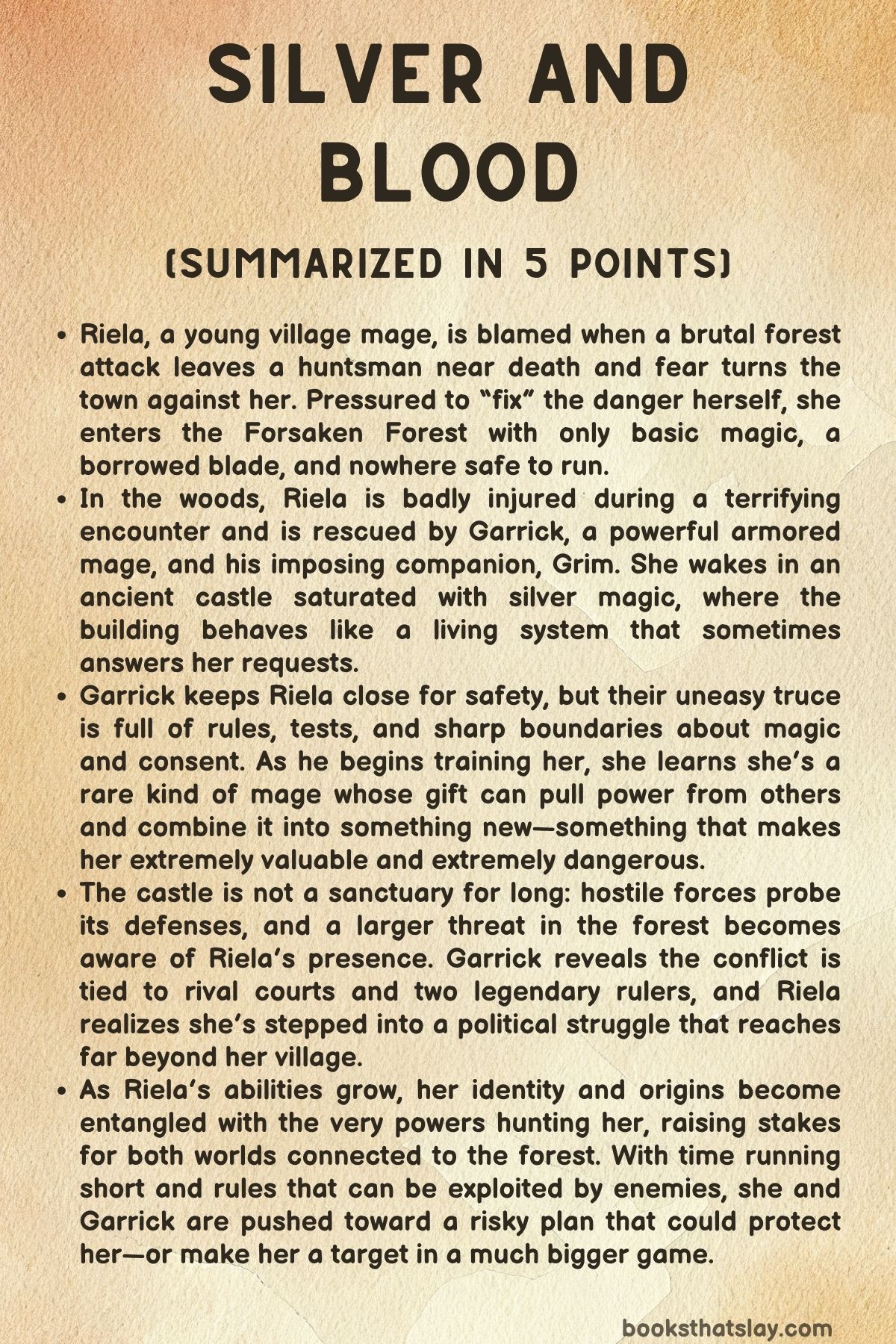
Silver and Blood by Jessie Mihalik is a fantasy romance set on the edge of a dangerous, magic-choked forest where old powers still rule. Riela, a village mage with raw talent and almost no training, is blamed when a huntsman is attacked and is forced into the woods to “fix” the problem.
Instead, she collides with court-level magic, living castles, and beings out of nursery rhymes who turn out to be real. What begins as survival in an enchanted wilderness becomes a clash of sovereign powers, harsh laws, and a bond that could protect Riela—or make her the spark for war.
Summary
Riela is dragged from sleep when frightened villagers bring a mauled huntsman, Hector, to her door. His wife, Mirra, claims Riela’s newly awakened magic attracts monsters and demands Riela go into the Forsaken Forest to kill whatever attacked him.
Riela argues she was asleep and reminds them her magic once saved the village from a flood, but fear has soured their gratitude. With no real choice, and unwilling to flee to a capital that forces mages into service, she agrees to go at first light.
The villagers escort her to the forest’s edge to ensure she doesn’t run. A blacksmith presses a sword and dagger into her hands.
Riela packs supplies and two cherished books from her late parents, then steps into the trees and immediately feels the forest noticing her.
Her magic is limited to what she can control: light and a sense for distant power. Following a strong silvery pull, she travels deeper until night falls and the woods turn unnaturally still.
A scarlet presence stalks her, splits, and closes in from both sides. One attacker reveals itself as a tall creature made of blood-red vines and thorns, eyes glowing like coals.
Riela cannot shape her magic into a weapon, so she fights with steel and desperation. She slices vines that leak thick red sap with a rose-like scent, but the creature bites her shoulder and drives poison into her.
Pain spreads fast. She stabs until her strength wavers, and a sudden flare of magic forces the monster back long enough for it to collapse.
Before she can even recover her dagger, an armored mage appears and destroys the vine creature with a single devastating strike. Another of the same kind charges, and the newcomer cuts it apart as well.
Riela, poisoned and bleeding, barely stays upright when an enormous black shadow moves through the trees. Thinking it a wolf, she tries to lift her sword and fails.
The mage steadies her and tells her to spend her energy healing. When she admits she doesn’t know how, she assumes she’s dying and bitterly asks him to tell her village she died bravely.
Instead, he uses pale, moonlit magic to dull her pain, orders her to sleep, and promises she is safe as darkness takes her.
The mage is Garrick, and the huge black companion is Grim—something rarer than any wolf. Garrick carries Riela through a risky kind of travel and brings her to an ancient castle saturated with dense silver magic.
He cleans her wounds, draws poison from her blood, and heals her shoulder, pushing himself to exhaustion. When Riela wakes, she finds herself in a vast bedroom with seamless windows and a view of lake and forest.
Her injuries are gone, but her clothes are torn, and her weapons are missing. The castle feels alive under her senses, full of silver power in the stone.
Lost in shifting corridors, she meets Grim, who guides her to a kitchen where food and water wait. Garrick appears, introduces Grim by name, and conjures boots when she complains she’s barefoot.
Riela tries to leave, but Grim blocks her until Garrick gives a firm command. As she wanders, the halls loop and reroute her as if the building is choosing where she can go.
She finds a neglected library and asks aloud for cleaning tools. The castle provides them, along with a ladder, as though responding to her.
When Garrick catches her cleaning, he suspects she is searching for secrets, then cleans the entire room with a casual wave and leaves her startled by the ease of his power.
While reading, Riela finds a familiar fairy tale nearly identical to one from her childhood, yet the wording is subtly wrong, and the changes raise her unease. Her grief surfaces hard, and Grim stays with her as she reads aloud.
Later, she discovers the castle sits on an island linked to the forest by a magical bridge. When she tries to cross, an invisible barrier shocks her with painful force.
Garrick admits he healed her and tells her she can leave the castle, but warns that the forest itself hoards mages and does not allow magical beings to escape. He names the vine monsters as chagri and makes it clear he is trapped, too.
Garrick demonstrates that the castle can produce food if fed magic properly. He guides Riela’s hand, helping her merge her blue-tinged power with the castle’s silver reservoir, and a sticky bun appears.
Riela cannot repeat it at first, but when she asks aloud, the castle produces apples, hinting something about her connection goes deeper than it should. She tests the bridge again and finds Garrick has removed the outward barrier, but when she attempts to return, another ward blocks her.
Their argument ends with Riela colliding with the ward and dropping in pain, and Garrick healing her again. Despite the tension, a reluctant humor flickers between them.
The next morning, Riela accidentally arrives in the kitchen just by opening her bedroom door, as if the castle is choosing her path. Garrick grows alarmed when she describes the castle providing items without her consciously paying magic for them.
He tests her power by pulling at it, and the sensation crushes her chest. When she returns the feeling by gently tugging at his magic, the contact floods her with silvery-blue force and expands her perception beyond the castle—bright sparks of magic scattered through the forest and, deeper still, a massive thicket of bloodred power that seems to notice her and start moving closer.
Garrick cuts off the flow and orders her to dump the excess into the castle’s reservoir before it overwhelms her.
He finally gives her the truth: she is a “focus,” an extremely rare mage who can draw power from multiple others and combine it into something new. He warns she could have died during the flood that made the village fear her.
He agrees to train her because leaving her untrained is too dangerous. When she mentions the bloodred presence, he identifies it as the Blood King’s castle and admits the Blood King is real.
Then he says the words that turn Riela’s childhood rhymes into threats: Garrick is the Silver King.
Riela reels, remembering a rhyme about a King of Stone. Garrick explains there were once six sovereigns, but he does not know the fates of the others.
The Blood King controls the only remaining doorway to another realm, Lohka. Garrick also teaches her that Etheri—his kind—treat language as binding, and careless permission can be exploited.
To calm her fear, he swears by stone and silver that he will not trick her with words, will not punish her for using his name, and will not take advantage of her ignorance. The oath matters, and it shapes everything that follows.
Training begins with small acts: severing magic from herself and gifting it to the castle to create food. With Garrick’s guidance she produces toast, porridge, and a sticky bun, improving slowly.
Then danger reaches the door. A woman’s voice begs for help for her dying daughter, but what Riela senses outside is a violent purple vortex of hunger.
The door opens anyway, and a pale, clawed creature forces its way in, repeating a demand for life. Grim fights it, Garrick arrives and kills it with brutal efficiency, and the encounter leaves Garrick bleeding and the castle’s protections clearly strained.
Riela insists on helping him and offers her magic, but the contact hurts her again, and she blacks out.
When she wakes later, Garrick has collapsed into a healing torpor after rebuilding defenses. Riela refuses to leave him on the cold floor.
With Grim’s help she drags a mattress down, hauls Garrick onto it, covers him with blankets, and stays close through a night of nightmares. In the morning, when Garrick wakes, their closeness and attraction flare sharply, then halt when Garrick sees her dagger and re-centers on control and caution.
He agrees to take her to the forest’s edge the next day, warning that hope can be as risky as fear.
Riela continues exploring and finds an inner courtyard garden and a silver-inlaid dais in a central glade. Garrick reacts with immediate fury and forbids her from being there.
Riela argues she needs some freedom or she will risk the forest. He relents with strict rules: she may use the courtyard only during daylight, must not touch the dais, and must not use her magic near it.
She swears to obey, and he warns he will know if she breaks her oath.
Tension between them keeps shifting—suspicion, need, humor, anger, desire. Riela discovers Garrick’s study and a magical painting showing him crowned on a throne.
When he catches her near his desk, she kisses him on impulse. Garrick steps back instantly, refusing to take advantage, and she flees in embarrassment.
Their argument turns into a volley of notes delivered by the castle, ending with an invitation to dinner and a promise they will try for the forest’s edge.
But Riela’s true goal becomes the sealed stone doorway that leads to Lohka. She pushes her magic against it until cold numbness crawls through her fingers.
A week passes in training and study. A messenger sent to her cottage reports it was ransacked and her parents’ miniatures stolen.
Riela’s frustration hardens into recklessness. To trigger the door, she tries to provoke a fight.
Garrick’s vow prevents him from harming her, so she targets Grim, then escalates—until she throws a dagger at Garrick with magic. The blade sinks into his shoulder.
He collapses bleeding, and Riela panics.
The world shifts. They land in Lohka.
A guardwoman approaches, and a man orders her to stand down—revealed as Grim in human form: Vastien Grim. Garrick is already healed; he allowed the injury because Riela demanded conflict, and he still refuses to attack her.
They learn the door’s rules: Vastien can cross because he is bound to Garrick, and Riela can cross alone. The key, they realize, is blood.
When Riela cuts her arm and lets her blood touch the dais, the door opens cleanly.
In Lohka, Garrick drops any disguise and forces his court to kneel, reclaiming authority from a cousin who had taken his throne. Riela becomes an immediate target because her connection to the doorway is visible, and court predators circle.
At dinner, an Etheri lord publicly insults and sexualizes her. Garrick responds with cold, terrifying punishment, suspending the man in a binding sentence meant to last a month.
The violence turns Riela’s stomach, and the doorway tether drains her until she becomes dangerously weak. Garrick realizes she must return to Edea to recover.
Back in Edea, Riela confronts Garrick about his political “betrothal” to Bria. He explains it began as a childhood shield for Bria’s safety and continued for stability, not romance.
He admits jealousy about Vastien’s closeness to Riela but insists Bria is not his lover. Even as their trust grows, the threats around them grow faster.
Then catastrophe hits. Riela wakes half-frozen after an attack that shattered plans and nearly killed her.
She learns she was unconscious for a week. A curse forced everyone back to Edea, and in the chaos she pulled vast amounts of magic from the land, the forest, and Roseguard’s power.
The consequences are severe: the land near Stoneguard Castle is withered, the door has changed, and it now allows anyone—or anything—to pass. Worse, Riela looks into a mirror and sees her true self: fully Etheri, with altered hair, eyes, and subtly pointed ears.
Her magic has shifted as well.
Garrick gives her the hardest truth: the Blood King is Feylan Naeilir, King Roseguard—and he is Riela’s father. Feylan has invoked primogeniture and issued a three-day deadline for Riela to present herself at the Blood Court or face war.
Riela refuses to abandon the villages caught in the middle. Garrick offers marriage as protection.
Riela hesitates, wanting to see what her power has done. In Edea, the dais area is trampled and burned, and the forest nearby is twisted from what she drained.
Garrick explains restoring the old seal once required multiple sovereigns and nearly killed them, and the other courts will not help now.
Riela decides to act anyway. She draws the door’s magic into herself until it goes dormant and closes, proving she can shut it.
She can also open it—meaning she is a living key. Garrick warns that knowledge could get her hunted from every direction.
Their desire finally breaks through restraint, but they stop when Vastien is stranded on the other side, a reminder that every choice has immediate costs.
They return to Riela’s cottage and find strangers living there. The woman mistakes Riela for a monster and attacks until Vastien disarms her.
The villagers have discarded what remained of Riela’s life. Riela visits her parents’ graves and discovers a hidden stone box protected by charms.
Inside is a letter and journal from her mother, Inna of the Sapphire Court, explaining the protections that hid Riela and leaving answers about the past. Riela learns Feylan’s relationship with her mother was nonconsensual.
Rage and resolve sharpen into a vow: she will kill him.
Back at the castle, they study Blood Court hospitality rules under primogeniture. As Feylan’s acknowledged heir, Riela would be protected as a guest unless she attacks physically or magically.
Feylan can test her parentage and, if proven, require her to remain for three weeks. She can bring a bonded betrothed or a single guard, but their actions could also void protection.
Riela and Garrick search for loopholes, weighing risks that could turn her into legal prey.
That night, Riela chooses a betrothal bond as both protection and a test of trust. Their magic locks into place during intimacy, forming a powerful connection that shares emotions and even dreams.
The next day, Bria drills Riela in etiquette and survival tactics, warning her never to strike first and to force others to reveal themselves through their own aggression.
Yet when departure nears, Riela decides Garrick cannot come—his court needs him, and Feylan would use him as leverage. She packs in secret, seduces Garrick so he sleeps deeply, and slips out before dawn into the damaged forest, planning to reach the Blood Court alone.
As she moves through the twisted trees, she tries to get far enough away to use magic without alerting him. A small light forms in her palm, and she finds Garrick waiting in the shadows with a crown of flowers, calm and unyielding.
He tells her she forgot something.
Him.
Characters
Riela
Riela begins Silver and Blood as a woman trapped between duty and fear, living on the village’s edge both physically and socially. Her newly manifested magic makes her a convenient scapegoat, and the opening conflict with the villagers—especially Mirra—shows how quickly gratitude for past heroism can curdle into suspicion when people are frightened.
What defines Riela most at first is stubborn loyalty: she refuses to run to the capital despite the danger of conscription, refuses to abandon her home and her parents’ graves, and even walks into the Forsaken Forest because she’d rather face monsters than let her neighbors’ terror decide her fate. That loyalty is not passive; it is a fierce, sometimes reckless agency that repeatedly pushes her into confrontation—first with the chagri, later with Garrick’s rules, and eventually with the Blood Court itself.
As her situation changes, Riela’s internal struggle shifts from “survive the village’s hatred” to “survive what I am.” Her power is strong but untrained, and that imbalance makes her both vulnerable and catastrophic. The story steadily reframes her magic from a simple “gift” into a structural force that shapes politics, geography, and the very permeability of worlds.
When she learns she is a focus, the label doesn’t merely categorize her—it explains her loneliness: her magic is relational, activated through others, and therefore dangerous in ways she can’t predict. Her fear around drawing too much, hurting herself, or alerting the Blood King becomes an anxiety about identity itself, because her power does not stay contained within her body or intentions.
That theme culminates when her Etheri traits surface and her magic shifts in color and character; Riela isn’t just learning new abilities, she is losing the comfort of believing she is fully human and fully “herself.”
Emotionally, Riela is written as someone whose tenderness is inseparable from fury. She grieves deeply—her parents’ keepsakes, the altered fairy tale, her cottage being taken over, the truth of her mother’s trauma—but she also turns pain into forward motion.
Her vow to kill Feylan is not a sudden personality change; it is the moment her protective instincts stop being small and local and become moral and political. Even her romantic arc with Garrick is shaped by this pattern: she wants safety, but she rejects the kind of safety that requires surrendering her autonomy.
That’s why she repeatedly tests boundaries—crossing the bridge, pushing at sealed doors, provoking “attack scenarios,” trying to leave alone—because control matters to her as much as survival.
Riela’s growth is most visible in how she learns to negotiate power without losing compassion. At first she is forced into decisions by others; later she bargains, sets rules, and manipulates systems like hospitality law not as a trick, but as a way to protect people who have no power at all.
By the end of the summary, her choice to go to the Blood Court alone shows both her greatest strength and her greatest flaw: she is willing to carry danger by herself if it means others won’t have to, even when the story has already proven that isolation is exactly what her enemies want. The final image—Garrick waiting with a crown of flowers—lands because it confronts her core misconception: that sacrifice must be solitary in order to be real.
Garrick Ryv’ner
Garrick is introduced as a savior figure, but the story quickly complicates that role into something more guarded and politically burdened. He rescues Riela with competence and decisiveness—destroying chagri, healing poison, moving through the ether—yet his kindness is braided with control.
He removes her weapons for safekeeping, wards the bridge, commands Grim, and speaks in carefully measured terms that reflect a lifetime of surviving courtly loopholes. His castle feels like an extension of him: immense, ancient, responsive, and suspicious of intrusion.
In many ways Garrick’s “softness” is not warmth but restraint—an ongoing choice to limit himself because he knows what happens when power stops negotiating.
His identity as the Silver King reframes his earlier behavior: he isn’t simply private, he is besieged. He cannot leave the forest; he is locked in a long stalemate with Feylan; and he is haunted by the collapse of an older order where six sovereigns existed and now only fragments remain.
That history gives Garrick a particular kind of exhaustion. He is not the flamboyant monarch who enjoys dominance; he is a ruler who has been stuck holding a line so long that even hope feels like a threat.
When he tells Riela that “hope is dangerous,” it reads less like pessimism and more like trauma-informed strategy—expectation has historically been used against him, and he has learned that longing creates openings.
Garrick’s relationship to consent and language is central to his characterization. He warns Riela about Etheri wordplay, demonstrates how vague permissions can be exploited, and then ties himself down with vows by stone and silver.
Those vows do two things at once: they protect Riela from being manipulated, and they expose Garrick’s own desire to be trusted without becoming predatory. The loophole that redirects harm to him is not just a clever magical mechanic; it externalizes his ethics.
Garrick would rather suffer injury than become the kind of powerful being who uses force to “teach” obedience. That’s why his refusal to fight her—even when she demands seriousness—feels like a moral boundary that costs him, not a dominance game.
At the same time, Garrick is not idealized. He admits he saved Riela for self-interested reasons, he monitors her as a potential threat, and his anger can be sharp and frightening.
His brutality toward Cainsian shows that when he chooses violence, he chooses it absolutely, and that contrast is important: Garrick’s restraint is a decision, not a limitation. The story uses that duality to make his romance with Riela feel both magnetic and risky.
When he marks her with a public kiss, it is protection—and also possession in the political sense, a statement that her body and status now sit inside his sphere of authority.
What softens Garrick is not that he becomes less powerful, but that he allows vulnerability to coexist with power. His healing hibernation on her floor, the private jealousy he admits, the way he lets her keep calling him Garrick instead of insisting on titles, and the gradual move from command to teaching all show a man relearning partnership.
His proposal of marriage is not framed as romantic fantasy; it is an attempt to build a shield out of law, bond, and legitimacy in a world that respects force. That Riela still hesitates underscores the tension: Garrick’s protection is real, but it comes with gravity, and he knows it.
In the final moment, when he waits for her rather than dragging her back, he demonstrates his deepest evolution—choosing presence over control, and companionship over containment.
Vastien Grim
Vastien begins as Grim, a massive black guardian who reads like a mythic creature at first—silent, watchful, obeying Garrick’s commands with absolute clarity. He functions initially as the story’s physical boundary: he blocks doors, forces Riela to confront confinement, and embodies the castle’s will to keep danger out.
Yet his behavior toward Riela is never purely threatening. He brings food, offers comfort in the library, and stays close when she breaks down, suggesting that his loyalty includes discernment and empathy rather than mindless obedience.
The revelation that Grim can shift into Vastien in Lohka recontextualizes his earlier “animal” presence as a constrained identity rather than a simple form. His curse—wolf in Edea, human possible in Lohka—mirrors the broader theme of borders and enforced shapes: worlds decide what you are allowed to be.
Vastien’s ability to move more freely than Garrick across the doorway because he is bound to him also makes him a living illustration of how bonds operate politically and magically. He is not merely a companion; he is an instrument of sovereignty, a being whose autonomy has been negotiated by larger forces.
As Vastien becomes more verbal and advisory, his role shifts from guard to mediator. He shields Riela during the overwhelming dominance of the Silver Court, explaining without humiliating her, and later offers pragmatic emotional counsel—encouraging trust, suggesting the betrothal bond as a test, grounding Riela’s choices in survival rather than pride.
He is unusually useful in a story full of manipulation because he is direct. His loyalty to Garrick is clear, but he is not a flatterer; he pushes toward outcomes that protect both of them, and that makes him one of the few characters who consistently speaks from care rather than strategy.
Vastien also serves as a foil to Garrick in how he handles intimacy and power. Where Garrick over-regulates himself through vows and caution, Vastien seems more comfortable naming the emotional truth of situations.
That difference matters because it gives Riela a second lens on the Silver King: Vastien’s presence suggests Garrick is not simply a cold ruler, but someone his closest companion believes is capable of genuine partnership. When Vastien helps disarm the woman in Riela’s cottage without turning the moment into cruelty, it reinforces his moral steadiness.
He is a stabilizing force—rare in a setting where most beings are either hungry, political, or both.
Feylan Naeilir
Feylan is the looming absence that shapes nearly every choice, and the novel deliberately builds him as more than a villainous monster-king. He is a sovereign whose power is scarlet, whose castle is a bloodred thicket that “notices” Riela, and whose influence reaches across dimensions through curses, laws, and court ritual.
His menace is systemic. Even when he is off-page, he is changing the rules: invoking primogeniture, setting deadlines, manipulating hospitality protections to bind Riela to his court, and turning the structure of law into a weapon.
The most important aspect of Feylan’s characterization is how the narrative links his violence to entitlement. The revelation that he is Riela’s father is not framed as a tragic twist to humanize him; it is framed as a consequence of nonconsensual harm done to Inna.
That detail makes Feylan’s politics feel personal in the most violating way: his claim over Riela is an extension of his earlier claim over her mother. His interest in her is not merely dynastic—it is possessive, and the story positions that possessiveness as the core horror of the Blood Court.
He does not just want her power; he wants her compliance, her presence, her legitimacy as something he can display and control.
Feylan’s ability to weaponize the environment—breaking seals, unleashing creatures, forcing doors open to anyone—suggests a ruler who prefers destabilization because chaos increases dependence on the strongest player. The deadline of three days is a perfect example: it is not designed for fairness, it is designed to force urgency, fracture alliances, and create a narrow corridor where mistakes become wars.
That he can make a legal threat feel like a physical noose is what makes him frightening. He is not only a predator; he is a legislator of predation.
Bria
Bria enters the story as a political anchor within Garrick’s world, and the narrative uses her to show that not all court power is predatory. Her status as a high-ranking ally and her history of a “betrothal” with Garrick create immediate romantic tension for Riela, but the narrative carefully reveals that the bond is strategic and protective rather than intimate.
That matters because Bria’s presence challenges Riela’s assumptions about women at court: Bria is not a rival to defeat, she is a survivor and operator who has learned how to remain dangerous without becoming cruel.
Bria’s most defining trait is competence under threat. She recognizes Riela’s tether as a visible vulnerability, understands how quickly attention turns lethal, and acts to get Riela cleaned, dressed, and guided through social minefields before someone can exploit her.
Later, when she trains Riela in etiquette and survival tactics, the advice is stark: do not strike first; bait others into attacking if defense becomes necessary. That counsel reveals the grim reality Bria lives with—morality at court is not about innocence, it is about who can prove justification after blood is spilled.
Bria’s pragmatism is not coldness; it is a form of protection shaped by experience.
Bria also humanizes Garrick without excusing him. Her long-standing political arrangement with him implies he has spent years choosing stability over personal desire, and her willingness to work with Riela suggests she is invested in Garrick’s future as much as her own security.
In a story where trust is expensive, Bria represents a kind of trust that has been tested by time and strategy rather than romance.
Mirra
Mirra is the story’s early face of communal fear, and she is presented not as a cartoon villain but as someone whose grief and terror have found a target. Her husband’s mauling turns into accusation because blaming Riela is emotionally simpler than accepting the forest’s unpredictability or Hector’s possible recklessness.
Mirra’s insistence that Riela’s magic “draws monsters” also reveals the village’s relationship with power: they like magic when it saves them, and hate it when it reminds them they are not in control.
What makes Mirra important is that she embodies the social violence that precedes physical violence. She helps create the conditions where the village can justify sending Riela into danger as penance, which shows how communities often turn outsiders into sacrificial solutions.
Even if Mirra’s fear is understandable, her actions reinforce a central theme: danger does not have to be monstrous to be deadly; it can be ordinary, familiar, and convinced of its own righteousness.
Hadwin the baker
Hadwin functions as the first clear counterpoint to the crowd mentality. His private urge that Riela run to the capital is compassionate, but it is also revealing: he understands both the village’s capacity for cruelty and the state’s capacity for exploitation.
Hadwin is not powerful in magic or status, yet he tries to intervene in the only way available to him—quiet counsel and concern—making him a small but meaningful marker that the village is not a single unified villain.
His presence also highlights Riela’s defining refusal. Hadwin offers an escape route that might seem rational, but Riela rejects it because her identity is rooted in place, memory, and the belief that survival purchased by abandoning the dead is not survival she can live with.
In that sense, Hadwin’s role is less about changing the plot and more about clarifying Riela’s values.
Hector
Hector appears mostly through the consequences of his injury, but that absence is itself telling. He is the wounded huntsman whose mauling ignites the village’s panic, yet even early on Riela suspects he should not have been in the forest at night and may have been doing something reckless.
That hint positions Hector as part of the story’s recurring pattern: people make choices around forbidden borders, then blame someone else when the border bites back.
Hector is also a narrative tool for exposing how quickly communities rewrite history. Riela’s past act of saving the village from a flood should have protected her socially, but Hector’s injury overrides gratitude.
His body becomes evidence used against her, and that dynamic reveals the fragility of social “credit” for outsiders. Hector doesn’t need deep page time to matter; his injury is the lever that pries Riela out of her life and into the larger world.
Inna Pathriart
Inna becomes one of the emotional cores of the novel despite appearing primarily through what she leaves behind. As Riela’s mother and a member of the Sapphire Court, Inna is revealed as someone who made deliberate, high-stakes choices to protect her child: hiding Riela, burying protections, leaving a letter and journal designed to survive even if she did not.
The specificity of her preparations suggests she understood exactly what forces would come hunting, and she planned for Riela’s future agency rather than merely her survival.
The journal’s revelation about Feylan’s nonconsensual relationship with Inna reframes the entire conflict from political rivalry to generational harm. Inna is not only a victim; she is a strategist who refuses to let violation be the final story.
Her decision to leave truth behind for Riela is an act of reclamation—she ensures her daughter will not be manipulated by half-stories, and she hands Riela the moral clarity needed to resist the Blood Court’s claims. Inna’s presence lingers as both love and warning, shaping Riela’s vow and sharpening her sense that justice is not abstract.
Koru
Koru serves as a symbol of instability within the Silver Court. As Garrick’s cousin who has effectively occupied or benefited from the throne in Garrick’s absence, Koru represents opportunism that thrives when legitimate power is constrained.
His significance lies less in personal nuance and more in what his position reveals: even “home” is not safe for Garrick, and loyalty within courts is conditional, often dependent on who appears strongest in the moment.
Koru’s presence also intensifies Riela’s danger. If Garrick’s own court can be taken from him, then Riela—new, tethered, and visibly valuable—has no reason to expect mercy from anyone who sees advantage in her.
Koru is a reminder that courtly threats do not need monstrous forms; ambition is enough.
Lord Mar
Lord Mar is portrayed as predatory attention rather than overt action, and that subtlety is what makes him dangerous. As someone from the Sapphire Court who notices Riela and looks “suspicious,” he represents the wider political ecosystem circling her emergence.
His interest implies that Riela’s identity and magic have implications beyond Garrick and Feylan; other courts may see her as leverage, asset, or threat.
The function of Lord Mar is to widen the story’s chessboard. Even if he does little in the summary, his attention suggests that once Riela becomes visible in Lohka, she can no longer be protected by silence.
Surveillance becomes a form of aggression, and Mar embodies that early.
Cainsian
Cainsian is the clearest example of court entitlement at its crudest. His insult and sexualization of Riela reduce her to a resource to be “used,” echoing the broader theme of powerful beings treating others’ bodies and magic as property.
He is not complex in motive, but he is thematically sharp: he demonstrates what the Blood Court’s culture normalizes and what the Silver Court is willing to punish.
Garrick’s brutal retaliation against Cainsian is pivotal because it exposes two things at once. It shows Garrick’s capacity for terrifying violence, and it shows that protection in this world often comes packaged with dominance and spectacle.
Cainsian’s role, then, is not just to threaten Riela; it is to force the story to ask what “safety” costs when it is enforced by a king who can make suffering last a month with a word.
Shar
Shar appears as the agent of a major turning point, and in Silver and Blood that role matters more than extended characterization. Shar’s attack on Riela and the dais triggers the cascade that opens doors too widely, breaks bindings, and accelerates Feylan’s timeline.
The curse marks Riela’s body with rose-and-vine imagery, tying personal violation to the aesthetics of the Blood Court and making the political conflict literally skin-deep.
Shar’s presence also reinforces that Feylan’s reach is not abstract. He has operatives, tactics, and curses that can alter reality quickly.
Even if Shar is not deeply explored in the summary, the impact of Shar’s actions is enormous, and that makes Shar feel like a tool of strategy rather than a random monster—someone deployed to exploit the exact weakness Riela represents: her ability to draw and combine magic under stress.
Themes
Fear, Scapegoating, and the Cost of Being “Other”
The opening conflict makes social fear feel practical rather than abstract: a wounded man, an unknown attacker, and a community that needs a simple explanation quickly. Riela’s magic becomes that explanation.
What’s striking is how the villagers hold two contradictory ideas at once without seeing the contradiction—she once saved them by diverting a flood, yet they treat her as the reason monsters appear. That double standard shows how gratitude can evaporate when people feel exposed and powerless.
Mirra’s accusation is not only grief speaking; it’s also a demand that someone pay for the chaos, and Riela is convenient because she is visibly different and lacks protection. Even Hadwin’s advice to run contains a grim truth: institutions are not neutral either, because the king conscripts mages.
So Riela faces hostility from the village and exploitation from the state, which corners her into danger while also blaming her for the danger’s existence.
Once she enters the forest, the pattern repeats in a different form. The forest reacts to her presence with a hostile awareness, and later the Blood King’s attention moves toward her as soon as she inadvertently touches a wider magical network.
In both cases, Riela’s mere existence draws response—fear from villagers, predation from monsters, strategic interest from rulers. The story keeps pressing the same question from multiple angles: what happens when an individual’s power is defined by everyone else’s anxiety?
Riela is forced into roles she did not choose—problem, weapon, bargaining chip—because others decide what she represents. That theme deepens when she becomes fully Etheri in appearance; even her reflection turns into evidence that her identity has always been contested.
Her changing ears, eyes, and magic color are not just fantasy details; they underline how quickly “difference” becomes justification for control. In Silver and Blood, fear is shown as contagious and self-protective: it spreads through crowds, through courts, and through rules like hospitality and primogeniture that dress coercion up as law.
The cost is that Riela must constantly prove her humanity, competence, and innocence to people who benefit from doubting all three.
Power, Consent, and the Ethics of Protection
Protection in this story is never simple. Garrick saves Riela’s life, heals her, feeds her, and offers training, but every act of care sits beside the reality that he also has motives and leverage.
The castle wards, the shifting corridors, the blocked bridge—these create safety while also creating captivity. Riela’s fear that she is a prisoner is reasonable because her freedom depends on someone else’s decisions.
Garrick tries to correct that imbalance with promises and careful wording, including a vow not to trick her with words, yet the narrative keeps showing how rules can still trap people even when intentions are good. The “Etheri law” of precise language becomes a structural way to discuss consent: permission has to be specific, boundaries have to be explicit, and ignorance is dangerous because it can be exploited.
Riela is not only learning magic; she is learning how to survive in a world where consent is written into speech and then weaponized through loopholes.
That focus sharpens when the story brings in Feylan and the Blood Court. Hospitality rules protect Riela while simultaneously setting conditions that can hold her in place for weeks.
Primogeniture gives Feylan legal cover to demand her presence under threat of war. These are systems that pretend to be orderly while enabling coercion.
The mother’s journal then pushes the theme into its most personal and painful register by revealing that Feylan’s relationship with Inna was nonconsensual. That detail reframes Riela’s lineage as a product of violence and makes “bloodline politics” feel like a continuation of bodily violation, not a separate political issue.
Riela’s vow to kill him is born from that realization: protection is not meaningful if it requires accepting the rules of someone who harmed her mother.
Meanwhile, Garrick’s protection has its own ethical tension. His vow prevents him from harming Riela, but the story shows how vows can create unintended consequences: harm routes back to him, and their attempts to test the vow’s boundaries become a lesson in how “safety measures” can still produce risk.
Even their eventual betrothal bond—chosen, mutual, and emotionally intense—raises questions about how power can be shared without erasing autonomy. The bond gives comfort and strength, but it also increases vulnerability because thoughts, emotions, and dreams can spill across it.
Protection is treated as an ethical problem to solve, not a romantic gesture to accept. The characters have to negotiate what care looks like when both parties have power, when one party has far more knowledge, and when the world’s laws are designed to treat people as assets.
Identity, Belonging, and the Shock of Inherited Truth
Riela begins with a clear sense of who she is: a village mage with limited, practical abilities, anchored by her cottage, her parents’ graves, and two treasured books. That identity is stable because it is rooted in place and memory.
The story then methodically destabilizes it. The first destabilization is social—her neighbors redefine her as a danger.
The second is physical and magical—her power responds to stress in ways she doesn’t understand, and she learns she is a “focus,” able to draw from multiple sources and combine magic into something new. That revelation changes the meaning of everything that came before: her exhaustion after saving the village was not a simple overreach; it was a near-fatal consequence of power that no one trained her to manage.
The label “focus” also changes her position in the world. She is no longer just someone with a gift; she is someone whose gift can reshape conflicts between courts.
The identity theme reaches its turning point when her true Etheri appearance asserts itself. The mirror scene is important because it’s private and unmediated—no one is accusing her, flattering her, or bargaining with her.
Her altered hair, eyes, skin, ears, and violet magic force her to confront that her human life was partly a constructed shelter. That doesn’t erase her human experiences; it makes them more complicated.
Belonging becomes a wound rather than a comfort: the village that shaped her childhood rejects her, and the Etheri courts want to claim her for political reasons. When she learns Feylan is her father, the inherited truth is not a romantic “lost princess” twist; it is a grim inheritance tied to harm done to her mother and to legal claims that threaten war.
Being someone’s daughter becomes a chain that can be yanked by primogeniture, not a relationship she can choose.
The story also links identity to language and education. Riela’s discovery of altered words in the fairy-tale book suggests history can be edited and that identity categories can be distorted over time.
Her instinct to clean the library “because the books deserve better” reflects a deeper desire: she wants the truth preserved, not buried under dust or propaganda. Even her magic training follows the same logic—learning to sever magic and gift it to the castle is a lesson in separating self from power, so that her identity isn’t swallowed by what she can do.
By the time she returns to her cottage and finds strangers living there and her remaining belongings discarded, belonging becomes starkly material. Home is not just a feeling; it’s a space that can be taken.
Her parents’ graves remain, but even that sanctuary contains a hidden box and a letter that confirm her mother built protections around a secret the world would weaponize. Identity is shown as something you assemble from memory, body, magic, and chosen bonds—then defend against everyone who wants to define you for their purposes.
Desire, Trust, and Emotional Risk Under Pressure
Attraction between Riela and Garrick grows in a setting where safety and danger sit inches apart, which makes every emotional step feel like a decision with consequences. Their early interactions are full of friction: he is guarded, she is suspicious, and the castle itself enforces closeness by rerouting her paths and controlling access to exits.
Trust has to be built in a space that resembles confinement, which is why the story pays so much attention to promises, rules, and the specific phrasing of agreements. Garrick’s vow not to trick her with words is not only an ethical marker; it’s a trust-building tool in a world where language is binding.
Riela’s insistence on leaving and his insistence on caution aren’t merely plot obstacles; they show how differently they evaluate risk because they carry different histories and responsibilities.
Desire complicates that negotiation rather than replacing it. Their physical closeness often arrives after vulnerability: Riela half-conscious from poison, Garrick collapsing from overuse of magic, the two of them sharing warmth on a mattress on the floor while Grim stands guard.
These moments make desire feel tied to survival needs—warmth, reassurance, the relief of not being alone—yet the narrative keeps reminding the reader that comfort can become dependence if it isn’t chosen freely. That’s why Riela reacts so strongly after kissing him in his study: her flight isn’t childish; it’s a response to the fear that wanting someone who holds power over her could erase her agency.
Garrick’s harsh note and her scribbled response capture the relationship’s core tension: both of them use sharpness to protect softer feelings, and both of them are testing whether the other will stay present when things become awkward, messy, or frightening.
The betrothal bond takes emotional risk to its highest level because it turns trust into a literal channel. Sharing emotions and dreams can be intimacy, but it can also be exposure.
The bond offers a way to protect Riela in court politics, yet it also raises the cost of betrayal and the pain of separation. This is why Riela’s later decision to leave alone carries such weight: she tries to regain control by acting independently, even if it means deceiving Garrick long enough to get distance.
It’s not simply a dramatic choice; it shows how trauma and duty can make someone sabotage closeness to avoid feeling trapped by it. Garrick waiting for her in the forest with a crown of flowers is a direct answer to that impulse—he refuses to let love become another form of abandonment, and he reframes partnership as something you carry with you, not something that limits you.
Romance is never treated as a separate storyline that floats above politics and danger. It is shaped by injuries, oaths, power imbalance, and external threats, and it asks whether two people can choose each other without turning that choice into a cage.