Skylark by Paula McLain Summary, Characters and Themes
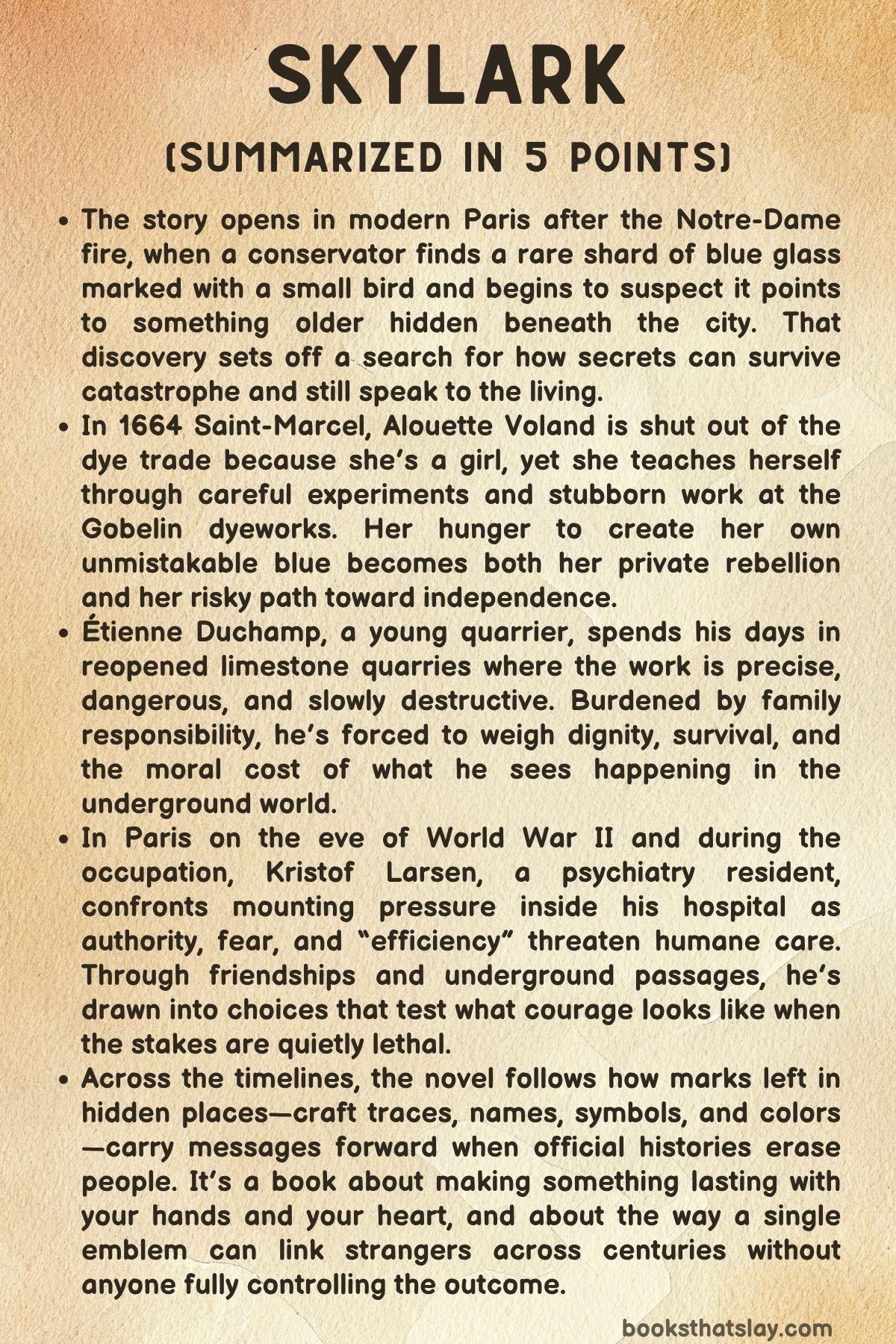
Skylark by Paula McLain is a historical novel that begins with the 2019 Notre-Dame fire and uses what the flames expose—marks, fragments, hidden work—as a doorway into older lives stitched into Paris. A conservator’s discovery of a blue glass shard etched with a flying bird becomes a quiet invitation to follow a symbol across centuries.
The book moves between 1660s Saint-Marcel, wartime Paris in the early 1940s, and later echoes, tracing how craft, secrecy, and survival leave traces in stone, cloth, and memory. It’s a story about what people risk to make something lasting, and what they must do to stay alive.
Summary
When Notre-Dame burns, the blaze tears open the cathedral’s upper spaces and exposes details usually hidden: old carpenters’ marks, tool scars, and chambers built for sound. After the fire, specialists pick through charred remains and catalog the human remnants preserved in the structure—names, fingerprints, small prayers scratched into place.
Among the debris, a conservator finds a tiny piece of unusually pure blue glass. Etched into it is a small bird in flight.
Walking home along the Seine with the shard tucked away, she thinks about her grandfather’s stories of passageways under Paris and bird symbols used as signals for people on the run. The fragment feels like a message that outlived its sender, and she begins to wonder what chain of hands carried it forward.
In 1664, in Saint-Marcel on the foul, industrial Bièvre River, eighteen-year-old Alouette Voland rises before dawn and steals a scrap of scarlet cloth tied to her father’s guarded dye practice. The neighborhood is ruled by dyes, tannery chemicals, and river water stained by runoff, and the trade is controlled by guild rules that keep women at the edges.
Alouette works at the Gobelin dyeworks hauling water and scrubbing wool, treated as expendable by an overseer who never lets her forget that being René Voland’s daughter does not grant her a place at the vats. Gossip about Alouette’s vanished mother isolates her further.
Still, Alouette refuses to accept a life spent only carrying and cleaning. The stolen scarlet becomes both proof of what she can understand and a private promise that she will create something of her own.
René Voland is obsessed with perfecting a signature red—Voland’s Scarlet—and he guards his recipe book as if it were a passport to a better life. At home, Alouette listens as he talks about new rumors from abroad and tests.
She quietly demonstrates that she knows more than he expects, naming ingredients, mordants, and methods. She also holds a separate ambition: not red, but a blue so clean and bright it cannot be dismissed as ordinary woad.
In secret, she grows dye plants—woad, madder, weld, yarrow—and fills a stained notebook with careful observations. She works at night in her kitchen, measuring, steeping, changing variables, furious at vague instructions and stubborn failures, yet continuing anyway.
During a feast-day gathering on the Île aux Singes, Alouette studies the stolen scarlet in sunlight and notices how the color shifts and deepens. Back at work, she is given an expensive bundle of raw silk meant for a wedding gown and is warned to be careful.
She hears talk that the old limestone quarry on the Butte-aux-Cailles will reopen, and the news angers her: the butte will be cut away, and workers will be sent into dust and danger for little pay. In the crowd she notices a young quarrier, Étienne Duchamp, standing apart with a calm, watchful air.
Étienne’s life is defined by what lies under the surface. He descends into the reopened quarry where daylight is replaced by lantern glow and limestone dust.
Under the direction of master mason Antoine Pelletier, he splits massive blocks by careful sequence—wedges, water, patience—knowing one mistake can crush men. The work eats at lungs and futures.
He returns to a small cottage where his grandmother holds the household together and where he cares for two children, Thomas and Marie, left in his charge after their mother’s death. The family came to Saint-Marcel after a cave-in in Rouen shattered their prospects and took Étienne’s father.
Étienne saves what little he can, trying to keep promises to the children while fearing the same slow death that surrounds him every day.
The story also moves to Paris in 1939. Kristof Larsen, a Dutch psychiatry resident at Hôpital Sainte-Anne, feels the city tightening with uncertainty after Germany invades Poland and France declares war.
After a night of jazz, he meets Alesander Extebarria, a Basque architecture student with an unusual fascination: the layers beneath Paris. Alesander leads Kristof through a hidden entry and down a spiral stair marked with a depth measurement.
Underground, he shows Kristof inscriptions, quarry traces, and old routes, explaining that Paris rests on a honeycomb of tunnels. Kristof notices a soot-dark bird shape on a ceiling, a sign that feels intentional, then hurries to keep up in the dark.
By early 1940, Sainte-Anne is reshaped by preparations for war. Dr. Blaise Claudel arrives with emergency protocols and converts spaces to wards.
He champions controlled electrical stimulation for severe cases, presenting it as modern efficiency. Kristof is unsettled by how quickly treatment becomes procedure, how consent and care can be pushed aside when institutions decide speed matters more than people.
He shares concerns with a colleague, Julian, and both sense that behind the hospital’s polished routines are older habits of control.
Around this time, Kristof meets twelve-year-old Sasha Brodsky in his neighborhood building. She studies on the landing to escape a noisy apartment, and when the concierge scolds her, Kristof intervenes.
Sasha’s mother Rachel invites him to dinner with the family—Rachel, Sasha’s father Felix, and Sasha’s younger brother Rald. They are Jewish refugees from Warsaw, carrying both gratitude for safety and fear about what is coming.
Kristof is drawn to their warmth and ordinary rituals. Their table becomes a small refuge from the growing dread outside.
Back in Saint-Marcel, Alouette’s frustration with weak blues turns into a risky choice. Watching harsh chemicals transform a hide, she realizes gentle methods may never give her the blue she wants.
She steals arsenic and adds a measured amount to a woad vat. The result shocks her: a bright, luminous blue that holds overnight, cleansed of woad’s usual stink.
René recognizes what she used and admires the color, but he warns that the guild would never allow such a breakthrough to come from an outsider—least of all a young woman. Alouette begs him to leave Saint-Marcel and claim the chance elsewhere.
René hesitates, trapped by caution and pride.
Étienne, meanwhile, witnesses corruption underground. After hours he writes his name and the children’s names in soot on a clean wall, a private claim that they existed.
Then he discovers men hiding a crate stamped with the Gobelin crest, smuggling goods through tunnels to avoid taxes. He sees how profit moves quietly while workers cough and die.
For the first time, survival begins to look like a question that will demand a hard answer.
As Alouette continues experimenting, the arsenic begins to poison her—tingling fingers, dizziness, a metallic taste. She knows what is happening, yet she keeps going, convinced that risk is the only door left open.
One evening she goes near the quarry to gather wild woad and finds the hillside stripped and ruined. Étienne warns her it is unsafe, and they speak tensely about the costs of work and the lack of choices.
Their honesty draws them together. Later, Alouette discovers René secretly experimenting with the same dangerous method she created.
He insists it will secure their future, but Alouette sees the tremor in his hands and feels that something is already sliding out of control.
In 1940, war closes in fast. Kristof hears reports of the German offensive in the Low Countries and receives letters from his father describing bombers and soldiers overwhelming their hometown.
Refugees flood Paris. At Sainte-Anne, Kristof treats traumatized soldiers, including Henri Allard, shattered by the collapse at Sedan.
Kristof works slowly, building trust with quiet visits and small comforts. When Henri finally offers a gentle childhood memory, Kristof uses hypnosis to guide him toward calm.
The work is personal for Kristof: he carries the memory of his sister Annelies, who died by suicide in 1935, and he remains determined to hear the pain patients cannot fully say.
By occupation, daily life becomes a lesson in when to be visible and when to disappear. Sasha walks through Paris with a boy named Gérard, who carries her satchel and his violin like a small act of defiance.
He plays Bach for her on a corner, and Sasha cries silently afterward, overwhelmed by the way music can hold both comfort and loss. At Sainte-Anne, Kristof sees German presence harden into routine.
A patient he has long cared about, Georges Plomin, vanishes after a “transfer” to an “Eastern Facility.” Kristof recognizes the word as a door that closes without explanation. Soon after, he sees Vichy officials in the ward and spots Alesander—once his underground guide—now in uniform.
Alesander meets his eyes briefly, then looks away, leaving Kristof unsure whether he has been betrayed or warned.
In 1664, Alouette’s story turns darker. She is confined in Salpêtrière, subjected to brutal “treatments” meant to purge disorder: bleeding, forced purging, restraints.
Another inmate, Marguerite, offers small mercies. Outside the gates, Étienne waits with a carved limestone lark and a note, paying a midwife to try to get word inside.
He begins teaching himself to read and write, carving more birds, writing Alouette’s name again and again as if repetition could keep her from being erased. Inside, Alouette learns the institution’s hierarchy and dangers.
A guard tries to extort her for a supposed message, and she cannot tell whether any letter exists or whether the men are playing with her fear. Weeks pass.
She mentors a frail orphan girl, Christiane, teaching her plants and warnings. During mass, Alouette becomes violently ill, and her cellmate Sylvine suggests the possibility Alouette dreads: she may be pregnant.
In 1942, Alesander reappears and summons Kristof to meet. This time he reveals he has been working with the resistance, using a fabricated Vichy identity as cover.
He brings Kristof into an underground operations center with Ursula, a nurse Kristof remembers from Sainte-Anne, and others. They show records indicating that psychiatric hospitals are being targeted under policies linked to Aktion T4—methods designed to kill patients quietly through “efficiency,” starvation, and transfers.
Ursula recognizes the pattern from Vienna and tells Kristof what happened to her family. They need someone inside Sainte-Anne to identify those at risk and build a network.
Kristof agrees, thinking immediately of Julian.
Soon Kristof, Ursula, Alesander, and a group that includes Sasha move through the tunnels for an escape. Underground time blurs: long hours in darkness, slick passages polished by water, chambers glittering with quartz and streaked limestone.
A game of folded drawing briefly lifts spirits, but fatigue and fear return. Their route becomes uncertain as erosion and shifting water alter passages.
At a sinkhole, they rig rope to cross a narrow ledge. One by one they make it—until the ledge collapses under Alesander.
The rope snaps and he falls into darkness.
Kristof descends to reach him and finds Alesander badly injured, dying from blood loss and internal damage. They manage to haul him up, but he cannot be saved.
Kristof speaks gently, offering him a peaceful image of home while others hum, keeping him company at the end. Alesander dies underground, and Sasha marks the wall with an epitaph and a bird in flight.
The group moves on, guided by Alesander’s maps and the signs left behind. After nearly seventy-two hours, they reach daylight.
In the months that follow, the route becomes a corridor for refugees moving south, with Kristof helping guide groups onward.
In 1664, Alouette escapes Salpêtrière by river with Marguerite and Sylvine, slipping through patrols, stealing a skiff, and reaching a convent where nuns grant sanctuary. The ordeal triggers premature labor, and Alouette loses her child.
The nuns treat the infant with reverence, and Alouette names him René. She learns her mother once found refuge there and that Henriette now lives elsewhere as an herbalist.
After recovery, Alouette and her companions leave with a merchant. In 1665, Étienne travels urgently after receiving news.
In Lamballe, he finds Alouette alive. He tells her her father died in confinement, gives her the carved lark, and they choose to go forward together.
By 1666, in Camaret-sur-Mer, Alouette has built a life on a remote coast, collecting and recording blues shared by local women—a living catalog of color and method. During a storm she gives birth to a daughter, Christiane, but hemorrhages and dies after holding her child and watching dawn break into a perfect blue.
Much later, a descendant craftswoman fitting stained glass on the Île de la Cité uses that storied blue and leaves a hidden mark, so the bird’s promise—made in stone, cloth, and secret signs—continues across time, waiting to be found again in a shard of blue glass.
Characters
Alouette Voland
Alouette is the story’s fierce engine of invention and refusal. In Skylark, she begins as an eighteen-year-old caught in the narrow permissions of Saint-Marcel: allowed to labor, forbidden to belong to the craft she understands best.
What makes her compelling is how completely she treats color as both knowledge and selfhood. She does not merely want to dye cloth; she wants authorship, proof that her mind is real in a world that keeps trying to make her body the only thing that counts.
Her secrecy with the scrap of scarlet cloth is not petty theft so much as the first private declaration that she will take what is denied to her, learn what she is not supposed to learn, and build a future from it. Alouette’s experimental rigor separates her from the tradition-bound workers around her: she records, tests, repeats, and pushes beyond folklore into something like proto-science, not because she is modern, but because necessity forces her to invent her own legitimacy.
Her greatest contradiction is that the very brilliance she extracts from matter also extracts a price from her body. The arsenic blue is a breakthrough and a self-poisoning, a perfect emblem of how women’s ambition in her world must often become clandestine and therefore dangerous.
Even her hope has a bodily cost—tingling, dizziness, metallic taste—signals that her work is literally entering her bloodstream. That physical deterioration sharpens the tragedy of her circumstances: she is not reckless because she loves risk, but because she understands that “safe” is simply another word for trapped.
When she is taken into Salpêtrière, her conflict with the guild becomes a conflict with an entire system of punishment disguised as medicine. Her endurance there shows that her intelligence is not only technical; she learns hierarchies, manipulations, bargains, and survival tactics, and she still finds room to teach and care, especially through her bond with Christiane.
By the end of her arc, Alouette’s artistry becomes legacy rather than escape, and her longing for a blue “unmistakably hers” turns into a shared inheritance that travels forward in hidden marks, recipes, and quiet vows.
René Voland
René is both a gatekeeper and a victim of the same world that empowers him. He appears as a master of technique and reputation—obsessed with “Voland’s Scarlet,” hungry to perfect something that will outlast him—yet he is also a man ruled by fear of losing what little standing he has.
He recognizes Alouette’s gifts with a clarity that could have been liberating; he speaks the language of mordants and ingredients with her as if he cannot help but respect her mind. And yet, that respect never fully becomes courage.
René’s love expresses itself as caution, which in a rigid system becomes complicity. He warns her that the guild would never allow her discovery, especially because she is a girl, and his realism is accurate—but it also becomes the excuse he hides inside.
What makes René tragic is his tendency to retreat into perfectionism as a way to postpone moral action. He tells himself they will leave once the formula is perfected, that the right leverage will purchase safety, that secrecy will control consequences.
But secrecy does not protect him; it isolates him, encourages obsession, and tempts him into the very danger he condemns in his daughter. When he begins using arsenic after warning her away from it, he becomes a mirror of the hypocrisy forced by survival: he cannot accept Alouette’s authorship, yet he cannot resist her method’s power.
His tremor on the scaffolding and his relentless work suggest a man already being consumed by the dream he calls legacy. René’s failure is not lack of affection; it is the inability to choose freedom over status before the machinery of authority closes.
His eventual death in confinement completes that irony: the system he tried to appease does not negotiate. It simply takes.
Henriette Voland
Henriette is the haunting absence that shapes Alouette long before she returns as a person. Her disappearance is the village’s favorite story—fuel for gossip, suspicion, and the casual cruelty that isolates her daughter.
Yet the narrative complicates the easy label of “madness” by tying Henriette to grief, bodily loss, and the fragile line between healing and being punished for healing. She is remembered as a healer who lost babies and then “unraveled,” which hints at a world that offers women almost no language for trauma except accusation.
Henriette’s return is therefore not a tidy reunion but an intrusion of unresolved pain: she comes carrying warning and guilt, not comfort, and Alouette’s rejection of her is not ingratitude so much as self-protection against being pulled back into the old wound.
What gives Henriette weight is that she embodies both the cost of female knowledge and the ambiguity of survival. She knows how rumor moves, how institutions retaliate, how quickly a woman can be turned into a cautionary tale.
Her warning about the guild is an attempt at repair, but she cannot undo the years of abandonment, and she does not ask Alouette to forgive her so much as to believe her. Later, when the convent reveals that Henriette once found refuge there and has lived onward as an herbalist, Henriette becomes a thread connecting different forms of women’s underground history: the healer who must disappear, the daughter who is punished, the sanctuary that quietly resists.
Henriette’s role is less about redemption than about continuity—proof that women’s lives, even when fractured, leave routes and shelters behind.
Étienne Duchamp
Étienne is the novel’s portrait of steadiness under pressure, a man whose gentleness has been forged by catastrophe rather than comfort. He is introduced through the quarry’s disciplined danger: wedges, water, sequence, lungs slowly sacrificed to the stone.
His world teaches him patience because impatience kills. That carefulness extends beyond work into how he holds responsibility at home—caring for Thomas and Marie after their mother’s death, living with the constant fear of repeating his father’s dust-driven fate.
Étienne’s love is practical: hidden savings, promises measured in bread and rent, vigilance against the sudden collapse that took their prospects before.
His moral tension intensifies when he discovers smuggling in the tunnels. The scene matters because it places him at the intersection of labor and exploitation: the powerful profit while workers die, and survival begins to look like complicity.
Étienne is not naturally an outlaw; he is pushed toward desperation by the slow violence of poverty. That is why his connection with Alouette feels so earned.
They recognize the same problem in different forms: she is barred by gender, he is trapped by class, and both are exhausted by being told their limits are natural law. His attraction to her is not only romantic; it is a kind of recognition of another person who refuses to accept the assigned size of their life.
Étienne’s tenderness becomes most striking when Alouette is institutionalized. His vigil at Salpêtrière, the carved limestone lark, the repeated writing of her name as he teaches himself literacy—these are acts of devotion and resistance, attempts to keep her from being erased.
Even when he cannot save her immediately, he refuses the disappearance that institutions rely on. His eventual reunion with Alouette after René’s death shows him as someone who endures long enough to become a bridge into the next life chapter.
Étienne is not the loud kind of hero; he is the kind who keeps showing up, learns what he must learn, and chooses love as an action.
Lucienne
Lucienne functions as the voice of hard-earned survival among the dyeworks women. She is older, seasoned by disappointment, and her advice to Alouette carries the weary logic of someone who has watched hope get punished.
She cautions Alouette to handle the silk carefully and not to waste energy on bitterness, which reveals a worldview shaped by scarcity: one mistake can cost a job, one wrong expression can invite retaliation, and the safest strategy is to keep your head down. Yet her presence is not merely discouraging.
Lucienne’s counsel implies care, a desire to keep the younger girl from being crushed by the system that already assumes she is disposable.
Lucienne also highlights what makes Alouette unusual. By offering resignation as wisdom, she throws Alouette’s refusal into sharper relief.
She represents a path Alouette might have taken—competence without recognition, endurance without escape—and therefore she deepens the stakes of Alouette’s ambition. Even if Lucienne never becomes a dramatic force, she anchors the social reality of laboring women: solidarity mixed with fear, kindness constrained by what the overseers can do.
Madame Poirier
Madame Poirier is authority at its most intimate and corrosive: not a distant law but a daily pressure applied through humiliation. She enforces the dyeworks hierarchy by reminding Alouette that her father’s status will not elevate her and by treating her as disposable.
What makes her effective as an antagonist is that she polices not only behavior but identity. She stands in for the guild’s gendered logic—women can scrub and haul and rinse, but they cannot claim mastery.
Her cruelty is procedural, almost bureaucratic, which is precisely why it feels inescapable: she does not need personal hatred; the system supplies the justification.
Madame Poirier’s role also exposes how oppression recruits intermediaries. She is a woman exercising power over another woman, demonstrating how institutions distribute small authorities to keep people divided.
By insisting on Alouette’s smallness, she unintentionally reveals Alouette’s true threat: Alouette is dangerous to Madame Poirier because she wants more than survival. The overseer’s function is to make sure wanting more feels shameful.
Antoine Pelletier
Antoine Pelletier, the master mason, embodies craft discipline and the ruthless standards of dangerous work. Under him, Étienne learns the slow precision that quarrying demands, the understanding that one wrong judgment can collapse stone and bodies alike.
Pelletier is not portrayed as sentimental, but his authority is rooted in competence and the weight of responsibility for men’s lives underground. He represents a version of mastery that is recognized and legitimate—the kind Alouette is denied.
At the same time, Pelletier’s presence emphasizes how even respected craft exists inside exploitation. The quarry destroys lungs no matter how skilled the supervision is.
Pelletier can teach technique, but he cannot change the economic machine that makes workers replaceable. He therefore functions as a contrast: a craft tradition that can be honorable in method while still trapped in a brutal structure.
Thierry Lavigne
Thierry Lavigne appears as a quiet warning bell within the Voland household orbit. As René’s journeyman, he sees the toll René’s obsession is taking and shows concern that feels both personal and pragmatic.
Thierry’s anxiety suggests that people around René recognize the danger—chemical exposure, exhaustion, guild attention—before René admits it. In that sense, Thierry becomes a witness to the way pride and secrecy corrode communities: he is close enough to notice the tremor and the overwork, but not powerful enough to stop it.
Thierry also underscores the difference between apprenticeship that is sanctioned and apprenticeship that is forbidden. He occupies a legitimate rung within the craft hierarchy, while Alouette is forced into illegitimate experimentation.
His presence quietly reinforces the injustice: two people can stand beside the same cauldron, and only one is allowed to be there by right.
Kristof Larsen
Kristof is the moral lens of the twentieth-century storyline, a man trained to interpret minds who is forced to confront how institutions can weaponize care. As a psychiatry resident at Sainte-Anne, he is positioned between theory and suffering, between professional ambition and human obligation.
His discomfort with Dr. Claudel’s protocols reveals his core ethic: consent matters, dignity matters, and efficiency is not neutral when applied to vulnerable bodies. Kristof’s empathy is not abstract; he sits with patients, returns repeatedly, and believes in slow trust.
His work with Henri Allard shows his instinct to use gentleness as medicine in a world rushing toward brutality.
Kristof’s interior life is shaped by grief, especially his sister Annelies’s suicide, which becomes the private wound that sharpens his attention to quiet signs. He is not a savior type who believes he can fix everything; he is a listener who believes the smallest act of presence can keep someone tethered.
That makes him particularly vulnerable to the horror of disappearance—when Georges Plomin is “transferred,” Kristof feels the institutional lie crack open and reveal the machinery beneath. His relationship with the Brodsky family deepens this because it gives him ordinary warmth and therefore raises the stakes: he is no longer watching war from a clinical distance; he is watching it stalk people he has eaten with.
Kristof’s arc turns decisively when he chooses resistance, not as ideology but as an extension of care. Once he learns that hospitals themselves are being folded into systematic killing, he accepts that neutrality is impossible.
The tunnels become his counterpart to the clinic: hidden routes, hidden truths, and the insistence that what is buried can still save lives. His continued guiding of refugees after Alesander’s death marks him as someone who transforms grief into method—carrying maps, names, and fragile bodies forward.
Alesander Extebarria
Alesander begins as mystery and becomes sacrifice. He is introduced with charismatic knowledge of the underground—doors, spirals, inscriptions, a Paris beneath Paris—making him seem like a guide not just to tunnels but to hidden histories.
His architectural training shows in how he measures and maps, how he thinks in structures and weak points, and how he treats space as something that can protect or betray. At first, he also embodies the intoxicating possibility that the city contains secret exits from the fate pressing down on its surface.
His apparent transformation into a Vichy uniform is one of the narrative’s sharpest shocks because it weaponizes uncertainty: the same man who offered hidden doors now appears as the face of collaboration. When the truth emerges—that he is resistance, using the uniform as cover—the earlier ambiguity becomes the point.
Alesander lives in a world where morality must be disguised to survive, where identity is a tool and trust is constantly endangered. His leadership in the tunnels is practical and strategic, but he also brings play and humanity, as seen in the drawing game that briefly restores laughter underground.
That matters because it shows resistance as more than logistics; it is also the preservation of spirit.
Alesander’s death is the culmination of his role: the guide who cannot guide himself past the earth’s changing dangers. When erosion and altered water tables betray his map, it becomes a larger metaphor for war itself—plans rendered obsolete by chaos.
His final moments, holding a photograph of home and asking what lies ahead, reveal the tenderness under his competence. He dies not as a symbol but as a person, and his loss becomes a mark the survivors literally inscribe into stone.
Through him, the tunnels become a memorial as well as a route.
Dr. Blaise Claudel
Dr. Claudel represents the cold face of institutional rationality—the kind that can label cruelty as protocol. His arrival with “Emergency Psychiatric Protocols,” his conversion of spaces into wards, and his promotion of controlled electrical stimulation all frame him as a man who values readiness and output over consent.
He speaks the language of modernity—efficiency, innovation, preparedness—yet the ethical void is visible in how quickly patients become problems to be processed. Under occupation, his office becoming linked to military liaison confirms what was already implied: his medicine is compatible with power, and compatibility is not innocence.
Claudel is frightening because he does not need to twirl villainy; he only needs to keep insisting that circumstances require sacrifices. His presence highlights how medical authority can become an extension of state authority, especially when the patients are the kind society already prefers to forget.
Whether he believes he is doing good or simply enjoying control, the outcome is the same: a system that makes disappearance administratively clean.
Julian Broussard
Julian is Kristof’s mirror, reflecting the compromises that fear and responsibility can force. He shares Kristof’s unease about dangerous treatments and the way the hospital’s polished surface hides older patterns of control, but he is also pulled by the vulnerability of his personal life—his wife Patrice, their hope for a baby, the desire not to invite retaliation that could destroy their future.
Julian embodies the question of what courage costs when you have something to lose that is not only your own life.
Because he stands near Kristof without immediately stepping fully into action, Julian deepens the realism of the resistance storyline. Not everyone can move from alarm to defiance at the same speed.
His torn state shows how systems maintain themselves: they don’t only threaten; they offer people the illusion that if they stay careful, they can keep what they love. Julian’s significance lies in that tension—he makes Kristof’s eventual choice look less like inevitability and more like decision.
Sasha Brodsky
Sasha is the novel’s portrait of a mind fighting to remain expansive inside shrinking circumstances. She is twelve when introduced, studying Greek roots on a landing as a way to carve out mental space from domestic pressure and the encroaching war.
Her intelligence is not presented as precocious decoration; it is survival. Language—Latin, Ovid, etymologies—becomes her portable refuge, a place the occupiers cannot easily confiscate.
Her sensitivity to absence, like an empty desk after Passover, shows how quickly a child learns to read danger in small gaps.
Sasha’s emotional world is defined by the push and pull between ordinary beauty and gathering terror. She notices sparrows drinking, a woman gardening, music in the courtyard, and these details matter because they show she is actively collecting proof that the world still contains gentleness.
At the same time, she carries Warsaw inside her as memory and grief, and her imagination struggles to make a future when the present keeps erasing people. When she goes underground with the refugee group, her narration of time dissolving in darkness turns her into a witness not just to fear but to endurance.
She is not the strongest physically, but she is resilient in attention—marking, remembering, holding onto phrases and symbols. Her chalk inscription for Alesander and the liberty bird in flight show that she has learned the novel’s deepest practice: leaving a trace so a person does not vanish completely.
Rachel Brodsky
Rachel radiates the domestic courage that often goes unnamed in wartime stories. She invites Kristof into the family’s orbit with food and conversation, turning hospitality into a small act of defiance against isolation and fear.
Her pregnancy during worsening news underscores a brutal paradox: life insists on continuing even when the world feels determined to end it. Rachel’s strength lies in maintaining warmth without denying reality.
She understands what they fled, understands what might be coming again, and still chooses to build a home that offers her children routine and a sense of being held.
Rachel also embodies the precariousness of refuge. The family’s escape from Warsaw does not erase the reach of anti-Jewish violence; it merely delays it.
Her role in the narrative makes the stakes personal for Kristof, transforming abstract headlines into faces at a dinner table. She is a reminder that resistance begins not only in tunnels but also in keeping a family human under pressure.
Felix Brodsky
Felix carries the quiet weight of exile and responsibility. He teaches Kristof Go, a game of strategy and patience, which subtly mirrors the kind of thinking survival now requires.
Felix’s attention to news from Poland and the fate of relatives shows the constant double-vision of refugees: living in one city while mentally inhabiting another where loved ones are trapped. His “ordinary routines” are therefore not complacency but containment—an attempt to keep panic from consuming the household.
When Sasha later notes that home life has become harder since her father is gone, Felix’s absence becomes a wound the text does not need to explain in detail to make it devastating. His role emphasizes how occupation fractures families not always with dramatic scenes, but with the silent removal of a stabilizing presence.
Felix stands for the vulnerability of fathers who cannot protect their families from state machinery, and for the particular danger faced by Jewish men under occupation.
Rald Brodsky
Rald is the younger sibling whose presence amplifies what is at risk. He plays in courtyards and inhabits childhood more simply than Sasha can, and that contrast matters.
His normalcy is not naïveté so much as a measure of what the family tries to preserve. Through him, the narrative shows how war steals not only lives but also the right to be carefree.
Rald’s role is small but emotionally structural: he is part of what makes the Brodsky home feel like a living thing worth defending.
Gérard
Gérard represents tenderness as resistance in occupied Paris. His small gestures—carrying Sasha’s satchel, instinctively slowing to let German officers pass without friction—show how people learn a choreography of survival, when to vanish and when to appear ordinary.
He does not posture as brave; he acts careful, and carefulness becomes its own form of bravery when it protects someone else. His suggestion of a “memory palace” for the future is especially revealing because it offers Sasha a method for hope that does not rely on certainty.
He is not promising safety; he is offering imagination as a tool.
When Gérard plays Bach’s Chaconne on the street corner for Sasha, the moment becomes a public insistence on beauty under surveillance. His playing is described as imperfect but resolute, which makes it more powerful: he is not performing mastery, he is performing presence.
Gérard’s role is to remind Sasha—and the reader—that art can be a signal fire, small but unmistakable, saying, we are still here.
Henri Allard
Henri Allard is war trauma given a human voice rather than a diagnosis. He arrives shattered after Sedan, carrying the collapse of communications, the panic of rumor, and the personal shame of flight that so many soldiers internalize.
His catatonia is not emptiness; it is overflow. What makes Henri important is how he allows Kristof’s approach to care to become visible: the slow building of trust, the use of small comforts, the attempt to return a person to himself without forcing him.
Henri’s willingness to offer a childhood memory—goats, tall grass, grandparents’ land—shows how healing begins with reclaiming a self that existed before terror. The hypnosis session is not framed as a miracle cure but as a temporary shelter, a pause where Henri can breathe.
Through Henri, the narrative argues that attention is an ethical act, and that even brief peace matters when the world is structured to erase it.
Annelies Larsen
Annelies is present mostly through Kristof’s memory, but her influence is profound. Her suicide in 1935 becomes the defining grief that shapes Kristof’s sensitivity to what people cannot say directly.
She loved poetry, left subtle warning signs, and died leaving a letter on a bridge beside schoolbooks—details that make her loss feel both intimate and unbearably ordinary. Annelies functions as the reason Kristof refuses to treat patients like cases.
He has lived through the aftermath of not hearing someone in time, and that failure becomes his lifelong vigilance.
Her presence also complicates the narrative’s treatment of “madness.” Across timelines, women like Henriette and inmates like Alouette are labeled disordered for social convenience, while Annelies’s pain is private, internal, and tragic. Annelies therefore acts as a quiet critique of simplistic categories: suffering can be invisible, and institutions often misunderstand what they claim to treat.
Georges Plomin
Georges Plomin is the emblem of institutional disappearance. He is a long-catatonic patient Kristof has not given up on, which already marks him as someone society has decided is expendable.
When Kristof discovers that Plomin has been “transferred” to an “Eastern Facility,” the vagueness becomes the horror. The stripped bed and disinfected absence show how bureaucracies erase people cleanly, leaving behind only sanitized surfaces and unanswered questions.
Plomin matters because he forces the story’s ethical center into focus: care is not only what happens in sessions; it is also the refusal to accept administrative euphemisms. His disappearance is what makes Kristof’s suspicion become certainty, and it ties the hospital storyline to the broader machinery of wartime killing.
Plomin is not developed through dialogue, but through absence—and that is precisely the point.
Ursula
Ursula bridges the hospital and the resistance, turning private knowledge into shared action. She is first remembered as a nurse who vanished, then reappears as part of an underground operations center, carrying documents and lived understanding of what the Germans do to psychiatric patients.
Her story about Vienna and her psychiatrist uncle being murdered for refusing cooperation adds personal urgency to her competence; she is not theorizing cruelty, she has watched it enter her family.
Ursula’s character is defined by steadiness under stress. Underground, she can snap at others from fatigue and fear, but she also apologizes, which reveals emotional integrity rather than hardness.
She brings both evidence and care: proof in memos and logs, and humanity in how she keeps the group moving. Ursula represents a form of courage that is methodical—collect the records, confirm the pattern, build a network, act.
Marcel
Marcel appears as a working piece of the resistance machine, a radio operator whose presence emphasizes that underground survival depends on skills that are often invisible. He embodies coordination, signal, and the fragile infrastructure of connection.
In a narrative filled with hidden doors and secret routes, Marcel stands for the idea that information itself is a lifeline, and that resistance is built not only from daring but from steady technical labor.
Adrienne
Adrienne is defined primarily through absence, as the key forger who disappeared after a 1941 raid. Her disappearance communicates both the indispensability and the danger of unseen work.
Forgers are architects of second lives, people who make paper into passage, and the loss of Adrienne signals how vulnerable the network is when a single essential node is removed. She becomes one of the “absent friends” toasted in the tunnels, which turns her into a symbol of the many whose names must be carried forward because the world has tried to erase them.
Monsieur Moreau
Monsieur Moreau personifies the violence of certainty masquerading as medicine. He lectures about women’s disordered humors and “heat,” then bleeds and purges Alouette with ritualized brutality.
He does not see a person; he sees a category. That categorical thinking is what makes him dangerous: he believes himself righteous, and belief becomes permission.
Moreau’s methods also reveal the continuity of institutional cruelty across centuries—different tools, same impulse to control bodies, especially women’s bodies, under the banner of treatment.
Moreau’s special “interest” in Alouette after she refuses a guard’s coercion shows how power retaliates when denied. He represents the way institutions punish refusal by reframing it as pathology.
In doing so, he becomes one of the clearest antagonists in the earlier timeline, not because he is uniquely monstrous, but because he is fully normalized inside his role.
Sister Marthe
Sister Marthe embodies the unsettling calm of benevolent oppression. She leads Alouette through the asylum routine with composed insistence that the ordeals are “for her benefit.” What makes Sister Marthe complex is that she likely believes this.
She is not a sadist; she is a functionary of a worldview where suffering is corrective and authority is synonymous with care. Her gentleness therefore becomes part of the trap, because it offers Alouette no clear villain to fight—only a system of belief that can inflict harm while speaking softly.
Sister Marthe also illustrates how institutions maintain themselves over time: by recruiting people who can perform kindness without questioning the violence underneath. Her presence adds moral ambiguity to the asylum scenes and underscores how difficult it is to resist a cruelty that presents itself as compassion.
Léontine de Mouchy
Léontine de Mouchy, the superioress, represents power as organization and selection. Her authority is visible in the hierarchy Alouette observes: children forced into labor, the foundling wheel, and the grooming of certain inmates as “jewels.” Léontine is less a character of emotion than of structure—she is the personification of institutional priorities, deciding who is useful, who is disposable, and who can be shaped into acceptable forms.
Her presence makes the asylum feel like a managed economy rather than a place of healing. Under her rule, bodies become resources and morality becomes administration.
Léontine’s significance lies in how she demonstrates that cruelty can be systematic, orderly, and socially sanctioned.
Marguerite
Marguerite is one of the asylum’s quiet lifelines, a woman whose kindness becomes practical rescue. She gives Alouette aqua mirabilis after the purging, offering relief without demanding anything in return.
That small act establishes Marguerite as someone who has learned to preserve fragments of humanity inside an inhumane system. When the time comes to escape, Marguerite’s willingness to move, hide, change clothes, salvage what they can, and seek sanctuary shows she is not only gentle but capable.
Marguerite’s character highlights how solidarity among women forms an alternative survival structure when official structures are built to harm. She is part of the trio who refuses disappearance, and her decision to ring the convent bell is a moment of courage that is not dramatic but decisive—choosing trust in sanctuary over the fatal logic of isolation.
Sylvine
Sylvine is one of the story’s sharpest voices about gendered punishment. She understands the prison economy of Salpêtrière—the bargains, the lies, the guards’ manipulations—and she teaches Alouette how not to be destroyed by it.
Her warning that coerced bargains never make women safer reveals a hard, protective realism. Yet Sylvine is not only a strategist.
Her confession—imprisoned after adultery, abused by the system, losing a baby and never being allowed to see the child—turns her into a living record of what institutions take from women and how they justify taking it.
Sylvine’s stated desire to avenge what was taken makes her an embodiment of rage transformed into survival. She does not romanticize endurance; she treats it as warfare.
At the same time, her care for Alouette—covering for her nausea, naming the possibility of pregnancy, sharing resources—shows that her vengeance does not erase her capacity for tenderness. Sylvine becomes, in effect, a mentor in resistance before the word “resistance” exists in that timeline.
Christiane
Christiane exists in two forms that echo across the novel: first as the frail orphan girl assigned to help Alouette in the Salpêtrière gardens, then later as Alouette’s daughter, born during a storm. In Skylark, the orphan Christiane’s hunger to learn “even what can kill” mirrors Alouette’s own drive and becomes a poignant reversal of the world that refused Alouette apprenticeship.
Alouette teaches her herbs and dangers, creating a miniature lineage of female knowledge inside a system designed to erase it.
When Christiane becomes Alouette’s child, the name turns into a bridge between those earlier lessons and the future the novel insists on preserving. Alouette’s death after holding her newborn and watching the dawn’s perfect blue frames Christiane as both continuation and cost.
She is the living proof that Alouette’s struggle did not end in confinement or disappearance; it became transmission.
Jean-Baptiste
Jean-Baptiste is the asylum’s petty predator, important because he shows how power degrades into everyday coercion. He corners Alouette and claims a message has arrived, demanding a kiss as payment.
His cruelty is transactional, making intimacy into currency and hope into leverage. He also demonstrates how institutions enable individual abuses: the guard’s access and impunity turn a “treatment” facility into a hunting ground.
Jean-Baptiste’s threats about Moreau’s special interest reveal the system’s layered violence. Even if his message is a lie, the lie works because the institution already runs on fear.
He is not the largest villain, but he is one of the most realistic: the person who exploits the cracks in a cruel system to satisfy himself.
Thibault
Thibault operates as a counterpoint to Jean-Baptiste, illustrating the uncertainty that keeps inmates off balance. He is presented as a guard who can be bribed, yet when approached he denies any message and dismisses Jean-Baptiste as a liar.
Whether he is honest, covering himself, or participating in manipulation, the effect is the same: Alouette is left unable to know what is real. Thibault matters because ambiguity is itself a tool of control.
When communication cannot be trusted, people become easier to manage.
Mathilde Cadieux
Mathilde Cadieux, the midwife bribed to smuggle a note, represents the dangerous middle ground between compassion and survival. She accepts money yet also offers truth, warning Étienne that Salpêtrière can become a permanent disappearance and hinting at intentional neglect or killing.
Her pragmatism does not erase her humanity; it is the form her humanity must take to operate near power without being crushed by it. Mathilde’s presence expands the social ecosystem around the asylum, showing how even outside helpers are constrained by risk, rumor, and limited access.
Thomas
Thomas is one of the children Étienne cares for, and his role is to embody the stakes of Étienne’s choices. Thomas represents the future that depends on Étienne’s lungs holding out, his wages continuing, and his moral compromises not destroying what he’s trying to protect.
He is part of what keeps Étienne tethered to responsibility even when desperation tempts him toward the smuggling economy. Thomas’s significance lies less in individual action and more in what he symbolizes: innocence dependent on fragile adult endurance.
Marie
Marie, like Thomas, is a child whose presence turns hardship into urgency. She is part of Étienne’s small household world shaped by loss and makeshift care.
Her dependency magnifies the quarry’s danger and the cruelty of a system where a single accident can orphan children again. Through Marie, the narrative keeps reminding the reader that survival is never solitary; it is a chain of lives held together by one person’s ability to keep going.
Mémé
Mémé, Étienne’s elderly grandmother, anchors the household with endurance and blunt love. She mends, tends, and tries to keep the family intact after disaster.
Her urging that Étienne not destroy himself gives voice to the quiet wisdom of people who have survived long enough to recognize when grief turns self-destructive. Mémé’s importance is emotional and thematic: she embodies continuity across generations, the domestic equivalent of the carved birds and written names—small acts that keep a family from vanishing.
Themes
Inheritance, Hidden Records, and What Survives
When the cathedral roof collapses in Skylark, the fire exposes what was never meant to be seen: the carpenters’ marks, tool cuts, acoustic chambers, and the small private traces left behind in stone and mortar. That opening image sets up a world where history is not only preserved in grand narratives, but also in tiny, stubborn remnants that outlast official versions of the past.
Names scratched into hidden places, fingerprints in soot, a secret drawing embedded in mortar, and the shard of unusually pure blue glass etched with a bird all carry the same message: people keep trying to leave proof that they existed, even when they have no sanctioned way to be remembered.
The book keeps returning to the idea that legacy is often accidental, smuggled forward through objects and markings rather than archives and monuments. Alouette’s stained notebook, her experimental swatches, and Étienne’s soot-written names in the quarry function like parallel “documents” created by people who are denied the authority to publish their truth.
In 1942, the chalked Latin line and the liberty bird in flight become another version of that impulse—an insistence that a person’s life and choices should not be erased by fear, war, or bureaucracy. Even the tunnels themselves act as a kind of memory storage: layers of inscriptions, old routes, and repurposed spaces hold stories across centuries, available to anyone who knows how to read surfaces and absences.
The theme becomes especially sharp in the contrast between official power and unofficial record-keeping. Institutions attempt to define what matters—guilds guarding recipes, hospitals controlling files and transfers, regimes rewriting reality—yet the narrative argues that the most truthful record is often what gets hidden.
Survival, here, is not only staying alive; it is also ensuring that something meaningful remains when everything else is taken.
Knowledge as a Form of Defiance
Alouette’s life is shaped by the rule that she is not allowed to learn “properly.” She can scrub wool, haul water, and obey, but she cannot apprentice, claim expertise, or publicly innovate. Her response is not passive endurance; she builds a private education with observation, repetition, and record.
The careful attention she pays to mordants, plant behavior, and measurement turns knowledge into resistance because it refuses the limits placed on her mind.
What makes this theme powerful is that learning is never presented as clean or safely rewarded. Alouette’s experiments succeed only when she violates accepted boundaries—using arsenic, forcing results that tradition warns against, taking methods into her own hands when the rules are designed to keep her dependent.
The discovery of that luminous blue is both triumph and warning: it proves her brilliance, but it also shows how a gatekept world punishes creativity that comes from the wrong person. Her father’s reaction deepens the theme by revealing the way oppression reproduces itself through fear.
He recognizes the achievement, but his imagination is confined by what the guild will permit; his caution becomes another cage, and in time he adopts the same dangerous secrecy he once advised against.
The war-era storyline mirrors this structure through psychiatric practice. Kristof’s training teaches him to care, listen, and treat patients as human beings, yet the hospital environment shifts toward protocols that privilege efficiency, control, and militarized priorities.
Knowledge becomes contested terrain: is medical innovation meant to heal, or to manage inconvenient bodies? Kristof’s ethical discomfort shows that expertise can become complicity if it is separated from consent and compassion.
The resistance network then reframes knowledge again, turning maps, logs, memos, and tunnel routes into tools for protection rather than domination. Across centuries, the book argues that learning is never neutral.
Who is allowed to know, what counts as “legitimate” knowledge, and how knowledge is used all decide whether it becomes liberation or harm.
Bodies Under Pressure: Labor, Illness, and Institutional Control
Work in the novel is intensely physical, and the body becomes the first place where inequality is written. In Saint-Marcel, the river is polluted by industry, the dyeworks rely on low-status labor, and the quarry grinds people down with dust that slowly kills.
Étienne understands that a single mistake underground can cost lives, but even perfect skill cannot protect him from the long damage of inhaled stone. Alouette’s hands and nerves begin to register the price of her ambition as tingling, dizziness, and a metallic taste, making her success inseparable from self-harm in a world that offers her no safe path upward.
This is not a romanticized struggle; the theme insists that survival is often a calculation made with a body that can be used up by others.
The asylum scenes bring institutional control into brutal focus. Alouette’s confinement transforms her from a person into a diagnosis, and the “treatments” demonstrate how easily care becomes punishment when power is unaccountable.
Bleeding, forced purging, humiliation, and the constant threat of exploitation show a system that claims moral certainty while destroying the vulnerable. What is especially chilling is the calm conviction of the staff who believe they are doing good; the cruelty is not presented as a few bad actors but as a structure that normalizes harm.
The 1940–1942 hospital storyline echoes this, replacing religious certainty with bureaucratic certainty. Transfers, protocols, and euphemisms like “Eastern Facility” drain meaning from human life, turning disappearance into an administrative action.
The mention of targeted killing through “nutritional efficiency” shows how control can be exercised quietly, without dramatic violence, through rationing and paperwork. In both eras, the theme argues that institutions do not need open brutality to be lethal; they only need authority, secrecy, and a public that looks away.
Against this, the narrative places small acts of bodily care—Kristof’s patient attention to Henri Allard, the sharing of soothing remedies in the dormitory, companions guiding each other through tight tunnel passages. These moments do not erase the harm, but they insist that the body is not only a site of suffering; it is also where solidarity becomes real.
Choice, Risk, and the Cost of Becoming Free
Freedom is never presented as an abstract value; it is something purchased through risk, loss, and irreversible decisions. Alouette’s earliest act—stealing a scrap of scarlet cloth—is small, but it signals a willingness to claim agency in a world built to deny it.
Each later step escalates the stakes: illegal experimentation, exposure to toxic materials, choosing intimacy on her own terms, planning escape even when it means leaving safety and familiarity behind. The book shows how empowerment can arrive alongside fear, because making a choice often means accepting consequences without protection.
Étienne’s storyline sharpens this theme by placing him at the edge of moral compromise. He is responsible for children, trapped by poverty, and haunted by prior disaster; when he discovers smuggling through the tunnels, he confronts the fact that “honest” survival may be structurally impossible for people like him.
The narrative does not rush him toward heroism; it respects the grinding reality that can push decent people toward dangerous options.
In the wartime timeline, Kristof faces a different version of the same conflict. He can remain a doctor who tries to help within the system, or he can step into resistance and accept that neutrality is no longer ethical.
His decision gains weight because it is tied to memory—his sister’s suicide, his commitment to listening for pain, his refusal to let suffering be ignored. Sasha’s experiences add another dimension: the daily discipline of learning when to be visible and when to disappear, the struggle to imagine a future at all, and the way music and companionship become choices that preserve human dignity under occupation.
The tunnels symbolize this theme in practical terms: they are routes that demand courage, patience, and trust, and they also punish mistakes without mercy. Alesander’s death is the clearest statement of the cost of freedom—plans can be correct and still fail, bravery can be real and still end in loss, and the work must continue anyway.
Yet the book refuses cynicism. The escape corridor that grows after his death suggests that individual sacrifice can create collective possibility, and that freedom is often built from what someone was willing to risk when they did not have to.