Babel by RF Kuang Summary, Characters and Themes
Babel by RF Kuang is a historical fantasy novel set in a world where language and translation hold immense power, directly affecting global politics and society. The story follows Robin Swift, a young boy from Canton who survives a plague and is brought to England by the mysterious Professor Lovell.
In England, Robin is trained in the art of translation at the prestigious Babel Institute in Oxford, an institution that wields great power through its control of language and silver—a substance that enables translation magic. As Robin grapples with his identity as a Chinese scholar in a foreign land, he becomes entangled in political and ideological struggles against British imperialism. The novel explores themes of identity, language, power, and resistance, highlighting the complexities of belonging and the oppressive systems that shape history.
Summary
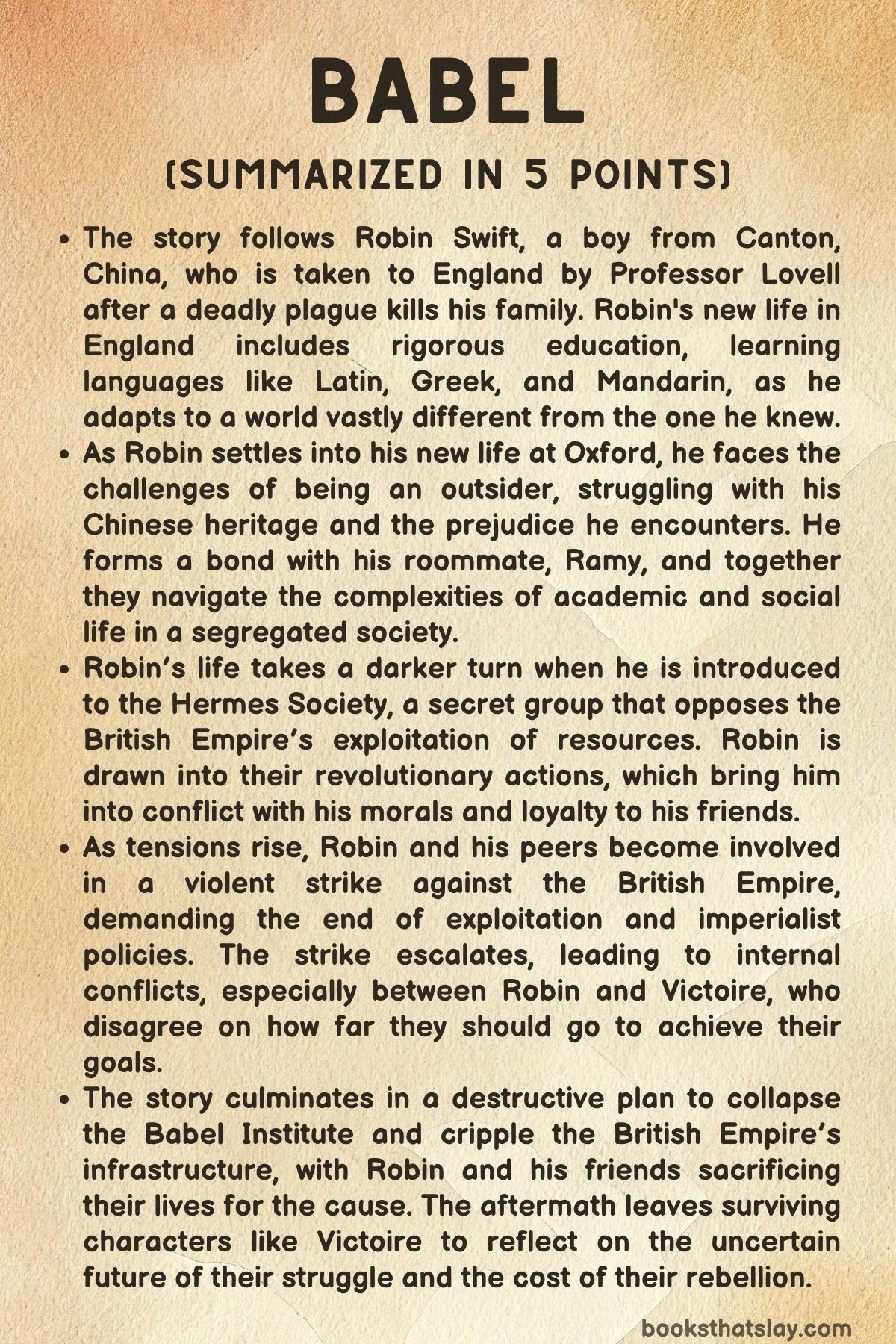
In an alternate 19th-century Britain, the empire’s dominance rests on silver-working—a magical system where the untranslatable “meaning lost in translation” between languages is captured on enchanted silver bars to produce extraordinary effects, from healing and infrastructure to military power.
The heart of this system is the Royal Institute of Translation at Oxford, known as Babel, a towering institution that hoards linguistic knowledge from colonized lands to fuel British expansion.
The story opens in 1828 in cholera-ravaged Canton (Guangzhou), China. A young boy, his family dead from the plague, lies dying beside his mother’s body. Professor Richard Lovell, a stern Babel scholar and sinologist, arrives and revives the child using a silver bar.
He offers the boy a new life in England in exchange for total devotion to study. The boy accepts, chooses the English name Robin Swift, and boards a ship for London—already performing his first act of translation-as-betrayal by mistranslating to dismiss a desperate Chinese laborer.
In Hampstead, under Lovell’s cold, often abusive tutelage, Robin spends years mastering Latin, Ancient Greek, and Mandarin (his native Cantonese). He deduces that the distant, racist Lovell is his biological father. Robin excels academically but internalizes deep alienation: he is neither fully English nor allowed to remain Chinese.
Lovell beats him when he falters, reinforcing that his worth lies only in service to Babel.
Robin enters Babel as a first-year student. He forms a close cohort with three others: Ramy Rafi Mirza (a witty, pragmatic Indian from Calcutta who openly resents the empire), Victoire Desgraves (a sharp, principled young woman from Haiti, shaped by revolution and loss), and Letitia “Letty” Price (a naive white British admiral’s daughter whose privilege often blinds her to her friends’ realities).
The four become inseparable—“a little family”—bonding over late-night study sessions, shared meals, and the subtle (and not-so-subtle) racism they face from white students and faculty. Robin experiences xenophobic violence and exclusion, yet Oxford initially feels like a utopia of knowledge.
Early in his first term, Robin encounters his doppelgänger: Griffin Lovell, his older half-brother (another mixed Chinese son of Professor Lovell). Griffin, who fled Babel years earlier, recruits Robin into the clandestine Hermes Society, a network of radicals dedicated to stealing and redistributing silver bars to undermine Britain’s imperial advantage.
Hermes operatives sabotage silver-dependent infrastructure and smuggle knowledge back to colonized peoples. Robin is torn: Babel offers intellectual belonging and power, but it directly enables exploitation. He participates in small thefts but hesitates at full commitment, eventually stepping back from Hermes for a time.
As Britain escalates tensions with Qing China over opium trade and silver access (a fictionalized parallel to the lead-up to the First Opium War), Professor Lovell takes Robin, Ramy, Victoire, and Letty on a diplomatic voyage to Canton as translators.
The trip exposes the group to the brutal realities of empire: British arrogance, Chinese resistance under Commissioner Lin Zexu, and Lovell’s cold complicity in gunboat diplomacy and opium pushing. Cultural and racial fractures within the cohort widen. On the return voyage, during a heated confrontation, Lovell berates Robin for any sympathy toward China.
In a burst of rage—partly self-defense, partly accumulated trauma—Robin uses a silver bar to blast a hole through Lovell’s chest, killing him. The group, stunned, disposes of the body at sea and agrees to maintain the lie that Lovell is merely ill.
Back in Oxford, guilt and paranoia consume them, especially Robin. The cover-up strains their friendships.
Letty, overwhelmed by her privileged worldview, grows increasingly unstable. Meanwhile, Robin reconnects with Hermes. Griffin pushes for bolder action as Britain prepares for war. Robin, Ramy, and Victoire lean toward resistance; Letty wavers but remains tied to the group.
Tensions explode when authorities close in. Letty betrays the group out of fear and loyalty to Britain. During a police raid on a Hermes safehouse, she shoots and kills Ramy. Robin and Victoire are captured. Griffin stages a daring rescue, but in the chaos, Griffin and another operative (Sterling) exchange fatal gunfire. Griffin dies in Robin’s arms despite desperate attempts to revive him with silver. Robin and Victoire escape, now fully radicalized by grief and loss.
The surviving pair, aided by remaining Hermes contacts and radical Oxford elements (including some scholars of color and laid-off workers), seize control of the Babel tower itself.
They occupy the institute, issuing demands that Britain abandon its aggressive war plans against China and cease exploiting silver and foreign languages. The occupation draws support from reformers and the public, temporarily fortifying Oxford against advancing British forces. Without Babel’s ongoing silver maintenance, imperial infrastructure begins to fail—most dramatically when Westminster Bridge collapses.
Inside the tower, ideological rifts emerge. Robin grows increasingly willing to embrace violence and sacrifice, arguing that only decisive destruction can cripple the empire. Victoire advocates for caution and long-term strategy, emphasizing survival to continue the fight elsewhere.
Some allies drift away when Robin proposes further escalation (such as targeting more civilian infrastructure). As British troops close in and the situation becomes untenable, Robin and a small group of committed scholars—mostly from colonized backgrounds—choose martyrdom.
They pile silver bars into resonant pyramids and engrave them with a self-destructive match-pair (centered on the untranslatable nature of certain words), triggering a catastrophic chain reaction.
The Babel tower collapses in a spectacular destruction, obliterating the empire’s central silver repository and research archives. Robin dies in the rubble, his final thoughts turning to his mother, to Ramy (with whom he had quietly fallen in love), and to the bittersweet necessity of their resistance. The act severely weakens Britain’s silver-based power, leaving the empire’s future uncertain and halting (at least temporarily) its immediate imperial ambitions in China.
Victoire escapes before the final collapse, aided by Griffin’s earlier preparations and remaining networks. In the epilogue, she flees on the run, silver bars hidden in her clothing. She reflects on her Haitian roots, the friends she lost, and the long, uncertain road ahead.
Carrying contacts for surviving Hermes cells (including one in Ireland), she boards a ship toward America, choosing continued struggle over immediate martyrdom. She knows Letty would hunt her if she learned Victoire survived, and that history remains fluid. The fight against empire is far from over; it has only entered a new, decentralized phase.
Throughout, Kuang weaves extensive footnotes on etymology, history, and translation theory. The novel explores how language and knowledge serve power, the moral ambiguities of resistance (“the necessity of violence”), the pain of hybrid identity, and whether institutions built on exploitation can be reformed from within or must be dismantled.
Robin’s arc—from eager scholar to revolutionary willing to burn it all down—embodies the central question: what price is worth paying to break the chains of empire?
The ending offers no easy triumph, only sacrifice, loss, and the fragile hope that Victoire and others will carry the resistance forward.
Characters
Robin Swift
Robin Swift, the protagonist of Babel, undergoes a significant transformation throughout the narrative. Initially introduced as a sickly boy from Canton, Robin’s journey is one of survival, education, and self-discovery.
His story begins with a traumatic loss: the plague that kills his family, leaving him an orphan. Saved by Professor Lovell and transported to England, Robin is thrust into a completely foreign world where he is given the opportunity to reinvent himself.
At first, Robin struggles with his identity. He faces the dual challenge of adapting to English society while also reconciling with his Chinese heritage.
His sense of alienation deepens as he navigates Oxford, a place filled with racial and classist tensions. However, Robin’s intelligence and drive are undeniable.
His linguistic abilities, particularly in Latin, Greek, and Mandarin, shape much of his character, and his education becomes a refuge where he can escape his inner turmoil. As he grows, Robin becomes increasingly aware of the racial dynamics at play, both in England and within the scholarly circles he inhabits.
He grapples with questions of identity, belonging, and power, especially as he becomes entangled in the politics of the Hermes Society. Robin’s eventual decision to participate in radical actions against British imperialism highlights his internal conflict between his scholarly ambitions and his desire to take action against the system that has oppressed him.
His journey is marked by intense personal growth, moral dilemmas, and an evolving understanding of what it means to fight for justice.
Professor Richard Lovell
Professor Lovell serves as a pivotal figure in Robin’s life. As the man who rescues Robin from certain death and brings him to England, Lovell represents both the opportunity for a new life and the complicated, often oppressive forces of British academia.
Initially, Lovell appears to be a benevolent, almost fatherly figure who takes Robin under his wing and provides him with the education and opportunities that will shape his future. However, as the story progresses, Lovell’s true nature and motivations come into sharper focus.
He is deeply embedded in the power structures of the British Empire, particularly in its exploitation of foreign scholars and resources. His involvement in the political machinations surrounding the Opium War and the control of silver at Babel reflects his complicity in the very systems Robin begins to resist.
Lovell’s cold, calculated demeanor contrasts sharply with Robin’s growing sense of rebellion, making him a key figure in Robin’s evolving worldview. Despite this, Lovell’s role in Robin’s transformation remains significant, as he represents both the promise and the peril of intellectual power in an imperialist context.
His death, which is later revealed to be a murder, further complicates Robin’s understanding of loyalty, ethics, and the cost of resistance.
Ramy Rafi Mirza
Ramy Rafi Mirza is introduced as Robin’s roommate at Oxford, and their friendship becomes one of the most important relationships in Robin’s life. Ramy, an Indian student who has lived in England for several years, is also an outsider, making him and Robin kindred spirits in many ways.
Unlike Robin, Ramy has already experienced the harsh realities of being a foreigner in England, and his pragmatic, often humorous approach to their shared struggles provides a necessary counterbalance to Robin’s more idealistic tendencies. Ramy’s cultural critique of British society offers Robin a new lens through which to view his own experiences.
However, Ramy’s pragmatism also manifests in moments of moral ambiguity, such as when he advises Robin not to confess to the murder of Professor Lovell. Throughout the story, Ramy serves as a foil to Robin: where Robin is often consumed by guilt and idealism, Ramy remains focused on survival and self-preservation.
Their friendship deepens as they navigate the dangers of being outsiders in a deeply classist and racist society. Despite their differences, the bond they share becomes an anchor for Robin as he faces increasingly difficult choices.
Victoire
Victoire, a fellow scholar and one of Robin’s companions in the strike against the British Empire, represents a more idealistic and cautious voice within the group. While Robin pushes for escalating violence and more drastic actions to force the British government to capitulate, Victoire serves as a counterbalance, advocating for diplomacy and patience.
Her concern for the moral implications of their actions makes her a crucial voice in the debates surrounding the ethics of resistance. Despite her more cautious stance, Victoire is also deeply committed to the cause of liberation and the fight against British imperialism.
Her character embodies the complexities of political resistance, where the line between right and wrong is often blurred, and the costs of radical action are significant. Victoire’s relationship with Robin becomes increasingly strained as their ideological differences widen, particularly regarding the use of violence.
Her survival at the end of the story, after the collapse of Babel, marks a moment of reflection for her. She is left to grapple with the aftermath of the violence, the loss of her friends, and the uncertain future of their struggle.
Victoire’s journey is one of moral questioning, survival, and the long road ahead for those who fight for justice.
Letty
Letty is another member of the group of scholars involved in the strike, though she is often portrayed as somewhat naive and disconnected from the larger issues at play. Coming from a position of privilege, Letty struggles to understand the gravity of the political struggles and the systemic injustices that motivate her friends.
Her attempts to fix their situation often come across as misguided, and her privilege blinds her to the realities that Robin, Ramy, and others face. Letty’s emotional breakdowns, particularly after the murder of Professor Lovell, highlight her inability to fully grasp the consequences of their actions and the moral complexities involved.
Despite her naivety, Letty is not a wholly unsympathetic character. Her deep emotional responses to the situation reflect the personal toll that their actions take on all of them.
However, Letty’s privilege and lack of understanding make her an outsider within the group, often struggling to connect with those who have faced more direct oppression and violence. Her role in the narrative underscores the tension between those who fight for justice and those who remain disconnected from the struggles of the oppressed.
Griffin Lovell
Griffin Lovell, Robin’s half-brother, introduces an element of mystery and intrigue into the narrative. Initially revealed as a doppelgänger of Robin, Griffin’s connections to the underground Hermes Society offer Robin a glimpse into a darker world of resistance and rebellion.
Griffin represents a more cynical and pragmatic approach to fighting against British imperialism. He is deeply involved in the theft of silver and the redistribution of wealth, operating on the margins of legality and morality.
While Robin is initially hesitant, Griffin’s persuasive and manipulative nature eventually draws Robin into the fold of the Hermes Society. Griffin embodies the tension between personal loyalty and the larger struggle for justice.
His willingness to embrace criminal actions for the greater good contrasts sharply with Robin’s own evolving sense of ethics. Griffin’s role in the plot is crucial, as he serves as both a mentor and a temptress, offering Robin the promise of power and purpose in exchange for his complicity in illegal activities.
His character highlights the moral ambiguity of resistance movements and the sacrifices required for meaningful change.
Professor Playfair
Professor Playfair is introduced as a figure of authority at Oxford. His role in the story is one of moral and intellectual complexity.
Playfair becomes a key figure in Robin’s journey as he must decide whether to trust him and the information he offers. His involvement in the political and criminal machinations of the Hermes Society ties him to the larger themes of resistance and power within the novel.
Playfair’s presence adds another layer of tension to Robin’s internal conflict, as he grapples with the ethics of rebellion and the shifting allegiances that mark his journey. Through Playfair, Robin is forced to confront the complexities of loyalty, betrayal, and the price of resistance.
Themes
The Struggle for Identity and Belonging
Robin’s journey is primarily shaped by his constant struggle to find a sense of identity in an unfamiliar world. Initially, he is a young boy from Canton, disoriented and displaced after losing his family to a plague.
His journey to England marks the beginning of his attempt to fit into a society that is both physically and culturally alien to him. Throughout the story, Robin is forced to confront his status as a foreigner, struggling with his Chinese heritage while being immersed in a colonial British world.
This identity conflict becomes particularly evident as he grapples with the pressures of assimilation. Although he becomes proficient in Latin, Greek, and English, the foreignness of his origins and the prejudices he faces in England highlight the complexities of being an outsider.
His initial encounters with British society—like the uncomfortable interactions with strangers or the subtle discrimination from his peers—underscore the challenges of belonging in a world that sees him as different. Despite his intellectual achievements and growing fluency in English, Robin’s sense of alienation remains.
This theme explores how identity is not only shaped by individual choice but is also deeply influenced by external perceptions and societal structures. Robin’s constant navigation between the desire for acceptance and the reality of his heritage illuminates the complexities of belonging in a world divided by race, culture, and power.
Imperialism and Colonialism
At its core, Babel explores the theme of imperialism, particularly British colonial expansion and the exploitation of foreign resources. The silver bars, which act as a form of magical currency, are a metaphor for the precious resources that the British Empire exploits to maintain its power.
This resource theft, particularly from China, becomes a focal point of resistance for Robin and his fellow scholars. The narrative consistently critiques the British Empire’s imperialistic actions, not just in terms of its military conquests, but also in its academic and intellectual dominance.
The establishment of Babel, an institution that controls the power of language, symbolizes the way empires use education, knowledge, and culture as tools of domination. Robin’s initial loyalty to Professor Lovell, an embodiment of the Empire’s intellectual elite, is challenged when he learns of the professor’s involvement in the Opium War, an example of British imperial exploitation.
The violence of the British Empire is further explored through Robin’s involvement with the Hermes Society, a group that seeks to redistribute wealth stolen by the Empire. As the story progresses, Robin’s increasing involvement in violent resistance—through acts of sabotage and revolt—becomes a direct response to the economic and social inequalities imposed by imperialism.
This theme reveals the deep connections between power, violence, and the exploitation of marginalized peoples, asking the reader to confront the consequences of empire-building.
Moral Ambiguity and the Ethics of Resistance
Babel challenges the concept of clear-cut morality, especially in the context of resistance against oppressive systems. Robin’s evolution as a character is marked by his internal struggle with the ethical implications of his actions, particularly as he becomes more involved with the Hermes Society and its criminal activities.
The Society’s mission—resisting the British Empire’s control over resources—becomes a complex moral battleground where the lines between right and wrong blur. Robin, initially reluctant to engage in acts of violence, is gradually drawn into a world where moral compromises are necessary for achieving greater societal change.
His decision to join the Society, despite his reservations, reflects the tension between individual ethics and the collective needs of a revolutionary movement. The group’s actions, including the strike against the British Empire and the violent measures taken to disrupt the silver-powered systems, force Robin to reckon with the costs of resistance.
The killing of Professor Lovell, a man who once cared for Robin but was deeply involved in the imperialist system, further complicates Robin’s sense of morality. As the story reaches its climax, Robin and his allies are faced with difficult decisions, weighing the potential for systemic change against the collateral damage of their actions.
The narrative suggests that the fight for justice often requires sacrifices and moral compromises, leaving the reader to ponder whether the end justifies the means.
The Power of Language and Translation
The role of language is central to the story, particularly in the context of translation and the power that language holds. The silver bars, which are key to the magic that powers Babel, are an embodiment of this theme.
The ability to translate between languages is not just an academic skill but also a means of power, one that can alter the very fabric of reality. The novel explores how language can both connect and divide people, acting as a bridge between cultures while also reinforcing imperial structures.
Robin’s mastery of multiple languages, including Latin, Greek, and Mandarin, becomes a way for him to navigate different worlds, but it also makes him painfully aware of the limits of communication. Despite his fluency, he cannot fully escape the oppression that comes with being a foreigner.
The theme of translation extends beyond language itself, reflecting the larger process of cultural translation that takes place when one is forced to adapt to a new society. Robin’s journey is not just about learning languages but about understanding the systems of meaning that those languages convey, particularly in the context of the British Empire’s control over knowledge and culture.
The ultimate destruction of Babel, the institution that controls this power, symbolizes the failure of language as a tool for perfect communication and understanding. In the end, the novel suggests that language is as much a tool of oppression as it is a means of liberation, a double-edged sword that reflects the complexities of power and resistance.
Sacrifice and Revolution
The theme of sacrifice runs throughout Babel, particularly in the context of the characters’ commitment to the revolutionary cause. As Robin and his friends push forward with their plans to dismantle the British Empire’s grip on power, they are forced to confront the personal sacrifices that come with such a mission.
The ultimate sacrifice is the destruction of Babel itself, a symbolic act of defiance against the Empire. However, the characters’ journey towards revolution is not just about external battles but also about their inner struggles.
Robin, in particular, is forced to reconcile his own sense of loyalty, identity, and ethics with the demands of the revolution. The deaths of key characters and the inevitable destruction of their plans reflect the high stakes of their actions.
Yet, the theme of sacrifice is also one of hope. Despite the devastating consequences, Robin and his allies are driven by the belief that their actions will bring about change.
This theme underscores the idea that true revolution requires personal cost—whether it’s the loss of one’s former identity, the moral compromises made, or the ultimate risk of death. The novel reflects on the nature of revolution itself, showing that while the struggle for freedom is fraught with hardship, it is also an act of profound courage and commitment to a better future.