Daughter of the Moon Goddess Summary, Characters and Themes
Daughter of the Moon Goddess by Sue Lynn Tan is a fantasy novel inspired by Chinese mythology, particularly the legend of Chang’e, the immortal Moon Goddess. The story follows Xingyin, Chang’e’s hidden daughter, who is forced to leave the moon when her existence is discovered by the Celestial Court.
Struggling in a realm that despises her family, she carves her path through determination, skill, and courage. As she rises from servant to warrior, she forges friendships, faces betrayal, and grapples with love and loyalty while keeping her true identity a secret. Ultimately, Xingyin’s journey becomes one of self-discovery, sacrifice, and hope for her mother’s freedom.
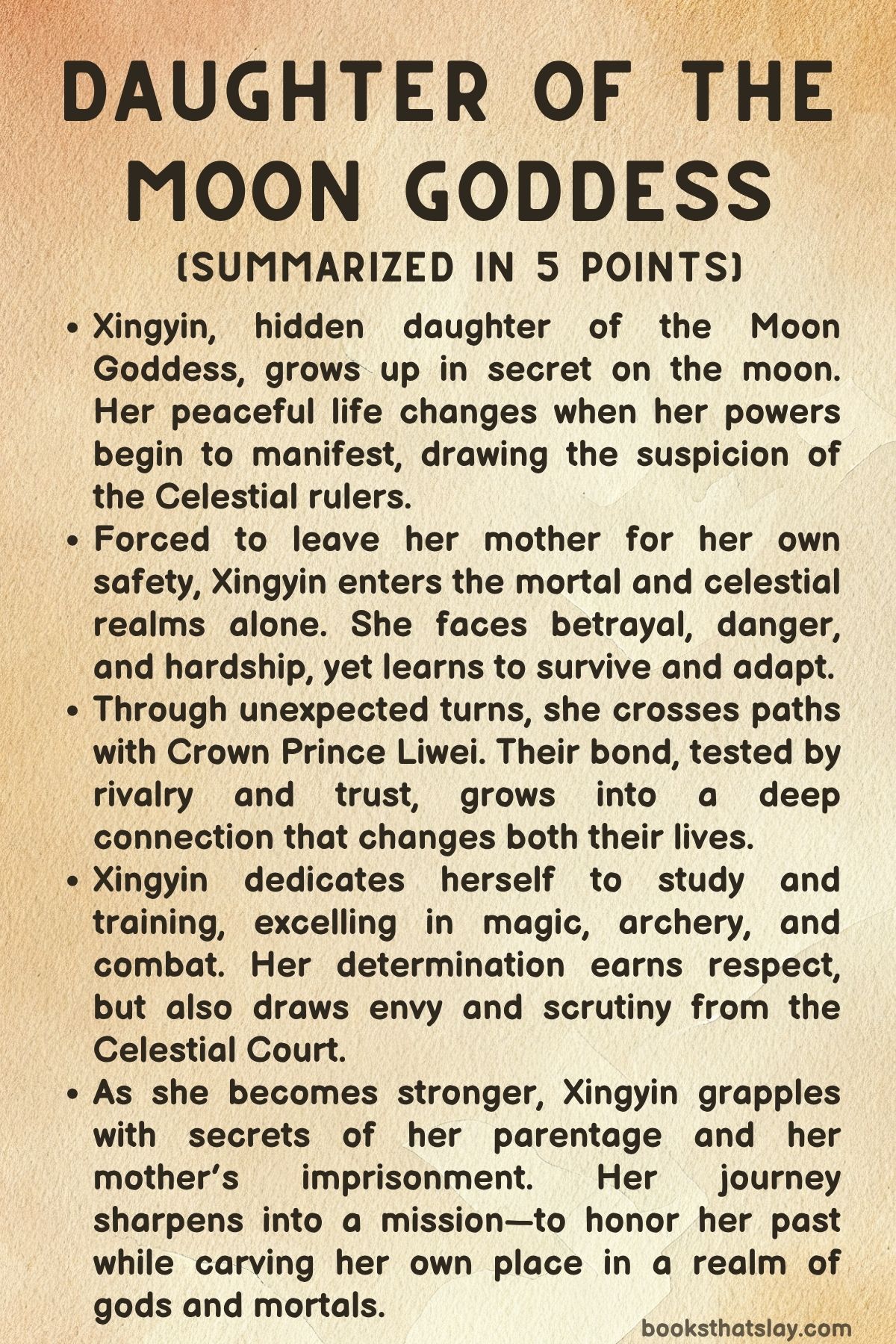
Summary
Xingyin grows up on the moon with her mother, Chang’e, unaware of her full heritage. When her hidden powers reveal her presence to the Celestial Empress, her mother sends her away for safety.
Alone, she finds herself in the Celestial Kingdom and begins working as an attendant at the Golden Lotus Mansion. Life is harsh, but her determination sustains her.
A chance encounter with a young man by the river leads her to meet Crown Prince Liwei, though she does not initially realize his identity. Their meeting changes her fate.
Liwei ensures Xingyin can compete to become his study companion. Against noble-born candidates, she faces three trials—brewing tea, composing a couplet, and performing music.
Despite setbacks and suspicion, she proves her worth, winning the final trial with a haunting melody on her flute. Her victory secures her a place by the prince’s side, giving her the first step toward the freedom and power she needs to one day save her mother.
At the Jade Palace, Xingyin begins her role as Liwei’s companion, assisting him in daily life and attending lessons. Though challenging, she gradually adjusts, forming a bond of friendship and mutual respect with him.
She studies astronomy, history, and herbology, while also training in combat under General Jianyun. Her natural skill in archery awakens something within her, pushing her toward excellence.
She befriends Shuxiao, a spirited soldier, and begins controlling her magic through meditation. Her Talent emerges as Air, with some affinity for Fire, though she learns about the dangerous, forbidden Talent of Mind.
Over the years, Xingyin grows stronger, mastering combat and deepening her bond with Liwei. He gifts her a Sky Drop Tassel to signal danger, and she gives him one in return, a sign of their equal partnership.
Their closeness, however, is shadowed by duty—Liwei’s mother, the Celestial Empress, plans to secure an alliance with the Phoenix Kingdom by betrothing him to Princess Fengmei. Xingyin conceals her heritage, knowing the empress despises her family due to Houyi, Xingyin’s father, who shot down the sunbirds—creatures tied to the empress’s kin.
As Xingyin rises in skill, whispers of war grow. She embarks on missions, including a battle against Governor Renyu, who uses a pendant to control minds.
Disguised as Lady Anmei, she resists his spell and, with Wenzhi’s aid, defeats him by shattering the pendant. Gravely injured, she recovers with Liwei and Wenzhi nearby.
Her bond with Liwei resurfaces, though strained by duty, while Wenzhi’s care and loyalty offer her another path. She is torn between them, caught between lingering love and new possibility.
The Celestial Court grows tense with threats from the Demon Realm. Xingyin continues her campaigns, proving her courage.
She saves Princess Fengmei from captivity, though the rescue mission results in betrayal. Lady Hualing, the Flower Immortal, uses forbidden Mind magic to control Liwei, forcing him into a duel against Xingyin.
Despite being wounded, she refuses to kill him, instead using her magic to bind him, affirming her love even in despair.
With the help of the Black Dragon, Xingyin escapes captivity. Back in the Celestial Army, she warns of Wenzhi’s treachery—he plans to lure Celestials into violating a treaty using enchanted mist.
Though the generals mistrust her, Liwei believes in her completely. During the battle, Xingyin strikes down the Mind Talents generating the mist, saving the army.
Her bravery strengthens her reputation, though danger remains close.
Xingyin later chooses to free the dragons’ essence from the pearls promised to the emperor. With Liwei’s support, she sacrifices part of her lifeforce to release them, earning their gratitude and a token of friendship.
When she presents the now powerless pearls to the Celestial Emperor, he furiously accuses her of treachery. Tortured with Sky-fire, she is only saved when Liwei intervenes and General Jianyun vouches for her.
The court sways in her favor, and the emperor reluctantly pardons Chang’e, ending her exile on the moon.
Finally, Xingyin returns home, reunited joyfully with her mother and Ping’er. For the first time, they are free together.
Visiting Houyi’s grave, Xingyin honors the father she never knew. Liwei confesses he has ended his betrothal, declaring his love for her.
Though she remains cautious, hope stirs within her heart. Wenzhi, appearing in a dream, expresses regret and longing, but she refuses his plea.
Xingyin embraces her true identity, no longer hiding as Chang’e and Houyi’s daughter. With her mother restored and the dragons freed, she looks to the future, resolved to protect her home and those she loves, standing strong beneath the endless night sky.
Characters
Xingyin
Xingyin, the daughter of Chang’e and Houyi, is the central figure of Daughter of the Moon Goddess, and her journey is one of self-discovery, resilience, and sacrifice. At the beginning, she is sheltered and innocent, content in her quiet life on the moon with her mother.
However, when her existence is threatened, she is thrust into a world that is both perilous and filled with opportunity. Her growth is evident in the way she endures humiliation at the Golden Lotus Mansion, demonstrating quiet strength and a refusal to yield.
As she matures, she becomes skilled in combat, magic, and strategy, while retaining a deep sense of loyalty to her loved ones. Despite the secrecy surrounding her lineage, she carries herself with dignity and ambition, determined not only to free her mother but also to forge her own path.
Xingyin embodies courage and vulnerability, caught between her heart and her duties, yet always moving forward with steadfast determination.
Chang’e
Chang’e, the Moon Goddess, is both a source of inspiration and sorrow in Xingyin’s life. Once a mortal woman whose love for Houyi shaped her destiny, she is transformed into an immortal bound by exile on the moon.
Her love for her daughter is fierce, though tinged with melancholy, as she must conceal Xingyin’s existence for safety. Chang’e represents sacrifice, as she drank the elixir to save herself and her unborn child, though it condemned her to eternal solitude.
Her longing for Houyi and her grief over their separation cast a shadow over her otherwise divine presence. Yet, through her quiet strength and resilience, she becomes a guiding force for Xingyin, instilling in her the values of perseverance and devotion that define the heroine’s journey.
Houyi
Though largely absent, Houyi’s presence lingers powerfully throughout the story. The famed archer who shot down nine suns, he is remembered both as a hero and a mortal who chose love over immortality.
His decision to forgo the elixir, wishing to remain with Chang’e, demonstrates his selflessness and humanity. His legacy lives on in Xingyin’s natural affinity for archery, a bond that transcends his death.
While he is not physically present, Houyi embodies devotion, sacrifice, and the cost of defying celestial order, shaping both Chang’e’s exile and Xingyin’s destiny.
Crown Prince Liwei
Liwei is introduced as a warm, charismatic figure who treats Xingyin as an equal, despite his station as the Celestial Crown Prince. He becomes her confidant, sparring partner, and companion in both study and adventure.
Liwei’s kindness and loyalty set him apart from the rigidness of the Celestial Court, and his support is instrumental in Xingyin’s rise. However, his role as heir brings inevitable conflicts, particularly with his mother’s ambitions to bind him politically through marriage.
His relationship with Xingyin is tender yet complicated, filled with affection, jealousy, and duty. Liwei evolves into a figure who must balance love with responsibility, ultimately willing to sacrifice personal gain for those he cherishes.
Wenzhi
Wenzhi is a complex and compelling character whose charm and loyalty initially make him a trusted companion. His devotion to Xingyin and his willingness to fight alongside her reveal his bravery, but his deeper ambitions and secret allegiances add layers of tension to his role.
Torn between love and duty to the Demon Realm, Wenzhi embodies betrayal and regret, forcing Xingyin to confront difficult choices about trust and forgiveness. His affection for her is genuine, but his actions complicate their bond, leaving him both a tragic and divisive figure.
Wenzhi’s duality highlights the theme of love clashing with loyalty, and he remains a shadowed presence in Xingyin’s life even after their paths diverge.
Shuxiao
Shuxiao provides Xingyin with much-needed friendship and loyalty in a world where alliances are fragile. Spirited and candid, she is a soldier whose courage earns her respect, though she also reveals moments of vulnerability, such as her longing for home.
Her camaraderie with Xingyin demonstrates the importance of companionship amid the trials of the Celestial Kingdom. She represents strength rooted in honesty, a grounding presence who reminds Xingyin of the bonds beyond duty and ambition.
The Celestial Emperor and Empress
The Celestial Emperor embodies authority and ruthlessness, ruling with a calculating hand that prioritizes power above compassion. His treatment of Chang’e and later Xingyin underscores his cruelty, as he uses punishment and fear to maintain order.
The Celestial Empress, by contrast, is driven by personal grief and vengeance, particularly against Xingyin’s family due to the death of her kin, the sunbirds. Her bitterness fuels much of the hostility Xingyin faces.
Together, they represent the oppressive force of celestial politics, serving as antagonists who test Xingyin’s resilience and determination to claim freedom for her mother and herself.
Prince Yanxi and Prince Yanming
Prince Yanxi and Prince Yanming, though more peripheral, enrich the story’s tapestry of relationships and alliances. Yanxi is a figure of wisdom and loyalty, offering counsel and friendship to Xingyin when she most needs it.
His honor and gratitude reflect a refreshing contrast to the Celestial Court’s manipulation. Yanming, the younger prince, brings innocence and warmth, with his paper dragon gift symbolizing sincerity and kindness.
These characters remind Xingyin of the wider world’s capacity for goodness, even amidst treachery and conflict.
Lady Hualing
Lady Hualing, the Flower Immortal turned ally of the Demon Realm, is a tragic villain whose betrayal at the hands of the Celestial Emperor drives her to vengeance. Her mastery of forbidden Mind magic and her cruelty toward Liwei and Xingyin establish her as a formidable antagonist.
Yet, her story is also one of betrayal and bitterness, revealing how the Celestial Court’s corruption and injustices can twist once-loyal immortals into enemies. In Daughter of the Moon Goddess, her presence intensifies the stakes, forcing Xingyin to confront not only external threats but also the moral complexities of love, loyalty, and survival.
Themes
Identity and Heritage
The question of identity runs at the core of Daughter of the Moon Goddess, shaping Xingyin’s journey from the moment she learns of her hidden lineage. Growing up in isolation on the moon, she initially defines herself only as the daughter of Chang’e, unaware of her father’s legacy.
Once she discovers Houyi’s connection to her life, her understanding of herself begins to shift. This knowledge is not simply a revelation but a burden, for her heritage is tied to exile, punishment, and enmity with the Celestial rulers.
Xingyin’s struggle lies in reconciling the greatness of her father’s heroism and the tragedy of her mother’s imprisonment with her own desires for freedom and belonging. Her need to keep her identity secret while maneuvering through the Celestial Kingdom becomes a recurring test, reminding her that selfhood is both a shield and a vulnerability.
By the end of the novel, she reclaims her heritage not as a source of shame but as a strength, embracing both the Moon Goddess and Houyi as vital to who she is. Her eventual pride in declaring her lineage underscores the evolution from secrecy and fear to self-acceptance and empowerment.
Power, Sacrifice, and Responsibility
The story constantly returns to the theme of sacrifice—whether it is Chang’e drinking the elixir to save her daughter, Xingyin leaving the safety of the moon to protect her family, or the countless battles where lives are risked for the greater good. Power is not depicted as something easily attained or wielded; rather, it is shown as a weight that demands sacrifice.
Xingyin learns that her abilities in archery, magic, and leadership come with responsibility, and misusing them could endanger others. The dragons’ pearls become the clearest example of this tension, as she chooses to risk her own lifeforce to restore the creatures rather than simply deliver them as political tokens.
This decision highlights her understanding that true power must be tempered by compassion and accountability. Throughout the narrative, the rulers of the Celestial Kingdom embody the opposite: the emperor and empress wield authority with cruelty and calculation, underscoring the corrupting potential of unchecked dominance.
Xingyin’s willingness to sacrifice for those she loves sets her apart, revealing that responsibility defines power far more than conquest or command.
Love, Loyalty, and Betrayal
Romantic and platonic bonds in the novel are portrayed as forces that empower but also complicate Xingyin’s path. Her relationship with Liwei evolves from friendship into love, yet it is repeatedly tested by politics, duty, and betrayal.
Wenzhi represents another kind of affection—devotion tinged with ambition and secrets—that forces Xingyin to question her trust in others. Beyond romance, loyalty emerges in her friendships with Shuxiao and her steadfast commitment to her mother, relationships that anchor her even when court politics and battles threaten to destabilize her world.
Betrayal, however, becomes an equally important thread: Wenzhi’s actions in aligning with the demons and the emperor’s constant manipulations remind Xingyin that love and loyalty are fragile when set against ambition and fear. Yet the narrative shows that betrayal does not erase love; instead, it complicates it, demanding forgiveness, resilience, or severance.
These shifting bonds deepen Xingyin’s emotional arc, pushing her to balance her personal desires with the broader loyalties she owes to her people, her heritage, and her heart.
Freedom and Confinement
The contrast between freedom and confinement is symbolically rooted in the image of the moon, where Xingyin spends her childhood hidden away, and in the exile that binds Chang’e. This tension recurs throughout the novel, as every achievement Xingyin secures is weighed against the threat of captivity, secrecy, or duty.
The Celestial Court itself becomes a gilded prison, where politics and appearances restrict even the most powerful. Xingyin’s determination to free her mother mirrors her own yearning for autonomy, as she repeatedly resists attempts by others—whether the empress, rival nobles, or Wenzhi—to dictate her choices.
Even in love, she struggles with the boundaries imposed by Liwei’s station and his obligations. Her eventual victories, both on the battlefield and in court, are victories of liberation, not only for her mother but also for herself.
By reclaiming her agency, she proves that freedom is not given but seized, often at great cost. The theme emphasizes that confinement is not just physical exile or imprisonment, but also the social, emotional, and political bonds that restrict one’s will—and breaking them requires immense courage.
Resilience and Transformation
Xingyin’s arc is defined by transformation, a movement from sheltered innocence to hardened resilience. The trials she faces—humiliation as a servant, the grueling tests of the Jade Palace, betrayal by allies, and near-death in battle—shape her into someone unrecognizable from the frightened girl forced from the moon.
Yet her resilience is not just physical endurance; it is emotional strength, the capacity to continue loving and hoping despite constant loss and disappointment. Her transformation is not a rejection of her vulnerability but a recognition that strength often arises from moments of weakness.
By the end, her resilience becomes a guiding force for others, inspiring loyalty and respect even among hardened soldiers and skeptical rulers. The narrative suggests that transformation is not a single turning point but an ongoing process, as Xingyin continues to grow in both power and wisdom.
This theme elevates her story into more than a personal quest—it becomes a universal reflection on how adversity shapes identity and how resilience ensures survival against forces designed to break the spirit.