Elektra by Jennifer Saint Summary, Characters and Themes
Elektra by Jennifer Saint reimagines the myths of the House of Atreus through the voices of three women—Elektra, Clytemnestra, and Cassandra. Set against the backdrop of the Trojan War, the novel examines cycles of vengeance, prophecy, and power within families burdened by curses and divine influence.
Saint brings a fresh perspective to the ancient tales, focusing on the emotional and psychological struggles of women whose choices and fates are shaped by loyalty, betrayal, and the gods’ whims. Through parallel narratives, the book explores how love and duty can both sustain and destroy, while vengeance fuels generations of tragedy.
Summary
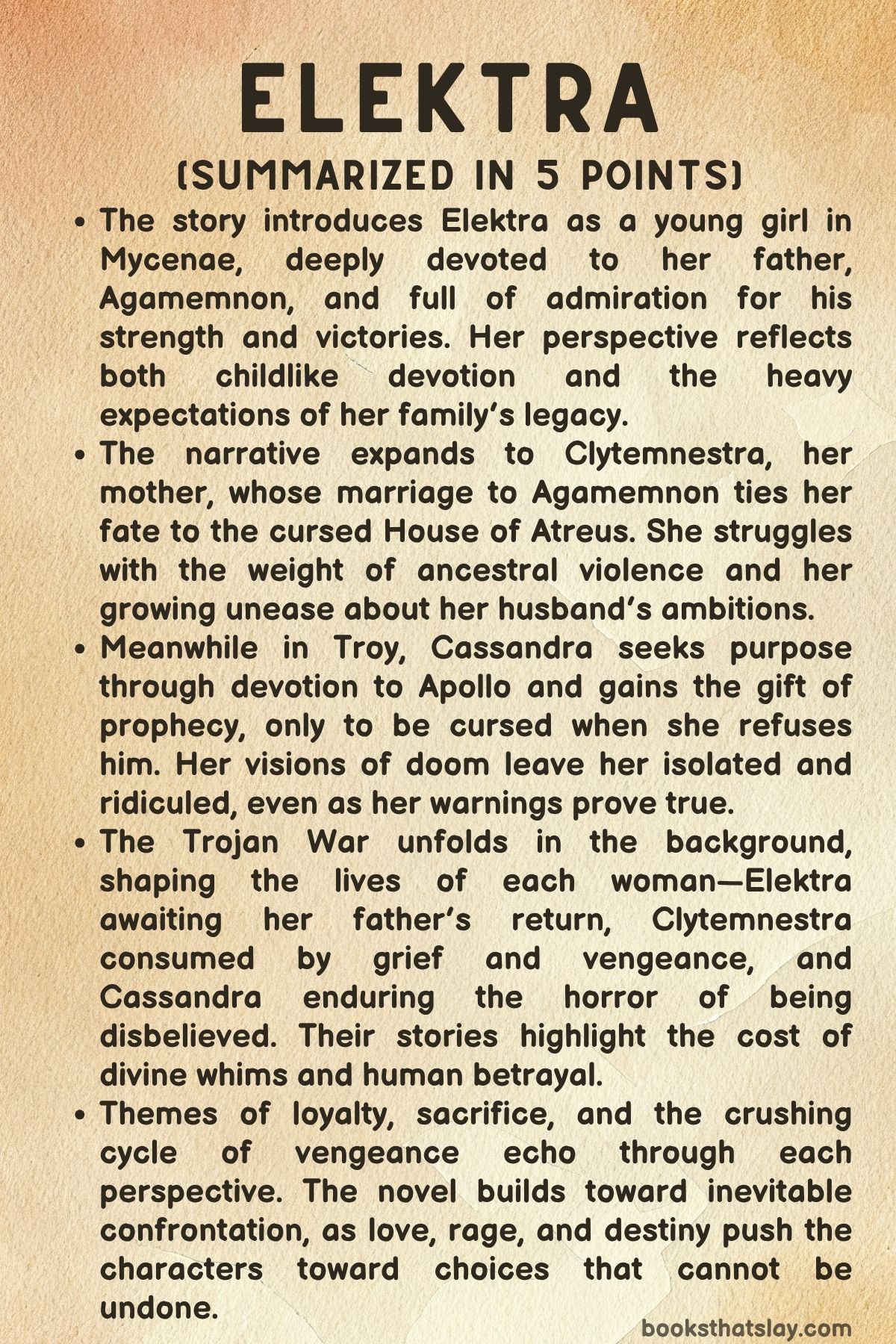
The story opens with Elektra in Mycenae, awaiting her father Agamemnon’s return from the Trojan War. She recalls her childhood memories of his pride in her, his gifts, and the sense of strength he carried.
When beacon fires signal Troy’s fall, Elektra believes her father will restore order upon his return.
The narrative then moves back to Clytemnestra’s youth in Sparta. She and her twin sister Helen grow up under the shadow of the House of Atreus, known for betrayal and bloodshed.
When Helen attracts countless suitors, Odysseus proposes a pact: all must swear loyalty to the chosen husband. Helen marries Menelaus, while Clytemnestra weds Agamemnon, who seizes back Mycenae with Spartan support.
The brothers’ rise to power secures alliances, but the family’s bloody history remains a constant threat.
Meanwhile in Troy, Cassandra, daughter of Priam and Hecabe, feels unwanted and out of place. She devotes herself to Apollo, who grants her prophetic visions.
But when she rejects him, he curses her so that no one will ever believe her prophecies. Her visions of Troy’s destruction isolate her, and she carries the burden of foresight without the power to change events.
Clytemnestra, settling into her role as Agamemnon’s wife, becomes aware of the horrific legacy of her husband’s family. She tries to focus on motherhood, cherishing her first daughter Iphigenia.
Yet the curse of vengeance and betrayal haunts her. Her fears prove justified when Helen is abducted by Paris, sparking the Trojan War.
Agamemnon rallies Greece’s armies, but the fleet cannot sail without favorable winds. Under the pretense of marriage to Achilles, Iphigenia is brought to Aulis, only to be sacrificed by Agamemnon to appease Artemis.
Clytemnestra watches in horror as her daughter is slain, fueling a vow of revenge against her husband.
Back in Mycenae, Elektra cannot accept her father’s guilt. She convinces herself that the sacrifice was demanded by the gods, clinging to loyalty to Agamemnon.
Clytemnestra, in contrast, withdraws into grief and anger, silently plotting her vengeance.
In Troy, Cassandra’s visions become increasingly dire. She foresees the disasters that follow Paris’s return with Helen.
Her warnings go unheeded as the Trojans celebrate, blind to their approaching ruin. She witnesses the deaths of warriors, the cruelty of Achilles, and finally the downfall of her city with the deception of the Trojan Horse.
When the Greeks sack Troy, Cassandra is taken as a slave and claimed by Agamemnon, her curse ensuring that her knowledge of his impending death will be ignored.
Clytemnestra, left behind in Mycenae, nurses her hatred through the years. When Agamemnon finally returns, she and Aegisthus conspire together.
Cassandra, brought back as Agamemnon’s captive, foresees the bloody outcome but cannot prevent it. Clytemnestra kills Agamemnon and Cassandra, taking power beside Aegisthus.
Elektra, horrified, rejects her mother completely and dedicates her life to avenging her father.
Elektra lives in poverty after marrying Georgios, a farmer, but keeps close to Mycenae to watch her mother and wait for her brother Orestes. When he finally returns, accompanied by his friend Pylades, they conspire to fulfill Apollo’s command: avenge Agamemnon by killing his murderers.
They pose as strangers bringing news of Orestes’s death, luring Aegisthus into a trap. Orestes kills him, then faces his mother.
Clytemnestra, weary of years of bloodshed, chooses not to plead for her life, hoping her death might end the cycle. Elektra urges Orestes to strike, and he kills Clytemnestra.
At once, Orestes is tormented by the Furies, driven into madness for committing matricide. He wanders Greece with Elektra and Pylades until Apollo cleanses him through rites at Delphi.
At last, Orestes is freed from his torment and returns to rule Mycenae. Elektra, unwilling to return to a place filled with grief, settles elsewhere with Pylades.
In the end, Elektra reflects on the lives lost—her father, her sister, her mother—and imagines reconciliation in the afterlife. Though the curse of the House of Atreus has consumed generations, she finds a small measure of peace, living quietly with her daughter while Orestes governs justly in Mycenae.
Characters
Elektra
Elektra is portrayed as a young woman whose life is shaped by devotion, loyalty, and vengeance. From her earliest days, she idolizes her father, Agamemnon, and clings to his memory as a symbol of strength, even after his betrayal of their family through the sacrifice of Iphigenia.
Her character arc is defined by her refusal to relinquish this idealized image of him, which places her in direct conflict with her mother, Clytemnestra. Unlike her siblings, Elektra refuses to see Agamemnon’s flaws and interprets events through the lens of divine necessity rather than human cruelty.
Her obsession with vengeance and her fixation on preserving her father’s honor drive her actions, including her alliance with Orestes in their plot to kill Clytemnestra and Aegisthus. Elektra embodies endurance and a sharp sense of purpose, but she also represents the destructive grip of the past, binding herself to grief and hatred in ways that consume her ability to live a full life.
By the novel’s conclusion, however, she gains a quieter existence with Pylades, allowing the reader to glimpse the possibility of healing, though her soul remains forever marked by loss.
Clytemnestra
Clytemnestra is one of the most complex figures in Elektra, a woman torn between maternal love, political duty, and the relentless curse of her lineage. Initially shown as a dutiful queen, her life unravels when Agamemnon sacrifices their daughter Iphigenia, an act that shatters her trust and reshapes her into an instrument of vengeance.
Her grief evolves into a cold determination, transforming her into both victim and perpetrator in the cycle of violence that defines the House of Atreus. Unlike Elektra, who views Agamemnon through the lens of reverence, Clytemnestra sees him as the embodiment of cruelty, a man who chose ambition and war over family.
Her relationship with her children becomes fractured, especially with Elektra, as both women represent opposing interpretations of loyalty and justice. Clytemnestra’s eventual death at the hands of Orestes and Elektra underscores her tragic acceptance of fate; instead of pleading for mercy, she allows her silence to speak, hoping her death will bring her children peace.
She emerges as a powerful yet deeply human figure, embodying the resilience and rage of a mother who has been wronged.
Cassandra
Cassandra stands as the voice of doomed truth, cursed by Apollo to see the future without ever being believed. Her character embodies isolation, torment, and the futility of knowledge without power.
Unlike Elektra and Clytemnestra, who are consumed by family ties and vengeance, Cassandra’s struggle is existential: she is forced to bear witness to catastrophe without the ability to alter its course. Her visions, often described with painful intensity, highlight the tension between divine will and human helplessness.
Her role in the narrative intertwines personal suffering with the fate of Troy, making her a symbol of innocence exploited by both gods and men. Taken as a prize by Agamemnon after Troy’s fall, she walks knowingly into her death at the hands of Clytemnestra, embodying the cruel irony of her curse.
Cassandra’s tragedy lies not only in her unheeded prophecies but also in the silence imposed upon her by others, a silence that mirrors the suppression of women’s voices throughout myth and history.
Agamemnon
Though much of his presence is filtered through memory, Agamemnon looms large as both hero and destroyer. To Elektra, he is the embodiment of strength and fatherly devotion, yet to Clytemnestra he is a murderer who sacrificed their daughter for the sake of war.
His decision to kill Iphigenia illustrates the central conflict of his character: the prioritization of duty and ambition over love and kinship. This choice not only destroys his marriage but also sets into motion the cycle of vengeance that consumes his household.
Agamemnon’s return from Troy, bringing Cassandra as a concubine, further compounds his arrogance and blindness to the cost of his actions. His murder at the hands of Clytemnestra is both an act of justice and a continuation of the blood curse of the House of Atreus, reflecting his dual nature as both victim of fate and perpetrator of violence.
Orestes
Orestes is presented as the son caught between divine command and human morality. Hidden away as a child for safety, he reenters the narrative as an adult burdened by Apollo’s decree that he must avenge his father’s murder.
His relationship with Elektra reflects both sibling loyalty and the destructive pull of vengeance. Unlike his sister, Orestes is hesitant, torn between love for his mother and the weight of divine obligation.
His matricide marks the climax of his internal struggle, a choice that brings immediate torment in the form of the Furies. His madness and eventual purification highlight the theme of divine interference in human lives, and his survival, unlike Cassandra or Clytemnestra, suggests the possibility of redemption.
However, the stain of matricide ensures his story remains one of profound tragedy, even as he assumes the throne of Mycenae.
Aegisthus
Aegisthus plays the role of opportunist and usurper, aligning himself with Clytemnestra to rule Mycenae during Agamemnon’s absence. His survival as a child, when Agamemnon spared him, ironically positions him later as the partner in Agamemnon’s downfall.
Though less psychologically layered than other characters, Aegisthus represents the persistence of vengeance in the cursed house, embodying the consequences of mercy twisted by fate. His death at Orestes’s hand mirrors his own reliance on betrayal and deceit, showing how cycles of violence inevitably consume those who perpetuate them.
Themes
The Cycle of Vengeance and Legacy of Curses
The narrative of Elektra is steeped in the endless chain of violence passed down through the House of Atreus. The novel portrays this curse not merely as a historical backdrop but as an active presence shaping every decision of its characters.
Clytemnestra enters her marriage already aware of the dark tales that haunt her husband’s family—Tantalus’s sacrilege, Pelops’s cruelty, and Atreus’s gruesome revenge against his brother. Each act of bloodshed begets another, forming a heritage that none of the descendants can escape.
When Agamemnon sacrifices Iphigenia, his choice is not an isolated act but an extension of this hereditary violence, binding his children into the same fate. Elektra, though outwardly devoted to her father, inherits not only his memory but also his thirst for vengeance, which becomes her life’s purpose.
Orestes, too, is ensnared when the oracle commands him to avenge Agamemnon, forcing him into the cycle that claims his mother’s life. This theme underscores how the family’s curse functions as both mythic inevitability and a commentary on how cycles of violence perpetuate themselves across generations.
No matter how the characters resist or embrace it, the curse directs their destinies, reducing personal choice to a mere illusion. In this way, the story emphasizes that inherited violence is not just about blood but also about the weight of memory, loyalty, and divine will that drags each member of the family deeper into tragedy.
Female Power and Resistance within Patriarchal Structures
Though the story unfolds in a world dominated by male warriors, kings, and gods, its women carry the emotional and moral center of the tale. Clytemnestra’s journey illustrates how female agency emerges from suffering; she is first a pawn in political alliances, but the murder of her daughter transforms her grief into a relentless force for vengeance.
Her resistance is both maternal and political, defying her husband’s authority and threatening the stability of his rule. Cassandra embodies another form of resistance, struggling against both divine oppression and human dismissal.
Apollo grants her sight only to render it powerless through his curse, forcing her into the cruel paradox of being right yet unheard. Her prophecies, consistently ignored, reflect the silencing of women’s voices even when their truths are undeniable.
Elektra herself, caught between loyalty to her father and rejection of her mother, resists Clytemnestra’s attempts at reconciliation, channeling her power through steadfast devotion to Agamemnon’s memory. Her choice to endure poverty and hardship in order to position herself close to her enemies is a form of agency rooted in endurance rather than direct confrontation.
Together, these portrayals highlight how women maneuver within structures that seek to control them, finding strength in grief, vision, and resilience. The novel positions female suffering not as passive tragedy but as a crucible that forges defiance and shapes the course of history.
The Burden of Prophecy and the Futility of Truth
Cassandra’s story illuminates the torment of knowing the future while being powerless to alter it. Her curse embodies the paradox of truth without influence, insight without validation.
From her earliest visions of Troy’s destruction to her warnings about the wooden horse, Cassandra represents the agony of foresight denied recognition. Her family interprets her as hysterical, the Trojans dismiss her as mad, and even the gods withdraw their favor after using her.
Yet her visions are always accurate, underscoring the futility of truth when the audience refuses to listen. This theme resonates beyond her personal suffering; it mirrors the broader human tendency to ignore uncomfortable truths, even when warnings are clear.
For Cassandra, prophecy is not a gift but a prison, stripping her of community and condemning her to isolation. When she is claimed as Agamemnon’s captive, her acceptance of her fate underscores how prophecy, far from granting control, enforces helplessness.
Her arc suggests that knowledge alone is not power unless others are willing to hear it, and the tragedy lies in how societies often reject the voices that could save them. Through Cassandra, the novel meditates on the futility of foresight in the face of collective denial, making her story one of the most haunting explorations of fate and silence.
Divine Influence and Human Responsibility
The gods in Elektra are ever-present, shaping events through demands, prophecies, and punishments, yet the novel consistently raises questions about human accountability. Agamemnon insists that Artemis required Iphigenia’s sacrifice, positioning himself as an instrument of divine will.
Elektra clings to this interpretation, preserving her image of him as blameless. Yet Clytemnestra sees the choice differently, perceiving it as a cowardly surrender of paternal duty to religious pressure.
Orestes’s command from Apollo further complicates the theme: if the god insists on vengeance, can Orestes be held responsible for matricide? His torment by the Furies suggests that divine endorsement does not absolve mortal guilt.
Cassandra’s relationship with Apollo sharpens this question even more; though cursed by the god, she is treated as though her visions are self-inflicted madness. Through these stories, the novel interrogates the space between divine compulsion and human decision.
While gods dictate terms, it is the mortals who enact them, bearing the consequences and the guilt. This tension reveals a worldview where the divine provides the excuse, but human beings carry the burden, ensuring that accountability cannot be entirely displaced onto higher powers.
The novel thus frames divine influence less as an escape from responsibility and more as the very force that exposes human frailty and complicity.
Family Loyalty and Betrayal
The tension between loyalty and betrayal within families drives much of Elektra’s emotional core. Elektra idolizes her father, defending him even after his role in Iphigenia’s death, while rejecting her mother as a traitor for seeking vengeance.
Clytemnestra, on the other hand, prioritizes her role as a mother, believing that avenging Iphigenia is the only way to honor her daughter. Her betrayal of Agamemnon, though framed as murderous treachery, is rooted in a loyalty to her children that transcends her role as wife.
Orestes embodies the most tragic conflict, torn between loyalty to his mother as the parent who raised him and loyalty to his father’s memory, reinforced by divine command. His eventual choice to kill Clytemnestra fractures him permanently, leaving him haunted by the Furies even after purification.
Cassandra’s loyalty to her family, despite their scorn, keeps her bound to Troy until its destruction, even when she knows escape is impossible. These intertwined loyalties and betrayals emphasize the impossibility of clean choices in a world defined by divided obligations.
The characters are trapped between conflicting bonds—parent to child, wife to husband, sibling to sibling—making betrayal inevitable no matter what they choose. Through this, the novel portrays family not as a sanctuary but as the site of the deepest wounds, where love and betrayal are inseparable forces shaping fate.