Across the River and into the Trees Summary, Characters and Themes
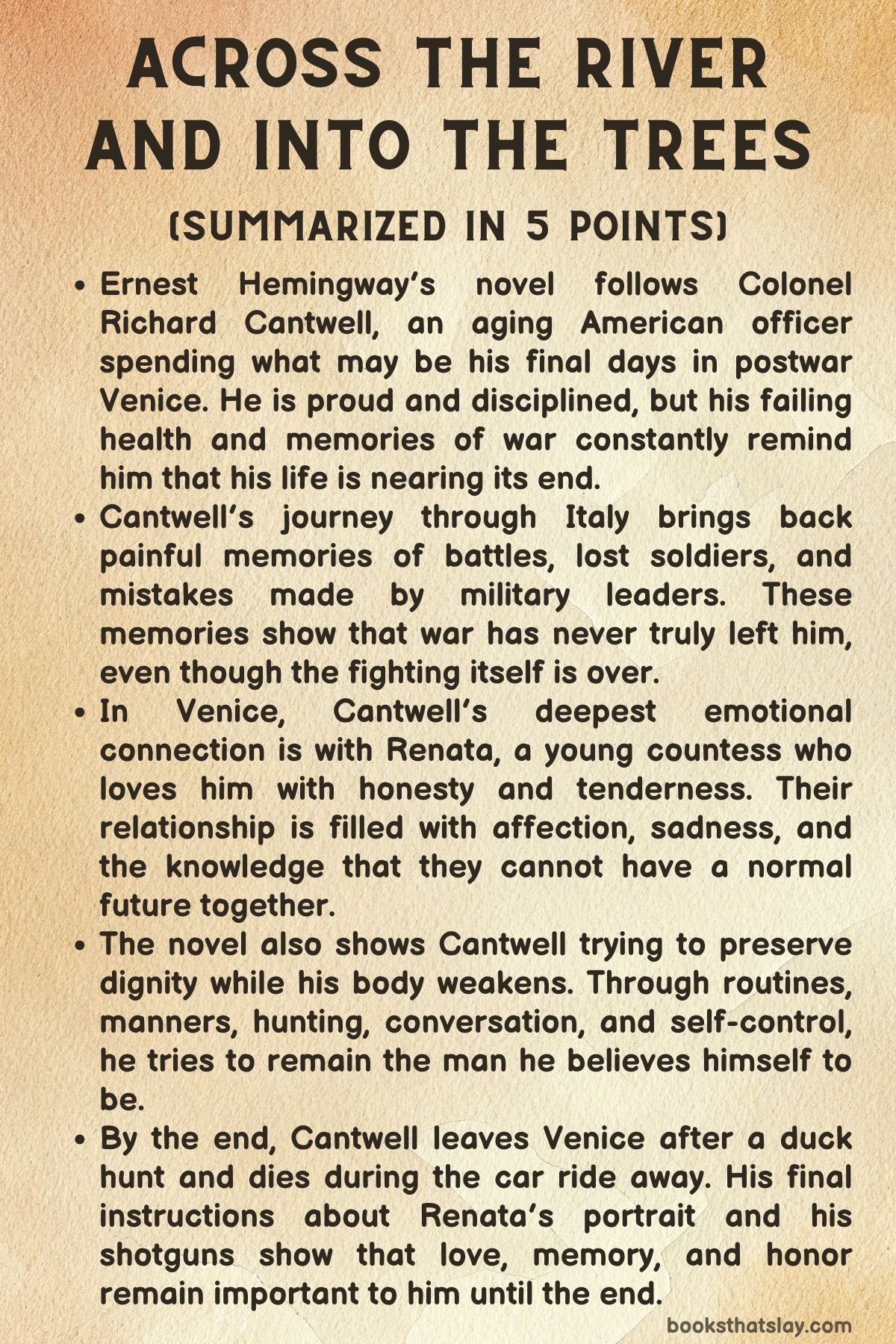
Across the River and into the Trees is Ernest Hemingway’s late novel about Colonel Richard Cantwell, an aging American officer spending a final stretch of time in postwar Venice. The book follows him through a brief, compressed period shaped by memory, desire, illness, and the long shadow of war.
Beneath its quiet surface, it is a story about a man measuring what remains of his life while trying to hold on to love, dignity, and self-command. Venice is not just a setting but a living presence, filled with beauty, habit, history, and private meanings. The novel is reflective, intimate, and deeply concerned with what survives after violence.
Summary
Colonel Richard Cantwell, a senior American officer marked by war and failing health, arrives in Italy carrying both authority and damage. He is no longer a man at the height of his powers, though he continues to act with discipline, pride, and habit.
Before going to Venice, he undergoes a military medical examination. He uses medication to steady the symptoms that trouble his heart and circulation, determined to present himself as fit.
The doctor warns him that the medicine is dangerous and that his body bears too many old injuries, but Cantwell leaves with official approval and little comfort. From the beginning, it is clear that he is a man living under a sentence he fully understands, even if he refuses to speak of it plainly.
He travels by car toward Venice with his driver, Jackson. Along the way, the landscape draws him back into memory.
Roads, rivers, canals, and damaged places call up the First World War, when he fought as a very young man in Italy. He remembers the marshes, the shelling, the wounded, the dead, and the strange endurance that once made him think he could survive anything.
The journey becomes more than travel; it is a return through the geography of his own life. He revisits places where he was wounded and where men died under his command or beside him.
War is not past for Cantwell. It remains inside his mind, attached to roads, bridges, fields, and water.
As he nears Venice, his mood changes. The city gives him pleasure, relief, and a sense of belonging that few places can offer.
He loves its surfaces, its history, its discipline, and its toughness. At the hotel and in its bars, he is greeted by staff and old acquaintances who know him well.
He moves through this world with confidence and ritual, ordering drinks, exchanging jokes, and speaking with practiced courtesy edged by irritation. Beneath the surface, however, he is watchful and tired.
He feels the weight of time, the strain of his body, and the need to control himself even in small things.
In Venice, the center of his emotional life is Renata, a very young Venetian countess whom he loves with complete seriousness. Their relationship has the quality of both romance and farewell.
When he meets her at Harry’s Bar, he is revived by her presence. She is young, beautiful, self-possessed, and affectionate, and she loves him without pretending that age, illness, and reality do not exist.
Their conversations move between play, tenderness, irony, and difficult truth. She knows he is old enough to be her father and knows that he is dying, yet she stays with him in love rather than pity.
Cantwell, for his part, treats her with reverence, desire, protectiveness, and sadness. He often calls her “daughter,” which shows both his tenderness and his awareness that their relationship cannot fit any ordinary future.
They spend their time in bars, on walks, in his hotel room, and at meals, building a private world out of talk, memory, and shared jokes. Renata rejects expensive gifts for their own sake, though she accepts a small piece of jewelry he buys her.
She gives him her emeralds to keep near him and later sends him a portrait of herself. These objects matter because they stand in for permanence, something neither of them really has.
The portrait especially affects him. It allows him to preserve her image, but it also reminds him that what he loves is already passing beyond his reach.
During dinner and later in the privacy of the hotel room, Cantwell talks more openly than he usually does. He tells Renata about war, command, failure, and loss.
He speaks of campaigns in Europe, of promotions and humiliations, of generals he admired and others he despised. He remembers times when men died because of foolish decisions made far from the front.
He still feels responsible for soldiers lost under orders he did not choose. In his view, military life rewards politics, ambition, and appearance more often than truth or skill.
He believes he might have risen higher if he had lied more easily, compromised more fully, or behaved more like the men he distrusts. Instead, he remains bitterly proud of what he knows and what he has endured.
These recollections are not casual stories. They are the burden he carries, and Renata becomes the one person before whom he can partly set that burden down.
She listens without trying to turn him into a hero or to clean up the moral ugliness of combat. He tells her about attacks, bombings, frozen roads, shattered regiments, and the deaths of officers and enlisted men.
He remembers the disorder of battle and the false simplicity of the plans made above him. The losses are still personal.
He can list the errors, the waste, and the dead with the precision of someone who never stopped reliving them. For Cantwell, war was not noble in any simple way.
It demanded skill, nerve, endurance, and obedience, but it also crushed men through vanity, politics, and bad command.
At the same time, the novel does not stay only with suffering. Cantwell and Renata create moments of lightness and pleasure.
They tease each other, invent games, imagine traveling in America, and speak with warmth about clothes, jewels, cars, food, and language. They ride through Venice in a gondola under blankets against the cold.
They kiss, talk, and try to suspend time. Their intimacy is emotional more than physical, though desire is very much present.
What matters most is the temporary refuge they give each other. With Renata, Cantwell can imagine being forgiven by life.
With Cantwell, Renata experiences a love touched by seriousness, loss, and history rather than mere social ritual.
After one evening together, Cantwell returns alone to his hotel room and places Renata’s portrait where he can see it from bed. He speaks to it, drinks, reads newspapers, and drifts between love, self-mockery, memory, and exhaustion.
In these solitary scenes, the full loneliness of his condition appears. He knows his body is failing.
He looks at himself with harsh honesty, seeing an injured and aging man whose face and body have been marked by violence. Yet even here he tries to keep his manners with the world and with himself.
He wants to be better tempered, less abrupt, less damaging in the time he has left.
The final movement of the novel brings him to the duck hunt that frames the story. In the frozen Venetian lagoon, he tries to take part in an old masculine ritual of skill, patience, and endurance.
The ice, the cold, and the difficult boatman create tension from the start. Cantwell shoots with care and still possesses flashes of mastery, but his strength is limited.
He takes medicine and drinks to steady himself, aware that both are dangerous. Alone in the blind, he thinks about Renata, about what he could possibly give her, and about the poverty of his remaining possessions when measured against love.
His medals, guns, books, and pension do not amount to much in the face of death. He realizes that even the security he might once have offered no longer exists.
After the hunt, he learns the reason for the boatman’s hostility: Allied troops had ruined the man’s family during the war. This revelation adds one more wound to the moral landscape Cantwell inhabits.
Violence has spread damage everywhere, beyond battles and beyond victory. There are no clean endings.
Cantwell then sets out by car, leaving Venice and Renata behind. He has already arranged, in effect, for what must happen after his death.
During the drive, he turns inward, accepting that he is no longer truly useful to the army and that his time with Renata is over. He suffers a final attack and understands what is happening.
His last thoughts and actions are those of a soldier still giving orders. After he dies, Jackson reads the written instructions: the portrait and the shotguns are to be returned to Venice for their rightful owner.
The novel ends not with triumph or dramatic revelation, but with a quiet completion. Cantwell passes out of the world as he lived in it, with control, pain, memory, and unfinished love.
What remains is Venice, Renata, the portrait, and the sense of a life spent bravely yet not peacefully.
Characters
Colonel Richard Cantwell
Richard Cantwell is the emotional and moral center of the novel, and nearly every other character is understood in relation to him. He is an aging American colonel whose body has been damaged by war, sport, time, and a serious heart condition.
What makes him compelling is the tension between outer control and inner collapse. On the surface, he is disciplined, witty, proud, and socially skilled.
He knows how to order a meal, judge a man, direct a driver, handle weapons, and move through elite Venetian spaces with ease. Yet beneath that composure is a man living in the shadow of death, carrying physical pain and a long burden of memory.
He refuses softness in his self-presentation, but his mind repeatedly returns to loss, mortality, and the sense that his best years have already been spent in service, violence, and endurance.
Cantwell’s personality is shaped by war more completely than by anything else. He does not simply remember military campaigns; he lives among their remains.
Landscapes, roads, rivers, bridges, marshes, and cities all trigger recollection. He measures people by standards formed in battle: courage, honesty, endurance, competence, and loyalty matter to him far more than politeness, status, or ideology.
This is why he has such contempt for empty heroics, political generals, social climbers, and those who profit from conflict without sharing its cost. His bitterness is not abstract.
It comes from having seen men die under bad orders, having obeyed commands that led to destruction, and having realized that military institutions often reward appearance more than truth. He remains proud of his experience, but that pride is mixed with guilt, exhaustion, and a sharp awareness that skill and bravery do not protect anyone forever.
One of the most revealing features of Cantwell is his divided attitude toward power. He clearly values command and has a strong instinct for leadership, judgment, and control.
He still thinks like an officer, gives orders naturally, and interprets situations tactically. At the same time, he recognizes the limits and failures of authority.
He knows how often command is compromised by vanity, bureaucracy, politics, and distance from actual combat. He is haunted not only by what he survived, but by the men he could not save.
That guilt gives his character much of its depth. He is not a romantic warrior enjoying his memories of battle.
He is a professional soldier who knows exactly what war costs and who has not found peace in having done his duty.
His relationship with his own body is equally important. He is physically brave, but his courage now takes the form of endurance rather than conquest.
He keeps moving despite pain, takes medicine to force himself through public life, drinks in ways that worsen his condition, and regards his damaged body with harsh honesty. He does not sentimentalize himself.
He sees himself as old, scarred, and diminished. Yet he also continues to insist on dignity.
His habits, routines, clothes, rituals, and manners become ways of defending self-respect against bodily decline. He cannot command his heart, but he can still command the shape of a day, the handling of a weapon, or the tone of a conversation.
That stubborn insistence on form is one of the most tragic and admirable things about him.
Cantwell’s tenderness appears most clearly in love, though even there it is complicated by age, irony, and self-doubt. His love for Renata exposes the gentler parts of him that war has not destroyed.
With her he is playful, reverent, protective, and emotionally open in ways that surprise even him. Yet he never fully escapes consciousness of the difference in age between them, nor of the fact that he is dying.
His habit of calling her “daughter” reveals both affection and sorrow. It is a term of intimacy, but also a sign that he knows their bond exists outside ordinary romantic structures.
He wants to love her without corrupting or diminishing her, but he also wants to be loved by her as a man, not merely pitied or admired. This tension gives their scenes much of their emotional force.
He is also a deeply social character who remains inwardly isolated. He can joke with bartenders, servants, nobles, and fellow veterans.
He is well liked, widely known, and comfortable in public spaces. Yet all of this ease exists beside profound loneliness.
When he is alone with Renata’s portrait, or alone in the duck blind, or alone in the car at the end, the full weight of his isolation becomes clear. He can speak brilliantly, but he cannot fully communicate the experience that made him who he is.
He can be admired, but not fully understood. His final tragedy is not just death; it is that he must carry his memories and judgments largely within himself.
In the end, Cantwell represents a man who has survived too much to believe in simple meaning, but who still longs for grace. He is harsh without being empty, proud without being shallow, and wounded without becoming passive.
His complexity lies in the way strength and damage coexist within him. He remains capable of love, humor, precision, and beauty even as his life closes around him.
Renata
Renata is far more than a young beloved or an emblem of beauty. She is the figure through whom the novel tests the possibility of renewal, tenderness, and emotional truth.
She is very young, aristocratic, elegant, and intensely alive, but Hemingway does not make her merely decorative. Her youth matters because it creates contrast with Cantwell’s age, but it also gives her a distinctive kind of directness.
She is capable of innocence, yet she is not naive. She understands death, war loss, family pressure, and the limits of fantasy.
She knows she loves a man much older than herself and that their relationship cannot simply become an ordinary future. What makes her powerful as a character is that she accepts these realities without surrendering her warmth.
Renata’s love is serious, but it is not passive. She listens, questions, jokes, decides routes, arranges messages, manages appearances, and often steadies the emotional rhythm between herself and Cantwell.
In many conversations, she is the one who keeps the relationship from turning either too sentimental or too despairing. She permits tenderness but resists melodrama.
She can speak about marriage, children, travel, jewels, clothes, or breakfast with girlish delight, and then almost immediately confront age, illness, and death with striking calm. This range gives her unusual emotional authority.
She is not presented as wise because she is older or more experienced, but because she has the instinct to be honest without becoming cruel.
Her social background is important, though it does not define her completely. As a young countess from a wealthy Venetian family, she belongs to an old world of manners, inheritance, and class memory.
She knows how to behave in society, what can be known in Venice, and how appearances function. Yet she is not trapped by that world.
She moves through it with natural confidence, but also with independence. She does not place excessive value on expensive gifts, because wealth is ordinary to her.
This allows her to respond to Cantwell without greed or calculation. When jewels appear between them, they become emotional objects rather than displays of status.
She understands value, but she cares more for the meaning attached to what is exchanged.
Renata also represents a different relation to history than Cantwell. War has touched her deeply through family loss and destruction, but she does not inhabit memory in the same punishing way he does.
She listens to his stories and respects what he has endured, yet she is not consumed by recollection. She remains oriented toward possibility, toward travel, language, daily pleasure, and the life she has not yet lived.
This makes her presence restorative. She does not erase Cantwell’s past, but beside her he is allowed to inhabit the present for a little while.
That is one reason he loves her so completely: she gives him access to a form of happiness that does not demand forgetting, only temporary relief.
Her compassion is one of her strongest traits. She is not frightened away by Cantwell’s illness, bitterness, or emotional heaviness.
She notices his condition, offers medicine, encourages rest, and tries to protect him from his own excesses. Yet her compassion is not maternal in a simplistic way.
She does not merely care for him; she desires him, admires him, and speaks to him as a beloved. At the same time, she is capable of setting boundaries.
She does not let the relationship turn into easy fantasy, and she resists false solutions. This balance of tenderness and firmness gives her character unusual dignity.
Renata is also important as a figure of idealization, though the novel complicates that idealization. Cantwell sees her as beauty, youth, love, and salvation.
The portrait reinforces this tendency, turning her into an image that can be cherished, addressed, and preserved. Yet she resists becoming only an image.
In person she is witty, changeable, feeling, and grounded. She eats, laughs, worries, asks questions, grows sleepy, and makes practical decisions.
The gap between the living woman and the portrait of her is significant. It shows that Cantwell loves not only an ideal, but also a real presence whose warmth depends on time and mortality.
Renata’s deepest function in the novel is to make visible the human side of a man otherwise armored by war. Through her, love becomes not an escape from reality but a way of facing it.
She cannot save Cantwell from death, but she gives his final days meaning, beauty, and emotional honesty. That is why her character lingers with such force.
Jackson
Jackson, the colonel’s driver, is a quieter character, but he plays a crucial structural and emotional role. He accompanies Cantwell through travel, listens to him, receives orders, and ultimately becomes the witness who survives him.
On the surface, Jackson is practical, respectful, and somewhat cautious around his superior. He knows that Cantwell can be difficult, abrupt, and unpredictable, yet he also recognizes his intelligence, authority, and essential decency.
Their relationship is shaped by military hierarchy, but it develops into something with more warmth and trust than a simple officer-driver arrangement.
Jackson’s importance lies partly in his ordinariness. He is not a grand figure, not a lover, not an aristocrat, not a veteran of Cantwell’s scale of experience.
Because of this, he helps anchor the narrative in everyday reality. Through his presence, the colonel is shown as a man moving in the real world, not just in memory and emotion.
They discuss roads, maps, cars, paintings, business, and practical details. Jackson’s questions often allow Cantwell to reveal knowledge or memory indirectly.
In this sense, Jackson functions as a listener who draws out the colonel’s reflections without challenging him too aggressively.
At the same time, Jackson is not just a passive receiver. He has his own history, including family loss and failure in civilian life.
These details matter because they place him within the wider human aftermath of war. He, too, belongs to a generation altered by conflict, even if his role has been smaller or less dramatic.
Cantwell’s treatment of him is revealing. He can be sharp, impatient, and commanding, but he is also capable of apology, generosity, and respect.
Their exchanges show that Cantwell values competence and loyalty in others regardless of class.
Jackson becomes especially important at the end because he is entrusted with the colonel’s final practical legacy. When Cantwell dies, Jackson reads and carries out the written orders concerning the portrait and the shotguns.
That act gives him a solemn function. He becomes the final custodian of the colonel’s intentions, the man who ensures that the emotional and symbolic remnants of his life are returned where they belong.
In that sense, Jackson stands for fidelity, continuity, and the quiet decency of carrying through another man’s last wishes.
The Gran Maestro
The gran maestro, the head waiter at the Gritti, is one of the most memorable secondary characters because he shares with Cantwell a combination of ceremony, irony, and historical memory. He is not simply a hotel employee.
He is a companion in style, wit, and veteran understanding. Their friendship rests on mutual recognition.
Both men understand form, ritual, and performance, but neither is fooled by empty display. Their invented Order, with its mock-grand language and private jokes, reveals the depth of their bond.
It is comic on the surface, yet serious underneath, because it expresses contempt for false heroics and solidarity with ordinary men damaged by war.
The gran maestro embodies cultivated service at its finest. He knows how to welcome, arrange, pour, seat, protect privacy, and maintain atmosphere.
In a novel so concerned with manners and control, this matters a great deal. He helps sustain the spaces in which Cantwell can still live well.
Meals, drinks, rooms, and discreet arrangements are never trivial here; they are part of a fragile order set against death and chaos. The gran maestro understands this instinctively.
He serves not merely food and wine, but a code of respect.
He also offers a kind of emotional intelligence that makes him more than a functionary. He knows when to joke, when to withdraw, when to indulge fantasy, and when to return things to practical terms.
He can meet Cantwell in mock-military play, but he also senses the danger when those imaginings come too close to deeper wounds or instability. Their rapport carries affection, but also tact.
He understands what kind of man Cantwell is and how best to receive him.
As a character, the gran maestro represents continuity, memory, and civilization maintained through discipline. In a book full of reflections on violence and loss, he stands for the small but essential human arts that make life bearable: hospitality, conversation, restraint, elegance, and loyalty.
Arnaldo
Arnaldo, the waiter who attends Cantwell in his hotel room, may seem minor, but he contributes significantly to the novel’s emotional texture. He is attentive, resourceful, and quietly affectionate toward the colonel.
His practical service often includes a personal touch, as when he brings drinks at his own expense or helps arrange communication with Renata. These gestures are not merely professional; they suggest genuine care.
Through Arnaldo, the reader sees that Cantwell inspires loyalty not only through rank or money, but through remembered kindness, habit, and reciprocity.
His conversations with Cantwell are revealing because they bring out the colonel’s softer side. They speak of food, family, ducks, and ordinary pleasures, which contrasts with the harsher world of war memories and mortal self-awareness.
Arnaldo’s gratitude for the ducks Cantwell has previously given his family gives the relationship warmth and social depth. It reminds us that generosity, even in small forms, creates lasting human bonds.
Arnaldo also helps establish Venice as a network of intimate knowledge. He knows where people are, who has been seen, what the social atmosphere is, and how things may be discreetly arranged.
In this way he is part of the city’s living intelligence. His function is modest, but his presence enlarges the sense that Cantwell belongs to a community of remembered interactions and mutual regard.
Count Andrea
Count Andrea appears briefly, yet he plays an important role in framing Cantwell’s relationship with Renata and his place in Venetian society. Andrea belongs to the same social world as Renata and helps move the colonel into that world without tension or scandal.
His exaggerated compliments and playful speech show how much of aristocratic interaction depends on style and performance. Yet there is no sense that Andrea is merely superficial.
He understands the rules of the world around him and acts with tact.
His chief importance lies in his role as facilitator. He identifies Renata’s arrival, creates the opening for the lovers to be together, and then withdraws gracefully.
This ability to read the emotional situation and step aside shows his refinement. Andrea helps make possible the private world Cantwell and Renata inhabit within public places.
He stands for a form of social ease that does not interfere but quietly supports.
Barone Alvarito
Barone Alvarito serves as an important figure in the final section of the novel. He is part of the hunting circle, a man of rank and habit, and one of the few people who can speak plainly to Cantwell at the end.
As a sportsman, he provides contrast to the colonel. He enjoys the shoot, performs well within its rules, and remains socially poised.
But his real significance emerges in his explanation of the boatman’s hostility. By revealing the family violation suffered during liberation, Alvarito introduces a painful moral complication that deepens the novel’s treatment of war.
He is also the man to whom Cantwell entrusts an important emotional message: to give his love to Renata and to understand what must be done if something happens. This suggests that Alvarito is dependable, discreet, and close enough to both worlds to serve as a bridge between them.
He is not analyzed inwardly in the way Cantwell is, but his presence matters because he belongs to the social and emotional network that surrounds the colonel’s final departure.
The Boatman
The boatman in the hunting scenes is one of the most striking minor characters because he first appears as a source of irritation and then becomes a figure of tragic human context. At the beginning, Cantwell experiences him as sullen, hostile, and uncooperative.
Their interactions are tense, and the colonel reads the man largely through the lens of wounded pride and disrupted sporting order. But later the revelation about the destruction of the boatman’s family changes everything.
His resentment toward Allied uniforms is not petty or irrational. It comes from a terrible personal history.
This reversal matters because it forces both Cantwell and the reader to confront how war damages civilians in ways that remain alive long after formal victory. The boatman is not developed through extended dialogue or introspection, but he carries powerful significance.
He reminds us that military liberation can coexist with atrocity, and that uniforms do not look innocent to everyone. His eventual cooperation with Cantwell on the return from the blind does not erase the wound behind his behavior.
Instead, it adds complexity to a brief relationship that might otherwise have remained merely abrasive.
The Surgeon
The army surgeon early in the novel serves an important diagnostic function, both literally and symbolically. He confirms Cantwell’s physical danger while also participating in the bureaucratic process that allows him to continue as though he were fit.
Their exchange is revealing because it shows the gap between medical truth and official necessity. The surgeon knows the medication is dangerous and that Cantwell’s body is compromised, yet he still signs off on him.
This small act reflects a larger pattern in the book: institutions acknowledge damage without truly addressing it.
The surgeon is not cruel or incompetent, but he is limited. He can identify the problem, warn against excess, and record a result, yet he cannot restore health or offer meaningful rescue.
He stands for professional knowledge that remains powerless before the lived reality of a man who has spent decades enduring injury. His brief presence helps establish the novel’s atmosphere of impending death from the start.
The Bartender at the Garage Bar
The bartender whom Cantwell greets upon arriving in Venice may appear only briefly, but he helps establish one of the key qualities of the colonel’s social world: his ability to form bonds across class and profession through wit, memory, and shared skepticism. Their conversation mixes humor, politics, and practical intelligence.
The bartender is politically aware, personally engaged, and comfortable with irony. He is one of the many service workers who are not treated as invisible background but as full social participants.
Through this character, the novel shows that Cantwell’s real affinities do not always follow rank. He can speak as easily and as warmly with a bartender or waiter as with a count.
What matters is authenticity, intelligence, and the ability to meet life without pretension. The bartender contributes to the sense that Venice is a place where Cantwell has a lived human network rather than simply luxurious surroundings.
Ettore and Other Hotel and Bar Staff
The hotel and bar staff, including figures like Ettore, collectively play a larger role than their limited page time might suggest. They form the framework of courtesy, service, and intimate public knowledge through which Cantwell and Renata move.
They identify strangers, carry messages, prepare rooms, safeguard objects, and maintain discretion. In a novel where public and private life constantly overlap, these characters are essential.
They make intimacy possible without pretending not to see it.
They also help define Cantwell’s character indirectly. His treatment of them reveals his values.
He jokes with them, tips them, trusts them, and relies on them. Though he can be abrupt, he recognizes their skill and takes them seriously.
Their respect for him seems earned rather than automatic. Together, they create the atmosphere of a world held together by professionalism and memory, a world in which style is not superficial but a defense against disorder.
Cantwell’s Former Wife
Cantwell’s former wife never becomes a central onstage figure, but her remembered presence contributes to the understanding of his emotional history. He describes her as ambitious, professionally driven, and someone to whom he gave too much of himself in the wrong way.
The marriage failed because his military life left little room for ordinary intimacy and because their forms of ambition and attachment were mismatched. What matters here is not whether his judgment of her is fair in every respect, but what the memory reveals about him.
He regards the marriage as an error and sees it as part of a life in which work, war, and absence damaged the possibility of domestic happiness.
Her place in the narrative also sharpens the contrast with Renata. The former wife belongs to a world of adult disappointment, conflict, and emotional failure, while Renata represents a late experience of purity, acceptance, and wonder.
Whether that contrast is fully just is less important than the fact that Cantwell experiences it as emotionally absolute.
General Figures and Absent Military Leaders
Many military leaders appear only in recollection, but they are important to the character system of the novel because they help define Cantwell by contrast. Some are respected as competent professionals; others are treated with contempt as political performers or men insulated from the consequences of their orders.
These offstage presences matter because they show that Cantwell’s inner life is crowded with judgments. He is always in conversation with the military hierarchy, even when far from battle.
The remembered generals, commanders, and staff officers form the invisible structure of grievance, admiration, and disillusionment through which he interprets his own career.
They also show that the novel is not only about private love or personal decline. It is about a man trying to assess the value of a lifetime spent inside institutions that rewarded some virtues while betraying others.
These remembered figures are therefore part of his character analysis, because they are the people against whom he measures honor, competence, and waste.
Themes
War, Memory, and the Burden of Survival
War exists in the narrative not as a distant historical event but as a living force inside Colonel Cantwell’s mind. His memories shape how he sees the world, how he judges people, and how he understands himself.
The conflict he experienced did not end when the fighting stopped. Instead, it continues through recollection, guilt, pride, and reflection.
His thoughts repeatedly return to the landscapes where battles occurred, the soldiers who served under him, and the decisions made by commanders far from the front. Roads, rivers, and towns trigger recollections of past violence, turning the physical environment into a map of emotional scars.
This shows how memory binds the present to the past so tightly that the two cannot easily be separated.
The theme also explores the psychological consequences of surviving when many others did not. Cantwell does not treat survival as a simple victory.
Instead, it carries responsibility and regret. He remembers the men who died under his command and wonders whether better decisions might have saved them.
His sense of duty and professional pride clashes with the painful recognition that military systems sometimes sacrifice individuals for strategy or prestige. These reflections reveal a man who believes in courage and discipline but has lost faith in romantic ideas of glory.
War appears as an experience that demands obedience while often ignoring the human cost of that obedience.
The memories he shares with Renata illustrate how storytelling becomes a way to process trauma. He recounts battles, campaigns, and strategic failures not to celebrate them but to confront their consequences.
The stories reveal the loneliness of command. Officers must give orders knowing that others will die carrying them out.
This moral tension continues to haunt Cantwell long after the war ends. His recollections become acts of testimony, showing how history lives inside individuals rather than existing only in official records.
Through these reflections, Across the River and into the Trees presents war as something that permanently alters identity. Cantwell’s personality, judgments, and emotional responses are shaped by decades of military experience.
Even moments of love or relaxation are shadowed by the knowledge of what he has seen and done. The theme ultimately shows that survival does not mean freedom from war.
Instead, it often means carrying its memory for the rest of one’s life.
Love and the Awareness of Mortality
The relationship between Cantwell and Renata stands at the center of the emotional landscape. Their love exists within a clear awareness of time and mortality.
Cantwell is an aging man with a failing heart, while Renata is young and full of possibility. This contrast intensifies every moment they share.
Instead of pretending that age and illness do not exist, both characters acknowledge them openly. Their conversations include references to death, future separation, and the uncertainty of how long Cantwell has left.
This honesty gives their relationship depth because it prevents love from becoming a comfortable illusion.
Cantwell experiences Renata as a source of renewal and emotional clarity. Her presence allows him to feel tenderness and happiness that his life of war rarely permitted.
At the same time, he understands that their love cannot escape the limits imposed by time and circumstance. This awareness creates a sense of urgency.
Simple activities such as walking through Venice, sharing meals, or sitting together become meaningful because they may be among the last moments he experiences with someone he truly loves. The fragility of life makes ordinary pleasures feel significant.
Renata’s role in this theme is equally important. She loves Cantwell with sincerity, yet she does not deny reality.
She recognizes that their relationship cannot easily lead to marriage or a conventional future. Instead of resisting this truth, she accepts it while continuing to care for him deeply.
Her compassion includes concern for his health and emotional well-being. She listens to his stories, encourages him to rest, and tries to protect him from despair.
Through her responses, love becomes an act of understanding rather than possession.
Their relationship also reflects the human desire to preserve what cannot be kept permanently. Objects such as Renata’s portrait and the emeralds symbolize attempts to hold on to beauty and affection even as time passes.
These objects remind Cantwell of the woman he loves, yet they also emphasize the gap between memory and presence. Love in the novel therefore carries both joy and sadness.
It provides meaning in the present while reminding the characters that the future may not belong to them.
This theme shows that love does not eliminate mortality but instead becomes more powerful because of it. Cantwell’s final days are enriched by his connection with Renata, even though he knows that death is approaching.
The emotional intensity of their relationship arises from this awareness, making their love both deeply fulfilling and inevitably temporary.
The Search for Dignity in the Face of Decline
The novel presents a portrait of a man confronting physical deterioration while trying to maintain personal dignity. Cantwell’s body has been damaged by years of combat, injuries, and stress.
His heart condition forces him to rely on medication that offers temporary relief but cannot solve the underlying problem. Despite this decline, he refuses to surrender the habits and standards that define his identity.
His careful manners, his attention to clothing and behavior, and his disciplined routines represent a deliberate effort to remain in control of himself even as his body weakens.
This struggle between control and vulnerability shapes many of Cantwell’s actions. He continues to participate in activities such as hunting, traveling, and social gatherings, even though these efforts strain his health.
The act of hunting in the frozen lagoon becomes symbolic of his determination to function as he always has. The cold, the physical effort, and the tension with the boatman test his endurance.
By continuing the hunt despite discomfort, Cantwell attempts to affirm that he is still capable of action and authority.
Dignity also appears in his interactions with others. Cantwell treats hotel staff, friends, and acquaintances with a mixture of courtesy and directness that reflects his belief in clear social conduct.
He values competence and honesty, whether in a soldier, a waiter, or a bartender. These relationships reinforce his sense of belonging within a community built on mutual respect.
Even when he becomes irritated or impatient, he usually regains control and restores a tone of civility.
The theme extends to his reflections on aging and appearance. Cantwell views his scarred body and weathered face without illusions.
He recognizes the damage inflicted by time and war, yet he does not allow self-pity to dominate his thinking. Instead, he continues to live according to the code he developed during his military career: endurance, honesty, and self-command.
His refusal to hide from the truth of his condition becomes part of his dignity.
In Across the River and into the Trees, decline is presented as unavoidable, but humiliation is not. Cantwell’s behavior shows that dignity can survive even when strength fades.
By continuing to act according to his principles, he preserves a sense of identity that illness cannot erase.
The Moral Complexity of War and Victory
The narrative challenges simplified ideas about heroism and victory by revealing the complicated moral consequences of war. Cantwell has participated in multiple campaigns and understands warfare from the perspective of someone who has commanded troops and seen the aftermath of battle.
His reflections reveal how military success often comes at a devastating cost. Strategies designed by distant leaders can lead to unnecessary casualties, while political considerations sometimes shape decisions more than tactical realities.
These observations expose the tension between official narratives of triumph and the painful experiences of soldiers on the ground.
Cantwell’s memories show that bravery and professionalism do not guarantee justice or fairness. Soldiers may fight courageously and still be sacrificed by flawed plans or miscommunication.
He remembers attacks that led to heavy losses and reflects on the pressure placed on officers to obey orders regardless of personal doubts. The theme emphasizes that responsibility in war does not always align neatly with authority.
Those who make decisions may never see the destruction their commands produce, while those carrying out orders must live with the consequences.
The presence of the hostile boatman introduces another dimension to this moral complexity. The man’s resentment toward Allied uniforms is rooted in personal tragedy experienced during the liberation of his region.
This revelation forces a reconsideration of the idea that liberation automatically brings justice or gratitude. Even armies fighting on the side of victory can commit acts that devastate civilian lives.
The boatman’s story reminds the reader that the boundaries between heroism and wrongdoing are not always clear.
Cantwell’s own attitude toward enemies further illustrates the theme. He does not express simple hatred toward opposing soldiers.
Instead, he often respects their professionalism and courage. His admiration for capable opponents reflects a soldier’s recognition that skill and discipline exist on both sides of a conflict.
This perspective challenges the traditional idea that war divides participants neatly into good and evil categories.
By presenting these experiences through Cantwell’s reflections, Across the River and into the Trees reveals war as a morally complicated human activity rather than a straightforward contest between heroes and villains. Victory does not erase suffering, and loyalty to duty does not remove the burden of remembering those who died.
The theme encourages readers to consider the ethical uncertainty that remains long after the fighting ends.