Across The Desert Summary, Characters and Themes
Across The Desert by Dusti Bowling is a middle-grade adventure novel about courage, friendship, and the strength it takes to face difficult truths. The story follows twelve-year-old Jolene, a girl living in Phoenix who feels lonely and worried about her mother’s growing dependence on prescription painkillers.
Her life changes when she witnesses a livestream of a young pilot crashing her aircraft in the Arizona desert. Convinced that the girl might still be alive and unable to rely on adults for help, Jolene sets out on a dangerous journey across the desert to find her. Along the way, she confronts fear, hardship, and the reality that asking for help can be as brave as rescuing someone else.
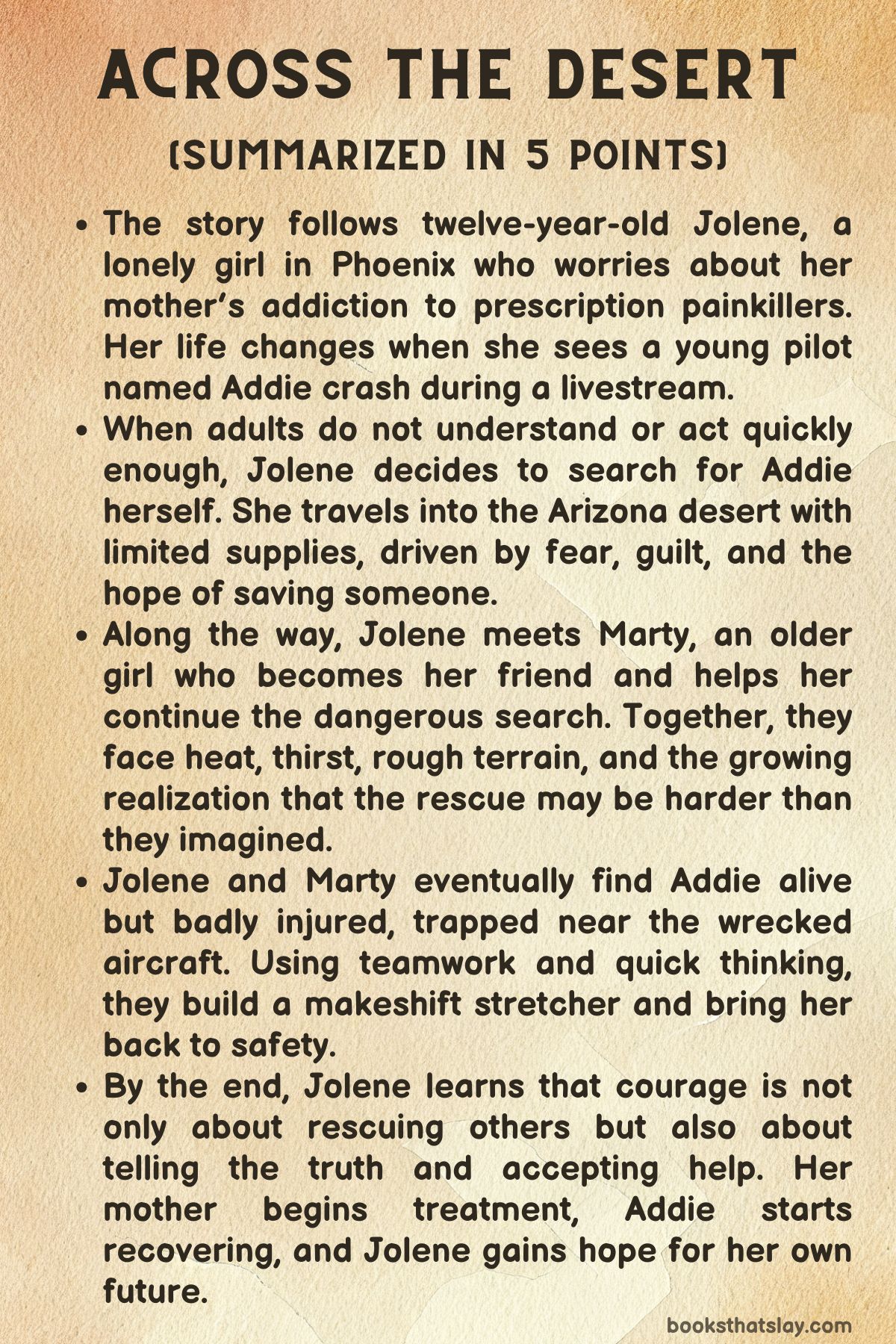
Summary
Twelve-year-old Jolene spends much of her time at the public library in Phoenix, Arizona. The building provides cool air from the intense heat and a place where she can use the computers.
Jolene often feels isolated at school. Other students mock her worn clothes, old shoes, and crooked teeth.
The one place where she feels understood is online, watching the livestream of a young pilot known as the Desert Aviator. The pilot, Addie “Earhart,” flies a small ultralight aircraft and broadcasts her flights on a site called Blipstream.
Jolene is usually the only viewer during the broadcasts, and the two girls communicate through messages while Addie flies.
Jolene studies maps and satellite images to guess where Addie flies. She believes the aircraft travels near Alamo Lake in the Arizona desert.
Jolene admires explorers, pilots, and mapmakers from history, and she enjoys drawing maps herself. At the same time, she carries a heavy worry at home.
Two years earlier she and her mother were in a serious car accident. Jolene survived with injuries, but her father died in the crash.
Since then her mother has been prescribed oxycodone for pain, and Jolene suspects she has become dependent on the pills. Her mother sleeps often and struggles to care for their apartment or provide regular meals.
During one livestream, Addie flies over cliffs and desert landforms while chatting with Jolene. Suddenly the engine fails.
The aircraft drops quickly, and Addie shouts for help before the stream cuts off as the plane crashes. Jolene panics and tries to tell someone at the library, but the librarian misunderstands the situation and shuts down the computer.
Jolene attempts to reconnect to the stream, but she cannot access it again.
She goes to a nearby fire station to report the crash, but the firefighter cannot confirm anything and questions how she knows about it. Afraid that authorities will contact her mother and discover her mother’s condition, Jolene leaves without giving accurate information.
She runs home and wakes her mother, trying to explain what happened, but her mother dismisses the story and forbids Jolene from using the internet again.
Determined to help Addie, Jolene calls the sheriff’s office near Alamo Lake and pretends to be an older witness reporting the crash. The sheriff says no aircraft in the area has been reported missing.
Realizing that no one will search for Addie, Jolene decides she must go herself. She packs water, simple food, a map she drew of the desert area, and her mother’s phone.
She leaves a note apologizing and explaining that she has gone to help someone.
Jolene travels by bus toward the desert town of Quartzsite. At the bus station she meets a seventeen-year-old girl named Marty.
Marty dropped her own phone in water and asks to borrow Jolene’s phone briefly. They begin talking, and Marty eventually accompanies Jolene on the bus ride.
During the trip Jolene admits that she saw the plane crash online and plans to find the pilot. Marty quickly realizes how dangerous the plan is, especially since Jolene is young and unprepared for the desert.
Marty invites Jolene to stay at her grandfather’s home while they figure out a safer plan. Marty tries calling authorities near Alamo Lake, but without proof they promise only to check the area the next day.
Jolene fears waiting will cost Addie her life. Late that night she quietly leaves the house to continue alone.
Walking toward the desert highway, Jolene steals an electric bicycle from a campground, leaving a note promising to return it. She rides along the side of the road at night while large trucks pass dangerously close.
Eventually she crashes the bike. The fall damages her supplies and breaks her water container.
After pushing the damaged bike for miles and reaching a small town, she discovers the gas station is abandoned. Exhausted and frightened, she sleeps outside until morning.
When she wakes, Marty has found her. Marty explains she could not let Jolene continue alone and decides to help her reach the crash site.
They travel by car toward the Flipside Café near Alamo Lake, using Jolene’s map as a guide. Along the way they talk about their lives and future dreams.
Marty hopes to become a doctor and help people struggling with addiction. Jolene feels her own dreams are unrealistic because of her family’s financial problems.
At the café they recharge Jolene’s phone and study a map of the surrounding desert. Jolene realizes she must adjust her earlier calculations.
While there, she briefly meets a famous pilot named Joanie Cash but decides not to ask her for help because she fears the police becoming involved.
With limited water and a partly charged phone, Jolene and Marty hike into the desert following the route Jolene believes Addie took during the flight. The terrain is harsh, and the heat grows intense.
They walk through dry washes and rocky canyons while rationing their water carefully. Jolene worries they may not find anything, but she refuses to turn back.
At one point they reach a place Jolene thought was the crash location but see no plane. Marty suggests Addie might already be safe at home, but Jolene breaks down emotionally.
She reveals the pain she has carried since the accident that killed her father and sister and the loneliness she feels at school and home. She believed rescuing Addie would prove that she mattered and could make a difference.
Soon after, Jolene hears a metallic sound echoing across the canyon. Climbing a ridge, she finally sees the wrecked ultralight aircraft.
Addie is alive but severely injured. Her legs are crushed and she has been trapped for days in the extreme heat with no water.
Her real name is Adelaide Chapman.
Jolene and Marty give Addie water and attempt to call emergency services, but Jolene’s phone battery dies. Addie’s own phone was destroyed in the crash.
They manage to free Addie from the wreckage and move her into the shade of a nearby abandoned mine. Addie is weak and suffering from dehydration and infection.
Realizing they cannot carry her back across the desert, the girls dismantle parts of the aircraft. Using the wings, metal bars, and wheels, they build a stretcher that can roll across the ground.
They wait until night to avoid the worst heat, then slowly begin the long journey back toward the café.
The trip is exhausting and frightening. They navigate by moonlight and struggle through rough terrain while pushing the stretcher.
At one point Marty is injured by a cactus, but they continue forward. Jolene keeps checking the map and encourages the others whenever doubts appear.
After hours of slow progress they finally reach the café. Jolene charges the phone and calls Addie’s mother.
An ambulance arrives and takes Addie to the hospital. Marty’s parents soon arrive as well.
During the drive back to Phoenix, Marty’s mother gently asks Jolene about her home situation. Marty reveals that her older sister died from an opioid overdose after becoming addicted to prescription pain medication.
Her parents now run a charity called Lucy’s Hope that helps families dealing with addiction. They explain that hiding a loved one’s addiction can prevent them from getting needed treatment.
When they arrive at Jolene’s apartment, Jolene confronts her mother about the pills. Her mother initially denies the problem and worries about the cost of treatment.
Jolene insists she needs help and asks her to accept support from the Peterson family’s charity. After a difficult conversation, her mother finally agrees to enter a treatment program.
Jolene temporarily stays with Marty’s family while her mother begins recovery. Addie survives surgery on her broken legs and starts rehabilitation.
The girls continue to message each other online and build a genuine friendship.
Later they attend an airshow together with their families. The pilot Joanie Cash recognizes Jolene and invites her to fly in her plane.
With encouragement from her mother and friends, Jolene climbs aboard despite her fear.
As the plane lifts into the air, Jolene realizes that her journey across the desert changed her life. She learned that bravery can take many forms, from rescuing a stranger to asking for help when someone you love is struggling.
The experience gives her hope for the future and confidence that she can pursue the dreams she once believed were impossible.
Characters
Jolene
Jolene is the emotional center of Across The Desert, and her character is shaped by loneliness, fear, intelligence, and a strong sense of responsibility. At twelve, she lives with pressures that feel far beyond her age.
She is dealing with poverty, bullying at school, grief from the loss of her father and sister, and the painful decline of her mother into opioid dependence. These conditions make her guarded and self-reliant.
She does not trust adults easily because the adults in her life have either failed her, abandoned her, or become too overwhelmed to protect her. That mistrust explains many of her choices.
When Addie crashes, Jolene does not simply think help is needed; she believes she alone must provide it. Her determination grows not only from concern for Addie but also from a deeper need to prove that she is capable of saving someone when so much in her own life has already been lost.
Jolene’s imagination and intellect are among her most important qualities. She loves maps, explorers, pilots, and women who pushed beyond limits.
Those interests are not random hobbies. They reveal how she sees the world and how she survives it.
Maps give structure to chaos. Adventure stories offer models of courage.
Women from history become proof that fear and hardship do not have to decide a person’s future. Jolene constantly measures herself against these figures, and while this gives her strength, it also shows her insecurity.
She wants badly to believe she can be brave and capable, yet she often talks herself out of larger dreams because poverty has convinced her that many futures belong only to other people. Her journey is therefore not just a rescue mission.
It is also the beginning of a change in how she sees her own worth.
One of the most moving aspects of Jolene’s character is the way she carries emotional pain in silence. She has trained herself to function through fear rather than speak about it.
Her anxiety is connected to the earlier car accident, and this fear surfaces whenever she feels trapped or helpless. She also stores up hurt from school cruelty and from her mother’s neglect.
Because she rarely expresses these feelings, they build into a powerful inner pressure. That pressure finally erupts in the desert, when the search for Addie seems pointless and Jolene voices the belief that no one really cares.
This moment is essential because it shows that her rescue effort was never only about Addie. Saving Addie became tied to saving a part of herself that still wanted to feel necessary, seen, and loved.
By the end, Jolene changes in ways that feel earned rather than sudden. She remains scared, but she becomes more open to help, more honest about pain, and more willing to imagine a future for herself.
She learns that courage is not only endurance or sacrifice. It can also mean telling the truth, asking for support, and allowing others to stand beside you.
Her final steps toward friendship, school, and even flying show a girl who has not escaped hardship but has begun to believe that hardship does not define the limits of her life.
Addie Chapman
Addie is first presented as a distant, almost mythical figure through a livestream screen, yet she gradually becomes one of the most human characters in the story. She is adventurous, skilled, and unusually confident for her age.
Her online identity as the Desert Aviator suggests freedom, daring, and self-possession. From Jolene’s perspective, Addie seems to represent everything bold and fearless.
She flies across open land, speaks directly to her only viewer, and appears to move through life with a kind of easy courage. That image is powerful because it offers Jolene both companionship and escape.
As the story deepens, Addie’s emotional life becomes clearer. Her love of flying is closely tied to grief.
Her father taught her to fly, and after his death she continues as a way of staying close to him. That detail transforms her flights from a hobby into something deeply personal.
Flying becomes memory, comfort, and mourning all at once. Addie is not reckless simply for the sake of thrill.
She is trying to preserve a bond that death interrupted. This gives her character a quiet sadness beneath her cheerful and capable exterior.
Like Jolene, she is a child trying to carry grief through action rather than through open emotional expression.
Addie also plays an important role in Jolene’s development because she offers the kind of attention and affirmation that Jolene rarely receives elsewhere. In their messages, Addie is encouraging, curious, and generous.
She takes Jolene seriously. She tells her she is smart, points out possible futures for her, and treats her like someone worth knowing.
That matters because Jolene has come to expect dismissal. Addie’s friendship becomes meaningful not because the girls know every detail about each other, but because Addie listens without judgment.
Even before the crash, she serves as emotional proof that Jolene can be valued by someone outside her difficult home and school life.
After the crash, Addie becomes more than an idealized figure. She is shown in pain, trapped, dehydrated, sunburned, and frightened.
These scenes strip away the glamour of her pilot persona and reveal her vulnerability. Yet even in that condition, she remains practical and resilient.
She helps map a route, shares needed information, and endures enormous suffering. Her strength is no longer the exciting strength of performance but the harsher strength of survival.
This makes her a fuller character. She is brave both in the air and in suffering, both as a symbol of possibility and as a real girl facing physical ruin with determination.
Marty Peterson
Marty begins as a stranger Jolene meets by chance, but she becomes one of the most important stabilizing forces in the story. She is older, more direct, and more experienced than Jolene, and from the start she notices the cracks in Jolene’s explanations.
What makes Marty compelling is that she does not simply challenge Jolene out of suspicion or authority. She does it out of concern.
She sees very quickly that Jolene is underfed, poorly equipped, and carrying secrets that are too heavy for her age. Her instinct is to protect, but she is careful not to overwhelm Jolene.
This gives her character a strong moral presence.
Marty’s maturity does not mean she is perfect or fearless. She is still a teenager, and the desert journey pushes her into situations that scare and test her.
She has moments of doubt, frustration, and physical pain. Yet she continues.
That endurance makes her more than a helpful side character. She becomes a partner in the rescue and an emotional bridge between Jolene and the adult support she eventually needs.
Marty knows when to push for honesty and when simply to stay beside Jolene. She recognizes that some truths must be offered gently if they are to be heard at all.
Her family history adds another layer to her character. The death of her sister Lucy from opioid overdose explains why Marty responds so sharply to the subject of addiction.
This is not abstract knowledge for her. She has lived through the devastation of watching a family break around substance abuse.
As a result, she cannot ignore the signs in Jolene’s life. Her bluntness comes from pain, but also from experience.
She understands that secrecy can become part of the problem. This makes her interactions with Jolene especially meaningful, because she is not merely judging her choices; she knows how dangerous silence can be.
Marty also represents a hopeful alternative model of family and care. She comes from a household shaped by tragedy, but that tragedy has been turned into service through Lucy’s Hope.
Marty wants to become a doctor, which matches her practical, compassionate personality. She is someone who meets suffering by trying to do something about it.
In many ways, she models the lesson Jolene most needs: that helping others does not require carrying everything alone. It can happen through community, honesty, and shared effort.
Jolene’s Mother
Jolene’s mother is one of the most painful and complicated figures in Across The Desert because she is both loved and resented, harmed and harmful. She is not presented as a villain in a simple sense.
Instead, she is shown as a parent broken by grief, physical pain, and addiction. After the car accident that killed her husband and daughter, she becomes unable to fully care for Jolene.
The medication prescribed after the accident appears to begin as legitimate treatment and then turns into dependency. This matters because it frames her not as someone who intentionally abandons her child, but as someone whose ability to function has been steadily consumed.
Even so, the damage she causes is real. Jolene lives with hunger, emotional neglect, and constant instability because of her mother’s condition.
The apartment is unkempt, daily life is disorganized, and Jolene feels invisible. Her mother’s refusal to properly respond when Jolene reports Addie’s crash is especially painful because it confirms Jolene’s belief that she cannot rely on the person who should protect her most.
This neglect has shaped Jolene’s personality in lasting ways, making her secretive, hyper-independent, and unwilling to trust adults.
What gives the mother depth is that the story allows signs of love to remain visible beneath the addiction. She is not cold because she does not care at all.
She is impaired, defensive, ashamed, and overwhelmed. When Jolene returns home, her mother’s distress is genuine.
She has been frightened, and her line about Jolene breaking her heart reveals that she is not emotionally absent in a total sense. The tragedy is that love without presence or responsibility is not enough.
She may feel deeply, but addiction has kept those feelings from becoming reliable action.
Her turning point comes when she is finally confronted not only by outsiders but by Jolene herself. This confrontation matters because the daughter stops protecting the mother from consequences.
Once the truth is spoken openly, the mother can no longer hide behind denial. Her agreement to seek treatment does not erase the harm she caused, but it marks the first real step toward accountability.
Later, when she appears in treatment, exhausted yet honest enough to name herself as an addict, she begins to regain moral and emotional clarity. Her character stands as a reminder that addiction harms whole families, but also that recovery begins when truth replaces secrecy.
Mrs. Peterson
Mrs. Peterson serves as one of the strongest adult figures in the story. She enters later than some central characters, but once she appears, she brings emotional steadiness, compassion, and practical action.
She does not approach Jolene with pity or judgment. Instead, she responds with the kind of careful attention Jolene has been missing for a long time.
This is significant because Jolene has learned to expect adults either to misunderstand her or to fail her. Mrs. Peterson becomes one of the first adults to show that authority can also be kind.
Her role is strengthened by the grief she carries from losing her daughter Lucy to overdose. That history gives her insight into Jolene’s home situation and shapes the way she speaks about addiction.
She does not reduce it to a moral weakness, nor does she excuse it in a way that ignores the suffering it causes. She understands both its tragedy and its consequences.
Because of that, her support feels grounded rather than sentimental. She knows that real help requires intervention, treatment, and honesty.
Mrs. Peterson also represents the idea that pain can be transformed into service. Through Lucy’s Hope, she and her family have turned private loss into public care for others facing similar struggles.
This makes her more than a comforting presence. She is someone who has chosen purpose after grief.
For Jolene, that is deeply important. Mrs. Peterson offers material help, emotional reassurance, and a model of adulthood built on resilience rather than collapse.
She helps open the possibility that families can be repaired, not by pretending nothing happened, but by facing what happened directly.
Mr. Peterson
Mr. Peterson is less central on the page, but his role still matters because he contributes to the atmosphere of safety that surrounds Marty’s family. He is part of the support system that catches Jolene when her own home life has become too unstable.
Though he is not as emotionally foregrounded as Mrs. Peterson, his presence suggests reliability and practical care. He helps solve immediate problems without making himself the center of attention.
This quieter function is important. Stories about crisis often depend not only on dramatic heroes but also on steady people who do necessary work in the background.
Mr. Peterson helps create that stability. His role supports the larger contrast between Jolene’s home and Marty’s family life.
Even in a family that has endured deep loss, there can still be structure, involvement, and shared responsibility. He strengthens the novel’s sense that care is often shown through consistent action rather than dramatic speeches.
Joanie Cash
Joanie Cash occupies a symbolic role that is larger than her amount of page time. She represents possibility.
For Jolene, pilots and explorers are figures from books, maps, and distant dreams. Joanie appears in real life as proof that those dreams can exist outside imagination.
She is accomplished, confident, and encouraging, but she is not presented as untouchable. Her brief interactions with Jolene are warm and affirming, especially when she recognizes Jolene’s artistic talent and speaks as though her future is not already limited by money or circumstance.
Joanie matters because she offers Jolene a new way to think about aspiration. Until then, Jolene often rejects hopeful ideas before they can disappoint her.
She assumes certain futures are closed to her. Joanie challenges that assumption simply by existing and by noticing her.
The final flight invitation becomes more than an exciting conclusion. It is an emotional opening.
By stepping into Joanie’s plane, Jolene symbolically steps toward a life she had not allowed herself to imagine fully.
Aunt Mallory
Aunt Mallory is not physically central to the main action, yet her importance in Jolene’s emotional life is considerable. She represents betrayal within family.
After the car accident, when Jolene was at her most vulnerable, Mallory failed to provide the dependable care Jolene needed. That abandonment left a lasting mark.
It helps explain why Jolene is so resistant to trusting adults and so determined to solve impossible problems alone. When people speak about asking for help, Jolene hears that advice through the memory of having been let down before.
Mallory’s significance lies in what she reveals about Jolene’s internal world. Jolene does not merely fear disappointment in an abstract way.
She has learned from experience that adults can disappear, choose convenience over responsibility, or leave her to systems that do not feel personal or safe. The mention of Mallory deepens the story’s treatment of abandonment and shows that Jolene’s isolation was formed through repeated wounds, not just current hardship.
Lucy Peterson
Lucy never appears directly in the present action, but she has a major influence on the story’s emotional and thematic structure. Her death from overdose gives the Peterson family its history of grief and its commitment to helping others.
Through Lucy, addiction is shown not only as a private struggle but as something with devastating consequences that ripple across entire families. She is a tragic example of how a medical prescription can become the beginning of a fatal path.
Lucy’s importance also lies in how her story affects Marty and Mrs. Peterson. It explains their urgency, their honesty, and their refusal to let Jolene continue hiding her mother’s condition.
Because Lucy’s loss is personal, their concern for Jolene carries weight. Lucy becomes the unseen force behind one of the novel’s key truths: love without intervention can become dangerous when addiction is involved.
Mrs. Chapman
Mrs. Chapman appears more clearly toward the end, but her role still matters because she helps frame Addie’s life outside the crash. Her fear and urgency after hearing from Jolene show a parent who is deeply connected to her child.
This creates an important contrast with Jolene’s home life. Addie, despite her grief and risky choices, comes from a situation where parental love remains visible and active.
Mrs. Chapman also becomes part of the healing circle that forms around the girls after the rescue. Her gratitude and involvement help move Addie’s story from survival into recovery.
She helps show that the rescue has consequences beyond the desert itself. Families are pulled back together, new bonds are formed, and the girls’ friendship becomes rooted in real-world connection rather than online distance.
Benjamin
Benjamin is only mentioned briefly, yet his absence is meaningful. He seems to represent a lost friendship from Jolene’s life, and that loss reinforces how isolated she has become.
The fact that Jolene speaks about him in the context of what a good friend would do suggests that she still values loyalty and closeness deeply, even if she has withdrawn from others. Benjamin’s small presence adds to the sense that Jolene’s loneliness is not natural to her character.
It is something that has grown around her through pain and instability.
Themes
Courage and Personal Growth
Courage in Across The Desert is not presented as a simple act of bravery but as a gradual process of facing fear, doubt, and vulnerability. Jolene’s journey across the Arizona desert is physically dangerous, yet the emotional risks she takes are just as significant.
At the beginning of the story, she already sees herself as someone who must handle problems alone. Her life circumstances have pushed her into independence too early.
With a grieving and addicted mother and a home environment lacking stability, she has learned to depend only on herself. When she witnesses Addie’s crash, Jolene believes that saving the injured girl is entirely her responsibility.
This belief pushes her to make choices that adults would consider reckless, but those choices also reveal a deep sense of determination and empathy.
The desert becomes the setting where Jolene’s inner strength is tested. She faces exhaustion, dehydration, fear of animals, and uncertainty about her plan.
Every obstacle forces her to confront the possibility that she may fail. Instead of presenting courage as fearlessness, the narrative shows Jolene continuing despite constant fear.
Her mind repeatedly fills with doubts about whether she has miscalculated the crash location or whether Addie may already be dead. Yet she keeps moving forward because turning back would mean abandoning someone who might still need help.
That determination grows stronger when Marty joins her, because Jolene begins to realize that courage can also involve trusting another person.
As the story progresses, Jolene’s idea of bravery changes. At first, she believes courage means completing the rescue on her own and proving that she is capable of extraordinary acts.
By the end, her understanding has expanded. She learns that admitting painful truths requires a different kind of strength.
Confronting her mother about addiction and accepting help from Marty’s family demands emotional bravery. These moments are not dramatic adventures like crossing the desert, yet they require Jolene to face fears she has avoided for years.
Her growth lies in recognizing that courage is not only about heroic action but also about honesty, vulnerability, and hope for change.
The Impact of Addiction on Families
Addiction shapes much of the emotional tension in the story, particularly through Jolene’s relationship with her mother. The narrative portrays opioid dependence as a force that quietly disrupts everyday life.
Jolene’s mother was once a functioning and caring parent, but after the car accident that killed her husband and daughter, she begins using prescription pain medication and gradually loses control over it. The result is not sudden chaos but a slow breakdown of responsibility and attention.
Jolene often finds her mother sleeping during the day, struggling to maintain their home, and unable to focus on her daughter’s needs. The emotional distance that forms between them becomes one of Jolene’s greatest sources of loneliness.
For Jolene, addiction is confusing and frightening. She suspects something is wrong but cannot fully explain it or talk about it openly.
Instead, she tries to protect her mother’s secret from outsiders. This secrecy becomes a burden that isolates her further.
She fears that if authorities discover the truth, her mother will be punished or she herself will be removed from home. Because of that fear, she avoids asking adults for help even when she desperately needs it.
The silence surrounding addiction creates a cycle in which Jolene feels responsible for maintaining the illusion that everything is normal.
The story also shows addiction’s wider consequences through Marty’s family. Marty’s sister Lucy died after becoming addicted to opioids, which began with a prescription for dental surgery.
Lucy’s death reveals how easily addiction can begin and how devastating the outcome can be when treatment does not arrive in time. The Peterson family’s response to this tragedy adds another perspective.
Rather than retreating into grief alone, they create a charity that helps people struggling with substance dependence. Their openness about Lucy’s story contrasts strongly with the secrecy in Jolene’s home.
When Jolene finally confronts her mother and speaks openly about the addiction, the cycle of silence begins to break. Her mother initially resists the idea of treatment, partly because of shame and financial concerns.
The moment when she admits the problem and agrees to seek help is important because it shows that recovery starts with acknowledgment. The theme emphasizes that addiction does not affect only the person using substances.
It changes the emotional and practical lives of entire families, especially children who may feel responsible for protecting the adults who should be protecting them.
Friendship and Human Connection
Human connection becomes a lifeline for the characters, especially for Jolene, whose early life in the story is marked by isolation. Her first meaningful connection appears through online communication with Addie.
Even though the two girls have never met in person, their conversations create a sense of companionship that Jolene does not experience at school or at home. Addie listens to her ideas, encourages her interests, and speaks to her with respect.
This interaction is significant because it gives Jolene a feeling of being valued. For a girl who often feels invisible or mocked, that recognition becomes powerful motivation.
The online friendship initially seems distant and limited, yet it develops into something genuine. When Addie’s plane crashes, Jolene’s reaction demonstrates that the relationship is real to her.
She does not see Addie as a stranger but as someone whose life matters deeply. Her decision to search the desert is driven partly by empathy and partly by loyalty to the person who treated her kindly.
The friendship therefore acts as a bridge between digital interaction and real-world commitment.
Marty’s arrival expands this theme by introducing a relationship built on honesty and shared hardship. Unlike Jolene, Marty is more socially confident and emotionally open.
She challenges Jolene’s secrecy and questions her choices, yet she also supports her throughout the dangerous journey. Their partnership develops through difficult circumstances rather than casual interaction.
Walking through the desert together, solving practical problems, and helping Addie survive create a bond based on trust and cooperation. Marty becomes someone Jolene can rely on not only during the rescue but also when facing her complicated family situation.
The theme also explores how friendship can encourage personal growth. Both Addie and Marty repeatedly affirm Jolene’s abilities.
They recognize her intelligence, creativity, and courage even when she doubts herself. Their encouragement slowly begins to change the way Jolene sees her own potential.
By the end of the story, the three girls share a friendship built on shared experience and mutual support. The connection they form demonstrates that meaningful relationships can emerge in unexpected ways and that genuine friendship often begins when people choose to care about one another despite fear or uncertainty.
Hope, Healing, and the Possibility of Change
Hope in the story does not appear suddenly or without struggle. It develops through painful experiences and difficult choices.
At the beginning, Jolene sees the future as limited. Poverty, bullying, grief, and her mother’s addiction have shaped her expectations.
She believes that opportunities such as travel, creative careers, or higher education belong to people with more resources. This belief reflects how strongly her environment has influenced her sense of possibility.
Dreams feel distant, and survival from day to day seems more realistic than imagining a better future.
The journey across the desert begins to shift that perspective. Jolene accomplishes something that once seemed impossible.
She navigates miles of harsh terrain, uses her mapping skills to find the crash site, and plays a crucial role in saving Addie’s life. These achievements show her that determination and intelligence can create change even in overwhelming circumstances.
The experience does not solve all her problems, but it proves that she is capable of more than she believed.
Healing also becomes visible through the transformation of family relationships. Jolene’s confrontation with her mother creates a painful moment of truth.
Instead of continuing to hide the addiction, Jolene insists that help is necessary. This conversation opens the door to treatment and recovery.
The process is not presented as quick or easy. Her mother is exhausted and emotionally fragile during detoxification, yet she begins to take responsibility for her actions.
This step suggests that healing requires both honesty and support from others.
The presence of adults such as Mrs. Peterson and Mrs. Chapman strengthens this sense of possibility. They offer care, guidance, and practical help without dismissing the girls’ experiences.
Their support shows that recovery and stability often depend on community involvement rather than individual struggle alone. Jolene’s time living temporarily with the Peterson family exposes her to a household where people communicate openly and work together to face problems.
The final scenes emphasize that hope can grow gradually after hardship. Jolene returns to school with a renewed sense of confidence and forms new friendships.
Addie continues her recovery after surgery, and the girls maintain their connection. The opportunity to fly with Joanie Cash symbolizes Jolene’s changing outlook on life.
Stepping into the airplane represents a willingness to imagine a future that once seemed unreachable. Hope becomes not just a feeling but a direction forward, built from courage, honesty, and the support of others.