Across Five Aprils Summary, Characters and Themes
Across Five Aprils by Irene Hunt is a historical novel set during the American Civil War and told through the experiences of a young boy named Jethro Creighton. Living on a farm in southern Illinois, Jethro grows up during one of the most difficult periods in American history.
The story shows how the war reaches far beyond battlefields and deeply affects families, communities, and personal beliefs. As the conflict stretches across five Aprils, Jethro witnesses loss, division, courage, and change. Through his experiences, the novel presents a coming-of-age story that explores moral choices, loyalty, and the heavy cost of war on ordinary people.
Summary
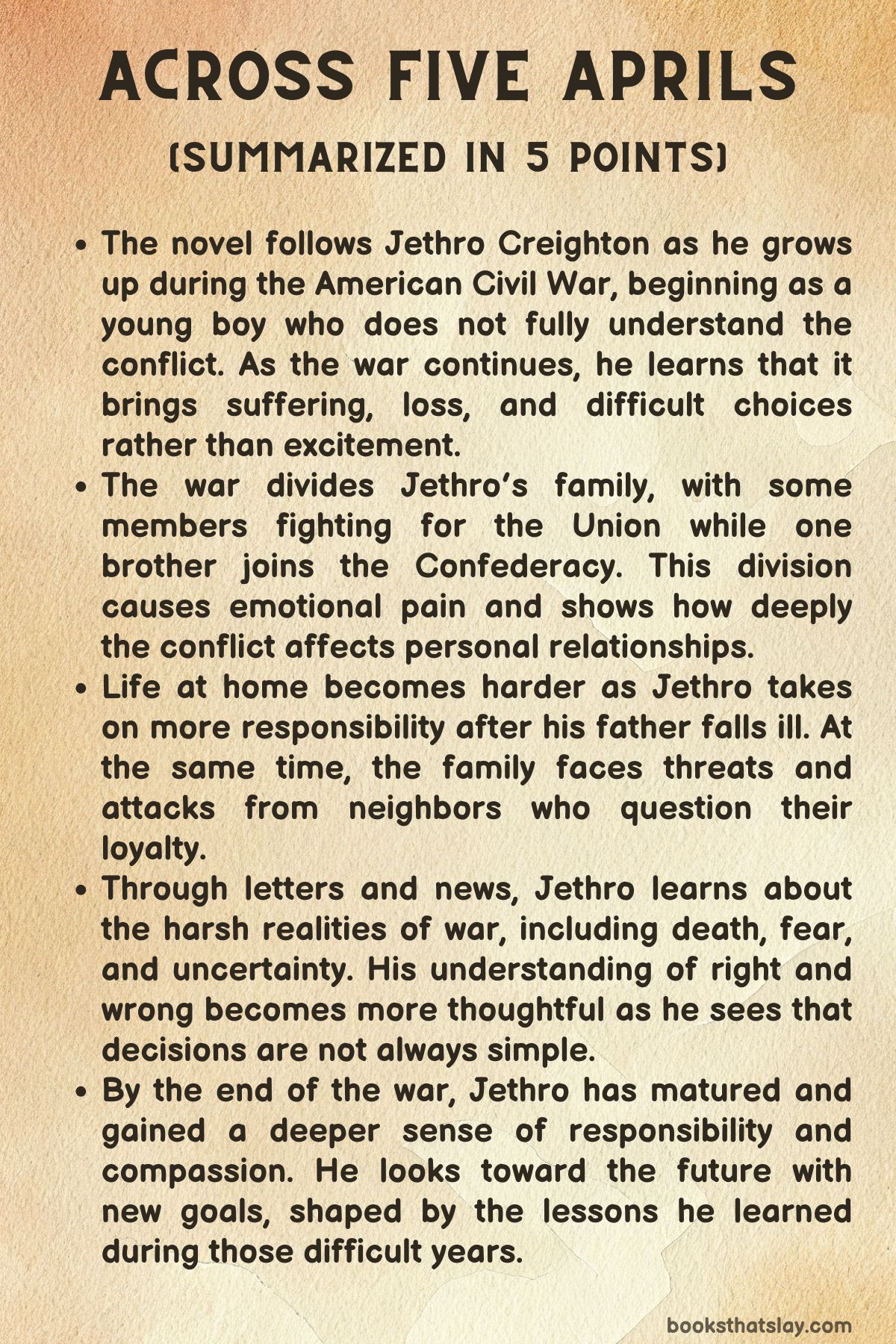
Across Five Aprils follows the life of Jethro Creighton, the youngest child in a farming family in southern Illinois, during the years of the American Civil War. At the start of the story in April 1861, Jethro is nine years old and helps his mother, Ellen Creighton, with planting potatoes on their farm.
Although the country is tense with rumors of war, Jethro does not fully understand the seriousness of the situation. His older brothers and cousin speak of the war with excitement, making him think it will be quick and adventurous.
His mother, however, feels anxious about the coming conflict, knowing that war brings suffering rather than glory.
Jethro’s family has already experienced hardship. Several of his siblings died from illness when he was younger, and his sister Mary died in a tragic accident caused by Travis Burdow, the troubled son of a disliked local family.
This memory remains painful for the Creightons and shapes Jethro’s thoughts about justice and responsibility. His father, Matthew Creighton, prevented an angry mob from lynching Travis after Mary’s death, an act that some people in the community viewed as weakness but that showed Matthew’s belief in fairness and restraint.
When a relative from Kentucky, Wilse Graham, visits the Creighton home, a tense political discussion takes place during dinner. Wilse sympathizes with the Southern states and believes they have the right to separate from the Union.
Members of the Creighton family argue with him, especially about the issue of slavery. For Jethro, the conversation is confusing.
He begins to realize that the war is not simply about fighting but involves complex questions about justice, freedom, and the future of the nation.
Soon afterward, news arrives that Confederate forces have fired on Fort Sumter. This event signals that the Civil War has begun.
In the early days of the conflict, many people treat the war as if it will be brief. Soldiers march off with cheering crowds, and the mood seems almost celebratory.
However, the excitement fades when real battles bring heavy casualties and defeat.
The war begins to divide the Creighton family. Jethro’s brothers Tom and John, along with their cousin Eb Carron, join the Union army.
Another brother, Bill, struggles with his beliefs about the conflict. He dislikes slavery but also criticizes the North’s motives.
After arguing with John, Bill leaves home and eventually joins the Confederate army. His decision shocks the family and leaves them emotionally divided, as one brother fights for the Union while another fights for the Confederacy.
Letters from the battlefield gradually reveal the harsh reality of war. Tom writes about suffering, cold weather, and the death of soldiers who were unprepared for the conditions.
These accounts destroy the earlier illusion that war is exciting. Jethro, who once admired the idea of battle, begins to understand its cruelty and waste.
As the war continues, the Creighton family faces challenges at home as well. Jethro takes on greater responsibilities when his father suffers a heart attack and becomes too weak to manage the farm.
Though still young, Jethro works hard to help maintain the family’s land. His sister Jenny becomes his closest companion during this time, and together they support their parents and care for the farm.
Hostility from neighbors also becomes a problem. Because Bill joined the Confederacy, some people accuse the Creightons of being traitors.
A group of troublemakers threatens the family and eventually burns their barn and poisons their well. These attacks show how deeply the war has divided communities even far from the battlefields.
Tragedy strikes again when the family learns that Tom has been killed in battle. The news devastates them.
Tom’s death forces Jethro to confront the full emotional weight of the war. The family records his death in the family Bible, a solemn reminder of how many lives the conflict has taken.
Meanwhile, the war itself continues to bring both hope and disappointment. Newspapers and letters describe famous battles and changing generals.
Some leaders are praised as heroes, while others are criticized for poor decisions that lead to unnecessary deaths. Jethro observes that even the leaders on the side he supports are not perfect.
This realization deepens his understanding that the war is complex and that people on both sides struggle with difficult choices.
Another challenge arises when many Union soldiers desert the army and hide in nearby areas. One of these deserters is Jethro’s cousin Eb.
Sick, hungry, and ashamed, Eb secretly returns home. Jethro finds him hiding in the woods and struggles with what to do.
Instead of reporting him, Jethro decides to write a letter directly to President Abraham Lincoln, asking for guidance.
To Jethro’s surprise, Lincoln replies personally. In the letter, the president explains that he plans to allow deserters a chance to return to the army without severe punishment.
Lincoln admits that his decision may be criticized, but he believes it is better to show mercy. The letter deeply influences Jethro, reinforcing the idea that leadership requires compassion as well as strength.
Eb eventually returns to the army, grateful for the opportunity to redeem himself.
As the years pass, the war grows even more destructive. Jenny’s sweetheart, Shadrach Yale, serves as a Union soldier and writes letters describing the terrible conditions and heavy losses he witnesses.
During the Battle of Gettysburg, Shad is seriously wounded. Jenny travels to Washington to care for him in the hospital, and they are married there while he recovers.
John continues to fight in the Union army and writes proudly about victories achieved by his regiment. Gradually, the Union begins to gain the advantage in the war.
Important victories raise hopes that the conflict may finally end. At the same time, political debates continue across the country.
Abraham Lincoln delivers the Gettysburg Address and later wins reelection as president, strengthening the Union’s determination to continue the fight until the Confederacy surrenders.
Near the end of the war, news arrives that General Sherman has captured Savannah during his campaign through the South. While many people celebrate the success, others worry about the destruction caused by the campaign.
Jethro learns that even victory can carry moral questions.
In April 1865, the war finally comes to an end when Confederate General Robert E. Lee surrenders to Union General Ulysses S. Grant. Communities celebrate the long-awaited peace.
Jethro travels into town to join the celebrations and watches fireworks that mark the nation’s reunion.
However, the joy is quickly replaced by sorrow when news spreads that President Lincoln has been assassinated. Jethro feels a deep personal loss, remembering the letter Lincoln wrote to him and the wisdom it contained.
For Jethro, Lincoln represented kindness and moral courage during the nation’s darkest years.
Soon afterward, Shad returns home from the war. He reunites with Jethro, and they reflect on how much they have both changed during the conflict.
The war has taken many lives and left lasting scars, but it has also taught important lessons about responsibility, compassion, and resilience.
Shad and Jenny encourage Jethro to continue his education and eventually attend university. Although Jethro feels uncertain about leaving the farm, he realizes that the future holds new opportunities.
As the story closes, Jethro looks ahead to a life shaped by the experiences of the war years, carrying with him a deeper understanding of the world and his place within it.
Characters
Jethro Creighton
Jethro Creighton is the emotional and moral center of Across Five Aprils. The story follows his growth from a curious, impressionable nine-year-old boy into a more thoughtful and mature young teenager shaped by war, loss, and responsibility.
At the beginning, Jethro sees the coming conflict through the eyes of boys and young men who imagine honor, excitement, and quick victory. He does not understand his mother’s fear, and he even mistakes her anxiety for weakness.
This early attitude shows how innocence can distort reality. As the years pass, however, Jethro becomes one of the clearest lenses through which the human cost of war is understood.
His mind is active, his heart is sensitive, and his moral development gives the narrative much of its depth.
Jethro is especially compelling because he is neither heroic in a grand, dramatic sense nor passive. He is observant, reflective, and deeply affected by everything around him.
He listens closely to adult conversations about slavery, politics, loyalty, and war, even when he cannot fully understand them at first. Over time, his understanding grows.
The deaths, divisions, and hardships he witnesses strip away his childhood certainty. He begins to see that public causes and private pain are closely connected.
His family’s suffering teaches him that war is not only fought by soldiers on battlefields but is also endured by mothers, sisters, farmers, and children at home.
One of Jethro’s most important qualities is his ability to feel sympathy even when situations are morally difficult. This appears strongly in his response to Eb’s desertion.
He does not react with easy judgment. Instead, he sees Eb as frightened, exhausted, and human.
His decision to write to President Lincoln reveals his courage and his instinct for mercy. Jethro’s growth is marked by this movement away from simple ideas of right and wrong toward a more serious understanding of conscience.
By the end, he has become a young man with emotional depth, practical strength, and intellectual promise. His journey is a coming-of-age story shaped by grief, labor, family loyalty, and the search for what is right.
Ellen Creighton
Ellen Creighton represents maternal love, endurance, and intuition. From the opening, she understands the danger of the approaching war more clearly than Jethro does.
While younger men and boys imagine glory, Ellen senses loss. Her anxiety is not weakness but wisdom born from experience, grief, and responsibility.
She has already known deep personal sorrow through the deaths of several children, and this history gives her an awareness of fragility that others often lack. She stands as one of the clearest reminders that women in wartime carry emotional burdens that are no less serious than those borne by soldiers.
Her relationship with Jethro is especially important. Because he survived when several other children did not, she feels a special attachment to him, almost as if his life carries a larger meaning.
This does not mean she loves her other children less, but her concern for Jethro has a particular intensity. She recognizes his intelligence and sensitivity and wants to protect both.
At the same time, she does not prevent him from growing. As the family’s hardships increase, she accepts the painful necessity of his taking on adult responsibilities.
Ellen also serves as a moral force within the family. She tries to keep political arguments from becoming destructive and insists on decency even when tempers rise.
Her strength is quiet rather than theatrical. She suffers, worries, and grieves, yet she continues working and caring for others.
Her headaches and emotional strain show how deeply war invades domestic life. Ellen’s character makes visible the cost of endurance.
She is not simply the worried mother figure; she is a woman whose emotional intelligence is repeatedly proven correct, and whose presence holds the family together through fear and sorrow.
Matthew Creighton
Matthew Creighton is the moral backbone of the family. He is a man of restraint, principle, and quiet authority.
Jethro, especially when young, sometimes mistakes these qualities for weakness. That misunderstanding is important because it shows the difference between childish ideas of strength and genuine moral courage.
Matthew’s decision in the past to stop a mob from killing Travis Burdow reveals his character very clearly. He refuses to let rage become justice, even when his own daughter has died.
This act is not softness. It is discipline, humanity, and a refusal to surrender conscience to public anger.
Matthew’s role in the family is that of a stabilizing presence. He does not speak recklessly, and he does not reduce difficult matters to slogans.
In political discussions, he shows seriousness and thoughtfulness. He opposes slavery, but he also understands that human history moves slowly and painfully toward justice.
This gives his outlook a reflective quality that contrasts with the louder certainty of younger men. He believes that morality cannot depend only on passion; it must also rest on patience and reason.
His illness marks a turning point in the household and in Jethro’s development. When Matthew suffers a heart attack and becomes physically diminished, the family loses not only labor but also a protective center.
Yet even in weakness, his influence remains strong. Jethro continues to measure difficult situations against the standards his father has embodied.
Matthew’s humanity also appears in his responses to Bill and Jenny. He does not always make easy or popular choices, but he acts from seriousness rather than impulse.
He is a portrait of fatherhood shaped by responsibility, grief, and ethical steadiness.
Jenny Creighton
Jenny Creighton grows from a lively girl into one of the most emotionally resilient characters in the story. At first, she appears in a familiar domestic role, serving meals, enduring teasing, and showing affection for Shad.
Yet as the war continues, her character gains substance and complexity. She is affectionate and spirited, but she is also capable of endurance, discretion, and emotional maturity.
Her bond with Jethro becomes especially important after the family is shaken by loss and hardship.
One of Jenny’s defining qualities is her combination of warmth and strength. She is deeply in love with Shad, but her feelings are not shallow or romanticized.
As his letters become darker and more realistic, Jenny must live with fear, uncertainty, and delayed hope. She learns to carry private emotion in a disciplined way.
Her refusal to read aloud Shad’s most intimate words is a sign of maturity and respect, not secrecy. She understands that love has a private dimension that should not be exposed for public consumption.
Jenny also becomes a partner in labor and survival after Matthew’s illness. She works beside Jethro on the farm, and this shared labor strengthens their relationship.
Her emotional intelligence helps Jethro grow; she can apologize, forgive, and understand shades of feeling that he is still learning to name. Later, when she travels to see wounded Shad and marries him in the hospital, her courage is made unmistakable.
She is not merely waiting at home for events to decide her future. She steps into crisis with dignity and devotion.
Jenny represents the strength of those whose love must survive fear, distance, and the possibility of permanent loss.
Shadrach Yale
Shadrach Yale is one of the most admirable and intellectually influential figures in the novel. As a teacher and family friend, he helps shape Jethro’s mind early on by encouraging curiosity, learning, and respect for knowledge.
He introduces ideas that widen Jethro’s sense of the world, and he treats the boy’s intelligence seriously. In this way, Shad is more than a family acquaintance; he is a mentor figure whose influence stretches beyond affection into education and moral formation.
Shad’s character combines idealism with increasing realism. At first, he is thoughtful and articulate, able to explain military and political matters more clearly than most others around Jethro.
He respects President Lincoln and sees the war with more seriousness than those who speak only of adventure. Yet even he cannot remain untouched by prolonged violence.
His letters from the front trace the transformation of a young man whose hope is worn down by suffering, death, and repeated military blunders. Through him, the story shows how war changes not only bodies but also voices, expectations, and inner life.
His love for Jenny gives him emotional depth, but his finest quality may be his honesty. He does not offer false comfort.
When he begins to doubt his own survival, he says so. He refuses to place himself above the countless other young men whose futures have also been destroyed.
This humility gives him moral weight. He is not self-dramatizing, and he does not imagine that his own pain is uniquely important.
Even after he is wounded, his survival and marriage to Jenny do not erase what he has seen. By the end, Shad represents recovery without simplification.
He returns marked by history, yet still capable of guiding Jethro toward learning and a larger future.
Bill Creighton
Bill Creighton is one of the most complex and tragic characters in Across Five Aprils. He is thoughtful, inward, and difficult for others to classify.
Considered peculiar by neighbors and deeply attached to his brother John, Bill stands apart because he is unwilling to accept easy answers. He opposes slavery, yet he is deeply troubled by what he sees as Northern arrogance and self-interest.
This internal conflict makes him a powerful example of how the Civil War divided not only regions but also households and consciences.
Bill’s tragedy lies in the fact that his search for truth isolates him. He is not a villain, nor is he driven by cruelty or vanity.
Instead, he is a man unable to reconcile competing moral claims in the world around him. His break with John is painful precisely because of their former closeness.
When disagreement becomes violence, the emotional damage is greater than the physical injury. Bill leaves not because he lacks feeling for his family, but because he can no longer remain within the certainty they represent.
His choice to fight for the Confederacy places a permanent strain on the family. Even those who try to understand him cannot approve of his decision.
Yet the story does not flatten him into a symbol of betrayal. He remains human, conflicted, and sorrowful.
Later, when John meets him as a prisoner, the old bond between the brothers reappears, showing that affection can survive political and military division even when it cannot undo the consequences. Bill’s insistence that his mother know he did not kill Tom reveals the burden he carries.
He is a figure of divided loyalty, moral unrest, and lifelong exile from home.
John Creighton
John Creighton represents duty, steadiness, and conventional responsibility. As one of the older sons, he enters the war from a position shaped by family obligation, marriage, and fatherhood.
He is less impulsive than Tom and less conflicted than Bill. His loyalty to the Union is firm, and this certainty gives him a stabilizing role in the family’s understanding of the war.
Yet he is not presented as simplistic. His letters reveal weariness, frustration, and pride, showing that duty does not protect a man from suffering.
John’s character is especially important in contrast with Bill. The closeness between the two brothers before the war gives their division greater emotional force.
John cannot understand Bill’s position, and Bill cannot accept John’s confidence in the Northern cause. Their conflict becomes a personal version of national fracture.
Still, John remains a man of feeling. His later reconciliation with Bill among Confederate prisoners shows generosity and emotional depth.
He does not erase the past, but he allows brotherhood to survive amid ruin.
At home, John is also important through absence. Nancy’s loneliness and the children’s need for him reveal what military service costs families even before death enters the picture.
His letters from battles show both exhaustion and professional pride, especially when he feels his army has not received proper recognition. This pride is not vanity so much as a soldier’s need for his suffering and effort to be acknowledged.
John is a portrait of the ordinary soldier who keeps going through discipline, endurance, and attachment to home.
Tom Creighton
Tom Creighton begins as one of the young men most eager for war. His early confidence reflects the common illusion that the conflict will be swift and exciting.
He belongs to the generation of boys who are drawn to military life through ideals of courage and action before they understand its real cost. This makes his development, though brief, especially meaningful.
Once he experiences army life, his tone changes. His letter home strips away romantic ideas and presents soldiering as hardship, discomfort, and suffering.
Tom’s death carries tremendous emotional weight because it confirms how brutally war cuts short ordinary young lives. He is not killed in some grandly staged moment of heroic climax.
He dies suddenly, almost casually, from a stray bullet. This matters because it shows the random cruelty of war.
A hopeful young man can disappear in an instant, leaving behind grief that will be carried for years. His death is not only a family tragedy but also a loss of possibility.
Tom’s character helps expose the distance between expectation and reality. He is full of the energy that war so often consumes first.
Though he does not remain present long enough to become as complex as some others, his role is crucial. He embodies youth, optimism, and vulnerability, and his death marks one of the clearest moments when the family’s remaining innocence is shattered.
Eb Carron
Eb Carron is an important figure because he shows the breaking point between endurance and collapse. As a cousin and close companion to Tom, he enters the Union army with the enthusiasm of a young man who expects action and purpose.
Over time, however, fear, exhaustion, and emotional depletion overwhelm him. His desertion is one of the novel’s strongest examinations of human frailty under extreme pressure.
Eb is not portrayed as cowardly in a shallow sense. Instead, he is shown as someone worn down by suffering to the point where judgment and courage fail.
When Jethro finds him hiding, he is hungry, sick, ashamed, and desperate. These details prevent him from being reduced to a moral example.
He is a damaged young man whose body and spirit have both been strained beyond ordinary limits. His situation forces Jethro to confront the difference between legal guilt and human pity.
What makes Eb’s character particularly moving is his response to mercy. Once Lincoln’s amnesty gives him a path back, he returns to the army, not because his fear has vanished but because he has been given another chance to live with honor.
He knows many soldiers despise him, yet he accepts this burden. Eb becomes a figure through whom the novel argues that justice without mercy is incomplete, and that redemption is possible even after failure.
Nancy Creighton
Nancy Creighton is a quiet but meaningful presence whose character reveals the loneliness of wartime marriage. She is shy, somewhat distant, and not immediately easy for Jethro to understand.
At first, she appears almost outside the emotional center of the household, but this distance reflects her position as someone living with worry and partial separation. Her husband is away, her children miss their father, and her life is shaped by waiting.
Nancy’s significance lies in the calm emotional intelligence she brings to certain moments. She understands privacy, dignity, and the hidden strains that others do not always notice.
When she explains to Jethro why Jenny should not be expected to share Shad’s most personal words, she shows a tact and maturity that broaden his understanding. She is gentle without being weak and perceptive without being showy.
Her character also expands the portrait of domestic life during war. She must continue caring for children while carrying uncertainty and fear.
She is not placed at the center of major dramatic events, yet her presence makes the household world more complete. Nancy represents the many women whose war consisted of waiting, worrying, raising children, and enduring absence with very little recognition.
Ross Milton
Ross Milton serves as one of the story’s strongest voices of public conscience. As a newspaper editor and thoughtful observer of events, he provides interpretation, guidance, and moral seriousness during moments of confusion.
He is physically limited by arthritis, but intellectually and ethically he is one of the most active figures in the community. For Jethro, he becomes an important adult influence, someone who helps him connect local suffering with national events.
Milton stands out because he is willing to speak publicly against cruelty and hypocrisy. When the Creightons are harassed after Tom’s death, he uses his position as editor to challenge the cowardice of their persecutors.
This gives him a civic role that goes beyond private kindness. He is a defender of decency in a time when fear and political fury can easily corrupt community life.
His friendship toward Jethro after the ugly scene in Newton is also important. He sees the boy’s hurt and responds with respect rather than pity.
He is also one of the most realistic thinkers in the novel. Even near the war’s end, he does not imagine that peace will solve everything at once.
He understands that old hatred, injustice, and prejudice will remain. His comments on the future of formerly enslaved people show moral clarity and foresight.
Ross Milton is therefore both mentor and commentator, a figure who brings historical intelligence and ethical gravity to the lives around him.
Dave Burdow
Dave Burdow is one of the most quietly powerful characters because he complicates the idea of social judgment. The Burdow family has long been treated as degraded and dangerous by the community, largely because of poverty, isolation, and the violent behavior associated with Travis Burdow.
Yet Dave Burdow emerges as a man of decency and courage. When Jethro is threatened on the road, Dave intervenes and likely saves his life.
This act forces both Jethro and the reader to reconsider assumptions about worth, reputation, and character.
Dave’s significance comes from the contrast between social standing and moral action. Men who present themselves as respectable citizens threaten the Creightons, while Dave, who comes from the family most widely scorned, behaves honorably.
He asks for no praise and offers help in a plain, practical way. Later, his sending logs for the new barn continues this pattern of quiet generosity.
He does not attempt to dramatize his goodness. He simply acts.
Through Dave Burdow, the novel challenges inherited prejudice. He shows that suffering and exclusion do not erase humanity, and that goodness can survive in people whom society has dismissed.
His character stands as a corrective to shallow moral labeling and broadens the novel’s vision of justice.
Wilse Graham
Wilse Graham is significant because he brings the political division of the nation directly into the Creighton home. As a relative from Kentucky who sympathizes with the South, he is not merely an outsider arguing for effect.
He genuinely believes the Southern position has been misunderstood, and he presents his view with conviction. This makes him an important character in the novel’s treatment of political complexity.
He is wrong in important ways, especially in his willingness to excuse slavery’s continued existence, but he is not written as a cartoon enemy.
Wilse’s arguments force the family, and Jethro especially, to recognize that national conflict is shaped by deeply held beliefs as well as selfish interests. He exposes Northern hypocrisy on race, raising uncomfortable truths even as he defends a flawed cause.
This layered portrayal matters because it prevents the political world of the novel from becoming too simple. Wilse is articulate, passionate, and sincere, and those qualities make disagreement with him more serious.
His visit leaves a strong impression because it is one of Jethro’s first encounters with the full moral and political complexity behind the war. Wilse’s role is not to be admired, but to be taken seriously as a representative of divided loyalties within families and border states.
He adds depth to the story’s treatment of belief, argument, and sectional identity.
Mary Creighton
Mary Creighton is absent for most of the narrative because she has already died before the main events begin, yet her presence remains emotionally important. Her death in a wagon accident caused by Travis Burdow’s reckless cruelty becomes part of the family’s inner history and one of the earliest tragedies shaping Jethro’s understanding of justice.
She is remembered not through extensive scenes but through the pain left behind.
Mary’s narrative function is larger than biography. Her death introduces themes that later return during the war: violence, blame, revenge, mercy, and the long afterlife of grief.
Matthew’s refusal to allow a lynching after her death becomes a defining moral moment for the family. In this sense, Mary’s loss prepares the emotional and ethical ground for the war years.
She is a reminder that suffering did not begin with the Civil War for this family; the war enters a household already marked by sorrow.
Though she is not developed as fully as living central characters, Mary matters because memory matters. The dead continue shaping the living, and her place in the family story helps explain why later events strike with such force.
Travis Burdow
Travis Burdow is one of the clearest examples of moral failure shaped by social damage. As the young man responsible for Mary’s death, he is associated with violence, bitterness, and recklessness.
His drunken attack on her wagon is both cruel and senseless, and the consequences are irreversible. He becomes a symbol of how destructive resentment can become when it hardens into lawless behavior.
At the same time, the novel suggests that Travis did not emerge from nowhere. The Burdows have been treated as outsiders, and Travis grew up within neglect, contempt, and social rejection.
This does not excuse his conduct, but it does place it in a broader context. He is a damaged product of both personal weakness and communal failure.
The story does not ask readers to absolve him, but it does suggest that cruelty often grows in conditions that others have helped create.
Travis remains important less as a changing character than as a source of remembered trauma. His actions haunt the family and shape community tensions.
He is a dark figure whose presence reinforces the novel’s refusal to separate private sorrow from the larger failures of society.
Sam Gardiner
Sam Gardiner represents practical courage and community self-respect. As the general store owner, he is part of the public life of Newton, and he responds strongly when local thugs try to intimidate decent people.
His treatment of Jethro in the store shows fairness and protective instinct, and later his plan to expose and humiliate Wortman reveals boldness joined to intelligence.
What makes Sam memorable is his refusal to let cowardly harassment dominate the town. He understands that bullies often depend on bluff, fear, and the silence of others.
By taking action against Wortman and embarrassing him publicly, Sam helps restore a sense of moral order. His courage is not abstract; it is rooted in defending ordinary civic life from intimidation.
Sam’s role, though not central across the whole story, is important because it shows that communities are not helpless. People of action and integrity can resist disorder.
He adds energy and grit to the social world surrounding the Creightons.
Guy Wortman
Guy Wortman functions as a representative of mob-minded patriotism corrupted by malice and self-importance. He is aggressive, suspicious, and eager to accuse others of disloyalty.
His harassment of Jethro and his targeting of the Creighton family show how easily public causes can be used as cover for cruelty. Wortman is less interested in justice than in power, spectacle, and the pleasure of intimidation.
His character exposes a form of wartime corruption that exists far from the front lines. While others sacrifice, he bullies the vulnerable.
He thrives on accusation and group pressure, and his behavior toward the Creightons becomes especially ugly after their family has already suffered loss. In this way, he stands for the moral ugliness that can grow within communities claiming to defend noble causes.
Wortman’s downfall is important because it strips him of false authority. Once he is publicly humiliated, his followers abandon him, revealing that much of his power depended on fear rather than respect.
He is an example of noisy, performative loyalty without real honor.
Abraham Lincoln
Abraham Lincoln appears only indirectly for much of the story, yet he becomes one of its most powerful moral presences. For Jethro, Lincoln begins as a distant public figure but gradually becomes a model of leadership shaped by sorrow, mercy, and restraint.
The president’s personal reply to Jethro’s letter is one of the novel’s defining moments. It transforms Lincoln from symbol to human being and confirms that moral seriousness can exist within political power.
Lincoln is important because he embodies a difficult balance. He leads a war, yet he resists cruelty for its own sake.
He makes hard decisions, yet he remains capable of compassion. His willingness to pardon deserters and to risk criticism in order to act mercifully deeply affects Jethro’s understanding of justice.
Lincoln becomes proof that strength and kindness are not opposites.
His assassination near the end carries enormous emotional force because he has come to represent hope for a wise peace. His death feels not only like a national disaster but also like a personal blow to Jethro.
Lincoln stands in the novel as the rare public leader whose moral burden is visible, and whose humanity matters as much as his office.
General Grant and General McClellan
The military leaders in the novel are not developed as intimate characters in the same way as the Creightons, but they still matter because they shape the emotional life of the families waiting at home. Grant, McClellan, Burnside, Sherman, Lee, Jackson, and others are seen largely through letters, newspapers, and discussion.
This distance is appropriate because it reflects how ordinary citizens experience leadership during war: through reports, rumors, and consequences.
Grant comes to represent effectiveness after early frustration, though public opinion about him rises and falls. McClellan represents hesitation and the limits of popularity without decisive action.
Burnside becomes associated with terrible waste. Sherman is linked to victory shadowed by destruction.
Lee and Jackson are viewed with a mixture of respect and fear because of their military skill. These figures matter less as fully rounded personalities than as forces acting upon the lives of others.
Their decisions send sons into battle, alter national morale, and shape how people think about justice, competence, and sacrifice.
By presenting these leaders from the viewpoint of a family far from Washington and the battlefields, the novel reminds readers that history is often received indirectly but felt very directly. Great men make decisions, but ordinary households live with the results.
Themes
The Personal Cost of War
War in Across Five Aprils is not presented primarily through dramatic battlefield scenes but through the quiet devastation it brings to ordinary families. The story shows that the consequences of war stretch far beyond soldiers and military strategy.
The Creighton family experiences the conflict as a constant presence that alters daily life, relationships, and emotional stability. At the beginning, many young men imagine the war as an exciting opportunity for glory and quick victory.
Crowds cheer when soldiers depart, and the mood resembles celebration rather than mourning. This early enthusiasm reflects a common misunderstanding about war, especially among those who have never experienced its brutality.
As the years pass, reality replaces this illusion. Letters from the battlefield reveal suffering, cold, hunger, and death.
Tom’s early optimism disappears in his writing, and his eventual death forces the family to face the irreversible consequences of the conflict. His death is sudden and senseless, which reflects the unpredictable nature of war.
No heroic moment redeems the loss. Instead, the family must carry grief while continuing their everyday responsibilities.
The war also reaches the family through absence and anxiety. Mothers and wives wait for letters, uncertain whether the next message will bring hope or tragedy.
Ellen lives with constant fear for her sons, and Nancy struggles with loneliness while her husband is away. The emotional strain is visible in Ellen’s headaches and the tense atmosphere within the household.
Even those who survive, like Shad, return changed by what they have witnessed.
Beyond emotional loss, the war also creates practical hardship. When Matthew becomes ill, Jethro must take on adult responsibilities to keep the farm functioning.
The destruction of the family’s barn by hostile neighbors adds another layer of difficulty. These experiences show that war affects economic stability and daily survival as much as it affects emotional well-being.
The theme emphasizes that the true cost of war is measured not only in military victories or defeats but in the lasting damage to families, communities, and the inner lives of those who endure it.
Moral Complexity and the Search for Right and Wrong
The story repeatedly confronts the challenge of deciding what is morally right during a time when certainty is difficult. The Civil War creates situations in which people must choose between competing loyalties, beliefs, and responsibilities.
Characters struggle to understand the meaning of justice while facing pressure from family, neighbors, and the nation itself. The conflict between Bill and John illustrates how deeply moral disagreement can divide people who once shared close bonds.
Bill opposes slavery but distrusts the motives of the Northern states, while John believes firmly in the Union cause. Their argument reveals that war is not simply a battle between good and evil but also a conflict shaped by complicated political and personal convictions.
Jethro’s moral growth is closely tied to this theme. As a child, he tends to view situations in simple terms.
He initially believes that courage means taking decisive action and that hesitation signals weakness. Over time, however, he learns that moral decisions are rarely so straightforward.
The suffering he witnesses forces him to reconsider earlier assumptions about bravery, loyalty, and justice. His encounter with Eb’s desertion is a particularly important moment.
Eb has broken the law by abandoning the army, yet Jethro sees the human fear and exhaustion behind the act. Instead of immediately condemning him, Jethro searches for a compassionate solution.
The letter from President Lincoln strengthens this idea that moral judgment requires humility and mercy. Lincoln acknowledges the difficulty of governing a nation during war and admits that even leaders must make uncertain choices.
His willingness to forgive deserters reflects a belief that justice should not ignore human weakness. This perspective deeply influences Jethro’s understanding of leadership and responsibility.
Community tensions also highlight the complexity of moral judgment. Some neighbors accuse the Creightons of disloyalty because Bill joined the Confederacy, even though the family has sacrificed greatly for the Union.
These accusations reveal how easily public opinion can distort truth when fear and anger dominate discussion. Through these situations, the narrative shows that moral clarity often requires patience, empathy, and reflection rather than loud declarations of certainty.
The Growth from Childhood to Maturity
The movement from childhood innocence to thoughtful maturity shapes the emotional structure of the narrative. Jethro begins the story as a boy who sees the world through imagination and incomplete understanding.
His curiosity and intelligence are clear, yet his perspective is still shaped by the simplified ideas of those around him. Early in the story, he believes that war will be exciting and that victory will come quickly.
This belief reflects the optimism and limited experience typical of childhood.
As the years pass, Jethro’s experiences gradually reshape his thinking. The deaths, separations, and hardships brought by the war force him to confront realities that many children never face so directly.
He must accept responsibilities that would normally belong to adults. After his father becomes ill, Jethro helps manage the farm and support the family.
Physical labor becomes part of his daily routine, and this work develops both his strength and his sense of responsibility.
Emotional maturity grows alongside these practical duties. Jethro becomes more reflective as he listens to conversations about politics, justice, and leadership.
Instead of repeating the confident statements of others, he begins to question and evaluate what he hears. The letter from Lincoln encourages this intellectual development by showing him that thoughtful reflection is more valuable than rigid certainty.
Relationships also contribute to his growth. Jenny becomes a partner in work and emotional support, while figures such as Shad and Ross Milton guide his intellectual curiosity.
Through these connections, Jethro learns that maturity involves listening carefully and considering different perspectives before forming conclusions.
By the end of the story, Jethro is no longer the boy who once imagined war as adventure. He has learned that courage may involve patience, forgiveness, and persistence rather than dramatic action.
His decision to pursue education after the war suggests that his growth will continue beyond the farm. The transformation from childhood innocence to thoughtful maturity reflects how historical events can shape personal identity and moral understanding.
Community Division and Social Conflict
The war creates tension not only between the North and South but also within small communities where neighbors must continue living beside one another despite political disagreement. The town surrounding the Creighton farm becomes a place where loyalty is constantly questioned and where fear can easily turn into hostility.
This atmosphere shows how national conflict can fracture everyday relationships and create suspicion even among people who once shared ordinary social ties.
One of the clearest examples of this division appears when Bill joins the Confederate army. His decision causes many neighbors to view the entire Creighton family with suspicion.
Some accuse them of supporting the enemy, ignoring the fact that other members of the family are fighting for the Union. This reaction shows how easily communities can abandon fairness when political passions become intense.
People often judge others not by their individual actions but by association.
The hostility escalates when a group of men threatens the Creighton family and eventually burns their barn and poisons their well. These acts demonstrate how fear and anger can lead to violence even far from battlefields.
The attackers justify their cruelty by claiming to defend patriotism, but their actions reveal how political slogans can hide personal malice and cowardice.
At the same time, the narrative also shows examples of solidarity and decency within the community. Neighbors help rebuild the Creighton barn, and individuals such as Ross Milton and Sam Gardiner openly challenge those who try to intimidate others.
These moments suggest that communities are capable of resisting destructive behavior when individuals act with courage and integrity.
The presence of people like Dave Burdow further complicates social assumptions. Although his family is widely disliked, he proves to be one of the most honorable figures in the area by protecting Jethro and helping the Creightons.
His actions challenge the tendency of communities to label individuals based on reputation rather than character.
Through these conflicts and acts of cooperation, the story shows that society during wartime becomes a testing ground for moral behavior. Communities may either collapse into suspicion and cruelty or rebuild themselves through fairness and mutual support.