Kin by Tayari Jones Summary, Characters and Themes
Kin by Tayari Jones is a coming-of-age novel about friendship, loss, family secrets, and the difficult cost of leaving home. Set between Honeysuckle, Louisiana, Memphis, and Atlanta, the story follows Vernice “Niecy” Davis and Annie Kay Henderson, two girls shaped by absent mothers and raised by older women who carry their own burdens.
As they grow into young adulthood, each searches for love, safety, identity, and a future beyond the lives handed to them. Kin is about the ties that hold people together, the truths they hide, and the pain of becoming yourself.
Summary
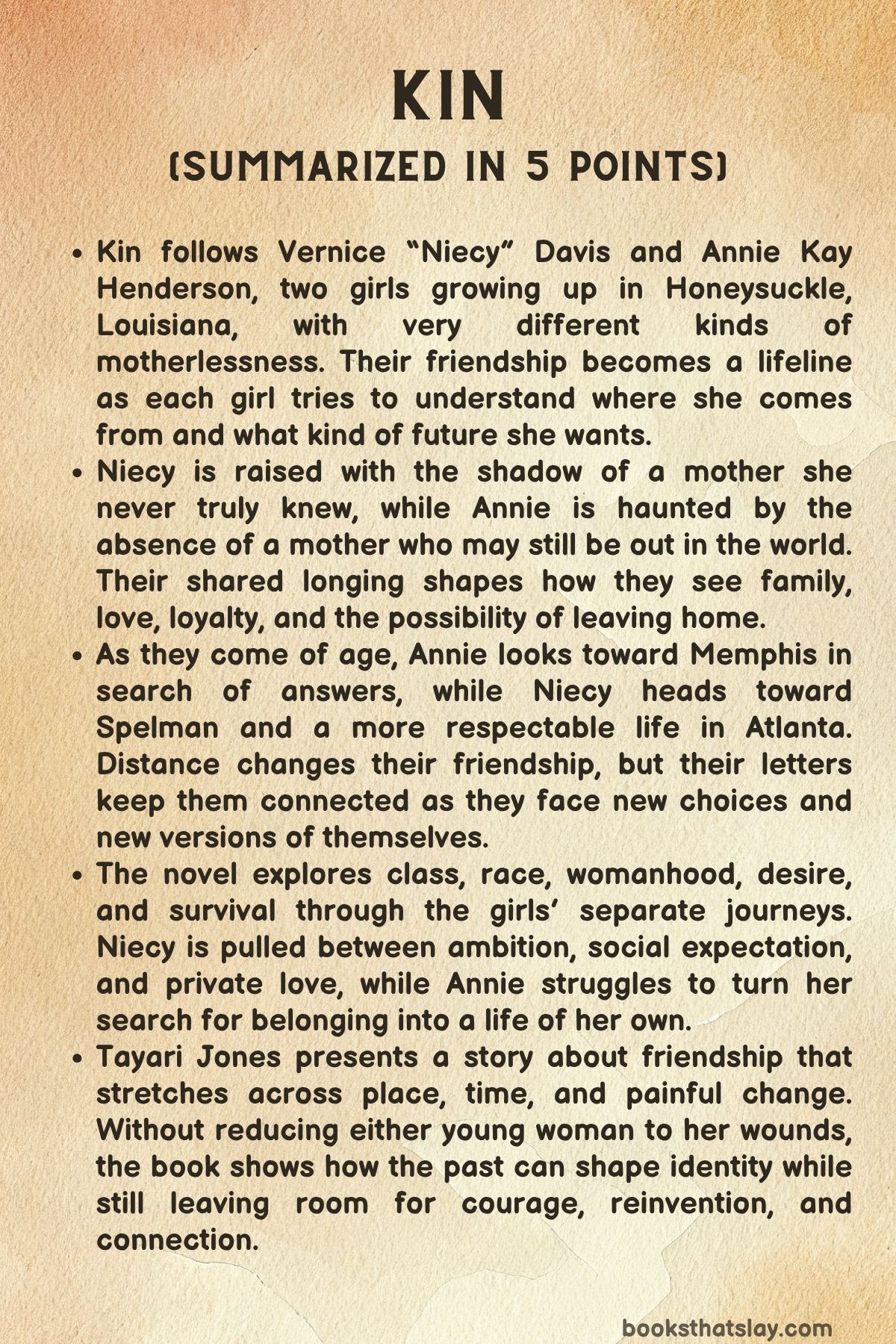
Kin follows Vernice “Niecy” Davis and Annie Kay Henderson, two girls from Honeysuckle, Louisiana, whose lives are joined by friendship and by the absence of their mothers. Niecy’s mother, Arletha, was killed by Niecy’s father when Niecy was still a baby.
After Arletha’s death, Niecy is raised by Aunt Irene, who had once gone north to Ohio but returned to Louisiana when her own mother became ill. Irene stays after tragedy strikes and becomes the main force in Niecy’s life.
Niecy grows up surrounded by memories of Arletha, but those memories belong mostly to other people. She has photographs and stories, yet no real memory of being mothered by her.
Annie Kay’s loss is different. Her mother, Hattie Lee, is not dead, at least not as far as Annie knows.
Hattie Lee abandoned Annie soon after birth, leaving her with Irvina, Annie’s strict grandmother. Annie has only one photograph of her mother, but that photograph becomes a kind of promise.
She believes that somewhere beyond Honeysuckle there may be a woman who can explain who she is and why she was left behind. Niecy’s mother is gone forever, while Annie’s mother is absent by choice.
This difference shapes the girls’ understanding of love, loyalty, and abandonment.
Niecy and Annie grow up relying on each other. Their friendship gives each girl a place to put feelings that cannot be easily spoken at home.
Annie becomes especially determined to find Hattie Lee after learning that her mother once came back briefly to Honeysuckle, borrowed money from Mr. Daniel at The Den, and left behind an address in Memphis. Annie imagines possibilities around this small piece of information.
At one point, she wonders if Mr. Daniel could be her father, but he denies it and warns her not to build her life around wishful thinking. Still, he gives her work and wages, and the Memphis address becomes a symbol of escape.
As graduation approaches, the girls’ paths begin to separate. Niecy plans to attend Spelman College in Atlanta, a step toward education, respectability, and a wider world.
Annie plans to run away to Memphis with Clyde. She asks Niecy to come with her, but Niecy refuses.
Annie leaves secretly in a stolen Packard with Clyde, his cousin Bobo, and Clyde’s girlfriend Babydoll. Her departure wounds Niecy, who feels abandoned by the friend she trusted most.
The trip to Memphis quickly turns dangerous and uncertain. The car breaks down in Mississippi, and the group is turned away from a respectable rooming house.
They are sent instead to Lulabelle’s, which turns out to be a brothel. Lulabelle allows them to stay, but their welcome has a cost.
The boys must work, while Annie and Babydoll wash sheets. Debt builds around them, and Clyde makes things worse by wasting money.
The place becomes both refuge and prison. Lulabelle is harsh, but she also shows Annie a rough kind of care.
During this time, Annie draws closer to Bobo, and their relationship becomes one of the few steady comforts in her new life. After six weeks, the group finally reaches Memphis.
Back in Honeysuckle, Niecy struggles with Annie’s sudden departure. Aunt Irene encourages her to write instead of letting hurt harden into silence.
Niecy eventually sends a letter, and the two girls begin corresponding. Their letters become the thread that keeps them connected as their lives move in different directions.
Aunt Irene leaves Honeysuckle for Dayton, and Niecy goes on to Spelman. Her journey to Atlanta is marked by humiliation when a white bus driver forces her from her seat and her luggage is lost.
She arrives with little, but she begins again.
At Spelman, Niecy works in the library and becomes close to Joette, a wealthy and rebellious student. Their friendship becomes romantic, though it must remain hidden.
Joette offers Niecy excitement, desire, and a vision of herself outside the rules of respectability. At the same time, Niecy meets Franklin McHenry, a young lawyer from a prominent Black family.
Franklin represents stability, status, and a future that society will recognize. Niecy is drawn to Joette, but she also sees Franklin as a practical and respectable choice.
In Memphis, Annie and Babydoll work at the Elektra, a bar where Annie constantly watches women’s faces, searching for Hattie Lee. Bobo works at the Peabody and plays music, and he and Annie try to build a life together.
Annie writes to Niecy about Memphis, Bobo, and the search for her mother. Niecy writes back about college, Joette, and Franklin.
The letters show both closeness and distance. Each girl still needs the other, but each is being changed by the life she has chosen.
Niecy’s life in Atlanta becomes more complicated when she and Franklin attend the segregated Fabulous Fox Theatre and sit in the colored balcony. During intermission, Niecy sees Marylinda downstairs passing as white with her father, Harold Freeman, a white Jewish man who chose to live as Black after marrying Marylinda’s mother.
The sight unsettles Niecy. It makes her think about performance, hidden identities, and the private arrangements people make to survive.
Soon afterward, Niecy tells Joette she needs a break from their relationship because Franklin is her boyfriend. Joette challenges her, but Niecy begins moving toward the life Franklin offers.
Annie’s search for Hattie Lee becomes obsessive. At the Elektra, she fixates on women who might be her mother, including a drunk woman with tangerine lipstick.
Babydoll warns her that she is risking her job and her sense of control. Bobo also grows frustrated, reminding Annie that she does not even know whether Hattie Lee is alive.
Annie and Babydoll eventually visit Hattie Lee’s old address and meet Sweet and Isaiah. They tell Annie that Hattie Lee died about a month earlier.
Annie collapses under the news and begins mourning the mother she never knew. She writes to Granny to say Hattie Lee is dead and sends money for a girl’s education, as if trying to turn grief into something useful.
In Atlanta, Franklin proposes to Niecy with his grandmother’s ring. Niecy accepts, though she asks to finish school first.
Joette is devastated. She leaves the dorm and later returns changed and angry.
Niecy becomes increasingly involved with Marylinda’s family and with Atlanta’s respectable Black society. She learns that Joette is engaged to Thomas Donaldson Jr., though Joette later admits she does not want to marry him.
Joette asks Niecy to get on a bus with her and talk, but Niecy walks away, choosing the path that seems safer and more acceptable.
Then Annie learns that Hattie Lee is not dead. Isaiah admits he lied to protect Sweet from the truth that Hattie Lee had stolen from him and run away.
Bobo is furious because Annie had begun to heal from the false death. Annie asks Niecy to come to Memphis, and together they go to Hattie Lee’s new address.
Annie does not confront her mother directly. Instead, she meets a younger girl named Annie, Hattie Lee’s daughter, along with other younger children.
Hattie Lee watches from behind newspaper-covered glass but does not come out. Annie tells the younger Annie to say she will not return.
The meeting confirms what Annie already feared: her mother is alive, but still unwilling to claim her.
Niecy marries Franklin in Atlanta. Annie attends as maid of honor, and Joette also appears.
On the wedding day, Annie urges Niecy to speak honestly to Joette, but Niecy avoids the confrontation. She chooses Franklin’s world, even though part of herself remains unspoken.
After the wedding, Annie’s life begins to fall apart. Bobo leaves her for another woman.
Annie becomes involved with her boss, Mr. Wilson, and loses her job after Mrs. Wilson attacks Babydoll by mistake. Annie then realizes she is pregnant by Mr. Wilson and writes to Niecy for help.
Niecy sends money and allows Annie and Babydoll to take Franklin’s Cadillac to Lulabelle, who arranges an illegal abortion. Annie survives at first and calls Niecy, saying she is coming to Atlanta.
But when she arrives at the McHenry house, she is still in serious danger. She speaks gently with Niecy, asking about love and college, and then goes to sleep.
During the night, Annie dies from internal bleeding.
Annie’s death breaks open the life Niecy has tried to build. She must arrange the funeral through Joette’s family business, bringing together grief, memory, and the past she tried to leave behind.
Overwhelmed, Niecy finally tells Franklin her secrets, including the truth about Joette. Annie’s death leaves Niecy unable to keep living behind silence.
In the end, Kin shows how friendship can shape a life even after separation, and how the search for family can lead not to comfort, but to truth.
Characters
Vernice “Niecy” Davis
Vernice “Niecy” Davis is one of the central figures in Kin, and her character is shaped by loss, ambition, secrecy, and the painful pressure to choose a life that appears safe. Motherless from infancy after Arletha’s murder, Niecy grows up surrounded by stories, photographs, and the emotional weight of a mother she cannot remember.
This makes her different from Annie: Niecy has proof of her mother’s existence, but not the living relationship she needs. Her silence as a toddler, broken by the word “mother,” suggests that grief enters her life before language fully does.
As she grows older, Niecy becomes intelligent, observant, and inwardly divided. She is hurt when Annie leaves Honeysuckle without saying goodbye, but she is also capable of forgiveness, especially after Aunt Irene encourages her to write instead of remaining trapped in resentment.
Niecy’s journey to Spelman marks her attempt to build a future beyond Honeysuckle, but her arrival in Atlanta is not simple freedom. The humiliation she suffers on the bus and the loss of her luggage show that escape from home does not mean escape from racial violence or vulnerability.
At Spelman, she tries to reinvent herself through education, work, and social advancement. Her relationship with Joette reveals a passionate and hidden part of her identity, while her relationship with Franklin represents stability, respectability, and protection.
Niecy does not move toward Franklin because she feels nothing for Joette; rather, she chooses him because his world seems to offer security, status, and a socially acceptable future. This makes her morally complex rather than simply cowardly.
She wants love, but she also wants survival.
By the end of the story, Niecy’s greatest conflict is the fear of being fully known. She hides her relationship with Joette, steps into Franklin’s respectable family circle, and avoids confronting the emotional truth of her own choices.
Annie’s death breaks through this carefully built life. When Niecy finally tells Franklin her secrets, it is not only confession but also collapse.
Annie’s death forces her to understand that secrecy has a cost, and that being protected by respectability can also mean being imprisoned by it. Niecy’s character is therefore defined by the tension between who she is, who she loves, and who she believes she must become.
Annie Kay Henderson
Annie Kay Henderson is the other central character in the book, and her life is driven by longing. Unlike Niecy, whose mother is dead but remembered, Annie is haunted by the possibility that her mother is alive somewhere and has simply chosen not to return.
This uncertainty shapes Annie’s entire emotional world. Her one photograph of Hattie Lee becomes almost sacred because it is the only stable evidence she has of the woman who abandoned her.
Raised by the stern Irvina, Annie grows up with discipline but not tenderness, and this lack makes her desperate for signs of belonging. Her search for Hattie Lee is not just a search for a person; it is a search for an explanation of herself.
Annie’s decision to leave Honeysuckle for Memphis shows her courage, impulsiveness, and vulnerability. She is willing to risk everything for the possibility of finding her mother.
Yet the journey quickly exposes how dangerous such hope can be. At Lulabelle’s, Annie enters a world that is both protective and exploitative, and she begins to understand that survival often comes through compromise.
Her love for Bobo gives her a new kind of attachment, one based on chosen intimacy rather than blood. Still, even love does not cure her obsession with Hattie Lee.
At the Elektra, she scans women’s faces with a need so intense that Babydoll sees it as dangerous. Annie’s grief when she believes Hattie Lee has died shows how deeply she has built her identity around an imagined reunion.
The most devastating part of Annie’s character arc is that when she finally reaches Hattie Lee, she chooses not to force a confrontation. Seeing the younger Annie and the other children reveals that her mother has continued living, naming, and replacing.
Annie’s decision to tell the younger girl that she will not return is an act of self-protection, but it is also heartbreaking because it confirms that she has been emotionally orphaned again. After Bobo leaves and Mr. Wilson exploits her, Annie becomes increasingly vulnerable.
Her pregnancy and illegal abortion show how limited her choices are as a young Black woman without power, money, or secure protection. Her death is tragic because she is still reaching for a future.
She dies after speaking tenderly with Vernice, still curious about love and college, still imagining a life beyond pain. Annie is one of the most tragic figures in the story because her hunger for love is genuine, but the world repeatedly answers it with abandonment.
Aunt Irene
Aunt Irene is one of the most important maternal figures in the book because she represents practical love, endurance, and moral steadiness. She returns from Ohio to care for her ill mother, then remains in Honeysuckle after Arletha’s murder to raise Niecy.
Her life is marked by interrupted plans, but she does not treat care as a burden. Instead, she becomes the person who gives Niecy structure, memory, and emotional grounding.
Through Irene, Niecy receives a version of motherhood that is not biological but deeply real.
Irene’s wisdom appears most clearly when she encourages Niecy to write to Annie rather than cling to anger. She understands that silence can harden into loss, and she pushes Niecy toward communication before resentment destroys the friendship.
Irene is not sentimental; her love is firm and practical. When she eventually leaves Honeysuckle for Dayton, her departure also teaches Niecy that caretakers have lives of their own.
Irene’s character shows that motherhood in the story is not defined only by birth. It is defined by who stays, who feeds, who advises, who remembers, and who helps a child become strong enough to leave.
Arletha
Arletha, Niecy’s murdered mother, is physically absent from most of the story but emotionally present in nearly every part of Niecy’s life. Her death creates the original wound in Niecy’s identity.
Because Arletha was killed when Niecy was a baby, she exists for her daughter through fragments: photographs, memories told by others, and the terrible knowledge of violence. Unlike Hattie Lee, Arletha did not abandon her child.
She was taken. This distinction matters because it gives Niecy a different kind of grief from Annie’s.
Niecy can mourn her mother without wondering whether she was unwanted.
Arletha’s role in the story also reveals how violence against women reshapes entire families. Her murder forces Aunt Irene into a permanent caregiving role and leaves Niecy to grow up with a past she cannot fully access.
Arletha is not developed through direct action, but her absence is powerful. She becomes a symbol of stolen motherhood, of the way a woman’s death can continue to shape a child’s choices long after the event itself.
Hattie Lee
Hattie Lee is one of the most haunting characters in the novel because she is more powerful as an absence than many characters are in person. For Annie, Hattie Lee is mother, mystery, wound, fantasy, and destination.
She abandoned Annie shortly after birth, yet Annie continues to imagine that there may be a reason, a misunderstanding, or a reunion waiting somewhere. Hattie Lee’s absence gives Annie’s life a direction, but it is a direction built on emotional uncertainty.
When Annie learns that Hattie Lee has supposedly died, the news devastates her because it seems to kill the possibility of explanation. But the later revelation that Hattie Lee is alive is even more painful.
Her life has continued elsewhere, with other children, including another daughter named Annie. This repetition of the name is cruelly revealing.
It suggests either guilt, carelessness, longing, or some tangled combination of all three. When Hattie Lee watches from behind newspaper-covered glass and refuses to come out, she becomes almost ghostlike: present, visible, and still unreachable.
Her refusal to face Annie confirms the emotional abandonment that has shaped Annie’s life. Hattie Lee is not simply a villain; she is a damaged and evasive woman whose choices have left deep wounds.
Still, the story does not excuse the harm she causes.
Irvina
Irvina, Annie’s grandmother, is a stern and severe guardian whose role is rooted in duty more than warmth. She raises Annie after Hattie Lee leaves, giving the child a home but not the emotional softness Annie longs for.
Irvina’s strictness helps explain why Annie becomes so consumed by the idea of finding her mother. Annie has been cared for, but she has not felt fully cherished.
Irvina provides survival, discipline, and family structure, yet her hardness leaves Annie emotionally hungry.
At the same time, Irvina should not be dismissed as merely cold. She is another woman left to carry the consequences of someone else’s abandonment.
Like Aunt Irene, she becomes a substitute mother, but unlike Irene, she does not seem able to transform duty into tenderness. Her presence in the story shows that caregiving can preserve a child’s life while still failing to meet the child’s deepest emotional needs.
Mr. Daniel
Mr. Daniel is a practical and somewhat guarded figure connected to Annie’s search for Hattie Lee. Because Hattie Lee once borrowed money from him and left an address in Memphis, he becomes one of the few links Annie has to her mother’s past.
Annie briefly imagines that he might be her father, but he denies it and warns her not to chase fantasies. His response is blunt, but it also carries a kind of weary realism.
He understands that hope can become dangerous when it is built on too little truth.
At the same time, Mr. Daniel is not without care. He helps Annie earn wages, making him part of the chain of adults who offer partial assistance without fully protecting her.
His character reflects the limits of adult guidance in the story. He can warn Annie, and he can give her work, but he cannot heal the wound that drives her toward Memphis.
Clyde
Clyde is important as a catalyst in Annie’s escape from Honeysuckle, but he is also a sign of youthful carelessness and male irresponsibility. Annie plans to run away with him, yet the journey quickly reveals that Clyde is not a reliable protector.
The stolen Packard, the breakdown in Mississippi, and the group’s entrapment at Lulabelle’s all show how reckless the escape is from the beginning. Clyde helps create the possibility of flight, but he cannot provide safety once the dream becomes difficult.
His decision to waste earnings on sex while the group is trapped in debt reveals his selfishness and immaturity. Clyde’s character contrasts strongly with Annie’s emotional seriousness.
She is running toward a mother, a past, and an answer; Clyde seems to be drifting through the adventure with far less awareness of its consequences. He represents the danger of trusting escape to people who do not understand what is truly at stake.
Bobo
Bobo begins as part of the runaway group, but he becomes much more significant through his relationship with Annie. Unlike Clyde, Bobo develops into a source of affection, music, and emotional companionship.
His work at the Peabody and his music suggest ambition and charm, and for a time he and Annie create something that looks like a life together. Their relationship gives Annie a form of chosen family, which matters deeply because her biological family has failed her.
Still, Bobo’s love has limits. He becomes frustrated by Annie’s obsession with Hattie Lee, especially because Annie does not even know whether her mother is alive.
His anger when Isaiah reveals the lie about Hattie Lee’s death shows that he understands how fragile Annie’s healing has been. Yet Bobo eventually leaves Annie for another woman, repeating the abandonment pattern that has defined her life.
This does not erase the tenderness he once offered, but it complicates it. Bobo is neither purely cruel nor purely faithful.
He is loving for a time, but not strong enough to remain.
Babydoll
Babydoll is one of the most vivid supporting characters in the story because she combines sharp observation, survival instinct, and loyalty. She travels with Clyde, Bobo, and Annie, and like Annie, she must navigate the dangers of Lulabelle’s and later Memphis.
At the Elektra, Babydoll sees clearly what Annie cannot always see about herself. When Annie fixates on women who might be Hattie Lee, Babydoll warns her that she looks unstable and risks losing her job.
This warning is not cruel; it is protective. Babydoll understands that women in their position cannot afford to appear vulnerable in public.
Babydoll’s loyalty becomes especially important after Annie becomes pregnant. She helps Annie seek a way out, travels with her, and is even attacked by Mrs. Wilson by mistake.
Babydoll is not idealized, but she is dependable in a world where many people are not. Her character shows a form of friendship based less on childhood innocence and more on shared danger, work, and survival.
Lulabelle
Lulabelle is morally complicated because she offers shelter while also presiding over a place that traps vulnerable young people. When Annie, Clyde, Bobo, and Babydoll arrive after being turned away elsewhere, Lulabelle gives them a place to stay.
Yet that refuge comes with labor, debt, and exploitation. Her brothel becomes both a sanctuary and a cage.
This duality makes her one of the more complex adult women in the story.
Lulabelle treats Annie with rough tenderness, which suggests that she recognizes something wounded and searching in her. Later, she helps arrange Annie’s illegal abortion, again occupying a morally difficult position.
She provides access to something Annie desperately needs, but the procedure ultimately leads to Annie’s death. Lulabelle’s character reflects the brutal reality that women without legitimate power often depend on unsafe networks of help.
She is not simply benevolent or predatory; she belongs to a world where care and exploitation are painfully entangled.
Joette
Joette is one of the most emotionally intense characters in Kin. Wealthy, rebellious, and drawn to freedom, she opens a new world for Niecy at Spelman.
Through Joette, Niecy experiences desire, glamour, defiance, and a kind of love that cannot safely be made public. Joette’s privilege gives her a boldness that Niecy does not fully share, but her privilege does not protect her from heartbreak.
She loves Niecy in a way that demands recognition, while Niecy increasingly chooses concealment and respectability.
Joette’s devastation after Franklin proposes to Niecy shows how deeply she has invested in their relationship. Her later engagement to Thomas Donaldson Jr. appears less like love than retaliation, performance, or surrender to the same social expectations Niecy has chosen.
When Joette begs Niecy to get on a bus with her, she is asking for honesty, movement, and a life outside the roles prepared for them. Niecy’s refusal wounds them both.
Joette’s final importance lies in what she represents: the life Niecy might have chosen if desire had been enough to overcome fear, class pressure, and social danger.
Franklin McHenry
Franklin McHenry represents respectability, stability, and the promise of social advancement. As a young lawyer from a prominent family, he offers Niecy a future that looks secure and admirable.
He is not presented as a villain. His proposal, his family world, and his seriousness all make him a practical choice for Niecy.
That practicality is exactly what makes him so powerful in the story. He offers a life that can be publicly recognized.
Yet Franklin also becomes part of Niecy’s self-erasure. By choosing him, she moves away from Joette and toward a version of herself that can be accepted by respectable Atlanta society.
Franklin does not fully know the woman he marries until Annie’s death forces Niecy to confess. His character matters because he is less a romantic rival than a symbol of the life Niecy believes she must choose.
He embodies safety, but also the danger of being loved for an incomplete version of oneself.
Marylinda
Marylinda is a fascinating character because she reveals the instability of racial identity, class performance, and hidden family histories. When Niecy sees her at the Fabulous Fox Theatre passing as white downstairs with her father, the moment unsettles her.
Marylinda’s ability to move between racial worlds exposes the artificial yet powerful boundaries that govern the society around them. She becomes a mirror for Niecy, who is also living with divided identities and concealed truths.
Marylinda’s family draws Niecy deeper into Atlanta’s respectable Black society, but the theatre scene complicates the meaning of respectability itself. Marylinda shows that identity can be performed, protected, and strategically hidden.
Her presence helps Niecy think about the lives people conceal in order to survive or belong. In that sense, Marylinda is not only a supporting character but also a thematic key to the book’s interest in secrecy.
Harold Freeman
Harold Freeman, Marylinda’s father, is a white Jewish man who chose to live as Black after marrying Marylinda’s mother. His character complicates the story’s treatment of race because he does not fit simple categories.
His choice suggests love, loyalty, and perhaps rebellion against the racial order, but it also raises questions about identity, passing, and belonging. While many characters are forced into roles by race and gender, Harold appears to have made an unusual and deliberate crossing.
His presence at the theatre with Marylinda, where she is passing as white, adds further complexity. Father and daughter occupy a public space through concealment, performance, and contradiction.
Harold’s character helps show that identity in the story is not only inherited; it is also lived, chosen, disguised, and judged by others.
Sweet
Sweet is connected to the painful falsehood about Hattie Lee’s death. When Annie and Babydoll go to Hattie Lee’s old address, Sweet and Isaiah tell Annie that Hattie Lee died about a month earlier.
Sweet initially appears as someone who delivers devastating news, but the later revelation of Isaiah’s lie changes the meaning of the encounter. Sweet is also someone Isaiah wants to protect from the truth that Hattie Lee stole from him and ran off.
Sweet’s role is brief but important because she belongs to the world of Hattie Lee’s aftermath. Through her, Annie encounters not her mother directly but the damage her mother has left behind.
Sweet’s presence suggests that Hattie Lee’s pattern of harm extends beyond Annie, affecting others who trusted her or were close to her.
Isaiah
Isaiah is a morally conflicted figure whose lie deeply harms Annie even though he tells it for a protective reason. By saying Hattie Lee is dead, he gives Annie a false ending.
For a moment, that lie allows her to grieve and begin healing, but it is a cruel kind of mercy because it is built on deception. When Isaiah later confesses, he reveals that he lied to protect Sweet from knowing that Hattie Lee had stolen from him and run away.
Isaiah’s character shows how adults often manage pain by hiding truth, even when truth belongs to someone else. His confession may be honest, but it comes after Annie has already suffered.
Bobo’s fury is justified because Isaiah’s lie reopens a wound that had barely begun to close. Isaiah is not malicious in a simple sense, but his attempt to control the truth has devastating emotional consequences.
Younger Annie
The younger Annie, Hattie Lee’s daughter, is one of the most painful discoveries in the story. Her name alone wounds Annie Kay because it suggests replacement, repetition, or some unresolved attachment in Hattie Lee’s life.
The younger girl is innocent, but her existence confirms that Hattie Lee did not simply vanish into ruin or death. She built another family and gave another child the name Annie.
This younger Annie functions almost like a living mirror. She shows Annie Kay the life she was denied and the role she was never allowed to occupy.
When Annie tells the younger girl to say that she will not return, she is speaking both to the child and to herself. The moment is quiet but devastating because Annie chooses not to beg, accuse, or perform her pain.
She walks away from the fantasy of reunion and accepts that her mother will not give her what she needs.
Mr. Wilson
Mr. Wilson is Annie’s boss and later the man who becomes sexually involved with her, leaving her pregnant and vulnerable. His character represents the danger of male power in the workplace and the limited protection available to women like Annie.
Because he is her employer, the relationship is not equal. Even if Annie participates emotionally or physically, the imbalance of power is impossible to ignore.
He has status, control, and a wife; Annie has far fewer options.
Mr. Wilson’s importance lies in how his actions push Annie toward crisis. After Bobo leaves, Annie is emotionally exposed, and Mr. Wilson becomes part of the chain of events that leads to her pregnancy, job loss, abortion, and death.
He is a figure of exploitation masked by intimacy. His role shows how quickly a woman’s life can be endangered when desire, dependence, and power become tangled.
Mrs. Wilson
Mrs. Wilson appears most forcefully through her attack on Babydoll, whom she mistakes as the target of her anger. Her reaction exposes the gendered consequences of Mr. Wilson’s behavior.
Rather than the powerful man bearing the full cost, women are set against each other. Mrs. Wilson’s attack leads to Annie losing her job, worsening Annie’s already precarious situation.
Although Mrs. Wilson is not developed in great detail, she represents another form of damage within the story’s social world. She is wronged by her husband, but her anger falls on a more vulnerable woman.
Her character shows how betrayal by men often produces conflict among women who are themselves trapped in unequal systems.
Thomas Donaldson Jr.
Thomas Donaldson Jr. is most important as Joette’s fiancé and as a symbol of the respectable path expected of women in her social class. Joette’s engagement to him does not appear to come from deep love.
Instead, it reflects pressure, performance, and perhaps an attempt to answer Niecy’s rejection with a socially acceptable future of her own. Through Thomas, the story shows that Joette, despite her rebelliousness, is not free from the expectations that shape Niecy’s choices.
Thomas’s role is therefore symbolic rather than deeply personal. He represents the kind of marriage that can hide heartbreak beneath status.
His presence makes Joette’s conflict clearer: she may appear bold, but she too can be pulled back into the safety of convention.
Themes
Motherlessness and the Search for Origin
In Kin, Annie and Vernice grow up shaped by missing mothers, but their losses are not the same. Vernice’s mother is dead, turned into memory, photographs, family stories, and silence; Annie’s mother is alive somewhere, which makes absence feel like rejection rather than finality.
This difference gives Annie’s search a desperate emotional force. She does not simply want information about Hattie Lee; she wants proof that she was wanted, remembered, and explainable.
Her fixation on women’s faces in Memphis shows how a child’s unanswered question can become an adult hunger. Vernice, by contrast, lives with inherited grief and the burden of a mother she cannot personally know.
Both girls are forced to build identity around emptiness. The novel shows that motherlessness is not only about lacking care; it is about lacking a clear beginning.
Annie’s final refusal to confront Hattie Lee directly suggests painful growth: she sees that finding a mother may not heal the wound if the mother remains unwilling to claim her.
Friendship, Distance, and Emotional Survival
The friendship between Annie and Vernice begins as a form of shelter. Both girls carry private wounds, and their bond gives them a shared language for loneliness, ambition, and escape.
Yet the friendship is tested when their paths split: Annie runs toward Memphis, risk, love, and the dream of finding Hattie Lee, while Vernice moves toward Spelman, education, social respectability, and marriage. Their letters become a lifeline, allowing them to remain emotionally present even when their daily lives no longer match.
The distance between them is not only physical; it is also moral and social, as each girl begins making choices the other cannot fully understand. Still, the bond survives resentment, silence, and shame.
Annie turns to Vernice when she is most vulnerable, and Vernice’s response proves that friendship can become a chosen form of kinship. By the end, Annie’s death forces Vernice to understand how deeply she depended on being known by someone from her first life.
Respectability, Secrecy, and the Cost of Belonging
Vernice’s life in Atlanta is shaped by the pressure to become acceptable. Spelman, Franklin, his family, and respectable Black society offer security, status, and a future that appears orderly.
Yet this world demands concealment. Vernice’s love for Joette, her uncertainty, and her fuller self must be hidden if she wants to fit into Franklin’s life.
Her choice is not presented as simple ambition or betrayal; it is a survival strategy in a society where gender, sexuality, race, and class all place limits on what a young Black woman can openly claim. The scene of passing at the theatre deepens this theme, showing that many people live behind carefully managed identities.
Vernice learns that social acceptance often depends on performance. In Kin, respectability is both protection and prison: it offers Vernice a stable future but asks her to silence parts of herself.
Annie’s death breaks that silence because Vernice can no longer bear the loneliness of being only partly known.
Escape, Home, and the Illusion of Freedom
Leaving Honeysuckle seems like the first step toward freedom, but both Annie and Vernice discover that escape does not erase danger, longing, or limitation. Annie’s journey to Memphis begins as a romantic adventure and a search for her mother, but the broken car, Lulabelle’s brothel, debt, unstable work, and failed relationships show how quickly escape can become another kind of trap.
Vernice’s move to Atlanta appears more respectable, yet she faces racism, lost belongings, class pressure, and emotional confinement. Both young women leave home hoping to become larger versions of themselves, but each new place demands a price.
The novel questions the idea that freedom is simply movement. Annie can reach Memphis and still remain bound to Hattie Lee’s absence; Vernice can enter elite spaces and still feel divided inside.
Home becomes complicated too: Honeysuckle is painful, but it is also where their friendship began. True freedom, the novel suggests, requires more than departure; it requires honesty, safety, and the right to belong without self-erasure.