Land of Dreams Summary, Characters and Themes
Land of Dreams by Gian Sardar is a historical novel set in Depression-era New York and 1930s Hollywood, where survival, ambition, and image-making shape every choice. The story follows Frankie Donnelly, a sharp young woman who turns desperation into opportunity and finds a place inside the studio machine.
As she learns how stars are protected, scandals are buried, and public myths are created, she also falls in love with Jack Sawyer, a famous actor trapped by the same system that made him. The book blends romance, mystery, and studio politics while exploring truth, loyalty, power, and the cost of manufactured dreams.
Summary
Frankie Donnelly begins the story in New York City in December 1930, during the hard years of the Depression. She has very little to hold on to.
Her mother has recently died, her employer has taken his own life, and she is desperate for work. Outside a restaurant where job interviews are being held, she notices a strange break of light in the sky.
The sight distracts the crowd, and Frankie uses the confusion to her advantage. She slips her application to the top of the pile and tries to act as though she has been waiting all along.
Her quick thinking nearly succeeds, but the manager rejects her when he learns she has an arrest record. Outside, Nico Marconi, a polished Hollywood publicity man, approaches her.
He has seen her performance and recognizes her nerve, speed, and ability to improvise. He offers her work if she can find her way to Hollywood.
Frankie accepts. That chance meeting changes the course of her life and pulls her into the world of movie studios, public illusions, and controlled scandals.
By February 1933, Frankie is working at RCO Studios in Hollywood as Nico’s assistant. She is not simply doing office work.
She is learning the hidden trade of fixing problems before the public sees them. She rides through the studio’s elaborate sets and thinks about asking Nico for a promotion.
She knows she has come a long way since New York, and she wants to become his associate. More than that, she wants to prove that a woman can handle the difficult work of protecting stars, shaping stories, and controlling damage.
Frankie’s private life is already tangled with her work. She has secretly fallen in love with Jack Sawyer, one of RCO’s biggest stars.
Their relationship must remain hidden because the studio publicly presents Jack as the romantic partner of June Finney, its leading actress. The public relationship is part of the studio’s image-making.
The truth matters less than what sells tickets and keeps stars profitable.
Nico soon gives Frankie the promotion she wants, but it comes with a painful assignment. She must help announce that Jack and June are engaged and will marry in March.
The engagement is false. June is pregnant by another man, and the studio needs Jack to pretend he is the father so June can keep the baby without losing her career.
The marriage will also help promote their upcoming film, Land of Dreams, at a time when the studio needs a success.
Frankie is crushed because Jack is her secret boyfriend, but she hides her feelings and does the job. She gives the engagement story to gossip reporter Magda and invents details about a romantic beach proposal.
In doing so, Frankie becomes part of the system that is hurting her. She understands how the work is done, but the personal cost is becoming harder to ignore.
Nico later tells Frankie that Jack has reacted badly to the engagement news and is drinking at the Cocoanut Grove. Frankie goes to retrieve him, only to discover that Jack arranged the scene so Nico would send her.
They escape through a side hallway, and Frankie punches a man who grabs her. Jack laughs, and for a short time they are able to feel free together.
Jack tells Frankie he will not marry June. Frankie warns him that the studio has power over him.
It knows damaging secrets from his past, including the wife he left after the war. Jack still believes there must be a way out.
That night, Jack takes Frankie to his Pasadena estate and surprises her by arranging for them to fish together because she once told him she had never done it. They pretend to be ordinary people named Annie and Grant, imagining a life away from the studio, June, the wedding, and every public lie.
The evening gives them a glimpse of the life they want, but Frankie knows it cannot last. Her new position depends on getting Jack to cooperate.
Soon after, Nico offers Frankie a studio-owned house in Edendale, a quiet place she has admired. Frankie understands the gift is also a warning.
Nico knows about her relationship with Jack, and he expects her to choose her career over love. He sends her to Jack’s house to persuade him to accept the arranged marriage.
Jack is drunk and angry, and their argument exposes the pressure both of them are under. Jack resents being controlled because of old mistakes, while Frankie insists he could lose everything if he defies the studio.
The argument takes a dangerous turn when Jack hears someone outside and, fearing reporters, grabs a shotgun. In a drunken panic shaped by memories of war, he points it toward a starving woman and her little boy who are searching his trash for food.
Frankie stops him before anyone is hurt. She sends him inside, gives the woman food, and spends the night in his guest room.
The next morning, she removes the bullets from the shotgun, arranges for a doctor to explain Jack’s absence from interviews, and returns to the studio to manage June, the press, and the coming premiere.
After June Finney dies, Frankie visits Jack and finds him shattered. The studio doctor has medicated him, and Jack is frightened because he cannot clearly remember the night June died.
Fans gather outside his gate, including a poor girl named Agnes who asks how someone like June could die. Frankie comforts Jack, but she also tells him that nothing can happen between them now.
Their hidden relationship could make him look guilty.
Nico drives Frankie to Jack’s press conference and tells her that bungalow two has been searched for the gun and June’s missing necklace. Neither was found, which makes Nico think Jack did not kill June.
Tank Adams, June’s former lover, has also been found, but he claims he has an alibi. During the press conference, Jack becomes upset when reporters ask about June’s replacement in future films.
Another reporter reveals that someone overheard studio staff discussing June’s necklace and the lack of security. Frankie realizes her careless words may have helped feed the public story.
Frankie begins spending time at the police station to listen for rumors. She sees reporter Dottie there and learns that the medical examiner will protect June’s reputation, meaning June’s pregnancy will stay secret.
She also sees Fred leaving an interrogation room and realizes Nico is arranging for him to serve as Jack’s alibi. At the same time, Frankie discovers that Jack’s friend Milton Ewing has used private details from her childhood in a film set, including memories of her mother and their tenement home.
Frankie feels exposed and betrayed.
The case against Jack grows stronger when Darlene Cleary, a neighbor near the bungalows, tells the police and Dottie that Jack was at the bungalow the night June died. Dottie prints the story, and public opinion turns against him.
At June’s funeral, the police arrest Jack in front of everyone. Nico argues with police chief Mickey Mulroney and works to get Jack released, while also pushing the police to hold Tank so suspicion will be divided.
In custody, Jack tells Frankie he fears he may have blacked out and done something terrible. He also learns that Nico had been paying Ida, June’s sister, to influence June and keep her obedient to the studio’s plans.
Jack begins to wonder whether Frankie has been part of similar manipulation. Feeling used and unable to trust her, he ends their relationship.
Frankie starts to question Nico’s loyalty and motives. She searches his safe and finds payment records to Ida, a police report about a neighbor child drowning in June’s pool, letters from Tank, and a note from June that sounds like goodbye.
She investigates the bungalows and notices that Darlene’s dog’s barking makes the story of Jack’s movements seem unlikely. Then an earthquake strikes.
In the damage, Frankie discovers a hidden tunnel leading from the bungalow property. She begins to suspect that Nico used it and knows more about June’s death than he has admitted.
After the earthquake, Nico finally tells Frankie the truth. June called him after Tank failed to come to her, saying she was ending things.
Nico used the tunnel to reach her and found her already dead, apparently from an overdose or suicide. There was an empty pill bottle and a note.
To protect June’s reputation and preserve the public image of her, Nico staged the scene as a robbery-murder, took the note, and hid the truth. Frankie realizes Jack is innocent.
She also understands that June loved Tank, but Nico had helped drive Tank away by convincing him June did not want him.
Frankie leaves the studio and works with Jack to publish a carefully shaped public statement through Magda. The article admits that Jack and June’s romance was invented by the studio, that June loved someone else, and that the studio had tried to force its stars into impossible versions of perfection.
It does not reveal June’s suicide or every detail of Nico’s role, but it clears Jack and gives Tank the truth that June loved him.
By the end, Frankie and Jack reconcile. They have both seen how damaging Hollywood’s illusions can be, but they also choose honesty with each other.
The story closes with them together on the beach, watching glowing waves and facing a future no longer fully controlled by the studio.
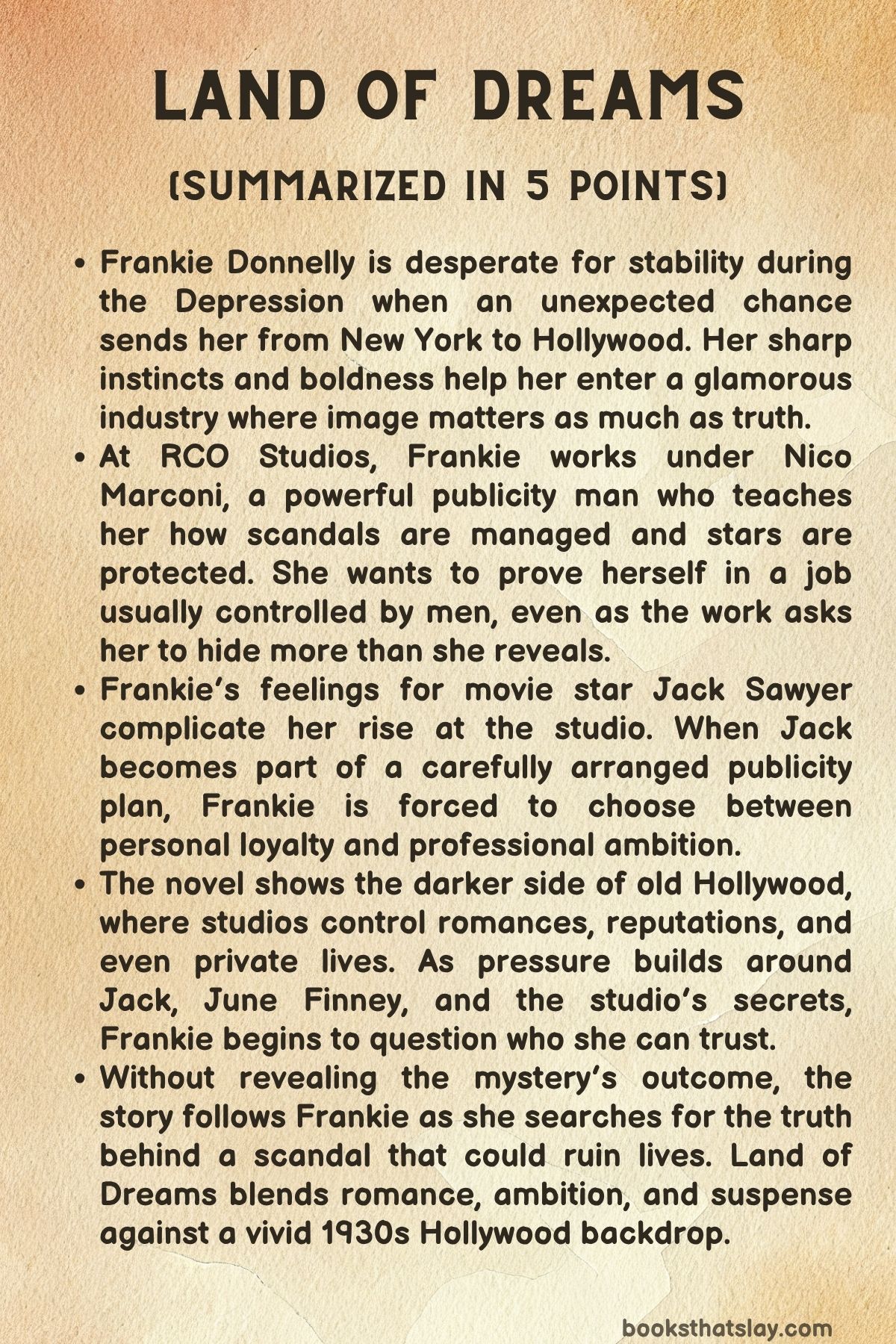
Characters
Frankie Donnelly
Frankie Donnelly is the emotional and moral center of Land of Dreams. She begins as a desperate young woman in Depression-era New York, shaped by grief, poverty, and the harsh knowledge that survival often requires boldness.
Her decision to move her job application to the top of the pile shows her intelligence, nerve, and willingness to bend rules when life gives her no fair chance. This moment reveals one of her defining traits: Frankie is not passive.
She acts quickly, reads people sharply, and understands that opportunity often belongs to whoever is brave enough to seize it.
In Hollywood, Frankie becomes more than Nico’s assistant. She is learning how to manage secrets, protect reputations, control gossip, and turn painful truths into polished public stories.
Her ambition is important because it is not shallow. She wants a real place in a male-dominated world, and she wants to prove she can do the work of a fixer as well as Nico can.
At the same time, her ambition often forces her into painful compromises. Her promotion depends on persuading Jack to accept a false engagement, even though she loves him.
This conflict makes Frankie deeply complex: she wants professional independence, but the job she desires requires her to participate in lies that wound her personally and morally.
Frankie’s love for Jack exposes her vulnerability. With him, she briefly imagines a life outside the studio’s machinery, especially when they pretend to be ordinary people named Annie and Grant.
Yet she is never naïve about the world they inhabit. She knows that fantasy cannot protect them from contracts, scandals, reporters, and studio power.
Her relationship with Jack is therefore both romantic and tragic, because she loves him while also trying to manage him as part of her work. Her strength lies in how she continues to function even when her private life is breaking apart.
As the mystery around June’s death deepens, Frankie becomes more independent. She begins by serving Nico’s system, but gradually learns to question it.
Her search through Nico’s safe, her attention to Darlene’s dog, and her discovery of the tunnel all show that she is no longer merely cleaning up scandals; she is searching for truth. By the end of the story, Frankie rejects the version of success that requires total obedience to the studio.
Her final choice to help publish a controlled but honest statement shows her growth. She does not expose every private wound, but she refuses to let Jack remain trapped in a lie.
Frankie’s journey is about moving from survival, to ambition, to moral courage.
Nico Marconi
Nico Marconi is one of the most powerful and morally complicated figures in the book. He is polished, clever, observant, and highly skilled at turning chaos into opportunity.
When he first sees Frankie manipulating the job application line, he recognizes her talent immediately. This says much about Nico: he values performance, nerve, and the ability to improvise under pressure.
He becomes Frankie’s mentor because he sees in her a younger version of the qualities that have made him successful.
Nico’s power comes from his ability to control stories. He understands Hollywood as a place where image matters more than truth, and he treats human lives as material to be arranged for public consumption.
His plan to make Jack pretend to be the father of June’s child shows both his ruthlessness and his practicality. To Nico, the false engagement is not cruelty for its own sake; it is a solution to a professional crisis.
He believes he is protecting June, Jack, and the studio, but his protection often becomes manipulation.
His relationship with Frankie is especially layered. He rewards her with a promotion and a studio house, but both gifts come with conditions.
Nico teaches Frankie the business, yet he also tests whether she will sacrifice personal feeling for professional loyalty. He sees her love for Jack and uses the pressure of her ambition to control her choices.
This makes him both mentor and antagonist. He opens doors for Frankie, but he also tries to shape her into someone who will accept the studio’s moral compromises without hesitation.
Nico’s actions after June’s death reveal the full danger of his worldview. He does not kill June, but he does transform her death into a staged crime in order to preserve her public image.
He takes her note, hides the truth, and helps create the conditions that lead to Jack’s suspicion. His decision comes from a twisted sense of loyalty: he believes the beautiful lie is kinder, safer, and more useful than the painful truth.
Yet the damage caused by that lie proves how destructive his control can be. Nico is not a simple villain; he is a man who has spent so long managing appearances that he has lost the ability to respect truth as something people deserve.
Jack Sawyer
Jack Sawyer is a glamorous movie star whose public image hides deep fear, guilt, and emotional damage. To the outside world, he is one of RCO’s biggest stars, handsome enough and famous enough to be used as the perfect romantic partner for June Finney.
Privately, however, Jack is unstable, wounded, and increasingly trapped by the studio’s demands. His character shows the cost of fame when a person’s identity becomes property controlled by others.
Jack’s love for Frankie is sincere, but it is also complicated by his weakness. He wants to escape the false engagement with June, and he wants to believe there is a way to live honestly with Frankie.
Yet he often responds to pressure through drinking, anger, and avoidance. His refusal to marry June seems noble at first because he rejects a lie, but it also shows his inability to grasp how dangerous the studio’s power can be.
Frankie understands the machinery better than he does, while Jack often reacts emotionally after the trap has already closed around him.
His past is central to his character. The abandoned wife, the war trauma, and the drunken panic with the shotgun all suggest a man haunted by earlier failures and violence.
When he nearly threatens a starving woman and her child, the scene strips away his star image completely. He becomes frightening, lost, and vulnerable.
Frankie’s intervention saves him from committing an irreversible act, but it also reveals how fragile he is beneath the charm.
After June’s death, Jack becomes even more tragic because he cannot trust his own memory. His fear that he may have blacked out and done something terrible makes him psychologically vulnerable.
The studio has controlled so much of his life that he no longer has firm ground beneath him. His suspicion of Frankie, especially after learning about Nico’s payments to Ida, shows how deeply manipulation has poisoned his ability to trust.
By the end, Jack is cleared not only of suspicion but also of the false romance that trapped him. His reconciliation with Frankie suggests that he may finally have a chance to live with more honesty, though the book does not erase the damage he carries.
June Finney
June Finney is one of the most tragic figures in the story. Publicly, she is RCO’s top actress, a glamorous woman whose image must remain flawless.
Privately, she is pregnant, emotionally isolated, and in love with Tank Adams rather than Jack. Her character reveals how cruel the studio system can be to women, especially women whose bodies, reputations, and romantic lives are treated as studio assets.
June’s pregnancy becomes a problem not because it is morally wrong, but because it threatens the image created for her. The studio’s solution is to force a false engagement to Jack, turning her private crisis into a publicity strategy.
June is therefore trapped inside a role she did not freely choose. She must appear romantic, pure, and professionally useful, even as her real desires are ignored.
Her love for Tank makes this even more painful because the man she wants is pushed away through Nico’s manipulation.
Although June is absent after her death, her presence shapes the entire second half of the book. Everyone tries to define her: the studio wants her remembered as perfect, the medical examiner protects her reputation, Nico hides her note, Jack fears he may be blamed for her death, and Tank is denied the truth of her love.
June becomes the center of a battle between image and reality. Her death exposes how thoroughly Hollywood can consume a person, even after that person is gone.
June’s tragedy lies in the fact that she is not allowed full human complexity. The public sees a star.
The studio sees a brand. Nico sees a reputation to preserve.
Only later does the truth emerge that she loved someone, suffered deeply, and wanted an escape from the impossible life arranged around her. In that sense, June represents the emotional cost of perfection.
Her story shows that being adored by the public can still leave a person profoundly unseen.
Tank Adams
Tank Adams is June’s true love and one of the key figures connected to the hidden truth of her death. He is first treated as a possible suspect because of his relationship with June and his disappearance, but his deeper role is more tragic than criminal.
Tank represents the life June actually wanted, in contrast to the life the studio was arranging for her.
His importance comes from the fact that he disrupts the studio’s manufactured romance. June’s pregnancy and love for Tank make the planned Jack-and-June engagement a lie from the beginning.
Yet Nico’s interference drives Tank away by convincing him that June does not want him. This manipulation has devastating consequences.
Tank is not merely removed from the scandal; he is separated from the woman who needed him.
Tank’s character also exposes the cruelty of controlled information. Because he does not know June still loved him, he is left with a false understanding of her final days.
The public statement that Frankie and Jack eventually release matters partly because it gives Tank a piece of the truth. It cannot undo June’s death, but it restores her love for him to the record.
Tank’s role in the story is therefore tied to grief, miscommunication, and the damage caused when powerful people decide which truths others are allowed to know.
Magda
Magda is a gossip reporter who understands Hollywood’s public language and participates in the machinery of fame. Frankie gives her the fabricated engagement scoop, complete with invented details about a romantic beach proposal.
Magda’s role shows how gossip columns do not merely report celebrity culture; they help create it. The romance between Jack and June becomes real to the public because people like Magda publish the version the studio wants seen.
At the same time, Magda is not presented only as a shallow gossip figure. By the end, she becomes the channel through which Frankie and Jack release a more honest public statement.
This shift is important because it shows that publicity itself is not always false; it depends on who controls the story and why. Magda can spread a lie, but she can also carry a carefully chosen truth.
Her character reflects the blurred line between journalism and performance in Hollywood. She is part of the same ecosystem as Nico and Frankie, where words can protect careers, destroy reputations, or reshape public sympathy.
Magda’s presence reminds the reader that fame depends not only on actors and studios, but also on the writers who translate private lives into public myth.
Dottie
Dottie is another reporter, but her role is sharper and more investigative than Magda’s. She appears around the police station and later prints Darlene Cleary’s claim that Jack was at the bungalow the night June died.
Through Dottie, the book shows the dangerous speed with which suspicion can become public judgment. Once her story appears, public opinion turns against Jack, and his arrest at June’s funeral becomes almost inevitable.
Dottie is important because she does not operate fully under studio control. Unlike Magda, who receives a planted romantic scoop, Dottie follows rumors and turns them into pressure.
This makes her a threat to Nico’s carefully managed narrative. Her reporting may not reveal the whole truth, but it breaks the studio’s illusion of control.
As a character, Dottie represents the press as both necessary and dangerous. She can challenge powerful institutions, but she can also amplify incomplete information.
Her actions push the plot forward by making the hidden scandal impossible to contain. She is not simply an enemy of the protagonists; she is a force that exposes how unstable every constructed story becomes once outsiders begin asking questions.
Milton Ewing
Milton Ewing, Jack’s friend, has a smaller role but a meaningful impact on Frankie’s emotional journey. His use of private details from Frankie’s childhood in a film set is a deep betrayal.
The tenement memories, her mother, and the intimate material of her past are transformed into studio property without her consent. This moment wounds Frankie because it makes her realize that even her personal history can be taken, reshaped, and displayed.
Milton’s action reflects one of the story’s larger concerns: Hollywood feeds on real lives while pretending everything is artificial. Frankie has learned to manipulate other people’s images, but Milton’s set forces her to experience that exploitation from the other side.
Her memories are no longer safely hers. They have been converted into atmosphere, scenery, and emotional decoration for someone else’s work.
His character also complicates Frankie’s relationship with Jack. Because Jack is connected to Milton, Frankie feels betrayed by Jack as well.
Whether or not Jack intended harm, the incident reinforces Frankie’s fear that intimacy in Hollywood is never fully private. Milton therefore functions as a reminder that creative glamour can hide acts of emotional theft.
Ida
Ida, June’s sister, represents the intimate betrayal that can occur when family becomes entangled with studio control. Nico pays her to influence June and keep her compliant with the studio’s plans.
This makes Ida a disturbing figure because she is close enough to June to affect her emotionally, yet she becomes part of the system pressuring her.
Ida’s role is significant because she shows that the studio’s power does not stop at contracts or publicity. It reaches into family relationships, using money and access to shape private decisions.
For June, this means that even someone who should have been a source of protection becomes connected to manipulation. Ida’s actions deepen the sense of June’s isolation.
Although Ida may have her own motives, the effect of her involvement is damaging. Jack’s discovery that Nico paid her also causes him to suspect Frankie, which helps break his trust.
Ida therefore affects the story both directly and indirectly: she pressures June, reveals Nico’s methods, and contributes to the collapse of Frankie and Jack’s relationship.
Fred
Fred serves mainly as part of Nico’s effort to protect Jack after June’s death. Frankie sees him leaving an interrogation room and realizes Nico is arranging for him to act as Jack’s alibi.
Fred’s role is brief, but it is revealing because it shows how quickly Nico moves people into position when a scandal threatens the studio.
Fred is less important as an individual personality than as evidence of the system around Nico. He represents the kind of person who can be used to create a protective version of events, whether or not that version is fully honest.
His presence reminds the reader that Hollywood power depends on networks of cooperation, favors, silence, and arranged testimony.
Through Fred, Frankie sees another layer of Nico’s manipulation. Nico may be trying to save Jack, but he is still doing it through manufactured truth.
Fred’s role therefore strengthens Frankie’s growing discomfort with the methods she has been trained to admire.
Darlene Cleary
Darlene Cleary is the neighbor whose claim places Jack at the bungalow on the night June dies. Her statement becomes a turning point because it gives Dottie the material needed to turn suspicion into public accusation.
Darlene’s importance lies in how one witness, one observation, or one mistaken interpretation can reshape a person’s fate.
Her dog’s barking later becomes crucial to Frankie’s investigation. Frankie realizes that the pattern of barking makes Jack’s supposed movements unlikely, which helps her question the story being built around him.
Darlene therefore functions both as a source of danger and as an accidental clue. Her statement harms Jack, but the details surrounding her home also help Frankie uncover the truth.
Darlene’s character shows how ordinary people become part of public scandals. She is not a studio executive, star, or reporter, yet her words influence the direction of the case.
In a world obsessed with image, even a neighbor’s account can become powerful when it enters the press.
Mickey Mulroney
Mickey Mulroney, the police chief, represents official authority in a world where law enforcement and studio influence overlap. His argument with Nico after Jack’s arrest shows the tension between public justice and private power.
Mickey is not simply solving a crime in isolation; he is operating in a city where Hollywood money, fame, and publicity affect every decision.
His role is important because Jack’s arrest is both a legal event and a spectacle. The funeral setting makes the arrest highly visible, and Mickey’s involvement turns public suspicion into official action.
Yet Nico’s ability to argue with him and arrange Jack’s release shows that police authority is not untouched by influence.
Mickey’s character helps reveal the larger environment of the story. Justice is not clean or simple.
It is shaped by politics, headlines, reputation, and pressure from powerful men. Through him, the book suggests that truth can be difficult to reach when every institution has its own image to protect.
Agnes
Agnes is a poor girl among the fans outside Jack’s gate after June’s death. Her question about how someone like June could die is simple but emotionally powerful.
She represents the public’s innocent belief in Hollywood glamour. To Agnes, June seems almost above ordinary suffering, which makes her death confusing and frightening.
Agnes’s poverty also creates a contrast between fantasy and reality. She is drawn to the world of stars, yet her own life is marked by hardship.
Her presence outside the gate shows how deeply ordinary people need dreams during the Depression. Stars like June and Jack are not just entertainers; they become symbols of beauty, escape, and hope.
Frankie’s response to Agnes reveals Frankie’s compassion. Even while managing crisis and protecting Jack, Frankie recognizes the girl’s grief and confusion.
Agnes helps remind the reader that Hollywood’s lies do not only affect the stars. They shape the emotional lives of fans who believe in the images they are given.
Themes
Ambition, Survival, and Moral Compromise
Frankie’s rise begins in desperation, not glamour. Poverty, grief, unemployment, and the stigma of an arrest record force her to depend on quick thinking and nerve before anyone is willing to offer her a chance.
Her journey in Land of Dreams shows ambition as something shaped by hunger and fear as much as desire. In Hollywood, success comes with conditions: she must hide private feelings, protect public lies, manage scandals, and prove herself in a world where men hold authority.
Her provisional promotion gives her power, but it also tests her conscience. The studio-owned house becomes a symbol of reward and control, reminding her that advancement may require obedience.
Frankie’s ambition is never simple selfishness; it is tied to the need for safety, respect, and independence. Yet the more deeply she enters Nico’s world, the more she sees that survival inside a corrupt system can make a person participate in harm.
Her final choice to leave the studio shows that real success requires moral independence, not just professional recognition.
Illusion, Image, and the Cost of Hollywood Perfection
Hollywood is presented as a place where reality is constantly edited, polished, and sold. Jack and June’s fake engagement is not treated as a personal matter but as a publicity tool designed to protect a studio investment, save June’s career, and promote a film.
Romance, grief, loyalty, and even innocence become materials that can be shaped for public consumption. The stars are expected to appear flawless, even when their private lives are breaking apart.
June’s pregnancy, Jack’s past, and the truth of June’s death are all hidden because the studio values image more than human pain. This theme becomes darker as the story reveals how far Nico will go to preserve a beautiful public story.
He does not merely lie to reporters; he alters evidence, manipulates relationships, and allows people to suffer under false suspicion. The novel suggests that manufactured perfection can become violent because it leaves no room for weakness, mistakes, or truth.
Fame protects the studio more than it protects the people who create it.
Love Under Pressure
Frankie and Jack’s relationship is tender because it exists against a world determined to use them. Their private moments, especially when they imagine themselves as ordinary people, reveal their longing for a life outside performance.
The names Annie and Grant represent freedom from studio rules, public scrutiny, and the burdens of reputation. Yet their love is repeatedly tested by fear, secrecy, ambition, and distrust.
Frankie must persuade Jack to accept a fake marriage even though it wounds her deeply, while Jack sees her loyalty to Nico as evidence that she may be part of the same machinery controlling him. Their romance cannot remain innocent because every choice has public consequences.
After June’s death, Frankie understands that their hidden relationship could make Jack look guilty, so love becomes something dangerous as well as comforting. The story does not present love as an escape from conflict.
Instead, it becomes meaningful only when both characters face truth, reject manipulation, and choose honesty over the roles written for them.
Truth, Guilt, and Personal Responsibility
The mystery around June’s death exposes how easily guilt can be shifted when powerful people control the story. Jack’s fear that he may have harmed June is especially painful because his own trauma and drinking leave him uncertain of himself.
Public opinion turns against him quickly, showing how suspicion can become punishment before truth is known. Frankie’s investigation is important because she does not accept the official version once details begin to fail.
Her guilt also matters: she recognizes that careless words, professional loyalty, and silence may have contributed to danger. In Land of Dreams, truth is not revealed by institutions but by personal courage.
The police, the press, and the studio all serve different interests, while Frankie must decide what kind of truth can still protect the living and honor the dead. The final statement does not expose everything, but it breaks the central lie and restores Jack’s innocence.
The ending suggests responsibility is not only about revealing facts; it is also about choosing which truths can repair damage without creating new cruelty.