Acts of Faith Summary and Analysis
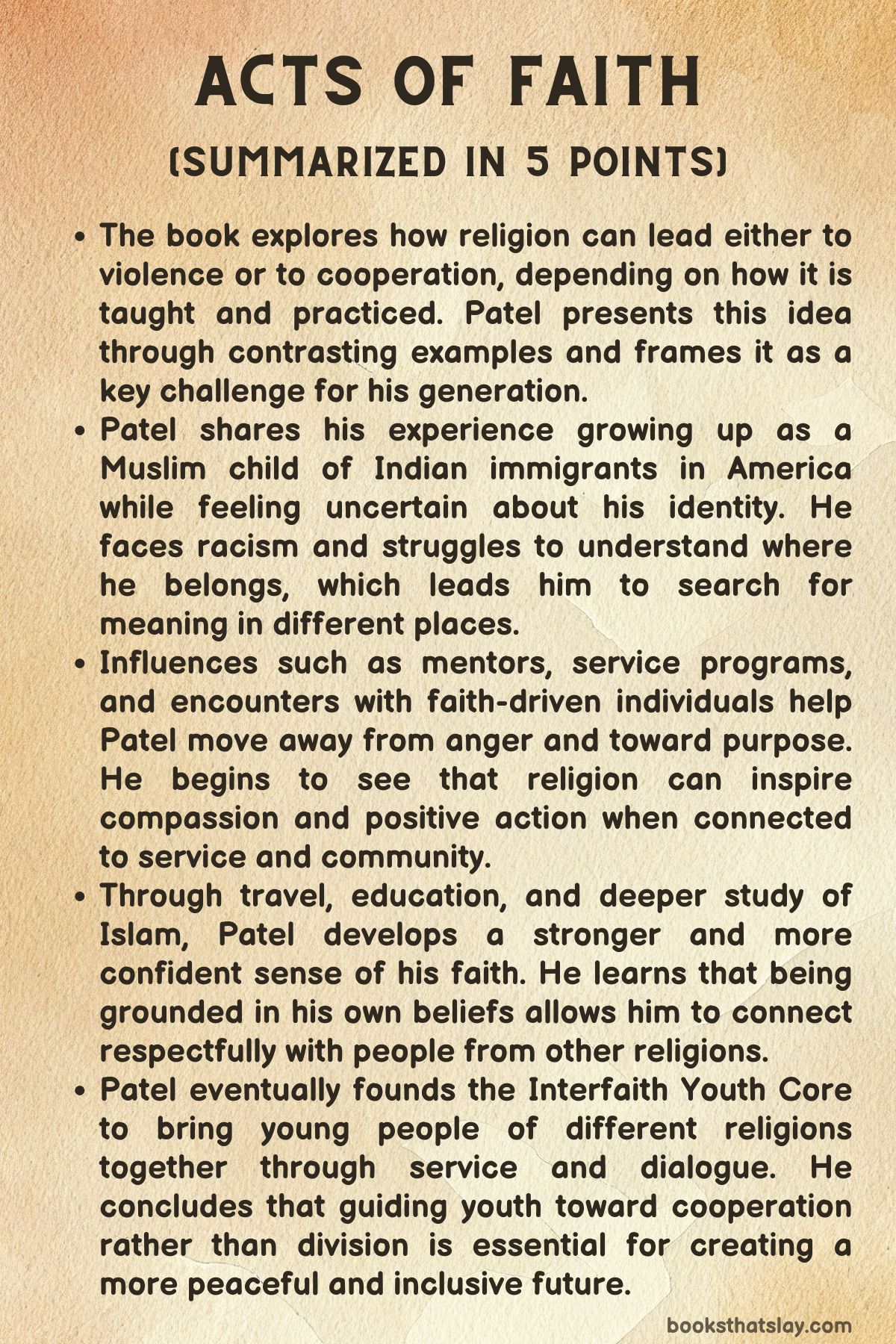
Acts of Faith: The Story of an American Muslim in the Struggle for the Soul of a Generation by Eboo Patel is a memoir that explores how religion can either divide people through hatred or unite them through cooperation. Patel reflects on his own journey as the child of Indian Muslim immigrants growing up in the United States while searching for identity, purpose, and faith.
Through personal stories, historical examples, and encounters with leaders from different traditions, he argues that young people need positive religious leadership that encourages pluralism rather than extremism. The book traces how Patel’s experiences eventually lead him to create the Interfaith Youth Core, an organization devoted to bringing people of different religions together through service and dialogue.
Summary
The book begins with a central question: in a world where religion inspires both compassion and violence, how will people of different faiths interact with one another? Patel introduces two contrasting examples to illustrate this dilemma.
One is Eric Rudolph, a Christian extremist who committed deadly bombings and justified them through a belief system rooted in hatred. The other example comes from a small town in Tennessee where middle school students educate their community about the Holocaust.
These students were inspired by a principal who believed in teaching empathy and respect for people of different backgrounds. Patel describes these two paths as opposite sides of what he calls the “Faith Line,” a divide between religious hatred and religious cooperation.
Patel explains that his interest in this question is personal. He grew up in the United States as the son of Indian Muslim immigrants.
His childhood included religious rituals, such as daily prayers taught by his mother, but religion was not always a strong presence in his life. His parents focused on building successful careers and creating opportunities for their children in America.
As a result, Patel often felt more concerned with fitting into American society than understanding his own faith.
During his youth, Patel struggled with the feeling of being different. At school he was often one of the few brown students in largely white environments.
Experiences of racism made him aware of his outsider status. At the same time, his family’s Muslim identity sometimes felt distant or undefined.
Patel was searching for a sense of belonging but did not yet understand how religion might guide him.
A turning point came through mentors and programs that gave him responsibility and encouragement. One of the most important influences was the YMCA, where Patel joined a leadership program for teenagers.
The organization focused on service, teamwork, and leadership. Through volunteer activities and youth leadership camps, Patel began to develop confidence and a sense that he could contribute to society.
The experience helped him move away from anger and aimlessness during adolescence.
In school, Patel was also shaped by teachers who challenged him intellectually. One teacher pushed him to prove that he could succeed academically, which motivated Patel to work harder than ever before.
At home, his father encouraged him to read literature and explore ideas. Through writers such as Henry David Thoreau, Patel began to see the connection between ideas and real-world action.
When Patel entered college at the University of Illinois, he encountered a new world of political activism and identity discussions. Many students were deeply engaged in movements focused on race, power, and inequality.
Patel became involved in these discussions and adopted a strong commitment to identity politics. He grew increasingly angry about injustice in society and sometimes expressed that anger through confrontational activism.
Despite his involvement in political movements, Patel gradually began to feel that something was missing. The groups he joined focused heavily on criticizing social systems but offered little sense of community or hope.
At the same time, Patel was still searching for a deeper sense of identity and purpose.
During this period he encountered people whose faith inspired social action. One major influence was Dorothy Day, a Catholic activist who believed that service to others should be motivated by love and spiritual commitment.
Patel volunteered with a Catholic Worker community that helped people experiencing poverty. What impressed him most was the attitude of the volunteers.
They were committed to social justice but did not express their beliefs through anger. Their actions were guided by compassion and faith.
Through these experiences Patel began to see that religion could be a powerful force for positive change. However, he also noticed that many religious organizations were disconnected from young people or unable to address the challenges facing them.
Another turning point occurred when Patel traveled to India with a friend. At first he hoped the trip would help him reconnect with his cultural roots.
Instead, the experience complicated his understanding of identity. While he appreciated aspects of Indian culture, he also saw inequalities and social structures that troubled him.
This led him to realize that his future work would take place in the United States rather than in the country of his family’s origin.
During this trip Patel met with the Dalai Lama. The conversation had a profound impact on him.
The Dalai Lama encouraged Patel to understand that being rooted in one’s own faith while learning from others was an important form of interfaith engagement. He also emphasized that service to humanity should be at the center of such work.
This meeting strengthened Patel’s belief that cooperation among religions could help address social problems.
Patel also drew inspiration from his grandmother in India. She quietly helped vulnerable people in her community, sometimes offering shelter to those escaping abuse or danger.
When Patel asked why she did this, she simply replied that helping others was part of being a Muslim. Her example showed him that religious faith could express itself through compassion and service rather than through conflict.
Later Patel attended Oxford University as a Rhodes Scholar. While there, he began studying Islamic history and theology more seriously.
For the first time he explored the intellectual and ethical traditions within Islam. He learned about scholars, poets, and teachings that emphasized justice, learning, and service.
This deeper understanding helped him embrace his identity as a Muslim in a meaningful way.
While at Oxford Patel worked with a group of young leaders interested in creating a movement that would bring people of different religions together through service. These conversations led to the creation of the Interfaith Youth Core, an organization designed to connect young people from diverse religious backgrounds.
The organization was built around three main ideas: bringing people from different traditions together, encouraging them to work on community service projects, and creating space for reflection about faith and values. Patel believed that when young people collaborated on solving real problems, they would see one another as partners rather than enemies.
Events around the world reinforced the urgency of this work. Patel observed how extremist movements often targeted young people who felt isolated or angry.
He studied examples of radicalization across different religions and noticed similar patterns. Charismatic leaders would offer young people a powerful identity and a sense of heroic purpose, directing their frustration toward violence.
Patel argued that the problem was not religion itself but how religious ideas were interpreted and taught. Religious traditions contain passages that can be used to justify violence, but they also contain teachings about compassion and justice.
The outcome depends on the guidance young people receive and the communities they join.
Through the Interfaith Youth Core, Patel and his colleagues began organizing conferences, service projects, and leadership programs. These initiatives brought together students from many religions, including Islam, Christianity, Judaism, Hinduism, and Buddhism.
By working side by side on community projects, participants developed respect and friendships across religious boundaries.
The organization faced many challenges, especially in raising funds and convincing religious leaders that young people should participate in interfaith programs. Some leaders worried that exposure to other religions might weaken their children’s faith.
Patel responded by emphasizing that the goal was not theological agreement but shared values such as compassion, service, and justice.
Gradually the organization gained supporters and funding. Conferences and youth councils demonstrated that interfaith cooperation could succeed when focused on practical action rather than abstract debates.
Patel also built partnerships with educators, activists, and religious leaders who believed in the importance of pluralism.
Patel’s personal life also developed during this period. He met Shehnaz, a lawyer committed to defending religious freedom, and the two eventually married.
Their relationship reflected the same principles of faith, service, and partnership that shaped Patel’s broader work.
By the end of the book, Patel reflects on how the struggle between extremism and pluralism continues around the world. He believes that young people stand at the center of this struggle.
If they are guided by leaders who promote hatred and division, religion can become destructive. But if they are inspired by leaders who emphasize service and cooperation, religion can become a force for healing.
Patel concludes that people of different faiths must learn to support one another rather than compete or isolate themselves. The future depends on building communities where diversity is seen as a strength.
For Patel, the work of interfaith cooperation is not simply a social project but a moral responsibility shared by everyone.
Key People
Eboo Patel
Eboo Patel is both the narrator and the central figure, and his character is defined by movement rather than stability. He begins as a young American Muslim who feels uncertain about where he belongs.
He is shaped by immigrant family expectations, suburban life, racial exclusion, academic ambition, and a vague religious inheritance that does not yet feel alive to him. One of the most striking aspects of his character is his honesty about vulnerability.
He does not present himself as naturally wise or consistently grounded. Instead, he admits how easily anger, confusion, and the desire for belonging could have pushed him toward destructive paths.
That self-awareness gives his voice credibility, because he does not describe extremism as something done only by distant strangers. He recognizes how ordinary humiliation, isolation, and resentment can make radical certainty appealing.
As he matures, Patel becomes a seeker. He is drawn to people and traditions that connect belief with action.
He wants a framework that can hold together justice, service, and identity without collapsing into hatred. His intellectual life is active, but the book makes clear that ideas alone are never enough for him.
He needs embodied examples, mentors, and institutions. This is why his growth is tied to the YMCA, the Catholic Worker movement, Islamic scholarship, the Dalai Lama, and eventually the Interfaith Youth Core.
He is repeatedly transformed when ideas become practices.
Another key part of his character is that he moves from borrowed identities to earned conviction. Early on, he tries on political anger, ethnic consciousness, and even spiritual orientations that do not finally fit him.
Later, he arrives at a deeper Muslim identity that is not defensive or tribal. His faith becomes something he understands from within rather than something handed to him as a marker of difference.
That change matters because it allows him to engage other traditions without insecurity. His maturity lies in learning that strong identity and openness to others are not opposites.
By the end, Patel stands as a builder. He is not content to interpret society’s divisions; he wants to create structures that can heal them.
He becomes persuasive not because he has solved every tension in himself, but because he has learned to turn those tensions into a constructive public mission. His character arc is the passage from confusion to calling.
Hasib Hassain
Hasib Hassain is one of the most haunting figures in the book because he is presented not as a monster beyond comprehension, but as a young man whose path Patel can partly recognize. That recognition is essential to the moral seriousness of the narrative.
Hassain’s importance lies in how he embodies the danger of alienation joined to manipulative leadership. He is bullied, excluded, and left without healthy forms of guidance.
Those early wounds do not automatically make him violent, but they create openings through which radical influences can work.
What makes Hassain such an unsettling presence is the ordinary quality of his life before extremism fully claims him. He is not introduced as visibly monstrous or irredeemably cruel from the start.
Instead, he belongs to the category Patel most worries about: young people caught between worlds, carrying humiliation and anger, searching for dignity and significance. In that sense, Hassain serves as a dark mirror to Patel.
Both are second-generation Muslim youths dealing with racism, dislocation, and uncertainty. The difference lies in the institutions and voices that reach them.
Hassain’s character is therefore less about private psychology than about formation. He is shown as someone gradually claimed by a worldview that turns grievance into holy mission.
His tragedy is that his need for meaning is met by a theology of hatred rather than a theology of service. He becomes an example of how radicalization is built, not born.
Through him, the book argues that society cannot afford to ignore lonely or wounded young people and assume they will find healthy paths on their own.
Eric Rudolph
Eric Rudolph appears as another example of religious extremism, but from a different tradition. His function in the book is to show that the problem is not confined to Islam.
Rudolph represents how Christian language and identity can also be shaped into a justification for violence. He is portrayed as unrepentant, convinced that he acted rightly, which makes him a powerful symbol of what happens when faith loses humility and becomes fused with ideological certainty.
Rudolph’s character is important because he reveals that extremism depends on communities of reinforcement, not only isolated individuals. He is not imagined as acting from nowhere.
He is supported by teachers, sympathizers, and a moral world in which violence feels righteous. This makes him especially significant in the narrator’s larger argument.
The threat comes not simply from unusual evil, but from systems of formation that train people to despise those outside their circle.
Unlike Patel, Rudolph does not move toward self-questioning. He stands for the hardening of conviction into moral blindness.
His presence gives the memoir a wider scope by showing that the “Faith Line” runs through many traditions and many communities. He is one of the clearest embodiments of religion turned away from mercy and toward destruction.
Linda Hooper
Linda Hooper is one of the book’s quiet heroes. As principal of the school in Whitwell, Tennessee, she demonstrates how educational leadership can cultivate empathy across religious and cultural difference.
Her character matters not because she dominates the narrative, but because she represents the kind of adult who reaches young people before fear and prejudice do. Where extremists train followers to simplify the world into enemies and allies, Hooper teaches students to care about the suffering of people unlike themselves.
What makes her so important is that she works in a setting where such concern might not be expected. Her students do not learn compassion because their town naturally leads them there.
They learn it because an educator deliberately broadens their moral imagination. Hooper shows that pluralism is not passive tolerance.
It requires teaching, example, and institutions that make empathy actionable.
She functions almost as a counterfactual throughout the memoir. Patel wonders what might happen if more figures like her reached vulnerable young people before demagogues did.
That question gives her character unusual symbolic weight. She stands for preventive moral leadership, for the idea that kindness and historical understanding can be taught with enough force to shape lives.
Patel’s Mother
Patel’s mother is one of the earliest transmitters of faith in his life. She introduces him to prayer, religious memory, and the language of spiritual protection.
Her character combines devotion, discipline, and ambition. She is a woman who advances professionally while also trying to preserve elements of religious and cultural identity within the family.
In many ways, she represents the first generation immigrant balancing adaptation and continuity.
At the same time, she also shows the limitations of inherited religion when it is not fully translated for a new environment. She teaches rituals and boundaries, but those do not always answer her son’s deeper emotional and existential questions.
The gap is not a sign of indifference; it reflects the difficulty many immigrant parents face when their children are growing up in a social world very different from the one they knew. Her faith is sincere, but sincerity alone does not always become guidance that young people can use during crises of belonging.
She remains important because she gives Patel the early language that later returns to him with new meaning. Even when his faith seems distant, fragments remain alive in him.
The prayers she taught him become part of the deeper recovery of his Muslim identity. She is therefore a foundational figure: not the one who completes his formation, but the one who plants the first seeds.
Patel’s Father
Patel’s father is a complicated and memorable presence because he embodies both immigrant aspiration and moral anger. He is ambitious, educated, and intent on succeeding in America, yet he is deeply affected by what happens in the Muslim world.
His outrage during the Gulf War and Bosnia reveals that his faith and political conscience are stronger than they may seem in everyday family life. He is not casually assimilated; he carries history, injury, and solidarity within him.
One of the most important dimensions of his character is that he tries to shape his son through intellect and seriousness. He pushes Patel toward literature because he does not want him to become merely functional or career-driven.
This is a revealing parental instinct. He wants his son not only to succeed, but to become deep.
In that sense, he helps prepare Patel for the moral and intellectual life he later builds.
Yet Patel’s father also struggles to communicate across generational distance. He sees his son’s anger but cannot fully reach it.
This limitation makes him believable and human. He is neither absent nor idealized.
He is loving, worried, morally alive, and sometimes unable to bridge the gap between his own formation and his son’s lived experience. His character helps explain why second-generation identity struggles can be so painful even in caring families.
Sohail
Sohail appears briefly, but his role is meaningful because he helps expose the failure of certain religious leadership to respond to real human suffering. At his mother’s funeral, the imam offers instruction without comfort, doctrine without tenderness.
Sohail becomes the silent center of that scene. He is grieving, vulnerable, and in need of spiritual care, yet the authority figure before him cannot meet that need.
Because of this, Sohail functions as a representative of young people who are physically near religious institutions but emotionally untouched by them. His importance does not lie in a lengthy personal portrait but in what his situation reveals.
He becomes a measure of whether faith communities can speak to pain in a living way. In that moment, they do not.
His character helps clarify Patel’s growing conviction that religious leaders must be able to connect faith to human experience if they hope to guide the young.
Mr. Schrage
Mr. Schrage is one of the most formative teachers in Patel’s youth. He represents the power of challenge when it is paired with standards and belief in a student’s potential.
His sharp question on the first day of class unsettles Patel and provokes a crisis of self-assessment. Instead of withdrawing, Patel responds by trying to prove himself.
This dynamic makes Mr. Schrage a catalyst.
What stands out about him is that he does not flatter Patel. He draws effort out of him by demanding excellence.
In a memoir concerned with how young people are shaped, Mr. Schrage is an example of productive authority. He does not simply encourage; he calls forth discipline, ambition, and pride in achievement.
Patel’s long research paper becomes a turning point because the teacher’s challenge gives the student a new image of what he can become.
His role also reinforces one of the book’s broader insights: youth development often depends on adults who take young people seriously enough to expect more from them. Mr. Schrage helps Patel discover not just academic ability, but the pleasure of disciplined striving.
Lisa
Lisa, Patel’s Mormon girlfriend in adolescence, represents a gentler but still significant influence on his development. She brings together faith, intellect, and restraint in a way that surprises him.
Her values create boundaries in their relationship, and those boundaries shape him as much as her companionship does. Because physical intimacy is limited, their bond becomes centered on conversation, books, and mutual admiration.
Lisa matters because she is one of the first people through whom Patel sees that religious identity can produce integrity rather than narrowness. Her Mormonism is not presented mainly as doctrine; it is lived in habits, expectations, and moral seriousness.
She also challenges Patel’s assumptions about competition and gender. He is surprised not only by her intelligence but by his own desire to celebrate it.
Their eventual separation is important because it shows the real demands religion can place on love and belonging. Conversion is not a minor issue between them; it marks a serious limit.
Lisa’s character therefore introduces Patel to the fact that faith can both connect and divide. She is a tender figure in the memoir, associated with affection, learning, and the first recognition that serious belief shapes life choices in lasting ways.
Emily Shihadeh
Emily Shihadeh occupies a smaller space in the narrative, but she symbolizes Patel’s attraction to artistic, political, and emotionally charged identities during college. Her performance about Palestine captivates him, and his response to her suggests how deeply he is drawn to expressions of struggle, memory, and resistance.
She belongs to the world of cultural activism that initially feels alive and meaningful to him.
Her character is less developed than others, but her presence helps define a stage in Patel’s own growth. She is connected to a period when identity, politics, and art are fused in his imagination.
Through her, readers see what kind of voice and atmosphere appeal to him before his commitments become more rooted in faith and institution-building.
Sarah
Sarah is one of the most revealing figures in Patel’s college years because she complicates his understanding of religion, identity, and community. She is Jewish, politically engaged, thoughtful, and morally serious.
For Patel, she becomes evidence that religion can be lived through ethical concepts and communal memory, not only through ritual observance. Her understanding of justice, charity, and responsibility expands his view of what faith can mean.
At the same time, Sarah also introduces him to the protective boundaries of a strong religious community. In Israel, Patel begins to see that her Jewish identity is not merely symbolic.
It carries collective history, expectations, and limits, especially around marriage and belonging. This creates one of the memoir’s sharpest emotional realizations for him.
He sees that others possess the kind of rootedness he lacks.
Sarah’s importance lies in this double role. She both attracts him toward a richer moral vision and exposes his own spiritual homelessness.
Through her, Patel understands that identity can be thick, communal, and inherited in ways he has not yet claimed for himself. She is therefore central to his movement from vague openness toward the desire for a more grounded faith.
Dorothy Day
Dorothy Day is not a personal acquaintance in the usual sense, but she is one of the major moral presences in the book. Her thought and example give Patel an alternative to empty anger.
She offers a vision in which service and structural critique belong together, and love is not sentimental but demanding. For Patel, Day is transformative because she links radical social concern to spiritual depth.
Her role in the memoir is almost prophetic. She enters at a moment when Patel is becoming dissatisfied with political rage as an identity.
Day shows him that one can resist injustice without becoming consumed by contempt. This is one of the book’s decisive moral lessons.
Her influence helps redirect Patel from performance and denunciation toward disciplined service.
Because of this, Day functions as one of the narrator’s spiritual teachers even across time and tradition. She demonstrates that people rooted in their own faith can still become universal moral guides.
Brother Wayne Teasdale
Brother Wayne Teasdale is an intriguing figure because he is both inspiring and limited. He is one of the first people to encourage Patel toward interfaith work, and without him the later movement might not take shape in the same way.
He sees possibility in Patel before that possibility is fully formed. In this sense, he plays the classic role of the mentor who names a future before the student can inhabit it.
Yet Wayne is not presented as a complete answer. His spirituality is broad and sincere, but sometimes too diffuse to give practical guidance.
Patel admires his openness while also feeling frustrated by the lack of structure in the interfaith spaces around him. This complexity makes Wayne believable.
He is a visionary, but not necessarily an organizer. He can bless a direction without fully designing a movement.
That combination is exactly what makes him important. He helps Patel imagine the work, even if Patel must later define it more clearly than Wayne can.
He represents the generosity of spiritual encouragement and the fact that inspiration alone does not build institutions.
Kevin
Kevin is one of the most important companions in the memoir because he shares Patel’s search during a formative period. As a Jewish friend and collaborator, he represents the possibility of serious interfaith friendship before the idea has become an organized project.
He is not just a symbolic partner from another tradition. He is someone whose presence makes interfaith work concrete, personal, and intellectually alive.
Kevin often serves as a stabilizing counterpart to Patel. His Jewish identity appears more settled, and Patel notices that with some envy.
This contrast sharpens Patel’s awareness of his own uncertainty. Yet Kevin is never merely a foil.
He is a collaborator in travel, reflection, and early movement-building. Their friendship demonstrates that trust across religious difference does not require sameness.
It requires honesty, shared purpose, and mutual respect.
His importance also lies in practicality. Great ideas in the memoir often become real through company rather than isolation.
Kevin is one of the people who helps carry possibility forward from conversation into action.
The Dalai Lama
The Dalai Lama plays a brief but decisive role. He serves as a figure of spiritual authority whose clarity cuts through Patel’s confusion.
His recognition that Patel is a Muslim is important not only because it is accurate, but because it gives Patel permission to stop escaping himself. The moment carries symbolic force: a leader from another tradition sees his identity more clearly than he himself does.
The Dalai Lama also articulates one of the book’s core principles, that interfaith engagement must grow from commitment to one’s own tradition rather than the abandonment of it. This matters because Patel has been drifting among identities, attracted by many things but not rooted in himself.
The Dalai Lama helps him understand that genuine interfaith work is strongest when participants stand firmly in their own faiths while learning from others.
His character combines serenity, authority, and practical wisdom. He does not overwhelm the memoir with abstraction.
Instead, he offers a simple, memorable redirection that becomes foundational for Patel’s later work.
Mama
Patel’s grandmother, Mama, is one of the most powerful moral figures in the memoir. She represents lived Islam at its best: generous, brave, practical, and unselfconscious.
Unlike public intellectuals or organizers, she does not theorize service. She performs it.
Her willingness to protect abused and endangered people gives Patel a direct example of faith as action. When she says, in essence, that this is what Muslims do, she collapses the gap between belief and responsibility.
Mama is especially important because she grounds Patel’s rediscovery of Islam in family memory rather than in abstract doctrine alone. She is not merely kind.
She is courageous in a way that carries risk. Her home becomes a place of refuge.
She is willing to intervene where others might stay distant. This makes her a model of moral adulthood for Patel.
She also complicates his relationship with India. Through her, he sees dignity, service, and spiritual beauty, even as he remains critical of hierarchy and class.
Mama stands as proof that a tradition may contain profound ethical resources even within imperfect social settings. She is among the clearest examples of the kind of Muslim identity Patel ultimately wants to claim.
Azim Nanji
Azim Nanji is one of the major intellectual mentors in the memoir. He helps Patel discover Islam as a civilization of ideas, ethics, poetry, and service rather than as a distant label or a defensive identity.
This is crucial because Patel’s early life contains fragments of religion but not a deep intellectual relationship with it. Nanji opens that door.
What makes Nanji so effective as a guide is his combination of scholarship and recognition. He does not simply assign texts.
He understands Patel’s hunger and directs it. He also honors Patel’s family background, especially his grandmother’s service, which helps Patel see continuity between inherited example and scholarly understanding.
Nanji gives him both content and confidence.
His role in the memoir is that of the teacher who interprets a tradition in a way that makes vocation possible. Through Nanji, Islam becomes not something Patel is trapped inside or embarrassed by, but a source of dignity, thought, and public responsibility.
Geoffrey Walford
Geoffrey Walford matters because he offers Patel sober academic guidance at an important crossroads. He does not romanticize graduate study, nor does he urge aimless brilliance.
Instead, he advises Patel to pursue work that can sustain long-term passion and connect to a real future. In a memoir full of moral intensity, Walford contributes an element of practicality.
His character highlights the value of wise restraint. He is not a charismatic visionary.
He is useful because he asks grounded questions and points Patel toward a field of inquiry that may actually matter to his life. Sometimes the most influential mentors are the ones who help narrow a path rather than enlarge a dream, and Walford serves that function well.
Charles Gibbs
Charles Gibbs is one of the first institutional believers in Patel’s interfaith vision. His significance lies in the fact that he treats Patel’s idea not as youthful idealism but as something worth developing.
He gives access, legitimacy, and connection to a broader network. In the arc of the memoir, that kind of recognition is essential because it marks the movement from private conviction to public possibility.
Gibbs represents what established leadership can do when it takes younger voices seriously. Rather than guarding authority, he makes room for emergence.
His support helps Patel understand that the interfaith idea can travel beyond a personal dream into collaborative work with peers and mentors.
April Kenze
April Kenze is one of the most important organizational figures in the latter part of the memoir. She represents commitment translated into labor.
Patel emphasizes not only her competence but her heart, and that emphasis matters. Movements are often described in terms of vision, but April shows that they also survive through people whose dedication is steady, practical, and deeply human.
As an Evangelical Christian, she also embodies one of the memoir’s strongest claims: serious religious conviction does not prevent interfaith cooperation. In fact, it can fuel it.
Her presence challenges simplistic assumptions that strong theology always leads to exclusion. She enters the work honestly, aware of theological difference, yet committed to shared service.
That makes her a living example of the kind of partnership Patel hopes to build.
Bill Ayers
Bill Ayers appears as a figure of warning and insight. His earlier life in radical militancy echoes aspects of Patel’s own anger, which is why Patel’s father finds his memoir unsettling.
Ayers represents what political fury can become when it glorifies confrontation over transformation. At the same time, he is also someone who offers Patel practical advice about storytelling and movement-building.
This dual role makes him interesting. He is neither dismissed nor glorified.
He stands as an example of how rebellious energy can go astray, but also of how people shaped by earlier extremes can still offer useful wisdom. His presence reinforces the book’s broader interest in how movements recruit, narrate themselves, and appeal to youthful desire for significance.
Yossi Klein Halevi
Yossi Klein Halevi is important less as a close character than as a case study in the memoir’s comparative approach to extremism. Through him, Patel demonstrates that the path toward religious nationalism and militancy is not unique to one faith.
Halevi’s radicalization is tied to memory, fear, inherited trauma, and charismatic influence. That pattern resembles other forms of extremism discussed in the book.
His role strengthens Patel’s argument that violence emerges through interpretation, community, and formation rather than through one uniquely dangerous religion. Halevi becomes a parallel example showing how wounded history can be converted into aggressive certainty if not guided toward empathy and moral restraint.
Osama bin Laden
Osama bin Laden appears primarily as an organizer of extremism rather than as a psychologically intimate portrait. Patel is interested in him because he demonstrates how radical movements recruit and shape the young.
Bin Laden’s significance in the narrative lies in his ability to package violence as noble purpose. He becomes an example of strategic formation, not random evil.
This focus matters. Patel is less interested in demonizing him than in understanding the machinery of influence around him.
Bin Laden stands for the terrifying efficiency of religious totalitarianism when it identifies vulnerable youth, offers them identity, and directs them toward destruction. His presence pushes Patel’s own project into sharper relief by showing what kind of organized moral alternative is needed.
Shehnaz
Shehnaz is one of the most complete and admirable figures in the later part of the memoir. She is intelligent, committed to justice, professionally capable, and morally serious.
Patel is drawn to her not only because of affection, but because her work defending religious freedom aligns with his own deepest concerns. She is not an ornament to the story of his public life.
She belongs inside its ethical core.
What stands out in her character is balance. She is grounded in faith while active in the civic world.
She combines legal discipline with moral commitment. In a book where Patel is searching for communities that unite identity and action, Shehnaz becomes part of the answer.
Their marriage symbolizes not just personal happiness but the joining of shared values and purpose.
She also matters because her relationship with Patel shows a mature form of faith-based partnership. By this point, he is no longer seeking identity through other people in a confused way.
He is able to meet someone from a place of greater rootedness. Their union therefore reflects his larger development.
Imam Feisal Abdul Rauf
Imam Feisal appears near the end as a figure of mature Muslim leadership. His importance lies in the kind of community he helps Patel imagine: broad, future-oriented, and deeply engaged with American life.
He helps articulate a version of Islam that is confident without being narrow and civic without being diluted.
For Patel, this matters enormously because one of his long struggles has been the search for a Muslim community that can hold complexity. Imam Feisal helps name that possibility.
He represents a public Islam concerned with renewal, contribution, and belonging. His presence near the conclusion signals that Patel’s search for mentors and companions within his own tradition is finally bearing fruit.
Themes
Faith as a Force That Can Heal or Harm
From its opening contrast between violent extremism and compassionate moral education, Acts of Faith presents religion as a force that does not move in only one direction. Patel is concerned with the fact that faith is powerful, and that this power can be used to build either human solidarity or destructive certainty.
He refuses the easy argument that religion is automatically noble, but he also rejects the idea that religion is naturally the source of violence. Instead, he shows that faith takes shape through interpretation, institutions, and leadership.
This makes the theme especially important because it shifts the conversation away from abstract arguments about whether religion is “good” or “bad” and toward the human choices that form believers.
The memoir repeatedly places examples of cruelty and examples of service beside one another to show how the same broad religious world can produce completely different outcomes. Extremists such as Eric Rudolph or the young Muslim bombers Patel discusses are not presented as products of belief alone.
They are the result of communities, mentors, and teachings that direct moral passion toward hatred. Their faith gives them a frame through which violence feels justified, even sacred.
On the other side are figures such as Linda Hooper, Patel’s grandmother, Dorothy Day, and the Dalai Lama, all of whom show that deep belief can generate care for strangers, moral courage, and a sense of responsibility for the wider world. Patel’s point is not simply that some believers are better people than others.
It is that religion becomes socially meaningful through the habits and values people are taught to attach to it.
This theme also matters because Patel places himself inside the problem. He does not describe violent believers as aliens he cannot understand.
He admits that anger, exclusion, and confusion were part of his own youth, and that he too was vulnerable to influences that could have turned him toward bitterness. That admission makes the book’s treatment of faith more serious.
Religion is not shown as a distant set of doctrines but as a living force that can answer deep emotional needs. If those needs are met by voices of fear, faith becomes a weapon.
If they are met by traditions of service and pluralism, faith becomes a source of moral creativity. By keeping both possibilities in view, Patel argues that the real struggle is over what religious commitment will mean in the lives of the next generation.
The Search for Identity in the Life of a Second-Generation Immigrant
Patel’s account of growing up in America is shaped by a persistent feeling of partial belonging. He is inside the country and formed by it, yet he is also marked as different because of race, religion, and family background.
This gives identity in the memoir a restless and unsettled quality. He is not only trying to decide what he believes.
He is also trying to understand what it means to be American, Muslim, Indian, and young in a society that often treats those identities as if they cannot exist comfortably together. The pressure of that uncertainty appears in school experiences, in encounters with racism, in his attraction to political movements, and in his longing for communities that offer recognition.
One of the most striking elements of this theme is how often Patel tries on identities that do not finally satisfy him. At different moments he seeks acceptance through academic success, radical politics, cultural affiliation, romance, and borrowed spiritual language.
These efforts are not shallow; each one gives him something real. Yet none of them gives him the stable center he needs.
His involvement with identity politics in college is especially revealing. For a time it gives him a language for oppression and a community built around shared anger.
It helps him name structures of injustice that had been hidden from him in his earlier education. But that framework also becomes limiting because it encourages him to think of identity mainly as injury and opposition.
He begins to see himself through resentment rather than through calling.
The memoir shows that identity becomes most dangerous when it is either empty or rigid. When Patel feels he has no real grounding, he is vulnerable to confusion and imitation.
When others build identity through exclusion, fear, or purity, they become vulnerable to extremism. The challenge is to form a self that is rooted without becoming closed.
Patel gradually arrives at that through a serious return to Islam, not as inherited habit alone but as an intellectual and ethical tradition he can claim for himself. This matters because he does not solve his identity crisis by escaping complexity.
He solves it by learning that he can be fully American and fully Muslim without betraying either one.
His trip to India deepens this realization. Instead of discovering a lost homeland that resolves his tensions, he recognizes that romanticizing India will not answer the questions he faces.
He sees inequality there as well as beauty, and he comes to understand that his task lies in the American setting that formed him. This gives the theme its mature shape.
Identity is not presented as a fixed essence waiting to be recovered in pure form. It is something that must be made truthful through reflection, commitment, and responsibility.
Patel’s eventual embrace of a pluralist Muslim identity becomes meaningful because it is not inherited passively or adopted for comfort. It is earned through struggle, and it allows him to belong to himself without withdrawing from others.
The Importance of Mentorship and Institutions in Shaping Young Lives
Throughout the memoir, Patel returns to a practical question that underlies many of his reflections: who forms young people before anger, alienation, or extremism reaches them? This question gives extraordinary weight to teachers, mentors, community leaders, and institutions.
He is deeply aware that youth do not develop in a vacuum. They are shaped by schools, religious communities, service organizations, peer groups, and public narratives.
What adults build around them matters. The book argues again and again that the fate of young people often depends less on abstract values than on whether those values are embodied in structures that are patient, demanding, and loving.
The YMCA is one of the clearest examples of this theme. Patel does not describe it as a place that solved all his problems through grand ideology.
Its power came from something both simpler and more demanding: it gave him belonging, responsibility, and adults who cared enough to expect something from him. The leadership programs there helped redirect him during a period when he might easily have drifted into destructive habits.
That experience becomes one of the memoir’s recurring lessons. Young people need more than warnings; they need communities in which their energy is noticed and guided.
The same principle appears in his memories of Mr. Schrage, whose challenge pushes him toward academic excellence, and later in mentors such as Azim Nanji, Brother Wayne Teasdale, Geoffrey Walford, and the Dalai Lama, each of whom helps Patel move toward a more coherent life.
What makes this theme especially powerful is that Patel also shows the failure of institutions that do not know how to reach the young. The imam at Sohail’s mother’s funeral cannot offer language of comfort or relevance.
Many religious leaders worry about preserving tradition but do not know how to speak to the emotional and social realities of second-generation youth. Families often assume that inherited customs will hold their children in place, but Patel makes clear that this assumption is dangerously weak in the face of racism, loneliness, and public hostility.
Extremists succeed, in part, because they understand youth development. They provide purpose, identity, and the excitement of belonging to something that feels larger than the self.
This theme is therefore central to the book’s moral and political argument. If pluralism is to survive, it cannot remain a noble sentiment stated by well-meaning adults.
It must become institutional. It must have camps, councils, schools, mentors, books, networks, and service programs.
Patel learns this not only from positive examples but from the strategic discipline of the extremists he studies. They recruit, train, and inspire.
He comes to believe that people committed to cooperation must be at least as serious about youth formation as those committed to division. The memoir’s later focus on building the Interfaith Youth Core follows directly from that insight.
Good values without institutions remain fragile. Institutions without moral depth become empty.
Patel’s life shows that when strong institutions and strong mentors come together, they can change a person’s future.
Pluralism as a Civic and Spiritual Responsibility
Pluralism in the memoir is not mere tolerance, and Patel is careful to show the difference. Tolerance can mean little more than agreeing not to interfere with one another.
Pluralism, as Patel understands it, asks for something more active and demanding. It requires engagement across difference, cooperation in shared public life, and a willingness to see the dignity of people whose beliefs one does not share.
This is not a retreat from religious seriousness. In Patel’s view, it is one of the highest expressions of religious seriousness in a diverse society.
The memoir treats pluralism as both a civic necessity and a spiritual discipline, something that must be practiced through service, reflection, and relationship.
This theme grows out of Patel’s gradual realization that his deepest heroes are people of faith who worked across boundaries. He notices that figures such as Gandhi, Martin Luther King Jr., the Dalai Lama, and Dorothy Day were not weakened by contact with difference.
Their moral force was strengthened by the way they understood common humanity. Patel comes to see that the great challenge of his generation is not whether religion will disappear in a modern world, but whether religious conviction will be directed toward shared flourishing or mutual suspicion.
In that sense, pluralism becomes a response to the realities of globalization, migration, and public diversity. People of different faiths are already living together.
The question is whether they will do so as rivals, strangers, or partners.
What gives this theme depth is Patel’s insistence that pluralism does not ask people to water down their beliefs. One of the turning points in the book comes when the Dalai Lama tells him to learn more about his own faith while also learning from others.
That insight becomes foundational. Patel eventually understands that weak identity does not make pluralism easier; it often makes it harder.
People who lack grounding may either avoid meaningful engagement or respond defensively when challenged. Strong, thoughtful commitment to one’s own tradition can make genuine encounter possible because it removes the fear that listening to others means disappearing.
Pluralism also becomes practical through service. Patel is not interested in endless theological debate that goes nowhere.
He believes people come to respect one another most deeply when they work together on shared social problems. Service creates the possibility of moral recognition.
It allows participants to see one another not first as doctrinal opponents but as fellow human beings committed to feeding, teaching, sheltering, and healing. This is why the Interfaith Youth Core is built around social action as much as conversation.
Patel wants pluralism to become embodied in habits, friendships, and institutions rather than remain an abstract ideal.
By the end of the memoir, pluralism stands as Patel’s answer to both personal confusion and public division. It gives him a way to be rooted in Islam while fully participating in a diverse American democracy.
It also offers a counter to extremism by refusing the logic that identity must be defended through hostility. The book’s closing vision suggests that saving one another across lines of religion is not optional generosity.
It is the condition for a livable common life.