Adam of the Road Summary, Characters and Themes
Adam of the Road by Elizabeth Gray Vining is a historical children’s novel set in medieval England in the late 13th century. The story follows an eleven-year-old boy named Adam Quartermayne whose father is a traveling minstrel.
Adam dreams of joining his father on the road and learning the life of storytelling and music. When they finally travel together, a series of separations and adventures forces Adam to grow up quickly. As he journeys through towns, forests, and fairs, Adam learns courage, independence, and responsibility. The novel portrays medieval life vividly while showing how a young boy discovers his identity and place in the world.
Summary
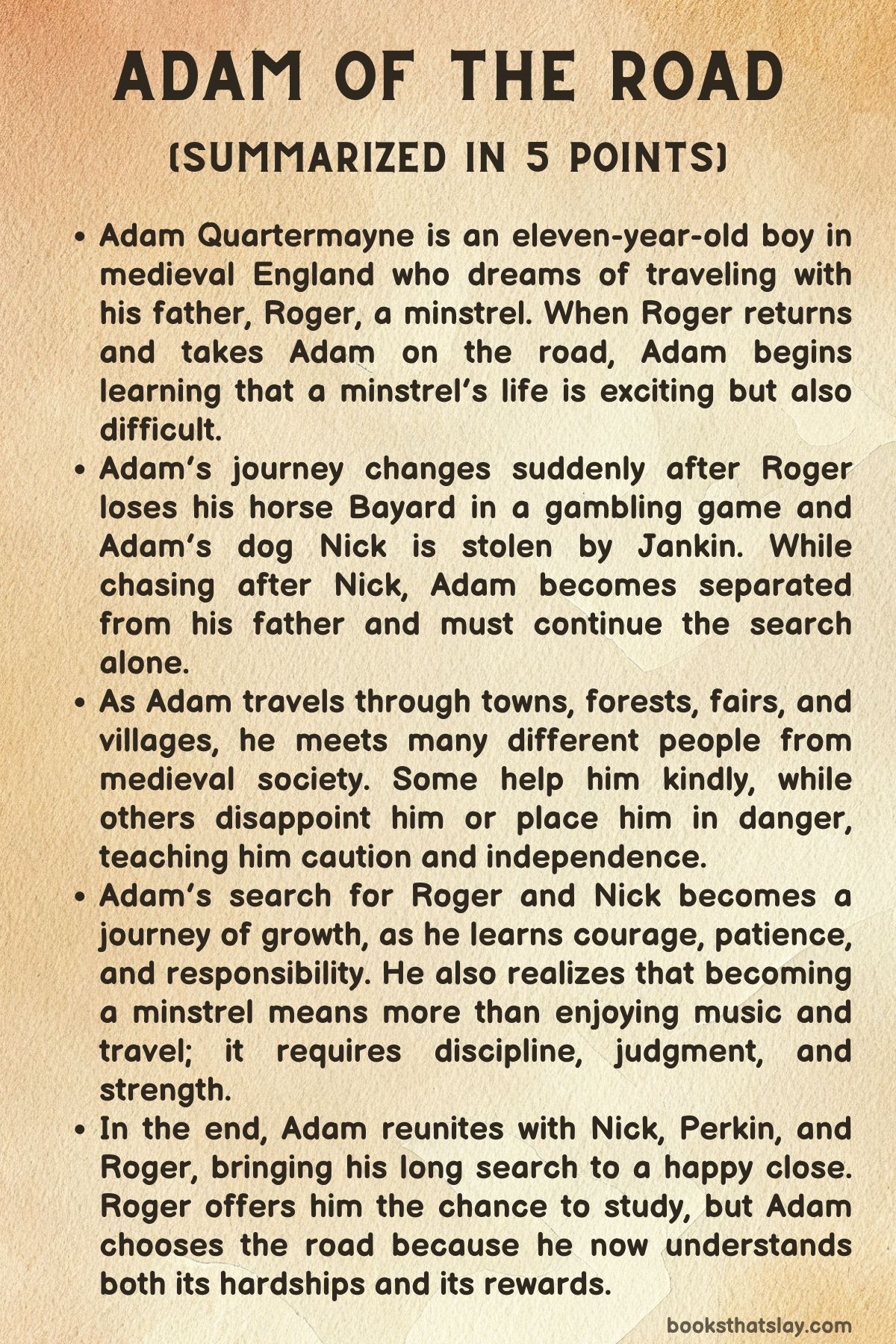
The story of Adam of the Road begins in the year 1295 in the town of St. Alban in England. Adam Quartermayne is an eleven-year-old boy studying at a boys’ school while waiting for the return of his father, Roger, a traveling minstrel.
Roger has been in France learning new songs and stories, and Adam constantly imagines the day his father will come back to take him on the road. Adam’s closest companion at school is Perkin, the hardworking son of a plowman who dreams of studying at Oxford and becoming an advisor to the king.
Adam’s cheerful personality balances Perkin’s seriousness, and the two boys share many moments together.
Adam’s other beloved companion is his red spaniel, Nick. Because dogs are not allowed at the school, Nick lives with Dame Malkin, an elderly woman in a nearby village.
Adam and Perkin often sneak out to visit the dog. Adam also enjoys playing his harp and telling stories, proudly speaking about his father’s life as a minstrel.
One day, a rumor reaches Adam that a minstrel may be returning to the area. Filled with excitement, Adam rushes to the road with Perkin and Nick to watch for travelers.
Soon Roger appears riding a warhorse named Bayard. Father and son happily reunite after their long separation.
Roger explains that he has been serving a noble family, Sir Edmund de Lisle and his household, and that he now travels with them as their minstrel. Adam is thrilled when Roger agrees that he can accompany him.
Adam quickly leaves school, says goodbye to Perkin, and begins life on the road with Roger and Nick. They travel with Sir Edmund’s family toward London.
Adam meets members of the household, including Margery de Lisle, a friendly girl who tries to make him feel welcome, and Hugh, a proud page who initially looks down on Adam. During the journey Adam struggles to prove himself as a young minstrel, especially after playing poorly on his harp while Roger performs for the ladies in a carriage.
Though embarrassed, he begins learning more about the skills and responsibilities of a minstrel.
At Sir Edmund’s home, Adam slowly becomes friends with the other boys in the household. By sharing Bayard and demonstrating his riding skills, he earns their respect.
Adam spends much of his time learning songs and stories from his father while the other boys learn trades from their families.
Later in the summer, Sir Edmund’s daughter Emilie is married. Many entertainers gather for the wedding feast, including several minstrels.
Among them is a small minstrel named Jankin. After the festivities, Roger drinks and gambles with the other minstrels.
By morning he has lost all his money and even the valuable horse Bayard to Jankin. Roger feels ashamed, and he and Adam must continue their travels on foot.
Father and son journey toward London together. Adam enjoys walking along the roads of England, but trouble soon follows.
At an inn, Jankin appears again and attempts to gamble for Nick, Adam’s beloved dog. Roger refuses.
Later that night Nick disappears from the stable. A stable boy explains that Jankin claimed to have traded the horse for the dog and took Nick away.
Adam is devastated and immediately begins searching for the thief.
Roger and Adam follow the trail toward the town of Guildford. While searching, Adam catches sight of Jankin and Nick across the river.
Determined to rescue his dog, Adam chases after them and even dives into the river to swim across after the ferry carrying Jankin and Nick. The current pushes him off course, and by the time he reaches land Jankin and the dog have vanished.
Adam becomes separated from his father during the pursuit.
Exhausted and soaked, Adam is taken in by a kind ferryman and his wife, John and Jill, who feed him and give him a place to rest. After returning to Guildford, Adam searches everywhere for Roger but learns that his father has already left to continue the search.
Adam sets out alone toward the great St. Giles Fair in Winchester, where many travelers and performers gather.
Along the way Adam travels with a merchant named Daun William and his group. Their journey through the King’s Forest turns dangerous when a robber knight and his followers attack them.
Adam escapes into the woods and manages to reach a nearby town to report the crime. The sheriff’s men capture the robbers and rescue the merchant’s goods.
Adam’s courage impresses the group, and they continue on to the fair.
At St. Giles Fair, Adam searches desperately among crowds of merchants, performers, and pilgrims for his father and his dog. Days pass without success.
Hoping for help, Adam even visits a shrine to pray for a miracle that will reunite him with Roger and Nick. While watching a play about the biblical story of Adam and Eve, he climbs onto a roof for a better view but accidentally falls and injures himself.
Adam wakes up in the home of a parish priest named Master Walter and his sister Dame Prudence, who care for him while he recovers. Because of his injury, Adam must stay there for weeks.
The priest hopes Adam will become a clerk in the church, but Adam does not want to give up the life of a minstrel. When he is finally strong enough to travel again, he learns from another group of minstrels that Roger had indeed been at the fair and even fought Jankin over the stolen dog before being forced to leave.
Adam joins a family of traveling performers called the de Veseys and journeys with them through the countryside. However, he soon realizes they are very different from his father.
They tell crude stories, struggle to earn money, and sometimes behave dishonestly. When one of them steals food in a town and a pursuit begins, Adam decides he cannot continue traveling with them.
Adam resumes his journey alone. Eventually he learns that Roger recovered Bayard and went to Sir Edmund’s estate in London.
Adam travels there but discovers that Roger has already been summoned to Wales with Sir Edmund’s household. Roger leaves a message asking Adam to remain there until they can meet again.
During the winter Adam lives quietly at the estate. One day while skating on a frozen stream, he encounters Jankin again.
Adam confronts him angrily and demands to know what happened to Nick. Jankin admits that the dog escaped from him earlier and ran away.
Adam realizes that Nick likely returned to St. Alban where Dame Malkin lives.
Adam travels back to St. Alban and learns that Nick did indeed return there. Perkin later took the dog with him to Oxford.
Determined to see his friend and recover his dog, Adam sets out again. Along the way he stays with Perkin’s family, helping them with farm work so Perkin can continue his studies.
The villagers reward Adam’s kindness by giving him clothes, shoes, and even a pair of bagpipes.
Finally Adam reaches Oxford and reunites with both Perkin and Nick. Soon afterward Roger arrives as well.
Father and son greet each other proudly. Roger offers Adam the chance to remain at Oxford and study, but Adam chooses the life he truly wants.
He decides to travel the roads with his father as a minstrel.
The story ends with Roger recognizing that Adam has grown stronger and wiser through his adventures. Adam has learned responsibility, perseverance, and the meaning of the road that his father once described as home.
Together they prepare to continue their journeys across England, sharing music and stories as traveling minstrels.
Characters
Adam Quartermayne
Adam is the emotional and moral center of Adam of the Road. At the beginning, he is lively, impulsive, proud, and full of imagination.
He thinks of himself mainly as a minstrel’s son and takes comfort in the idea that his father will always return for him. He loves performance, praise, and adventure, and he often speaks confidently even when his understanding of the world is still incomplete.
His affection for Nick, his admiration for Roger, and his friendship with Perkin reveal that beneath his boasting there is a deeply loving child who wants security as much as freedom.
As the story goes on, Adam grows through loss, separation, and hardship. He is forced to move beyond childish confidence and face hunger, fear, loneliness, embarrassment, and disappointment.
His search for Nick and Roger becomes more than a physical journey. It becomes the process through which he learns endurance, judgment, and self-reliance.
He makes mistakes, trusts the wrong people at times, and becomes discouraged, but he keeps moving forward. That persistence is one of his strongest qualities.
He is not brave because he never feels fear. He is brave because he continues despite fear, exhaustion, and uncertainty.
Adam also develops a clearer sense of identity. Early on, being a minstrel seems to mean fine clothes, songs, admiration, and the romance of the open road.
Later, he learns that the life also includes hardship, discipline, moral choice, and the duty to understand one’s audience. He sees different kinds of entertainers and begins to distinguish between showmanship and true artistry.
By the end, his decision to remain a minstrel is no longer the dream of a child copying his father. It is the informed choice of a boy who has suffered enough to know what the road demands and still wants it.
His growth is convincing because he does not become a different person. He remains warm, imaginative, and eager, but he gains steadiness and maturity.
Roger Quartermayne
Roger is a compelling father figure because he combines charm, talent, affection, and weakness. He is clearly gifted as a minstrel, admired for his stories and songs, and respected enough to serve noble households.
In Adam’s eyes, he represents freedom, artistry, and worldly knowledge. He is the person Adam most wants to resemble.
Roger’s language about the road gives the wandering life a near-sacred meaning, and he carries himself with the confidence of someone who belongs wherever he travels.
At the same time, Roger is not an idealized parent. His gambling exposes a serious flaw in his character and becomes the cause of much suffering.
Losing Bayard is humiliating enough, but the chain of events that follows leads to Adam’s separation from both his father and his dog. This failing makes Roger more human and more believable.
He loves his son deeply, yet his choices are not always responsible. His shame after gambling away the horse shows that he understands the damage he has done.
He is careless in one sense, but never indifferent.
Roger’s love for Adam comes through most clearly in moments of vulnerability. He searches for him anxiously, leaves messages, and never seems to stop trying to recover what has been lost.
He also respects Adam’s intelligence and growing independence. One of the most important parts of his character is that he gradually stops treating Adam as a small child and starts recognizing him as someone becoming his equal in spirit.
That final respect gives emotional weight to their reunion. Roger is not only a father teaching a son.
He is also a man learning to see that the boy beside him has become worthy of the road in his own right.
Nick
Nick, Adam’s red spaniel, is far more than a pet. He represents loyalty, comfort, and home.
In a story filled with movement, changing places, and uncertain human behavior, Nick is constant. Adam’s attachment to him reveals how deeply he needs companionship and emotional stability.
Nick’s tricks and affectionate nature also connect him to the life of performance, making him part of Adam’s image of what a minstrel’s life should be.
Nick’s disappearance gives the story much of its urgency. Adam’s search for him is not just about recovering a dog.
It is about recovering a part of himself. Nick symbolizes innocence and devotion, and the pain Adam feels when he loses him shows how seriously he loves.
Unlike people, who can disappoint, change plans, or make bad choices, Nick’s loyalty is unquestioned. That is why his theft feels especially cruel.
Nick’s eventual return carries emotional meaning beyond simple reunion. He stands for continuity after upheaval.
Finding him again suggests that not everything good has been permanently lost. In that sense, Nick helps hold Adam’s world together.
Though he does not speak, he remains one of the most meaningful presences in the novel because he embodies affection without complication.
Perkin
Perkin is one of the most important influences on Adam’s development. He is intelligent, disciplined, serious, and ambitious.
As the son of a plowman, he has a practical understanding of work and responsibility that contrasts with Adam’s more romantic outlook. Yet he is never cold or rigid.
His friendship with Adam shows that he has warmth, humor, and patience. The bond between the two boys is persuasive because each offers the other something valuable.
Perkin gains lightness and companionship, while Adam benefits from Perkin’s steadiness and thoughtfulness.
Perkin represents an alternative path through life. He is drawn toward education, order, and service through scholarship, whereas Adam is drawn toward song, story, and travel.
Their different ambitions never destroy their friendship. Instead, the contrast enriches the novel by showing two valid but very different models of growth.
Perkin’s dream of Oxford and public service gives him dignity and direction, and his dedication makes him admirable.
Later, when Adam finds Perkin again, their friendship has matured rather than faded. Perkin’s care for Nick is an act of loyalty to Adam, and his continued affection shows that their connection was never superficial.
The scenes with Perkin’s family also deepen his character by placing him within a hardworking household shaped by duty and sacrifice. He remains one of the clearest examples of quiet goodness in Adam of the Road, not because he dominates events, but because he consistently acts with honesty, effort, and care.
Dame Malkin
Dame Malkin is a small but deeply important presence. She gives Adam and Nick a place of safety near the school, and her cottage represents warmth, kindness, and welcome.
She belongs to the world of ordinary people rather than nobles, courts, or performers, and her generosity has no display about it. She listens to Adam, feeds him, cares for Nick, and offers him a kind of grandmotherly affection.
Her importance lies partly in what she symbolizes. She is one of the places where Adam feels rooted.
In a story defined by movement, her home is stable. Adam’s returns to her are always emotionally meaningful because they suggest that kindness can remain waiting even after much has changed.
She is linked to memory, comfort, and trust.
Dame Malkin also understands Adam better than he may realize. Her rumor about Roger’s return sparks great joy, and later her knowledge of Nick’s movements helps guide Adam again.
She does not control the story’s action, but she quietly supports it at crucial points. Characters like her give the novel moral texture because they show how much a child’s survival can depend on the uncelebrated goodness of ordinary people.
Margery de Lisle
Margery is one of the first members of the noble household to treat Adam kindly. She is curious, approachable, and open in a way that softens the rigid social boundaries around them.
Her willingness to speak with Adam in French and her efforts to comfort him after embarrassing moments show that she is more thoughtful than many of the people around her rank might suggest.
At the same time, Margery is still shaped by her own social world. Her attempts at kindness do not always succeed because she does not fully understand Adam’s pride and sensitivity.
This makes her believable. She is neither patronizing nor idealized; she is simply a well-meaning girl whose position in society gives her assumptions she may not even notice.
Her role also helps illuminate Adam’s discomfort in noble settings. Through Margery, the story shows that kindness can cross class boundaries, but those boundaries still exist.
She adds grace and warmth to the household scenes and provides a contrast to more openly dismissive characters such as Hugh in the earlier part of the story.
Hugh
Hugh begins as a source of tension. He is proud, competitive, and conscious of social standing.
His early treatment of Adam reflects jealousy as well as snobbery, especially since Bayard was a gift he seems to have wanted for himself or for his own circle. Hugh’s behavior captures the insecurity that often hides beneath arrogance.
He is not cruel simply for the sake of cruelty. He is a boy protecting status and reacting to disappointment.
As he gets to know Adam better, Hugh becomes less hostile. He learns to admire Adam’s skill and courage, and his change in attitude shows that he is capable of fairness.
This shift is important because it suggests that prejudice in the novel is not always fixed. Sometimes it arises from immaturity and can be corrected by experience.
Hugh grows enough to recognize Adam’s worth when he sees it plainly.
Even after their friendship improves, Hugh remains a realistic character rather than a transformed saint. He still belongs to a world of privilege and expectation.
His comments about Bayard and household matters remind the reader that resentment and pride do not disappear overnight. That complexity makes him effective as both rival and companion.
Simon
Simon, the squire, brings gentleness and humor into the noble household sections. He is older than Adam and serves partly as an intermediate figure between boys and men.
He is capable in the martial world around him, but he also responds warmly to music, emotion, and romance. His affection for Emilie makes him sympathetic because it gives him a quiet vulnerability.
Simon’s friendship with Adam matters because he treats him with respect rather than condescension. When Adam feels humiliated after his poor harp-playing, Simon helps him recover his confidence through conversation and shared laughter.
This ability to restore emotional balance is one of Simon’s most appealing traits. He understands embarrassment and disappointment without dramatizing them.
He also serves as a reminder that not all sorrow in the novel belongs to children. His love for Emilie cannot alter the marriage arranged for her, and that disappointment places him inside the larger social structure of the time, where personal wishes often yield to family strategy.
Simon is decent, restrained, and quietly sad, which gives him a memorable humanity.
Sir Edmund de Lisle
Sir Edmund represents noble authority at its most functional and respectable. He is generous enough to reward Roger, employ him, and allow Adam entry into his household’s world.
He appears as a powerful man, but not a tyrannical one. His generosity toward Roger and his household’s generally ordered life suggest competence and responsibility.
What makes Sir Edmund interesting is that he is not developed through intimate emotion so much as through social force. He belongs to a class whose decisions shape the lives of everyone around him.
His daughter’s marriage, his travels, and his obligations to the king all remind the reader that noble households are centers of command and influence. His world is organized by duty, rank, and political service.
Even when he is not directly present, Sir Edmund’s authority is felt. His name opens doors for Roger, structures Adam’s experiences, and affects where characters travel and live.
He is less an emotionally rich individual than a figure of order and power, but that role is important in giving the story its medieval framework.
Lady Richenda
Lady Richenda adds refinement and courtesy to the de Lisle household. She treats Roger as an entertainer worthy of attention and allows Adam into the carriage with the women, which gives him access to a more privileged setting than he is used to.
Her presence reflects the ceremonial and cultivated side of noble life, where stories, music, and manners have social value.
She is not a dominant figure in the action, but she helps shape Adam’s understanding of audience and behavior. The scene in which he performs badly in her presence becomes an important lesson in pride and professionalism.
In that sense, her role is tied to Adam’s education. She represents the kind of listener a minstrel must serve well.
Lady Richenda’s importance is therefore indirect but meaningful. She helps define the standards of the world Roger moves in successfully and Adam hopes to enter.
Her courtesy also shows that nobility in the novel is not presented as wholly distant or harsh.
Emilie de Lisle
Emilie is a relatively quiet figure, but she carries thematic weight because her life reflects the limited freedom available to noble daughters. Her arranged marriage shapes Simon’s sadness and Adam’s growing awareness that fairness does not always govern the world.
Though she is not given as much direct speech or action as some others, her situation speaks clearly.
She also helps define the atmosphere of the household. Her wedding is a moment of splendor, display, and transition, but it is shadowed by the fact that personal feeling has little power against custom and alliance.
Emilie becomes a symbol of grace constrained by duty.
Her gift to Roger after the wedding shows appreciation and generosity. Through that gesture, she appears kind and observant.
Though not a central actor, she contributes to the novel’s picture of a society where individuals often live within roles chosen for them.
Jankin
Jankin is one of the clearest antagonistic figures, though he is not purely evil. He is sly, opportunistic, and morally careless.
His gambling with Roger, his claim over Bayard, and especially his theft of Nick make him a source of bitterness and danger for Adam. He embodies the darker side of the minstrel world, where talent can exist alongside selfishness and trickery.
Jankin’s actions force much of the story into motion. Without his theft of Nick, Adam would not be driven into so many tests of courage and endurance.
He is therefore important not only as a person but as a disruptive force. He takes what Adam loves and sets the boy on his long path toward maturity.
Yet Jankin is not written as a flat villain. Later, he shows regret and admits that he did not understand what Nick meant to Adam.
This does not erase his wrongdoing, but it complicates him. He becomes a man capable of guilt, which makes him more believable.
His moral weakness remains real, but he is not presented as beyond conscience.
Daun William
Daun William, the merchant, serves as one of the story’s most helpful adult companions outside Adam’s immediate circle. He is practical, worldly, and kind in a direct way.
After hearing Adam’s story, he offers him a place among his traveling party. His sympathy comes partly from imagining how Roger must feel, which suggests emotional intelligence as well as generosity.
He also represents the commercial world of medieval travel, a world different from minstrelsy or nobility but equally important. Through him, Adam sees another kind of adult life shaped by trade, negotiation, and movement.
Daun William is not sentimental, but he is decent, and that steadiness matters in a story where Adam often depends on the mercy of strangers.
After Adam helps rescue him from the robber knight, their relationship briefly takes on the warmth of shared adventure. Even when that excitement fades, Daun William remains a positive figure, showing that kindness can exist without deep personal attachment.
He helps Adam survive a difficult stretch of the journey.
Master Walter
Master Walter, the parish priest, represents security, order, and a possible future that does not suit Adam. He rescues and shelters the injured boy, and there is genuine charity in his actions.
He gives Adam medical care, food, and structure at a time when the boy is helpless. His goodness is real, and the reader is meant to value it.
At the same time, Master Walter cannot fully understand Adam’s calling. He imagines that the boy should become a clerk and settle into church life.
From his perspective, this is a generous and rational plan. From Adam’s perspective, it feels like the loss of his true self.
This difference creates tension without making Master Walter unkind.
He is therefore important as a figure of well-meant misunderstanding. He offers safety, but also a life of confinement from Adam’s point of view.
Through him, the story explores how love and care can still fail to see another person’s deepest nature.
Dame Prudence
Dame Prudence is one of the gentlest caregivers in the novel. She nurses Adam patiently after his fall, feeds him, and attends to his recovery with practical tenderness.
Her kindness is immediate and physical, expressed through action rather than speechifying. She helps make the priest’s home feel humane rather than merely orderly.
Her role becomes especially touching because Adam is far from everyone he longs for when she cares for him. She cannot replace Roger or Nick, but she helps him endure their absence.
Like Dame Malkin, she belongs to the group of quiet helpers whose goodness sustains the wandering child.
Adam’s farewell note to her shows that her kindness leaves a real mark on him. She is not part of his permanent world, but she becomes one of the people whose generosity shapes his journey toward adulthood.
Jack de Vesey
Jack de Vesey, one of the traveling minstrels Adam later joins, serves as a contrast to Roger. He is part of the same broad profession, but his standards are lower and his conduct less honorable.
Through him and his family, Adam learns that not everyone who performs for a living shares Roger’s artistry or moral sense.
Jack helps reveal Adam’s developing judgment. Earlier in the story, Adam sees minstrelship mostly through admiration for his father.
With the de Veseys, he encounters meanness, hunger, unreliability, and poor behavior within the same profession. Jack is not monstrous, but he is careless and self-serving enough to show Adam what kind of minstrel he does not want to become.
His value as a character lies in that contrast. He broadens the novel’s portrait of the road by showing that wandering performers are not all noble at heart.
Some are compromised by hardship, bad habits, and weak principles.
Allison de Vesey
Allison, like her husband, contributes to Adam’s disillusionment with this minstrel family. She is practical and hardened by poverty, and her behavior suggests a life shaped by scarcity more than generosity.
She helps maintain the family’s rough habits and broken promises, making Adam increasingly uncomfortable among them.
Still, she is not without context. Her coarseness seems tied to survival.
The family struggles constantly, and that struggle has worn away refinement and perhaps compassion. This gives her a degree of realism.
She is unpleasant from Adam’s perspective, but she also reflects the damage long hardship can do.
Through Allison, the story shows that the road can degrade as well as liberate. She is part of a social reality Adam must understand if he is to choose the minstrel life with open eyes.
Lawrence de Vesey
Lawrence is one of the sharper examples of resentment shaped by inequality. His anger about privilege, food, and punishment reveals a rebellious streak and a strong sense that the world is unfair.
His theft shows moral failure, but it also arises from hunger and frustration rather than simple malice.
He is important because he introduces a rougher social anger than Adam has previously encountered. Lawrence’s words about the rich having much while others have little bring class tension close to the surface.
The novel does not excuse his conduct, but it allows the reader to see the bitterness behind it.
For Adam, Lawrence is another warning. Talent and hardship alone do not guarantee character.
Lawrence lives on the road, but without Roger’s discipline or Perkin’s integrity. He helps show how easily suffering can turn into selfishness.
John Ferryman
John Ferryman is one of the novel’s most solid examples of plain decency. He and his wife rescue Adam without expecting reward and give him shelter when he is wet, exhausted, and alone.
John’s kindness is practical rather than emotional. He helps because help is needed.
His house briefly becomes a haven in the middle of chaos. Characters like John matter because they prove that the world Adam travels through, though dangerous, is not empty of goodness.
John’s refusal to take payment strengthens that impression. He acts out of principle and hospitality.
He also helps restore Adam physically and mentally after a frightening ordeal. His role is short, but his impact is lasting because he appears at exactly the moment Adam most needs trust.
Jill Ferryman
Jill Ferryman adds warmth and attentiveness to the refuge the ferryman’s house offers. She finds Adam’s lost belongings, dries him, feeds him, and gives him guidance about where to go next.
She is maternal without being sentimental, and her care helps stabilize Adam after his reckless pursuit of Jankin.
Her practical intelligence is one of her strongest qualities. She does not simply pity Adam.
She listens, thinks, and offers sensible advice. In that way, she becomes another example of the adults who quietly protect children in moments when official structures fail them.
Jill’s kindness also reinforces the novel’s respect for ordinary working people. She is not wealthy, learned, or powerful, yet her generosity carries real moral importance.
Sir Adam, the Bailiff
Sir Adam, the bailiff, represents lawful authority functioning as it should. When Adam reports the robbery, Sir Adam listens, acts quickly, and leads the pursuit of the criminals.
His competence stands in contrast to the lawlessness of the forest and the selfish violence of the robber knight.
For Adam, Sir Adam is an impressive figure because he confirms that courage and truth can bring justice. The boy’s determination to seek help would mean little if no one responded.
Sir Adam’s response validates Adam’s effort and gives him a moment of partnership with adult authority.
Though he is not deeply developed emotionally, Sir Adam is important structurally and morally. He shows that the world contains institutions capable of restoring order, not just private kindness or private wrongdoing.
Perkin’s Father
Perkin’s father, the plowman, embodies labor, duty, and quiet sacrifice. His life is shaped by obligation to the lord’s fields as well as the needs of his own family.
Through him, the novel presents the heavy demands placed on working people in medieval society. He is not described in grand terms, but his burden is deeply felt.
His acceptance of Adam into the household and Adam’s work on the farm reveal his fairness and practicality. He does not sentimentalize help; he values it because it matters.
At the same time, the home he leads is generous enough to welcome Adam and later contribute to his restoration as a minstrel.
As a character, he gives depth to Perkin’s background. Perkin’s seriousness and ambition make more sense once the reader sees the hardworking world from which he comes.
Perkin’s Mother
Perkin’s mother represents domestic generosity and restorative care. She helps make Adam feel part of the family and later gives him dyed clothes that help him look and feel like himself again.
Her gift is not merely practical. It is an act of recognition.
She sees what Adam longs to become and helps him move toward it.
She also contributes to the sense of home that surrounds Perkin’s household. After so much wandering, hunger, and disappointment, Adam’s time there is healing.
Much of that healing comes through the steady comfort she provides.
Her kindness is especially meaningful because it is active, skillful, and sustaining. She does not offer abstract sympathy.
She makes, repairs, feeds, and welcomes. That grounded generosity helps prepare Adam for the final stage of his journey.
Bayard
Bayard, though a horse rather than a human character, carries symbolic weight throughout the story. He represents pride, mobility, and status.
For Adam, Bayard is part of the glamour of his father’s world. The horse’s beauty and strength make Roger’s life seem grander and more secure.
When Roger loses Bayard through gambling, the loss marks a fall in fortune and dignity. Bayard becomes a visible sign of Roger’s weakness and Adam’s changed circumstances.
Later, the horse remains linked to Jankin, resentment, and unfinished wrongs.
Bayard’s eventual return to Roger helps complete part of the broken order of the story. Like Nick, the horse is tied to the restoration of what was lost, though Nick matters more emotionally.
Bayard is thus important not only as property, but as a symbol of both loss and recovery.
Themes
Growing Into Independence
Adam’s journey reflects the slow and sometimes painful process of learning independence. At the beginning of the story, he is still emotionally dependent on his father.
Roger represents safety, direction, and identity for him. Adam believes that once he joins his father on the road, life will simply become an exciting adventure filled with songs, travel, and admiration.
His expectations are shaped by imagination rather than experience. When he finally begins traveling with Roger, he sees only the romantic side of the minstrel life.
Circumstances soon force Adam to face a very different reality. Losing Nick and becoming separated from Roger removes the protective structure that surrounded him.
For the first time, Adam must decide where to go, whom to trust, and how to survive. He has to travel alone, ask strangers for help, and deal with fear and exhaustion.
These experiences change him gradually rather than suddenly. He still feels lonely and uncertain, but he keeps moving forward because he has no other choice.
Each challenge teaches him something about responsibility and resilience.
Adam’s independence is also emotional. At first, his sense of identity comes almost entirely from being Roger’s son.
Later he begins to understand himself as a person who can make decisions and face consequences. When he chooses not to become a clerk despite the safety it offers, he demonstrates that he now understands what he wants from life.
His final decision to remain a minstrel is therefore not simply a child copying his father’s path. It is the choice of someone who has seen hardship and still feels drawn to the road.
This gradual growth shows that independence does not come from a single heroic act. Instead it develops through repeated struggles, mistakes, and moments of perseverance.
Adam learns how to navigate the world without constant guidance, and through that process he becomes capable of standing beside his father as a partner rather than merely following him as a child.
The Meaning of the Road
The road functions as both a physical setting and a powerful symbol throughout Adam of the Road. For Roger, the road represents freedom, creativity, and a kind of spiritual belonging.
He teaches Adam that traveling is more than movement from place to place. It is a way of life in which a minstrel carries stories, music, and news between communities.
The road connects villages, towns, and castles, allowing performers to bring entertainment and knowledge to different audiences.
At the same time, Adam gradually learns that the road contains hardship as well as freedom. Early in the story, the road seems exciting and full of possibility.
Adam imagines that traveling with Roger will mean constant adventure and admiration. After he becomes separated from his father, however, the road reveals its harsher side.
He must walk long distances in poor weather, sleep in unfamiliar places, and sometimes go hungry. The same road that once promised excitement now demands endurance and courage.
Encounters with different travelers deepen this understanding. Adam meets merchants, pilgrims, farmers, robbers, and other minstrels, each with their own reasons for traveling.
Through these meetings he realizes that the road carries every kind of human story, including kindness, greed, bravery, and injustice. The road is therefore not simply romantic scenery.
It becomes a place where Adam observes the complexity of the world.
By the end of the story, the road no longer symbolizes childish adventure alone. Instead it represents a life that requires discipline, adaptability, and empathy.
Adam chooses to return to the road with a new awareness of what it demands. The symbol therefore reflects his personal growth.
The road remains full of wonder, but it is now understood as a challenging path that shapes character and maturity.
Loyalty and Companionship
Relationships form the emotional foundation of Adam of the Road, and loyalty becomes one of the strongest forces guiding the characters’ actions. Adam’s attachment to Nick is one of the clearest examples.
The dog is more than a pet; he is a source of comfort, stability, and unconditional affection. When Nick is stolen, Adam’s determination to recover him drives much of the story’s action.
His search reflects how deeply loyalty shapes his sense of responsibility. Nick cannot speak or defend himself, yet Adam refuses to abandon him.
Friendship also plays an important role in this theme. Adam’s bond with Perkin shows how companionship can support personal growth.
Although the boys have different personalities and ambitions, their respect for each other remains steady. Perkin helps care for Nick when Adam is gone, demonstrating loyalty even when their paths temporarily separate.
Their reunion later in the story confirms that true friendship does not fade easily.
Loyalty is also tested in Adam’s relationship with his father. Roger’s gambling mistake causes suffering and separation, yet Adam continues to believe in him.
This faith is not blind admiration. Rather, it reflects Adam’s understanding that people can make serious mistakes while still deserving love.
Roger, in turn, searches for Adam and never abandons hope of finding him again. Their relationship shows that loyalty can survive disappointment and hardship.
The contrast between loyal and disloyal behavior also appears through other characters. Jankin’s theft of Nick demonstrates selfishness and betrayal, while the kindness of strangers such as the ferryman’s family reveals generosity toward someone they barely know.
These examples emphasize that companionship can come from unexpected places. The theme ultimately suggests that loyalty is expressed through actions rather than words.
Those who show kindness, protect others, and remain faithful in difficult moments create the strongest and most meaningful bonds.
Social Class and Medieval Society
The story presents a vivid picture of medieval society, where social class strongly shapes people’s lives and opportunities. Adam moves between several different social environments during his travels, allowing readers to see how nobles, scholars, merchants, farmers, and entertainers live.
Each group has its own customs, responsibilities, and expectations, and Adam’s experiences reveal the advantages and limitations of each position.
The noble household of Sir Edmund illustrates the wealth and authority held by the upper class. The household is organized, comfortable, and full of servants and attendants.
However, it is also governed by strict social rules. Emilie’s arranged marriage shows how even privileged individuals must follow family expectations rather than personal wishes.
Through these details, the story shows that status brings both power and restriction.
In contrast, Perkin’s family represents the life of working people. The plowman’s responsibilities to his lord and the constant labor required to maintain the farm demonstrate the physical demands placed on lower-class families.
Despite these hardships, the household is generous and supportive. Adam’s time there shows that dignity and kindness are not determined by wealth or rank.
The world of traveling performers occupies a position somewhere between these social groups. Minstrels move freely across social boundaries, performing for nobles in castles and for villagers in marketplaces.
This mobility gives them unusual access to different parts of society. At the same time, their livelihood depends on pleasing audiences and earning favor from patrons, which makes their position uncertain.
Through Adam’s encounters with many kinds of people, the story presents medieval society as complex rather than fixed. Social divisions exist and influence daily life, yet individuals from different backgrounds still interact through trade, travel, and storytelling.
Adam’s journey across these social boundaries allows him to understand the wider world beyond the limited perspective of a single community. His experiences suggest that character and generosity often matter more than rank or wealth in determining a person’s true value.