Addicted to You Summary, Characters and Themes
Addicted to You by Becca Ritchie and Krista Ritchie is a contemporary romance novel that centers on two young people bound together by secrets, addiction, and a complicated friendship that slowly becomes something deeper. Lily Calloway and Loren “Lo” Hale have spent years pretending to be a couple to hide their destructive habits from their wealthy families—Lily struggles with compulsive sexual behavior, while Lo battles severe alcoholism.
Living together under this arrangement allows them to protect each other’s secrets, but it also traps them in a cycle that grows harder to escape. As their relationship evolves from a façade into something real, both must confront the damage their addictions cause and decide whether love can survive the truth. The book kickstarts the Addicted series by the authors.
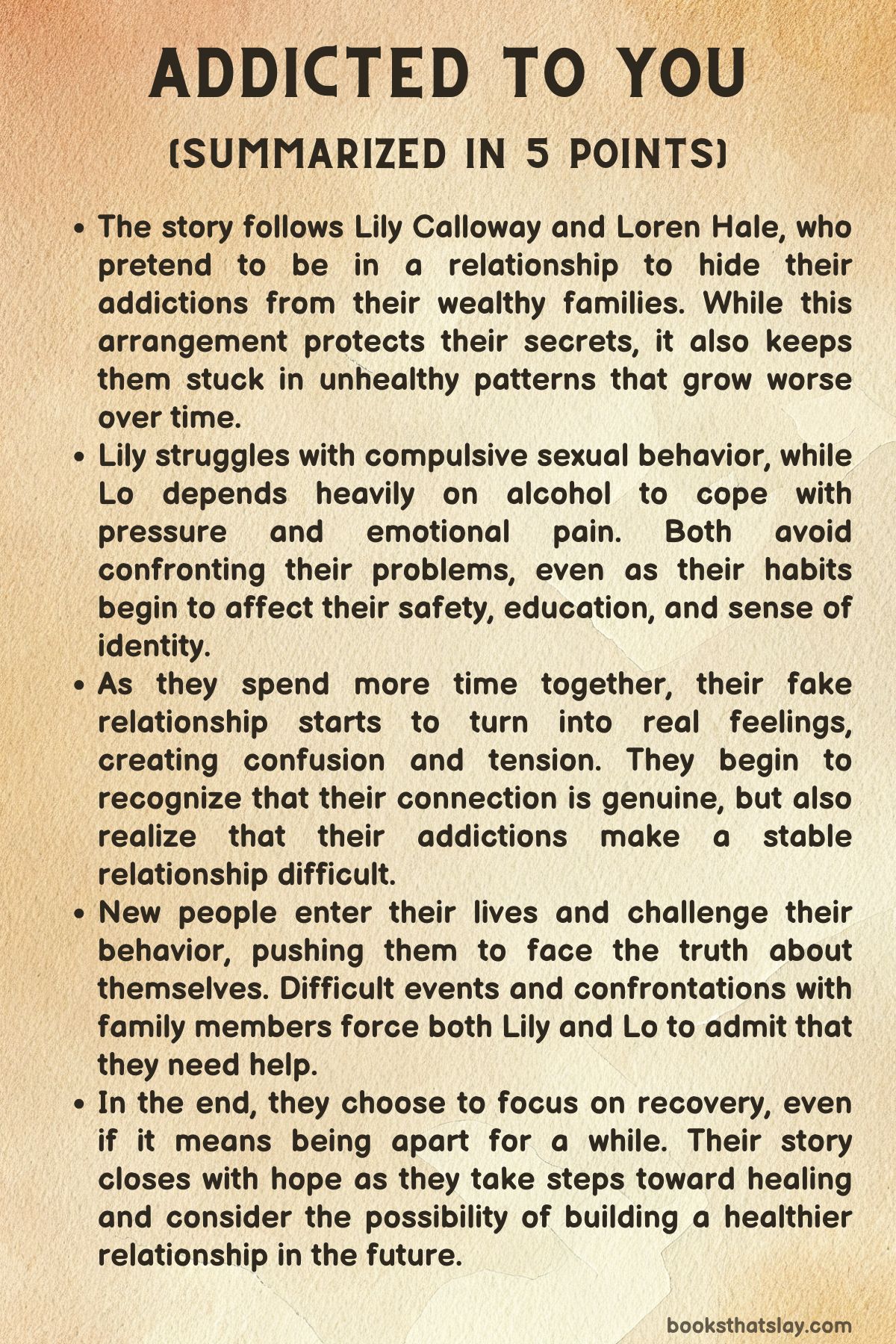
Summary
The story begins with Lily Calloway leaving a fraternity house after a night spent with a man whose name she does not remember. Her best friend and pretend boyfriend, Loren “Lo” Hale, arrives to pick her up.
Lily and Lo have known each other since childhood and now share an apartment while pretending to be romantically involved in order to keep their families from discovering their addictions. Lily cannot resist seeking sexual encounters with strangers, while Lo drinks constantly.
Their arrangement allows them to hide their problems while offering each other protection from outside scrutiny.
Their relationship is filled with confusing signals. Lo often touches Lily in ways that blur the line between acting and genuine affection, leaving Lily unsure of what he truly feels.
Although they share intense chemistry, they avoid discussing their addictions or the effect these behaviors have on their lives. Their families believe they are a stable couple, but in reality they are barely managing to function.
Lily’s family is wealthy and influential. Her sisters—Poppy, Rose, and Daisy—each have distinct personalities, and their family gatherings often make Lily feel exposed and uncomfortable.
During a family lunch celebrating Daisy’s return from Paris, tension rises when Rose hints that Lily may be hiding something from the family. Lily becomes overwhelmed and retreats with Lo, who continues to shield her from confrontation.
At college, Lily struggles to maintain focus. She feels directionless compared to others around her and often distracts herself with sexual fantasies or pornography.
Her addiction interferes with her studies and her sense of identity. Meanwhile, Lo’s drinking becomes more obvious as he regularly consumes alcohol until he passes out.
Despite living together and presenting themselves as a couple, Lily and Lo maintain physical relationships with other people. When Lily hears Lo having sex with someone in their apartment, she experiences jealousy she cannot fully explain.
These emotions reveal that her feelings for him are stronger than she previously admitted.
Memories from their past show how their complicated relationship began. As teenagers, Lily once attempted to comfort Lo after he was criticized by his father, and the two slept together.
That encounter left them both confused, and they avoided repeating it for years.
Lily’s addiction grows more dangerous. After one reckless night, she wakes up with two men in her bed and no memory of how the evening unfolded.
Lo becomes worried for her safety and takes her to get medical testing. Although Lily tries to minimize the situation, it becomes clear that her behavior is escalating.
Their families soon surprise them with a vacation on a yacht for Lily’s father’s birthday. Trapped with relatives and without easy access to their usual outlets, both Lily and Lo struggle to manage their impulses.
Lily becomes fixated on one of the servers on the yacht and nearly acts on the attraction. Before she does, Lo confronts her, admitting that he wants her for himself.
This confrontation forces both of them to acknowledge feelings they had hidden behind their fake relationship.
For the first time in years, Lily and Lo begin a real romantic relationship. They admit that they have always cared deeply for one another but were afraid to risk losing the friendship that sustained them.
Lily worries that her addiction will prevent her from remaining faithful, while Lo doubts his ability to control his drinking. Nevertheless, they promise to try to change.
Even after this confession, their struggles continue. Lily finds it difficult to communicate her needs, and Lo still relies on alcohol.
Their relationship becomes passionate but unstable as they attempt to balance desire, affection, and recovery.
Around this time, Lily meets Connor Cobalt, an intelligent and confident student who offers to tutor her in economics. Connor’s presence introduces a new influence in their lives.
Another newcomer, Ryke Meadows, begins appearing around Lo and Lily as well. Ryke initially claims he wants information about comic conventions, but his true intention is to get closer to Lo because he suspects Lo has a severe drinking problem.
Social events bring further complications. During a Halloween party at a mansion, Lo drinks an enormous amount of expensive alcohol, which leads to a confrontation with the host.
The situation nearly turns violent before Ryke helps Lily and Connor escape with Lo, who has passed out.
Ryke becomes increasingly involved in Lo’s life. Having grown up with an alcoholic father himself, he recognizes the signs in Lo and tries to encourage him toward change.
Lily struggles with Ryke’s blunt honesty because she does not want to admit how serious Lo’s addiction has become.
Meanwhile, Lily’s own behavior continues to cause tension. During one night at a club, a man begins harassing her in the bathroom and attempts to force himself on her.
Connor and Ryke intervene before the situation worsens. The incident forces Lily to confront the consequences of her addiction and the vulnerability it creates.
The event also exposes Lily’s secrets to her family. Her sister Rose learns about the truth behind Lily and Lo’s relationship and Lily’s compulsive behavior.
Although Rose reacts with anger and disappointment, she also expresses concern and support. This confrontation marks the first time Lily openly acknowledges her addiction to someone in her family.
Lo also begins to face his reality. After the incident, he finally admits that he is an alcoholic.
Determined to change, he attempts to detox with medical supervision arranged by Connor. The process is painful and exhausting, but Lo manages to remain sober for the first time in years.
As Lo begins recovery, Lily realizes that she must also confront her own issues. Their relationship has always revolved around enabling each other’s destructive habits, and they must now learn how to support one another without falling back into the same patterns.
New dynamics form among their circle of friends. Connor begins dating Lily’s sister Rose, which creates unexpected connections between their worlds.
Ryke continues to push both Lily and Lo toward healthier choices.
The story reaches a turning point during a Christmas gala attended by their families. Lo plans to tell his father about his decision to pursue sobriety and possibly enter rehabilitation.
His father reacts with anger and attempts to discourage him from seeking help. The confrontation escalates until Ryke steps in.
In the aftermath, Ryke reveals a shocking truth: he is Lo’s half brother. Their father had an affair years earlier, and Lo never knew the full story of his family history.
Learning this revelation shatters Lo emotionally but also helps explain Ryke’s determination to help him.
With his father refusing to support him and even cutting off his financial support, Lo decides to move forward with rehabilitation anyway. He also reveals that he has been expelled from college due to failing grades caused by his drinking.
Lily faces her own difficult choices. She decides to move in with her sister Rose, transfer schools, and begin therapy to address her addiction.
Although she and Lo love each other deeply, they recognize that they must work on themselves separately if they want any hope of building a healthier future.
The novel ends with an emotional goodbye as Lo leaves for rehab. Lily promises to wait for him, uncertain of what their lives will look like when he returns but determined to confront her own struggles while he confronts his.
Their story closes with the possibility that recovery, honesty, and love may finally give them a chance at something real.
Characters
Lily Calloway
Lily Calloway is the central perspective through which the events of Addicted to You unfold, and her character is defined by an ongoing internal conflict between desire, shame, and the need for control. Lily struggles with a compulsive need for sexual encounters, which she does not initially view as a problem.
Instead, she sees it as a part of her identity that helps her cope with stress, boredom, and emotional discomfort. However, as the story progresses, it becomes clear that this behavior is isolating her from her family, damaging her education, and putting her in dangerous situations.
Lily often finds herself trapped between the immediate satisfaction of her impulses and the consequences that follow afterward. She tends to suppress guilt and avoid confronting the seriousness of her addiction, which allows her behavior to continue unchecked for much of the story.
Despite these struggles, Lily is not indifferent to the people around her. She deeply cares about Loren Hale and depends on him for emotional stability.
Their relationship has always been complicated because it mixes friendship, secrecy, attraction, and dependency. Lily frequently feels confused by Lo’s actions and fears that her addiction will eventually drive him away.
Her difficulty in saying no to others also shapes her personality; she often allows uncomfortable or harmful situations to continue because she struggles to assert boundaries. As Lily begins to acknowledge the consequences of her behavior, she gradually starts to recognize that she needs help.
By the end of the story, she shows signs of growth by agreeing to therapy and trying to rebuild connections with her family, particularly her sister Rose.
Loren “Lo” Hale
Loren Hale is Lily’s closest companion and the other half of their long-standing arrangement. He is intelligent, charismatic, and often protective of Lily, but he is also deeply affected by alcohol dependence.
Drinking has become his primary method of dealing with emotional pain and pressure from his family. Lo grew up under the expectations of a powerful father who valued success and discipline, leaving him feeling inadequate and resentful.
Alcohol allows him to escape those expectations, but it also destroys his academic performance and personal stability.
Lo’s relationship with Lily is complex because it mixes genuine affection with years of secrecy and unhealthy coping mechanisms. For a long time, he hides his deeper feelings for her because he does not want to become just another casual encounter in her life.
His hesitation to pursue a real relationship is partly motivated by insecurity and partly by his awareness of Lily’s addiction. Once they finally admit their feelings, Lo becomes more openly affectionate and supportive, yet his alcoholism continues to threaten their progress.
The turning point for Lo occurs when he finally recognizes the full impact of his addiction. The incident involving Lily’s assault and the intervention from their friends force him to confront the reality that his drinking harms both himself and the people he cares about.
His decision to detox and eventually seek rehabilitation marks a significant moment of accountability. Lo’s journey is defined by the struggle to break free from his father’s influence, face his own vulnerabilities, and learn how to live without relying on alcohol.
Rose Calloway
Rose Calloway, Lily’s older sister, represents discipline, ambition, and emotional restraint. She is highly focused on her career and personal goals, which often makes her appear cold or judgmental to those around her.
Rose expects excellence from herself and from others, and this perfectionist mindset shapes how she interacts with Lily. For much of the story, Rose appears frustrated with Lily’s behavior and suspicious that she is hiding something from the family.
Her confrontational personality often leads to tense exchanges, especially when she believes Lily is being irresponsible.
Although Rose’s actions can seem harsh, they stem from genuine concern for her sister. She is one of the first people who senses that Lily is struggling with something serious.
When the truth about Lily’s addiction is revealed, Rose initially reacts with anger and disappointment, but her response quickly shifts toward support. She encourages Lily to seek professional help and even offers her a place to live so she can start over in a healthier environment.
Rose’s development throughout the story reveals that her strict exterior masks a strong sense of loyalty and protectiveness toward her family.
Rose also forms a surprising connection with Connor Cobalt. Their relationship highlights another side of her personality, showing that she is capable of vulnerability and openness when she meets someone who understands her ambitions and intellect.
Through Rose, the narrative explores how love and family responsibility can coexist with personal ambition.
Connor Cobalt
Connor Cobalt is introduced as Lily’s tutor, but he quickly becomes a significant presence in the group. He is highly intelligent, confident, and analytical, often approaching situations with logic rather than emotion.
Connor’s personality is shaped by his own background as the son of a powerful businessman, which allows him to relate to the pressures faced by Lily and Lo. Unlike many characters in their social circle, Connor remains calm and observant, often noticing problems that others ignore.
Connor’s involvement in Lily and Lo’s lives grows because he recognizes the seriousness of their addictions. Rather than judging them, he tries to provide practical support.
He arranges medical supervision during Lo’s detox and encourages both Lily and Lo to take responsibility for their recovery. His willingness to help without expecting anything in return demonstrates a strong sense of moral responsibility.
Connor’s relationship with Rose adds another dimension to his character. Their dynamic is built on intellectual competition and mutual respect.
Both are ambitious and highly capable, which allows them to challenge and support each other. Connor’s presence in the story highlights the importance of rational thinking and stability in contrast to the chaotic lifestyles of Lily and Lo.
Ryke Meadows
Ryke Meadows initially appears mysterious and somewhat intrusive, but his motivations become clearer as the story progresses. He is physically strong, disciplined, and direct in his approach to problems.
Ryke grew up with an alcoholic father and understands the destructive cycle of addiction. Because of this experience, he recognizes the signs in Lo and becomes determined to intervene before the situation worsens.
Ryke’s blunt honesty often makes him seem harsh, particularly when he openly calls Lo an alcoholic or challenges Lily about her behavior. However, his actions are driven by a desire to help rather than to criticize.
He refuses to ignore the seriousness of their addictions, which sets him apart from many other people in their lives who prefer to overlook the problem.
The revelation that Ryke is Lo’s half brother adds emotional depth to his character. For years, he struggled with the knowledge of their shared father and the complicated circumstances surrounding Lo’s birth.
His decision to approach Lo under false pretenses shows both his determination and his uncertainty about how to build a relationship. Ultimately, Ryke’s role becomes that of a catalyst for change, pushing Lo toward sobriety and encouraging Lily to confront the reality of her addiction.
Daisy Calloway
Daisy Calloway is Lily’s younger sister and represents innocence mixed with curiosity about the adult world. She is artistic, imaginative, and eager to explore opportunities that excite her, such as modeling during her time in Paris.
Daisy often appears carefree and expressive, contrasting with Rose’s seriousness and Lily’s internal struggles.
Despite her youth, Daisy is perceptive about the tensions within her family. She senses that Lily is distant and often tries to reconnect with her.
Daisy’s visits and conversations reveal how Lily’s addiction has created emotional distance from the people who care about her. Although Daisy does not fully understand the depth of Lily’s struggles, her affection and admiration highlight the impact Lily’s choices have on those around her.
Daisy’s character also emphasizes the theme of family expectations and public image. Growing up in a wealthy and influential household exposes her to pressures similar to those faced by her sisters.
Her storyline suggests that she is still forming her identity and may face her own challenges as she navigates the same social environment.
Jonathan Hale
Jonathan Hale, Lo’s father, represents the harsh expectations and emotional distance that shaped Lo’s upbringing. As a powerful businessman, he values success, discipline, and control, but he shows little empathy for his son’s struggles.
Jonathan’s relationship with Lo is marked by criticism and disappointment, which contributes to Lo’s feelings of inadequacy.
Jonathan’s refusal to acknowledge Lo’s addiction reflects his belief that problems should be solved through willpower alone. When Lo announces his decision to seek professional help, Jonathan reacts with anger and dismissiveness.
His inability to offer support demonstrates how parental pressure and emotional neglect can contribute to destructive coping mechanisms.
The revelation of Jonathan’s past actions, including the affair that resulted in Ryke’s birth, further complicates his character. His behavior has caused lasting damage to multiple people in his life, yet he continues to deny responsibility.
Through Jonathan, the narrative highlights the generational consequences of secrecy, power, and unresolved conflict within families.
The characters in Addicted to You are connected by complicated relationships, personal struggles, and the challenge of confronting addiction. Each character contributes a different perspective on responsibility, loyalty, and the difficult process of change.
Together, their interactions shape the emotional core of the story and drive the transformation experienced by Lily and Loren.
Themes
Addiction as Identity, Secrecy, and Self-Deception
Addiction is not presented here as a background trait or a private weakness that can be separated from daily life. It shapes how Lily and Lo think, how they structure their home, how they respond to stress, and how they understand themselves.
What makes this theme especially striking is that both characters begin from a place where they do not fully want recovery. They are not simply trapped by destructive habits; they have built their routines around those habits and, in some ways, protected them.
Lily does not initially frame her compulsive sexual behavior as something that must stop. Lo, in the same way, treats alcohol as both shield and fuel.
Their arrangement with each other works because it hides the truth from their families while also allowing the truth to continue. This creates a powerful portrait of self-deception.
They are honest with each other about what they do, but that honesty does not automatically become healing. Instead, it often becomes permission.
The theme becomes richer because addiction is shown not only through the acts themselves but through the stories the characters tell about those acts. Lily repeatedly minimizes risk until danger becomes unavoidable.
Lo treats his drinking as a manageable part of his personality long after it is clearly destroying his education, judgment, and health. Their secrecy is not just social performance; it becomes a mental structure that lets them avoid naming what is happening.
Even when other people start noticing the damage, Lily and Lo continue trying to preserve the system that lets them function without facing change.
The novel also shows that addiction can become tied to identity in a frightening way. If Lily gives up compulsive sex, who is she when desire no longer controls every spare moment?
If Lo becomes sober, what remains of the version of himself who numbs pain before anyone can touch it? That question gives the theme its emotional force.
Recovery is terrifying not only because it requires sacrifice, but because it threatens the self that has formed around the addiction. By the end, the story suggests that healing begins only when both characters admit that secrecy has not protected them at all.
It has only made their suffering easier to disguise.
Love, Codependency, and the Difference Between Comfort and Healing
The relationship at the center of Addicted to You is built on loyalty, tenderness, sexual tension, and long familiarity, but it is also built on mutual damage. That tension gives this theme much of its complexity.
Lily and Lo are not strangers who fall into a harmful dynamic by accident. They choose each other again and again because each one offers safety from exposure.
They understand the parts of each other that the outside world does not see. That understanding is intimate and deeply moving, but it also becomes the basis for codependency.
They protect each other, cover for each other, and remain emotionally indispensable to one another in ways that make actual recovery harder. The bond is real love, yet it is also a system of survival that depends on avoidance.
This theme matters because the story refuses to treat love as an automatic cure. Once Lily and Lo finally admit their feelings and start a real romantic relationship, nothing becomes simple.
Their honesty does not erase their addictions. In some scenes, their closeness seems to intensify the problem because they continue using sex, emotional reassurance, and secrecy as substitutes for hard boundaries.
They often confuse being needed with being loved, and they sometimes confuse immediate comfort with genuine care. Lo can be protective, but he can also be evasive.
Lily can be devoted, but she can also depend on him so completely that she neglects her own responsibility to change.
What makes the theme effective is that the novel does not deny the value of their connection. Their relationship is not false.
They are, in many ways, the people who know each other best. The emotional weight of the story comes from the fact that their love is sincere and still not enough on its own.
That is a harder and more honest idea than a conventional romance usually offers. Love can reveal truth, create motivation, and offer comfort during pain, but it cannot replace treatment, self-control, accountability, or personal choice.
By the final sections, the story moves toward a sharper distinction between comfort and healing. Lily and Lo still care for each other, but the possibility of a healthier future depends on separation, therapy, rehab, and individual work.
The relationship survives not because they remain fused together, but because they begin to understand that loving someone does not mean becoming the place where they hide. It means wanting them to live honestly, even when honesty is painful.
Family Pressure, Wealth, and the Performance of Perfection
Money in this story does not create freedom in any meaningful emotional sense. It creates privacy, image management, and pressure.
Lily and Lo come from wealthy families whose names carry status, and that status shapes the way they move through the world. Public appearance matters.
Reputation matters. Expectations are always present, even when parents are physically absent.
This theme becomes important because both protagonists are trapped inside polished family systems that leave very little room for visible failure. Their addictions grow in part because secrecy is easier than vulnerability in households where disappointment feels unbearable.
The family setting is not presented as simply cruel or heartless. There is affection, especially among Lily and her sisters, but the emotional language of her family is often strained by judgment, distance, and surface control.
Rose senses that something is wrong long before Lily admits the truth, but the path to honesty is difficult because Lily fears exposure more than she trusts support. She has learned to compartmentalize her life so completely that home and reality cannot easily meet.
Her family meals, events, and public appearances show how much energy goes into looking stable even when stability does not exist.
Lo’s family history gives the theme a darker edge. His father is not merely demanding; he represents a model of masculinity and authority built on pressure, shame, and denial.
Lo’s alcoholism does not emerge in a vacuum. It develops in the shadow of a parent who values control but offers little emotional refuge.
When Lo finally seeks help, his father’s reaction reveals the toxic core of this family system: appearance is protected, weakness is denied, and pain is treated as failure. The later revelation about his family history adds another layer, showing how hidden wrongdoing can shape the lives of children who inherit its consequences.
Wealth also affects how others see Lily and Lo. They are often judged as privileged, careless, or shallow, and sometimes that judgment is not entirely unfair.
Yet the story pushes beyond easy assumptions by showing that money cannot remove loneliness, addiction, fear, or trauma. It can only help conceal them.
The performance of perfection becomes one of the most damaging forces in the novel because it delays truth. Admitting that something is broken threatens the family image, so the damage continues behind closed doors.
In the end, the theme suggests that recovery requires more than private resolve. It also requires breaking the family script that says problems must be hidden, controlled, or denied.
Real change begins when the characters stop performing wellness for the people around them and begin telling the truth about what their lives have become.
Boundaries, Consent, and the Struggle to Reclaim Agency
Agency is one of the most painful and significant concerns in the novel, especially through Lily’s perspective. Her addiction is not only about desire; it is also about compulsion, dissociation, shame, and an ongoing inability to set clear limits.
This makes the theme of boundaries and consent especially important because the story repeatedly shows how a person can appear sexually open while still lacking real power in key moments. Lily often struggles to say no.
She goes along with situations she does not fully want, avoids confrontation, and lets discomfort pass unspoken until it becomes harm. That pattern defines much of her emotional life.
This theme works because it refuses simplistic assumptions. Lily’s sexual compulsions do not mean she is always in control of what happens around sex.
In fact, the opposite is often true. Her behavior places her in situations where her judgment is compromised, her instincts are blurred, and her personal limits are difficult for even her to recognize.
The club assault is the clearest and most disturbing example of this. It forces a sharp distinction between fantasy, compulsion, and violation.
For perhaps the first time with full emotional clarity, the narrative shows that wanting sex in general is not the same as consenting in a specific moment. That difference is morally obvious, yet Lily’s own relationship to desire has become so disordered that she struggles to assert it.
The theme also appears in quieter ways. Lo often touches or provokes Lily in ways that expose how weak her boundaries can be.
Even when she wants him, the imbalance remains important: she is not skilled at stopping what overwhelms her, and he does not always act with enough care. Their relationship becomes more meaningful once they begin to understand this pattern and speak more directly about need, shame, and control.
That communication is imperfect, but it marks movement toward agency rather than mere reaction.
Family and social settings reinforce the same issue. Lily is watched, judged, sexualized, and misunderstood by others, while still being unable to explain herself honestly.
Her body becomes the place where compulsion, fantasy, fear, and public scrutiny collide. As a result, reclaiming agency means more than saying no to men.
It means learning how to tell the truth about what she wants, what she does not want, and what kind of life she is no longer willing to live.
By the end, this theme becomes inseparable from recovery. Healing is not framed only as abstaining from destructive behavior.
It is also the gradual rebuilding of self-possession. Lily’s decision to seek therapy matters because it points toward a future in which desire no longer rules her without question, and in which her choices can finally belong to her in a fuller, safer, and more honest way.