Expiration Dates by Rebecca Serle Summary, Characters and Themes
Expiration Dates by Rebecca Serle is a contemporary novel about love, choice, fear, and the stories people build to survive uncertainty. Its central character, Daphne Bell, has spent her life receiving mysterious notes that tell her how long each romantic relationship will last.
That strange knowledge shapes the way she loves, protects herself, and imagines her future. When one note arrives without an ending, everything she believes is tested. Set largely in Los Angeles, the novel pairs an unusual premise with emotional questions about illness, grief, commitment, and whether love is something written in advance or something a person must actively choose.
Summary
Daphne Bell has lived for years under the rule of a private mystery. Before every important relationship, she receives a note with a man’s name and the exact length of time they will be together.
The notes always prove true. Because of that, Daphne has built her romantic life around limits.
She lets herself feel only so much, always knowing when the ending will arrive. The system has brought excitement, pain, and a strange sense of order.
She does not understand where the notes come from, but she trusts them completely.
Then she receives a new note with only one name on it: Jake. There is no time attached.
For the first time, Daphne believes she may have met the person she is meant to be with for the rest of her life. Jake seems promising from the start.
He is kind, intelligent, open, and serious about love. He works in television, has a gentle sense of humor, and carries his own history of grief.
He was once married to the woman he loved deeply, but she died young after an illness. Jake is not interested in shallow romance.
He wants something real, steady, and lasting.
As Daphne begins dating Jake, the novel also moves through earlier relationships that shaped her. These memories explain how deeply the notes have influenced her.
Some of the relationships were brief and light, like a short romance in Paris that felt meaningful mostly because of the city and the moment. Others left a deeper mark.
One was with a man named Josh, who offered her a kind of ordinary happiness after a period of illness, only to leave and return to his former love. That breakup taught Daphne how much she wanted to be fully chosen by someone, and how much that desire scared her.
The most important relationship from her past is with Hugo. Hugo is the only person Daphne has ever told about the notes.
Years earlier, they met by chance outside an acting class and soon started dating. His note gave them three months.
Even with that warning, Daphne fell hard for him. Their connection felt electric, playful, and alive.
She tried to stay detached because she knew the relationship had an end date, but she could not manage it. With Hugo, she wanted more time, more certainty, and more of herself than she had planned to give.
When their relationship ended, they eventually became close friends, though their history always remained present beneath the surface.
As Daphne and Jake grow closer in the present, Hugo remains a major part of her life. He is her best friend, her confidant, and the person who knows how she thinks when fear takes over.
Their friendship is warm, familiar, and complicated. Jake senses that Hugo matters deeply to her, and Hugo clearly has feelings he has never fully put away.
Daphne tries to treat Hugo as part of her past while moving toward a future with Jake, but the emotional line is never as clean as she wants it to be.
The biggest thing Daphne hides from Jake is not just the notes. She is also living with a serious heart condition.
In college, she suffered a sudden cardiac arrest that revealed a genetic defect. The diagnosis changed the course of her life.
She spent years in hospitals, endured procedures and recovery, and had to accept that her future would always carry medical uncertainty. During the worst of that period, a man named Tae stayed by her side with loyalty and devotion.
He cared for her through fear, pain, and dependence. But once Daphne began recovering, their relationship broke apart.
She loved him, but she also saw that illness had changed the shape of their bond. Since then, Daphne has carried the burden of feeling fragile, guilty, and dangerous to love.
Because of that experience, she keeps people at a distance. She fears not only abandonment but also the damage her condition might cause to someone who commits to her.
She cannot imagine offering a simple future. She especially dreads hurting Jake, a man who has already lost a wife.
Even as their relationship becomes serious, she delays telling him the truth. Jake, meanwhile, offers her patience and sincerity.
He invites her into his routines, cooks for her, makes space for her in his home, and treats commitment as something thoughtful rather than performative. Over months together, their bond becomes comfortable and stable.
That stability brings its own anxiety. Jake asks Daphne to move in.
Friends around her celebrate the relationship, and many of them think Jake is exactly the partner she needs. But Daphne begins to worry that calm is not the same as truth.
She loves being cared for, yet she wonders whether she is disappearing inside a safe, well-made life. She is also haunted by the thought that the note with no time limit might not mean forever with Jake.
It might mean something else entirely. Since her life is medically uncertain, she starts to suspect that the blank space may reflect not endless love, but the end of the universe’s promise.
For years she believed the notes guaranteed both love and survival for the span written on the page. A blank note suggests a terrifying possibility: maybe nothing is guaranteed now.
Eventually, she tells Jake about her condition. He reacts with compassion and seriousness.
He is hurt that she waited so long to tell him, but he does not pull away. Instead, he wants to stay, help, and face what comes together.
Soon after, he proposes. Daphne says yes.
On the surface, she now has everything she once thought she wanted: a devoted man, a future, and the possibility that the note was right.
But doubts continue to grow. Jake wants to talk about marriage, timing, and children.
Daphne finds herself unable to answer these questions clearly. She has spent so much energy protecting others and controlling her own feelings that she no longer knows what she wants outside of fear.
Then Hugo finally says what has been hovering between them for years: he still loves her. He tells her he would choose her even with uncertainty, even without guarantees, even for a short life or a difficult one.
During that confrontation, he reveals the truth that changes everything. On the day of Daphne’s first date with Jake, he saw the real note.
It did not say forever. It said Jake would last only three weeks.
Hugo replaced it with a note that had no ending because he wanted Daphne to experience love without a prescribed limit. He wanted her to choose freely instead of obeying fate.
This revelation shatters the foundation of Daphne’s certainty. The relationship with Jake was never proof of destiny.
It lasted because she stayed, because he stayed, and because they built something together. The blank note was not a message from the universe.
It was a disruption, and in that disruption Daphne is forced to confront herself. She sees how much of her life has been shaped by fear, avoidance, and the habit of apologizing for who she is.
She begins to look at her scarred body, her illness, and her choices differently. For the first time, she understands that damage does not erase wholeness.
Daphne realizes that Jake is good and loving, but he is not her right future. He offers safety, but safety alone is not enough.
She also sees that Jake may be trying to save her in ways connected to his grief, just as she has been trying to spare him pain by never fully being herself. In a painful, honest conversation, she ends their engagement.
She tells him she cannot marry him and that he deserves a love that is open, joyful, and fully present. It is a heartbreaking choice, but it is also the first major decision she makes without hiding behind the notes.
Afterward, Daphne rebuilds her life. She gets a promotion that sends her to Italy to work as a producer, stepping into a larger version of her professional self.
Time passes. She grows into a life that is less ruled by fear and prediction.
In the closing section, sixteen months later, she heads to meet Hugo at a café. On the way, she picks up what seems to be another note, but before she can read it, the wind carries it away.
This time, she lets it go. Rather than chase the answer, she walks forward.
Hugo is waiting for her, and she chooses the future before her without needing to know how long it will last.
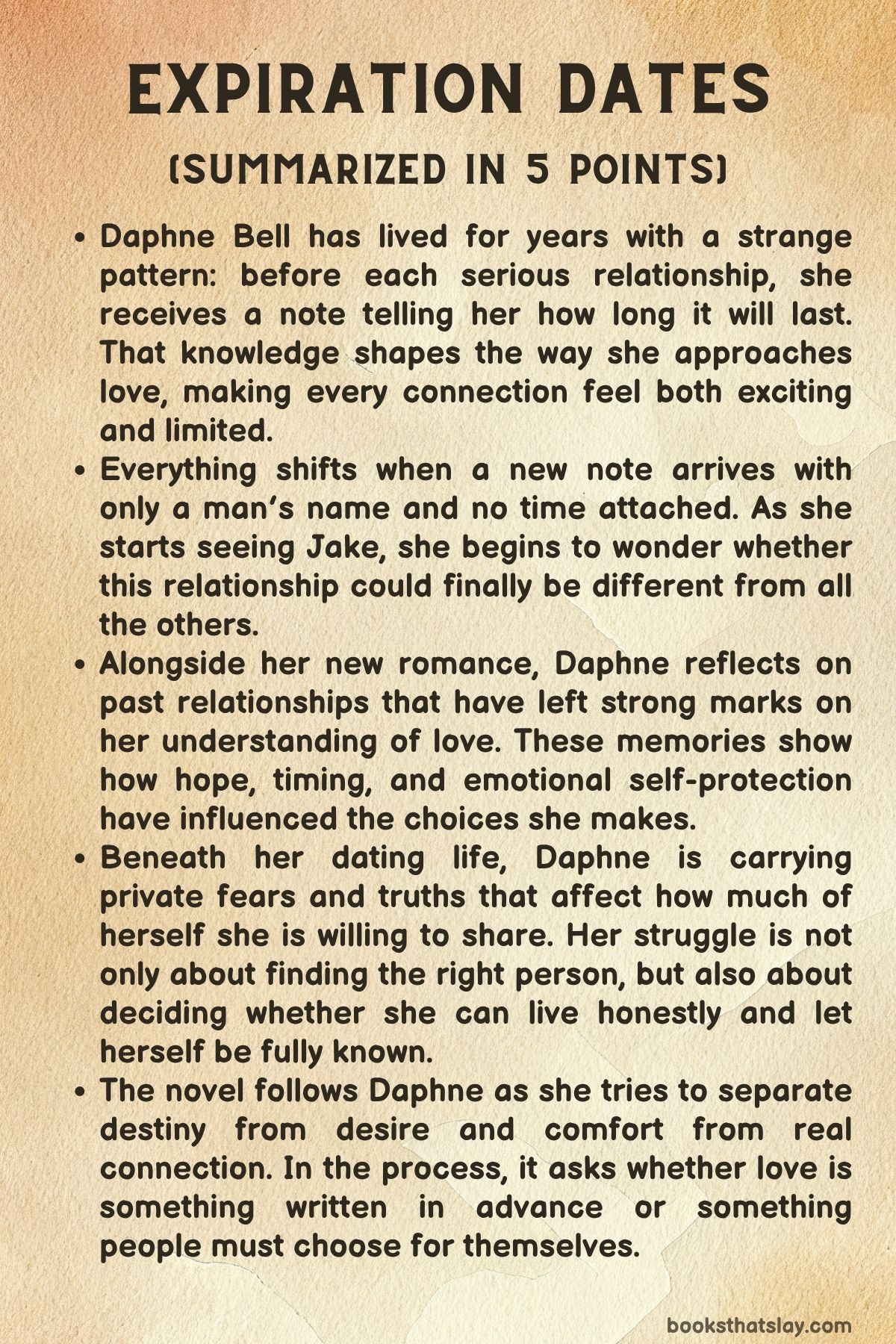
Characters
Daphne Bell
Daphne Bell is the emotional and structural center of the novel. Her life is shaped by two private systems of control: the mysterious notes that tell her how long each romantic relationship will last, and the medical reality of her heart condition.
Together, these forces make her someone who is always measuring risk. She wants love deeply, but she has trained herself to approach it with caution, calculation, and an almost ritual distance.
This creates one of the most interesting tensions in her character: she is a romantic who has learned to behave like a realist. She does not lack feeling; in fact, she often feels more than she can safely express.
What she lacks is trust in permanence, in her body, and in the possibility that she can be loved without becoming a burden.
A major part of Daphne’s character is the way she confuses self-protection with wisdom. Because she knows when relationships will end, she tells herself she is being practical.
Because she is ill, she tells herself she is being responsible by holding part of herself back. Yet much of her behavior comes from fear rather than clarity.
She often withholds truth, not because she is dishonest in a cruel sense, but because she cannot bear what honesty might demand from other people. She fears pity, dependency, grief, and the possibility of being chosen fully and still lost.
That makes her guarded, evasive, and at times frustrating, but it also makes her very human. Her emotional life is built around trying to minimize damage, even when that effort causes damage of its own.
Daphne’s development lies in her gradual rejection of the story she has built about herself. For years, she acts as though her illness has marked her as fundamentally separate from other people, and as though love must always be managed with one eye on loss.
By the end, she begins to understand that uncertainty is not unique to her. Her scars, her vulnerability, and her fear do not make her less whole.
This realization changes how she sees romance, choice, and self-worth. Her final movement is not simply toward one man over another; it is toward a life in which she no longer lets fear masquerade as fate.
That is what gives her arc its force. She does not become a different person.
She becomes more honest about who she has been all along.
Hugo
Hugo is one of the most layered characters in Expiration Dates because he exists in multiple roles at once: former lover, best friend, unfinished possibility, and emotional mirror. He is charismatic, socially fluent, attractive, and often entertaining, but beneath that polish is a man who feels deeply and remembers everything.
His relationship with Daphne is powerful because he understands her in a way that no one else does. He knows about the notes, he has seen the cost of her fear, and he has lived inside the closeness and distance she creates.
That knowledge gives him a special place in her life, but it also traps him. He is never entirely free of what they were to each other.
What makes Hugo compelling is that he is neither a fantasy nor a simple obstacle to Daphne’s relationship with Jake. He is flawed, jealous, proud, and sometimes emotionally immature.
He can be performative, especially when he feels threatened, and he often hides sincerity behind style or wit. At the same time, his flaws come from genuine feeling rather than shallowness.
He does not want a symbolic version of Daphne. He wants the difficult, inconvenient, fully real one.
That becomes central to his importance in the novel. He pushes against the stories she tells herself and challenges her tendency to treat love as something that must fit a prediction or a plan.
His most consequential act, replacing Jake’s note, is ethically messy and emotionally revealing. It is a violation, but it is also the clearest expression of what he believes Daphne needs: the experience of choosing without a script.
That decision shows both his selfishness and his insight. He wants her, but he also wants her freedom from the very system that has defined her life.
In that sense, Hugo represents love not as safety or certainty, but as honesty and risk. He is the character who refuses to let Daphne hide inside explanation.
By the end, he becomes the person waiting not because fate selected him, but because both of them have finally arrived at a more truthful place.
Jake Green
Jake is written as a deeply decent man, and that decency is central to both his appeal and his limitations. He is thoughtful, attentive, emotionally mature, and serious about commitment.
Unlike many romantic leads who are defined by mystery or volatility, Jake is defined by steadiness. He listens carefully, takes love seriously, and offers Daphne an adult kind of partnership rooted in patience and care.
His grief over his late wife has made him more intentional rather than more closed. He understands loss, and that experience has sharpened his desire for something deep rather than casual.
Jake’s role in the story is not simply to be the safe choice. That description is too shallow for what the novel is doing with him.
He is genuinely loving, and he gives Daphne much of what she claims to want: reliability, tenderness, dignity, and room to be considered seriously. He clears space for her in his home, imagines a future with her, and responds to her illness with compassion rather than retreat.
In many ways, he behaves exactly as a good partner should. That is why his character matters.
He is not made lesser in order to justify Daphne’s eventual decision. He remains admirable, which makes her choice more painful and more honest.
At the same time, Jake carries his own unresolved needs. His history with his first wife suggests that part of his love is tied to rescuing, protecting, and enduring loss with dignity.
Daphne begins to understand that he may be trying to create meaning from his past grief through the relationship. This does not make his love false, but it does complicate it.
He is not only offering stability; he may also be trying to redeem an old wound. As a result, Jake represents a kind of love that is sincere and good but not entirely right for Daphne.
He is crucial because he shows that being loved well is not always the same as being loved rightly.
Tae
Tae occupies a major emotional place in Daphne’s past because he is connected to the period when her life changed most dramatically. He enters as a bright, capable, serious young man, and he becomes the partner who stays through the nightmare of her diagnosis and treatment.
His devotion is not abstract. He sits with her in hospitals, supports her family, and remains present through pain, fear, and uncertainty.
In narrative terms, he represents loyalty under pressure, but on a character level he also represents the way crisis can reshape intimacy.
What makes Tae significant is that his love is both genuine and limited. He cares for Daphne with extraordinary consistency, yet over time he becomes tied to the version of her who is sick and in need.
When she starts trying to reclaim herself beyond patienthood, their relationship cannot survive the shift. This does not make him cruel or weak.
It makes him someone whose connection to her was formed inside emergency and could not easily adapt once the emergency passed. That is a subtle and painful truth, and the novel handles it with sympathy.
Tae helps explain why Daphne later fears being known through illness. He loved her, but the relationship left her with the sense that once someone sees that vulnerable version of her, they may never fully see the rest.
He is therefore not just an old boyfriend; he is part of the psychological foundation of her secrecy. His presence in the story adds emotional depth because he shows that love and caretaking are not always enough to sustain a shared future.
Kendra
Kendra serves as one of Daphne’s clearest links to ordinary emotional reality. She is practical, warm, observant, and more grounded than Daphne in matters of commitment.
As the friend who sets Daphne up with Jake, she helps move the plot, but her deeper function is to offer a perspective shaped less by fear and more by lived partnership. She does not romanticize love in a dreamy way; instead, she sees it through action, consistency, and the daily choice to build a life with someone.
Her conversations with Daphne often reveal the gap between what Daphne says she wants and what she actually allows herself to accept. Kendra’s marriage becomes an important contrast to Daphne’s revolving, time-limited relationships.
She is not presented as smug or simplistic; rather, she represents the possibility that love can be both exciting and stable without becoming a trap. She is also one of the few people willing to name patterns Daphne would prefer not to examine, especially where Hugo is concerned.
Kendra’s value as a character lies in her emotional clarity. She understands that partnership is not about abstract perfection but about safety, recognition, and being able to remain fully oneself over time.
Through her, the novel introduces a version of love that is less dramatic than Daphne’s fantasies but more durable than many of her experiences. Kendra is not central in a plot sense, yet she is central in a thematic sense because she keeps pointing Daphne back toward honesty.
Irina
Irina is more than an employer figure. She is one of the adult women who helps shape Daphne’s later life, and she offers a form of mentorship that is sharp, unsentimental, and affectionate in its own style.
Working for a powerful film producer gives Daphne proximity to glamour, pressure, and ambition, but Irina’s importance comes from how she treats Daphne as capable rather than fragile. In a story where Daphne often fears being reduced to her illness, Irina stands out as someone who refuses to do that.
Irina’s own romantic life, especially her long, unstable connection with Penelope, provides a mature counterpoint to Daphne’s emotional education. She understands that love can be real and still not be enough to make a relationship work.
This idea becomes one of the novel’s most important truths. Irina does not speak in sentimental formulas.
She sees the gap between passion and compatibility, between longing and sustainability. Because of that, her advice carries weight.
She also reflects a version of female adulthood built on competence and self-possession. She values Daphne, promotes her growth, and eventually helps open a new professional future for her.
In that respect, Irina’s role extends beyond romance. She reminds Daphne that identity cannot rest only on who one loves.
Work, self-definition, and the ability to step into a larger life matter too. That contribution is essential to Daphne’s final movement toward independence.
Debra Bell
Debra, Daphne’s mother, is loving, socially engaged, and at times gently overbearing in the way many caring parents are. She belongs to the world of family expectations, cultural belonging, and visible concern.
Her questions about Daphne’s dating life, background, and future are not merely comic touches; they show a mother trying to place her daughter inside a life she can understand and bless. Debra wants Daphne to be happy, but she also wants that happiness to take recognizable form.
At a deeper level, Debra’s character carries the history of Daphne’s illness. She has seen her daughter at her weakest, helped care for her body, and lived through the terror of almost losing her.
That past shapes the emotional atmosphere around her, even when she is speaking casually. Her protectiveness comes not only from personality but from trauma.
She belongs to the circle of people who know what Daphne has survived, and that history gives their relationship tenderness as well as pressure.
Debra helps define Daphne’s sense of home. She represents continuity, care, and the version of love that shows up in routines, meals, memory, and community.
Even when she is not at the center of a scene, she strengthens the novel’s emotional world by reminding the reader that Daphne’s choices affect not only romantic partners but also the family that has lived alongside her fear.
Moshe Bell
Moshe is one of the wisest and most emotionally balanced figures in the novel. He offers Daphne a form of love that is gentle, philosophical, and quietly direct.
Unlike characters who try to solve her life for her, he helps her think more honestly about it. His conversations with her, especially late in the story, are important because he cuts through the idea that her uncertainty is uniquely tragic.
He reminds her that no one’s time is guaranteed and that life always involves risk, whether people admit it or not.
What makes Moshe memorable is the calm depth of his perspective. He does not minimize Daphne’s illness, but he refuses to let her use it as a justification for self-erasure.
His understanding of love is generous without being naive. When he tells her that love is a net, he gives the novel one of its clearest ways of imagining care: not as control, rescue, or certainty, but as something that can hold a person through falling.
That idea reframes how Daphne sees both loss and attachment.
As a father, he embodies support without domination. He does not tell her whom to choose.
He tells her to follow her heart. In a story full of signs, predictions, and hidden scripts, Moshe becomes a voice for lived truth rather than magical certainty.
His role is relatively small in terms of page time, but his emotional impact is large.
Murphy
Murphy, Daphne’s dog, might appear at first to be comic relief, but he carries real symbolic and emotional importance. He is her most constant companion, the relationship in her life that has lasted the longest, and a quiet marker of her need for attachment that does not come with romantic danger.
Daphne projects personality onto him in funny ways, but the humor only underlines how much he means to her. He is domestic comfort, loyalty, and continuity.
Murphy becomes especially important during one of the novel’s most intense moments, when he runs off just as Daphne’s understanding of her life is collapsing. Her panic over losing him reveals how deeply she values constancy, and his return becomes a small but meaningful expression of devotion.
He does not leave her. That matters in a story where so much is measured by endings.
In a broader sense, Murphy represents uncomplicated love. He asks nothing of Daphne except presence.
He does not need her to explain herself, protect him from truth, or promise a future. His role may be quieter than the human characters, but emotionally he anchors the world around her.
Josh
Josh is important because he represents Daphne’s hunger for normal life after illness. Their relationship arrives during a period when six months feels enormous to her, not because of romance alone but because survival itself has altered her sense of time.
Josh is careful, responsible, and outwardly decent. He insists on handling workplace boundaries correctly before dating her, which marks him as conscientious and adult.
Yet Josh also reveals one of Daphne’s recurring fears: that she may be loved provisionally rather than finally. His return to his former girlfriend confirms the suspicion that she is not the person he truly wanted, only the person who happened to be there for a while.
That emotional wound matters because it sharpens Daphne’s longing to be chosen with certainty. After Josh, she decides never to doubt the notes again, which shows how much the breakup hardens her reliance on external structure.
Josh is not written as a villain. He is more ordinary than that, and that is exactly why he matters.
He embodies the disappointment of being almost enough, of building something that looks stable until it suddenly reveals itself as temporary. His character deepens Daphne’s fear of investing in a future that may belong to someone else.
Noah
Noah belongs to the early San Francisco period of Daphne’s adulthood, when life still feels open, mobile, and full of possibility. Their brief relationship captures the excitement of being newly untethered and young enough to treat short-term romance as adventure.
He is less psychologically central than Hugo, Jake, or Tae, but he helps establish Daphne’s earlier relationship to time. Five weeks once felt exciting rather than devastating.
His importance lies in what he reveals about the younger Daphne. With him, she is still capable of meeting limitation with curiosity instead of dread.
The relationship is part of her education in how desire, youth, and temporary connection can feel meaningful even without permanence. That phase of her life contrasts sharply with the heavier emotional stakes of her later relationships.
Noah’s presence reminds the reader that Daphne was not always ruled by fear in the same way. There was a period when transience itself could feel beautiful.
That memory adds texture to her character by showing what has changed over time.
Martin
Martin functions as a brief but revealing episode in Daphne’s romantic history. He is tied to Paris, fantasy, and the appeal of experience itself.
Their affair matters less because of who he is as a person and more because of what the situation means to her. He represents the kind of romance that becomes memorable because of context, atmosphere, and the story one tells afterward.
Through Martin, the novel shows Daphne’s awareness of performance in her own life. She knows she is partly interested in the idea of having had a Paris romance, which means she is capable of standing inside an experience while already imagining how it will look in memory.
That self-awareness is a recurring trait in her character. She often narrates her life to herself even as she lives it.
Martin therefore serves a subtle purpose. He shows the difference between intensity and depth.
Something can feel vivid and still not matter very much. That distinction becomes increasingly important as Daphne learns to separate fantasy from truth.
Stuart
Stuart represents projection more than intimacy. Because he is connected to Daphne’s youth and later reappears as a polished, successful adult, he briefly allows her to imagine a neat story of rediscovery and fulfillment.
She is quick to turn him into a symbol of what life might look like if timing and history aligned perfectly.
The reality is much more limited. Their connection lasts only one night, and the note confirms that what felt like the beginning of a larger story was actually just a passing event.
Stuart matters because he exposes Daphne’s tendency to build elaborate futures from emotionally charged moments. She does not merely respond to people; she often responds to what they allow her to imagine.
He is useful as a character because he reveals how strongly Daphne wants meaning and pattern. Even before the note corrects her, the encounter shows how quickly she can move from possibility to fantasy.
That tendency follows her into later relationships in more serious ways.
Penelope
Penelope appears mostly through Irina’s discussions of their long and unstable history, but she still plays an important thematic role. She represents a relationship sustained by real feeling yet undermined by incompatibility.
Her bond with Irina has passion, repetition, attachment, and history, but not the structural strength needed for peace. Through Penelope, the novel insists that love alone does not automatically create a workable life.
Although Penelope is not given as much direct development as other characters, her presence helps widen the novel’s emotional argument. Not every failure in love comes from lack of feeling.
Sometimes two people care deeply and still cannot build something healthy or lasting together. That idea matters for understanding not only Irina, but also Daphne’s eventual choices.
Penelope thus functions as a supporting character with thematic weight. She helps frame the distinction between wanting someone and being able to live well with them, which is one of the novel’s most important questions.
Saber
In Expiration Dates, Saber, Jake’s dog, is a small but effective supporting presence. Like Murphy, Saber helps create a domestic world around his owner.
He reflects Jake’s warmth, steadiness, and capacity for care. The meeting between the two dogs quietly mirrors the merging of Daphne and Jake’s lives, suggesting the possibility of shared routine and home.
Though Saber is not deeply explored, the dog adds texture to Jake’s character. People who care well for animals often reveal themselves indirectly, and that is true here.
Saber contributes to the sense that Jake’s life is stable, adult, and open to partnership. He helps make Jake’s world feel welcoming, lived-in, and real.
Themes
Fate, Choice, and the Need for Certainty
Daphne’s life is shaped by a private system that appears to turn love into something measurable. The notes she receives before each important relationship give her a beginning, a person, and an ending.
That pattern creates the illusion that uncertainty can be managed if she only accepts the terms. For much of the novel, she treats this system as a form of truth.
It allows her to believe that heartbreak is not random, that attachment has boundaries, and that emotional risk can be controlled in advance. The notes are therefore not only a magical device.
They are also a structure Daphne uses to make life feel survivable. She does not have to ask whether to trust, whether to stay, or whether to imagine a future, because the note has already done that work for her.
What makes this theme so powerful is that the story slowly exposes how certainty can become its own kind of prison. Daphne believes that knowing the length of a relationship protects her, but in practice it limits her emotional freedom.
She calibrates her feelings instead of living them. She chooses how much to care based on what she expects to lose.
In that sense, fate becomes less a cosmic truth than a habit of self-containment. The notes let her avoid the full vulnerability of choice, because choice would mean admitting that love is not safe even when it lasts.
A relationship can be real and still fail. It can be sincere and still end.
It can bring joy without a guarantee.
The revelation that Hugo replaced Jake’s note forces a complete rethinking of this system. The moment matters not only because it exposes deception, but because it removes the logic Daphne has used to organize her romantic life.
If Jake was never meant to be forever, then their relationship existed because they both participated in it, not because destiny approved it. That truth is frightening because it places responsibility back in human hands.
It asks Daphne to live without a script and to accept that meaning is not handed down in advance. She must decide what she feels, what she wants, and what she is willing to risk.
This theme gives the novel much of its emotional tension. It asks whether people truly want freedom if freedom means living without guarantees.
Daphne’s answer changes over time. At first, she clings to explanation.
By the end, she allows the possibility that not knowing may be more honest than certainty. Her choice not to chase the final note is the clearest expression of that growth.
She no longer needs fate to authorize her future. That moment turns the story away from prediction and toward agency.
Love is no longer valuable because it is promised. It becomes valuable because it is chosen.
Love, Safety, and Emotional Truth
The novel draws an important distinction between being loved and being known, and that distinction shapes nearly every major relationship. Daphne does not simply want affection.
She wants the kind of love that can hold her whole self, including fear, illness, messiness, contradiction, and desire. The problem is that she often cannot offer that whole self in return.
She edits herself constantly. She hides her medical condition, downplays her emotional needs, avoids difficult conversations, and performs versions of herself that seem easier to accept.
Because of this, safety becomes a complicated idea. It is not just about whether someone is kind.
It is about whether she can be unguarded without feeling ashamed.
Jake represents one form of love: stable, mature, thoughtful, and deeply generous. He gives Daphne space, patience, and care.
He responds to her illness with seriousness rather than retreat. He imagines a future with her and tries to make room for her in his life in both practical and emotional ways.
Yet the relationship still fails, not because his love is false, but because Daphne cannot fully inhabit it. She feels protected with him, but she also feels herself becoming too careful, too polished, too apologetic.
Safety in that relationship begins to resemble containment. She appreciates what he offers, but appreciation is not the same as emotional alignment.
The novel is careful here. It does not treat Jake as inadequate.
It shows that a good relationship can still be the wrong one if it asks a person to remain only partially visible.
Hugo represents another form of love, one tied less to stability and more to recognition. He sees the parts of Daphne she would rather keep hidden.
He knows her habits, her evasions, her private logic, and her fear. He is not always easy, and he is not always emotionally graceful, but he insists on truth.
He wants not the edited version of her, but the difficult one. That insistence matters because Daphne has spent years believing that honesty about herself will either drive people away or turn their care into pity.
With Hugo, love becomes linked to the possibility of being fully seen and still wanted.
The novel also broadens this theme through side relationships, especially through Irina’s view that love alone is not enough and Kendra’s belief that partnership depends on being safe enough to remain fully oneself. Together, these perspectives create a richer understanding of intimacy.
Love is not only desire, sacrifice, or loyalty. It is also the ability to tell the truth and live inside that truth without fear of abandonment.
The emotional force of the novel comes from Daphne’s gradual recognition that she has often accepted partial forms of love because she has offered only partial versions of herself. Her final decision is painful, but it is rooted in a new commitment to emotional truth over appearance, comfort, or destiny.
Illness, Mortality, and the Burden of Self-Protection
Daphne’s heart condition is not just backstory or emotional context. It shapes the way she understands time, attachment, and responsibility.
After surviving cardiac arrest and years of treatment, she develops a life organized around medical uncertainty. Her body becomes something she cannot fully trust, and her future becomes something she cannot imagine in simple terms.
This experience changes her relationship to romance in lasting ways. She does not see herself as someone moving toward an open-ended future like other people.
Instead, she experiences life as provisional, negotiated, and fragile. That fragility affects not only how she sees herself but also how she thinks others will see her.
One of the novel’s most affecting insights is that illness can become an identity even when a person is trying to escape it. Daphne wants to be more than a patient, but she also internalizes the logic of fragility.
She assumes that loving her means taking on a burden. She fears becoming an object of care rather than desire, and she is haunted by the idea that anyone who commits to her is also committing to grief.
This is especially painful because it leads her to present self-protection as kindness. She hides her condition from partners not only because she fears rejection, but because she believes she is shielding them.
In reality, that secrecy keeps her isolated and reinforces the idea that her truth is too heavy to be shared.
The novel also shows that illness affects power within relationships. Tae’s devotion during Daphne’s worst medical years is genuine, yet their relationship cannot survive her movement back toward independence.
With Hugo, she ends the relationship partly because she cannot bear the thought of his love being reshaped by pity or fear. With Jake, she delays honesty because she knows his history with loss and cannot stand the possibility of becoming another person he must watch suffer.
In every case, illness creates not only vulnerability but also guilt. Daphne does not simply fear dying.
She fears what her possible death will do to those who stay.
What makes this theme resonate is that the novel refuses to let illness become a simple moral lesson. Daphne is not magically cured, and her fear is never treated as irrational.
Instead, the story examines the emotional habits that grow around chronic uncertainty. It asks what happens when a person starts to confuse self-denial with responsibility.
Her turning point comes when she begins to see her body differently. Standing before the mirror, she finally recognizes that scars and damage do not erase wholeness.
That realization does not remove mortality, but it changes her relationship to it. She starts to understand that she has been living as if her condition disqualifies her from ordinary human hope.
The novel pushes back against that belief. Mortality belongs to everyone, not only to the visibly vulnerable.
Once Daphne accepts that, she can stop using illness as the sole explanation for every emotional retreat. She remains ill, but she is no longer willing to let illness define the limits of her personhood.
Identity, Reinvention, and the Fear of Disappearing
Daphne spends much of the novel trying to determine whether love can coexist with selfhood or whether commitment always demands some kind of surrender. This tension appears in small domestic details as well as large emotional decisions.
She loves her apartment, her strange collections, her unruly habits, and the life she has made around her own tastes. These things are not random personality markers.
They stand for the self she has managed to preserve after years of medical trauma, romantic disappointment, and fear. Her attachment to them reflects a deeper anxiety: if she settles too fully into someone else’s life, will she still be recognizable to herself?
This concern becomes sharper in her relationship with Jake. On paper, moving in with him makes sense.
He is caring, committed, and willing to make room for her. He even creates a separate space in his apartment because he understands that she values independence.
Yet Daphne still feels uneasy. The comfort of the relationship begins to seem dulling rather than expansive.
She worries that intimacy is turning her into a quieter, dimmer version of herself. This fear is not simple immaturity or avoidance.
It grows from years of already feeling altered by illness, by expectation, and by the need to manage how others see her. She has had too much of her life defined by forces outside her control.
As a result, any form of settling can begin to resemble erasure.
The novel treats identity not as a fixed essence but as something fragile, revised, and often defended through performance. Daphne has long performed competence, distance, charm, and romantic ease.
She has also performed gratitude and manageability in relationships, as though asking for too much would make her less lovable. These performances protect her, but they also separate her from her own desires.
That is why the theme of reinvention is so important. She does not need a new self in the dramatic sense.
She needs permission to stop curating herself for survival.
Her professional shift at the end of the novel matters within this theme as much as her romantic choice. Stepping into a producing role and accepting a future beyond assistant work signals movement toward a fuller adult identity.
Her life is no longer organized only around whom she dates or whether she is chosen. She begins to occupy space differently, with more authority and less apology.
The decision to let the final note blow away completes this transformation. She is no longer asking an outside system to define who she is or what comes next.
Identity, in the end, becomes linked to openness rather than control. She does not finish the story with certainty, but she does finish it with a stronger sense that she can remain herself while stepping into love, work, and time without a script.