Wind and Truth Summary, Characters and Themes
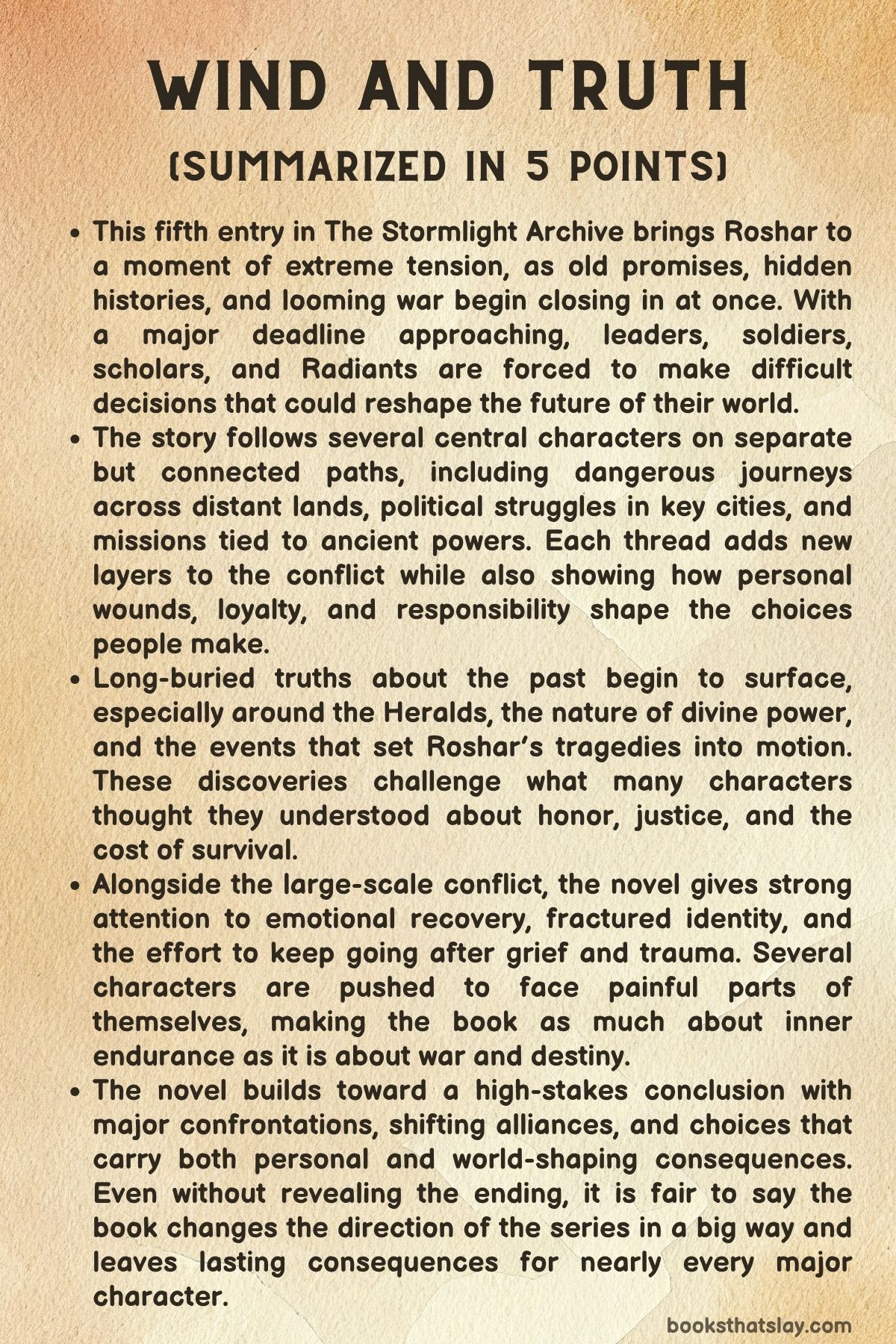
Wind and Truth is Brandon Sanderson’s fifth Stormlight Archive novel, a huge fantasy story set across ten days that decide the future of Roshar. The book brings together war, faith, memory, trauma, politics, and magic on a grand scale while staying close to the personal struggles of its central characters.
Kaladin, Shallan, Adolin, Szeth, Dalinar, Navani, Jasnah, Sigzil, Venli, and others all face choices that test what kind of people they want to be. The story also reaches deep into the ancient past, revealing long-hidden truths about Honor, Odium, the Heralds, and the cycle of suffering that has shaped their world.
Summary
Wind and Truth opens with a look into the past on the night Gavilar Kholin is assassinated. Gavilar is trying to gain immense spiritual power and become something like a Herald.
He has begun meddling with ancient forces far beyond his understanding while also manipulating secret groups for his own rise. His ambitions set the tone for the novel: many people in this world seek power in the hope of controlling fate, but the cost of that desire is often terrible.
Seven years later, Roshar stands on the edge of a final reckoning. Dalinar has made a binding agreement with Odium.
In ten days, a contest of champions will decide the fate of nations. Until then, both sides race to shape the battlefield, seize key cities, and outmaneuver each other through war, politics, and spiritual power.
Kaladin begins the book in a quieter place than before. After years of battle and loss, he has stepped back from command.
Yet peace does not last. He is sent with Szeth to Shinovar, where the mad Herald Ishar may hold answers and where Kaladin’s growing skill in helping damaged minds might matter more than his fighting ability.
Their journey becomes one of the novel’s emotional centers. Kaladin tries to help Szeth face a lifetime of pain, obedience, guilt, and shattered identity.
In return, Szeth’s story unfolds through memories of his childhood, military training, exile, and manipulation by the voice that shaped his life. What Szeth always believed was divine guidance turns out to be the influence of Ishar, whose corruption has poisoned Shinovar for years.
Shallan’s story moves along a different but equally dangerous path. Still struggling to integrate the broken parts of herself, she works with Adolin and others to oppose the Ghostbloods, who are searching for the prison of Ba-Ado-Mishram, an ancient and powerful being whose imprisonment damaged the world.
Shallan learns that the Ghostbloods have been watching her closely and are willing to use anti-Stormlight, a deadly weapon capable of killing spren. Her conflict with Mraize and Iyatil becomes a tense contest of disguise, deception, and survival.
At the same time, she is forced to confront painful truths about her past, including the reality of her mother Chana and the hidden causes behind the return of the current Desolation.
Adolin takes on the defense of Azimir, where one of the enemy’s main attacks will come through an Oathgate. His plotline becomes a story of leadership without magical powers.
He earns the trust of skeptical allies, helps organize the defense, teaches the young emperor Yanagawn strategy, and repeatedly throws himself into battle against impossible odds. Even after terrible losses, including the amputation of his leg, Adolin refuses to stop.
His strength comes not from Radiant oaths but from loyalty, courage, and the trust he has built with both people and spren. Maya’s growth and the support of deadeye spren become one of the novel’s most moving developments, showing that old wounds in Roshar are not beyond healing.
While armies clash in Azimir, on the Shattered Plains, and near Thaylen City, Dalinar and Navani are drawn into the Spiritual Realm. What begins as an attempt to learn more about the past turns into a perilous journey through history itself.
They witness humanity’s arrival on Roshar after destroying its original world. They see the making of the Oathpact, the rise of the Heralds, Honor’s compromises, and the betrayals that shaped the long war.
These revelations transform the moral landscape of the series. Honor was not purely noble.
Odium was not the only source of disaster. Many of Roshar’s deepest tragedies came from fear, pride, and attempts to secure peace through force.
The truth about Ba-Ado-Mishram becomes especially important. Long ago, she was trapped through deception, and her imprisonment had vast consequences for the singers and for Roshar itself.
Shallan, Renarin, and Rlain pursue her prison through the Spiritual Realm while also dealing with Mraize and Odium’s interference. Renarin and Rlain, both touched by powers outside the usual order, become crucial to understanding Mishram not as a simple monster but as a being shaped by pain, fear, and conflicting hopes for her people.
Their growing relationship offers one of the novel’s gentlest strands amid the chaos.
Elsewhere, Jasnah faces Odium in a debate over Thaylen City. This conflict is not won by swords but by philosophy, politics, and moral weakness.
Taravangian, now Odium, proves devastatingly effective because he understands how to exploit contradiction. He turns Jasnah’s own imperfect actions against her and persuades Queen Fen to switch sides.
The scene underlines one of the book’s central ideas: intelligence alone is not enough to defeat someone who can use truth, half-truth, and fear with equal skill.
Venli’s role grows steadily as she leads dissenting singers who reject Odium’s rule. Guided by strange rhythms in the stone, she uncovers the importance of the Shattered Plains and helps create an alliance with Sigzil.
Their plan is not to win by overwhelming force but by controlling territory at the exact moment the contest terms take effect. Sigzil, meanwhile, carries the burden of command in Kaladin’s absence and suffers deeply for it.
His battles with Moash are especially brutal, ending in sacrifice that strips him of Radiant status but saves his spren.
As the final day arrives, every thread tightens. Adolin and a handful of survivors sneak through occupied Azimir to retake the throne room before the deadline.
Szeth, Kaladin, and Nale confront Ishar at the last monastery. Shallan faces Mraize and finally kills both Iyatil and Mraize during the struggle over Mishram’s prison.
Renarin and Rlain choose to free Ba-Ado-Mishram, correcting an ancient wrong despite the risk.
The contest itself brings the book to its most painful decision. Odium names Gavinor, Dalinar’s grandson, as his champion.
The boy has been twisted by time and torment in the Spiritual Realm and filled with hatred toward Dalinar. Dalinar refuses to kill him, but refusing means losing.
Around him, battles rage toward their own deadlines. In Azimir, Adolin defeats Abidi and then stands with a tiny band of defenders until time runs out and the enemy is forced to withdraw.
In Shinovar, Szeth at last claims full ownership of himself and speaks the ideal that declares his moral independence. Kaladin reaches his final ideal as well, realizing that he must protect himself in order to keep protecting others.
With that step, he gains the power needed to stand against Ishar and shield Szeth.
Dalinar’s climax is spiritual rather than military. After learning Honor’s full history, he finally earns the trust of Honor’s power.
For a brief moment he can take it fully and even destroy Odium, but doing so would ruin Roshar. Instead, he chooses a third path.
He gives up his bond to Honor in a deliberate act that reshapes the conflict. Odium destroys the Stormfather and joins with Honor, becoming a new force called Retribution.
Dalinar dies protecting Gavinor, but not before arranging matters so that the new god is immediately threatened by other divine powers across the wider universe.
The aftermath is harsh and strange. Stormlight vanishes.
Only Voidlight remains broadly available, though Navani and the Sibling preserve Towerlight within Urithiru by sealing Navani away in a gemstone. Shallan is trapped in Shadesmar.
Adolin is stranded in Azimir. Sigzil leaves Roshar carrying a Dawnshard.
Wit survives through hidden safeguards on another world. Kaladin becomes the new Herald in a reforged Oathpact designed to spare its members endless conscious torment.
Szeth is left alive, at peace in a way he has never been before, though still marked by grief and loss.
The novel ends in sorrow, sacrifice, and uneasy hope. Dalinar is dead, yet his plan is still unfolding.
Roshar has survived, but in a transformed and more dangerous universe. The old cycle has been broken, though not cleanly, and the future now belongs to those left behind to carry light into a darker age.
Characters
Dalinar Kholin
Dalinar stands at the moral and spiritual center of the novel. His arc is defined by responsibility, guilt, and the burden of deciding not just how to win, but what kind of victory is worth having.
He begins as a man who believes duty can hold the world together if he is strong enough to bear its weight. As the story progresses, he is forced to confront a harder truth: many of Roshar’s disasters were created by people who also believed they were acting for the greater good.
What makes him compelling is that he does not discover simple answers. Instead, he is shown history in all its ugliness and contradiction, including the failures of Honor, the compromises of the Heralds, and the cost of rigid ideals.
His movement through the Spiritual Realm is not only a plot device but a deep test of character. He learns that the foundations of his faith, and even his view of Honor, were incomplete.
Rather than turning away from those revelations, he accepts them. That acceptance becomes the measure of his maturity.
He no longer wants a clean story in which his side is righteous and the enemy is wicked. He becomes willing to understand pain, betrayal, and imperfection without surrendering to cynicism.
That is why he can briefly become worthy of Honor’s power: not because he is flawless, but because he sees clearly and still chooses sacrifice.
His final decision is the defining act of his character. Faced with two terrible options, he refuses both and creates a third path, even though it costs him his life.
He chooses not to kill Gavinor, refuses to let divine power reduce morality to a narrow rule, and acts with long vision rather than immediate triumph. Dalinar ends not as a conqueror but as a tragic architect of survival.
His death confirms the old Blackthorn is gone. In his place stands a man who has learned that strength without wisdom is ruin, and that the highest form of honor may be accepting loss so others can still have a future.
Kaladin Stormblessed
Kaladin’s journey is one of the richest emotional threads in the novel because it moves away from battlefield heroism and toward inner steadiness. He begins in a quieter role, no longer defined purely by command, and that change matters.
For much of the series he has been the man who saves others through force, leadership, and sacrifice. Here, he is asked to save people through listening, patience, and compassion.
The wind calling to him signals that his role is changing. He is still a protector, but protection now includes emotional understanding, moral clarity, and restraint.
His relationship with Szeth brings out the best of him. Kaladin does not lecture or dominate him.
He keeps returning to the simple truth that a damaged person still has agency. That is important because Szeth has built his whole life around surrendering responsibility to others.
Kaladin becomes a healer not by fixing Szeth, but by giving him space to choose. This approach also defines Kaladin’s confrontation with Nale and Ishar.
He repeatedly sees that raw argument cannot restore broken minds. He must reach through memory, empathy, music, and shared pain.
His flute, awkward at first, becomes a symbol of a different kind of strength. Music, once something peripheral, becomes the instrument through which he reconnects another shattered soul to buried compassion.
His final ideal is the culmination of a very long psychological struggle. For years he has believed that protecting others requires endless self-erasure.
By finally saying that he must protect himself too, he completes his deepest lesson. It is not selfishness.
It is balance. He cannot be the shield for everyone if he destroys himself in the process.
The power that follows this realization feels earned because it rests on an emotional truth rather than spectacle. By the end, his acceptance of becoming a Herald is heartbreaking but fitting.
He does not take the role from a desire for glory. He takes it to spare Szeth and to continue protecting others in the widest sense possible.
He becomes, in the purest way, a guardian who understands the cost of guardianship.
Shallan Davar
Shallan’s story is built on memory, identity, and the violence of avoidance. She is one of the most psychologically complex figures in the novel because her struggle is never just against outside enemies.
She is fighting for a stable self. Early on, she is trying to bring her fractured personas back into a more integrated whole, but the book makes clear that healing is not a clean merging where the past disappears.
The return of old patterns, the pressure of Ghostblood manipulation, and the reappearance of forms of self-deception all show that trauma can be managed without being fully conquered.
Her conflict with the Ghostbloods has unusual weight because it is both external and personal. Mraize and Iyatil are not simply villains pursuing power.
They represent the seductive logic of secrecy, compartmentalization, and emotional detachment, all things Shallan herself has used in order to survive. Her infiltration of their hideout, her recognition that she has been watched, and her discovery of anti-Stormlight all place her in a contest where intellect and improvisation matter as much as magical skill.
Yet the deeper threat is internal. She is constantly at risk of surrendering to the old habit of dividing herself into masks rather than facing pain directly.
The revelations about her mother transform her arc. The truth is not merely that her childhood was worse than she fully understood, but that her personal history is entangled with world-altering consequences.
Her mother’s identity, her own childhood self-defense, and the chain of events that followed all place Shallan at the center of vast historical tragedy. But the novel wisely resists turning this into a story of special destiny.
Instead, it remains a story about responsibility without self-annihilation. Her most powerful act is not killing enemies, though she does that too.
It is extending forgiveness while refusing to lie to herself any longer. By the end, after killing Mraize and Iyatil and helping free Ba-Ado-Mishram, she emerges as someone more whole than before, though still unfinished.
Her being stranded in Shadesmar is therefore emotionally appropriate. She is no longer lost in herself, but she is still in transit.
Adolin Kholin
Adolin’s role in the novel is a defense of human worth outside grand destiny. He has no divine calling, no special prophetic status, and no formal Radiant bond of the usual kind, yet he becomes one of the book’s clearest examples of leadership.
His defense of Azimir is not about personal glory. It is about showing up, learning quickly, earning trust, and refusing to abandon people even when the odds become absurd.
He thrives in a story that often favors cosmic scale because he keeps the human scale visible.
One of his greatest strengths is that he makes other people better around him. He teaches Yanagawn strategy without condescension.
He wins over Kushkam not with status but with consistency. He pays attention to soldiers, scribes, civilians, and allies alike.
His social intelligence is as important as his skill with a sword. The book makes it clear that war is not sustained by champions alone, but by relationships, and Adolin excels at building them.
That is why his army holds together as long as it does, and why people keep following him long after easier leaders would have broken.
His injury sharpens rather than diminishes his arc. Losing part of his leg could have turned him into a figure defined by frustration or self-pity, but the story instead uses it to deepen his resilience.
He is forced to fight stripped of his usual fluid confidence, and that makes his later duel with Abidi even more impressive. The moment when his armor chooses him is one of the novel’s strongest affirmations of earned trust.
It is not a reward for being born noble or for speaking sacred words. It is a response to years of loyalty, care, and integrity.
His connection with Maya reaches a remarkable point as well. Through him, deadeye spren are no longer treated as lost remnants of a broken past.
They become participants in the future. By the end, Adolin stands as proof that heroism can come from devotion, humility, and stubborn decency rather than cosmic selection.
Szeth-son-son-Vallano
Szeth’s arc is the most severe study of obedience in the novel. His whole life has been shaped by fear of moral freedom.
As a child, he desperately wanted someone to tell him clearly what was right and what was wrong. That longing made him vulnerable to authority, dogma, and manipulation.
His flashbacks show how thoroughly this need defined him. Every stage of his upbringing pushed him toward the belief that choice was dangerous and submission was safety.
Even when he was capable, gifted, and perceptive, he preferred to hand judgment over to others.
What makes his story powerful is that the novel does not treat this as simple weakness. It shows why surrendering agency can be tempting, especially for someone traumatized and punished for independent thought.
The voice in his head exploited exactly that vulnerability. His training, exile, and later life as an assassin all become extensions of the same wound: he would rather be a weapon than a person responsible for moral judgment.
The Shinovar pilgrimage forces this issue back onto him. Each duel is not just a contest of skill but a confrontation with the assumptions that built his identity.
His conversations with Kaladin become essential because they slowly make another life imaginable. For perhaps the first time, someone refuses to replace one set of orders with another.
Kaladin insists that Szeth choose, and this proves more difficult than any battle. Szeth’s greatest breakthrough comes when he stops asking whether he has permission to act and starts deciding whether action is worthy.
His final ideal, declaring himself his own agent and law, is not arrogance. It is the birth of moral adulthood.
He reaches it only after seeing the damage caused by blind following in his family, his culture, and himself.
The ending leaves him in a striking place. He loses powers, kills those who need release, survives the confrontation with his father, and is spared the burden of becoming a Herald because Kaladin takes that path instead.
For a man who has spent his life defined by sacred burdens, punishment, and service, peace itself becomes the strange new challenge. He ends as a character finally capable of living rather than merely obeying.
Navani Kholin
Navani’s arc combines intellect, emotional endurance, and adaptive courage. She enters the novel not as a warrior but as a scholar-queen, yet she proves just as vital as any fighter.
Her movement through the Spiritual Realm highlights one of her greatest strengths: she observes patterns under pressure. While Dalinar wrestles more openly with moral and spiritual history, Navani studies the mechanics of what is happening around them.
She realizes that anchors matter, that the visions can be navigated, and that escape is possible if one understands the logic beneath the chaos.
Her emotional life in the novel is equally important. She is not merely supporting Dalinar.
She has her own confrontation with old pain, insecurity, and memory. The visions that expose her most difficult moments show that intellectual brilliance has never protected her from hurt.
Yet she is never reduced by those wounds. Instead, she becomes more dangerous to Odium because she learns from them.
She adapts quickly, protects Gavinor as best she can, and eventually escapes the Spiritual Realm through wit and nerve.
In the aftermath, Navani becomes the keeper of continuity. With Dalinar gone and the Stormfather destroyed, she helps preserve what can still be saved.
Her union with the Sibling and her willingness to encase herself in a gemstone to preserve Towerlight reveal the scale of her commitment. She becomes less physically present and more symbolic, a guardian suspended between life and stillness so that a remnant of Roshar’s older light can survive.
She is one of the novel’s clearest examples of intellect transformed into sacrifice.
Jasnah Kholin
Jasnah’s story is one of intellectual authority placed under ruthless scrutiny. She enters as one of the most formidable minds in the coalition, a ruler and thinker whose confidence often appears unshakable.
Yet the novel wisely does not flatter her. Instead, it places her against Taravangian, an opponent uniquely able to exploit the gap between theory and lived behavior.
Her debate for Thaylen City is devastating because it is not decided by who is smarter in the abstract, but by who can better weaponize moral inconsistency.
The core of her arc lies in this tension. Jasnah believes in principle, in rational examination, in ethical seriousness.
But she is also human, bound by attachment, fear, and prior compromise. Taravangian exposes that she cannot always live with pure consistency, and that realization shatters more than her political strategy.
It wounds her idea of herself. This is one of the novel’s strongest uses of her character, because it refuses to let brilliance become a shield against vulnerability.
She loses not because her ideals are worthless, but because ideals without room for human contradiction can be used against the person who holds them.
Even in defeat, however, Jasnah remains significant. She does not collapse into emptiness.
She refuses Odium’s offer and continues to bear the consequences of failure. Her arc suggests that wisdom may require moving beyond the illusion of perfect coherence.
She is left in a painful but potentially fertile position: stripped of certainty, yet not stripped of strength. That makes her one of the characters most likely to change in profound ways after the novel’s ending.
Sigzil
Sigzil’s role is tragic and admirable because he embodies competence under impossible conditions. Left to lead in Kaladin’s absence, he faces overwhelming odds on the Shattered Plains and never really gets the resources needed to win cleanly.
His arc is not about triumph but endurance, calculation, and painful sacrifice. He is thoughtful, disciplined, and strategic, qualities that allow him to hold the line far longer than should be possible.
Yet the story never pretends that smart planning can erase the cost of war. He loses soldiers, loses ground, and loses certainty.
His clashes with Moash carry particular emotional force. Through them, Sigzil is tested not just tactically but spiritually.
The loss of Leyten and the threat to his spren make clear that this battlefield is one where old loyalties and personal grief cannot be kept separate from command. His most defining act comes when he breaks his own bond in order to save his spren from anti-Stormlight death.
That choice is devastating because it preserves another life by tearing apart part of his own identity. He survives, but altered.
By the end, Sigzil becomes a transitional figure in a larger cosmere sense as well. Receiving a Dawnshard and leaving Roshar places him on a path beyond the local war.
But even within this novel, what stands out most is his steadiness. He does not have Kaladin’s mythic emotional pull or Dalinar’s scale, yet he proves indispensable.
He is a portrait of exhausted duty carried with dignity.
Venli
Venli develops into one of the key political and spiritual counterweights in the story. Her importance lies in the fact that she represents a singer future not controlled by Odium and not subordinate to human narratives either.
She is no longer merely reacting to larger powers. She is building an alternative.
Her relationship to song, stone, and rhythm gives her a form of insight distinct from the human characters, and the novel uses that difference well. She senses truths in the land itself, especially around the Shattered Plains, and follows them with increasing confidence.
Her storyline with the dissenting singers and renegade Fused shows her growing into leadership. She must think not only of survival, but of identity, alliance, and what it means to reject one tyrannical structure without simply embracing another.
Her cooperation with Sigzil is especially important because it is practical rather than sentimental. They form peace through necessity, intelligence, and mutual recognition.
The treaty they create is one of the few genuinely constructive political acts in the novel.
Venli also carries thematic weight through her refusal of Odium’s totalizing vision. Even when tempted with security and power, she continues searching for a better path for her people.
By helping secure Narak at the crucial moment, she proves that the singers are not merely pieces in a war between human rulers and divine forces. They are agents in their own right.
Her final position under the altered divine order is uneasy, but she has earned a degree of autonomy that once seemed impossible.
Renarin Kholin
Renarin’s quietness can make him easy to underestimate, but the novel treats him as one of its most spiritually perceptive characters. His outsider status has always shaped him, and here it becomes a source of unusual strength.
Bonded to a spren touched by Sja-anat, he occupies a space between categories, which allows him to sense possibilities that others miss. He is especially important in the search for Ba-Ado-Mishram, where empathy matters as much as magical capacity.
One of Renarin’s greatest qualities is his refusal to reduce others to their threat value. He sees complexity where others see monsters, and this is crucial in his understanding of Mishram.
His sympathy is not naïve. It does not deny danger.
Instead, it opens the possibility that old wrongs must be faced honestly if the world is to heal. This makes him central to the moral movement of the latter part of the novel, where correcting an ancient betrayal becomes more important than preserving a fearful status quo.
His relationship with Rlain adds tenderness and emotional clarity. Their connection grows not through spectacle but through shared vulnerability and recognition.
In a book crowded with war and divine upheaval, their bond offers one of the clearest statements that intimacy itself can be an act of hope. Renarin ends the novel as both witness and participant in a major correction to history, and his gentle strength feels more consequential than ever.
Rlain
Rlain’s character carries the pain of alienation but also the possibility of reconciliation. His memories reveal how much he gave up, and how much he risked, in becoming a bridge between peoples who distrusted one another.
The novel does not romanticize that role. It shows the cost of being the one expected to enter danger for the sake of others, often without enough gratitude or protection in return.
This gives his emotional life a quiet bitterness that feels earned.
Yet Rlain never becomes defined solely by hurt. Like Renarin, he is capable of seeing complexity in beings others would label irredeemable.
His interactions with Ba-Ado-Mishram matter because he approaches singer history from within, not as an observer looking for a useful lesson. He feels the weight of what was stolen from his people.
That gives his role in the decision to free Mishram great moral force.
His romance with Renarin is understated but deeply meaningful. It is not merely a personal subplot.
It symbolizes the possibility of a world no longer governed entirely by inherited division. Rlain’s dignity, patience, and eventual emotional openness make him one of the novel’s most quietly rewarding characters.
Gavinor
Gavinor is one of the most tragic figures in the novel because he is turned into a weapon before he is old enough to understand what has been done to him. Earlier books positioned him as a child marked by trauma, but here that trauma is intensified in horrifying ways.
Odium uses time, memory, and selective truth to age him prematurely and shape his rage against Dalinar. He becomes the perfect champion for a contest built around moral impossibility.
What makes Gavinor so painful is that he is not evil, nor even truly choosing freely in the decisive moment. He is the embodiment of inherited violence.
The sins of older generations have been poured into him until he can no longer distinguish his own pain from the story imposed on him. In that sense, he is not only a person but a judgment on the world that produced him.
Dalinar’s refusal to kill him makes Gavinor central to the novel’s ethical climax. He is the life that cannot be abstracted into strategy.
No argument about the greater good can erase the reality that killing him would mean murdering a child broken by forces beyond his control. Gavinor survives, but survival is not healing.
He remains a wound carried into the future, and that is exactly why he matters.
Taravangian and Odium
Taravangian becomes even more dangerous after fully aligning with Odium because he no longer contains the internal division that once limited him. Before, he could be split between cold calculation and overwhelming emotion.
Now those aspects serve the same imperial purpose. This makes him terrifying not simply because he is cruel, but because he can rationalize cruelty with almost perfect confidence.
He truly believes domination is the surest path to safety, and that belief lets him commit atrocities while still viewing himself as a guardian.
His strength as an antagonist lies in his flexibility. He can argue philosophy with Jasnah, manipulate Gavinor, tempt Venli, exploit Dalinar’s guilt, and destroy whole cities, all while remaining convinced that these acts are necessary.
He is not chaos. He is systematized moral corruption.
That makes him more unsettling than a purely monstrous villain. He understands exceptions, attachments, and human weakness because he shares them.
In fact, the epilogue note that he secretly preserved versions of his family shows the hypocrisy at the core of his worldview. He claims universal necessity while still making personal exceptions.
His transformation into Retribution only increases this danger. By combining with Honor, he gains not just more power but a claim to legitimacy.
He becomes a force that can speak the language of both justice and domination. Yet Dalinar’s final move leaves him strategically exposed.
The novel ends with Taravangian stronger than ever in one sense, but also newly vulnerable in another. That tension makes him a compelling long-term threat rather than a final answer.
Nale
Nale’s role is fascinating because he is both antagonist and victim. He has spent centuries retreating into law because law offered him structure after his mind began to fail.
This makes him frustrating, contradictory, and at times cruel, but the novel also makes clear that his rigidity comes from terror. He clings to external systems because he no longer trusts his own judgment.
That fear sits beneath his harshness.
His confrontation with Kaladin is one of the clearest examples of the book’s interest in healing rather than simple defeat. Kaladin cannot reason him into health through logic alone.
What finally reaches Nale is music, memory, and the reminder of the compassion he once had. This does not erase his past crimes, but it restores some measure of self-recognition.
By surrendering, he becomes one of the few ancient figures in the story who is allowed a genuine moment of return rather than simple collapse.
Nale also matters because he stands as a warning about the danger of replacing morality with system. He followed rules so intensely that he lost sight of why rules should exist at all.
His partial recovery therefore has thematic importance. It suggests that even deeply damaged people may still be called back by empathy.
Ishar
Ishar is one of the most disturbing figures in the novel because he shows what happens when immense authority survives after sanity has failed. He has become convinced that only he can save Roshar, and because he possesses extraordinary knowledge and power, that delusion is not harmless.
He distorts religion, identity, and magical law around himself. Shinovar bears the marks of his corruption in both landscape and people.
His relationship to Szeth is especially damaging. For years he shaped Szeth’s life through the false voice of guidance, exploiting the boy’s longing for certainty.
That manipulation gives Ishar a uniquely intimate villainy. He did not merely oppose people on a battlefield.
He entered the structure of another person’s conscience and warped it.
At the same time, the climax with Kaladin reveals that Ishar is not empty of pain. He is overflowing with it.
The torrent of suffering he forces onto others is also his own burden. This does not excuse him, but it complicates him.
Kaladin’s ability to stand, empathize, and survive that wave of pain shows that Ishar is not beyond understanding, only beyond ruling himself. His defeat is therefore not a simple triumph over evil, but a confrontation with unbearable accumulated damage.
Ba-Ado-Mishram
Ba-Ado-Mishram is one of the most important hidden presences in the novel. For much of the story she exists as rumor, memory, face, prison, and unresolved historical crime.
What makes her compelling is that she is never reduced to one clean category. She is dangerous, angry, and capable of violence, but she is also a victim of betrayal whose imprisonment damaged the fabric of the world itself.
She becomes a symbol of what happens when one side secures peace through treachery and then refuses to reckon with the consequences.
Her significance grows as characters come to understand that the old narrative about her was incomplete. The wrong done to her was not just tactical.
It was spiritual and civilizational. The singers’ history, the failure of Honor, and the broken condition of Roshar all connect to her treatment.
That is why freeing her is such a morally charged act. It is risky, but preserving her imprisonment would mean accepting a foundational injustice.
Even when released, she is not transformed into a benign figure. Her anger remains real.
This is important. The book does not erase trauma by revelation.
Instead, it suggests that truth and release are necessary even when they do not produce immediate reconciliation. Mishram is a character shaped by wounds on a civilizational scale, and her continued volatility feels honest.
Maya
Maya’s growth is one of the most hopeful developments in the novel. Once seen mainly as a damaged remnant of abandoned oaths, she increasingly becomes a being with will, loyalty, and purpose.
Her bond with Adolin has always been unusual because it is based less on formal magical structure and more on care, constancy, and mutual recognition. Here that relationship reaches new importance.
Her decision to gather deadeye spren and bring them into the defense of Azimir changes the terms of what recovery can look like. Deadeyes are no longer merely symbols of a fallen age.
Through Maya, they become active participants in the present. This is not a return to how things were before.
It is something new. They are willing to fight beside humans without simply reproducing the old structure of Radiant bonds.
That makes Maya an agent of renewal.
She also deepens Adolin’s character by proving that his way of relating to others has power. He did not restore her through command or destiny.
He did it through respect. Maya stands for the possibility that relationships built on patience can succeed where systems built on oath alone once failed.
Wit
Wit serves several functions in the novel: trickster, observer, messenger, and one of the few beings who can grasp the scale of what is happening beyond Roshar. He often appears at the edge of events, but his marginal position is deceptive.
He is constantly interpreting the larger stakes, warning others about danger, and preparing contingencies. His awareness that the change in Odium’s vessel creates new loopholes gives him an important strategic role.
At the same time, he remains emotionally distinct from many of the main cast. He is not detached, but he is seasoned by long experience and carries knowledge others cannot yet fully understand.
This can make him seem elusive, though the ending gives him a more vulnerable edge. Retribution destroys him on Roshar, but one of his safeguards restores him elsewhere.
Even in apparent defeat, he persists.
His final perspective is especially valuable because it frames Dalinar’s death not as failure but as part of a larger design. Wit recognizes the brilliance in Dalinar’s sacrifice, which helps the ending land as tragic yet purposeful rather than merely bleak.
He is the witness who can see the board from farther away.
Sylphrena
Syl continues to be much more than Kaladin’s spren companion. In this novel she becomes a participant in his transformation from soldier to healer-protector.
Her interest in reading and writing, her role in the flute scenes, and her emotional responsiveness all reinforce her as a character of curiosity, loyalty, and intuition. She often senses truths before Kaladin can articulate them, especially in moments involving song, memory, and emotional recognition.
Her importance in Kaladin’s final arc is immense because she evolves with him. She is present not only in battle but in therapy, music, and moral conflict.
When she becomes the flute, the symbolism is perfect: she is no longer just the blade or spear that helps him fight. She becomes the instrument through which he helps another soul return to itself.
Syl also matters in the climax with Ishar and the reforged Oathpact because she is part of the wider network of spren trying to survive divine upheaval. Her bond with Kaladin represents a healthier form of mutual support than many older sacred relationships in the series.
She remains playful, but her playfulness now rests on depth rather than innocence.
Pattern
Pattern’s role is quieter than Shallan’s larger dramatic movements, but he remains central to her stability and growth. He is one of the few constants in her life, a companion who can tolerate complexity without demanding false neatness.
His presence helps ground scenes that might otherwise become swallowed by uncertainty or psychological fragmentation. He does not simplify Shallan.
He accompanies her through complication.
He also serves as a reminder that truth in this narrative is rarely singular or comfortable. Pattern is a being drawn to truth, but not always the kind humans find easy to bear.
That makes him a fitting partner for Shallan, whose whole life has been shaped by partial knowledge, hidden memory, and necessary revelation. In the final confrontation with Mraize, Pattern helps make deception itself into a tool of survival.
That combination of honesty and illusion fits Shallan’s arc well.
Testament
Testament embodies the lingering cost of broken bonds. More than many other spren, Testament carries the emotional history of earlier harm directly into the present.
Her existence keeps Shallan’s story from becoming too clean. Healing does not erase the damage Shallan caused as a child, however unknowingly.
Testament stands as a living reminder that trauma can leave permanent marks even when relationships continue.
At the same time, Testament is not just a sign of guilt. She is part of the ongoing effort to move forward honestly.
Shallan’s willingness to engage with her, rather than burying that history, shows real development. Testament therefore represents not only harm but accountability.
Moash
Moash remains one of the bleakest mirrors in the story. Like Kaladin, he comes from pain, betrayal, and deep grievance.
Unlike Kaladin, he has chosen numbness over responsibility. His willingness to let Odium direct his pain makes him dangerous in a very particular way.
He is effective precisely because he has hollowed himself out. He kills without the hesitation that conscience would create.
His conflict with Sigzil and the Windrunners highlights this moral emptiness. He is no longer trying to justify himself in any meaningful human sense.
He has become a tool that knows it is a tool and prefers it that way. That makes him a dark counterpart to Szeth.
Where Szeth painfully fights toward agency, Moash abandons it.
Even so, the novel does not make him uninteresting. His continued presence matters because he demonstrates what surrender to pain can become when there is no corrective force of empathy, friendship, or self-examination.
He is not the grand villain, but he is one of the most intimate embodiments of spiritual ruin.
Gavilar Kholin
Though he appears mainly through the opening material and through the long shadow of his choices, Gavilar remains one of the most important shaping figures in the narrative. He is ambition stripped of humility.
He believes he can handle secrets, powers, and ancient conflicts because he views himself as uniquely suited to rise above ordinary limitations. That arrogance does not die with him.
Its consequences echo through the entire story.
He represents a recurring problem in the series: the belief that sufficient will and intelligence justify meddling with forces one does not understand. Unlike Dalinar, Gavilar never seems to grow into moral seriousness.
He seeks transcendence without surrender, authority without wisdom. This makes him a useful contrast to the characters who do change.
His failure is not only political or spiritual. It is a failure of self-knowledge.
Yanagawn
Yanagawn grows impressively through his association with Adolin. He begins as a young ruler lacking formal military education, but he is not weak.
What he lacks in experience he makes up for in adaptability, courage, and willingness to learn. Adolin’s mentorship works because Yanagawn is eager to develop rather than hide behind rank.
His biggest contribution to the novel is that he understands the meaning of holding power physically and symbolically. His decision to keep fighting for the throne room, even when retreat would be easier, shows that he learns quickly what sovereignty means in wartime.
He is never presented as a grand military genius, but as someone becoming worthy of rule through action. That makes him one of the book’s more satisfying secondary successes.
Queen Fen
Fen plays a smaller but very important role as the ruler whose choice reveals the effectiveness of Taravangian’s manipulation. She is practical, proud, and deeply concerned for her people.
Her decision to side with Odium is not framed as simple cowardice but as the result of political pressure, philosophical persuasion, and fear. This makes her choice frustrating but believable.
She matters because she stands for the kind of leader who can be moved not by devotion to evil but by a mix of self-preservation and strategic calculation. Her shift changes the balance of power and proves that the enemy can win through persuasion as well as destruction.
Cultivation
Cultivation remains mysterious, but this novel highlights both her insight and her limits. She sees large patterns and gives crucial guidance, especially to Dalinar, yet her methods are not beyond moral question.
Her attempt to force Taravangian through the destruction of what he loves backfires disastrously. This shows that long-term planning and subtle intervention are not guarantees of wisdom.
She is compelling because she is neither passive nor all-knowing. She understands transformation, but even she cannot perfectly control what growth or pressure will produce.
Her contrast with Honor and Odium continues to be one of the wider metaphysical tensions of the series.
The Stormfather
The Stormfather undergoes one of the most revealing recontextualizations in the novel. Once a symbol of harsh but reliable divine continuity, he is shown to be carrying fear, secrecy, and inherited damage from Honor’s fall.
His reluctance to let Dalinar see the full truth is not simple malice. It is protective, ashamed, and deeply anxious.
He knows too much about how ideals can fail, and that knowledge makes him resistant to transparency.
This gives him an unusually tragic dimension. He is both a guardian and a damaged archive.
His death at the hands of Odium is therefore more than the destruction of a powerful being. It is the collapse of a major line of continuity between Roshar’s present and its sacred past.
His loss is one of the reasons the ending feels like a true turning point rather than a temporary crisis.
Noura, May, Notum, and other supporting figures
In Wind and Truth, many supporting characters add texture and emotional reinforcement to the larger arcs. May helps reveal Adolin’s ability to work with former connections in mature ways rather than shallow nostalgia.
Notum’s willingness to help without taking a standard human bond points toward new relationships between spren and mortals. Noura’s act of sitting on the throne matters because it shows that survival often depends on ordinary courage at the right moment.
Characters such as Hmask, Zabra, Kushkam, and Neziham strengthen the Azimir storyline by making it feel like a defense carried by a living community rather than by a single hero. Their presence gives the battles moral weight because they remind the reader what, and who, is actually being protected.
Themes
The burden of choice and the refusal to surrender moral agency
A central concern in Wind and Truth is the question of what it means to choose for oneself when every tradition, institution, and divine force seems to demand obedience. The novel returns again and again to characters who have been shaped by commands, vows, inherited duties, and rigid systems of belief.
What gives this theme its force is that the story does not treat obedience as a simple weakness. In many cases, obedience begins as a survival strategy.
People accept rules because rules promise order. They submit to authority because authority seems to offer protection from uncertainty.
Yet the novel steadily shows that moral collapse often begins when a person stops examining whether an order deserves to be followed.
Szeth’s journey gives this theme its clearest and most painful shape. His life has been defined by the desire to escape the terror of personal responsibility.
He wants right and wrong to be settled by somebody else, because choice feels unbearable. The tragedy of his life is not only that he was deceived, but that he trained himself to believe deception was preferable to freedom.
His development across the novel turns this theme into something deeply human. He does not become wiser by receiving a better set of instructions.
He becomes wiser when he finally understands that no authority can remove the burden of judgment from him. His final growth comes through accepting that he must decide what is worth doing and what is not.
This idea also appears in Kaladin’s role as a healer, in Jasnah’s public defeat, in Dalinar’s crisis before the contest, and even in the history of the Heralds. Each of these storylines asks whether morality can be outsourced to law, oath, divine command, or ideology.
Nale clings to law because he no longer trusts his own mind, but the novel shows that law without conscience becomes cruelty. Jasnah relies on principle, but she learns that principle alone cannot spare a person from contradiction.
Dalinar faces the most extreme version of the problem when he is forced to choose between two terrible options, neither of which can be made clean through logic.
The power of this theme lies in the novel’s refusal to offer comfort. It does not say that choosing for oneself guarantees wisdom.
It says something harder: moral adulthood begins when a person accepts that no sacred structure can fully protect them from the responsibility of judgment. Freedom is frightening because it removes excuses.
Yet the novel treats that fear as the necessary price of becoming whole. In that sense, its deepest idea is that goodness is not passive loyalty to a rule, but active willingness to bear the weight of choice.
Trauma, memory, and the struggle to become whole without denying pain
The novel treats trauma not as background material that explains behavior and then fades away, but as an active force that shapes identity, perception, and moral possibility. Memory in this story is not stable, and the past is not safely buried.
Instead, old wounds keep returning through visions, fractured selves, repeated patterns, and inherited emotional damage. What makes the treatment of this theme so strong is that the story does not reduce healing to revelation alone.
Discovering the truth matters, but truth by itself does not erase pain. The past remains powerful even after it is understood.
Shallan’s storyline is one of the clearest expressions of this idea. Her fractured identity shows that trauma can divide the self into separate modes of survival.
She has learned to live through masks, substitutions, and compartmentalized memory. Yet the novel does not treat those defenses with contempt.
They were once necessary. The tragedy is that what once helped her survive now prevents her from becoming fully present in her own life.
Her progress comes not from pretending the damage never happened, but from refusing to let avoidance govern her any longer. The revelations about her mother intensify this process by tying private suffering to large historical catastrophe.
Even then, the novel keeps the emotional focus personal. The real challenge is not simply learning what happened, but choosing to live without hiding from it.
Dalinar and Navani face trauma differently, through visions that force them to revisit moments of shame, violence, helplessness, and grief. Their passage through the Spiritual Realm makes memory almost physical.
Pain becomes something entered and endured rather than merely remembered. Dalinar’s arc is especially powerful because he does not try to edit his life into a more flattering story.
Even when given openings to revise the past in symbolic ways, he comes to see that healing does not come through denial. He must face what he did, what it cost others, and what it taught him.
That acceptance becomes part of his moral authority later in the book.
The novel also widens this theme beyond individual characters. Roshar itself feels traumatized.
The world has been marked by ancient betrayals, broken oaths, imprisonment, and recurring cycles of devastation. Ba-Ado-Mishram’s imprisonment functions as a kind of civilizational wound, one that distorts everything built on top of it.
In that sense, the story suggests that trauma is not only personal but collective. Societies can normalize damage, build myths around it, and call the result stability.
What emerges from all of this is a demanding vision of healing. The novel does not promise restoration to innocence.
It suggests that wholeness comes when people stop trying to become untouched and instead learn how to live truthfully with what has marked them. Pain remains part of them, but it no longer has total power over their identity.
That is why the most meaningful acts of recovery in the novel are tied to honesty, empathy, and forgiveness rather than forgetfulness.
Honor, law, and the danger of reducing morality to rigid ideals
One of the most compelling achievements of the novel is the way it questions the very ideals that fantasy stories often celebrate without hesitation. Honor, vows, law, duty, and righteousness all matter here, but the narrative refuses to treat them as automatically good.
Instead, it asks what happens when noble principles are stripped of context, empathy, and humility. The result is not moral clarity but disaster.
The novel is deeply interested in the difference between a principle that guides life and a principle that hardens into an instrument of harm.
Dalinar’s journey through history reveals that even Honor itself is not beyond failure. This is crucial to the theme.
The story could have left Honor as a symbol of pure order opposed to Odium’s destruction, but instead it shows that Honor made compromises, justified betrayal, and caused suffering while still acting in the name of a larger moral framework. That complexity changes the entire philosophical field of the novel.
If even a divine power associated with honor can become narrow, fearful, or self-justifying, then no oath can be accepted as good simply because it is an oath.
Nale’s arc gives this issue a more personal and psychological shape. He clings to law because law feels stable.
It promises a rule that exists outside the uncertainty of failing judgment. Yet the novel shows that once law becomes a refuge from conscience, it turns hollow.
Nale is not evil because he values order. He becomes dangerous because he values order more than moral perception.
He prefers consistency to compassion. His partial restoration through music and memory makes clear that the book sees empathy, not abstraction, as the missing element that law cannot generate by itself.
Jasnah’s debate with Taravangian pushes the theme in another direction. She is intellectually serious, ethically engaged, and committed to reason, yet she is undone when her principles are tested against the messier reality of human action.
Taravangian exposes the gap between what she professes and what people actually do when confronted with love, fear, and survival. The point is not that principle is useless.
The point is that moral systems collapse when they imagine themselves above contradiction. Taravangian is able to win because he understands that high ideals can be turned against those who hold them if those ideals do not account for human complexity.
Dalinar’s final decision resolves this theme in a powerful way. He receives Honor’s power not because he worships simplicity, but because he understands the failures built into simplicity.
He sees that an oath can protect, but it can also trap. He sees that duty can be noble, but it can also excuse cruelty.
His choice at the climax rejects both sentimental innocence and ruthless utilitarianism. The novel therefore presents true honor not as perfect obedience to a fixed code, but as the difficult practice of holding principle and human reality together without sacrificing either entirely.
Sacrifice, protection, and the cost of trying to save a world
Protection in the novel is never cheap. The story keeps asking what it really means to save other people when every act of defense seems to demand pain, compromise, or loss.
This is not a simple celebration of heroic sacrifice. In fact, the novel is often suspicious of sacrifice when it becomes self-destructive, performative, or disconnected from wisdom.
Instead, it studies the cost of protection from many angles and asks whether saving others can still be meaningful when the savior cannot preserve everything.
Kaladin’s arc gives this theme emotional clarity. For much of his life, he has equated protection with relentless self-erasure.
He survives by becoming indispensable to others, by carrying burdens that should break him, and by assuming that his own well-being matters less than the lives around him. The novel challenges this pattern directly.
His final ideal is powerful because it reframes sacrifice. He realizes that protecting others does not require destroying himself.
This is one of the most mature statements in the story. It does not reject sacrifice, but it rejects the fantasy that a protector can remain effective while treating his own life as disposable.
Adolin’s defense of Azimir offers a different version of the same theme. He is not a chosen savior with cosmic power.
He is a battered commander trying to hold a city together through discipline, courage, and loyalty. His sacrifice is physical, immediate, and visible.
He loses part of his leg, fights through exhaustion, and keeps returning to the field despite every rational excuse to stop. Yet the novel avoids making him merely a martyr figure.
His strength comes from community. He protects by teaching, encouraging, trusting, and standing with others rather than above them.
That makes his endurance feel human rather than mythic.
Dalinar brings the theme to its largest scale. He is forced into a situation where any available choice will cost dearly.
His sacrifice is not only personal but strategic and metaphysical. He gives up victory in the obvious sense in order to preserve a future that still contains possibility.
His death protecting Gavinor completes a long moral transformation. He once believed strength meant imposing order through force.
At the end, strength means accepting loss so that another life is not treated as expendable. It is an act of protection stripped of glory.
The theme also extends into the reforged Oathpact. Kaladin and the Heralds choose renewed burden in order to defend the spren and hold back annihilation.
Yet even here the novel modifies the old ideal of sacrifice. The new arrangement is shaped by compassion.
Endless torment is no longer treated as noble simply because it is endured. The story insists that even sacred duty must change if it is to remain humane.
By the end, protection is shown as both necessary and tragic. No character can save everyone.
Many sacrifices fail to preserve what they were meant to preserve. And yet the novel does not become hopeless.
Its deepest faith lies in the idea that trying to protect others still matters, even in partial defeat, because such acts shape what kind of future remains possible. In that sense, sacrifice is valuable not because it is grand, but because it keeps human dignity alive in a world that repeatedly threatens to erase it.