Don’t Let the Forest In Summary, Characters and Themes
Don’t Let the Forest In by C.G. Drews is a dark young adult novel that blends boarding school mystery, psychological horror, and an intense love story. It follows Andrew, a boy who returns to Wickwood Academy carrying loneliness, guilt, and feelings he has never fully spoken aloud.
What begins as a troubled reunion with his best friend Thomas soon turns into something far more frightening, as missing parents, cruel rumors, and impossible creatures begin closing in around them. The story moves through fear, longing, and unraveling reality, showing how grief and love can shape the world around a person in dangerous and devastating ways.
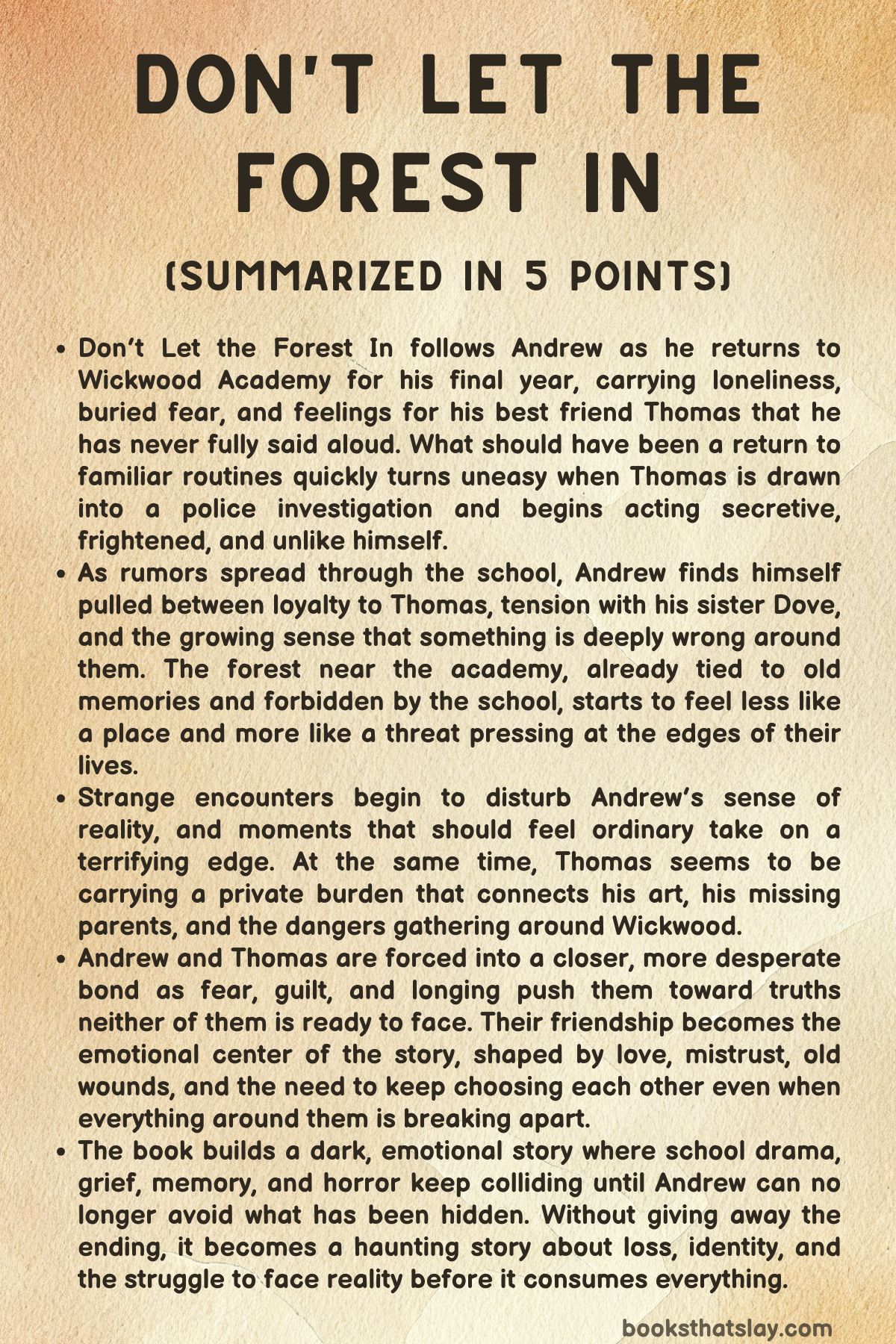
Summary
Andrew returns to Wickwood Academy for his last year with a desperate sense of relief. Home life has always felt tense and fragile, while the school, for all its secrets, feels like the only place where he truly belongs.
More than anything, he is aching to see Thomas Rye again. Over the summer he has been separated from Thomas and from his twin sister Dove, and the distance has left him hollow.
His feelings for Thomas are far more serious than friendship, though he has only ever expressed them indirectly, especially through stories he writes. Before the summer began, he slipped Thomas a piece of writing that acted as a hidden confession, comparing love to cutting out his own heart and handing it over.
So when he arrives back at school, he is consumed by fear and hope over what Thomas might say or do.
His reunion with Thomas is immediate but unsettling. Thomas drops everything to come to Andrew, hugging him tightly and fussing over him in a way that feels full of emotion, yet he also seems distracted and frightened.
Andrew notices signs that something is very wrong: a scab on Thomas’s face, blood on his sleeve, and a strange reluctance to talk about home. That tension sharpens when police officers appear at school and Thomas reacts with visible fear.
Soon Andrew secretly overhears a meeting in which Detective Stephanie Bell explains that Thomas’s parents are missing. Their house was found covered in blood after a night of screaming and violence, and Thomas is already under suspicion.
Andrew is horrified by what he hears, but his loyalty to Thomas remains absolute. Even so, the knowledge leaves him shaken, especially because he has already seen blood on Thomas’s clothes.
As rumors move through the school, Thomas becomes isolated and watched. Students whisper that he may have killed his parents.
Andrew feels the pressure of those suspicions from every side, while also dealing with the memory of his own breakdown the year before, when he injured himself badly in an episode that marked him as unstable in the eyes of others. Dove keeps her distance, still locked in unresolved anger connected to Thomas, and Andrew finds himself trapped between fear for Thomas and frustration at everyone around him.
The school itself seems different too. The forest bordering the grounds has been fenced off, and students are warned to stay away from it at all costs.
Andrew and Thomas still try to hold onto their old rituals. They sneak out to stargaze, share snacks, swap stories and drawings, and try to talk honestly.
Thomas admits that things at home looked terrible when he left and that he lied because he panicked, but he refuses to explain further. He seems to carry a constant dread that Andrew will eventually see something rotten in him and turn away.
Andrew, who feels just as damaged inside, answers with the kind of raw honesty he can rarely manage, making it clear that whatever darkness Thomas fears, Andrew feels it in himself too. Their connection deepens in these moments, but it is also strained by secrecy and the sense that something is stalking them from just beyond the edges of ordinary life.
That threat becomes unmistakable when Andrew follows Thomas into the forbidden forest. The woods feel wrong from the moment he enters them, too still and too dark, and then he realizes that the wetness covering the leaves and ground is blood.
Thomas appears from the branches above him, tense and angry, warning that Andrew should not be there. Their argument grows worse when Thomas reveals he is officially considered a person of interest in his parents’ disappearance.
Wanting to comfort him, Andrew says the wrong thing and implies he would stand by him even if he had done it. Thomas hears this as proof that Andrew believes he is a murderer, and the wound between them opens.
In the days that follow, Thomas keeps pulling away. He disappears at night, returns injured and exhausted, and refuses to explain himself.
Andrew’s own grip on safety weakens. He experiences increasingly horrifying events: something touches him in the dark when no one is there, mushrooms seem to grow impossibly out of his clothes and skin, and a monstrous presence stalks him in the bathroom.
Publicly, these episodes make him appear unstable. Privately, they leave him terrified that reality itself is slipping.
When he finally goes into the forest at night, hoping to find Thomas and confront the truth, he instead comes face to face with a monster. It is a grotesque thing of hooves, decay, and vines, and it attacks him viciously.
Thomas arrives just in time, drags Andrew to shelter, and then turns back to fight. He kills the creature with brutal force and, standing over its ruined body, begs Andrew not to hate him.
Back in their room, Thomas finally tells the truth. Monsters have been coming out of the forest every night, and he has been secretly hunting them before they can reach the school.
One attacked his parents at home before term began. He hid, then ran, and now believes that cowardice makes him responsible for whatever happened to them.
Worse, he shows Andrew drawings he made before any of the attacks, drawings that perfectly match the monsters now appearing in real life. Thomas is convinced that his art somehow creates these creatures.
Andrew refuses to leave him alone with that burden. Instead, he helps tend Thomas’s wounds and commits himself to helping fight whatever is happening.
Together they try to stop it at the source. They decide Thomas’s sketchbook must be destroyed, but even that attempt becomes a nightmare.
In the forest they are attacked by small blood-drinking creatures Thomas once drew. Thomas sacrifices himself to distract them so Andrew can tear apart the sketchbook and bury the pieces.
Andrew returns to find Thomas covered in bites and half collapsed. Though they survive, destroying the sketchbook does not end the danger.
Soon the school itself begins to feel infected. During another attack, a creature known as the Antler King comes inside.
Vines burst through walls, flowers and brambles spread through the halls, and the school seems to turn into an extension of the forest.
Andrew is trapped in the middle of this horror with a teacher named Clemens, who refuses to listen to his warnings until it is too late. The Antler King kills Clemens in front of Andrew in a scene of terrible violence, while Andrew is pinned and helpless.
Thomas charges in with a hatchet and destroys the monster, but the situation it leaves behind is almost as dangerous as the creature itself. There is a dead teacher, Thomas is bloodied and armed, and no one would ever believe the truth.
The boys clean what they can, escape in the confusion of a fire alarm, and return to the dorm carrying fresh trauma. The school later lies about Clemens’s death, calling it an accident, but rumors only intensify.
Thomas is increasingly seen as suspicious, while Andrew begins to feel the forest is invading his own body.
He discovers a seed-like thing growing inside him after vines entered his ear during the attack. He and Thomas realize the corruption is no longer outside them; it is getting under Andrew’s skin.
At the same time, Andrew learns that his own writing has power. When he writes stories onto the trees in the forest, he can shape what happens to the monsters and destroy them.
This changes everything. Thomas’s drawings may have helped create the horrors, but Andrew’s words can alter them.
Even as they fight side by side, however, the emotional strain between them becomes harder to bear. Thomas confesses that he loves Andrew.
Andrew, frightened and overwhelmed, admits he is asexual and fears he cannot give Thomas what he wants. Instead of leading to understanding, the conversation turns painful, tangled with jealousy, shame, and old misunderstandings.
They part from it wounded, with the monsters still closing in.
On Halloween, events finally collapse. Andrew is called to the principal’s office and accused of sneaking into the forest.
Bryce Kane, who has long tormented Thomas, twists the story against him, and the adults decide Andrew is unstable and should be removed from school. His father is coming to collect him.
Andrew is devastated, because leaving means abandoning Thomas to the horrors alone. In panic, he decides he must destroy the last of Thomas’s drawings.
In the art room he finds the forest physically growing through the space. He tears apart one final pastel drawing, only to realize too late that it is not a threat but a tender image of himself, Thomas, and Dove together.
Then he discovers Bryce’s corpse hanging among the trees, overtaken by the same corruption consuming everything else.
The truth begins breaking open when Andrew runs into the forest and tries to bring Dove into the reality he still believes in. What follows shatters him.
Thomas reveals that Dove has been dead for months. She died in the summer after going into the forest following an argument connected to Andrew and Thomas.
Andrew could not bear her death and fractured under the weight of grief, building a false version of reality in which she was still alive and present beside him. At last he understands that the monsters and the forest have grown out of his guilt, denial, and pain.
He is the “prince” they want. The forest begins consuming him completely, roots and flowers tearing through his body as he walks deeper into the woods to finish the story in blood.
At the heart of the forest, Andrew confronts the force that has worn Dove’s face and fed on his sorrow. He prepares to tear out his own heart and bury it, believing sacrifice is the only ending left.
Thomas reaches him in time and refuses to let him die. He insists Dove’s death was not a punishment and that Andrew is not beyond saving.
In that final struggle Andrew chooses another ending. He writes a different fate for himself and for the forest.
By dawn the woods fall silent. The monsters are gone.
The long nightmare finally loosens its grip. Beneath the quiet tree, Andrew sits bloodied and exhausted with Thomas resting in his lap, asking him to wake and prove that after everything, they are still real.
Characters
Andrew
Andrew stands at the center of Don’t Let the Forest In, as a boy whose inner life is so intense that it reshapes the way he experiences the world. He returns to school already carrying loneliness, emotional hunger, and the aching need to be close again to the two people who define his sense of safety: Dove and Thomas.
What makes him compelling is that he is not simply frightened by the strange events around him; he is also deeply vulnerable to them because his mind is already full of grief, guilt, longing, and self-doubt. He constantly interprets himself as empty, broken, or difficult to love, and that damaged self-image affects every decision he makes.
Even his confession of love is hidden in story form, showing that he can express himself most truthfully only through fiction, metaphor, and indirect language.
His relationship with Thomas reveals both his greatest strength and his greatest weakness. Andrew is fiercely loyal, almost to a self-destructive degree.
He wants to believe Thomas even when the evidence looks terrible, and when Thomas is accused, isolated, or injured, Andrew’s first instinct is to protect him. At the same time, that devotion is tangled with insecurity.
He is jealous, fearful of abandonment, and quick to interpret distance as rejection. Because of this, he often turns panic into impulsive action, whether that means sneaking into the forest, hiding evidence, or making choices before fully understanding what is happening.
He wants to save Thomas, but he often acts from emotion before clarity.
Andrew’s arc is shaped by the collapse of denial. Much of his instability comes from the fact that he cannot face unbearable truths directly, especially when it comes to loss.
He tries to hold the world together through belief, stories, and emotional insistence, but reality keeps forcing itself through the cracks. That makes him tragic, but not passive.
He is not merely a victim of events. He gradually becomes someone who participates in shaping the supernatural struggle, especially when he realizes that writing itself can alter the fate of monsters.
This connection between language and reality makes him more than an observer; it makes him a creator whose emotional life has literal consequences.
By the end, Andrew becomes most powerful when he stops fleeing the truth. His journey is not about becoming fearless, but about accepting grief without letting it dictate the ending.
He begins as someone who would rather break himself than lose love, and he ends as someone forced to choose life while still carrying pain. That movement gives him depth beyond the role of haunted protagonist.
He is sensitive, frightened, loving, selfish, brave, and fragile all at once, which makes his character feel painfully human.
Thomas Rye
Thomas is written as both protector and mystery, and much of his power as a character comes from the tension between those two roles. From the beginning, he is the person Andrew most longs for, but he is never simply a comforting figure.
He returns Andrew’s affection with intensity, tenderness, and hunger, yet he is also secretive, exhausted, bloodstained, and visibly haunted. That duality defines him.
He is the boy who runs to embrace Andrew and the boy who will not explain what happened at home. He is warm, artistic, emotionally perceptive, and deeply frightening in the same breath.
This makes him magnetic because Andrew, and the reader, are always trying to decide whether he is a source of safety, danger, or both.
What shapes Thomas most is guilt. He believes he failed his parents, and later believes his art may be responsible for manifesting the monsters.
That guilt becomes the core of his character. He does not defend himself with arrogance or anger so much as with silence, avoidance, and self-sacrifice.
He repeatedly throws himself into danger to protect Andrew, not because he thinks he is heroic, but because he seems to feel his own suffering is deserved. Even when he survives, he often reacts as though survival itself is suspicious.
His whispered pleas not to be hated reveal how profoundly he fears moral rejection. He worries that once the truth is known, love will disappear.
His love for Andrew is one of the clearest emotional truths in the story. Unlike Andrew, Thomas eventually speaks more directly, confessing his feelings and naming what he wants.
Yet even that honesty is burdened by fear. He does not approach love with confidence; he approaches it like someone expecting to be abandoned for asking.
His relationship with Andrew is therefore shaped by both desire and terror. He wants closeness, but he keeps withdrawing in the name of protection.
He shares just enough truth to keep Andrew near, then hides the worst of it because he thinks Andrew should be spared. That pattern makes him frustrating at times, but it also fits his emotional logic: he loves through secrecy, endurance, and bodily risk.
Thomas is also important as a character because he exists at the intersection of art and horror. His drawings seem to generate monsters, which turns his imagination into something dangerous.
That gives him a deeply tragic artistic identity. Creativity, for him, is not harmless self-expression.
It becomes entangled with shame, violence, and responsibility. Yet he remains profoundly gentle beneath that burden.
He sketches, notices, remembers, and values Andrew’s writing. Even when events turn savage, there is still something delicate in the way he sees the world.
That contrast keeps him from becoming just a dark romantic figure. He is instead a frightened boy trying to carry impossible blame while still loving with his whole heart.
Dove
Dove is one of the most emotionally significant figures because she represents love, fracture, memory, and unbearable loss all at once. At first, she appears as Andrew’s twin sister and one of the anchors of his life.
Her distance from Thomas immediately signals unresolved damage, and her refusal to sit with them or make peace suggests that she sees dangers Andrew either cannot or will not acknowledge. She is not passive in the background.
Even when she seems quiet, tired, or emotionally withdrawn, her presence carries tension. Andrew watches her closely because her choices matter to him, yet he never fully understands her perspective until much later.
That gap between his perception and her reality becomes crucial.
As a character, Dove embodies the painful fact that the people closest to someone can be both deeply loved and profoundly misunderstood. Andrew depends on her presence emotionally, but he does not truly process her separate interior life.
She is not just his sister or emotional support; she is a person with her own anger, fears, loyalties, and wounds. Her conflict with Thomas is especially important because it shows that she refuses to smooth over emotional damage for Andrew’s comfort.
She can stand apart, hold her position, and resist reconciliation when she believes something is wrong. That gives her a firmness that contrasts with Andrew’s desperate need to preserve connection at any cost.
Her later role transforms her from supporting character into one of the story’s deepest emotional wounds. Once the truth emerges, her significance expands beyond her physical presence.
She becomes inseparable from Andrew’s denial and grief, which means she functions on two levels at once: as the real sister who was lost, and as the continued presence his mind cannot surrender. That gives her extraordinary narrative weight.
She is not reduced to a plot twist. Instead, her absence explains the emotional architecture of Andrew’s unraveling.
The fact that he continues to live as though she is still there shows how central she is to his sense of self and reality.
Dove therefore becomes a tragic figure not because she dominates the plot through action, but because her loss changes everything. She represents the life Andrew cannot accept, the truth he keeps rewriting, and the love that remains even after death.
Her importance lies in how completely she shapes the emotional landscape of the story. Through her, the narrative shows that grief is not only sorrow but distortion, repetition, and desperate invention.
Lana Lang
Lana brings a very different kind of energy into the story. She is sharp, observant, and practical, often cutting through confusion with a bluntness that other characters avoid.
In a narrative full of secrecy, longing, and emotional collapse, Lana serves as someone grounded enough to recognize danger quickly and respond to it without sentimentality. She warns Andrew to keep his head down, pushes back against Bryce’s cruelty, and provides information without dressing it up.
That directness makes her valuable because she acts as a counterweight to Andrew’s tendency toward emotional drift and obsessive focus.
What makes her more than just the “blunt friend” figure is that her toughness seems protective rather than merely harsh. She notices what is happening around her and reacts with intelligence.
When Bryce taunts Andrew, she steps in decisively. When Thomas disappears, she is one of the few people who actually offers Andrew useful information.
Even if she does not fully understand the supernatural reality, she understands the social reality of the school very well. She knows how rumor works, how authority works, and how vulnerable Andrew and Thomas are within that environment.
That gives her a quiet moral strength.
Lana also helps define Dove by association. Their friendship suggests that Dove is not isolated, and that there are parts of Dove’s life and emotional world that exist outside Andrew’s gaze.
Through Lana, the story briefly widens beyond Andrew and Thomas’s intense bond. She reminds the reader that other people are watching, judging, and interpreting events too.
This matters because it prevents the narrative from becoming entirely sealed inside Andrew’s perception.
Though she is not at the center of the emotional or supernatural conflict, Lana is an effective supporting character because she introduces clarity. She is the sort of person who survives hostile environments by refusing to be soft in public.
Her presence adds texture to the school setting and gives the story one of its few voices of unsentimental common sense.
Bryce Kane
Bryce functions as a human antagonist for much of the story, but he is not important only because he is cruel. He represents the social violence of privilege, mockery, and public humiliation.
From his earliest appearances, he targets Thomas and Andrew in ways designed to worsen their vulnerability. He harasses, taunts, twists narratives, and turns rumor into entertainment.
He understands where they are weak and presses there repeatedly. In that sense, he is not merely a bully in the generic sense.
He is a character who feeds on instability and uses the school’s culture to make others feel watched, exposed, and unsafe.
His value in the story lies partly in contrast. While the forest monsters embody hidden horror, Bryce embodies the ordinary brutality people inflict in daylight.
He does not need supernatural power to be dangerous. His malice works through social performance, lies, and the confidence that authority will often side with him or at least excuse him.
That makes him infuriatingly believable. He helps create the sense that Andrew and Thomas are trapped not only by monsters, but by a system that already sees them as suspicious, unstable, or easy to sacrifice.
Bryce is also significant because the corruption that begins to appear around him suggests that cruelty itself has become entangled with the spreading sickness of the forest. By the time Andrew notices signs of moss on him, Bryce has become more than a school tormentor.
He begins to look like another symptom of a world rotting from within. His death then carries more than shock value.
It becomes a horrifying collision between Andrew’s rage, the supernatural forces surrounding them, and the terrifying possibility that violent wishes can be answered.
As a character, Bryce is intentionally unpleasant, but he is useful precisely because he sharpens the stakes. He keeps pressure on the protagonists in the human world, making sure their suffering is not confined to the forest or the night.
He reminds the reader that fear becomes even more destructive when cruelty already has a place waiting for it.
Detective Stephanie Bell
Detective Bell represents institutional suspicion and the cold, external logic of adult investigation. She is one of the first characters to bring formal scrutiny to Thomas’s situation, and her presence immediately changes the tone.
Until then, fear and secrecy move mostly through rumor, private worry, and emotional tension. Bell makes those fears official.
She lays out the facts around Thomas’s missing parents with clarity and seriousness, which means she acts as a voice of rational suspicion in a story otherwise full of unstable perception.
What makes her effective is that she is not portrayed as monstrous or absurdly cruel. From the summary, she seems like someone doing her job based on evidence that truly does look alarming.
Thomas’s home was full of blood, his parents vanished, witnesses heard violence, and he appears evasive. Bell’s suspicion is painful, but not irrational.
That makes her role more complex than that of a simple antagonist. She is a threat to Thomas and Andrew, yet she also anchors the narrative in the reality of consequence.
People cannot disappear in a house full of blood without attracting attention. Her investigation reminds the reader that the boys cannot escape ordinary accountability just because extraordinary things are happening.
For Andrew, Bell represents a world in which belief must be proven, not pleaded for. He wants loyalty to be enough; she deals in evidence.
That contrast sharpens his desperation. Every time Thomas is taken away for questioning, Andrew feels more powerless because he knows the truth, even if spoken, would sound impossible.
Bell therefore heightens the emotional stakes without needing much page space. She stands for the adult systems that interpret damaged teenagers through the lens of crime, instability, and suspicion.
Principal Grant
In Don’t Let the Forest In, Principal Grant serves as a face of institutional control, image management, and emotional distance. She appears in moments when the school must respond to crisis, and each time she seems more concerned with containment than truth.
Whether dealing with police presence, disciplinary matters, or Andrew’s removal from school, she acts from the perspective of authority trying to preserve order. That makes her less emotionally vivid than some other characters, but still important.
She represents the kind of adult leadership that mistakes management for care.
Her interactions with Andrew and Thomas show how easily vulnerable students can be handled as problems rather than understood as people in distress. She allows rumor and suspicion to shape decisions, and when the situation becomes too strange or disruptive, her instinct is not to listen deeply but to isolate, remove, and control.
This is especially painful in Andrew’s case because he is already unstable and frightened. Rather than being met with trust, he is assessed, judged, and pushed out.
Grant therefore contributes to the sense that adult authority is structurally incapable of recognizing the real danger.
She also plays a role in the moral atmosphere of the school. Under her leadership, the institution fences off the forest, threatens punishment, and later lies about a teacher’s death.
These decisions create a setting where secrecy comes from above as much as below. The students are not the only ones hiding truth.
The school itself becomes complicit in denial and distortion. Through Grant, the story suggests that authority often protects itself first, even when reality is far worse than it wants to admit.
Andrew’s Father
Andrew’s father is not one of the most visible characters, but he is psychologically important because he embodies emotional absence. From the beginning, he is tense, uneasy, and oddly resistant to Andrew returning to school.
His warning about the forest hints that he knows more than he says, yet he does not communicate openly enough to help his son. That pattern continues later when Andrew reaches out in distress and receives only distracted, scheduled, businesslike concern.
He is physically present in the narrative, but emotionally inaccessible.
This makes him crucial to understanding Andrew’s emotional deprivation. Andrew longs for reassurance, guidance, and unconditional support, but his father offers distance, control, and delayed responses.
That gap helps explain why Andrew clings so fiercely to Thomas and Dove. The people he depends on most are not simply the people he loves; they are the people who make him feel seen in ways his father does not.
His father’s failures are not framed as flamboyant cruelty, but as a quieter kind of damage: neglect disguised as functionality.
He also contributes to the broader pattern of adults failing to meet the emotional reality of young people. He senses danger but does not explain it.
He steps in formally when Andrew is to be removed, but not intimately when Andrew is falling apart. That inability to bridge concern and care leaves Andrew alone at the exact moments when adult steadiness might have mattered most.
Mr. Clemens
Clemens is important because he becomes one of the clearest examples of adult arrogance meeting incomprehensible horror. When Andrew tries to warn him, Clemens responds with suspicion, discipline, and authority rather than curiosity or caution.
He assumes control because he thinks he understands the situation, and that certainty becomes fatal. In narrative terms, he represents the danger of adult dismissal.
He cannot imagine that Andrew’s terror points to something real, so he interprets it through the familiar categories of rule-breaking and student misconduct.
His death is horrifying not only for its violence but for what it does to Andrew. Clemens becomes the sacrifice Andrew feels he mentally offered in panic, which burdens Andrew with crushing guilt.
As a result, Clemens matters less as a fully developed person and more as a moral wound in Andrew’s consciousness. He is the human cost that cannot be explained away.
Once he dies, the story crosses a line from fear and secrecy into irreversible trauma.
Even so, his characterization is effective because he feels recognizable. He is the adult who thinks control is the same thing as safety, and who discovers too late that he has entered a reality he does not understand.
Through him, the story exposes how authority can become helpless the moment the world stops obeying its assumptions.
Dr. Reul
Dr. Reul appears briefly, but his presence is meaningful because he helps frame Andrew’s suffering as pathology rather than as a response to impossible events. Alongside other authority figures, he participates in the process by which Andrew is assessed and effectively removed instead of truly heard.
He represents the medicalized or therapeutic gaze used without sufficient understanding. In another kind of story, that role might offer support, but here it seems tied to institutional judgment.
His importance lies in how he contributes to Andrew’s sense of being disbelieved. Even if his intentions are not malicious, he becomes part of a structure that treats Andrew as unstable in a way that strips him of agency.
This deepens the novel’s tension between inner truth and outside interpretation. Andrew is genuinely unstable, but he is also confronting real horror.
Characters like Dr. Reul show how easily those two facts can be collapsed into one dismissive conclusion.
Themes
Grief as a Force That Distorts Reality
Grief in Don’t Let The Forest In is not presented as a quiet sadness that sits in the background. It becomes an active pressure that alters perception, memory, judgment, and even the shape of the world itself.
Andrew’s pain over loss is so severe that it cannot remain contained within ordinary mourning. Instead, it transforms into something immersive and destabilizing, making it difficult for him to tell where emotional truth ends and physical reality begins.
This is what gives the novel its strongest emotional charge. The horror is frightening on its own, but it becomes far more unsettling because it is tied to sorrow that Andrew cannot face directly.
He does not process loss through acceptance, conversation, or reflection. He processes it through denial, displacement, and fantasy, and those forms of avoidance slowly poison everything around him.
What makes this theme especially powerful is that grief is not shown as weakness. It is shown as something overwhelming enough to reorganize a person’s entire inner life.
Andrew’s attachment to the idea of Dove still being present is not a simple mistake. It is a desperate survival mechanism.
To accept her death would mean accepting not only absence, but also guilt, loneliness, and the fear that he failed the people he loved most. The story treats that refusal with seriousness rather than mockery.
At the same time, it never romanticizes denial. The longer Andrew clings to an impossible version of the world, the more dangerous the consequences become for himself and for Thomas.
This theme also explains why the supernatural elements feel emotionally coherent rather than random. The forest, the monsters, and the growing corruption all reflect unprocessed pain.
They are not only threats from outside. They are expressions of grief that has become too large to suppress.
By tying horror to bereavement in this way, the novel suggests that what is buried does not disappear. It changes form and returns.
Healing, then, requires more than endurance. It requires Andrew to confront the truth he has been resisting, however unbearable it may seem.
Only when he finally looks directly at his loss does the possibility of peace begin to emerge.
Love, Devotion, and the Fear of Being Unlovable
The relationship between Andrew and Thomas is shaped not only by affection, but by a constant fear that love will be withdrawn once the truth is fully seen. Again and again, both boys circle the same emotional terror: the belief that to be truly known is to risk rejection.
Andrew loves Thomas deeply, but he hides behind stories, implications, and partial confessions rather than speaking plainly. Thomas, in turn, carries the belief that there is something rotten at his center and that Andrew will eventually see it and turn away.
Because of that, their bond is filled with longing, tenderness, protectiveness, and misunderstanding all at once. Love is never simple comfort here.
It is also vulnerability, dread, and exposure.
What makes this theme so rich is the way devotion appears in both beautiful and painful forms. Andrew and Thomas care for each other with extraordinary intensity.
They tend each other’s wounds, search frantically when the other goes missing, defend one another against cruelty, and keep choosing each other despite fear. Yet that devotion is often tangled with silence.
Instead of saying exactly what they mean, they rely on fragments, symbols, stories, and emotional half-measures. As a result, even their most sincere attempts at closeness can go wrong.
A gesture meant to reassure becomes an insult. A confession becomes a wound.
A moment of honesty arrives too late or under the worst possible conditions. The story understands that love does not fail only because feeling is absent.
Sometimes it falters because the people involved do not believe they deserve to be loved completely.
This theme becomes even more significant because the novel refuses to frame love as a cure-all. Love does not instantly erase trauma, self-loathing, or fear.
It cannot undo death, guilt, or psychological collapse by itself. What it can do is offer a reason to remain, to fight, and to choose another ending.
That distinction matters. The bond between the boys is not valuable because it makes life easy.
It is valuable because it gives each of them something real to hold onto when everything else becomes unstable. In that sense, love is portrayed not as perfection, but as persistence.
It is the choice to stay beside someone even when both of you are frightened, damaged, and uncertain of what comes next.
The Monstrous Nature of Repressed Guilt and Inner Violence
One of the most striking ideas in the novel is that inner damage does not stay inward for long. Guilt, shame, rage, and self-hatred take on material force until they seem to stalk the characters from the forest itself.
The monsters are terrifying because of their appearance and brutality, but they also matter symbolically as embodiments of what has been denied or driven underground. Andrew and Thomas are not simply fighting creatures in the woods.
They are fighting feelings neither of them knows how to carry safely. Every attack, every spreading vine, every act of bodily corruption suggests that buried emotional violence has begun to express itself in physical form.
Andrew’s guilt is central to this theme. He is burdened by what happened to Dove, by the suffering around Thomas, by his own frightened thoughts, and by his sense that his private wishes can somehow destroy others.
He begins to suspect that even fleeting thoughts of harm may have consequences, which makes his own mind feel dangerous to him. That fear creates a terrible intimacy between imagination and violence.
He is no longer certain that a thought is just a thought. This is why the horror reaches such intensity: the self becomes a place of threat.
Thomas carries a related burden. He believes he may be responsible for creating the monsters through his drawings, and he is haunted by what he did and did not do when his parents were attacked.
Both boys therefore live with the belief that they are somehow the source of disaster.
The theme is powerful because it does not suggest that guilt is always false. Some guilt comes from real failures, real mistakes, real helplessness.
But the story shows how guilt can grow beyond truth into a totalizing force. It stops being a response to an event and becomes an identity.
A person no longer thinks, I did something terrible, but rather, I am terrible. Once that shift happens, the world itself begins to look accusatory.
The monsters reflect this transformation. They are not merely enemies to kill.
They are signs of what happens when pain curdles into self-condemnation. The struggle against them becomes, at its deepest level, a struggle to reject the belief that suffering proves one deserves destruction.
Storytelling, Art, and the Dangerous Power of Creation
Writing and drawing are not decorative details in this novel. They are among its deepest organizing forces.
Art becomes a way for emotion to leave the body and take shape in the world, which makes creation both meaningful and frightening. Andrew turns to stories because he cannot say things directly.
Thomas draws what he cannot fully explain or control. At first, these acts seem like ordinary forms of expression for two sensitive, wounded boys.
Gradually, however, the novel reveals that storytelling and image-making are bound to consequence. Words and pictures do not merely reflect feeling.
They can give it structure, direction, and terrible life. This creates a theme centered on the double nature of art: it can reveal truth, but it can also intensify obsession, preserve pain, and help turn fantasy into fate.
What is compelling here is that art is never reduced to a simple villain. The story does not argue that imagination is dangerous in itself.
In fact, imagination is one of the main ways Andrew and Thomas recognize each other. Their notebooks, sketches, and private creative exchanges form the language of their intimacy.
Through creative work, they confess affection, fear, admiration, and despair. Art becomes the space where they are most visible to each other.
At the same time, because both of them pour unresolved anguish into what they create, those creations become charged with emotional force they cannot fully manage. Expression without understanding becomes risky.
Creation without healing becomes unstable.
The novel also suggests that stories can imprison just as powerfully as they can liberate. Andrew repeatedly frames life through narrative, and that impulse helps him survive for a while.
But it also allows him to preserve versions of reality that shield him from unbearable truth. He clings to constructed meanings because they feel safer than chaos and loss.
The final movement of the book gives this theme its fullest form. A story written in blood becomes part of the effort to end the nightmare, which shows that narrative itself is not the enemy.
The question is what kind of ending a person chooses to write. Art can feed destruction when it serves denial, guilt, or self-erasure.
It can also open the way toward survival when it is finally aligned with truth. In that sense, creation is treated as a moral and emotional act, one capable of shaping both ruin and release.