Cruel Winter With You Summary, Characters and Themes
Cruel Winter With You by Ali Hazelwood is a snowed-in second-chance romance built on years of history, missed timing, and feelings that never really went away. At its center are two people who have known each other almost their entire lives and have spent just as long circling the truth of what they mean to one another.
The story takes place over one stormy Christmas Eve, but it carries the full emotional weight of childhood memories, family closeness, old wounds, and adult fear. It is intimate, funny, tense, and tender, using one forced night together to finally bring long-buried love into the open.
Summary
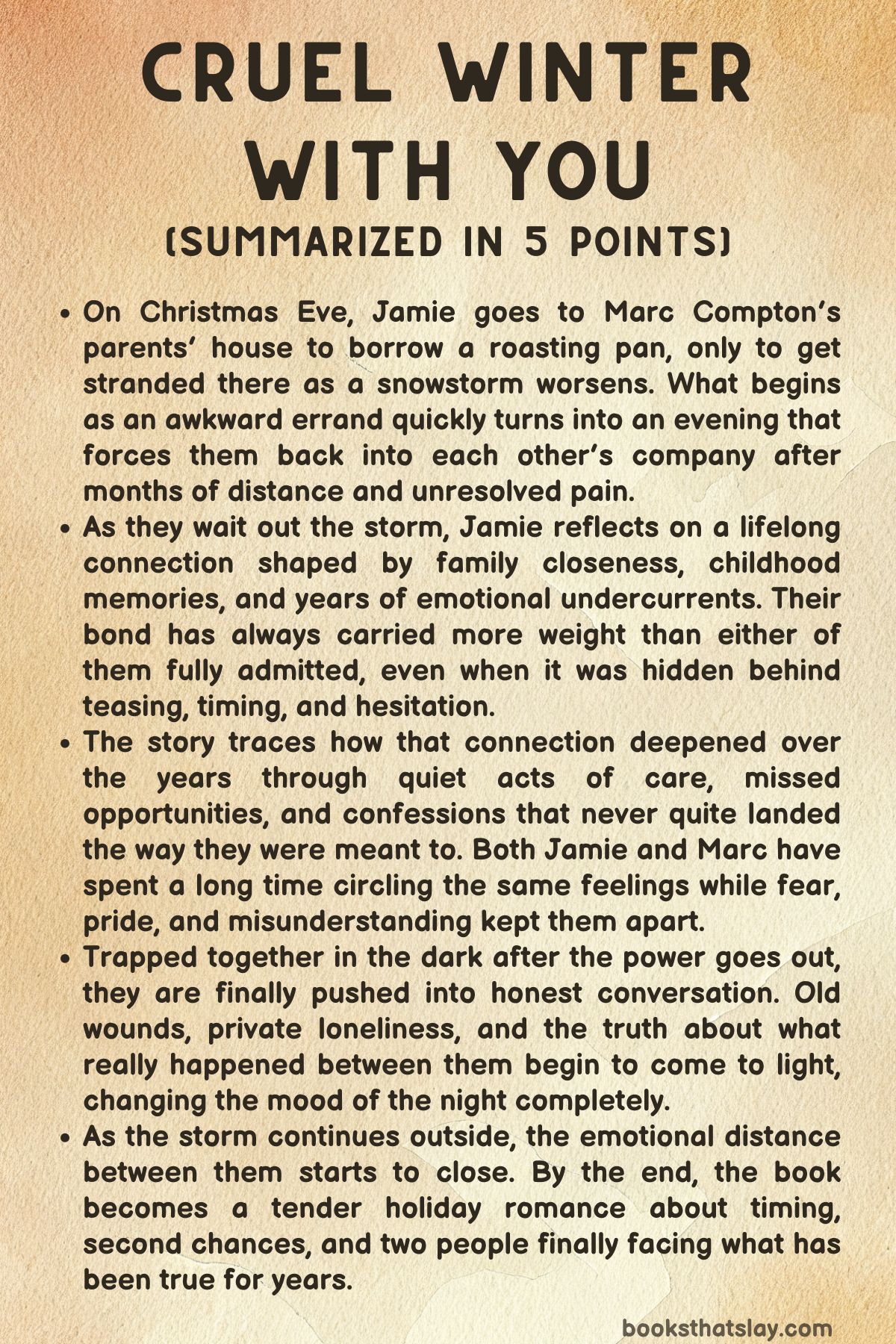
On Christmas Eve, Jamie drives through worsening winter weather to the home of Marc Compton’s parents. Her father has sent her to borrow a copper roasting pan for Christmas dinner, a simple errand made emotionally difficult because Marc is there.
Months earlier, things ended painfully between them, and Jamie arrives expecting resentment, distance, or at least some sharp remark that would match the awkwardness she feels. Instead, Marc opens the door in visible surprise and immediate concern.
Rather than acting angry, he focuses on the storm, her safety, and the fact that she should not be out driving in such dangerous conditions.
Before Jamie can complete the errand and leave, a neighbor spots them together. In an easy, careless way that catches Jamie off guard, Marc says something that makes it sound as if they are practically living together.
The remark is half joke, half instinctive possessiveness, and it leaves Jamie flustered. Marc uses the worsening weather as the reason she has to come inside, and once she is in the house, he takes control of the situation with quiet certainty.
He helps her out of her coat and winter gear, notices familiar details about her, and makes it plain that he is not going to let her drive back through the storm. His protectiveness is steady and unforced, and it reminds Jamie that beneath all their painful history, this has always been one of the most consistent things about him.
As the night stretches on, Jamie begins reflecting on everything that came before this moment. Their families have been closely connected for so long that Jamie has known Marc since he was born.
When they were children, she loved him in the simple, fierce way children can love, with a feeling almost like duty. She thought of herself as someone who would always care for him.
As Marc grew older, however, he became wild, teasing, and impossible in ways that created chaos around him, especially for his sister Tabitha. He could be exasperating, reckless, and smug, which gradually changed the tone of his relationship with Jamie.
Their bond shifted from sweetness into a pattern of teasing, sparring, and emotional concealment.
Still, even during those years, Marc behaved differently with Jamie than he did with anyone else. He might annoy her constantly, but he also paid attention to her in ways that mattered.
He bought her lunch at school when she needed help, sat with her after nightmares, and appeared during moments of distress without being asked. When family crises or private disappointments left her shaken, Marc had a way of showing up and staying close.
Jamie did not always know how to interpret that devotion. Some of it seemed like habit, some of it like friendship, and some of it like something deeper she was not prepared to name.
The truth becomes harder to ignore near the end of high school. After prom, Tabitha reveals that Marc has secretly been keeping a box full of photos of Jamie.
It is a startling discovery because it turns years of half-understood gestures into proof of something enduring and serious. Marc does not make a dramatic confession, but he admits enough.
He tells Jamie that he wants her and implies that one day he will make her understand how real his feelings are. Jamie is shaken by the intensity of it, not only because Marc has loved her for so long, but because some part of her has always been moving in the same direction.
Later, when Jamie is in college and Marc is beginning to shape his adult life, they reconnect during a holiday visit. Marc tells her he is leaving school to focus fully on building his company.
Most people doubt him, but Jamie encourages him. She sees his ambition clearly and believes he can succeed.
In that moment, she becomes one of the few people willing to support his decision without hesitation. Marc asks her out then, making another move toward the future he clearly wants with her.
Jamie turns him down, partly because she already has a boyfriend and partly because the depth of her reaction to Marc frightens her. He responds with unusual seriousness.
He says he will build something real, become someone worthy of the life he wants, and come back for her when the time is right.
Years pass. Marc becomes extremely successful, building the future he once promised.
Jamie, meanwhile, is consumed by the brutal demands of medical school, training, and residency. Her life is exhausting, structured by pressure, long hours, and emotional depletion.
On one especially terrible birthday, after an awful week at work, Marc appears in California with flowers. He takes her out and speaks with complete honesty.
He tells her he still loves her and wants a future together. He describes a life that is not casual or uncertain but full and lasting.
He wants a real partnership, a home, and everything that comes with loving someone without reservation.
For Jamie, that moment is overwhelming. She loves him too, but the force of what he offers terrifies her.
She is convinced that she will ruin it, that she will fail him, or that loving him openly will eventually lead to losing him. Instead of admitting what she feels, she lashes out.
She tells him cruelly that she is not attracted to him and never will be. The words are meant to protect herself by destroying the possibility before it can destroy her, but the result is devastating.
Marc leaves, and Jamie is left with immediate regret. Later she calls to apologize and confesses in a voicemail that she had panicked because she did have feelings for him.
When he never responds, she assumes he heard her and chose silence. That silence becomes its own wound.
In the present, trapped inside the house as the storm grows worse, the pressure of everything unsaid builds between them. Then the power goes out, leaving them in darkness and deepening the sense of isolation.
Jamie begins sliding toward a panic attack, and Marc notices immediately. He stays with her physically, grounding her, calming her breathing, and refusing to leave her alone inside the fear.
His care is intimate and instinctive, showing how completely tuned in he still is to her. The power outage transforms the house into a sealed world where all the old distance between them becomes harder to maintain.
They settle by the fire and start playing a drinking game, a light idea that quickly gives way to real questions and serious answers. The game strips away their defenses.
They talk about loneliness, anger, and the years they lost. Jamie learns that Marc was never truly fooled by her rejection.
He says he knew she was lying when she claimed she felt nothing for him. What angered him was not the rejection itself, but the way she denied herself what they both wanted.
He was furious that fear had so much power over her and over them.
Then they reach the heart of the misunderstanding. Jamie mentions the apology voicemail she left.
Marc has no idea what she is talking about. They realize she called his old number, and he never received the message.
Once he retrieves it and plays it aloud, the truth finally surfaces. He hears Jamie admitting that she panicked because she loved him and could not bear the risk of being hurt.
Years of hurt and confusion collapse in an instant. The silence Jamie thought was rejection was only absence.
The distance Marc thought was refusal was only fear.
Once the truth is known, the emotional barrier between them breaks. Marc kisses her, and the kiss changes everything.
When the power comes back, the house seems less like a trap and more like a place where something long delayed can finally begin. Jamie chooses to stay the night.
In Marc’s old bedroom, they continue talking with an honesty they have avoided for years. They confirm that neither of them moved on emotionally, no matter how much time passed.
The attraction between them, suppressed for so long, is no longer something either of them wants to resist.
They finally come together fully, not as two people circling an old possibility, but as two people deciding to stop running from what has always been true. Afterward, Marc tells Jamie that he loves her.
He does not demand that she say it back immediately, understanding that she needs room to arrive at the words in her own way. Jamie, now freer than she has been in years, promises that by next Christmas she will say it back.
It is not hesitation so much as her own careful way of stepping into happiness without fear.
As midnight arrives, Christmas begins, and so does their relationship at last. Outside, the storm continues to shape the world into silence and snow, but inside, uncertainty has given way to clarity.
What began as an errand on a dangerous night becomes the moment when two people finally stop misunderstanding each other and choose the life they nearly lost.
Characters
Jamie
Jamie is written as someone whose inner life drives much of the emotional movement in Cruel Winter With You. On the surface, she appears hesitant, awkward, and defensive, especially when she first arrives at Marc’s house.
She expects hostility and seems almost prepared for punishment, which immediately shows how deeply she has been carrying guilt, fear, and unresolved longing. Her discomfort is not simply about seeing an old love again.
It comes from years of emotional self-protection, from her habit of assuming that wanting something deeply will eventually end in pain. That makes her a character shaped less by a lack of feeling and more by an excess of it.
She feels so strongly that she cannot safely express it.
What makes Jamie compelling is the contrast between her competence and her emotional vulnerability. She has survived the intense demands of medical training and residency, which suggests discipline, intelligence, and endurance.
She is capable of functioning under pressure in the external world, yet when it comes to love, she becomes uncertain and reactive. This contrast gives her depth.
She is not weak, but she is frightened in a very specific way. She seems to believe that being loved fully would expose her to disappointment, and that belief governs many of her choices.
Even her cruel rejection of Marc does not read as indifference. It reads as panic from someone who cannot trust happiness when it is finally placed in front of her.
Her history with Marc also reveals how slowly she understands her own emotions. Throughout childhood and adolescence, she experiences his care without fully naming what it means.
She notices his presence, his attention, and the way he reliably shows up for her, but she does not completely process the emotional significance until much later. This delay is central to her characterization.
Jamie is not emotionally dishonest in a calculated way. Rather, she has spent years disconnected from the full truth of what she wants, or at least unwilling to say it aloud.
By the present timeline, she is exhausted by that pattern. The storm and forced proximity strip away her usual escapes, and for perhaps the first time, she has to confront not just Marc’s feelings, but her own.
By the end, Jamie’s growth comes from emotional acceptance rather than dramatic transformation. She does not become a different person overnight.
Instead, she stops resisting what has always been there. That shift matters because it turns her from someone ruled by fear into someone willing to trust love without complete guarantees.
Her arc is about moving from self-denial to honesty, and that honesty gives her character emotional weight.
Marc Compton
Marc is presented as charismatic, intense, and emotionally steadfast, but what gives him substance is the consistency beneath his outward confidence. From childhood onward, he is shown as chaotic, mischievous, and difficult in many ways, especially in the eyes of the people around him.
Yet his behavior toward Jamie always carries a different quality. He may be unruly in the larger family dynamic, but with her there is a thread of tenderness, protectiveness, and attention that never disappears.
This combination makes him more than a typical confident romantic lead. He is someone whose devotion has existed for years, even when it was unnoticed or unreturned.
One of Marc’s strongest defining traits is patience. He is not passive, because he clearly acts on his feelings and voices them when necessary, but he is patient in the sense that he allows time to pass without giving up the truth of what he wants.
He does not seem to fall in and out of love according to convenience. Instead, his feelings remain stable across different stages of life, from adolescence to adulthood.
That stability makes him emotionally persuasive as a character. His love is not portrayed as impulsive fantasy.
It is rooted in long observation, shared history, and repeated choices to remain present.
At the same time, Marc is not idealized into perfection. He has pride, anger, and a strong need for Jamie to stop hiding from herself.
His frustration with her is important because it shows that his love is not based on endless saintly endurance. He is hurt by her refusal to accept what exists between them, not because he believes her lies, but because he recognizes them as fear-driven.
That distinction adds maturity to his characterization. He understands her deeply, perhaps more deeply than she understands herself, and that understanding makes his anger feel grounded rather than petty.
He wants honesty, not performance.
His success in adulthood also reveals an important part of his personality. He is ambitious and capable of following through on the promises he makes.
When he says he will build something of himself, he does. Yet the story makes clear that professional success is not what defines him most.
What matters is that even after achieving the external things he once lacked, he still returns to the same emotional center. His career proves his determination, but his devotion proves his character.
In the present, he becomes the stabilizing force during Jamie’s panic and the one willing to create space for truth without forcing her into it. That balance of certainty, restraint, and emotional endurance makes him the anchor of the relationship.
Tabitha
Tabitha plays a secondary role in terms of page time, but she is important because she helps expose truths that the central pair would otherwise keep buried. She is connected to Marc through family and to Jamie through longstanding closeness, which places her in a unique position to observe dynamics that the two of them either ignore or avoid.
Her presence suggests someone practical enough to see what is obvious and bold enough to bring it into the open. The moment when she reveals Marc’s collection of Jamie’s pictures is especially significant because it disrupts the silence surrounding his feelings.
Without that intervention, their emotional stalemate might have lasted even longer.
Her function in the story is not merely that of a messenger. She represents the family intimacy surrounding Jamie and Marc’s history.
Because the two families are so intertwined, Tabitha becomes part of the emotional architecture of their relationship. She has likely witnessed years of glances, tensions, loyalties, and denials, and her actions suggest impatience with unnecessary secrecy.
That makes her feel like someone who understands both of them well enough to challenge the situation rather than politely stand back from it.
Tabitha also helps define Marc through contrast. His chaotic childhood behavior is partly framed through how he made life difficult for her and others, which places her in the position of someone who knows his flaws firsthand.
That matters because it prevents the story from treating him as flawless. If Jamie experiences his softness, Tabitha remembers his messiness too.
Through her, the narrative acknowledges that love does not erase a person’s more difficult traits. This makes the broader characterization around Marc more believable.
Even with limited direct focus, Tabitha comes across as perceptive, blunt, and useful in moments when emotional truth needs a push. She belongs to the type of secondary character who sharpens the story by refusing to let the main characters remain comfortably vague.
Her role may be brief, but it is meaningful because she helps move hidden feeling into visible reality.
Jamie’s Father
Jamie’s father appears only briefly in the summary, but his role still contributes to the emotional and social context of the story. By sending Jamie to borrow the roasting pan, he becomes the practical reason she ends up at Marc’s house on Christmas Eve.
In narrative terms, this might seem small, but it matters because it shows how naturally connected the families still are. The errand is not framed as something unusual or dramatic.
It comes from a long-standing closeness in which crossing household boundaries is normal. That detail reinforces how deeply Jamie and Marc are rooted in each other’s lives even before romance is openly acknowledged.
He also helps sketch Jamie’s position within her family world. The fact that she accepts the errand, even in emotionally difficult circumstances, suggests a pattern of responsibility and compliance.
She does what is needed, even when it places her in discomfort. This aligns with the broader portrait of Jamie as someone who carries burdens quietly and often puts duty ahead of emotional ease.
Her father’s request therefore does not just move the plot forward. It subtly supports what the story tells us about Jamie’s temperament.
More broadly, Jamie’s father stands for the ordinary family framework surrounding the extraordinary emotional tension of the main pair. Holiday obligations, household needs, and familiar community habits all continue as usual even while Jamie is carrying years of unresolved feeling.
That contrast is useful. It prevents the romantic conflict from existing in a vacuum and grounds it in everyday life.
Though he is not deeply developed as an individual in the summary, his presence adds realism and structure to the opening situation.
Mrs. Norton
Mrs. Norton, the neighbor has a very small role in Cruel Winter With You, but it is a strategically effective one. By noticing Jamie and Marc together and prompting Marc’s casual lie that they practically live together, this character becomes an external pressure point.
She represents the social gaze of the community, the sense that Jamie and Marc do not exist in total privacy even in a snowstorm. That brief moment pushes Marc to make a claim that is half joke, half wish, and it also forces Jamie further into the house and into the emotional situation she has been trying to avoid.
What makes this tiny role meaningful is that it introduces the idea that their bond is visible to others. Even when Jamie and Marc have been confused, separated, or silent, there is a suggestion that people around them can sense a connection.
She does not need deep characterization to serve this purpose. As a social witness, this figure helps blur the line between pretense and truth.
Marc’s offhand statement sounds like a convenient excuse in the moment, but it also hints at the domestic closeness he wants with Jamie. The neighbor’s presence makes that hidden desire audible.
This character also contributes to the atmosphere of a close-knit environment where personal histories are hard to keep fully private. In a more anonymous setting, Jamie might have arrived, taken the pan, and escaped.
Themes
Love Shaped by Time, Memory, and Patience
What stands out most strongly in Cruel Winter With You is the way love is shown as something built over years rather than sparked in a single dramatic moment. Jamie and Marc are not strangers discovering each other for the first time.
Their bond has been forming since childhood, through family closeness, private memories, quiet acts of care, and long stretches of emotional confusion. Because of that, their relationship carries the weight of history.
Every present interaction is connected to something older: childhood affection, teenage teasing, unspoken loyalty, missed chances, and moments of support that only become fully meaningful in hindsight. The story treats love as a force that can exist long before either person is ready to name it properly.
That long history matters because it gives emotional depth to even small gestures. Marc helping Jamie after nightmares, paying for her lunch, noticing her distress before she says a word, and staying attentive during family hardship all reveal a pattern.
His love is not based on convenience or fantasy. It has been expressed through consistency.
Jamie, on the other hand, only gradually understands how much of her own life has been shaped by his presence. Her feelings are not sudden either; they are delayed by fear, denial, and the difficulty of accepting that something so important has been there all along.
The story also suggests that real love requires patience. Marc does not stop caring when Jamie rejects him, and Jamie does not stop feeling for him even after she believes she has ruined everything.
Their eventual reunion works because the love between them survives distance, misunderstanding, and time. Instead of presenting love as fragile, the narrative presents it as durable, waiting for emotional timing to catch up with emotional truth.
That gives the romance a sense of earned resolution. Their union at the end is satisfying not simply because they confess their feelings, but because those feelings have already been tested by years of waiting and still remain intact.
Fear of Vulnerability and Emotional Self-Sabotage
Another major thread in the story is the damage people do when they are more afraid of being hurt than of losing happiness itself. Jamie’s emotional struggle is not based on a lack of love.
In fact, the opposite is true. She reacts harshly precisely because her feelings are so strong.
When Marc finally offers her the future she has secretly wanted, she cannot accept it with openness. Instead, she lashes out, denies her attraction, and says things meant to push him away.
That response shows how fear can distort honesty. Rather than protecting herself, she creates the very pain she hoped to avoid.
This makes emotional self-sabotage one of the most important patterns in the narrative. Jamie convinces herself that she will disappoint Marc, that being loved by him is dangerous, and that rejection is inevitable.
Those beliefs lead her to act against her own desires. She would rather destroy the possibility herself than risk having it taken from her later.
This is not shown as simple immaturity. It is presented as the consequence of anxiety, pressure, and deep insecurity.
She is exhausted by medical training, burdened by stress, and emotionally unsteady when faced with something as life-changing as Marc’s confession. Her cruelty comes from panic, not indifference.
Marc understands this more clearly than Jamie expects. His anger is not rooted in wounded ego or literal belief in her rejection.
He knows she lied because she was afraid. What upsets him is watching her deny herself what she truly wants.
That distinction is significant because it turns the conflict into something larger than a failed romantic moment. It becomes a study of what happens when a person cannot trust themselves enough to receive love honestly.
The storm-bound reunion forces Jamie to confront this pattern. She can no longer hide behind distance, time, or missed calls.
In that contained setting, she has to face what she feels and why she has been running from it. The emotional movement of the story depends on her learning that vulnerability is not weakness.
It is the only path to a life that is emotionally real. The ending becomes meaningful because she stops protecting herself through denial and begins choosing truth instead.
Miscommunication, Timing, and the Fragility of Human Connection
A striking feature of the plot is how much pain grows out of a simple failure in communication. The central misunderstanding is not dramatic in an artificial way; it is painfully ordinary.
Jamie does apologize. She does confess that she loves Marc.
But she leaves that confession on an old number, and he never hears it. That small mistake creates a major emotional consequence.
For Jamie, the silence becomes proof that she has been rejected. For Marc, her earlier words remain the last thing he believes she chose to say.
The story shows how easily two people can suffer for long periods when timing and communication fail at a crucial moment.
This theme works because the narrative does not reduce communication to mere spoken confession. It explores how people send mixed messages even when they are being sincere in some hidden way.
Jamie’s behavior is full of contradiction: she loves Marc, yet denies it; she wants connection, yet creates distance; she regrets hurting him, yet cannot confirm whether he ever heard her apology. Marc also communicates in layered ways.
He is direct in some moments, but guarded in others. Earlier in life, he frames his devotion through future promises and controlled restraint rather than total openness.
Both characters are emotionally expressive, but not always in forms the other can fully receive.
The storm setting strengthens this theme by stripping away outside distractions. Once trapped in the house, they are forced to do what they failed to do before: remain present, ask real questions, and listen carefully.
The drinking game becomes important not because of the game itself, but because it creates a structure for honesty. Through it, buried assumptions are challenged.
Jamie learns that Marc never believed her rejection reflected the truth. Marc learns that Jamie did try to reach him.
Their pain is not erased because it never mattered. It is erased because they finally access the missing piece of information that changes everything.
In that sense, the story treats communication as both fragile and sacred. A wrong number, a missed message, an old wound, or a fearful statement can distort years of feeling.
But the narrative also insists that direct honesty still has the power to repair what silence damaged. Connection survives not because misunderstanding is trivial, but because truth, once spoken and heard clearly, can finally set things in order.
Home, Safety, and the Movement from Emotional Exposure to Belonging
The entire story is framed by physical shelter, and that setting carries strong thematic weight. Jamie arrives in a snowstorm, anxious, cold, and emotionally unsteady.
Marc’s parents’ house becomes more than a location; it becomes a place where emotional truth can no longer be postponed. The worsening weather outside mirrors the instability inside Jamie, while the house offers warmth, containment, and reluctant refuge.
Marc insisting that she stay is not only an act of practical concern. It reveals his deeper role in her life as someone who has repeatedly served as a source of safety, even when their relationship was undefined or strained.
This idea of safety appears again and again. Marc notices when Jamie is close to a panic attack.
He comforts her physically and refuses to let her face that fear alone. He does not treat her distress as embarrassing or inconvenient.
Instead, he responds with calm certainty. That matters because the story links love with emotional shelter.
Jamie is not only choosing a romantic partner by the end; she is choosing the person with whom she can stop bracing herself. The house, the fire, the old bedroom, and the winter night all create an atmosphere in which guardedness slowly gives way to trust.
The theme becomes even richer because the home they share in this moment is tied to memory. Marc’s old bedroom is filled with the past, and yet it becomes the place where they finally begin a future.
Childhood familiarity and adult desire meet there without contradiction. The setting suggests that belonging does not require erasing old versions of oneself.
Instead, it allows those earlier selves to be carried forward into something more complete. Jamie, who has spent so much time resisting what she feels, is finally able to rest inside a space that holds both history and possibility.
By the end of Cruel Winter With You, the storm outside has not simply trapped them together. It has pushed them toward an emotional homecoming.
Safety is no longer just physical survival from bad weather. It becomes the confidence that they can be honest with each other, wanted by each other, and emotionally held without fear.
That movement from isolation to belonging gives the romance its deepest sense of completion.