Empire of Flame and Thorns Summary, Characters and Themes
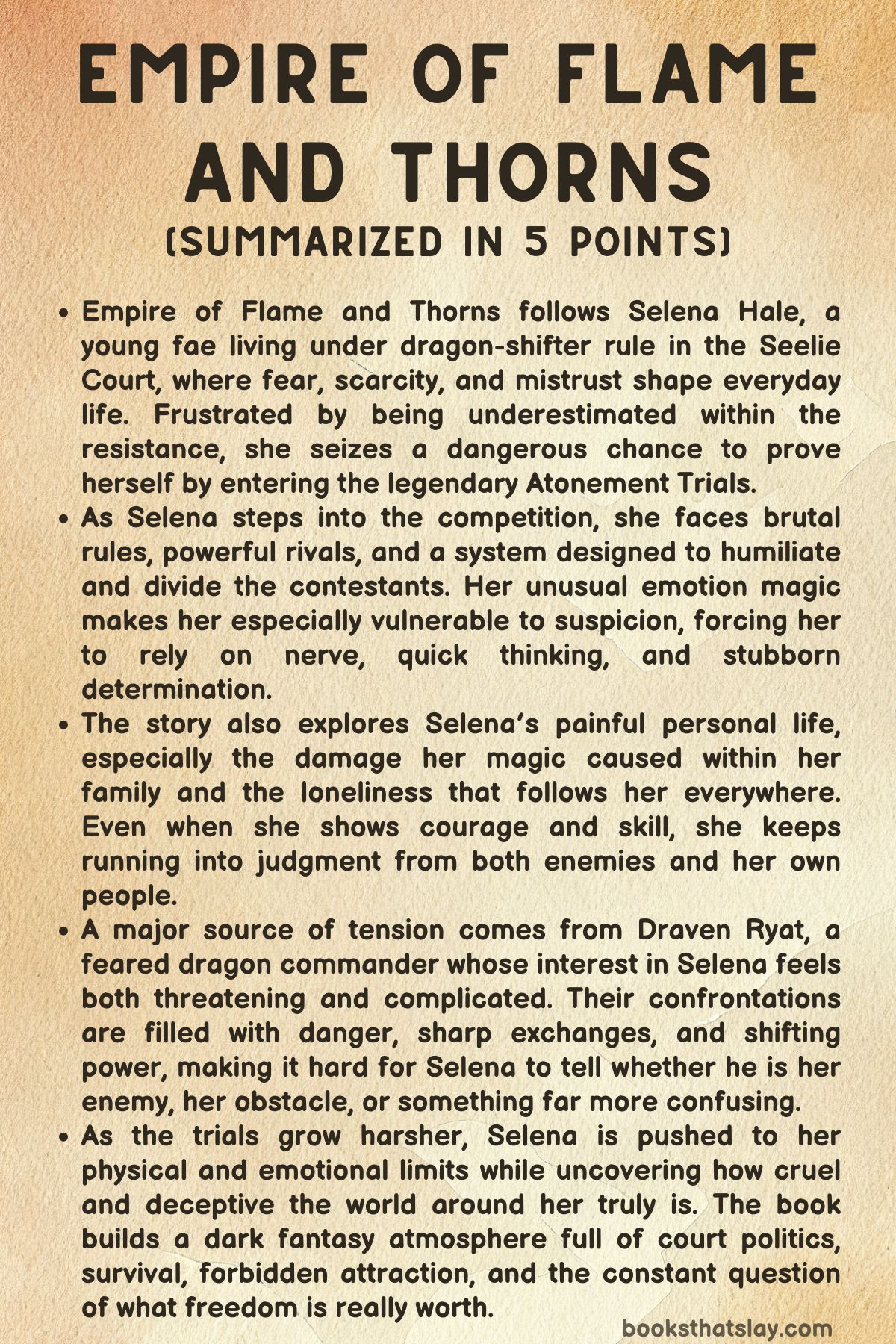
Empire of Flame and Thorns by Marion Blackwood is a fantasy romance set in a brutal world where fae live under the domination of dragon shifters, and survival depends as much on nerve as on strength. At the center is Selena Hale, a young woman marked by a feared kind of magic and by a lifetime of mistrust from both her enemies and her own people.
When she enters the legendary Atonement Trials, she hopes to earn freedom, purpose, and a chance to matter. Instead, she is pulled into a ruthless contest filled with violence, deception, political cruelty, and a dangerous connection to the very dragon commander she should hate most. It’s the first book in the Flame and Thorns series.
Summary
Selena Hale lives in the Seelie Court, where the fae have spent generations trapped under the rule of dragon shifters. Though she is loyal to a hidden resistance movement, she is treated as if she is only useful for small, unpleasant tasks.
While resistance leaders meet in secret, Selena is left outside gutting fish and keeping watch. When dragon patrols suddenly approach, she signals the danger, but a frightened young lookout panics and runs inside, nearly exposing everyone.
Selena rushes in after him and realizes the resistance leaders are still escaping through a secret route. To buy them time, she pretends to be drunk and distracting, drawing attention to herself.
The situation becomes far more dangerous when Draven Ryat, a feared dragon commander known as the Shadow of Death, enters the tavern. Knowing she must keep him occupied as well, Selena throws a drink in his face and then fleеs, leading soldiers on a frantic chase through the city until she manages to escape.
Afterward, Selena reflects on the grim history of her people. The dragon rulers justify their control by claiming the fae once enslaved dragons, and that the current punishment is deserved.
Selena sees only a people still suffering for ancient crimes they did not commit. When she spots a notice for the Atonement Trials, held once every hundred and fifty years, she sees a chance to finally prove herself.
The trials promise freedom to the winners, allowing them to leave the Seelie Court and begin new lives beyond its prison-like walls. Selena believes that if she wins, she can help the resistance from the outside and become truly valuable.
Even when officials react with discomfort to her emotion magic, she refuses to back down.
Telling her parents about her decision only deepens her pain. Instead of pride, they respond with bitterness and distrust.
Selena learns once again that they blame her childhood lack of control over her magic for ruining their marriage and destroying their family. She leaves the encounter hurt and alone, yet more resolved than ever.
Soon afterward, dragons arrive for the trials, and Selena joins the crowd gathered to greet them. The Iceheart rulers and powerful dragon clan leaders appear, including Draven.
Contestants are informed that the trials begin immediately, and they must reach the palace grounds before sundown or lose their place. Stronger contestants block the main gate, leaving Selena with no choice but to climb the iron wall surrounding the grounds.
The metal drains her magic and strength, but she forces herself over and collapses inside, officially earning a place in the competition.
At breakfast before the first test, Selena studies the other contestants and immediately sees how dangerous the field is. Alistair Geller stands out because of his fire magic and arrogant cruelty.
Isera impresses Selena by refusing to tolerate disrespect. Selena herself, however, struggles with old habits of making herself smaller to keep others comfortable.
Trying to gain information, she manipulates a former contestant into feeling more sympathy and talking to her, but another competitor notices what she is doing. The moment turns ugly.
Selena is exposed publicly, and the room’s suspicion toward her deepens.
In the first test, each contestant must force the administrator, Imar, to move using their power. Selena watches others succeed through strength and intimidation.
When her turn comes, Draven suddenly takes Imar’s place. Selena quickly realizes that her usual method will not work on him because he has mastered his own emotions so completely.
Desperate, she shocks the entire room by removing her shirt and seizing on Draven’s startled reaction, building that moment into panic and making him physically stumble. She passes the test and humiliates him before the rulers and contestants, which only intensifies the strange hostility already burning between them.
Later that evening, Selena is forced to attend a lavish ball, where the dragon rulers display luxury they could have shared with the fae all along but deliberately withheld. Selena feels deeply out of place among the elegantly dressed contestants and again finds herself pushed aside socially.
Draven corners her in a hallway, discovers the knife hidden on her body, and forces her to dance with him in exchange for not punishing her. During the dance, he points out how differently she acts with him than with everyone else, and he makes clear that by publicly dancing with her, he is making her a bigger target.
His prediction proves true almost immediately. Near the end of the evening, many contestants become violently ill from poison.
Selena barely makes it through the night.
The next day brings the first brutal trial: only the last forty contestants left standing inside a marked circle will continue. Selena enters already weakened from the poisoning.
Chaos breaks out at once, with contestants attacking one another using every advantage available. Selena survives not through raw power but through quick thinking, pain tolerance, and ruthless desperation.
She outsmarts some opponents, narrowly escapes others, and eventually pushes Alistair’s rage high enough that he begins attacking everyone around him, helping reduce the field. When the trial ends, Selena is battered nearly beyond endurance, but she has survived.
Her victory does not bring relief. After another trial, she returns to find eliminated contestants saying goodbye to those continuing on, and the scene only reminds her how alone she is.
Jeb confronts her in public, accusing her of cheating him. Selena snaps back and immediately regrets it.
That same night, Jeb and Tommen break into her room to kill her. Selena fights with everything she has, but they overpower her, leaving her bleeding and close to death.
Just before the final blow falls, Draven appears in a storm of violence. He rescues her, heals her through dragon magic, and executes both attackers in a public display meant to terrify the remaining contestants.
When Selena recovers, she discovers that Draven has locked her inside his own room. Though he saved her life, he intends to keep her from reaching the next trial.
Their time together becomes a battle of wills charged with anger, mocking conversation, and powerful attraction. Selena searches for a way out while Draven repeatedly blocks her.
The tension between them becomes physical and difficult to ignore. Eventually, when he tries to restrain her, Selena turns the moment against him by using a kiss as distraction, trapping him with his own handcuff, and escaping.
Soon after, Selena finds herself working beside Draven during another dangerous stage of the competition. Though she tells herself she should only see him as an enemy, she is increasingly forced to admit that she cares what happens to him.
Their guarded conversations reveal painful pieces of their pasts. Draven speaks of losing his parents young and inheriting leadership before he was ready.
Selena begins to see him as something more complicated than the monster she first imagined. At the same time, she never forgets the trial’s demands.
When the opportunity appears, she tricks him, steals the ring he carries, and hides it. What begins as strategy becomes tangled with desire, and the two finally give in to the attraction that has been building between them.
They share an intense physical encounter, but afterward both retreat emotionally, pretending it meant nothing.
Selena flees with the stolen ring, only to be ambushed by Kevlin near the finish line. The fight is savage.
Kevlin maims her badly in an attempt to take the ring, but Selena fights through blinding pain and manages to wound him in return. Another contestant, Lavendera, arrives and could easily steal the ring for herself, yet chooses not to.
Selena drags herself forward and crosses the finish line in full view of the rulers. She is declared one of the three winners of the Atonement Trials, alongside Isera and Alistair.
At last, it seems she has earned the freedom she risked everything to claim.
That victory proves to be the cruelest deception of all. After returning home briefly and receiving only more bitterness from her parents, Selena is taken with the other winners to the Ice Palace for a formal ceremony.
There, in a place of impossible beauty, she expects liberation. Instead, each winner is fitted with an iron collar that cuts off access to magic.
Draven fastens Selena’s collar himself. In that moment, he reveals that he had not been trying to ruin her chances in the trials, but to save her from winning them.
The rulers finally expose the truth: the Atonement Trials were never meant to free strong fae. They were designed to identify the most powerful among them so the dragons could enslave them and drain their magic and life force over centuries.
Previous winners all died in bondage. Selena realizes too late that her triumph has delivered her into a far worse prison.
As the truth settles in, heartbreak turns into fury, and she swears that she will never submit quietly to the fate they have chosen for her.
Characters
Selena Hale
Selena stands at the center of the story as a character shaped by contradiction, hunger, and emotional injury. She is brave, sharp, impulsive, and often very funny, but beneath that defiant exterior is someone who has spent most of her life feeling mistrusted, unwanted, and underestimated.
From the beginning, her frustration is not only about oppression under dragon rule but also about her own people refusing to fully believe in her. That makes her more complex than a simple rebellious heroine.
She is not fighting from a position of confidence. She is fighting from a deep need to prove that she matters.
Her decision to join the Atonement Trials comes from political purpose, but it is also tied to personal desperation. She wants freedom, yes, but she also wants recognition, usefulness, and some form of dignity that no one has willingly given her.
Her emotion magic is central to who she is, because it reflects both her strength and her isolation. She can sense and influence feelings, which gives her unusual insight into others, but it also makes people fear her motives.
That fear defines her relationships. Even when she wants connection, she often approaches people through manipulation, calculation, or defensive humor because she assumes honesty will not be enough.
This is especially visible in her interactions with Kevlin and the other contestants. She wants allies, but she does not trust that she can earn them openly.
At the same time, she is deeply disturbed by the crueler uses of her own power. That tension gives her moral weight.
She is capable of causing real damage, yet she keeps resisting the temptation to become monstrous simply because others already see her that way.
Selena’s emotional journey is just as important as her physical survival. Again and again, she is forced to face what loneliness has done to her.
She notices every exclusion, every insult, every moment of being ignored, and these moments matter because they explain why acceptance affects her so strongly. Her connection with Draven becomes powerful not only because of attraction but because he sees parts of her that others dismiss.
That recognition is intoxicating to someone who has spent years treated like a danger or a disappointment. By the end, she has grown tougher, more self-aware, and more dangerous.
Her final fury carries such force because it rises from betrayal layered over a lifetime of pain. She does not end as someone broken into obedience.
She ends as someone sharpened by suffering and ready to fight with far greater clarity than before.
Draven Ryat
Draven is introduced as an object of fear long before he becomes emotionally legible. In Empire of Flame and Thorns, he carries a title that makes him sound almost mythic, and his first appearances encourage that impression.
He is powerful, disciplined, cruel in reputation, and highly aware of how to use intimidation as a form of control. He enters scenes with the confidence of someone who has spent centuries being obeyed, and much of his presence depends on that controlled menace.
Yet what makes him compelling is that the story slowly reveals how much of that identity is constructed armor. He is not merely a brutal enforcer.
He is someone shaped by responsibility, training, grief, and isolation, much like Selena herself, though expressed through a completely different social position.
One of Draven’s defining traits is restraint. He has trained himself so thoroughly that even Selena struggles to affect him with emotion magic.
That detail says a great deal about his character. He is not simply strong in a physical sense; he has made himself emotionally inaccessible as a survival strategy.
This suggests a life built around vigilance and self-denial. He leads, commands, punishes, and performs strength constantly, but emotional openness appears to be something he has almost carved out of himself.
That is why his moments of visible feeling matter so much. His anger when Selena is attacked, his worry when she disappears, and his inability to remain fully detached from her all reveal cracks in the persona he has carefully built.
His relationship with Selena brings out his contradictions more clearly than any other part of the summary. He threatens her, traps her, manipulates her social standing, and repeatedly tries to control her choices, which makes him genuinely dangerous.
At the same time, he protects her, heals her, worries over her, and seems to understand her defiance rather than simply resent it. The tension between domination and care is what gives his character such intensity.
He is never softened into harmlessness. Even in his most intimate moments, there is always an edge of power and conflict.
That makes the connection between them both magnetic and troubling.
What ultimately defines Draven is that he operates inside a corrupt system while also appearing to know more about its horror than Selena does. His effort to keep her from winning the trial transforms his earlier sabotage into something darker and more tragic.
He is neither a straightforward villain nor a secret hero. He is a compromised man whose power makes him complicit, whose feelings make him vulnerable, and whose choices create devastating consequences.
That complexity makes him one of the most emotionally unstable forces in the story, because every action from him can contain both violence and feeling at once.
Alistair Geller
Alistair functions as one of the clearest examples of overt menace among the contestants. Unlike Selena, whose danger lies partly in what others assume about her, Alistair openly projects threat.
He is arrogant, aggressive, and socially powerful within the contestant group, sitting at the center of his allies like someone already convinced of his superiority. His fire magic strengthens that image.
It is rare, destructive, and visually dramatic, which suits his personality perfectly. He does not merely want to survive the trials.
He seems to enjoy dominance, spectacle, and the fear he creates in others.
What makes Alistair effective as a character is that he represents more than individual cruelty. He embodies the kind of strength the trial environment rewards: visible, violent, theatrical, and unchecked by empathy.
He exposes Selena at the gate, benefits from poisoning others before the arena fight, and acts with the confidence of someone used to forcing his will onto weaker people. In that sense, he is one of the clearest products of the world’s brutality.
The competition is designed to strip away fairness and reward ruthlessness, and Alistair adapts to that logic almost naturally.
At the same time, the summary hints that his brutality is not entirely simple. Selena senses immense buried rage inside him and uses it to destabilize him during the arena trial.
That detail suggests there is something volcanic beneath his swagger, something not fully controlled even by himself. He becomes more than a stock bully in that moment.
The rage inside him is so strong that once amplified, it spills outward and turns him into a destructive force against everyone around him. This implies that his cruelty may be rooted in deeper damage, resentment, or long-nursed fury, even if the story has not yet fully explained it.
Alistair also serves an important contrast to Selena. Both are feared by others, but for very different reasons.
Selena’s reputation is shaped by suspicion and misunderstanding layered over real ethical complexity. Alistair’s reputation seems earned through repeated displays of cruelty.
That contrast helps define Selena’s moral position in the story. She is tempted to become more ruthless, but characters like Alistair show what that path looks like when empathy has already been abandoned.
He is therefore both an antagonist in the immediate plot and a warning about the kind of victor this world is built to produce.
Isera
Isera emerges as one of the most quietly impressive figures among the contestants. She does not dominate scenes through noise or theatrical cruelty.
Instead, she carries herself with control, competence, and a refusal to tolerate disrespect. When two men try to patronize her, she shuts them down with such calm certainty that Selena immediately notices and admires her.
That moment matters because it positions Isera as someone who possesses the self-command Selena wishes she had. She becomes, in a subtle way, an image of the confidence Selena lacks.
Her ice powers fit her characterization well. There is a precision and firmness to her presence that matches that element.
She is not described as warm or openly inviting, but she is also not petty or needlessly cruel. She appears serious, capable, and self-contained.
In a setting where many contestants rely on intimidation, manipulation, or brute force, Isera stands out as someone whose strength seems grounded in discipline rather than performance. That makes her presence feel steadying, even when she is not central to the action.
Isera’s importance also lies in how she broadens the moral landscape of the trials. Without characters like her, the contestant pool might feel divided only between the monstrous and the victimized.
She complicates that pattern. She is strong enough to win, sharp enough to survive, and guarded enough not to invite easy friendship, but nothing in the summary suggests that she enjoys cruelty for its own sake.
Her eventual victory alongside Selena and Alistair creates an interesting trio, because each winner seems to represent a different model of power: ruthless force, guarded competence, and improvisational emotional intelligence.
There is also something telling about how little personal vulnerability Isera reveals. Unlike Selena, who wears so much of her hurt internally even when trying to hide it, Isera appears harder to read.
That distance can be interpreted as emotional discipline, survival instinct, or both. In a story full of characters exposed through conflict, a figure like Isera is significant precisely because she resists easy interpretation.
She comes across as someone who has learned that survival often depends on control, and that lesson may make her one of the more formidable figures moving forward.
Lavendera
Lavendera is one of the most morally striking secondary characters because she combines menace, judgment, and restraint in unusual ways. Her scarred appearance and tree magic give her a severe presence, and her first major act in the arena is unforgettable: she kills Maximus in direct response to the poisoning of contestants.
That moment establishes her as someone fully capable of lethal violence, but it also suggests a private code. She is not violent at random.
She acts with purpose, and that purpose seems tied to contempt for cowardice and cruelty disguised as strategy.
She also provides some of the clearest political insight in the summary. Her explanation of the ball, the clothing, and the palace luxury cuts directly to the logic of power governing the fae.
She understands that the rulers are staging abundance as humiliation, proving that deprivation is not necessary but chosen. This gives her a sharper interpretive awareness than many of the others.
She is not merely surviving the trials. She is reading the system behind them.
That awareness makes her feel older, harder, and more experienced, even if her full backstory remains unknown.
Lavendera’s most revealing moment may be when she finds Selena and Kevlin fighting over the ring near the finish line. She could easily take advantage of their weakness, but instead she chooses to walk away.
Her statement that it cannot be her suggests internal boundaries that matter deeply to her, even at a moment where victory is within reach. That choice transforms her from a dangerous competitor into someone morally enigmatic.
She is capable of killing, but she is also capable of refusing power when taking it would violate something essential in her.
As a character, Lavendera represents a harsher and more solitary form of integrity than Selena possesses. She does not appear to need approval, and she does not soften herself for others.
Yet she is not simply cruel. She sees clearly, judges hard, and acts according to principles that may not always be gentle but are distinctly her own.
That gives her a memorable authority. She feels like someone the story could deepen further, because every important choice she makes hints at a larger private philosophy beneath her severe exterior.
Kevlin
Kevlin initially appears as a useful but relatively harmless figure: an older contestant with experience, a man who has failed the trials before and therefore possesses knowledge others want. That history immediately gives him a certain sadness.
To fail once would be devastating; to fail twice and still return suggests a life so constrained that the trial remains worth risking everything for. He carries the weariness of someone familiar with disappointment, which makes Selena’s decision to manipulate him particularly revealing for both characters.
His role in the breakfast scene is important because it shows how quickly vulnerability can turn into humiliation in this environment. Selena increases his sympathy to gain information, and when Tommen exposes what she has done, Kevlin’s reaction is explosive.
His anger is not just about being magically influenced. It is also about public embarrassment, wounded pride, and the terror of appearing weak in front of other contestants.
In a brutal competition, being made a fool can be socially devastating. His outburst therefore feels believable and layered rather than exaggerated.
Later, Kevlin becomes even more significant when he ambushes Selena near the finish line. By then he is no longer merely the wounded man from breakfast.
He is desperate, predatory, and fully willing to cripple someone else for a chance at escape. That transformation does not necessarily mean he has changed.
It may instead reveal what has always been lurking beneath the surface: a man worn down by repeated failure until survival and freedom matter more than mercy. His violence in that scene is frightening because it feels driven by accumulated despair rather than simple sadism.
Kevlin works well as a portrait of what the trials do to people over time. He is not presented with the swagger of Alistair or the clear discipline of Isera.
Instead, he seems eroded by the system, made bitter and opportunistic by repeated exposure to its false promises. That makes him tragic as well as threatening.
He is one of the clearest examples of how desperation can corrode whatever decency a person may once have had.
Tommen
In Empire of Flame and Thorns, Tommen is defined above all by physical force, social aggression, and resentment. From the beginning, he is associated with obstruction and exposure.
He is among the stronger contestants who block Selena at the gate, and later he publicly calls out her manipulation of Kevlin, helping turn the room against her. In both moments, he functions as an enforcer of hierarchy.
He is the kind of person who does not simply possess strength but enjoys using it to put someone else in their place.
His violence in the arena confirms that his threat is not superficial. He beats Selena brutally, injures her badly, and nearly kills her.
What stands out about Tommen is that he does not seem driven by ideology or principle. He is a raw expression of physical dominance within a system that rewards it.
That makes him terrifying in a very direct way. Where Draven’s danger is layered with complexity and Alistair’s is flavored by arrogance, Tommen’s feels immediate and bodily.
He hurts because he can, and because the setting permits it.
His final attack on Selena in her room, alongside Jeb, exposes the full extent of his moral collapse. At that point, he is no longer acting within even the savage rules of the trial.
He is participating in outright murder, invading her private space and relying on numbers and brute force to finish what he could not accomplish fairly. This removes any ambiguity about his character.
Whatever social justifications or competitive logic he might claim earlier fall away completely once he joins that assault.
Tommen is therefore less psychologically layered than some of the others, but he serves an important purpose. He embodies the kind of masculinity that the trials reward and the rulers likely depend upon: strength without conscience, confidence without honor, violence treated as entitlement.
His death under Draven’s punishment feels less like the loss of a complicated figure and more like the inevitable end of someone who mistook impunity for power.
Jeb
Jeb appears later than some of the other contestants, but he leaves a strong impression because of how quickly his resentment turns lethal. After the maze trial, he confronts Selena publicly and accuses her of cheating and stealing his egg.
What matters in that scene is not only the accusation itself but the insecurity beneath it. He cannot accept defeat as defeat.
He needs to explain it through her supposed dishonesty or unnatural power. In that sense, he represents one of the recurring responses Selena inspires in others: fear translated into blame.
His behavior helps underline how easily Selena becomes a target. Because her magic is poorly understood and already mistrusted, people can project almost anything onto her.
Jeb uses that suspicion to justify his hostility. He is less important as an individual strategist than as part of the larger social dynamic surrounding Selena.
He helps create the atmosphere in which attacking her feels acceptable to others.
That dynamic reaches its ugliest point when he joins Tommen in the nighttime assault. Jeb is the one poised to deliver the killing blow when Draven intervenes, which gives him a particularly brutal narrative role.
He moves from public accuser to attempted murderer with almost no hesitation, suggesting that beneath his grievance lies a readiness for cruelty that the competitive setting has only encouraged. He does not come across as someone driven by wounded fairness.
He comes across as someone willing to weaponize grievance into violence.
His death is also significant because Draven makes his punishment especially cruel, implying that Jeb’s actions triggered not only legal wrath but personal fury. That does not redeem Jeb or deepen him much psychologically, but it does magnify the consequences of what he chose to become.
He is one of the clearest examples of how quickly envy, humiliation, and social permission can harden into murderous intent.
Fenriel
Fenriel occupies a gentler space in the story than many of the other contestants, which makes his presence valuable even in limited page time. He is described as kind and is accompanied by a white hawk, a detail that immediately gives him a more open and almost graceful aura compared with the more threatening personalities around him.
His function is not to dominate the action but to remind both Selena and the reader that not every contestant has been completely deformed by suspicion or cruelty.
His kindness matters because Selena encounters so little uncomplicated warmth. In a world where most interactions are strategic, hostile, or humiliating, a simple decent exchange carries unusual weight.
Fenriel helps normalize the invitation to the ball by mentioning he received the same gift, and in doing so he acts as a small stabilizing presence. He does not solve Selena’s problems or become a major ally, but he contributes to the emotional texture of the story by showing that not everyone she meets is eager to exploit her.
The hawk companion also hints at a richer identity than the summary fully explores. Characters linked to animals often carry some symbolic extension of themselves through that bond, and in Fenriel’s case it suggests alertness, freedom, and perhaps a more natural or harmonious relation to power than what is seen in figures like Alistair or Tommen.
Even without much elaboration, this detail helps him stand apart.
Fenriel’s importance lies less in dramatic transformation and more in contrast. Against the story’s harsher personalities, he reflects the possibility of decency within a violent system.
That does not make him weak or irrelevant. It makes him part of the moral range of the contestant group, and that range is important for understanding how many different kinds of people the trials consume.
Selena’s Parents
Selena’s parents are central to understanding the wounds she carries, even though they are not central action figures. Their significance lies in the emotional history they represent.
When Selena visits them after registering for the trials and later after winning, she receives not support but bitterness, distrust, and blame. They do not treat her as a daughter who struggled with a frightening power as a child.
They treat her as the source of their suffering and the destroyer of their marriage. That creates one of the harshest emotional truths in the summary: the person who most needs unconditional love has instead been made to carry responsibility for damage she caused before she was capable of understanding herself.
Their reaction to her is painful because it contains both truth and cruelty. It is likely true that her uncontrolled magic affected the family deeply.
But the fact that they continue to define her through that damage, even as an adult still trying to survive and prove herself, shows how completely they have failed to move beyond their resentment. They do not seem interested in who she has become, only in what she once did to them.
This emotional rigidity helps explain why Selena is so hungry for approval elsewhere. She comes from a home where she was never allowed to outgrow her worst impact.
They also mirror a broader social problem in the story. Just as the fae as a people are punished across generations for ancestral wrongdoing, Selena is punished within her family for harm caused during childhood when she lacked control.
In both cases, guilt is made permanent. Forgiveness never arrives.
The past is used as a prison.
As characters, her parents are not deeply individualized in the summary, but they do not need to be. Their narrative purpose is devastatingly clear.
They are the first authorities who taught Selena that love can be conditional, that mistakes can become identity, and that being feared can matter more than being understood. That background shapes nearly every vulnerable choice she makes afterward.
Emperor Bane and Empress Jessina
Bane and Jessina stand at the summit of institutional cruelty in the Empire of Flame and Thorns. While many other characters inflict harm directly, these two embody the cold intelligence behind the entire system.
Their public behavior is marked by theatrical contempt. They announce that the trials are meant to entertain them, impose sudden cruel conditions, and oversee suffering with the detached confidence of rulers who do not view contestants as fully human beings.
Their power is not wild or explosive. It is administrative, ceremonial, and absolute.
What makes them especially disturbing is the scale of deception they control. The Atonement Trials are presented as a path to freedom, but in reality they are a mechanism for identifying the strongest fae to enslave and drain over centuries.
That revelation redefines everything that came before. Countless acts of bravery, rivalry, hope, and sacrifice have been taking place inside a lie designed by these rulers.
In that sense, Bane and Jessina are not merely antagonists. They are the architects of despair.
Their use of ceremony is also revealing. The collars, the formal presentation of winners, the grandeur of the palace, and the public ritual of selection all convert domination into spectacle.
They do not hide their power; they aestheticize it. This suggests rulers who understand that control is strongest when it feels inevitable, ancient, and publicly endorsed.
Their cruelty is not impulsive. It is systematized and ritualized.
As characters, they are not explored with the emotional intimacy given to Selena or Draven, but their lack of softness is part of their function. They represent the impersonal face of empire: rulers who can offer luxury, hope, and recognition only to transform those gifts into instruments of enslavement.
By the end of the summary, they stand not simply as political villains but as the ultimate source of the story’s moral horror.
Imar
Imar, the tournament administrator, serves as the official face of the trials’ procedures. He is not presented with the grandeur of the emperors or the emotional intensity of Draven, but he plays an important structural role because he gives shape to the competition.
He explains rules, oversees demonstrations, and signals advancement, which places him in the position of a gatekeeper. Characters like Imar are often easy to overlook, yet they matter because systems of cruelty depend not only on tyrants and warriors but on competent administrators who keep the machinery moving.
His most memorable moments are tied to how contestants must prove themselves against him. In the first test, they must force him to move, which immediately marks him as a figure of authority and composure.
He is less emotionally vivid than many others, but his function reveals a certain confidence. He stands in front of dangerous magic repeatedly, trusting in his status and ability to control the process.
That suggests someone deeply embedded in the order of the palace and comfortable within it.
Imar also represents the illusion of fairness. He is part of what makes the trials appear organized rather than chaotic, official rather than arbitrary.
Yet the later revelation about the true purpose of the competition throws his role into a darker light. Even if he is not the ultimate designer of the lie, he helps maintain its legitimacy.
His authority therefore becomes morally compromised by the institution he serves.
As a character, he is more symbolic than intimate. He represents the bureaucratic layer of oppression, the kind that smiles in rules, measures performance, and calls brutality a test.
That makes him a useful reminder that cruelty is not sustained only by obvious monsters. It is also sustained by those who administer it calmly.
Themes
Power, Control, and the Performance of Authority
Nearly every major event in Empire of Flame and Thorns is shaped by the unequal distribution of power and by the way that power is constantly staged, displayed, and reinforced. The dragon rulers do not rely on force alone.
They build a complete system in which domination becomes visible in daily life, public ritual, and even private humiliation. Food is rationed while alcohol is freely available, which shows that oppression in this world is not just about chains or walls.
It is about managing a population’s strength, hope, and clarity of mind. The rulers make people weak, dependent, and easier to govern, and this political design gives the story a strong sense that cruelty has been organized into an entire social order.
That same logic continues throughout the trials. What is presented as an opportunity for freedom is actually a theatrical demonstration of authority.
Contestants are fed richly, dressed beautifully, and invited into luxury, but these gifts are not acts of generosity. They are reminders that the rulers could have chosen to ease suffering long ago and deliberately refused.
The ball becomes especially important in this regard because clothing, dance, etiquette, and public attention all become tools of control. Selena is not simply attending a social event.
She is being positioned, watched, and used inside a hierarchy where appearance carries political meaning. Draven understands that system perfectly, which is why his actions during the dance are so damaging.
He does not need to strike her physically in order to place her in danger. He only needs to manipulate how others see her.
The ending gives this theme its sharpest edge. The trials are revealed to be a fraud, and the language of redemption and reward is stripped away to expose naked exploitation.
Freedom was never the prize. The strongest fae were always being selected for enslavement.
That revelation turns the entire competition into a machine of extraction, where even hope has been weaponized. The story therefore argues that oppressive systems survive not only through violence, but through spectacle, false promises, and carefully managed desire.
What makes that argument so effective is that Selena spends much of the narrative trying to win approval from a structure that was built to consume her from the start.
Isolation, Belonging, and the Hunger to Be Chosen
Selena’s struggle is not only political or physical. It is deeply emotional, and much of her vulnerability comes from how badly she wants a place where she is trusted, valued, and chosen without suspicion.
From the opening pages, she is already positioned on the margins. She is part of the resistance, yet not fully included in its inner circle.
She is useful enough to be given unpleasant work and dangerous assignments, but not respected enough to be treated as an equal. That early frustration matters because it establishes a pattern that follows her throughout the story.
Again and again, Selena stands close to communities that should sustain her, yet remains outside their real center.
Her family life intensifies this wound. The visit to her parents is one of the clearest examples of emotional rejection in the summary because there is no warmth hidden beneath the tension.
They do not simply misunderstand her; they have built an entire version of their family history around the harm her uncontrolled magic caused in childhood. Whether or not their pain is real, the result for Selena is devastating.
She leaves that home without comfort, pride, or reassurance, and the absence of those things explains much about her later behavior. She often tries to make others comfortable even when it hurts her.
She struggles to claim space for herself. She craves approval from people who have given her every reason to withhold it.
These are not random traits. They are the marks left by long-term emotional exclusion.
The trials then become another arena in which her longing for belonging is exposed and punished. She is isolated socially, mocked publicly, and treated with disgust because of her emotion magic.
Even when she acts from strategy, the reaction is shaped by preexisting fear. This means she cannot enter the competition on equal terms.
Other contestants are allowed ambition, alliances, and aggression, while Selena is constantly reduced to what people assume she might do. Her loneliness becomes one of the most painful threads in the narrative because it is not dramatic in an obvious way.
It appears in small moments: eating alone, failing to defend her seat, watching others say goodbye to eliminated friends, realizing no one will wait for her or mourn her in the same way.
Her relationship with Draven becomes compelling partly because he creates the unsettling possibility of being seen differently. He notices her sharpness, her anger, and the contrast between her public submission and private boldness.
That recognition matters because it offers a form of acceptance she has rarely received. But the story refuses to make that recognition simple or safe.
The person who sees her most clearly is also dangerous, manipulative, and bound to the system that destroys her. That tension gives the theme its emotional force.
Selena is not merely searching for love or friendship. She is searching for a place where her existence is not treated as contamination, threat, or inconvenience.
The Burden of Inherited Guilt and Historical Punishment
The larger political world of the novel is built on the idea that descendants can be made to suffer for crimes committed long before they were born. Selena’s bitterness toward the history of the Seelie Court reveals one of the book’s central moral concerns: what happens when an entire people are trapped inside a punishment that has lost all proportion, justice, and humanity.
The dragon version of history claims that the fae once enslaved dragons and therefore earned the destruction that followed. There may be truth in the ancient grievance, but the present reality is clearly no longer about accountability.
It is about perpetual domination. Generations of fae who had no part in the original violence continue to live behind walls, stripped of freedom and dignity, as if inherited identity itself were enough to justify endless suffering.
This idea of inherited blame is not limited to politics. It also appears in Selena’s personal life, which makes the theme feel both broad and intimate.
Her parents continue to define her through the damage caused by her childhood magic, even though she was a child with limited control. They do not treat those past harms as something the family endured together.
Instead, they preserve them as the central truth about who she is. In that sense, Selena lives under judgment in both the public and private spheres.
Her people are punished for ancestral history, and she is punished for the uncontrolled actions of her younger self. The parallel is important because it suggests that oppressive thinking begins with a refusal to allow growth, context, or change.
The trials deepen this theme by dressing cruelty in the language of atonement. Even the title of the competition implies moral debt.
Contestants are made to perform for the chance to be forgiven, but the structure itself is dishonest. No real redemption is possible because the rulers never intended to release them.
The word “atonement” becomes a tool for laundering exploitation into something that sounds righteous. That choice adds sharp political meaning to the story.
It shows how systems of power often depend on convincing the oppressed that suffering is deserved, useful, or morally necessary.
Selena’s fury comes partly from recognizing this lie. She understands that she and her people are living inside a story written by their conquerors, one that transforms collective punishment into justice.
By exposing that distortion, the novel asks whether history should be used to explain harm or to endlessly reproduce it. Its answer is clear.
Memory without mercy becomes another weapon. Justice without limit becomes revenge disguised as order.
The pain of the present cannot be made legitimate simply by pointing to the sins of the past.
Desire, Vulnerability, and the Danger of Trust
The connection between Selena and Draven gives the story much of its emotional tension because it turns attraction into a site of risk, confusion, and painful self-revelation. Their relationship is never separate from power.
From the beginning, he represents danger, surveillance, and authority, while she meets him with defiance that surprises even herself. What makes their dynamic effective is that it is not based on easy softness.
It grows through conflict, taunting, mutual fascination, and moments where each gains a temporary advantage over the other. This creates a charged emotional field in which desire is never simple pleasure.
It is always tied to exposure, control, and the possibility of harm.
For Selena, that attraction is especially destabilizing because it collides with her instincts for survival. She knows Draven can ruin her.
He threatens her, confines her, manipulates situations around her, and remains loyal to a brutal regime. Yet he also protects her life, heals her, worries about her safety, and sees parts of her that others dismiss or fear.
Because both realities are true, Selena cannot sort him into a single role. He becomes neither straightforward enemy nor safe ally.
That uncertainty makes trust feel intoxicating and dangerous at the same time. The more she responds to him, the more she risks surrendering the hard certainty she depends on to keep going.
The period in which he imprisons her is central to this theme. Their proximity creates intense sexual tension, but the emotional importance lies in how that tension keeps colliding with coercion.
Selena is not entering a balanced relationship. She is trapped, angry, attracted, and trying to reclaim agency however she can.
Even when intimacy rises between them, the imbalance never disappears. This is why the later encounter by the river carries so much weight.
Their physical union is passionate, but it is also shadowed by secrecy, deception, and the knowledge that neither of them is fully honest about what comes next. Selena steals from him.
Draven has concealed truths from her as well. Their closeness does not dissolve conflict; it sharpens the tragedy because genuine feeling appears in the middle of irreconcilable loyalties.
The ending transforms desire into heartbreak and betrayal. Selena realizes that the man she has begun to care for is still bound to the machinery that captures and drains her.
His earlier attempts to stop her are reframed as efforts to save her, yet that explanation cannot erase what has happened. The intimacy they shared becomes unbearable in retrospect because it did not protect her from being delivered into bondage.
This gives the theme real force. Trust in the novel is never merely about whether one person likes another.
It is about whether vulnerability can survive inside a world built on domination. The answer remains uncertain, and that uncertainty leaves Selena’s emotional awakening inseparable from rage.