The Hunter by Tana French Summary, Characters and Themes
The Hunter is a rural crime novel by Tana French and the second Cal Hooper book. Set in the small Irish village of Ardnakelty, it follows a community that looks quiet from the outside but is full of old grudges, private bargains, and hard memories.
At the center is Cal, a retired Chicago police officer trying to build a steady life, and Trey, the sharp, guarded teenager he has come to care for. The story mixes murder, fraud, family damage, and village politics, but its strongest pull comes from the relationships. It is as much about belonging, loyalty, and survival as it is about solving a crime.
Summary
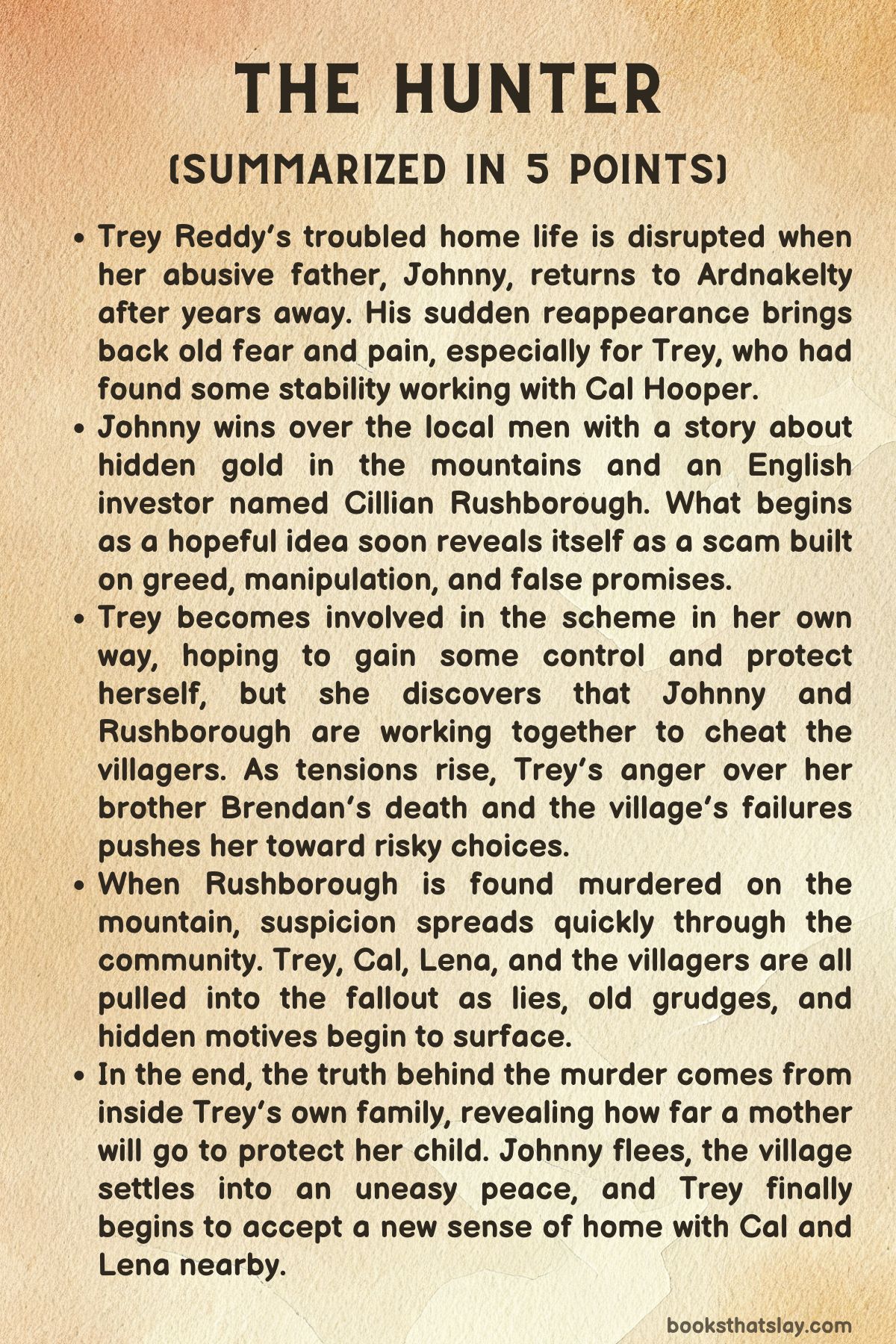
The story opens with Trey Reddy trying to hold together a difficult life in Ardnakelty. She spends much of her time helping Cal Hooper repair furniture, finding in his workshop a calm and order that do not exist at home.
Her family house is noisy with younger siblings, while her mother, Sheila, has grown quiet and worn down by years of strain. The balance of that household is shaken when Trey’s father, Johnny Reddy, suddenly returns after years away.
His return brings no comfort. Trey remembers the violence he once inflicted on the family, and his attempt to slide back into their lives only fills her with anger and dread.
Cal quickly senses the danger Johnny represents. Trey asks to stay away from home for a night, and Lena Dunne, Cal’s partner, takes her in.
Trey’s thoughts make clear that Johnny’s absence had brought a kind of relief, and his return revives fear that had never fully gone away. Johnny claims he left to earn money for the family, but Trey cannot forgive him.
She thinks of her older brother Brendan, who felt forced to shoulder adult burdens after Johnny disappeared. Brendan later vanished and is believed dead by Trey, though his body has never been found.
Johnny soon begins working his charm on the local men. He tells a story about an Englishman, Cillian Rushborough, whose grandmother supposedly came from Ardnakelty and left directions to hidden gold in the hills.
Johnny presents this as a rare chance for local people to profit from their land. The village is poor enough, and frustrated enough, that even an unlikely story has power.
At first the men are doubtful, but Johnny plays expertly on hope, resentment, and greed. He suggests that even if no real gold is found, Rushborough will pay to dig on their land.
Then he reveals the deeper trick: if they seed the river with bought gold so Rushborough can “discover” it, they can lure him into paying much more. The plan is a fraud, but it offers the men a dream of sudden change.
Cal recognizes almost at once that Johnny is running a scam, but he decides to join the scheme with a small investment so he can watch what Johnny is doing and protect Trey. Mart Lavin, an older local man, helps him enter the circle.
Trey, meanwhile, notices that for the first time people in the village pay attention to her because she is close to Johnny and may know something useful. After years of being overlooked, she feels the strange pull of that new importance.
Rather than staying outside the plan, she chooses to get involved, hoping to use the situation for her own purposes.
Rushborough arrives and seems convincing enough to stir the men further. He produces a gold ring that he claims came from Ardnakelty long ago, and that small object tips the mood from amused doubt toward belief.
Yet Trey is already moving in another direction. Borrowing Cal’s camera, she secretly photographs the men placing gold in the river before dawn.
She then takes those pictures to Rushborough, expecting to expose the fraud and drive him away. Instead, she discovers the truth is worse than she imagined.
Rushborough and Johnny are partners. The whole story about ancestry and hidden gold is fake, designed not to cheat an outsider but to cheat the local men themselves.
Johnny also owes Rushborough money, which gives Rushborough leverage over him.
Rushborough responds to Trey with cruelty. He hits her and threatens both her and her dog, Banjo.
Then he makes her part of the scheme by giving her fake gold and ordering her to present it as something she found in the hills. Trey leaves with a deeper hatred than before.
She now understands that Johnny is not just reckless or selfish; he is willing to use her and everyone around him. She also starts thinking beyond the scam itself.
Brendan’s death still hangs over her, and the village’s silence and compromises have made her feel that Ardnakelty as a whole deserves punishment.
Lena and Cal gradually piece together the fraud from different angles. Lena checks local memory and learns there has never been any real story about gold in those mountains.
Cal plans to expose Johnny to the men, but Trey reaches the pub first and plays the role Rushborough assigned to her. She lays down the bag of “gold,” letting the men believe she found it herself.
The effect is immediate. Greed rises.
Questions fly. Cal sees that if he openly exposes Johnny in that moment, Trey will be caught in the blast.
He says nothing.
The tension sharpens after that. Cal confronts Johnny privately and demands that he leave Ardnakelty, making it clear he will not let him drag Trey down.
Johnny, bruised and frightened, warns that Rushborough is dangerous. At home, Trey waits for Johnny and sees evidence of the fight.
She begins to understand that Cal knows far more than he has said.
Soon after, events shift from fraud to murder. In the night, vehicles appear outside the Reddy home and men threaten Johnny from the darkness.
The next morning Trey finds Rushborough’s body on a mountain road. He has been beaten and stabbed.
She brings Cal to the scene before the police arrive. When Johnny shows up, he looks shocked, but Cal cannot tell whether that shock is genuine or performed.
Trey then reveals to Cal that she had photographed the river setup and shown the pictures to Rushborough. Cal is startled by how much she has been carrying on her own.
The murder investigation begins under Detective Nealon. Trey, still driven by anger and by the memory of Brendan, lies to the police.
She claims she heard local men outside her house on the night of the killing, trying to steer suspicion toward the villagers. Cal sees what she is doing.
She wants revenge not just on one person but on the whole place that failed her brother and her family. Johnny, meanwhile, tries to manage the story while keeping himself safe.
Rumors spread quickly through Ardnakelty. Some locals want Johnny blamed, some fear Cal will be blamed as an outsider, and Lena counters village suspicion by letting people believe she and Cal are getting married, which gives him a more secure place in the local social order.
Nealon uncovers more of Rushborough’s background. His real name is Terence Blake, and he was involved in drugs and other criminal activity in London.
The invented grandmother story falls apart completely. Phone records show contact with Johnny, making him look even more suspicious.
Pressure grows on every side. Trey eventually retracts her lie about the men and instead says she saw Johnny leave the house that night.
Lena pushes her to do this by forcing her to face the real cost of her revenge. If Trey keeps lying, Cal may be blamed and may even sacrifice himself to protect her.
The final truth comes not from the police but from within the family. Sheila tells Trey that she killed Rushborough.
Seeing Trey drawn into the same darkness that took Brendan, Sheila decided to act. She used Johnny’s phone to lure Rushborough to the family shed by promising money to cover Johnny’s debts.
When he bent down to collect it, she struck him with a hammer and stabbed him. Then she moved the body to the road so it would be found away from the house.
Sheila’s confession changes everything. For years she seemed passive, but her silence had hidden both endurance and a fierce instinct to protect her children.
Trey responds at once. She helps remove evidence by burning the shed, injuring her ankle in the process.
At the same time, a group of village men take Johnny away to a field, forcing him to dig and making clear that his time in Ardnakelty is over. Whether they mean only to terrify him or something worse is left uncertain, but the threat is real.
Cal pulls away when he sees smoke rising from the Reddy place and rushes back for Trey. Johnny arrives there too and, faced with the collapse of everything, chooses to disappear.
He tells Trey to say he was lost in the fire and leaves with money from Cal, heading out of her life again.
In the end, the official story points toward Johnny, which suits both the village and the investigation. Trey recovers at Cal’s house.
Cal does not demand explanations from her, but he makes clear that she has a place with him. Lena shelters Sheila and the younger children.
Mart accepts the outcome because it removes both Johnny and police pressure from the community. Standing with Cal and looking at the burned mountain, Trey realizes she may never find Brendan’s grave now.
Yet for the first time, she feels a measure of peace. What remains is damaged and imperfect, but it is steadier than what came before: a chosen family, a guarded future, and a silence that no longer feels empty.
Characters
Cal Hooper
Cal Hooper is the moral center of The Hunter, but he is not written as a simple hero. His strength comes from restraint, patience, and a careful sense of responsibility rather than dramatic displays of authority.
A retired Chicago police officer, he has come to rural Ireland hoping for a quieter life, and that desire shapes nearly everything he does. He wants peace, routine, and honest work, yet the novel makes clear that peace is never something he can fully separate from conflict.
His instincts as an investigator remain active even when he tries to live like an ordinary villager fixing furniture and tending his home. He notices shifts in tone, hidden motives, and danger long before many others do.
What makes him compelling is that he does not seek control for its own sake. He steps in because he sees how easily vulnerable people can be used and because he cannot ignore what he knows.
His bond with Trey reveals the deepest part of his character. He is not her father, yet he becomes the adult who offers her steadiness, respect, and practical care.
He teaches her carpentry, listens to her without crowding her, and allows her space to think for herself. This matters because Trey has grown up in a world where adults either fail her or try to use her.
Cal’s version of care is different. He does not flatter her, and he does not treat her like a helpless child.
At the same time, he sometimes underestimates how independently she is acting. He tries to protect her by entering Johnny’s scheme and keeping watch, but he does not fully grasp how far Trey’s anger and intention have developed.
That gap between them is important because it shows that love and trust are not the same thing as full understanding.
Cal is also marked by an outsider’s tension. He has built a place for himself in Ardnakelty, yet he knows it can never be completely simple.
He is accepted, but not in a way that erases difference. The villagers respect him, but they also view him through their own codes of belonging, history, and suspicion.
This affects his choices during the murder investigation. He knows when to speak and when silence may protect someone.
He knows that truth, in a close community, can damage the innocent as much as the guilty. That knowledge makes him morally complex.
He is not guided only by the law. He is guided by what will leave the least harm behind.
By the end, Cal becomes something close to family for Trey without demanding the title. That emotional position is hard won.
He does not rescue her in a clean or complete way, nor does he solve the moral damage around him. Instead, he becomes a dependable presence in a world where dependability is rare.
His importance lies in the fact that he offers a model of masculinity and adulthood built on care, discipline, and accountability rather than ego, charm, or domination. In a story filled with manipulation, Cal stands out because he values what can be built slowly and honestly.
Trey Reddy
Trey is the emotional force that drives the story. She is young, but the novel never treats her youth as innocence.
Instead, she is shown as highly intelligent, deeply watchful, and already shaped by grief, fear, and disappointment. Her childhood has been narrowed by hardship.
She has lived with domestic violence, parental neglect, poverty, and the disappearance of her beloved brother Brendan. Because of this, she reads the people around her with unusual sharpness.
She misses little, and she has learned that survival depends on understanding what others want before they say it openly. What makes her such a strong character is that she is not reduced to damage.
She is wounded, certainly, but she is also ambitious, capable, and hungry for control over her own life.
Her relationship with power is central to her character. For much of her life, she has had very little social value in the eyes of the village.
She is a quiet girl from a troubled family, someone people can ignore. Johnny’s return changes that.
Suddenly she becomes useful to others because she may have access to information and influence. Trey quickly notices this shift, and the novel is very precise in showing how tempting that new power is.
She does not simply want affection or safety. She wants agency.
She wants to matter in a way that cannot be denied. That desire helps explain why she becomes involved in Johnny’s gold fraud rather than stepping away from it.
Her choices are often dangerous, but they are rooted in a need to stop being the powerless person in the room.
Trey’s anger is one of the most important aspects of her character. She carries the unresolved loss of Brendan as something active and unfinished.
She believes the village, in one way or another, failed him. That belief widens her anger beyond individual blame.
She begins to think in terms of collective guilt. This is why she is capable of lying to the police in a way that could endanger many people.
She is not only reacting to the immediate situation; she is acting from a much older wound. Her revenge is messy because grief is messy.
She wants justice, but she also wants pain returned to those who, in her mind, let pain happen.
At the same time, Trey is not unreachable. Her connection to Cal and Lena shows that she still has the ability to trust, learn, and imagine a future beyond bitterness.
Carpentry represents this part of her. It gives her skill, discipline, and a path that is hers rather than inherited from family chaos.
She is especially moving because she stands between two possible selves: one shaped by rage and damage, the other shaped by work, intelligence, and chosen loyalty. By the end, she has not escaped her past, but she has moved toward a life where she does not have to be ruled by it.
Her final peace is fragile, but it is real, and that makes her one of Tana French’s most memorable young characters.
Johnny Reddy
Johnny Reddy is written as a man whose greatest talent is making desire sound reasonable. He returns to his family not with remorse or humility but with performance.
He knows how to flatter, how to stir hope, how to shift blame, and how to present himself as a wronged man who only wanted better things for the people around him. That surface charm is essential to understanding him.
He is not dangerous because he is physically imposing or intellectually brilliant. He is dangerous because he knows exactly how to appeal to hunger, resentment, and fantasy in others.
He sees what people want to believe and hands it back to them in a polished form.
As a father, Johnny is a destructive presence. The novel makes clear that his absence was harmful, but his presence is worse because it reactivates fear and instability.
Trey remembers the violence he inflicted on the family, and that memory gives weight to every scene in which he tries to act like an affectionate parent. His attempts to reconnect are not expressions of genuine care.
They are methods of re-entry. He wants authority restored without accountability.
He wants emotional access to Trey without earning it. This makes him particularly corrosive because he tries to turn family language into a shield against judgment.
Johnny also represents a hollow form of masculinity built on charm, manipulation, and evasion. He dreams of money and status, but he does not build anything.
He moves from scheme to scheme, leaning on other people’s labor, trust, and vulnerability. Even his partnership with Rushborough is not a sign of real competence.
It reveals his weakness. He is already trapped in debt and trying to scramble out by drawing others into the trap with him.
He talks as if he is the architect of opportunity, but in reality he is always one step away from collapse. That unstable quality makes him both contemptible and strangely pathetic.
What prevents him from becoming one-dimensional is that he still has emotional influence, especially over Trey. He carries traces of Brendan in her mind, and he knows how to use the emotional history of fatherhood even after betraying it.
He can make himself seem like a route to power, action, and significance in a place where life often feels stalled. This is part of what makes him so harmful.
He does not merely lie; he offers an identity that others want to inhabit for a while. In the end, he flees again, choosing disappearance over responsibility just as he did before.
That ending confirms the truth of his character. He leaves wreckage, then vanishes, trusting others to absorb the damage.
Lena Dunne
Lena Dunne provides one of the clearest examples of mature strength in the novel. She is intelligent, self-contained, practical, and emotionally honest in a way that many others are not.
She understands Ardnakelty deeply because she belongs to it, yet she is also capable of looking at it critically. That balance gives her unusual authority.
She knows the habits of the community, the force of gossip, the long memory of local judgments, and the way women are often expected to absorb damage quietly. Because she sees these patterns so clearly, she becomes one of the few people who can interpret events without being fully seduced by either sentiment or panic.
Her relationship with Cal is especially important because it shows a version of intimacy built on equality. She does not exist merely to support his emotional journey.
She challenges him, reads him accurately, and often understands social realities he cannot fully see as an outsider. When village suspicion begins turning toward him, Lena does not respond with complaint or fear.
She takes practical action by spreading the rumor that they are getting married, knowing exactly how that story will change the town’s view of him. This is not romantic fantasy.
It is social intelligence used as protection. She knows how community narratives work, and she uses them better than the men around her.
Lena’s connection with Trey is equally significant. She offers care, but never in a soft or false way.
She can comfort Trey, shelter her, tend to Banjo, and speak with sympathy about pain inside families. Yet she can also confront Trey when Trey’s anger becomes destructive.
Her conversation with her near the end is one of the most important moral turning points in the story because Lena refuses to indulge revenge when it starts threatening innocent people. She makes Trey face consequences, not just feelings.
That gives her a kind of moral courage different from Cal’s. Cal protects through steadiness; Lena protects through clarity.
She also serves as a reminder of roads not taken. Her earlier dreams of leaving, studying, and becoming a vet suggest a wider life that never came to pass.
Yet the novel does not frame her as defeated. Instead, it presents her as someone who has turned experience into discernment.
She knows disappointment, but she has not become bitter. She knows compromise, but she has not surrendered her standards.
In a book full of people chasing grand fantasies of money or escape, Lena stands for the value of realistic judgment joined to quiet loyalty. She is one of the figures who make survival look intelligent rather than merely stubborn.
Sheila Reddy
Sheila Reddy is one of the most quietly powerful characters in The Hunter. For much of the story, she appears almost ghostlike within her own household.
She speaks little, moves carefully, and seems worn down by years of marriage to Johnny. Other people read her silence as passivity, but the novel eventually reveals that silence to be more complicated.
Sheila has endured humiliation, abandonment, and violence while trying to hold her children together in circumstances that would break many people. Her stillness is not emptiness.
It is the shape that long-term endurance has taken in her.
Her character is deeply tied to the effects of domestic abuse. She has lived so long inside Johnny’s orbit that her choices often look constrained, contradictory, or difficult to explain from the outside.
She does not simply throw him out when he returns, and that frustrates Trey. Yet the novel resists easy judgment.
It shows that marriage, obligation, fear, community shame, and habit can form a prison that is emotional as much as practical. Sheila is fully aware of Johnny’s nature.
She does not need other people to explain him to her. The tragedy is that knowing the truth and being free to act on it are not the same thing.
What transforms her character is the revelation that she kills Rushborough to protect Trey. This act changes the reader’s understanding of everything that came before.
Sheila has seemed resigned, but in the decisive moment she becomes the person who acts most absolutely. Her choice is brutal, but it comes from a fierce maternal line she will not let crossed.
She has already lost Brendan in effect, even if his grave remains hidden. She sees Trey moving toward another disaster and decides that passivity is no longer possible.
In this sense, her violence is both a rebellion and a final assertion of agency after years in which agency seemed to have been stripped from her.
Sheila’s refusal to kill Johnny is equally revealing. On the surface, it may seem illogical that she can murder Rushborough but not her husband.
Yet that contradiction expresses the deep moral and emotional distortions created by her life. She still thinks in terms of vows and betrayal.
Johnny remains bound to her through a system of belief, duty, and history that she cannot fully break, even after everything. This makes her psychologically convincing.
She is neither saintly victim nor cold avenger. She is a woman shaped by damage who still finds a way to act with terrifying force when her children’s future is on the line.
Mart Lavin
Mart Lavin serves as a voice of local knowledge, but he is far more than comic relief or village color. He understands the rhythms of Ardnakelty better than almost anyone, and that understanding gives him influence that is informal but real.
He can read a crowd, judge a scheme, and sense where opinion is turning. He often speaks in a casual manner, yet beneath that ease is a sharp awareness of power.
He knows Johnny is trouble from the start, and even when he allows events to develop, he never truly loses sight of the danger involved.
Mart is important because he represents the community at its most practical. He is not idealistic, but neither is he blind.
He knows the village men can be tempted by money, pride, and the fantasy of outsmarting an outsider. He also knows how quickly things can turn harsh once the sense of betrayal sets in.
His support for Cal is genuine, but it is based partly on judgment. He trusts Cal because Cal has shown steadiness and respect for local ways.
That trust matters because Mart functions as a kind of bridge between outsider and village.
At the same time, Mart embodies the darker side of communal justice. He accepts that some problems may be settled outside official law.
When suspicion hardens around Johnny, Mart does not respond like a man devoted to procedure. He responds like someone who believes a community has its own ways of defending itself.
The scene in which Johnny is taken to dig in the field carries the full weight of that local code. Mart may not say everything openly, but his silence is meaningful.
It suggests that order in Ardnakelty often depends on pressures and warnings that cannot be written down.
This complexity makes him a strong supporting character. He is loyal, funny, observant, and often kind, but he is also fully part of a world where morality is collective, flexible, and sometimes intimidating.
He helps show that village solidarity can protect, but it can also threaten. Through Mart, the novel presents community not as a soft refuge but as a structure with its own force and its own capacity for punishment.
Cillian Rushborough / Terence Blake
Rushborough, later revealed as Terence Blake, is the character who most clearly brings external criminality into the village, but his role is larger than that of a simple villain. He arrives dressed in performance, presenting himself as an Englishman with ancestral ties, romantic curiosity, and money to spend.
He gives the villagers the exact version of himself they are prepared to receive. That false identity is central to his character.
He understands that stories are valuable. Heritage, buried gold, nostalgia, and rural mystery are all things he can package into persuasion.
He is dangerous not because he belongs to Ardnakelty, but because he knows how to exploit what people there are ready to imagine.
Once Trey confronts him with the photographs, his real nature becomes clear. The polite mask drops, and what emerges is a man comfortable with intimidation and cruelty.
His violence toward Trey and Banjo is especially revealing because it shows how quickly he turns to fear as a tool. He does not see people as persons with dignity; he sees them as pieces to position.
His criminal background later confirms this. He belongs to a wider world of organized exploitation, debt, and force, and he treats the village as one more place to extract value.
Rushborough is also important as a contrast to Johnny. Johnny is all local familiarity, personal manipulation, and emotional history.
Rushborough is colder, more professional, and less sentimental. Together they form a destructive pair.
Johnny knows how to reach the villagers from inside their world, while Rushborough gives the scheme the authority of outside money and confidence. Their partnership reveals how local weakness and outside predation can feed each other.
His death matters not because he is mourned but because it exposes the depth of fear and desperation beneath the fraud. He becomes the point where greed, abuse, maternal protection, and village tension collide.
Even in death, he continues to shape events because his murder opens the question of what kind of justice is possible in a place where official truth and lived truth rarely align.
Brendan Reddy
Brendan never appears directly in the present action, yet he is one of the most powerful presences in the novel. He exists through memory, grief, and the choices other characters make because of him.
For Trey especially, Brendan represents love, protection, and the version of family life that might have been possible if responsibility had not fallen so unfairly on him. After Johnny disappeared, Brendan tried to step into the role of provider, and that burden ultimately led him away.
His absence becomes the emotional center of Trey’s rage.
Brendan’s significance lies in what he reveals about inherited damage. He is the child who responded to abandonment by taking on too much, by trying to solve adult problems with the limited means available to him.
In that sense, his fate is not an isolated tragedy but a result of the family structure Johnny created and the village failed to interrupt. Trey’s obsession with avenging him shows how unresolved loss can reshape moral judgment.
Brendan becomes more than a brother in her mind. He becomes proof that the world around her is guilty.
He also functions as a comparison point for Cal. Cal becomes, in some sense, the adult Brendan could never afford to remain.
He offers Trey protection without forcing her to care for him in return. That contrast deepens the emotional meaning of Brendan’s absence.
Brendan loved Trey, but he was still a boy asked to carry too much. His memory haunts the story because it stands for all the ways love can be present and still fail against poverty, violence, and neglect.
Detective Nealon
Detective Nealon represents official law entering a place governed largely by custom, history, and guarded loyalties. He is not romanticized, but he is shown as competent, observant, and more perceptive than many villagers assume.
He quickly gathers facts about Rushborough’s identity, criminal links, phone records, and likely movements. He also understands that what witnesses say may not line up neatly with what they mean.
His conversations with Cal show mutual professional recognition. He senses that Cal can see the case clearly, even if Cal refuses full involvement.
Nealon’s role is important because he introduces the possibility of formal truth while also showing its limits. He can collect evidence, test statements, and reconstruct timelines, but he cannot easily penetrate the emotional and social undercurrents of Ardnakelty.
People lie, protect one another, and shape stories according to private motives. Nealon knows this, yet he still has to work within the structure of legal proof.
This makes him a useful contrast to the village. He is not less intelligent than the locals, but he is operating inside a different system of meaning.
His presence increases pressure on Trey and Cal because he forces them to decide how much of the truth can be spoken without causing greater damage. He is therefore less a personal character study than a structural one.
He stands for the state’s claim to order, reason, and accountability. The novel does not dismiss that claim, but it does show that in a deeply entangled community, legal truth may arrive too late or remain incomplete.
Noreen Duggan
Noreen Duggan may not dominate the plot, but she is crucial in showing how village life functions through conversation, observation, and social positioning. Working in the local shop, she hears what people are thinking before they fully act on it.
She knows who is admired, who is distrusted, and how quickly public opinion can swing. Her scenes help reveal the pressure of living in a place where very little remains private for long.
She also helps define Lena by contrast and companionship. Their exchanges carry the history of family and local familiarity, and through Noreen the reader sees how ordinary women in the village navigate judgment, gossip, and practical survival.
Noreen is not idealized; she can be curious, sharp, and fully engaged in local talk. Yet she also shows loyalty in important moments, especially when Trey is treated badly in the shop.
She refuses to let the crowd’s hostility become total exclusion.
Her function in the story is to make the social world visible. Murders and scams do not unfold in isolation.
They spread through rumor, interpretation, and repeated retelling, and Noreen is one of the characters who reveals how that process works on the ground.
Themes
Chosen Care and Broken Family Structures
Family in The Hunter is not treated as an automatic source of safety or moral authority. Instead, the novel studies what happens when biological family fails in its most basic responsibilities and when care has to be rebuilt through choice rather than blood.
Trey’s home life is the clearest expression of this problem. Her father’s return does not restore anything; it reopens old fear.
His role as father has already been hollowed out by abandonment and abuse, and the story refuses to accept his claim to authority simply because he is biologically related to his children. The title of parent means little when it is not matched by protection, honesty, or sacrifice.
Against that damaged structure, the novel places other forms of attachment that are less formal but more meaningful. Cal’s connection with Trey grows out of shared work, mutual regard, and steady presence.
He does not try to possess her emotionally, and that is exactly what makes him trustworthy. He offers practical teaching, attention, and a place where she can exist without constant threat.
Lena also becomes part of this network of chosen care. She shelters Trey, tends to Banjo, argues with her when necessary, and steps in where official or traditional family systems are failing.
Together, Cal and Lena show that care is not about role alone; it is about consistency, discipline, and the willingness to place another person’s wellbeing above ego.
Sheila’s arc deepens this theme by showing how biological motherhood can remain powerful even when it is constrained by fear and trauma. She is not a conventionally strong mother figure for much of the book, yet her final actions reveal how fierce her protective instinct has always been.
What the novel captures especially well is that broken family systems do not erase the longing for family. Trey still wants something from her father, even if that something is mixed with anger.
She still responds to the emotional force of his presence because family damage is not neat. The child who has been failed does not become instantly free of need.
This theme matters because it shifts the story away from simple crime plotting and into a deeper study of belonging. Home is shown as something unstable.
It can be a site of fear, silence, and injury. But the novel also suggests that home can be remade through chosen bonds, through work done together, and through people who stay when leaving would be easier.
That is why the ending carries emotional weight. It does not restore the traditional family unit.
It creates a harder, less sentimental version of shelter, one built out of honesty, damage, and earned trust.
The Seduction of Power, Money, and Importance
The gold scheme is not only a criminal fraud. It is a way of exposing how badly people want to feel that their lives might change all at once.
The promise of buried wealth takes hold because it speaks to deprivation, resentment, and long frustration. Ardnakelty is a place where opportunities are limited, old disappointments have settled into habit, and many people feel that life has passed them by without reward.
Johnny understands this perfectly. He does not merely sell a lie about gold.
He sells the fantasy that hidden value has always existed beneath people’s feet and that they were foolish not to see it sooner. That fantasy is powerful because it makes hardship feel temporary and reversable.
The theme works on a personal level as well as a communal one. Trey is drawn into the scheme not because she believes in easy money in a childish sense, but because she recognizes that proximity to power changes the way people treat her.
For one of the first times in her life, adults notice her, question her, and try to win information from her. That attention gives her a taste of influence.
The novel is very sharp about this. It understands that power is not only cash or status.
Sometimes it is the simple fact of making others lean toward you. For a teenager who has mostly been overlooked, that can be intoxicating.
Johnny himself is an example of this theme in corrupted form. He craves the image of a man who can transform his family’s fortunes, command local admiration, and outsmart everyone in the room.
Yet he has no real foundation beneath that image. He is addicted not only to money but to the performance of importance.
Rushborough functions similarly, though in a colder register. He plays the role of wealthy outsider with ancestral romance because he knows others will respond to that posture of certainty and ownership.
Both men understand that many people are willing to suspend doubt when offered a vivid enough vision of upward change.
The novel also shows how the desire for power can distort moral judgment. Once the villagers imagine themselves profiting, skepticism weakens.
Once Trey imagines acting rather than merely enduring, she becomes willing to move in risky and ethically unstable ways. The story never suggests that wanting more from life is shameful.
What it examines is the danger that begins when longing turns into susceptibility. The false gold is important because it is both literal bait and symbolic bait.
It reveals how quickly value can be assigned to something because people need it to mean hope. In that sense, the book is not only about greed.
It is about hunger for dignity, leverage, and transformation, and about how easily that hunger can be used against people.
Community as Shelter, Pressure, and Judgment
Ardnakelty is not a decorative setting. It functions as a living force that shapes every decision in the novel.
Community here is neither idealized nor dismissed. It can nourish, defend, isolate, remember, and punish.
That complexity gives the story much of its power. Life in the village depends on recognition.
People know one another’s histories, family ties, old mistakes, and changing reputations. This can create solidarity, but it can also create suffocation.
There is very little room to start over cleanly because the past is always circulating in speech, memory, and assumption.
Cal’s experience as an outsider makes this especially visible. He is welcomed into local life to a degree, but his place remains conditional.
He earns respect through work, steadiness, and personal conduct, yet the murder investigation reminds him how quickly suspicion can pivot toward someone who is not fully rooted in the communal web. Lena understands this better than he does at first, which is why she uses the rumor of engagement as social strategy.
In a close community, belonging is not just emotional. It is political.
It determines who gets defended, who gets doubted, and who is allowed complexity.
Trey’s relationship with the village is even more painful. She has grown up feeling overlooked or reduced to her family’s troubles, and Brendan’s disappearance has sharpened her belief that the community fails those who most need support.
Her lie to the police comes from that sense of collective grievance. She wants to punish not only specific individuals but the wider social body that, in her mind, tolerated injustice and let loss become ordinary.
This is a very important insight in the novel: communities do not only commit harm through direct action. They also commit harm through what they normalize, excuse, or leave unspoken.
At the same time, the village is not simply cruel. Noreen protects Trey in the shop.
Mart stands by Cal. People ultimately treat Trey as more connected to Cal than to Johnny, which gives her a path back from public disgrace.
The problem is that community protection is selective and often comes tied to conformity, silence, or collective self-interest. When the men take Johnny out to the field, the novel shows how local justice can move outside any official structure.
That moment is frightening, but it also grows logically from a world in which the community sees itself as responsible for defending its own order.
This theme matters because it prevents the book from becoming a simple contrast between individual innocence and collective corruption. Instead, it presents communal life as morally mixed.
A village can provide belonging that saves people from isolation, but it can also enforce codes that crush vulnerability or hide truth. To live inside such a place is to be held and watched at the same time.
Grief, Revenge, and the Search for a Livable Form of Justice
Grief in this novel does not remain private or passive. It changes perception, feeds anger, and pushes people toward action that may not be fully rational but feels emotionally necessary.
Brendan’s absence is the clearest example. He is not present as a living character, yet his loss shapes Trey’s thinking at every crucial point.
She does not experience grief as sadness alone. For her, it becomes accusation.
Someone failed him. Many people failed him.
The world that let him vanish without repair cannot be trusted. This turns mourning into a form of moral heat that burns through her decisions.
Revenge emerges from that grief as an attempt to answer helplessness with agency. Trey wants pain returned somewhere.
That desire explains why she is willing to distort the truth and risk harm to others. She is not carefully weighing abstract ethics.
She is trying to make the world feel responsive to the wrong done to Brendan. The novel is very thoughtful about this.
It does not mock revenge as childish, nor does it celebrate it as cleansing. Instead, it shows revenge as emotionally understandable and practically dangerous.
Once Trey begins acting from collective blame, innocent people can be drawn into consequences they did not earn.
Sheila’s killing of Rushborough complicates the theme further. Her violence is not revenge in the same sense, but it is still connected to grief and fear of repetition.
She has already watched one child’s life be destroyed. She will not stand by while another is pulled into danger.
In her case, justice takes the form of direct elimination of a threat. The act is brutal, but the novel frames it as a desperate maternal intervention rather than a triumph.
There is no release or purity in it. Only necessity as she sees it, followed by concealment.
Cal offers the strongest counterpoint to revenge. He understands anger, but he is constantly trying to guide events toward the least destructive outcome rather than the most emotionally satisfying one.
This does not make him morally simple. He is willing to threaten Johnny, willing to stay silent at certain moments, willing to accept unofficial resolutions.
Yet he is always looking for a form of justice that leaves a future intact for Trey. That focus on future rather than retaliation is crucial.
By the end, the novel suggests that perfect justice is impossible in a world so marked by prior damage. The official case lands on a version of events that is incomplete.
The village gets an outcome it can live with. Johnny disappears.
Sheila survives. Trey loses forever the possibility of finding Brendan’s grave, but she gains a degree of peace.
This is not justice in a pure legal or moral sense. It is something rougher and sadder: an arrangement in which the cycle of harm is at least slowed.
The book’s insight is that for people shaped by grief, the real challenge is not only exposing wrongdoing. It is finding a way to go on living without letting pain become the only organizing force in the self.