Same As It Ever Was Summary, Characters and Themes
Same As It Ever Was by Claire Lombardo is a family novel about marriage, motherhood, memory, and the ways old wounds keep shaping ordinary days. At its center is Julia Ames, a suburban wife and mother whose life looks settled from the outside but feels far less certain within.
When a chance meeting with a woman from her past brings buried history back to the surface, Julia is forced to face the choices, hurts, and private failures that helped build her family life. The book follows her across decades, showing how love can be sustaining, imperfect, demanding, and still worth choosing again and again.
Summary
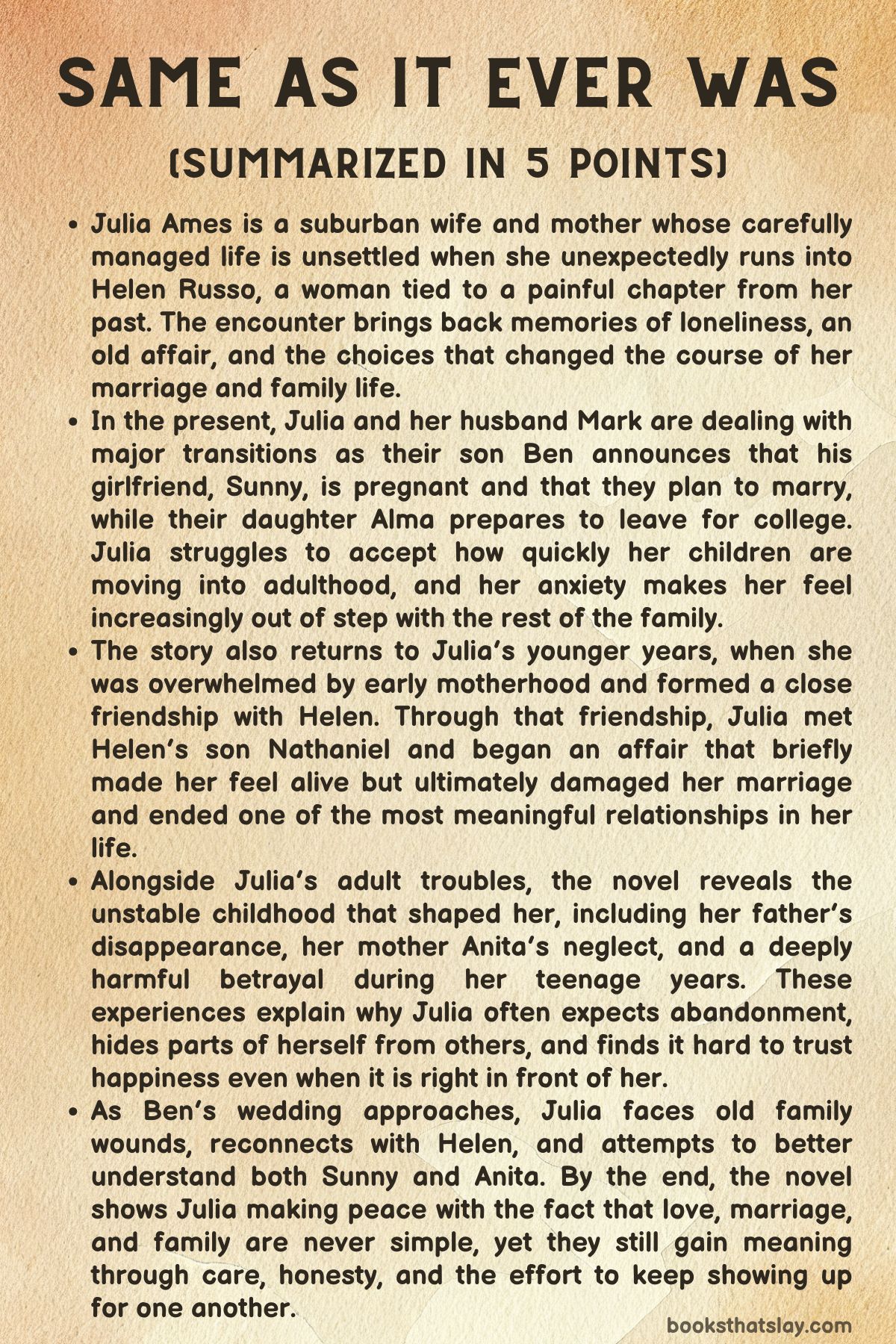
Julia Ames is preparing for her husband Mark’s sixtieth birthday party when a routine errand unsettles her. At a grocery store far from home, she runs into Helen Russo, a woman she has not seen in nearly two decades.
The meeting stirs up a period of Julia’s life she has tried to keep buried. Back at home in their Chicago suburb, Julia moves through the evening with her husband Mark, their daughter Alma, and their grown son Ben returning for the celebration.
Beneath the normal family gathering, Julia is rattled. Helen’s sudden reappearance brings back the memory of an affair, a friendship she lost, and the larger question of whether she has ever truly belonged inside the life she built.
In the present, Julia’s family is entering a season of change. Ben announces that his girlfriend, Sunny, is pregnant and that they plan to marry.
Julia reacts with worry and disbelief, while Mark is more steady and openhearted. Alma, seventeen and observant, reads the situation with more clarity than either parent expects.
Julia tries to get to know Sunny but feels awkward and defensive around her. Sunny is practical, organized, and carrying her own family pain, while Julia feels clumsy and uncertain in the role of future mother-in-law.
At the same time, Alma is preparing for college and dealing with academic pressure, disappointments in admissions, and the strain of growing up. Julia feels her children moving away from her just as she wants to hold them closer.
The novel moves back and forth in time to show how Julia reached this point. Twenty years earlier, she was a young mother raising Ben and feeling isolated in suburban domestic life.
One morning, overwhelmed and crying after dropping Ben at preschool, she skips the day’s routine and ends up at a botanical garden. There she meets Helen, an older, poised former lawyer with five grown sons, a warm household, and a confidence Julia finds magnetic.
Helen sees Julia clearly in a way few people do. Their friendship grows quickly.
Julia visits often, talks openly about her sadness, her frustration with marriage, and her uncertainty about whether she even wants another child. Helen offers companionship, advice, and a glimpse of a family life that feels fuller and more assured than Julia’s own.
Through Helen, Julia meets Nathaniel, Helen’s youngest son, an aspiring writer living in the family’s carriage house. Julia is immediately drawn to him.
Their attraction turns physical during a period when Julia feels disconnected from Mark, bored by the shape of her days, and starved for feeling. What begins as stolen intimacy becomes an affair that gives Julia a dangerous sense of aliveness.
She is happier on the surface, but also more reckless and more divided from herself. Her attachment to Nathaniel is not built on a realistic future so much as on escape, attention, and desire.
As Julia slips further into the affair, the friendship with Helen grows strained. Helen begins to understand that something is wrong and eventually confronts Julia with the truth.
She sees the affair not as romance but as another form of Julia’s habit of tearing apart the life she claims to want.
The affair collapses in humiliating fashion. Julia, desperate and confused, briefly imagines running away with Nathaniel, then finds even that fantasy empty.
When Mark comes to pick her up from a roadside gas station after one of these unraveling moments, he tells her he already knows. His response is not explosive but deeply wounded.
Julia admits that, at some level, she may have wanted to destroy the marriage because she believed Mark deserved better than she could give. Mark insists that she cut ties with Helen and Nathaniel, and she agrees.
Their marriage survives, but not because the hurt disappears. They simply continue, trying to rebuild around the damage.
The novel also reaches further back into Julia’s childhood to explain why she is so quick to expect abandonment and so poor at receiving stability. Her father left when she was very young after a tense and fragile marriage to her mother, Anita.
Julia never saw him again. Anita, volatile and unreliable, raised Julia in a world of emotional instability, sudden cruelty, and neglect.
There were moments of tenderness between mother and daughter, but they were never secure enough to trust. As a teenager, Julia discovered that her father had died years earlier and had another family, a revelation Anita had hidden from her.
During the same period, Julia was exploited by Jonathan, one of Anita’s boyfriends, a violation Anita failed to stop. That betrayal shaped Julia’s sense of herself and helps explain why she fled home for college and later kept so much of her past hidden from Mark.
Mark’s history is almost the opposite. He comes from a decent, emotionally limited Midwestern family.
He is earnest, intelligent, and often more stable than Julia, though not without his own loneliness. Their courtship began when he offered her quarters for a parking meter outside a restaurant, a small act of kindness that turned into dinner and then love.
Julia was guarded, while Mark was direct and sincere. Their marriage grew out of real affection, but it also rested on omissions.
Julia did not tell him the full truth about her family or her past. Even before the affair, she often felt alien inside marriage and motherhood, while Mark assumed that commitment and endurance were enough to keep a family intact.
As the present-day wedding approaches, these old tensions rise again. Julia reconnects briefly with Helen, who reveals that she came to a library event hoping to see her.
Julia is flooded by longing for the friendship she lost, but she also understands that revisiting it may reopen wounds. Around the same time, Mark’s friendship with Francine, the wife of his longtime friend Brady, becomes a new source of conflict.
Julia learns that Mark visited Francine when she and Brady were separated and did not tell her. Mark, in turn, admits that he once told Francine about Julia’s affair.
Their arguments expose how much pain still lives under the surface of a marriage that has lasted decades. Yet the conflict also brings honesty.
Mark reminds Julia that he stayed, that he kept choosing the marriage, and that his loyalty has its own weight.
Meanwhile, Julia slowly begins to understand Sunny better. Their relationship softens when they spend time together alone and speak honestly about pregnancy, fear, and complicated mothers.
Sunny reveals that her younger sister died of leukemia and that her family life has been marked by grief and blame. Julia shares that motherhood did not come naturally or instantly to her, a confession that comforts Sunny rather than pushing her away.
Julia also starts seeing Alma more clearly. Alma is sharp, independent, and sometimes exasperated by her mother, but she also wants connection.
Their small rituals, shared television shows, road trips, and late-night conversations become some of the most tender parts of Julia’s life.
Anita’s arrival for the wedding forces the deepest reckoning. Julia has longed for her mother’s presence and feared it in equal measure.
Anita arrives with her husband Marshall, whom Julia did not even know existed. Their visit leads to bitter arguments and painful disclosures, but also to a few late gestures toward truth.
Julia learns that Mark once told Anita to stay away after seeing how badly she had hurt Julia. Anita apologizes in her own imperfect way.
Marshall offers a steadier perspective and makes clear that he loves Anita, and by extension wants to know Julia too.
Before the wedding, Julia visits Helen one last time, bringing flowers and finding her preparing to leave the old family home. Their reunion is gentle and unspectacular, which is exactly what it needs to be.
On the wedding day, Julia, Mark, Ben, and Alma come together with a feeling of fragile wholeness. Ben asks his mother for advice about marriage, and she tells him that trying matters because it means you care.
That line captures the book’s central belief. Love is not clean, easy, or permanently secure.
It is made through repeated effort despite disappointment, history, and fear.
The novel closes by stepping beyond the wedding into the future. Mark dies two years later from an aortic aneurysm.
Helen also dies. Ben and Sunny build a family together, and Alma creates a restless, independent adult life.
Anita’s memory begins to fail. Julia carries grief, regret, and love forward.
In the end, the story does not offer a perfect repair of the past. Instead, it shows Julia arriving at a harder and more meaningful peace: family is messy, memory is unfinished, and still there is grace in continuing to show up for one another.
Characters
Julia Ames
Julia is the emotional center of the novel, and her character is built through contradiction, memory, self-sabotage, and longing. She is intelligent, observant, and often funny in a dry, private way, yet she spends much of her life feeling alien inside the very roles she has chosen.
As a wife, mother, and homemaker who later returns to library work, she appears outwardly settled, but her inner life is restless and often sharply divided from the image others see. She wants closeness, but she also resists being fully known.
She wants family, but she often feels trapped by its demands. That tension gives her character its force.
She is not written as a woman who simply regrets domestic life, nor as someone who is incapable of love. Instead, she is someone whose early emotional injuries make stability feel both desirable and suspect.
She keeps waiting for loss, disappointment, or exposure, and that expectation shapes how she behaves even when no immediate threat is present.
One of the strongest elements of Julia’s characterization is the way her past explains her flaws without excusing them. Her affair with Nathaniel is not treated as glamorous rebellion or a late discovery of passion.
It emerges from a deeper pattern in her personality: when life becomes too fixed, too demanding, or too revealing, she creates chaos. She reaches toward intensity because ordinary happiness feels fragile and unfamiliar to her.
At the same time, she is not cold or careless. She loves Ben and Alma deeply, and the novel makes clear that much of her suffering comes from how seriously she takes the emotional weight of motherhood.
She worries about damaging her children, disappointing them, or failing to remain essential to them as they grow older. Her fear of becoming unnecessary is one of the hidden engines of her anxiety.
Julia is also shaped by shame. Her shame about her mother, her childhood, the abuse she endured, and her own capacity to hurt other people creates a life of concealment.
She does not easily speak plainly, even to Mark, because she has trained herself to survive by withholding. Yet she is also capable of honesty when pushed to the edge.
Some of the most moving parts of her character come from these late acts of disclosure, when she begins to say what happened, what she feared, and what she still does not understand. By the end, she is not transformed into a calmer or simpler person.
What changes is her willingness to remain present inside an imperfect life without immediately trying to flee it. That growth gives her arc its lasting emotional power.
Mark Ames
Mark begins as the apparently stable counterpart to Julia, but he becomes far more complex as the novel moves forward. He is reliable, affectionate, practical, and often gentler than Julia expects.
He has built his identity around steadiness, responsibility, and endurance, which makes him seem almost uncomplicated at first. Yet the novel gradually reveals how much pain, disappointment, and pride live beneath that surface.
His decision to remain in the marriage after Julia’s affair can easily be read as forgiveness, but it is also tied to his sense of duty, his investment in the life they built, and his belief that perseverance is morally significant. He is not simply the wounded good husband.
He is a man who takes pride in having stayed, and over time that pride becomes part of how he understands himself.
What makes Mark compelling is that he is neither blindly patient nor emotionally transparent. He often appears emotionally healthier than Julia, but he also avoids full confrontation until resentment has already gathered force.
He does not always tell her what he is feeling when it first matters. His private visit to Francine and his decision to share Julia’s old affair with Francine show that he, too, has his own forms of secrecy.
He can feel wronged and morally superior at the same time, and the novel is sharp enough to show how those feelings affect a marriage long after the visible crisis has passed. He loves Julia, but he also wants that love to be recognized as effort, sacrifice, and proof of character.
Mark’s history helps explain his particular emotional style. He comes from a stable Midwestern family that is not cruel or damaged in the way Julia’s is, but he still grew up feeling somewhat unseen.
His loneliness is quieter than Julia’s, but it is real. He wants connection, admiration, and a sense that his life matters.
His move away from a scientific path toward work with Brady suggests a man who is open to reinvention but also vulnerable to comparison. He notices other marriages, other family arrangements, and other versions of success.
This matters because it prevents him from becoming a static symbol of dependability. He is not made of pure certainty.
As a father, Mark is warm, attentive, and often more emotionally accessible to the children than Julia imagines herself to be. He reassures Ben, comforts Alma, and seems less frightened by the natural movement of children into adulthood.
Yet even here, his calm is not total detachment. He feels the coming changes and responds by trying to imagine the future with Julia as something that can still be meaningful.
His love for her never entirely loses its tenderness, and that is one of the most affecting aspects of his character. He sees her at her worst and still reaches for her.
His later death makes the reader look back on his ordinary gestures of care with greater force, because the novel has already shown how much of family life depends on people who keep choosing each other in small, repeated ways.
Ben Ames
Ben is one of the most important figures for understanding Julia because he carries both her tenderness and her guilt. As a child, he is sensitive, watchful, and emotionally close to his mother.
He notices when she is upset, wants to protect her in the instinctive way children sometimes do, and becomes central to her experience of early motherhood. His sweetness is not just a trait that others assign to him; it becomes part of the emotional record Julia keeps of him, a memory that follows her into his adulthood.
Because of that, Ben is never only a son in the background. He is also a witness to Julia’s instability, even when he cannot fully understand it as a child.
As an adult, Ben is serious, responsible, and more self-possessed than Julia often knows how to handle. His announcement that Sunny is pregnant and that they plan to marry forces Julia to confront the fact that he is no longer available to her in the old way.
He is making adult choices without seeking her approval, and that unsettles her far more than she wants to admit. His distance from her in the present is painful because it suggests that memory runs both ways.
Julia remembers his childhood vulnerability, but he remembers her failures too, including the day she nearly left him and Mark behind. That detail matters because it shows that children preserve emotional truths even when parents assume those moments disappeared.
Ben’s character is also shaped by his effort to build something stable. He is not impulsive in the shallow sense.
His decision to marry Sunny, though rushed from Julia’s perspective, comes from a desire to meet responsibility directly. He wants to do right by the life he has helped create.
That seriousness aligns him somewhat with Mark, but Ben is not just a copy of his father. He is more emotionally careful, and he appears to have developed a stronger awareness of family damage.
His tenderness toward Sunny and his quiet attempts to manage conflict suggest someone who has learned, perhaps from watching his parents, that love must be accompanied by attention and discipline.
At the same time, Ben is not presented as fully mature or beyond misjudgment. He can be curt with Julia, dismissive when stressed, and impatient with the emotional complexity of his family.
These traits make him believable. He is a son entering adulthood under pressure, not a symbolic prize for his parents’ efforts.
His final scenes with Julia are especially effective because they show movement without sentimentality. He does not become suddenly transparent or endlessly forgiving.
Instead, he offers small signs of openness, gratitude, and trust. That restraint suits the novel’s understanding of family love, which is often real precisely because it remains uneven.
Alma Ames
Alma brings sharpness, intelligence, and a different generational energy to the family. She is perceptive enough to notice what her parents do not say, and one of her most interesting functions in the novel is that she disrupts their self-image.
Julia and Mark tend to imagine that their long marriage and relatively calm household have shielded Alma from certain forms of confusion, but Alma sees more than they think. She recognizes tension, surface politeness, and the emotional gaps inside supposedly stable relationships.
Her comment that Julia and Mark never fight is not praise; it is suspicion. She senses that silence can hide as much as open conflict.
What makes Alma memorable is that she is not reduced to teenage rebellion or youthful wisdom. She is complicated in ways that suit her age.
She can be affectionate, dismissive, idealistic, and cutting within the same scene. She is under visible pressure, especially around school, achievement, and college admissions, and the novel does a strong job of showing how this pressure sits inside a child of a high-functioning family.
Alma is not neglected in a dramatic way, but she is emotionally shaped by the atmosphere around her. She has absorbed expectations, anxieties, and forms of distance that she cannot always name.
Her frustration with Julia comes partly from wanting a mother who is emotionally available without becoming needy.
Her relationship with Julia is especially rich because it contains both irritation and real intimacy. They do not spend all their time together in an ideal mother-daughter closeness, but they share small private worlds: television shows, drives, fittings, late-night conversations, moments of physical care.
Alma often appears to understand more than Julia gives her credit for, especially regarding Sunny, queer identity, relationships, and the emotional cost of pretending everything is fine. At the same time, she remains vulnerable and deeply young.
Her admissions disappointments and her feelings of failure expose how much reassurance she still needs.
Alma also represents a possible break in the cycle of emotional inheritance. She has some of Julia’s fierceness and sensitivity, but she lives in a different world, with more language for identity, more freedom of movement, and more opportunities to step outside family mythology.
Her adulthood, glimpsed at the end, remains unsettled, but it is active and expansive. She does not appear trapped by the same forms of silence that shaped Julia.
That does not mean she escapes pain; it means she may have a different way of carrying it.
Helen Russo
Helen is one of the most influential characters in Julia’s life because she arrives at a moment of emotional starvation and offers recognition, structure, and a model of adulthood that Julia finds both comforting and intimidating. She is older, accomplished, financially secure, and socially confident.
Her household has the glow of success and continuity, and to Julia it seems like a place where family life has coherence rather than constant uncertainty. Helen’s kindness is genuine, but it is not soft or indulgent.
She is capable of listening closely, naming what others avoid, and offering the kind of clear judgment that can feel like rescue to someone adrift.
Part of Helen’s power as a character comes from the fact that she is not idealized for long. Julia initially sees her almost as a solution, someone whose approval could steady her life.
Yet Helen is more complicated than that fantasy allows. She has her own values, blind spots, and hierarchy of concerns.
She can be generous, but she can also be severe. Her response to Julia’s affair is especially revealing.
She is not merely angry because her son is involved. She is disappointed in Julia as someone she had taken seriously.
She interprets the affair as evidence of a deeper destructiveness in Julia, and that judgment lands with devastating force because it comes from someone whose respect mattered so much.
Helen’s role in the novel extends beyond the function of friend or moral authority. She represents a version of female adulthood that includes intellect, career history, social ease, and domestic accomplishment.
Julia admires her partly because Helen seems to have balanced forms of identity that Julia herself experiences as mutually threatening. At the same time, Helen’s confidence also exposes Julia’s insecurities.
Their friendship works because Helen sees Julia’s intelligence beneath the exhausted young-mother exterior, but it breaks because Helen’s standards leave little room for the full disorder of Julia’s inner life.
Their reunion in later life is moving because it strips away the idealization and the betrayal, leaving something quieter: two older women who mattered deeply to one another and can now meet without pretending the past can be undone. Helen’s widowhood and impending move from the family house also give her character a late vulnerability.
The home that once symbolized permanence is no longer permanent. In that sense, Helen’s arc mirrors one of the novel’s larger insights: even the lives that appear most complete are subject to loss, emptiness, and revision.
Nathaniel Russo
Nathaniel is important less as a fully mature romantic figure than as the catalyst for one of Julia’s central crises. He is younger than Julia, uncertain about his future, somewhat aimless, and attractive in part because he seems to exist outside the structure of her ordinary life.
He offers desire, attention, and a sense of possibility at a moment when Julia feels dulled by routine and invisible within marriage and motherhood. The affair feels intense partly because Nathaniel is available as projection.
Julia can attach to him meanings that have less to do with who he is than with what she needs him to represent.
That does not make him unreal as a character. He has his own frustration, vanity, and immaturity.
He speaks about work and ambition with a kind of generational self-pity that reveals both his insecurity and his limited perspective. He enjoys being the person through whom Julia feels revived, but he never fully grasps the scale of what she is risking.
His relationship with her is charged, but it lacks the moral and emotional depth required to sustain an actual life. The closer Julia gets to the possibility of escape, the more clearly she sees that Nathaniel cannot hold the fantasy she has placed on him.
Nathaniel also functions as a painful extension of Helen. Julia’s closeness with him is inseparable from her bond with Helen, which is one reason the affair carries such destructive force.
By crossing that boundary, Julia damages not only her marriage but also one of the few female friendships that had made her feel recognized. Nathaniel, in this sense, is tied to Julia’s pattern of moving toward what will undo her.
His later presence in the novel is brief, and that is appropriate. He does not remain central because he was never the true answer to Julia’s unhappiness.
He is a symptom, an opening, and then a dead end. The emotional significance of the affair lies less in the romance itself than in what it reveals about Julia’s hunger, Helen’s judgment, and Mark’s endurance.
Nathaniel matters because Julia once believed he could change her life, and then learns that he could only expose it.
Anita
Anita is one of the most difficult and painful characters in the novel because she is never reduced to a single moral category. She is neglectful, unstable, defensive, and at times cruel, yet she is not presented as a simple villain.
Her failures as a mother are profound. She withholds truths, allows damaging situations to unfold, and often treats Julia not as a child needing care but as an extension of her own frustrated life.
The emotional unpredictability of Julia’s childhood comes largely from Anita’s volatility. She can be playful and affectionate one moment, cutting and absent the next.
That inconsistency shapes Julia more deeply than straightforward hostility would have, because it trains her to hope for warmth while expecting betrayal.
One of Anita’s most damaging traits is her refusal to make reality stable for Julia. She hides the truth about Julia’s father, minimizes or ignores the harm done by Jonathan, and repeatedly meets Julia’s emotional need with evasion, contempt, or exhaustion.
This leaves Julia without a dependable story about her own life. Anita’s message, whether spoken directly or conveyed through action, is that dependence is foolish and pain should be handled privately.
That lesson becomes part of Julia’s adult difficulty with intimacy.
And yet Anita is not empty of feeling. The novel allows moments in which her own damage becomes visible.
She seems to have been shaped by addiction, disappointment, and emotional incapacity that she never mastered. Her later sobriety and marriage to Marshall suggest that change was possible, though it came too late to repair the past in any easy way.
When she returns for the wedding, she does not suddenly become maternal in the way Julia once wanted, but she does show up. In this novel, showing up matters, even when it arrives after years of failure.
What makes Anita such an effective character is that she embodies the painful truth that understanding is not the same as absolution. Julia can begin to see her mother as damaged, lonely, and limited without pretending that the harm was minor.
Their relationship remains scarred, partial, and emotionally unstable. Even so, the late movement toward contact has value.
Anita’s decline into memory loss near the end adds another layer of sadness, because it suggests that some reckonings arrive only when time is already running out.
Sunny
Sunny begins as a source of discomfort for Julia, but she grows into one of the novel’s most quietly important characters. At first, Julia sees her through the lens of crisis: the girlfriend who is pregnant, practical, and already making decisions that Julia has not emotionally caught up with.
Sunny can seem brisk, organized, and a little too sure of herself, especially when compared with Julia’s more inward, uncertain style. But as the novel gives her room, she becomes far more than a catalyst for Ben’s adulthood.
She emerges as a young woman carrying grief, family estrangement, and the burden of trying to build a stable future without much emotional support.
Sunny’s strength lies in her willingness to keep moving even when she is frightened. She is planning a wedding while pregnant, dealing with strained family ties, and trying to understand the family she is joining.
Her efficiency is not superficial control; it is part defense, part necessity. When she and Julia finally speak with honesty, it becomes clear that Sunny is not judging Julia as harshly as Julia feared.
In fact, she is looking for guidance, reassurance, and a language for what it means to become a mother while feeling unsteady and alone.
Her backstory, especially the death of her younger sister and the damage that loss did to her family, gives her emotional depth. She understands that family love can become warped by grief, blame, and silence.
This makes her a meaningful counterpart to Julia. They are not alike in temperament, but they are linked by the experience of trying to make a life after unreliable care.
Their growing bond is one of the novel’s more hopeful developments because it shows connection forming not through easy harmony but through candor.
Sunny also influences how Julia sees Ben. Through Sunny, Julia learns what Ben remembers, what he has said about his childhood, and how he is trying to become a husband and father.
This gives Sunny an interpretive role inside the family. She is not an outsider who simply joins the household; she changes the emotional understanding among its members.
By the end, she stands as a sign that family can expand without simply repeating its old injuries.
Francine
Francine is initially easy to misread as a polished suburban wife whose wealth and poise place her at a comfortable distance from Julia. In fact, she is one of the sharper observers in the novel and one of the few characters who sees Julia clearly from early on.
When she witnesses Julia being kissed by Nathaniel, she does not expose her, but her silence is not naive or passive. It carries knowledge.
Francine understands more about human weakness, marital disappointment, and private performance than Julia realizes.
Her marriage to Brady is not the perfect affluent life it seems to be from outside. Over time, Francine’s separation from Brady and her interactions with Mark and Julia reveal a woman who has lived inside compromise and emotional management for years.
She is socially adept and often appears controlled, but that control is less a sign of shallowness than of experience. She knows how to maintain form even when substance is failing.
This gives her an important place in the novel’s moral landscape. She is not idealized, but she is respected.
Francine’s connection with Mark adds another interesting layer to her character. Their mutual understanding, and Julia’s discomfort around it, suggest how marriages are observed and interpreted not only by spouses but by the larger social world around them.
Francine is part of the emotional history of Mark and Julia’s marriage even though she is not inside it. Mark’s sense of debt to her for encouraging him to stay after the affair makes clear that Francine has moral presence, not just social polish.
She also serves as a useful contrast to Julia. Both women are intelligent and perceptive, but Francine is more controlled in her expression and less visibly chaotic in her desire.
That difference makes Julia feel judged, even when Francine is not actually condemning her. In truth, Francine seems to admire parts of Julia too, especially her intensity.
Their relationship never becomes central, but it enriches the novel’s portrait of female observation, rivalry, and reluctant regard.
Brady Grimes
Brady might seem secondary at first, but he plays a valuable role in exposing the fault lines within other relationships. Wealthy, blunt, and often emotionally undisciplined, he serves as a contrast to Mark’s more measured personality.
His friendship with Mark goes back to childhood, which gives him access to the marriage in ways that feel both intimate and intrusive. When he appears at Julia’s house drunk and speaking too freely, he brings with him the disruptive energy of someone who says aloud what others prefer to leave implied.
His suggestion that the couples might have married each other’s spouses is startling not because it is necessarily true, but because it voices the speculative undercurrent that long friendships and neighboring marriages can produce.
Brady is not especially wise, but he is useful in the novel because he forces people into discomfort. His failing marriage to Francine reminds the reader that affluence and familiarity do not protect against emptiness.
He is a man whose life looks successful from outside and yet has gone badly wrong in intimate terms. That failure shadows Mark and Julia’s marriage as well, making them consider what holds people together and what merely keeps them adjacent.
He also reveals something about Mark’s aspirations and history. Through Brady, the reader sees the appeal of another life built around money, confidence, and social ease, as well as the cost of measuring oneself against that life.
Brady is not just a friend; he is part of the structure through which Mark made choices about work, adulthood, and masculinity.
Though Brady is not deeply interiorized, he does not need to be. His function is relational.
He stirs insecurity, comparison, and unwanted honesty. In a novel concerned with the stories people tell about stable family life, Brady is a reminder that those stories are often much thinner than they appear.
Marshall Torres
Marshall enters late, but he brings a calm and decency that matter greatly in the final movement of the novel. As Anita’s husband, he arrives as a surprise, which is fitting given how little Julia truly knows about her mother’s later life.
Yet Marshall is not written as a dramatic correction or magical healer. He is simply a grounded, respectful man who offers a steadier way of relating than Julia has ever associated with Anita’s world.
His presence changes the emotional atmosphere because he does not perform, deflect, or attack. He speaks plainly, and that plainness is powerful in a family shaped by concealment and old wounds.
What stands out about Marshall is his capacity for chosen connection. He tells Julia that he loves Anita and, by extension, Julia.
That statement is simple, but it carries enormous weight in a novel where love is so often tangled with injury, guilt, or obligation. Marshall suggests another model of family, one built partly through decision rather than blood alone.
His relationship with his daughter Lydia, and Anita’s closeness with Lydia, further reveals that Anita became capable of forms of care Julia never received from her. That fact is painful, but Marshall does not use it to wound.
Instead, he offers it as context for understanding a life Julia could not fully see from a distance.
Marshall’s role is also important because he softens the temptation to imagine Anita as fixed forever in the posture of Julia’s childhood. Through him, the novel acknowledges that people can change in partial, uneven ways.
That change does not undo the past, but it complicates it. Marshall helps create the possibility that Julia might approach Anita not only as the mother who failed her, but also as an aging woman who became someone else too late.
Themes
Marriage as Repeated Choice Rather Than Permanent Security
Marriage is presented less as a romantic destination than as a long process of choosing, enduring, withholding, forgiving, and sometimes failing each other. The central marriage is not idealized, yet the novel refuses the simpler conclusion that because it contains betrayal, resentment, and misunderstanding, it is therefore empty.
Instead, it shows how two people remain bound not by constant harmony but by shared history and recurring acts of return. Julia and Mark do not have the kind of marriage that can be summed up by visible compatibility.
Their bond includes attraction, boredom, loyalty, injury, gratitude, and a deep familiarity that can feel both intimate and suffocating. The novel is especially interested in the way a marriage can survive a major break and still remain marked by it for decades.
What makes this theme rich is the refusal to make endurance itself automatically noble. Mark stays after the affair, but the novel examines what that staying costs him and how he later uses it to understand himself.
Julia remains too, but her continued presence does not erase her restlessness. Their marriage becomes a place where unresolved pain and real affection coexist.
This is important because the story does not divide marriages into successful or failed ones. Instead, it suggests that every long marriage contains private versions of both.
There are moments when Mark and Julia seem deeply aligned, especially in ordinary domestic tenderness, and other moments when they appear to be speaking across an emotional distance that no number of years has closed.
The approaching wedding of Ben and Sunny gives this theme another dimension. Julia watches a younger couple entering marriage under pressure and wonders what advice is even honest.
The answer the novel offers is modest but hard-earned: trying matters. Marriage is shown as something sustained not by purity of feeling but by repeated effort, even when the effort is imperfect.
This idea gains greater force after Mark’s death, because the daily labor of being married becomes visible in retrospect. The marriage was not simple, but it was real, and its meaning lies partly in the fact that both people kept returning to it even when certainty had gone.
The Long Reach of Childhood Damage
The story treats childhood not as background information but as an active force shaping adult perception, desire, and fear. Julia’s life offers the clearest example of this.
Her father’s disappearance, her mother’s instability, the hidden truths around her family history, and the exploitation she experienced as a teenager all remain alive inside her adult life. These experiences do not appear only in moments when she consciously remembers them.
They shape the structure of her emotional responses. She expects abandonment, distrusts ease, and often experiences love as something that could turn dangerous or disappear without warning.
Because of that, adult stability does not fully soothe her. It can even make her uneasy.
One of the strongest aspects of this theme is that the damage is shown as psychological rather than merely narrative. Julia does not simply carry sad memories; she has been trained by early life to anticipate disappointment and to protect herself through distance, secrecy, and sabotage.
This helps explain why she struggles to be known by Mark, why she seeks intensity outside marriage, and why she finds motherhood both deeply meaningful and frightening. She does not want to become her mother, but she also lacks a trustworthy model for what maternal steadiness looks like.
Her love for Ben and Alma is real, yet it is shadowed by the fear that she will fail them in ways she cannot fully predict.
The theme also gains depth because the novel shows that damage can be transmitted even in quieter households. Ben and Alma are not raised in conditions like Julia’s, but they still absorb the emotional weather around them.
Ben remembers more than Julia expects. Alma notices the silence and tension within her parents’ marriage.
The novel is careful here: it does not claim that all injury reproduces itself identically. Instead, it suggests that children become readers of adult instability, even when that instability is polished into normality.
The challenge is not to create a perfect family but to interrupt the transfer of unspoken pain. By the end, there are signs that this interruption is possible, though never complete.
The past remains powerful, but it is not absolute.
Motherhood as Love, Fear, and Uneven Devotion
Motherhood in the novel is stripped of idealized language and shown as emotionally mixed from the beginning. Julia loves her children, but she does not experience motherhood as pure instinctive fulfillment.
Early motherhood leaves her isolated, exhausted, and unsure of herself. She is often ashamed of her frustration because the culture around her seems to expect gratitude and competence.
The novel gives unusual seriousness to this inner conflict. Julia’s difficulty is not a failure of love; it is part of how love becomes real for someone whose own emotional foundations are unstable.
She grows attached to Ben with intense devotion, yet even that devotion is complicated by the urge to flee, the fear of inadequacy, and the loss of her former self.
This theme deepens as motherhood unfolds across decades. With Ben, Julia is overwhelmed by the intensity of feeling and responsibility.
With Alma, motherhood arrives after the affair and during an attempt to rebuild the marriage, which gives her birth a symbolic meaning as well as an emotional one. Alma becomes tied to repair, fresh beginning, and hope, though the novel is careful not to reduce her to that function.
Later, as both children move toward adulthood, Julia faces a different maternal crisis: not how to care for them, but how to remain meaningful when they no longer need her in the same way. This transition is one of the most painful experiences in the present-day plot.
Her anxiety around Ben’s wedding and Alma’s college plans is partly about change, but more specifically about displacement. The family structure that once defined her is shifting.
Motherhood is also explored across generations through Anita and Sunny. Anita represents maternal failure in one form: inconsistency, emotional cruelty, neglect, and incapacity.
Sunny represents the fear of becoming a mother while already carrying grief and family damage. Julia’s conversations with Sunny are powerful because they allow her to speak honestly about maternal ambivalence instead of repeating comforting lies.
She tells Sunny that love can take time, that confusion is not the opposite of care, and that imperfection does not cancel devotion. That honesty becomes a form of care in itself.
The novel suggests that motherhood is not sanctified by pretending it is simple. It becomes more meaningful when women are allowed to admit that it can include attachment, boredom, protectiveness, anger, longing, and terror all at once.
Memory, Secrecy, and the Stories Families Live By
Family life in the novel is shaped not only by what happened but by what is said, hidden, revised, and remembered unevenly. Memory is not presented as neutral recall.
It is selective, emotionally charged, and often organized around shame. Julia’s life is full of events that remain unspoken for years: her affair, her childhood abuse, the truth about her father, the emotional reality of her marriage, even the depth of her friendship with Helen.
These silences are not simply omissions; they are part of how her family system works. To keep daily life functioning, certain truths are softened, displaced, or locked away.
Yet the novel repeatedly shows that buried things continue shaping the present whether they are spoken or not.
What makes this theme especially strong is that secrecy is shown as both protective and destructive. Julia hides parts of herself because concealment once helped her survive.
As a child, speaking openly would not have guaranteed safety. As an adult, however, the same habit limits intimacy.
Mark knows her, but not completely. Ben and Alma grow up inside a house where the emotional terms of the marriage are not openly discussed.
Even Helen remains separated from the official story of Julia’s life. The result is not dramatic mystery so much as accumulated distortion.
Everyone is living beside truths they only partly understand.
Memory also works as a form of inheritance. Ben remembers a day Julia might have preferred to forget.
Julia remembers her childhood in flashes, some painful, some unexpectedly tender. Anita and Julia hold different versions of the same history.
These differences matter because they show that family stories are not shared equally. Power often lies with the person who gets to define what counts as the real version.
For much of Julia’s life, Anita controlled information, and that control damaged Julia’s sense of reality. Later, Julia herself withholds stories from her husband and children, not out of malice but out of fear.
The late movement toward greater honesty does not result in full disclosure or perfect understanding. That is one of the novel’s strengths.
Families rarely arrive at total truth. Instead, they move through partial revelations, reinterpreted memories, and moments of recognition that come too late to repair everything.
Even so, these moments matter. They allow a more accurate, humane understanding of one another.
The story suggests that while people may never fully escape secrecy, they can become less ruled by it when they begin to speak with greater clarity about what shaped them.