The Trip by Audrey J. Cole Summary, Characters and Themes
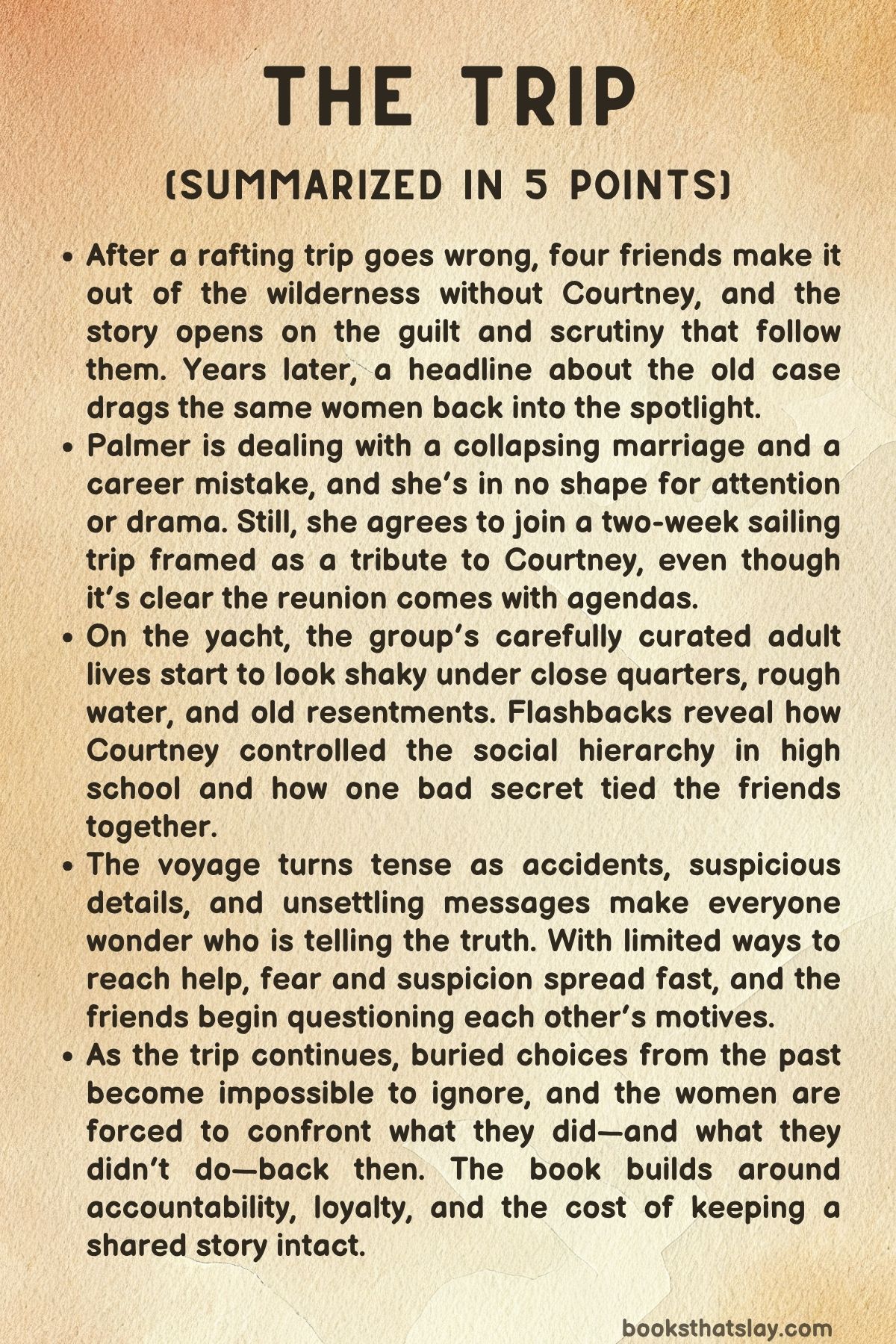
The Trip by Audrey J. Cole is a fast-moving psychological thriller about old friendships, buried choices, and what people will do to protect the lives they built after a shared disaster. Palmer Montague has spent two decades carrying the secret of what really happened to her friend Courtney during a high-school “senior trip” that ended with Courtney missing and four girls coming back alone.
Now, as Palmer’s marriage collapses, she agrees to join a sailing voyage meant to honor Courtney’s memory—only to realize the past hasn’t stayed buried. Out on open water, suspicion returns, and the truth starts forcing its way to the surface.
Summary
Memorial Day weekend in 2005 ends in panic and silence. Palmer Montague, Beth, Emma, and Gigi stumble out of the woods after a rafting accident on Washington’s Sol Duc River.
They are bruised, starving, and shaken, and one person is missing: Courtney. Their phones don’t work, their supplies were lost in the river, and none of them can even remember the exact name of the trailhead.
When Palmer finally gets a weak signal and calls 911, the operator presses for details—where are they, when did Courtney disappear, and when was she last seen. Palmer answers that the last time they saw Courtney was when she fell from the raft around noon the day before.
It sounds clean and simple, like an accident. It is also a lie.
Years later, Palmer is living a carefully managed life in Seattle: a nursing job, twin daughters, and a marriage that looks stable from the outside. That stability collapses when she discovers her husband, Matt, has been having an affair with a younger woman named Sydney.
Matt doesn’t deny it. He tells Palmer he’s leaving, he’s already rented an apartment, and he plans to build a new life without her.
Palmer is so rattled that her work begins to slip; she makes a serious medication error and is placed on leave. She tries to keep everything contained, but her fear and anger are tangled up with something older—Courtney’s disappearance, and the guilt Palmer never learned to live with.
Beth shows up at Palmer’s house with wine and pressure. Gigi has organized a two-week sailing trip from Seattle to San Diego as a public tribute to Courtney on the twentieth anniversary of her disappearance.
A recent newspaper story has brought the case back into the spotlight and revived suspicions about “the four” who returned without Courtney. Beth’s university is taking heat because of it, donors are pulling money, and the school’s board wants Beth to appear cooperative and sympathetic.
Beth insists Palmer come too, framing it as both damage control and a chance to finally face what happened. Palmer agrees, partly because she’s out of options and partly because she can feel her life splitting open anyway.
She doesn’t tell the others that her marriage is ending.
At Elliott Bay Marina, the tribute trip looks more like a branded spectacle than a private memorial. Gigi treats the sleek sailboat, Nautical Nirvana, as a floating set, constantly filming and posing while her assistant captures content.
The captain, Nojan, runs a strict safety briefing, warning them that open ocean conditions can turn dangerous fast and that tethers and life vests will not be optional when weather worsens. The boat’s first officer and chef, Adam, is friendly and competent-looking.
Palmer shares a stateroom with Beth and tries to settle her nerves while Gigi plays host, insisting the trip is about closure, about honoring Courtney because her body was never found.
The voyage pulls the women back into their history. Flashbacks reveal what Courtney was like in high school: charming when it served her, cruel when it didn’t, and skilled at controlling the people around her.
Courtney used Beth for homework help and treated her like a convenient accessory. She expected social rewards—like being asked to homecoming by the quarterback, Bryson—and when she didn’t get them, she turned her anger outward.
After Bryson chose Gigi instead, humiliating photos of Gigi appeared around school with a slur printed over them. Courtney acted supportive to Gigi’s face while privately enjoying the damage.
Palmer noticed the pattern even back then, but noticing wasn’t the same as stopping it.
As the boat reaches open water, the group settles into uneasy routines. Beth and Palmer talk privately about Gigi’s behavior: the drinking, the constant performance, and her bold flirting with Adam despite a public image of being happily married.
Emma arrives late, bringing her own controlled confidence. The women compare their adult lives.
Emma is launching a housewares line and angling for a major retail deal. Beth has become the president of a university and is being encouraged to consider running for Senate.
Gigi boasts about millions of followers and luxury gifts. Palmer lies that her marriage is fine.
Beneath the surface, cracks show. Palmer has a quiet moment with Adam at the helm and blurts out the truth about Matt leaving her.
Adam listens without judgment and suggests that perfect lives often hide rot. Soon after, Palmer spots Gigi secretly playing chess on her phone with an impressive winning streak, something Gigi insists must stay hidden because it doesn’t match her brand.
Emma also seems rattled by private phone calls, arguing with someone about a business deal falling apart.
Then the first real emergency hits. During a photo shoot on deck in roughening wind, Emma warns that the boat’s sail position is risky.
Gigi chases her hat, and the boom swings violently, striking her head. In the chaos, she slips under the lifeline and falls into the sea.
The crew scrambles—Nojan shouts orders, a buoy marker goes over, Palmer becomes the spotter, and Adam dives into dangerous waves to reach Gigi. They haul her aboard half-conscious, battered and coughing.
Nojan blames Adam for mistakes that contributed to the situation and tightens safety rules. Gigi refuses to turn back for medical care because she’s afraid of losing sponsorships, so Palmer takes responsibility for monitoring her.
After the rescue, Palmer’s mistrust grows. Adam says he replaced towels in Emma’s room, but Palmer checks and finds none.
During worsening weather, Palmer sees Gigi drop pills that aren’t what she claims. Talk turns to the engraved pocketknives Courtney once gave them, the same red knives tied to their senior trip.
Emotions flare, and then Gigi produces something that chills them all: a note that reads, “I know who killed me, and it’s time for you to confess. XO, Courtney.” The handwriting looks right.
Even the scent feels like Courtney. Emma accuses Gigi of faking it for attention.
Beth refuses to play along for social media. The storm outside intensifies, and inside the boat, paranoia takes hold.
That night, Beth researches Gigi and finds reports suggesting Gigi’s online empire is unstable: accusations of buying followers, brand deals in danger, and a marriage that may be breaking apart. The idea of Gigi being desperate for drama suddenly makes sense.
But before anyone can settle on a single explanation, another shock arrives. The boat loses power in the storm, and Adam announces that Captain Nojan is missing—possibly swept overboard.
With communications damaged and the sea turning violent, the women are trapped with a man they barely know, while the past is clawing its way back.
As they fight to keep the boat under control, the story returns to 2005 and finally reveals what Palmer lied about. On the rafting trip, Courtney had been escalating her control over the group, humiliating Beth and targeting anyone who threatened her.
Palmer had carried her own secret too: Courtney once forced her into a cruel prank against Emma by using blackmail. Courtney poured dish soap onto a shower floor while filming, and Emma slipped, breaking her ankle severely.
When questioned, Courtney blamed two boys. Palmer backed the lie, terrified of what Courtney would expose.
Palmer even tore pages from Courtney’s diary later, trying to protect herself.
During the rafting disaster itself, Palmer did not simply lose sight of Courtney at the rapids. Palmer found Courtney later in the woods.
They fought, and then a cougar appeared. Palmer ran.
She didn’t warn Courtney. She didn’t go back.
She let Beth persuade her that telling the truth would destroy her life and possibly lead to criminal charges. So when they eventually reached the van and called for help, Palmer gave the clean version: Courtney fell, and that was the last time anyone saw her.
Back in the present, the storm becomes catastrophic. A massive wave hits the yacht and flips the cabin into chaos—water pours in, objects crash, and the boat nearly capsizes fully.
When it rights itself, they realize Gigi never made it below deck. They find her later floating face-down, tethered but lifeless.
Palmer tries CPR, but it’s futile. Gigi is dead.
Moving Gigi’s body, Beth finds a wallet that changes everything. “Adam” is not Adam.
The ID name is Russell Vance, and Beth recognizes him: Courtney’s older brother. Confronted, Russell admits he infiltrated the trip after seeing it promoted online.
He believes one or more of the women killed Courtney, and he came to force the truth out. He claims he didn’t kill Nojan or Gigi and says he doesn’t know where the note came from.
They attempt to survive and navigate toward land, but the boat is badly damaged and far off course. Communications are failing.
Starlink is down. The radio mic is missing.
Fuel and power become inconsistent. Russell helps restore some navigation temporarily, but the situation keeps collapsing.
Palmer grows convinced Russell is sabotaging them and searches for Courtney’s diary, hoping it will reveal what he knows. Instead, pieces fall into place in unexpected ways: the diary contains proof of Courtney’s cruelty toward Beth, including a months-long catfishing scheme where Courtney posed as Russell online, leading Beth to believe she was in a secret romance and even engaged.
The humiliation was total, and it never healed.
Then Beth disappears. Blood is smeared across the deck.
Russell’s gun—hidden earlier—vanishes. Emma attacks Russell, convinced he killed Beth, while Palmer admits she took the gun at one point.
The boat drifts between accusation and panic, with everyone half-watching everyone else.
The truth finally snaps into the open when Beth reappears alive, hiding under equipment with Russell’s gun in her hand. She shoots Emma in the chest.
In the aftermath, Beth confesses to everything.
In 2005, Beth found Courtney across the river during the rafting disaster. They argued, and Courtney threatened Palmer while also mocking Beth about the fake romance.
Beth’s anger broke into violence. She stabbed Courtney repeatedly, including in the neck, and both of them fell into the river.
Beth then staged her own near-drowning so Palmer would focus on rescuing her instead of searching for Courtney’s body. Beth also admits that in the present she killed Captain Nojan by mistake in the storm, thinking he was Russell, and she sabotaged the boat’s systems to trap everyone and control the timeline.
When she realized Gigi had uncovered Russell’s identity, Beth ensured Gigi would not survive. She used Courtney’s perfume and a forged note to push the group into cracking and confessing, and she tore diary pages to erase evidence that pointed to her.
Russell admits his own part too: he forged the threatening note and used Courtney’s perfume as psychological pressure, but he did not intend the deaths that followed. Beth, however, is beyond bargaining.
She plans to eliminate the remaining witnesses.
Palmer acts. She grabs the flare gun and fires directly into Beth, setting her clothing on fire.
In the struggle, Palmer launches another flare into the sky to signal a distant ship. As the yacht rolls, Beth and Russell tumble overboard together.
Palmer tends to Emma’s bleeding chest wound while also fighting to survive herself. In the water, Beth attacks Palmer, trying to drown her, but Palmer breaks free and reaches Russell.
A rescue boat from the ship arrives and pulls them out. The Coast Guard is contacted, Emma is airlifted for surgery, and Beth disappears into the sea, never recovered.
Months later, Palmer, Emma, and Russell place a memorial plaque for Courtney at the trailhead. The public story finally shifts closer to the truth: Courtney did not vanish by accident, and the people who lived under suspicion for years were not all the same kind of guilty.
Emma survives and rebuilds her life. Palmer returns to work, ends her marriage on her own terms, and begins moving forward with a clearer sense of what she can and cannot carry.
Beth’s body is never found, and Palmer is left with the unsettling knowledge that even when the truth comes out, some ghosts don’t leave cleanly.
Characters
Palmer Montague
Palmer is the novel’s moral center and primary lens, a woman whose life is shaped by the collision between youthful cowardice and adult consequence in The Trip. As a teenager, she learns how easily truth can be bent when fear of social ruin and Courtney’s leverage become more powerful than her conscience; that early complicity hardens into a long, private sentence of guilt after Courtney disappears.
In the present, Palmer’s marriage implodes and her professional identity fractures after a medication error, showing how the past is not a sealed chapter but a pressure that leaks into decision-making, attention, and self-worth. What distinguishes Palmer is not purity but endurance: she repeatedly steps into responsibility when others freeze, whether it’s acting as spotter during the man-overboard emergency, performing CPR, or going up the mast despite danger.
Her arc is ultimately about reclaiming agency—first from a manipulative friend who once dictated reality, and later from the shame and silence that kept her emotionally captive for two decades.
Beth
Beth is the story’s most chilling study in buried humiliation curdling into control, and the way “the careful one” can become the most dangerous when her pain is dismissed. She initially presents as practical, competent, and socially cautious—the person who wants to write down the trailhead name, who tries to shepherd the group toward survival, and who later rises to high institutional power as a university president.
Yet that outward steadiness masks a deep wound: Courtney’s long-term cruelty, especially the elaborate fake romance scheme, doesn’t just embarrass Beth—it rewires her self-image into something brittle and vengeful. Beth’s violence is not impulsive in the simple sense; it is the culmination of years of stored grievance, sharpened by the belief that others either enabled Courtney or benefited from the silence afterward.
Her later actions on the boat reveal a terrifying blend of calculation and self-justification: she manufactures narrative, manipulates evidence, weaponizes fear, and repeatedly chooses the cleanest story over the messiest truth. Even her public-facing insistence on “tribute” and reputation management reflects the same impulse that drove her as a teen—control the frame, control the outcome—until the frame cracks and her hidden self is exposed.
Emma
Emma is defined by ambition, irony, and a slow-burning fury at being made collateral damage, embodying how one cruel incident can permanently redirect a life. As a teen, her broken ankle isn’t just an injury; it becomes a symbol of stolen choices and stolen trust, and her suspicion toward Courtney functions like a compass that keeps pointing back to an injustice nobody will admit.
In adulthood, she appears breezy and successful—launching a brand, speaking in polished updates—but cracks show through her tense phone calls, guardedness, and the way she evaluates safety and competence with a sharp, almost managerial attention. Emma’s volatility is understandable because she has lived with a double violation: the original harm and the ongoing gaslighting of being told a lie everyone benefits from.
When survival stakes rise at sea, Emma often becomes the most operationally clear-headed, stepping into leadership at the helm and making decisive calls under pressure, yet her anger also makes her vulnerable to misdirecting blame when new threats appear. Her character ultimately captures the cost of postponed truth: the longer the lie persists, the more it turns into identity, and the more explosive the reckoning becomes when reality finally forces its way in.
Gigi
Gigi is a portrait of performative confidence that doubles as a survival strategy, showing how charisma can be both armor and trap. On the surface, she is status, spectacle, and appetite—followers, sponsorships, brand-consistent choices, and a relentless need to curate even grief into content.
But underneath the influencer persona is a person whose worth has long been negotiated in public, from high-school humiliation to adult validation, making her both attention-hungry and deeply fearful of losing relevance. That fear explains why she rejects turning back for medical help after her fall: she is willing to gamble her body to protect the identity she sells.
Gigi’s intelligence flashes in small contradictions, like her hidden chess mastery, revealing someone far more strategic than her image allows and suggesting she has spent years learning how to win quietly in private while performing a different self in public. Narratively, she also functions as the catalyst—the one who draws outside scrutiny back onto “the four,” who pushes the commemorative voyage into existence, and who uncovers enough about Russell’s identity to become a target—making her the character whose obsession with visibility ironically leads her to the darkest kind of exposure.
Courtney
Courtney is the absent presence haunting every decision, a character built through memory, rumor, and the emotional bruises she leaves behind. In high school, she operates through social leverage: blackmail, manipulation, staged innocence, and the ability to turn other people’s fear into her currency.
She weaponizes secrets, humiliates selectively, and treats friendship as a hierarchy with herself at the top, which is why her cruelty feels personal but also systemic—she designs situations where others must participate in wrongdoing just to stay safe. Yet Courtney’s power is not invulnerability; it is desperation dressed as superiority, especially as rejection and rivalry expose how dependent she is on being chosen, admired, and centered.
Her disappearance becomes a moral vacuum that the others keep filling with self-protection, and the fact that her body is never found turns her into a permanent question mark that corrodes their ability to move forward cleanly. Courtney’s role is also thematic: she represents how a charismatic bully can fracture a group so thoroughly that even after she is gone, her methods—silence, coercion, narrative control—continue living inside the survivors.
Matt
Matt is the domestic betrayal that reactivates Palmer’s old trauma, illustrating how abandonment can echo earlier moral failures. He is not portrayed as a grand villain so much as a man choosing convenience and ego over responsibility, and that ordinariness makes the harm sharper because it denies Palmer the comfort of a dramatic explanation.
His affair with a younger woman and his emotional withdrawal push Palmer into disorientation and self-doubt at the exact moment she is already vulnerable, which contributes to her professional mistake and emotional unraveling. Functionally, Matt’s departure strips Palmer of the illusion that stability will arrive if she just keeps enduring; it forces her to confront that survival without truth is not peace, it is delay.
By the end, leaving him becomes part of Palmer’s reclamation, not because it fixes the past, but because it marks her refusal to keep accepting a life shaped by other people’s selfish choices.
Abagail Montague
Abagail, one of Palmer’s twin daughters, is less a fully individuated personality in the plot and more a living stake in Palmer’s future. She represents what Palmer stands to protect and what Palmer fears damaging: innocence, stability, and the chance to grow up without inheriting a legacy of secrets.
Through Abagail, Palmer’s conflict becomes more than personal guilt; it becomes a question of what kind of mother she can be while carrying unresolved shame. The twin dynamic also mirrors the story’s obsession with doubles—public face versus private truth—because Palmer’s home life demands calm even as her internal world fractures.
Emily Montague
Emily functions alongside Abagail as an anchor to Palmer’s ordinary life, grounding the thriller’s revelations in the everyday emotional labor of parenting. The twins’ presence intensifies Palmer’s urgency to choose honesty over avoidance, because she can no longer justify silence as self-contained; silence would shape her children’s sense of family, trust, and safety.
Emily also heightens the poignancy of Palmer’s isolation when Matt withdraws, since Palmer must keep a household emotionally upright while privately collapsing. In that way, Emily symbolizes the future Palmer could still build—one defined not by what she hid as a teen, but by what she chooses to model now.
Kate
Kate, Palmer’s sister, is the quiet infrastructure that makes Palmer’s survival possible. She provides practical care by stepping in with the twins, but more importantly, she embodies a relationship where Palmer does not have to perform perfection to be supported.
Kate’s role highlights how Palmer’s friendships with Beth, Emma, and Gigi were conditioned by fear and hierarchy, whereas family support can be steadier and less transactional. Even when Kate is offstage, her presence emphasizes that Palmer is not truly alone, and that choosing help is part of Palmer’s shift away from shame-driven isolation.
Adam
Adam, initially presented as the yacht’s first officer and chef, is a study in perceived competence versus actual identity. His calm demeanor and helpfulness make him seem like a stabilizing outsider, yet small inconsistencies—like the towel claim—plant the idea that he may be performing a role the way the women have always performed theirs.
When he dives into the sea to rescue Gigi, he complicates the easy villain narrative, showing real courage and care even while suspicion gathers around him. His revealed identity as Russell Vance transforms every earlier interaction into a question: how much was genuine kindness and how much was strategic proximity.
What keeps him compelling is that his motive is not greed or fame but truth—an obsession fueled by grief and the hollow space left by a sister whose fate has been buried under other people’s lies.
Captain Nojan
Captain Nojan represents professional authority in an environment where authority is constantly undermined by ego, secrecy, and weather. He provides structure through safety briefings and disciplined seamanship, and his frustration with the passengers’ recklessness—especially Gigi’s dismissiveness—signals that the sea does not care about status or narratives.
His disappearance in the storm functions like the removal of adult supervision, forcing the group into a claustrophobic test where competence and morality become inseparable. Even in absence, Nojan’s standards linger as a measuring stick: once he’s gone, the others must decide whether they will follow the rules that keep people alive or continue the habit of doing whatever preserves image and advantage.
Russell Vance
Russell is the engine of the modern-day reckoning, a character driven by grief, obsession, and the corrosive need to make the past speak in The Trip. His decision to infiltrate the voyage using a false identity shows both desperation and moral compromise; he is willing to lie in order to force honesty, mirroring the women’s own history of distortion.
Yet his actions are not simple vigilantism—he genuinely wants the truth more than he wants a particular culprit, and that makes him simultaneously threatening and tragically human. The forged note and the use of perfume reveal his understanding of psychology: he knows fear and memory will do what direct accusation cannot, especially with people trained for decades to deny.
Russell’s presence also reframes Courtney’s legacy; she is not just a vanished friend but a sister-shaped void that has reshaped an entire family’s life and turned Russell into someone who can’t move forward without answers.
Bryson
Bryson is less an active agent than a symbol of the social economy Courtney worships and weaponizes. His choice to ask Gigi instead of Courtney punctures Courtney’s sense of entitlement and triggers a spiral of cruelty, showing how status disappointments become emotional detonators when someone relies on admiration for self-worth.
Bryson also becomes a scapegoat in Courtney’s lies, falsely implicated in the soap incident, which illustrates how easily teenage reputations can be destroyed when narrative control is treated as a game. Through Bryson, the book underlines that the girls’ tragedy did not come from one isolated evil act, but from a culture where attention, popularity, and punishment are traded like currency.
Jake
Jake functions similarly to Bryson as a pawn in Courtney’s manipulation, but with an added layer: he is tied to Palmer’s private desire and vulnerability. Palmer’s crush photo becomes leverage, turning something tender into a weapon, and that transformation is central to how Courtney maintains control—by making intimacy dangerous.
Jake’s false implication in Emma’s injury shows how quickly Courtney can rewrite reality, and how quickly others will comply when the alternative is exposure. In that sense, Jake represents the collateral victims of the group’s secrecy: people harmed not because they are central, but because they are useful targets when a lie needs a body.
Sydney
Sydney appears as the “other woman” in Matt’s affair, but her narrative purpose is broader than rivalry. She embodies a specific kind of threat to Palmer: not just romantic displacement, but proof that Palmer’s life can be rewritten by someone else’s choices without her consent.
The Instagram DM and selfie detail emphasizes modern intimacy as intrusive and abrupt—betrayal delivered directly into Palmer’s hand, impossible to ignore or soften. Sydney’s youth and relocation plans also sharpen Palmer’s sense of being replaced, echoing the adolescent dynamics of being chosen or discarded that once shaped the group’s hierarchy.
Alex
Alex, Gigi’s husband, is a background figure whose looming divorce and money conflict expose the fragility beneath Gigi’s glossy persona. The possibility of separation and financial threat reframes Gigi’s desperation for sponsorship and public momentum, suggesting her performance is not just vanity but survival.
Alex’s role shows the mismatch between the image of a perfect, affluent marriage and the reality of control struggles behind closed doors. By the time the voyage turns deadly, Alex’s absence also underscores how isolated the women truly are—no matter how many followers or accolades they claim, the crisis strips them down to a small, frightened group with no reliable lifeline.
Coach Kelly
Coach Kelly represents institutional pressure and the blunt demand for accountability. She appears at the moment when the truth could have been spoken and wasn’t.
Her insistence on knowing who caused Emma’s injury forces the girls into a fork in the road—confess or collude—and Courtney seizes that moment to cement a shared lie. Although she is not central later, Coach Kelly’s presence is important because it shows the early mechanism of the cover-up: authority appears, fear spikes, and the group chooses the story that protects them rather than the one that is true.
She becomes a reminder that consequences were avoidable at the beginning, which makes the later fallout feel tragically earned.
Themes
Guilt as a force that keeps shaping the present
The story begins with a lie that is small in wording but enormous in consequence: when Palmer tells the 911 operator that Courtney was last seen at noon, she edits out the later encounter and locks everyone into a version of events that protects them legally while poisoning them emotionally. From that moment onward, guilt isn’t only a feeling; it becomes an organizing principle for how Palmer lives.
It shows up in her reflex to manage crises, to stay functional, and to carry more than her share—whether that means physically hauling Gigi through the woods or taking responsibility as the spotter during the man-overboard emergency. Years later, the same pattern returns in a different costume: Palmer’s marriage is falling apart, her professional confidence fractures after the medication error, and she still defaults to silence, concealment, and endurance.
The pressure isn’t only that something bad happened long ago, but that the “survival story” was purchased by deception. That bargain creates a constant inner audit: what she did, what she didn’t do, what she should have said, and what she allowed others to believe.
The sailing trip intensifies this because the setting forces proximity—no easy exits, no distractions that last—and the public framing of the voyage as a tribute turns private shame into a performance problem. Palmer’s guilt also has a moral dimension that grows sharper over time: she recognizes that her choices didn’t just protect her, they shaped the danger Courtney faced, and later enabled Beth’s ability to keep manipulating the group.
The theme lands with particular force because it refuses neat separation between past and present. The past keeps producing aftershocks—reputational damage, career consequences, relationships strained by secrecy—until the characters are forced to confront that guilt has its own gravity, pulling them back toward unfinished truth no matter how far they sail.
Power, coercion, and the cost of staying silent
Control in the story rarely looks like an obvious threat at first; it often arrives as social pressure, leverage, or the fear of being isolated. Courtney’s influence in high school runs on humiliation and evidence—photos, staged situations, the certainty that she can shift blame onto someone else.
Palmer’s worst decisions aren’t born from cruelty; they come from the calculation that telling the truth will destroy her life. The soap incident shows how coercion works when the stakes are social survival: Courtney corners Palmer with the promise of exposure, then scripts a lie so cleanly that the adults accept it.
Beth’s complicity demonstrates a second layer: even someone who dislikes Courtney can still participate in the silence if it offers safety. Later, the wilderness portion repeats the same structure in a different arena.
Beth becomes the voice of “reason” by insisting they should leave and seek help, but she also strategically trims the story, coaching Palmer on what not to reveal and framing honesty as legal catastrophe. That advice is persuasive precisely because it is partially true, which is how manipulation becomes durable.
On the yacht, coercion evolves again—now tied to image, money, and public perception. Gigi’s refusal to turn back for medical care after nearly dying is a form of self-coercion under the demands of her sponsorships; she sacrifices safety to maintain a curated identity.
Beth faces institutional pressure when the university’s donor fallout makes her attendance on the trip a reputational necessity, turning her presence into damage control rather than friendship. Even the captain and crew dynamics echo the theme: authority exists, but it is fragile in crisis, and trust becomes a weapon when someone is impersonating a role.
The eventual revelation that Beth orchestrated events for years makes the theme land as more than interpersonal drama. Silence was never neutral; it was a resource that someone could exploit.
Every time the group chose concealment, they helped create a world where the most ruthless person had the most room to operate. The cost is not only what happens to Courtney, but what happens to everyone’s capacity to be honest afterward—because once silence becomes a habit, truth starts feeling like danger even when it’s the only path out.
Identity, performance, and the gap between who people are and who they show
Public image is treated as both armor and trap. Gigi is the clearest embodiment: she turns the tribute voyage into content, treats grief as branding, and tries to control how every moment will appear to an audience that isn’t actually present on the boat but still dictates decisions.
Her secret chess streak is a sharp detail because it exposes how performance requires selective self-erasure; she must hide a genuine skill because it doesn’t match the persona she sells. Beth’s identity is also constructed, just through different institutions: the successful academic leader, the polished public servant, the potential Senate candidate.
That status amplifies the threat of scandal, which makes her more invested in narrative control and more willing to pressure others into coordinated stories. Emma’s identity is built around reinvention and product success, but it is brittle under pressure—her phone argument about deals collapsing hints that the image of steady progress depends on other people’s approval and financial backing.
Palmer, meanwhile, performs competence and stability even when her inner life is imploding. She lies about her marriage, hides her professional mistake, and tries to keep her daughters protected from the emotional earthquake of separation.
The boat becomes a pressure chamber that forces the difference between performed identity and real self into the open. Storm conditions strip away cosmetics: there is no angle, caption, or curated version of panic when someone is thrown overboard or when power fails.
The note “from Courtney” functions as a brutal symbolic attack on identity because it doesn’t just accuse; it reassigns roles. It implies that the survivors are not friends or mourners but perpetrators, turning their public stories into potential evidence against them.
Russell’s presence compounds this because he disrupts the “closed set” of identities the women have maintained for years. He is both outsider and intimate witness through the diary, and his disguise shows how easily a role can be performed convincingly.
Ultimately, the theme argues that performance cannot hold forever when built on avoidance. The characters can curate their lives on land—titles, followers, product lines, marriages that look intact—but the ocean setting forces a reckoning where identity is measured by actions under fear, not by the story told afterward.
Revenge, justice, and what “closure” really demands
The plot is propelled by competing definitions of justice. The public wants closure in the simplest form: a body, a culprit, a headline that ends uncertainty.
The university board wants reputational closure: make the noise stop, keep donors calm, control the optics. Gigi wants a version of closure that can be packaged: a dramatic tribute that turns tragedy into attention.
Russell wants investigative closure, but his methods are ethically compromised—impersonation, manipulation, psychological pressure—showing how grief can justify tactics that resemble the harm it claims to correct. Beth represents the darkest version: revenge disguised as moral reckoning.
Her confession reveals that she didn’t just react in 2005; she constructed a long arc of control to protect herself and eliminate threats, while framing it as a mission to expose truth. That tension—revenge wearing the costume of justice—runs through the story’s turning points.
The forged note and Courtney’s perfume are designed to make guilt speak, not to find truth; they are tools to break people emotionally, because emotional collapse produces errors, accusations, and openings for framing. Even the memorial aspects become unstable.
The knives were meant as sentimental objects, then become symbols of complicity, then literal evidence of danger. The sea “tribute” becomes a stage for punishment.
Closure, in this world, is not a peaceful ending but a contest over which story survives and who pays for it. The most revealing part of the aftermath is that even after survival and partial truth, closure remains incomplete in conventional terms: Beth’s body is never found, Courtney’s remains are never recovered, and the past cannot be fully proven or neatly resolved.
Yet a different kind of closure emerges—one based on refusing to continue living inside the lie. Palmer choosing to move forward without the marriage that betrayed her parallels the larger decision to stop performing stability at any cost.
The placement of a memorial plaque is not the same as solving everything, but it is an act of accountability that doesn’t depend on public applause. The theme ultimately suggests that closure is not something granted by perfect evidence; it is something built through confession, responsibility, and the willingness to accept consequences.
In The Trip, justice is messy, delayed, and imperfect, but it still exerts pressure until the characters either tell the truth or are destroyed by what they tried to hide.