The Swan’s Daughter Summary, Characters and Themes
The Swan’s Daughter by Roshani Chokshi is a fantasy romance set on the Isle of Malys, where magic has rules, bargains have teeth, and love can be both a refuge and a threat. It begins at Hush Manor, a drifting estate made of cloud-stuff, where Araminta—a veritas swan woman who can sing truth from others—lives under the control of her husband, the wizard Prava.
When their youngest daughter, Demelza, is born without wings and beyond Prava’s easy command, she becomes the family’s mistake and its missing piece. A royal bridal competition offers her escape, but it also places her beside a prince who expects marriage to kill him.
Summary
Araminta has spent years trapped at Hush Manor, a floating estate that glides above the Silent Lakes district. She is a veritas swan woman: her song can pull honesty out of anyone who hears it.
Her husband, Prava, presents himself as charming and generous, but his affection is a costume for possession. Long ago he pursued Araminta, learned her weaknesses, and waited for the moment she confessed love.
That confession brought a necklace into existence—an ornament with a winged key—binding her ability to shift between woman and swan. The key allows Prava to decide what she can be, and he keeps her compliant with rituals of comfort and threat, including a daily tea distilled with “hope.”
When Araminta nears the hatching of her brood, her body turns restless and raw with strange cravings and pain. Prava builds her a nesting tower high above the manor using a frostbound spellbook pulled from his sentient library, locking her into cold air and isolation.
Araminta constructs a huge nest from her own golden hair, scavenged finery, bits of books and silk, and captured snowflakes. Six daughters hatch first—winged, bright with truth-magic, and already alert like small children.
Prava names them and acts enamored, but his plans show quickly: he intends to use them as tools, trading their gifts and access to truth as weapons across courts and kingdoms. Araminta discovers each daughter also bears a key on a chain, meaning Prava can control their transformations and even barter that control away.
A seventh egg hatches late, marked with emerald veins and gold. The birth is harsh, the sound wrong, and the baby is different.
Demelza has russet hair, pale skin, and green eyes like Prava. She has no wings.
More importantly, she has no chain and no pendant at her throat. Her key is not something Prava can seize and trade.
It is locked in her heart, and it can only appear through love. That single difference makes her the one child in the house who is not fully under Prava’s hand.
Demelza grows up inside a home full of performance and fear. She loves to sing, even though her singing is objectively awful, and her sisters mock her for it.
The winged daughters are trained and sent away to serve Prava’s ambitions. He distributes their keys to distant rulers so the girls can infiltrate courts, force truths out of enemies, and tip kingdoms into conquest.
They return gifts, treasure, and rare magical components to their father, and for a long time they accept his praise as love. Demelza, staying behind at Hush Manor, watches the pattern with unease.
She notices how her mother’s body changes around Prava—how Araminta shrinks, how her voice tightens, how she avoids certain rooms and silences herself when he enters.
One day Prava demonstrates his control in front of them, forcing one of the winged daughters into swan form as punishment. He announces that the girls’ keys have been bargained, and that their lives are now part of his larger quest: immortality.
Demelza is excluded from the training and the missions. Prava pretends it is kindness—freedom to roam the manor, access to the library, time to study with the wyvern attendant—but the exclusion carries a warning.
He will find a use for her later.
Years pass. Prava gathers nearly everything he needs for an immortality spell.
Only one line remains incomplete, damaged in the source text: “A sacrifice of a _______ born of _______ and beast.” Demelza becomes indispensable in the research. She helps determine when and how the spell must be read, and she strains to recover the missing words.
At the same time, Araminta begins treating Demelza as if she must be hidden: dressing her in rags, smearing her with ashes, blurring mirrors so her face won’t show clearly. Araminta claims it is protection, but Demelza feels punished for existing.
The truth snaps into focus when Demelza challenges her mother and overhears Araminta telling Prava, “Demelza must go. Get rid of her.” Not long after, Prava figures out the missing words himself: “unripened heart, born of beauty and beast.” He reveals his conclusion without tenderness.
Demelza is the sacrifice. She is the child made from Araminta’s beauty and his own monstrous nature, and her heart is the final ingredient.
All she must do, he says, is let him carve it out.
Araminta’s fear finally breaks into action. For a brief moment Prava traps her in swan form to control her, but she forces her way to Demelza and apologizes for everything she allowed.
She gives Demelza a rune-etched knife that can cut through anything, even the border mist around the estate. She also tells Demelza the one place Prava cannot enter without invitation: Rathe Castle, seat of the royal family.
A bridal competition is about to begin for Prince Arris’s “hand and heart,” and Araminta sends the summons to Demelza like a door opening. Demelza flees Hush Manor and runs toward the castle as her only shelter.
Rathe Castle is alive with magic and spectacle. It reshapes its grounds into a winter wonderland of white roses, frozen lakes, frost birds holding lanterns, and glittering trees.
Prince Arris, eighteen and already exhausted by the story written for him, watches the preparations with dread. His royal line is bound to an ancient bargain: royal marriage requires the transfer of “hand and heart,” and the spouse is expected to end the heir’s first life.
Arris expects to die. His twin sister, Yvlle, refuses to accept that fate and tries to protect him with harsh methods.
She even cuts his arm as part of a spell that helps the castle detect outright attackers and remove them from the competition.
Contestants arrive with theatrical entrances—beauties in enchanted attire, creatures in silk and bone, girls with dangerous appetites disguised as charm. Queen Yzara announces three trials over four weeks, with eliminations each round, and adds that grace and true intent will matter.
Yvlle immediately proves the danger is real by activating the castle’s defenses; animated statues and vines seize contestants carrying weapons. Some are dragged away before they even begin.
Demelza arrives late, torn and scorched, and collapses at the gate. At a reception aboard a glass dining boat carved like a wyvern, Arris endures flirtation, offers, and thinly veiled threats.
When he goes to the orangery, he finds a daydream tree heavy with crystalline orbs, and he demands truth from the mysterious girl waiting there. Demelza’s veritas power triggers unexpectedly: a voice compels honesty, and the girl blurts that she came to cut out Arris’s heart to become queen.
The castle’s vines drag her away.
Only then does Demelza step forward, muddy and disheveled, and introduces herself. She explains her heritage and demonstrates her gift by singing a short, unpleasant tune that forces Arris to confess an embarrassing secret.
Arris realizes how valuable her ability could be in a court filled with liars and murderers. He asks her to meet him at midnight.
At the lake, Arris feeds Demelza when he notices she is hungry, and she proposes a bargain rather than romance: she will investigate the contestants’ motives and report to him weekly. In exchange, she gains protection and the chance to remain inside Rathe Castle, where her father cannot reach her.
She tells him the truth about Prava and the planned sacrifice, making it clear she is not chasing Arris’s heart—she is running for her life. Arris agrees, and begins leaving her food and notes, small acts that land deeper than he expects.
The first trial, Talent, takes place in caverns beneath the castle. Contestants perform magic, alchemy, dances, transformations, and songs.
Demelza panics when it is her turn and admits she has no talent to present. Queen Yzara orders her removed, until Arris stops the elimination.
Soon after, Demelza proves her usefulness in the most direct way: she exposes two siren contestants who plan to devour Arris. She baited them by listening to their private language and arranging for Arris to overhear the truth under the lingering force of her song.
Arris is furious about being used as bait, but the result is undeniable—he survives, and the sirens are dismissed.
As days pass, Demelza investigates, makes friends with her roommates Talvi and Ursula, and navigates the social war of the contestants. Rumors rise that she is a spy, amplified by the cruelty of the front-runner, Lady Edmea.
Demelza grows isolated, and Arris tries to help. Yvlle advises them to perform public affection so the other contestants stop treating Demelza like an outsider.
Demelza and Arris stage a kiss in view of the castle’s nosy plants. The kiss begins as strategy, then becomes something neither of them expected.
Arris reacts by magically blocking the audience. Demelza, unsettled by how real it felt, pulls away afterward and tells him not to visit that night.
The second trial tests discernment in the castle’s dining hall. Contestants are told to add only one thing to improve a feast for weary dignitaries.
Many add beautiful comforts, clever enchantments, and elegant conveniences. Demelza goes last and shocks everyone by tasting the food and thinking like a guest instead of a performer.
She declares the feast lacks salt. Queen Yzara laughs with real delight and praises Demelza for noticing what truly mattered.
Demelza wins respect, but her relationship with Arris frays when he assumes she must have been tipped off. Demelza, tired of being underestimated, turns cold and recommits to her role as investigator, even as her feelings keep pushing past the boundaries she set.
The third trial arrives as a living darkness in the gardens, a force that rattles the castle and frightens everyone. Demelza is summoned and finds herself suspended inside the dark, senses stripped away.
Instead of fighting it, she listens to it. She realizes it is not an enemy but a restless thing that wants definition.
She speaks to it, naming what she senses—fear, night, dreams—and shapes it with language until it becomes a jewel-like object that catches light. Her victory is clear.
She has not overpowered the dark; she has given it form.
Afterward, Cordelia confronts Demelza privately with a dagger, admitting she cannot go home empty-handed and believes Demelza would be valuable dead. Demelza tries to stop her with truth magic, but Cordelia has wax in her ears and resists.
Arris arrives in time with a strange silver cape and knocks Cordelia unconscious, saving Demelza. In the aftermath, Arris offers himself to Demelza’s gift and confesses he misses her and thinks he could love her.
He asks for a choice: if she comes to the ball, he will know she chooses him.
Demelza arrives. In that moment, her wings finally appear, and her heart-key manifests as a winged necklace—hanging from Arris’s wrist.
The bond is real now, and it terrifies her. Arris does not seize the power.
He returns the key to her, giving her control instead of claiming it. They become engaged, and the wedding preparations rush forward.
On the eve of the marriage, Demelza is warned from two sides. Queen Yzara admits she hates her, not for what she has done, but for what she could do to Arris.
A veritas swan can only love once, and that love grants power that can turn lethal. Then Prava appears through a magical window and offers Demelza a “way out,” pushing a glass knife toward her and urging her to cut out Arris’s heart to be free.
Arris sees the exchange through the castle’s magic and confronts her. Demelza holds the knife; Arris holds her necklace.
They face the worst truths: love creates risk, and neither of them is safe by nature alone.
Arris refuses the story that says marriage must be a trap. He proposes something simpler and harder: they will choose each other daily, with honesty, boundaries, and communication, even when fear returns.
Demelza agrees. They drop the knife and the necklace, and they kiss without pretending it solves everything.
They marry in full ceremony, Demelza’s dress changing as she walks to honor the regions of the Isle. Her family attends, and an empty plate is set for Prava, who watches from afar through a window at Hush Manor.
In time, Prava confesses truths to Araminta, and Araminta imprisons him. Demelza and Arris begin their marriage with both joy and caution, committed to a love that is not a spell but a choice they keep making.
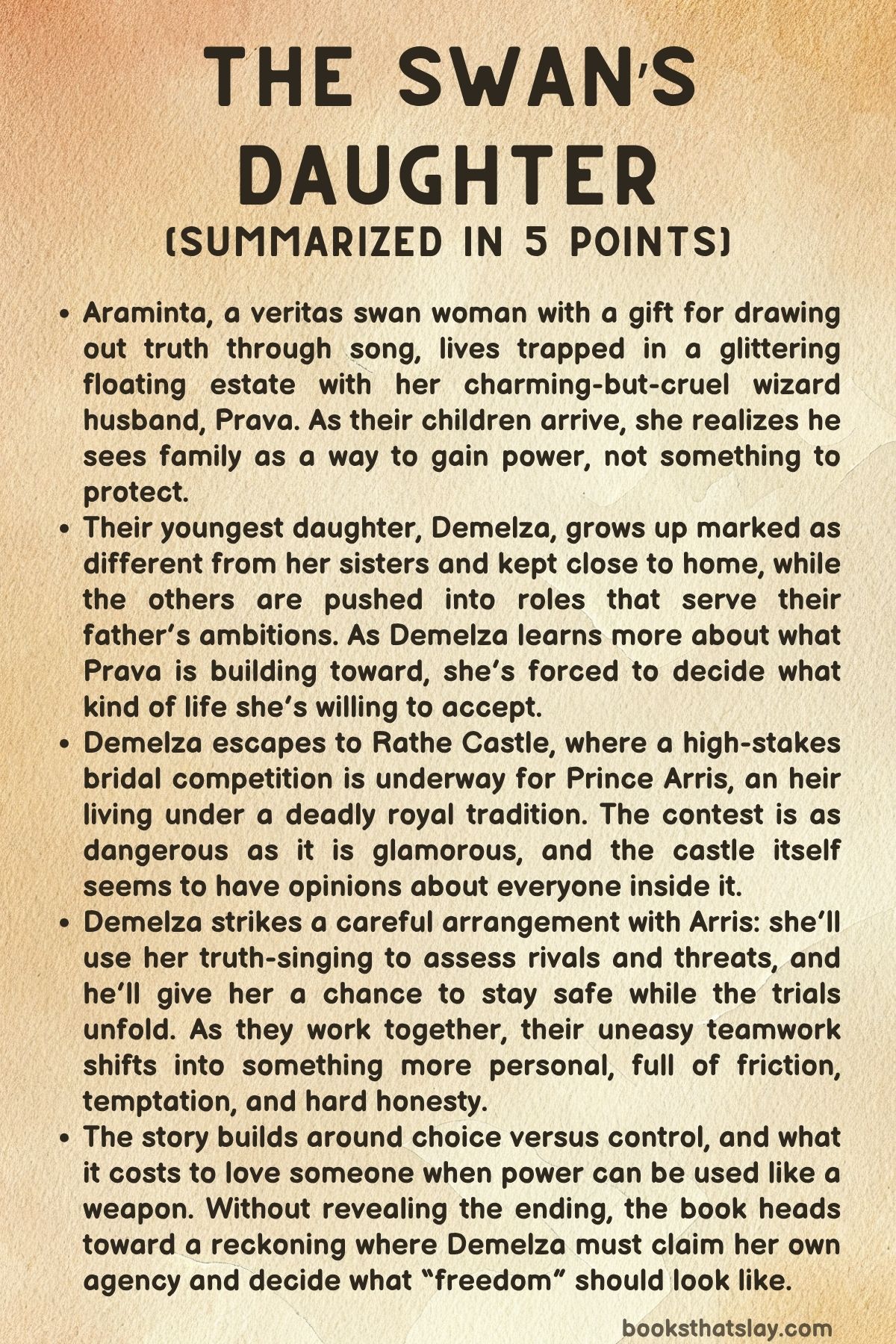
Characters
Araminta
Araminta is the aching emotional core of The Swan’s Daughter, a woman whose gift—singing truth from others—becomes a cage once it is exploited by someone willing to weaponize intimacy. She begins as a figure of stalled life, brooding in Hush Manor for years, and that long confinement shapes her into someone who survives through vigilance, concealment, and small acts of endurance rather than open rebellion.
Her motherhood is complicated and painfully strategic: she loves her children, yet she is also terrified of what love will cost them under Prava’s ownership, which pushes her into choices that look cruel on the surface—rag-dressing Demelza, smearing her with ashes, blurring mirrors—not as simple malice but as a desperate attempt to make her “less visible” to the predatory logic of the man who rules their home. Araminta’s tragedy is that her agency returns in fragments, often too late or in compromised form, yet those fragments still matter: when she apologizes, arms Demelza with a rune-etched knife, and points her toward Rathe Castle, she shifts from survival to resistance, and the story treats that pivot as imperfect but real.
Even in the ending, her arc refuses a neat absolution—she is both a mother who harmed and a mother who saved—and that duality makes her one of the most human characters in the book’s fairytale architecture.
Prava
Prava is a portrait of coercive power dressed in charm, and the book makes his cruelty feel especially chilling because it is administered through elegance: gifts, promises, “hope”-laced tea, and a courtly mask that hides a utilitarian worldview. He doesn’t merely want obedience; he wants ownership, symbolized by the winged key necklaces that convert bodies and transformations into property he can hold, trade, and leverage like currency.
His parenting is not love in the nurturing sense but love as possession—he is genuinely moved by his winged daughters while simultaneously selling their autonomy to distant rulers, turning them into infiltrators and instruments of conquest, which reveals the story’s sharper critique: affection does not redeem exploitation when affection is part of the trap. Prava’s obsession with immortality crystallizes the logic that defines him—everyone else is a component in a spell—yet the narrative also shows his most insidious tactic: reframing brutality as inevitability, as if sacrificing Demelza is simply “what must be done.” Even his late claims of remorse feel less like transformation and more like recalibration when he realizes the cost might be personal; the story’s resolution, in which Araminta later imprisons him, lands as a necessary correction rather than a moral miracle, emphasizing that control is his defining hunger and that hunger does not become harmless just because it speaks softly.
Demelza
Demelza’s identity is built around being the “wrong” child in a household obsessed with using children correctly, and that wrongness becomes her freedom as well as her wound. Unlike her sisters, she has no winged key chain that Prava can barter; her “key” being locked in her heart makes love the one force that can unlock her transformation, which turns intimacy into both vulnerability and power.
She grows up mocked—especially for her terrible singing—and that ridicule sharpens her deepest longing: not simply to be loved, but to be useful on her own terms, to matter in a way that cannot be bought or traded. At Rathe Castle, she initially survives by hiding—mud disguise, low status, quiet observation—but her arc is a steady movement from reactive flight to chosen presence: she bargains with Arris, investigates threats, sets traps, and begins to taste a future that is hers rather than assigned.
Her most defining strength is not raw magic but interpretation; she notices what others miss, whether it is the sirens’ predatory intent or the missing “salt” that exposes the dining hall’s trial as a test of care rather than flair. The third trial completes her thematic evolution: she learns creation is not domination, and she shapes living darkness into treasure by naming it truthfully, which mirrors how she is learning to name herself.
When her wings finally erupt and the heart-key manifests on Arris’s wrist, it externalizes her central conflict—love can become a shackle even when it is real—and her maturity is shown in what she chooses next: not the fantasy of safety, but the daily practice of trust, communication, and consent.
Eulalia
Eulalia is one of the six winged daughters whose individuality is partially submerged beneath the role they are forced to play, and that is itself part of her tragedy. She represents the first generation of Prava’s living weapons—children engineered by circumstance into tools of extraction and conquest—raised to associate their father’s attention with affection and purpose.
Her key necklace is an emblem of how the sisters’ lives are structured: transformation, travel, and identity are not expressions of self but permissions granted by power, sometimes even traded away to strangers. Eulalia’s emotional complexity lies in the implied gap between what she is—someone filled with “truth-magic,” capable of compelling honesty—and what she is used for—political infiltration and imperial leverage.
The story’s focus on Demelza means Eulalia remains somewhat distant, but she still functions as a moral mirror: she shows what Demelza might have become if her heart-key were not her own, and she embodies the unsettling idea that a child can sincerely love the person who is exploiting her because love was cultivated inside a closed system.
Euphemia
Euphemia, like her winged sisters, stands at the intersection of innocence and complicity, though the complicity is not chosen so much as trained. Her truth-gift is inherently intimate—it pulls secrets out of people—and the book frames that gift as something that can either clarify reality or violate it depending on who holds the leash.
Euphemia’s necklace places the leash in Prava’s hands, making her power a branch of his will, and her development abroad implies a life shaped by constant performance: entering courts, extracting truths, sending back treasure and components, and learning that affection from rulers may be as transactional as affection from her father. What makes Euphemia’s role poignant is the quiet erosion of self that likely accompanies such a life; when your magic is always deployed in service of someone else’s ambition, it becomes difficult to know what you would have wanted without that assignment.
In the background of the narrative, Euphemia contributes to the sense that the family’s curse is systemic, not personal—this is not one cruel moment, but a long machinery of use.
Evadne
Evadne’s function within the family is to show how thoroughly Prava industrializes wonder: even a swan-daughter with glittering truth in her voice can be reduced to an asset on a map. Her early toddler-like hatching underscores how unnatural their upbringing is—children born already tilted toward function rather than play—and the key chain confirms that their bodies are designed for trade, including the capacity to be forced into swan form at will.
Evadne’s life abroad, conquering and plundering under her father’s direction, suggests a character shaped by reward loops: gifts for success, praise for obedience, and the normalization of dominance as destiny. She also heightens Demelza’s outsider pain; the sisters are united by wings and by the language of duty, and Evadne stands as part of that closed circle that Demelza can watch but not enter.
Even without extensive personal scenes, Evadne’s presence thickens the moral atmosphere of the story, reminding the reader that victimhood and harm can coexist inside one person when a powerful parent scripts the role.
Eustacia
Eustacia reflects the polished, court-facing version of Prava’s project: she is the kind of daughter who can glide into palaces, charm rulers, and turn truth into strategy. The narrative’s emphasis on bargaining keys to “distant rulers” implies that Eustacia’s autonomy is repeatedly interrupted—her ability to transform, to leave, to return, to choose—subject to whoever temporarily owns her key, which makes her life a sequence of borrowed permissions.
In that sense, Eustacia represents the cruel irony of magical gifts in the wrong hands: a power meant to illuminate becomes a tool for coercion, espionage, and conquest. She also reinforces a central theme of the story: the most dangerous prisons are not always made of walls; they can be made of vows, ornaments, and the approval of people you were trained to worship.
Eustacia’s implied loyalty to her father, especially early on, reads less like moral failure and more like the predictable outcome of a childhood where love arrived attached to conditions.
Dulcinea
Dulcinea carries the story’s motif of beauty being harvested and repurposed, because the swan-daughters are described as glittering with truth and wonder, yet their wonder is immediately drafted into imperial utility. Dulcinea’s key chain marks her as one of the tradable six, and that trade makes identity fluid in the worst way: she must adapt to foreign courts while remaining tethered to her father’s hunger for immortality.
Her character, though not individually spotlighted, matters structurally because she is part of the collective pressure placed on Demelza; the six daughters prove Prava’s system “works,” which makes Demelza’s refusal feel like a disruption rather than a normal act of self-preservation. Dulcinea also underscores the book’s preoccupation with consent: transformation in this world is not only a magical act, it is a consent act, and Dulcinea’s consent is repeatedly overwritten by whoever holds the key.
In the background, she expands the emotional stakes beyond Demelza’s romance by showing how many lives are shaped by the same coercive design.
Corisande
Corisande is the winged daughter most clearly associated with the spectacle of Prava’s control, because the moment he forces her into swan form as punishment becomes a definitive demonstration of what the key necklace really means. That scene reframes the family dynamic: affection is not safety, and the father’s delight in his children does not prevent him from humiliating and overriding them when it serves his authority.
Corisande’s later letter urging Demelza to solve the last clue is especially revealing, because it suggests a complicated blend of desperation and indoctrination—she wants release from the “nest,” yet she is still participating in the machine that grinds toward Prava’s immortality. In other words, Corisande embodies the moral confusion of surviving under domination: she is both captive and collaborator, both sister reaching out and sister pushing the plot toward a sacrifice.
Her role sharpens Demelza’s emotional isolation and raises the stakes of Demelza’s choice to seek a life beyond the family’s orbit.
King Eustis
King Eustis is a study in weary governance and reluctant tradition, a man who can be gently humorous and affectionate while still enforcing a system that devours his own child. He understands the political cost of refusing the Isle’s marriage bargain—past refusals nearly destroyed magic and triggered war—and that understanding makes him an enabler of cruelty even when he personally dislikes it.
His relationship with Queen Yzara is both comic and unsettling, especially through their “poison chess” dynamic, which turns the idea of marriage into a continual negotiation of harm, consent, and endurance; it is playful on the surface, but it echoes the book’s darker marriages, showing how normalized danger can become when wrapped in ritual. Eustis’s primary narrative function is to represent institutional pressure: he does not need to be monstrous to keep the monstrous system running.
In that way, he provides a contrast to Prava—less overtly predatory, more socially sanctioned—yet the outcome for Arris is still fatal unless something changes.
Queen Yzara
Queen Yzara is vivid, theatrical, and sharply intelligent, and she channels those qualities into the aesthetics of power: spectacle, trials, pageantry, and the castle’s living mood. Her most interesting trait is how she merges tenderness and threat without apology; she can laugh with genuine delight at Demelza’s “salt” insight, and she can also declare she will no longer permit pity-based exceptions, explicitly positioning herself as a guardian of standards that may be lethal.
Her marriage philosophy—poisoning Eustis monthly as a ritual of choice—reads as a warped form of consent practice, a way of insisting that staying married is not passive surrender but an active recommitment, yet it also reveals how deeply violence is braided into the royal household’s language of love. Yzara’s suspicion of Demelza becomes more than simple jealousy or class disdain; she fears what veritas swan love can do, and her warning frames love as a dangerous magic that can turn devotion into possession.
In the broader architecture of the novel, Yzara is the voice of realism that refuses romantic shortcuts: she forces Demelza and Arris to confront that sincerity does not erase risk.
Prince Arris
Arris is a romantic lead shaped by dread rather than destiny, an heir who knows the future waiting for him is not a crown but an ending. The cursed bargain that makes royal marriage a lethal transfer of “hand and heart” produces a distinctive psychology: he is both hungry for life and practiced in emotional self-protection, repeatedly forced to interpret flirtation as potential murder.
His gentleness is not naïveté; it is courage under constant threat, and his calmness often reads as a coping strategy—if every bride might kill him, panic becomes unsustainable. Arris’s relationship with Demelza begins as pragmatism—her truth-voice can expose threats—but it quickly becomes the first space where he feels seen rather than targeted, especially because Demelza is frank about not wanting his heart as a prize.
His core conflict is choosing trust without surrendering agency, and the story dramatizes this when Demelza’s heart-key appears on his wrist: the beloved holds power, even unintentionally. Arris’s most mature moment is not the engagement or the wedding, but the explicit rejection of “love is enough” in favor of daily choice, communication, and mutual accountability; he becomes the character who insists romance must be a practice, not merely a feeling.
Yvlle
Yvlle is devotion sharpened into a blade, a character whose love expresses itself through control, traps, and preemptive violence because she cannot tolerate helplessness—especially not her brother’s. Her childhood decision to hide Arris in a booby-trapped chamber and the resulting harm to innocents establishes her central contradiction: she protects what she loves by becoming dangerous to everyone else.
As a teen, she continues that pattern with spells, surveillance, and blunt manipulation of the tournament, including her weapon-detection measures that remove obvious threats while acknowledging how inadequate such systems are against subtler malice. Yvlle is also one of the book’s clearest examinations of fear disguised as competence; she mocks Arris’s softness, interrupts his attempts at acceptance, and frames romantic hope as foolishness because hope, to her, invites death.
Yet she is not merely antagonistic—she is the embodiment of a love that cannot trust the world and therefore tries to dominate it, making her a thematic cousin to Prava even as her motives are radically different. In the Demelza-Arris dynamic, Yvlle functions like a harsh mirror: she forces them to consider whether protection is still love when it removes choice, and she pushes Arris to grow into a version of himself that can appreciate her care without surrendering to her control.
Rathe Castle
Rathe Castle operates as a character rather than a setting, with desires, moods, and a taste for spectacle that shapes the narrative as forcefully as any person. It transforms grounds into wintry labyrinths, conjures dining boats and frost birds, animates statues and vines, and uses reflection pools as eyes, making the environment feel like a sentient participant in the politics of marriage and survival.
The Castle’s liveliness also reframes the bridal competition as more than a social ritual; it becomes a living test administered by a place that wants drama, revelation, and story, aligning it with the book’s fairytale sensibility while still keeping the stakes lethal. Its magic collapses distance at key moments, especially when it forces Arris and Demelza into confrontation about Prava’s offered knife, turning private moral crises into shared ones rather than allowing secrecy to rot them from within.
In that sense, Rathe Castle acts like an external conscience—imperfect, theatrical, and sometimes ruthless—nudging characters toward truth not through tenderness but through inevitability.
Argento
Argento, the “grandfather tree,” is a distilled voice of legacy and blunt wisdom, and his counsel functions like an anchor in a story full of glamour and manipulation. He does not romanticize Arris’s predicament; instead, he reduces the choice to a single axis—trust—and in doing so he cuts through the tournament’s performance culture.
Argento’s significance is also symbolic: the curse that threatens to make Arris into a tree ties the royal line to arboreal fate, and Argento stands as both warning and continuity, a living reminder of what happens to heirs in this family. When he tells Arris to marry the person who made him hesitate, he reframes hesitation as discernment rather than weakness, offering Arris a language for choosing a partner based on safety of spirit rather than spectacle.
As a character, Argento is small in page-time but heavy in thematic weight, representing the story’s insistence that clarity can be more powerful than magic.
Angharad of the Vale
Angharad is a sharp example of how predation hides inside beauty and performance, and her scene in the orangery crystallizes the story’s preoccupation with forced truth. She enters as a scorched, bramble-torn mystery, playing vulnerability in a way that can lure sympathy, but once Demelza’s truth-compulsion triggers, Angharad’s intent snaps into the open: she came to cut out Arris’s heart to claim queenship.
What makes her memorable is not her depth but her function as a litmus test for the tournament itself—many contestants dress ambition as romance, and Angharad is simply more literal about it. Her removal by the castle’s protective vines reinforces the motif that this world is full of people who treat hearts as objects, and it also validates Arris’s paranoia: his fear is not melodrama, it is lived experience.
Angharad’s brief presence helps define the stakes that make Demelza’s later choices meaningful, because the alternative brides are not merely rivals; they are credible threats.
Lady Edmea
Edmea is the tournament’s polished front-runner and social predator, someone who understands that power is often won through narrative control rather than direct violence. Her glamour is real—she dazzles with aesthetic mastery in the talent trial and orchestrates social dominance among contestants—but the story emphasizes how easily glamour becomes cruelty when it is used to isolate, ridicule, and rewrite someone else’s reputation.
Edmea’s antagonism toward Demelza is less about Arris as a person and more about status disruption: Demelza is muddy, unpolished, and yet increasingly central, which violates Edmea’s assumption that queenship follows a predictable hierarchy of beauty and performance. Even so, Edmea is not painted as a simple villain; she admits she always expected to be queen and is uncertain whether the prince is even the point, suggesting she is trapped by her own ambition-script the way others are trapped by curses.
Her decision to dress Demelza in a regal gown after the third trial also reveals something nuanced: Edmea can recognize excellence even when she resents it, and she can participate in communal ritual even while undermining someone privately. Through Edmea, The Swan’s Daughter shows how courtly violence often looks like etiquette.
Thalassa
Thalassa is one half of the siren pair whose charm functions as camouflage for appetite, and she embodies the story’s warning that attraction does not equal safety. Her public persona allows her to remain near Arris without triggering immediate alarm, but once Demelza’s truth-touched influence lingers, Thalassa’s real intention surfaces with frightening calm: she prefers devouring him to marrying him.
Thalassa’s most unsettling feature is her practicality—she doesn’t rage or monologue; she simply starts dividing Arris’s body like a meal plan—because it frames predation as ordinary to her. After being shoved into the “pond of tranquility,” she returns pacified rather than punished, which gives her an eerie, almost comedic serenity and highlights another theme: not every threat can be killed, and sometimes the best victory is removal and containment.
Thalassa’s role ultimately strengthens Demelza’s competence arc; Demelza becomes someone who can anticipate danger, set traps, and act decisively rather than freezing in fear.
Pearl
Pearl mirrors Thalassa while adding her own distinct flavor of gleeful consumption, and her honesty under compulsion is designed to horrify precisely because it is delivered as admiration. She praises Arris as “delicious,” lingering on the sensory romance of violence, which collapses the distance between courtship and predation in a way that the whole tournament structure already implies but rarely states so nakedly.
Pearl’s partnership with Thalassa also highlights the book’s interest in invented languages and secret codes, because Demelza learns enough of their hybrid tongue to expose them, turning knowledge into a weapon of defense. Like Thalassa, Pearl survives the encounter, but her elimination feels like an exorcism of one possible future for Arris: a bride who consumes rather than cherishes.
In narrative terms, Pearl exists to make the romantic stakes sharper by proving that the threat against Arris is not hypothetical, and that Demelza’s odd excitement about being “instrumental” is a real psychological shift from a life where she was always the disposable one.
Ursula
Ursula is warmth and appetite transformed into a kind of integrity, a contestant whose most radical desire is not power but permission to live as herself. Her shapeshifting—especially her bear form—could have made her a fearsome rival, but the book uses it to show vulnerability and humor, as when her baking attempt becomes chaos and injury, and she refuses to shift human out of fear of worsening the pain.
Her confession that her mother is Lady Azeria, a famed general who expects a certain path, reveals Ursula’s deeper conflict: she is strong enough to serve the Crown, yet she longs to serve nourishment instead, treating cooking as her real vocation. Ursula’s presence also enriches the “girlhood” texture of the tournament; face masks, tea, hair-braiding, and shared rooms become a counterpoint to the lethal stakes, reminding the reader these are young women navigating identity under pressure.
As a foil to Demelza, Ursula shows a different kind of courage: Demelza fights by exposing truth, while Ursula fights by insisting that softness—feeding, caring, building—can be a form of leadership worthy of a throne.
Talvi
Talvi is the story’s lyrical conscience, a dreamy writer-singer whose artistry reframes inherited myths rather than simply repeating them. Her performance of “The Lamentation of Enzo the Fool,” especially through the sea witch’s heartbreak, demonstrates a key power in the novel: interpretation can be magic, because changing the story changes how people feel and what they believe they must accept.
Talvi’s temperament—sleepy, prickly when disturbed, yet startlingly perceptive—makes her feel real amid the heightened spectacle of Rathe Castle. She also resists Yvlle’s dismissals with thoughtful argument, as seen in her defense of dusk deer as ferocious destroyers of night, showing she understands that gentleness and danger can coexist in the same creature.
Talvi’s role in Demelza’s shared suite gives Demelza a peer relationship that isn’t defined by ridicule or desire, and that matters because Demelza’s life has been starved of ordinary companionship. In the competitive ecosystem, Talvi represents an alternative path to queenship: influence through meaning rather than dominance.
Zoraya
Zoraya embodies romantic determinism—the belief that love is something assigned by fate or social expectation rather than discovered through knowing a person. Under Demelza’s truth-voice, she becomes tearful and emphatic, insisting she wants love and does not want to murder Arris, yet her language also reveals how little her desire is anchored in Arris himself; she wants a prince, a story, a rightful arc.
Her later confrontation with Demelza after Demelza wins the third trial exposes insecurity not just about losing but about not truly understanding what she is competing for. Zoraya contributes to the story’s central question about intention: what does it mean to seek someone’s “hand and heart,” and how many contestants confuse possession with devotion?
Even when she is not malicious, Zoraya illustrates how harm can arise from entitlement and fantasy, because treating a person as destiny can erase their humanity as effectively as treating them as prey.
Cordelia
Cordelia is a quieter, sharper threat than the sirens because she operates through calculation rather than appetite, and she demonstrates how desperation can rationalize cruelty. Her admission that she cannot return home empty-handed makes her attack feel motivated by external stakes—family pressure, poverty, political need, pride—yet the book does not let that motivation excuse the act: she explicitly frames Demelza’s value in death, identifying Demelza as a veritas swan and treating her like a resource.
The fact that Cordelia uses wax in her ears to resist Demelza’s truth magic is particularly telling, because it shows premeditation and a willingness to disable the very thing that makes Demelza safe in this environment. Arris subdues Cordelia with a strange silver cape rather than killing her, which reinforces the story’s preference for restraint over revenge, but it also highlights how frequently Arris must manage threats that come packaged as courtship.
Cordelia’s presence intensifies Demelza’s final conflict: even among “normal” contestants, the competition encourages people to treat hearts—literal and metaphorical—as currency.
Themes
Coercive control disguised as devotion
Hush Manor runs on a version of love that is always conditional, always monitored, and always backed by the threat of punishment. Prava does not need constant violence to keep Araminta compliant because he designs a system where affection, comfort, and even “care” function as restraints.
The winged-key necklace is the clearest symbol of this control: it turns a living body into a locked door, and it turns transformation—something intimate and identity-defining—into a permission slip that can be granted or revoked. What makes this control especially corrosive is how smoothly it is packaged as romance and protection.
Prava’s courtship relies on enchanting gifts and grand gestures, but the moment Araminta confesses love, the relationship converts into ownership. The tea distilled with “hope” adds a quieter, psychological layer: it keeps her oriented toward endurance rather than escape, a daily ritual that trains her to accept pain as the price of stability.
The same mechanism is replicated with the six winged daughters. They are raised to associate their father’s attention with approval, pride, and purpose, and only gradually does the cost become obvious: their keys are traded to rulers, meaning their bodies and abilities become diplomatic currency.
This is exploitation with a warm smile. The daughters’ truth-singing—something that should protect others from lies—gets repurposed into an extraction tool that enables conquest.
Even Demelza, who begins outside Prava’s direct mechanism of control, is not free from his reach; she is handled through flattery and “freedom” inside a cage, invited to study and roam as long as she stays useful. The theme becomes more pointed when Araminta participates in Demelza’s degradation—rags, ashes, blurred mirrors—not because she is cruel by nature, but because long exposure to coercion can distort a victim’s idea of protection.
In The Swan’s Daughter, domination is most effective when it convinces the captive that compliance is safety, and when it persuades a family to mistake survival tactics for loyalty.
The politics of truth and the ethics of using it
Demelza’s veritas swan gift forces honesty, but the story refuses to treat truth as automatically moral. Her song can reveal what people hide, yet the consequences depend on who is wielding it, why they are using it, and what happens after the revelation.
Under Prava’s rule, truth is weaponized into a tool for leverage: keys are bargained, daughters are deployed, secrets are extracted, and entire kingdoms are “solved” like puzzles whose answers can be sold. That version of truth is parasitic.
It does not aim to heal; it aims to control outcomes and accumulate power.
At Rathe Castle, Demelza initially reframes her ability as protection. She bargains with Arris to investigate motives, exposing threats like the sirens and preventing assassination.
Even then, the story keeps the ethics complicated. Arris is relieved to have a safeguard, yet he also feels manipulated when he realizes he was used as bait.
That tension matters: truth can save someone and still violate them, especially when it overrides consent. The orangery scene makes this plain.
The command to “SPEAK TRUE” strips Angharad of her ability to choose how and when to confess; the castle’s defenses then punish her for what she blurts under compulsion. Honesty becomes a trapdoor.
Demelza’s own demonstrations also carry discomfort: she compels Arris to reveal a private insecurity for proof, and even though the moment is comedic, it establishes that her power crosses boundaries with ease.
The theme sharpens as Demelza’s relationship with Arris deepens. When love enters the picture, truth becomes emotionally dangerous rather than merely tactical.
Demelza cannot pretend her gift is neutral; it shapes intimacy by making concealment difficult and by raising the stakes of trust. This is why the later conflict with the knife and necklace lands so strongly.
Prava argues that love itself can become a form of captivity, because a veritas swan can love only once and the beloved might still hold power. Arris’s response offers an ethical alternative: instead of treating truth as a courtroom verdict or a magical shortcut, he proposes ongoing communication and daily choice.
Here, truth is not portrayed as purity; it is portrayed as force. The question is whether that force is used to dominate, to protect without consent, or to build a relationship sturdy enough to survive what honesty reveals.
Chosen commitment versus inherited bargains
Rathe Castle’s bridal competition is not framed as a romantic celebration; it is framed as a political mechanism designed to keep an unstable system from collapsing. Arris’s future marriage is tied to a lethal transfer of “hand and heart,” meaning the institution demands sacrifice as proof of legitimacy.
The royal family’s history shows how deeply tradition can normalize harm: the Isle once neared catastrophe when royals resisted marriage, so the court treats compliance as civic duty. Against that backdrop, Arris’s fear is not melodramatic—it is rational.
Many contestants arrive with explicit predatory intent, and even the palace’s defenses can only screen for obvious weapons, not for desire to consume, exploit, or rule.
Demelza’s storyline parallels this structure. She arrives at the castle because another bargain—Prava’s immortality spell—requires a sacrifice defined by lineage and symbolism.
Her life is meant to be a missing ingredient. In both spheres, the body becomes collateral for a larger promise: immortality for Prava, stability for the Isle.
The theme is not simply that traditions are bad; it is that systems built on inherited bargains pressure individuals to treat their own survival as negotiable. Arris tries to “buy time” through spectacle, hoping to delay the fatal outcome.
Demelza tries to remain “useful” so she will not be discarded. Both are reacting to institutions that do not fully recognize personhood.
What pushes this theme forward is the story’s insistence that commitment can exist without surrendering agency. Arris’s parents model a version of marriage that contains danger—their poison rituals are unsettling—but also contains repeated choice; even their toxic games are described as a way of reaffirming agency within a binding structure.
Demelza and Arris then craft a cleaner, more conscious version of that principle. When Demelza’s wings finally appear and the heart key manifests, the symbol could have repeated Araminta’s captivity.
Instead, Arris returns the key. That act matters because it rejects the logic of inherited bargains: he refuses to keep power simply because the magic offers it.
Later, when Prava attempts to reassert the old pattern by offering Demelza “freedom” through violence—cut out Arris’s heart—the couple confronts the possibility that fear can turn love into preemptive harm. Their answer is not a vow of certainty; it is a practice of choosing.
The most radical form of commitment here is not destiny, tradition, or magical binding—it is the decision to keep consent at the center even when old systems insist that someone must lose.
Identity, self-worth, and the right to become
Demelza begins as the “wrong” hatchling: wingless, mocked for her singing, and physically resembling the father who terrifies her mother. Her family treats these traits as evidence of lesser value, and Demelza absorbs that judgment so deeply that usefulness becomes her main language of self-worth.
She wants to be instrumental, necessary, the one who earns a place through service rather than belonging. This is why her early bargain with Arris feels less like romance and more like survival strategy.
It gives her a role where her mind matters, where her difference becomes relevant, and where she can imagine a future not defined by her father’s spell.
The castle environment intensifies this struggle because it is designed to rank, display, and eliminate. Contestants are constantly assessed through trials that reward spectacle, polish, and power, and Demelza arrives in a muddy disguise that marks her as disposable.
Social hostility—especially the rumors fueled by Edmea—recreates the dynamic of the nest: Demelza is pushed to the margins and treated as a problem to be managed. Yet her identity development does not come from suddenly becoming impressive in the way others expect.
It comes from finding value in perception, practicality, and care. Her “salt” solution in the discernment trial is a turning point because it validates a form of intelligence that is not ornamental.
She pays attention to what people actually need, not what looks grand. That moment also changes how she sees herself: she realizes she wants to dazzle not just to win a prince, but to prove she can shape her own narrative.
Her third-trial encounter with living darkness extends this idea. Instead of trying to crush it, she interprets it, speaks to it, names it, and helps it become something coherent.
That creative authority contrasts with Prava’s approach to magic, which is extractive and sacrificial. Demelza’s power grows through recognition rather than consumption.
The emergence of her wings later is not just a fantasy payoff; it is a declaration that her body and identity are not permanently defined by early humiliation or by her resemblance to Prava. Even the heart key being “summoned by love” is handled carefully: love here is not a trap that reduces her to someone else’s possession, but a catalyst that reveals who she already is when she is finally seen without contempt.
By the end, Demelza’s selfhood rests on a hard-earned principle: she is not an ingredient in another person’s future, not a mistake, and not a role created by fear. She becomes someone who can choose—how to use truth, how to love, and how to protect herself without turning into the kind of captor she escaped.