Juniper Hill Summary, Characters and Themes
Juniper Hill by Devney Perry is a contemporary romance set in the rugged beauty of Quincy, Montana. It follows Memphis Ward, a former New York socialite turned single mother, who flees her wealthy but controlling family in search of independence and a new life for herself and her infant son.
Exhausted and out of options, she finds an unlikely home above the garage of a brooding chef, Knox Eden, who values solitude and quiet. What begins as an arrangement marked by tension soon becomes a story of resilience, healing, and the courage to embrace love despite past wounds and lingering fears. It is the 2nd book in The Edens series by the author.
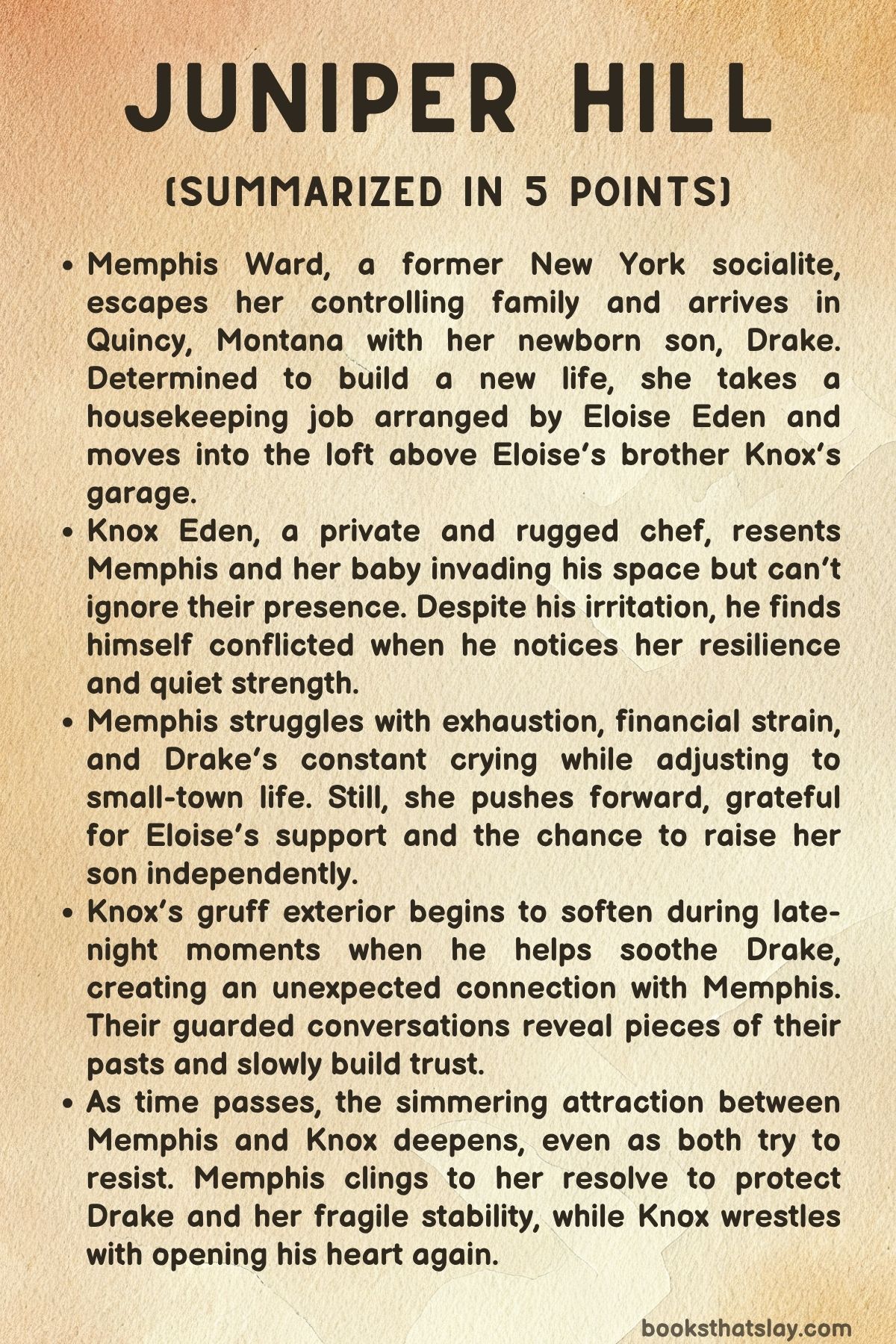
Summary
Memphis Ward drives across the country with her eight-week-old son, Drake, determined to leave behind her stifling life in New York City. With little money and even less certainty, she arrives in Quincy, Montana, to take up a housekeeping job at The Eloise Inn.
Her new residence is a loft above the garage of a modern home on Juniper Hill, arranged by Eloise Eden, the inn’s owner. Though Eloise welcomes her warmly, Knox Eden—Eloise’s brother and the property’s owner—is openly displeased at the unexpected intrusion into his quiet life.
Despite his reluctance, Memphis and her baby settle into the loft, grateful for a roof and a fresh start.
The challenges of single motherhood weigh heavily on Memphis. Drake’s colic keeps her awake at night, leaving her exhausted for her long days of cleaning at the inn.
Knox is frequently awakened by the baby’s cries, heightening his irritation. Yet despite his gruff demeanor, he can’t ignore her struggles.
Small gestures of compassion break through his tough exterior, especially when he sees Memphis’s determination to survive without asking for help.
Tension simmers between them. Memphis, still raw from being disowned by her wealthy parents for refusing to reveal Drake’s father’s identity, focuses on providing stability for her son.
Knox, scarred by past losses, fights against the attraction he feels. But when he begins stepping in during Drake’s crying fits—soothing the baby and giving Memphis brief moments of relief—their relationship slowly shifts.
Their nightly encounters in the loft create an intimacy neither expected, opening the door for conversations about family, sacrifice, and second chances.
As they grow closer, Knox learns the truth about Memphis’s past: she was once heir to a hotel empire, but her refusal to bend to her father’s demands cost her everything. Memphis, in turn, discovers Knox’s own painful history, including the loss of a child.
Their shared vulnerability deepens their bond, though both hesitate to admit their feelings outright.
Their fragile connection takes a turn when Memphis faces struggles outside her home. At Drake’s daycare, gossip spreads about her circumstances, while repeated phone calls from her estranged family stir up old wounds.
Tension escalates when Jill, a caregiver at the daycare, takes Drake without permission. Though the child is returned safely, the incident shakes Memphis’s trust.
Seeking comfort, she turns to Knox, and their relationship blossoms into romance. Their shared passion is undeniable, and Knox insists on being open about their love, no longer willing to hide behind caution.
Meanwhile, Knox achieves a professional milestone when his restaurant, Knuckles, impresses a famous food critic, earning him recognition beyond Quincy. Memphis supports him wholeheartedly, and he in turn champions her dream of starting an event-planning business in town.
Their relationship deepens, and Knox becomes a father figure to Drake, already envisioning a future together as a family.
This fragile peace is shattered when Memphis’s wealthy parents, Beatrice and Victor Ward, suddenly appear. Victor pressures her to return to New York, citing contracts and family obligations, but she refuses to be controlled any longer.
Knox stands firmly by her side, fiercely protective of her and Drake. Despite her strength, Memphis is devastated by her parents’ coldness, especially their refusal to acknowledge their grandson.
Knox’s comfort and support in this moment solidify his role in her life.
Their commitment is tested further when Averie Flannagan, a dangerous figure from Drake’s biological father’s past, orchestrates a scheme to kidnap the baby. Working through a daycare worker she manipulated, Averie’s plan nearly succeeds, but law enforcement intervenes in time.
The ordeal terrifies Memphis, yet it also proves the depth of Knox’s devotion. Together, they face the fear, determined not to let the past or outside threats dictate their future.
After the crisis, Knox takes decisive action: he moves Memphis and Drake into his home permanently, showing he is ready for a life together. Overcome with love and gratitude, Memphis accepts his proposal when he asks her to marry him.
Their family begins to take shape in the small Montana town, where Knox continues building his career and Memphis starts to carve out her own.
A year later, they are married, Knox has legally adopted Drake, and Memphis is pregnant with their second child. Life in Quincy has settled into a rhythm of love, family, and community.
Though scars from their pasts remain, both Memphis and Knox embrace the noisy, hopeful life they are building together. Their story comes full circle: two people who once guarded their hearts find not only healing but a future defined by love, trust, and resilience.
Characters
Memphis Ward
Memphis Ward emerges as the emotional core of Juniper Hill, embodying both fragility and strength. Once a privileged New York socialite, she chooses to leave behind a life of wealth and control to carve out a space where she and her son can survive on their own terms.
Her journey is marked by resilience—working as a housekeeper, enduring exhaustion from caring for a colicky newborn, and withstanding the weight of financial insecurity. Yet beneath that determination is deep vulnerability, born from parental rejection and the trauma of being disowned for refusing to reveal Drake’s father.
Memphis’s character becomes a study in reinvention, showing that survival is not only about endurance but about choosing dignity over dependency. Over time, her guardedness softens, revealing a woman who craves connection but fears losing the fragile independence she has built.
Her relationship with Knox becomes a turning point, as she learns that opening her heart does not mean sacrificing her hard-earned freedom, but rather expanding her definition of family and safety.
Knox Eden
Knox Eden, the brooding chef of Quincy, Montana, begins as a man of solitude, fiercely protective of his space and wary of outsiders. His reluctance toward Memphis is rooted not only in inconvenience but also in unhealed scars from his past—most notably the loss of his child, which shadows his every interaction.
Cooking serves as both his livelihood and his refuge, a space where he exerts control and finds expression for his passion. As Memphis and Drake intrude into his life, Knox’s character gradually shifts from guarded irritation to reluctant tenderness.
His nightly visits to soothe Drake reveal a man capable of immense care, even as he resists emotional vulnerability. What defines Knox is his slow but deliberate transformation: from a man defined by loss and detachment to someone willing to risk his heart again.
His love for Memphis and Drake becomes not just romantic or paternal—it becomes redemptive, proof that even the most broken spaces can nurture growth and love again.
Drake Ward
Though an infant, Drake Ward plays a pivotal role in shaping the dynamics of Juniper Hill. His constant crying due to colic reflects the chaos and exhaustion of early motherhood, testing Memphis’s endurance and patience.
Yet his vulnerability also draws out unexpected tenderness from Knox, bridging the gap between landlord and tenant and laying the foundation for their bond. Drake symbolizes both burden and blessing—he is the reason Memphis leaves behind her old life, the cause of sleepless nights and financial stress, but also the anchor of her new beginning.
In Knox’s arms, Drake becomes a symbol of healing, connecting past grief with present hope. By the story’s conclusion, his role evolves from a source of struggle to a source of joy, binding together a family forged through choice rather than blood.
Eloise Eden
Eloise Eden embodies warmth, steadiness, and generosity, acting as the bridge that first connects Memphis and Knox. As Knox’s sister and Memphis’s employer, she provides Memphis with a job and shelter, demonstrating a nurturing spirit that counterbalances her brother’s initial hostility.
Eloise is practical yet compassionate, showing faith in Memphis when others doubt her. Her importance lies not in dramatic action but in her quiet facilitation of relationships—offering support, guidance, and subtle pushes toward growth.
She is also deeply tied to her family legacy, balancing her own ambitions for the hotel with the expectations placed upon her. Eloise represents the rootedness of Quincy itself, a reminder that community can provide the stability that both Memphis and Knox need in order to rebuild their lives.
Beatrice and Victor Ward
Beatrice and Victor Ward serve as antagonistic forces, embodying the cold authority of wealth and control. Their rejection of Memphis after she refuses to comply with their demands illustrates the conditional nature of their love, one rooted in reputation and obedience rather than unconditional acceptance.
Victor’s threats and manipulations highlight his need for dominance, while Beatrice’s persistent phone calls reveal a more insidious form of control—emotional pressure masked as concern. Their arrival in Quincy brings conflict to a head, forcing Memphis to confront her past directly rather than simply escape it.
The Ward parents are critical not because they offer nurturing guidance, but because their cruelty sharpens Memphis’s resolve to build a different life for Drake, one unshackled by power and privilege.
Averie Flannagan
Averie Flannagan enters as a destabilizing presence, her obsession with Oliver and schemes of blackmail culminating in the kidnapping of Drake. She represents the darker edge of manipulation and obsession, exploiting others’ vulnerabilities for personal gain.
Her willingness to endanger a child underscores her ruthlessness, positioning her as the embodiment of the danger Memphis sought to escape. Yet her character also functions symbolically—she is a mirror of the destructive control Memphis experienced with her parents, only carried to a more violent extreme.
Through Averie’s downfall, the novel reinforces themes of resilience and justice, showing that while past traumas can resurface, they can also be confronted and overcome.
Jill
Jill, the daycare worker, begins as a seemingly ordinary caretaker but becomes a figure of betrayal when she takes Drake without permission. Her susceptibility to Averie’s manipulation reveals both her weakness and her desperation, qualities that make her dangerous despite her outward normalcy.
For Memphis, Jill’s actions represent a profound violation of trust, intensifying her sense of isolation and fear. Jill’s arc underscores one of the central tensions of the novel—that trust, once broken, is difficult to rebuild.
Though less menacing than Averie, Jill’s complicity makes her actions just as devastating, serving as a reminder that harm often comes not only from villains but also from those who fail in their responsibilities.
Themes
Escape from Control and the Search for Freedom
In Juniper Hill, the story of Memphis Ward begins with her leaving behind the gilded cage of New York privilege, where her family’s wealth came at the cost of her independence. Her departure is not just a geographical move but a rejection of the suffocating expectations and control her parents exerted over her life.
The choice to relocate to Quincy, Montana, with nothing but her newborn son is an act of defiance and a bold claim of agency. This theme explores the tension between societal privilege and personal freedom, showing that wealth cannot substitute for autonomy or dignity.
Memphis’s struggle is amplified by her family’s attempt to cut her off financially and emotionally, punishing her for keeping the truth about her child’s father to herself. Her journey is not only about survival but about redefining what it means to live authentically.
The town of Quincy symbolizes the possibility of self-reinvention—its remoteness offers both anonymity and a blank canvas. The narrative portrays how freedom often requires sacrifice, how safety and simplicity can feel more valuable than comfort, and how reclaiming one’s life demands courage even when it means walking away from every security previously known.
Memphis’s fight for control over her own choices becomes the moral heart of the book, reminding readers that liberation often comes with loneliness, but that loneliness can be transformed into strength.
Parenthood and Resilience
Motherhood in Juniper Hill is presented as both relentless and redemptive. Memphis’s relationship with her infant son Drake is the cornerstone of her new life, and her resilience is tested every hour of every day by the demands of caring for a colicky baby with limited resources.
Through her exhaustion, financial struggles, and constant anxiety, the narrative emphasizes the unyielding sacrifices of parenthood. What makes this theme especially powerful is the way motherhood is framed as a dual experience: it is simultaneously isolating, as Memphis endures sleepless nights alone, and grounding, as Drake becomes the reason she persists when everything else feels impossible.
Knox’s gradual involvement in Drake’s life deepens the thematic exploration. His willingness to step into the role of caregiver, despite his own past trauma and fears, highlights how parenthood can extend beyond biology.
The act of soothing Drake and supporting Memphis is a form of healing for Knox, proving that caring for a child can bridge old wounds and create unexpected bonds. The theme of resilience is inseparable from parenthood here—both Memphis and Knox embody endurance through love, facing their personal vulnerabilities while committing themselves to the fragile life of a child who represents their shared hope for the future.
Love Born from Vulnerability
The love story is built on fragility rather than perfection, showing how two people scarred by loss, betrayal, and distrust can build something strong out of their brokenness. Memphis and Knox resist their attraction at first, fearing the complications it might bring to their already difficult lives.
Yet it is in their most vulnerable moments—nightly encounters with Drake’s crying, confessions about past grief, and whispered exchanges in the dark—that their connection takes root. Love here is not romanticized as effortless passion but as a hard-won intimacy forged through shared burdens.
The characters’ guarded natures and emotional scars create obstacles that make their eventual surrender to one another meaningful. Knox, haunted by the loss of his child, risks reopening wounds by bonding with Drake, while Memphis risks her fragile stability by allowing herself to lean on someone again.
This theme underscores the idea that love often grows strongest when individuals allow themselves to be seen at their weakest. It suggests that true connection is less about surface attraction and more about the willingness to sit with another person’s pain, offering comfort instead of judgment.
The romance, therefore, becomes a metaphor for trust—an act of courage in the face of fear.
Family as Conflict and Family as Choice
The duality of family runs throughout the novel, presenting it as both a source of deep pain and a wellspring of healing. On one side, Memphis’s biological family embodies oppression, emotional manipulation, and betrayal.
Her parents’ refusal to acknowledge Drake, their use of financial leverage to control her, and their attempts to force her back into a life she rejected illustrate how family ties can become toxic chains. This conflict highlights the destructive nature of conditional love, where acceptance is withheld unless an individual conforms.
On the other side, Knox’s family, particularly Eloise and his siblings, represents a healthier model of kinship. They may not always agree, but their support and loyalty show that family can also be chosen and nurtured rather than simply inherited.
The final adoption of Drake by Knox further cements this theme—family is defined not only by blood but by devotion, presence, and commitment. This juxtaposition challenges conventional ideas of loyalty to kin, emphasizing that real family is built on respect and care.
By the end of the story, Memphis has shed the toxic bonds of her lineage and embraced a new family that she, Knox, and Drake actively create together.
Healing Through Community and Belonging
Quincy, Montana, is more than just the setting; it serves as a character in its own right, embodying the theme of belonging. The small town offers Memphis the anonymity she craves, but it also provides the possibility of connection through its tight-knit community.
Eloise’s kindness and support, Winslow’s steady presence, and even Knox’s reluctant involvement show how community care can soften loneliness. The gossip and judgment Memphis faces illustrate the risks of visibility in a small town, yet her eventual acceptance reflects how belonging requires both openness and trust.
For Knox, whose solitude was once a shield, Memphis and Drake’s presence cracks his isolation, reminding him that belonging is not found in silence but in shared lives. The town becomes the soil in which new dreams take root—Memphis imagines a future as a wedding planner, Knox expands his restaurant’s reputation, and together they envision a noisy household filled with children.
This theme speaks to the universal human need for belonging and how healing often requires not only personal resilience but also the embrace of others. Quincy provides the backdrop for transformation, reminding readers that a place can become home not through geography but through the connections it fosters.