Everyone on This Train Is a Suspect Summary, Characters and Themes
Everyone On This Train Is A Suspect by Benjamin Stevenson is a clever and entertaining homage to classic whodunits, set aboard the legendary Ghan railway. The story follows Ernest Cunningham, a writer who finds himself once again surrounded by murder.
This time, he is trapped with a group of crime authors, agents, and publishers at a literary festival that quickly turns deadly. Told in Ernest’s witty, self-aware voice, the book balances humor and tension while playing with the rules of fair-play mysteries. With professional rivalries, hidden scandals, and escalating danger, it becomes both a satire of the publishing world and a page-turning murder mystery.
Summary
The novel begins with Ernest Cunningham boarding the Ghan, a luxury train traveling from Darwin to Adelaide, to attend the Australian Mystery Writers’ Festival. He is accompanied by his girlfriend Juliette, while his persistent agent Simone also makes an appearance.
Among the writers on board are an eccentric mix of crime authors: Wolfgang, a flamboyant literary figure; Lisa Fulton, who writes legal dramas; Alan Royce, who specializes in forensic thrillers; SF Majors, a writer of psychological suspense; and the towering presence of Henry McTavish, an internationally famous Scottish novelist. Tensions are high from the start, as McTavish’s reputation for arrogance precedes him, and his cutting one-word online reviews of the other authors’ works further fuel resentment.
The train festival is structured to keep the group confined to the train rather than stopping at excursions, heightening the atmosphere of suspicion. Rivalries soon spill over at a panel discussion in Katherine, where McTavish unexpectedly supports Ernest during a heated debate, surprising everyone.
Yet beneath the bickering and literary egos lies an undercurrent of danger. Ernest becomes increasingly uneasy after cryptic exchanges with McTavish’s publisher, Wyatt Lloyd, and unsettling encounters with fellow passenger Douglas Parsons.
The journey takes a deadly turn when McTavish collapses and dies mid-panel after drinking from his signature silver flask. Though the official cause is left vague at first, Ernest is convinced he has been poisoned.
His fellow writers, each with expertise in different fields, become both suspects and potential investigators. Royce, for instance, leans heavily into the role of amateur detective, but his eagerness to declare solutions raises doubts about his competence.
Ernest insists that, as with his first book, he is simply recording events and not manipulating them.
At Alice Springs, the group continues with excursions, though tensions remain. Douglas acts suspiciously, leading Ernest to discover that he is carrying a revolver.
Conversations with Majors, Lisa, and Simone reveal layers of past scandals, rivalries, and potential motives. Douglas later shares his tragic backstory about his partner Noah, whose death decades earlier was linked to a school bus crash.
This story eerily resembles elements from McTavish’s novels, raising accusations of plagiarism and deepening Ernest’s suspicions about the past.
Meanwhile, Ernest’s personal life grows more complicated. His relationship with Juliette unravels when a misguided marriage proposal turns into an interrogation about her alibi, leading her to leave the festival altogether.
Simone confesses to her complicated history with McTavish and Wyatt, while Jasper Murdoch, another passenger, privately reveals that he is actually a bestselling author writing under a pseudonym. All of these revelations feed Ernest’s sense that everyone around him is hiding something.
When Alan Royce attempts a grand reveal of the murderer, he accuses Wyatt Lloyd, citing financial motives and incriminating evidence. Before this theory can be tested, Wyatt himself is found stabbed to death with a Gemini Publishing pen, Simone’s scarf clutched in his hand.
Panic escalates as the train continues its journey through the desert, now with multiple deaths behind it. Ernest resolves to uncover the truth before more lives are lost.
A breakthrough comes when Lisa confides in Ernest about her past with McTavish. She reveals that he raped her years ago, resulting in the birth of her daughter, Brooke.
Though Lisa had DNA evidence, Wyatt’s threats and legal manipulation forced her into silence. Brooke, who idolized McTavish as a father figure from afar, had secretly boarded the train, creating further complications.
Both Lisa and Brooke suspected each other of violence, though both insisted they acted only out of protection.
In the climactic confrontation, Ernest assembles the passengers to lay out the solution. He reveals that Royce tampered with Lisa’s evidence in exchange for Wyatt’s patronage, though he did not commit the murders.
Wolfgang’s pretentious career is exposed as a fraud built on AI-assisted writing and hoaxes. The key truth emerges: Jasper Murdoch had been ghostwriting McTavish’s novels for years.
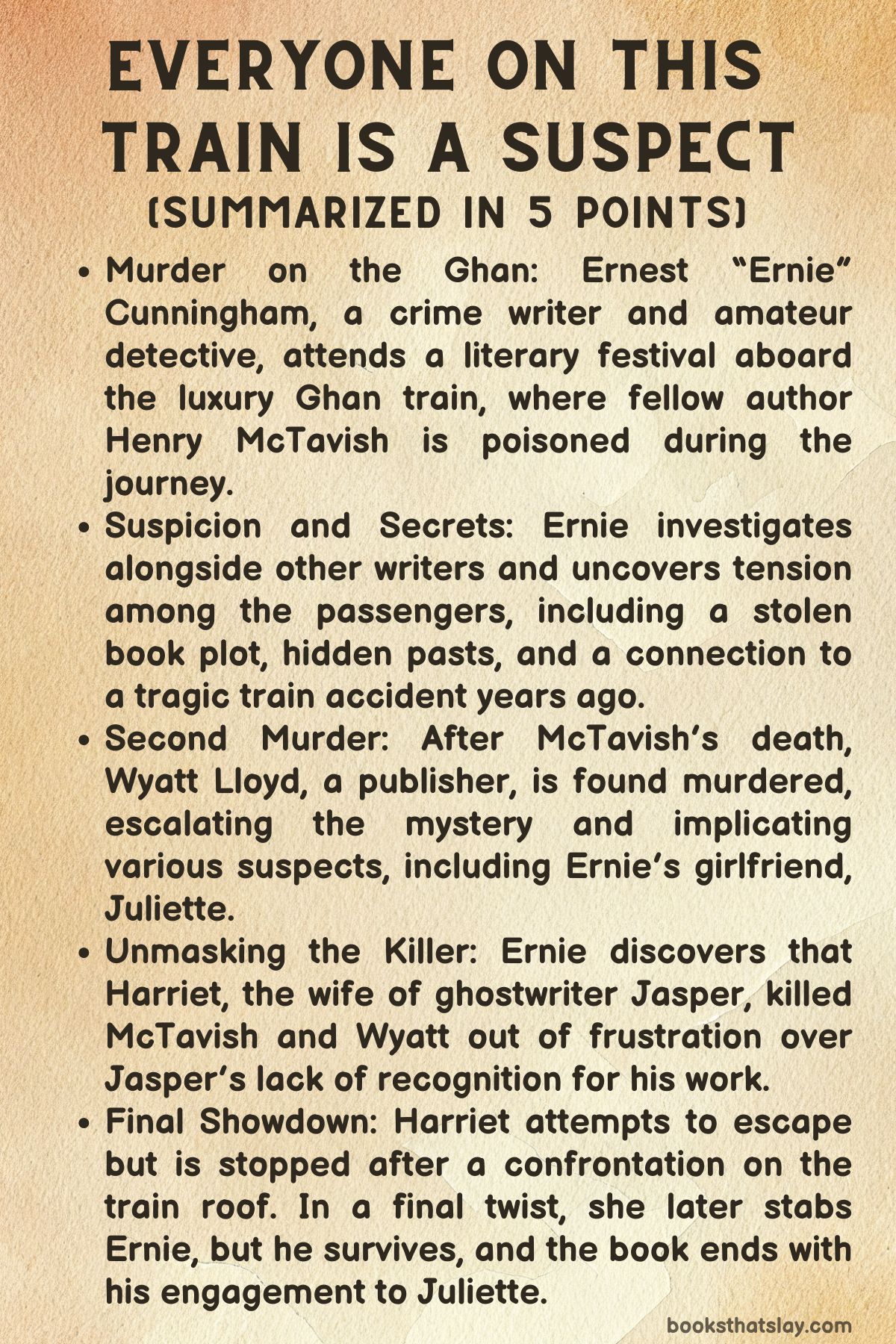
Harriet, Jasper’s fiercely protective wife, murdered McTavish with poisoned whiskey and later killed Wyatt when he dismissed Jasper’s manuscript as unmarketable under his own name. Harriet confesses, explaining that her actions were motivated by love for Jasper and anger at his talent being hidden.
Harriet takes Simone hostage and flees onto the roof of the train. In a desperate struggle, she stabs Ernest, but Jasper intervenes, embracing her before both fall from the train.
Though presumed dead, Harriet survives and later tracks Ernest to his hotel, stabbing him once more before Juliette saves him at the last moment.
The aftermath sees Royce arrested for evidence tampering, Douglas fined for illegal weapon possession, and Majors free to reignite her plagiarism case. Lisa avoids charges, while Brooke inherits McTavish’s estate.
Ernest, recovering from his wounds, proposes again to Juliette, who accepts this time. Reflecting on the chaotic journey, Ernest concludes that true legacy is not about fame or authorship but about the lasting effect one has on others’ lives.
Characters
Ernest Cunningham
Ernest Cunningham, the narrator and central figure of Everyone On This Train Is A Suspect, is a writer who finds himself once again entangled in a series of murders. His personality blends self-awareness, insecurity, and determination.
As the story unfolds, he constantly grapples with his identity as an author, haunted by the fact that his fame stems less from literary brilliance and more from his unfortunate involvement in real-life crimes. His narration is laced with irony and humor, but also deep vulnerability, particularly in his relationship with Juliette.
Ernest’s curiosity and sense of moral obligation drive him to investigate, despite his recognition that he is often out of his depth. His admiration for established writers clashes with his feelings of inadequacy, while his survivor’s guilt from past events continues to weigh heavily on him.
Ernest’s growth lies in his journey from a man seeking validation to someone who recognizes that legacy is not built solely on recognition but on the impact left on others.
Juliette
Juliette, Ernest’s partner, provides both emotional grounding and tension throughout the narrative. She is an accomplished writer herself, but frequently overshadowed by Ernest’s story, both in public perception and in his self-absorbed narration.
Her devotion to Ernest is clear, yet she becomes frustrated at being sidelined, culminating in a pivotal moment when she reveals she had originally been invited to the festival but sacrificed her place for him. This act underlines her selflessness but also her suppressed resentment.
Their fractured proposal scene illustrates how Ernest’s obsession with suspicion and storytelling overshadows genuine intimacy. Despite this, Juliette demonstrates strength and resilience, ultimately saving Ernest’s life and reaffirming her commitment to their relationship.
Her character embodies both loyalty and independence, standing as a counterbalance to Ernest’s insecurities.
Simone Morrison
Simone Morrison, Ernest’s literary agent, is ambitious, stylish, and relentlessly practical. She represents the publishing industry’s harsher realities—profit, image, and power struggles.
Simone’s history with McTavish and her willingness to manipulate circumstances for professional gain make her both a confidante and a suspect in Ernest’s eyes. Her sharpness and opportunism are often at odds with Ernest’s moral concerns, yet she is not depicted as one-dimensional.
Her candid confessions about her career, her bitterness toward Wyatt, and her attempts to navigate survival in a cutthroat field reveal a woman shaped by betrayal and disillusionment. Simone symbolizes the pragmatic, sometimes ruthless, side of the literary world, a foil to Ernest’s idealism.
Henry McTavish
Henry McTavish is the most domineering presence aboard the Ghan, even in death. A celebrated Scottish novelist, McTavish embodies arrogance, cruelty, and exploitation.
His literary fame contrasts sharply with his personal moral bankruptcy—an abuser, manipulator, and man who left a trail of emotional devastation. His disdain for other writers manifests in the scathing one-word reviews, which establish his authority and cruelty in equal measure.
The revelation of his rape of Lisa Fulton, his neglect of their daughter Brooke, and his reliance on ghostwriters shatters the veneer of genius, exposing him as a fraud both morally and professionally. McTavish’s presence looms over every character, either through admiration, resentment, or trauma, making him the linchpin of the story’s conflicts.
Lisa Fulton
Lisa Fulton emerges as one of the most tragic and compelling figures. A writer of legal dramas, she conceals a devastating past: McTavish raped her in 2003, resulting in the birth of her daughter, Brooke.
Forced into silence by legal threats and betrayal, Lisa raises her child while carrying profound resentment and grief. Her participation in the festival brings these buried wounds to the surface, and her confrontation with McTavish is both an act of defiance and maternal protection.
Lisa’s arc is one of resilience; she navigates her trauma with determination while balancing her duties as a mother. Her warning to Ernest—that people kill only for love or money—serves as a guiding principle, encapsulating both her pain and her insight into human motives.
Alan Royce
Alan Royce, the forensic thriller writer, initially presents himself as a man of knowledge and authority, yet his credibility unravels as the truth emerges. His arrogance and jealousy, particularly regarding McTavish’s refusal to endorse his work, drive much of his behavior.
Royce’s drunken bitterness and erratic outbursts reveal his insecurity beneath the surface bravado. Ultimately, his true crime is not murder but complicity—tampering with Lisa’s rape evidence in exchange for career advancement.
Royce’s fall from grace highlights the theme of corruption within both personal and professional spheres, demonstrating how ambition can lead to moral compromise.
SF Majors
SF Majors, a writer of psychological thrillers, offers sharp intellect and psychological insight throughout the story. Her conversations with Ernest frame much of the investigation, as she dissects human obsession, projection, and motive with clinical clarity.
Majors herself is entangled in literary controversies, particularly plagiarism disputes, which cast a shadow over her reputation. Though she often maintains a detached demeanor, her bitterness toward past injustices reveals a vulnerable core.
Majors functions as both analyst and suspect, blurring the line between detached professional and emotionally invested rival. Her presence emphasizes the blurred boundaries between fiction and reality, especially in how writers draw on and exploit real events.
Wolfgang
Wolfgang, the eccentric literary heavyweight, embodies flamboyance and contradiction. He mocks Ernest as a “pulp” writer, exuding arrogance and elitism, yet beneath this exterior he orchestrates one of the novel’s more audacious schemes: an elaborate art hoax involving the pseudonymous Erica Mathison.
His use of AI-generated writing to construct a bestseller underscores both his brilliance and cynicism about the publishing industry. Wolfgang thrives on spectacle and performance, thriving in chaos and scandal, yet his eccentricity masks deep cunning.
His character illustrates how art, deception, and identity intertwine, raising questions about authenticity and literary merit.
Wyatt Lloyd
Wyatt Lloyd, the publisher, personifies the corporate hunger for profit over integrity. His disputes with McTavish and Wolfgang highlight his ruthless pragmatism.
Wyatt sees authors not as artists but as commodities, and McTavish’s death becomes, for him, an opportunity for financial gain. His attempts to control narratives and his complicity in silencing Lisa’s rape case reveal the darker power structures at play in the industry.
Ultimately, Wyatt becomes a victim of the very system he upheld—murdered with a Gemini pen, a symbol of his profession. His death represents a collapse of authority and a poetic end to a man who profited from exploitation.
Jasper Murdoch
Jasper Murdoch initially presents himself as a failed self-published author but is later revealed to be Erica Mathison, the pseudonymous writer behind a bestselling novel. His character reflects the tension between ambition and humility, between recognition and personal contentment.
Jasper’s secret role as McTavish’s ghostwriter exposes his talent but also his willingness to subjugate his own identity. His relationship with Harriet, built on both love and shared secrets, shapes much of his story.
Jasper’s tragedy lies in being overshadowed—by McTavish, by his pseudonym, and ultimately by Harriet’s destructive love. His final moments, sacrificing himself alongside Harriet, reveal both his complicity and his love, cementing him as a tragic figure.
Harriet Murdoch
Harriet Murdoch, Jasper’s wife, is one of the most complex and ultimately destructive characters. Fiercely loyal and driven by love for her husband, she cannot tolerate his subservience to McTavish.
Her rage and desperation culminate in the murders of McTavish and Wyatt, acts she frames as justice for Jasper’s hidden talent. Harriet’s intelligence and meticulous planning make her both dangerous and tragic.
Her motivations are rooted not in greed but in love, a love so consuming that it drives her to violence. Her final confrontation with Ernest, and her survival of the fall only to attack him later, underscores her relentlessness.
Harriet embodies the destructive potential of devotion taken to extremes.
Douglas Parsons
Douglas Parsons, the Texan traveler, initially appears as a peripheral character but soon becomes integral through his tragic backstory. His partner Noah’s death decades earlier, and his misplaced belief that McTavish was responsible, add a poignant layer to the story.
Douglas embodies grief, guilt, and the desperate need for closure. His erratic behavior—carrying a revolver, acting suspiciously—masks his vulnerability.
Ultimately, Douglas is a victim of misinformation and mistaken identity, a reminder of how trauma can warp perception and drive desperate actions.
Brooke
Brooke, Lisa Fulton’s daughter and McTavish’s biological child, represents the innocence and pain of inherited trauma. Raised without her father but drawn to his work, she idolizes McTavish from afar, only to have her illusions shattered during the train journey.
Brooke’s presence is haunting—her sunburned skin and hidden movements suggesting both secrecy and yearning. Her struggle reflects the complexity of identity when tied to a parent’s crimes.
Though not central to the murders, Brooke’s existence forces characters, especially Lisa, to confront the lasting consequences of McTavish’s abuse. She is both a symbol of survival and a reminder of broken legacies.
Themes
Rivalry and Professional Jealousy
The world of Everyone On This Train Is A Suspect is structured around the egos, insecurities, and competitive instincts of authors brought together in an enclosed environment. Rivalries are not only professional but also deeply personal, stemming from grudges, betrayals, and long histories of unresolved resentment.
Henry McTavish’s scathing reviews of his peers symbolize how literary validation becomes both currency and weapon. For Ernest, who already feels like an outsider, these rivalries deepen his sense of inadequacy, as he compares his accidental notoriety to the more “legitimate” success of others.
Rivalry extends beyond publishing into matters of power, recognition, and survival. Lisa Fulton’s longstanding grudge against McTavish for personal and professional reasons illustrates how ambition often collides with trauma, while Wyatt Lloyd’s insistence on profit underscores how competition is not limited to the authors but extends to those who control their livelihoods.
The murders heighten these tensions, turning professional envy into literal life-and-death stakes. Rivalry is shown as a destructive force that corrodes relationships, blinds individuals to truth, and ultimately fuels violence.
Legacy and Authorship
Questions of who truly “owns” a story echo across the novel. Jasper’s ghostwriting of McTavish’s novels undermines the concept of authorship, revealing that legacy is often built on deceit.
Harriet’s crimes stem directly from her frustration at seeing her husband’s creativity buried beneath another man’s fame, showing the devastating consequences when recognition is denied. Ernest himself struggles with what kind of writer he is: an opportunist capitalizing on tragedy or a genuine storyteller capable of literary merit.
Even Lisa’s daughter Brooke reflects this theme, embodying the hidden legacies of personal betrayal and the blurred lines between fact and fiction. The novel suggests that legacies are fragile, constructed as much by perception and control as by talent.
What survives is not always truth, but the version that best suits power. This ongoing debate over authorship emphasizes the moral ambiguity behind creative production, questioning whether stories belong to those who write them, those who publish them, or those who live them.
Deception and Hidden Identities
Nearly every character conceals secrets, false personas, or hidden motives. Douglas masks his grief with eccentric behavior, Simone hides her bitterness under professional ambition, and Wolfgang orchestrates elaborate deceptions through his pseudonym scheme.
The confined train setting amplifies the tension as hidden truths inevitably emerge, showing how deception thrives in environments where scrutiny is constant. Jasper’s double identity as Erica Mathison represents not only a personal deception but also a commentary on how publishing often rewards appearances over substance.
Lisa concealing Brooke aboard the train extends this theme into the realm of maternal protection, illustrating that even lies told with good intentions can create dangerous consequences. Ernest’s own narration adds another layer, as he admits to structuring the story with foreshadowing and selective revelations, reminding readers that the act of storytelling itself is a form of controlled deception.
The theme demonstrates how lies, whether born of malice, ambition, or love, ripple outward and inevitably demand confrontation.
Justice and the Failure of Institutions
The novel repeatedly shows how official systems fail victims, leaving justice to be sought through flawed and personal means. Lisa’s account of McTavish’s rape and the subsequent erasure of evidence highlights the devastating impact of systemic failures, where threats and bureaucracy silence the truth.
Alan Royce’s complicity in destroying evidence illustrates how corruption enables predators to thrive while victims are marginalized. The law appears inadequate aboard the Ghan as well, where confinement makes the group reliant on informal “justice” through confrontation and deduction.
Ernest assumes the role of investigator not out of authority but because no trustworthy institution is available. Douglas’s decades-long grief over the school bus tragedy reinforces this theme, exposing how official reports distort or obscure the truth, leaving individuals to carry unresolved pain.
The murders aboard the train become a symbolic trial of characters’ morality, with justice delivered through exposure rather than courts. The narrative suggests that institutions fail more often than they protect, forcing justice into the hands of those willing to risk everything to uncover it.
Love, Obsession, and Betrayal
At the heart of the murders lies Harriet’s obsessive love for Jasper, which mutates into violence when her devotion collides with rejection and exploitation. Her actions demonstrate how love, when rooted in insecurity and bitterness, can turn destructive.
Juliette and Ernest’s relationship provides a contrasting perspective, though it too is strained by mistrust, egotism, and misplaced suspicion. Their fractured proposal scene illustrates how betrayal can come not only from intentional harm but also from the failure to see and value a partner fully.
Lisa’s story adds yet another dimension: her relationship with McTavish is one of violation and betrayal, but her bond with Brooke is protective and sacrificial. Obsession also emerges through characters like Majors, who embodies how envy and fixation corrode personal identity.
In every case, love is shown as a powerful motivator, but one that easily becomes twisted into obsession or overshadowed by betrayal. The theme underscores how human attachments drive people toward acts of loyalty, sacrifice, or destruction.
Storytelling and Self-Awareness
Perhaps the most meta theme of Everyone On This Train Is A Suspect is its preoccupation with the act of storytelling itself. Ernest narrates with constant reminders of structure, tropes, and expectations, creating a layered commentary on crime fiction as both entertainment and moral inquiry.
His self-awareness highlights the tension between presenting a narrative truth and acknowledging the artificiality of storytelling. This theme extends beyond Ernest, as nearly every character shapes or performs their own story—Jasper hiding behind a pseudonym, Douglas narrating his tragic past, and Simone pushing authors to create marketable drama.
The novel ultimately questions who has the right to tell a story and how stories shape identities, relationships, and reputations. The interplay between fact and narrative reflects the broader human need to impose order on chaos, to turn life into stories that can be shared, sold, or remembered.
Storytelling here is both survival and self-preservation, but it also carries the danger of distorting reality in pursuit of meaning.