The Wrong Bride Summary, Characters and Themes
The Wrong Bride by Catherine Maura is a compelling story of love, family dynamics, and emotional conflicts. It revolves around Raven, who finds herself caught in a complex web of emotions due to her unrequited love for Ares Windsor, her sister Hannah’s fiancé.
Raven has spent years silently yearning for Ares, all while supporting Hannah’s impending marriage to him. However, when circumstances take a dramatic turn, Raven is thrust into an unexpected situation where she must confront her feelings, her family’s expectations, and the challenges posed by Ares’s complicated relationships. This gripping narrative explores love, sacrifice, and self-discovery, as Raven navigates a life she never imagined, with unexpected twists that force her to redefine her path forward.
Summary
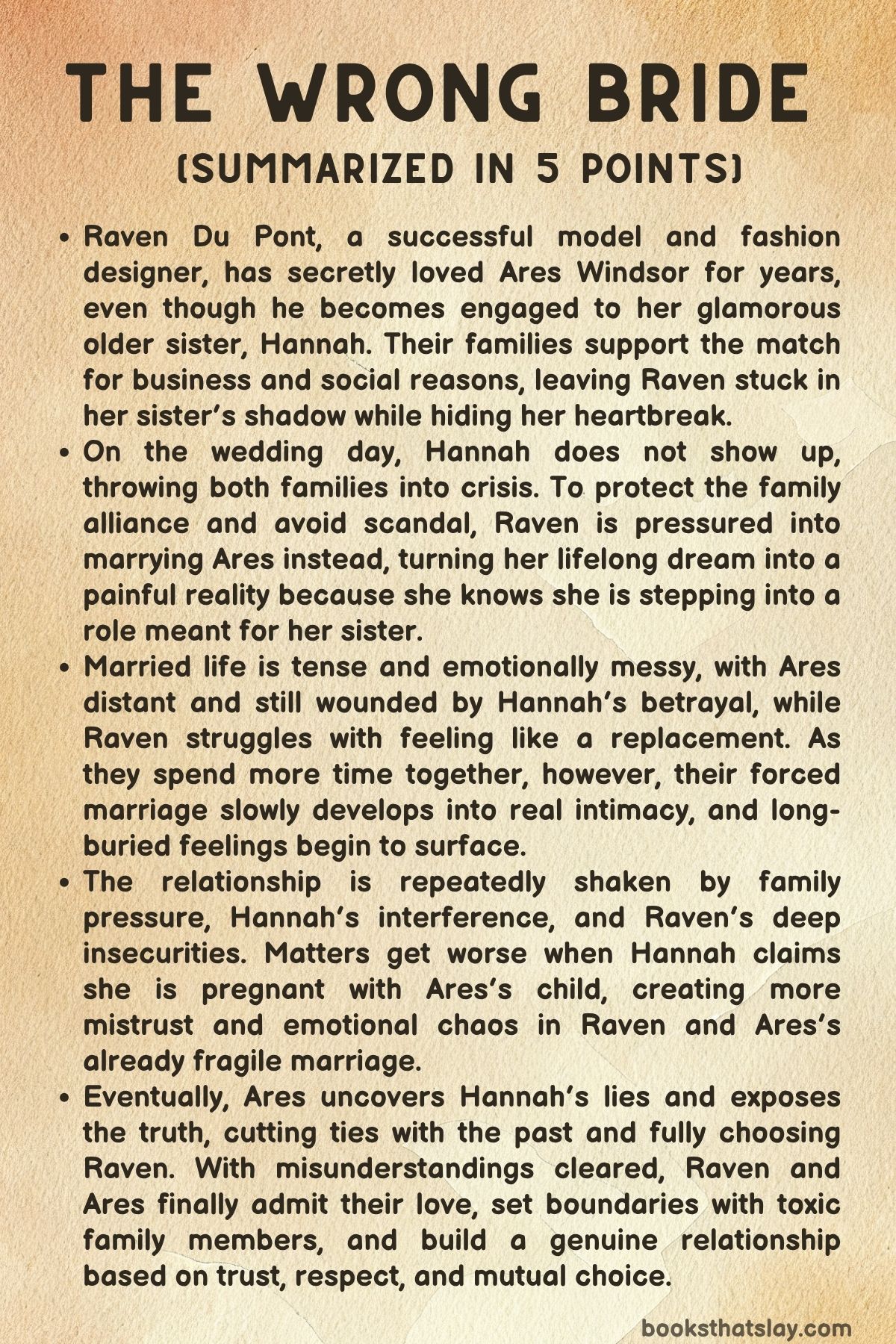
Raven Du Pont is a world-renowned supermodel and award-winning fashion designer who has been secretly in love with Ares Windsor for years. Ares, the elusive and powerful billionaire media mogul who heads Windsor Media, was originally intended to marry Raven as part of a long-standing family arrangement between the Windsors and the Du Ponts.
The alliance aimed to merge Windsor Media with the Du Ponts’ movie production company, Dreamessence, strengthening both empires.
Everything changed years earlier when Raven introduced her older sister, Hannah—a glamorous and rising actress—to Ares at a party. Ares became captivated by Hannah instead, and the engagement shifted to her.
Raven has lived in her sister’s shadow ever since. Their parents openly favor Hannah, constantly comparing Raven unfavorably and dismissing her successful career in fashion and modeling.
Raven’s mother is especially critical, while her father remains more passive. The only person who knows about Raven’s long-hidden feelings is her best friend, Sierra Windsor—Ares’s younger sister.
Raven maintains a close, friendly relationship with Ares, helping with wedding preparations for Hannah despite the emotional toll. She designs elements for the wedding (including aspects of Hannah’s gown) while suppressing her jealousy and heartbreak.
Hannah, meanwhile, grows increasingly reluctant about the marriage, prioritizing her acting career and feeling suffocated by the family pressures and Ares’s grandmother’s strict expectations for the Windsor legacy. Hannah repeatedly postpones the wedding and ultimately fails to show up on the big day, leaving everyone in crisis.
To salvage the crucial business merger and prevent financial and reputational damage to both families, Raven is pressured—particularly by Ares’s formidable grandmother—into stepping in as the bride at the altar. Ares, stunned and hurt by Hannah’s abandonment, goes through with the ceremony.
For Raven, marrying the man she has always loved should be a dream, but it quickly becomes “nothing short of torture.” Ares is emotionally distant and cold in the beginning. He is still reeling from Hannah’s betrayal and appears to have only ever had eyes for her sister.
Raven feels like the perpetual second choice, a substitute bride in a marriage of duty rather than desire.
Determined not to remain in Hannah’s shadow forever, Raven decides to fight for Ares. She views their union as a battlefield: “everything is fair in love and war,” and she is ready for war.
The story shifts heavily into their married life, filled with forced proximity, angst, and slow-burn tension. Raven actively works to win Ares over through small gestures, professional collaborations (their families’ businesses intersect), and moments of vulnerability.
Ares starts off guarded and sometimes cruel in his emotional unavailability, but cracks begin to appear. They share charged interactions, passionate encounters, and gradual intimacy.
Raven’s insecurities surface repeatedly—she overhears or learns details that make her feel like a replacement, and the thin walls of their shared history (including past events where she once gave Ares her virginity years earlier, only for a mix-up involving Hannah to complicate everything) add layers of pain.
Family dynamics intensify the conflict. Raven’s toxic mother continues her comparisons and invalidation, while Hannah’s jealousy and manipulations bubble up.
Hannah does not gracefully exit the picture. She remains a disruptive force, later claiming to be pregnant with Ares’s child.
This announcement throws Raven and Ares’s fragile marriage into chaos, amplifying Raven’s feelings of inadequacy and betrayal. She struggles with public scrutiny, media attention (given Ares’s media empire and her modeling fame), and the emotional whiplash of being married to a man whose past is so entangled with her sister.
Ares, for his part, grapples with duty to his family legacy, lingering hurt from Hannah, and growing, undeniable feelings for Raven. He is loyal, forthright, and protective once he commits, but his initial behavior leaves Raven questioning everything.
The Windsor siblings, including Sierra, provide some support and comic relief amid the drama. Business rivalries and professional pressures (Raven’s fashion world and Ares’s media dealings) weave into the background, though the emotional core remains the central romance.
The pregnancy scandal becomes a major turning point. Ares eventually uncovers the truth: Hannah’s claim is a lie, part of a web of deception and manipulation.
Revelations emerge about Hannah’s infidelity during her relationship with Ares (which he had long suspected but tolerated in certain ways due to the arranged nature of things), past mix-ups (including the bed-switch incident from years before), and her toxic jealousy toward Raven. In a confrontational climax, Ares exposes Hannah’s lies to Raven and the families, firmly choosing Raven and shutting down any lingering claims from his ex-fiancée.
He asserts that he has moved on and is fully committed to his wife.
With the deceptions cleared, Ares and Raven finally confess the depth of their feelings. Misunderstandings that kept them apart for years— including Ares’s own hidden emotions and the ways Raven’s introduction of Hannah altered their paths—are laid bare.
Ares takes deliberate steps to romance Raven properly, reaffirming that she is the one for him. He makes grand gestures, including a heartfelt re-proposal or renewal of vows in a meaningful location, declaring his love openly and publicly where it matters.
Raven, who has fought hard for her place and her self-worth, begins to heal from years of feeling second-best. She sets boundaries with her toxic family members (particularly her mother and Hannah), finds strength in her career and the new family she gains with the Windsors, and embraces the genuine love that has grown between her and Ares.
Their relationship evolves from a painful arranged marriage into a passionate, trusting partnership.
By the end, Raven and Ares achieve a hard-won happily ever after. They build a life together based on mutual choice, respect, and love, no longer defined by family expectations or past shadows.
The story emphasizes themes of self-worth, sibling rivalry, the weight of duty versus desire, manipulation within families, and the idea that true love often requires fighting through pain and deception. It is heavy on angst, emotional rollercoasters, steam, and family drama, with satisfying character growth—especially for Raven, who transforms from a silent sufferer into someone who claims her happiness, and for Ares, who learns to prioritize the right woman.
Characters
Raven
Raven is a complex character caught between the duties imposed by her family and her deep, unrequited love for Ares Windsor. From the very beginning of The Wrong Bride, Raven’s emotions are tangled in a web of familial expectations, jealousy, and heartbreak.
As the daughter of a family that has long planned a union between her and Ares, Raven grapples with feelings of being second-best, especially when compared to her sister, Hannah. This sense of inferiority is made worse by her mother’s dismissal of her career as a fashion designer, constantly placing her sister in the spotlight.
Raven’s internal struggle is heightened by her secret love for Ares, who is in a committed relationship with Hannah. She spends much of the book suppressing her emotions, even as her feelings for Ares grow stronger, and she is forced into a marriage with him after Hannah calls off their wedding.
Despite her reservations, Raven is often forced to conform to her family’s wishes, leading to feelings of entrapment and confusion.
As Raven navigates her relationship with Ares, her emotions fluctuate. On one hand, she is deeply hurt by the idea of being a substitute for her sister, yet on the other, she still longs for Ares’s affection.
Throughout the narrative, she struggles with jealousy, guilt, and an overwhelming sense of being misunderstood. Her relationship with Ares, while growing in intimacy and affection, is constantly shadowed by the unresolved tensions between Ares and Hannah.
Raven finds herself at the crossroads of love, duty, and self-identity, often questioning whether she can truly find happiness in a marriage that was never based on love. Her emotional journey is one of self-discovery, trying to come to terms with her role in her family and the uncertain future that lies ahead with Ares.
Ares
Ares Windsor is a powerful and influential figure who finds himself caught between duty and desire. Initially engaged to Hannah, Ares is pushed into a relationship with Raven due to his family’s pressure and the responsibilities he feels toward the Windsor legacy.
Ares’s character is defined by his sense of duty and loyalty, both to his family and to those he loves. However, beneath his composed exterior, Ares is conflicted and emotionally torn.
He has deep feelings for both sisters, though his connection with Raven becomes more intense as they navigate their complicated relationship.
Throughout the book, Ares is faced with the reality that his marriage to Hannah may not be built on true love, and his feelings for Raven, which have been brewing for years, complicate things further. Despite his emotional ties to Raven, Ares’s commitment to his family’s expectations is a heavy burden.
His internal battle is evident when he dreams about Raven and grapples with his deepening feelings for her. Ares’s struggle is not only external but also internal, as he is constantly torn between the woman he is expected to marry and the woman he has secretly desired for years.
His character arc is about reconciling the love he feels with the obligations placed upon him, ultimately choosing to confront his past with Hannah and pursue a future with Raven.
Sierra
Sierra is Raven’s best friend and a significant, though somewhat disruptive, force in her life. She plays the role of an instigator, often encouraging Raven to act on her emotions, even when it risks the fragile balance of her relationships.
Sierra’s personality is fiery and bold, unafraid to go after what she wants, which is evident in her ongoing rivalry with Xavier Kingston, a business competitor who steals her ideas. Her willingness to sabotage Xavier shows her determination to get what she believes is rightfully hers.
Sierra’s character also serves as a source of emotional support for Raven, pushing her to acknowledge and express her feelings for Ares, even when Raven is hesitant to act. Although Sierra is supportive, her influence sometimes encourages Raven to confront uncomfortable truths, especially about her own feelings for Ares.
Her friendship with Raven is important, providing both comic relief and emotional grounding for Raven as she navigates her complicated love life.
Hannah
Hannah, Raven’s sister, is the person who unknowingly stands between Raven and her happiness. Hannah is portrayed as a beautiful, famous, and seemingly perfect woman who has captured Ares’s heart, much to Raven’s despair.
From the outset, it is clear that Hannah and Ares have a deeply intertwined history, with their families planning for their union for years. However, as the story progresses, Hannah’s own doubts and insecurities surface.
Despite appearing to have the perfect life, she struggles with the pressures of her impending marriage to Ares, especially under the strict rules imposed by Ares’s family. She even admits to Raven that Ares has not been entirely emotionally present in their relationship, leading her to question the stability of their future.
Hannah’s presence in the story is pivotal in driving the emotional conflict between Raven and Ares. Her unresolved feelings toward Ares and their familial connection create a tense dynamic, particularly as Raven is forced into an uncomfortable situation where she has to consider marrying Ares herself.
Though Hannah ultimately calls off the wedding, revealing her own struggles with career pressures, her pregnancy with Ares’s child later disrupts the fragile peace between all three characters. Hannah’s character reflects the pressures of family expectations and the complexities of love, showing how even those who seem to have it all may not be truly happy.
Xavier Kingston
Xavier Kingston is a minor but significant character, acting as a rival to Sierra and a catalyst for the conflict that drives much of the early narrative. He represents the corporate world of competition and business deals, having stolen Sierra’s idea for a major project and presented it as his own.
Although he is a business antagonist to Sierra, his presence also reveals the competitive and cutthroat nature of the environment Raven operates in. Xavier’s actions push Sierra to act out in retaliation, especially after his success with the project that was meant for Raven.
Though Xavier does not play a major role in the emotional drama between Raven, Ares, and Hannah, his rivalry with Sierra serves as a backdrop to Raven’s own struggles with her career and personal life.
Themes
Unrequited Love and Emotional Struggle
In The Wrong Bride, the theme of unrequited love permeates the narrative, primarily through Raven’s intense, yet unspoken, feelings for Ares. Raven has secretly loved Ares for years, even though she is well aware that he has always been in love with her sister, Hannah.
The emotional toll of unrequited love is evident throughout the story, as Raven is forced to suppress her feelings while maintaining a facade of support for her sister and her impending marriage to Ares. Raven’s internal conflict is palpable, as she continues to navigate a world where the man she loves is emotionally unavailable to her.
This creates a powerful sense of isolation, as Raven cannot openly express her desires without risking the delicate relationships she has with both Ares and her sister. Her emotional turmoil is further compounded by her role in the wedding preparations, where she must design a wedding dress for Hannah—an act that requires her to put her own feelings aside for the sake of family and duty.
Raven’s struggles embody the painful reality of loving someone who cannot reciprocate those feelings, leading her to question her self-worth and her place in the complex emotional dynamics of her family.
Ares, too, faces emotional turmoil, as he begins to question his engagement to Hannah and the expectations placed upon him by both his family and his feelings. As the story progresses, Ares finds himself drawn to Raven, though his loyalty to Hannah complicates his emotions.
This creates a dynamic where both characters are caught in a web of conflicting feelings and obligations, unable to act on their desires without risking their relationships with others. The emotional burden of unrequited love weighs heavily on both Raven and Ares, and their journey toward understanding and reconciliation forms a core element of the book.
Family Expectations and Duty
Family expectations and the pressure of duty play a significant role in shaping the characters’ lives in The Wrong Bride. From the outset, Raven is caught between her desires and her family’s aspirations for her.
Her parents and the Windsor family have long planned for her to marry Ares, seeing it as a way to strengthen business alliances and maintain familial connections. Raven’s feelings of inadequacy are exacerbated by the constant comparisons made between her and her sister, Hannah, who is considered the more desirable match for Ares.
Raven is expected to support her sister’s engagement to Ares, even as she harbors deep, unresolved feelings for him. The theme of family expectations is particularly poignant when Raven is coerced into agreeing to marry Ares, despite knowing that their relationship is based on familial obligation rather than genuine affection.
Ares, too, feels the weight of family duty. His engagement to Hannah is not just a personal decision but a carefully orchestrated arrangement designed to preserve the Windsor family’s legacy and ensure the continued success of their business empire.
His feelings for both sisters further complicate his obligations, and as the pressure mounts, he begins to question whether his marriage to Hannah is truly what he wants or if it is merely the result of familial influence. The constant tug-of-war between personal desires and family duty creates a complex emotional landscape, one that neither Ares nor Raven can easily navigate.
Both characters are forced to make decisions that challenge their sense of identity and the roles they have been assigned within their families, ultimately questioning whether they can ever be truly free of these expectations.
Jealousy and Rivalry
Jealousy and rivalry are pervasive themes throughout the novel, driving much of the tension between the characters, particularly between Raven and her sister, Hannah. Raven’s jealousy is not only directed toward her sister’s relationship with Ares but also at the love and attention that Hannah receives from their parents.
Raven feels like the overlooked sibling, constantly playing second fiddle to Hannah’s more glamorous and seemingly perfect life. This jealousy is exacerbated by the fact that Raven has spent years harboring unspoken feelings for Ares, further deepening her sense of inadequacy.
Despite her feelings of resentment, Raven attempts to mask her jealousy and support her sister in her relationship with Ares, though the emotional strain is undeniable.
Hannah, on the other hand, is not immune to jealousy, especially as Ares begins to show more interest in Raven. The tension between the two sisters becomes particularly palpable when Hannah starts to question her relationship with Ares and the pressures of their arranged marriage.
Hannah’s jealousy emerges when she feels that Raven is too close to Ares, and her doubts about the relationship only intensify the rivalry between the two women. The theme of jealousy manifests in both subtle and overt ways, creating a volatile environment where both sisters are forced to confront their insecurities and the complicated dynamics of their shared relationship with Ares.
Self-Worth and Identity
Raven grapples with issues of self-worth and identity, particularly in relation to her family and her role as a designer. Raven’s career as a fashion designer is dismissed and undermined by her mother, who continually compares her to Hannah.
This constant invalidation leaves Raven feeling second-best, even though she pours her heart and soul into her work. Her identity becomes tied not only to her family’s expectations but also to her internal struggle with feelings of inadequacy.
Raven’s longing for validation, particularly from her parents, is palpable as she strives to be recognized for her talent and worth beyond the confines of her family’s plans for her life.
The situation is made even more complex by the emotional dynamics surrounding her marriage to Ares. Raven is thrust into a marriage with him not because of love, but because of family obligation, leading her to question whether she can ever truly be happy in this arrangement.
Her self-worth becomes inextricably linked to her ability to meet the expectations of both her family and Ares, leaving her in a constant state of emotional conflict. As Raven struggles with her feelings for Ares and her place within the Windsor family, she is forced to reassess her sense of identity and what it means to be truly fulfilled.
Manipulation and Deception
Manipulation and deception are central to the evolving dynamics, particularly regarding Hannah’s relationship with Ares. Hannah’s pregnancy becomes a key plot point, one that initially threatens to undermine Raven’s relationship with Ares.
However, it is later revealed that the child is not actually Ares’s, exposing Hannah’s manipulations and the lengths to which she is willing to go to control Ares’s emotions and decisions. This revelation shifts the power dynamics between the characters, as Ares confronts Hannah’s lies and manipulations.
Raven, too, becomes a victim of manipulation, not only through her family’s expectations but also through her own conflicted feelings for Ares. She is often forced to suppress her emotions and desires to maintain the peace and preserve her relationships with both her family and Ares.
The ongoing deception between the characters complicates their ability to be honest with one another, leaving them in a constant state of uncertainty. The theme of manipulation and deception is a driving force in the story, affecting the characters’ decisions and relationships, and adding layers of complexity to their emotional journeys.