The Coven Summary, Characters and Themes | Harper L. Woods
The Coven by Harper L. Woods is a dark and atmospheric fantasy that blends forbidden magic, ancient legacies, and dangerous romance. Set in the eerie grounds of Hollow’s Grove University, a place steeped in blood and secrets, the novel follows Willow Madizza, a young witch burdened by her family’s past.
When her hidden lineage is exposed after her mother’s death, she is forced into a world of ruthless Coven leaders and their deadly Vessels—immortal beings who feed on witches’ blood. Caught between survival, rebellion, and an intoxicating bond with Headmaster Alaric Thorne, Willow must uncover the truth about her heritage while navigating a treacherous web of power, desire, and betrayal.
Summary
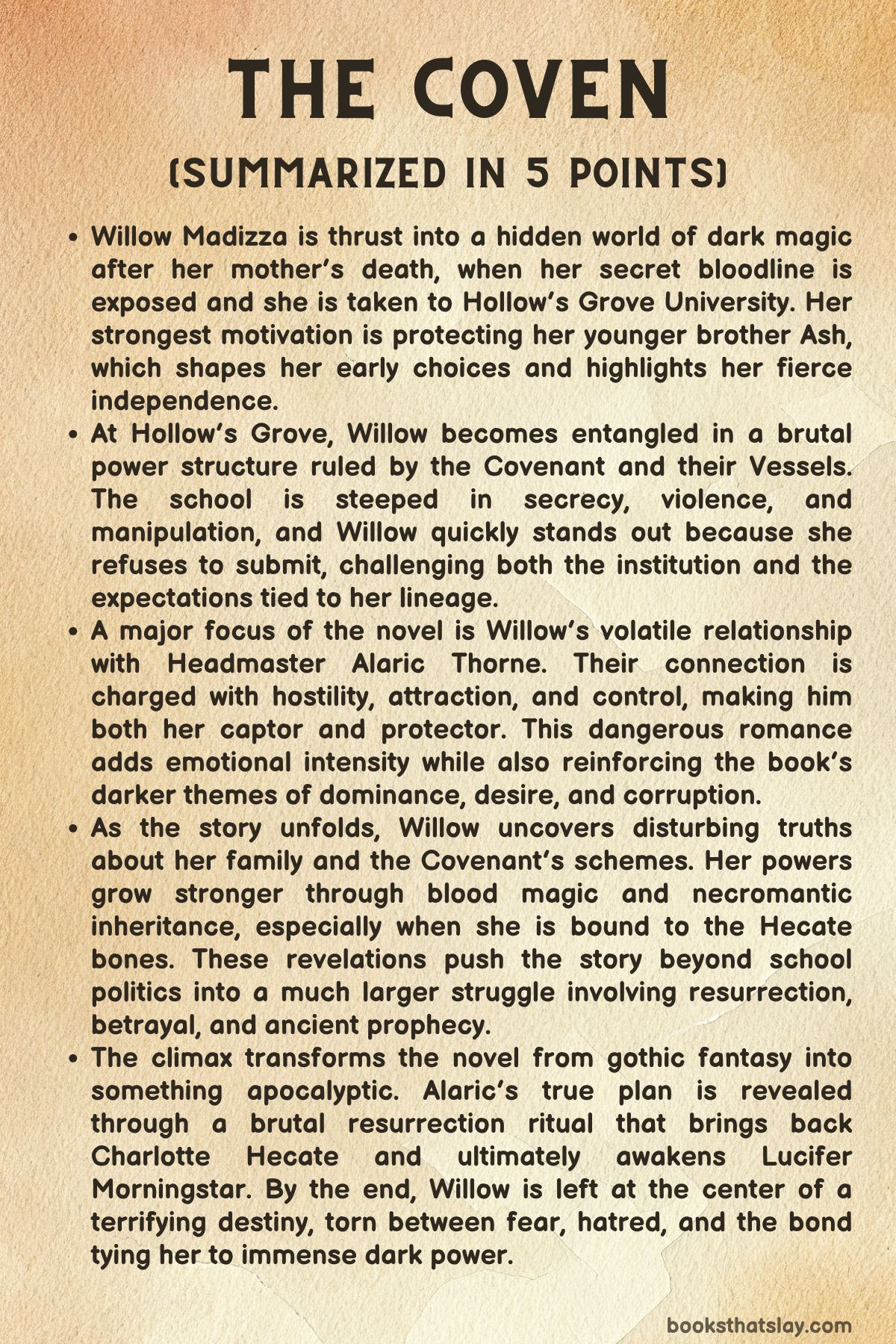
The story begins with Alaric Grayson Thorne, a centuries-old Vessel, called before the skeletal witches of the Covenant who rule Hollow’s Grove University. The Covenant decides to reopen the school after fifty years, accepting twelve chosen witches each year.
Alaric argues against this plan, fearing exposure, but the witches insist that their kind cannot survive without it. Reluctantly, he accepts their list of recruits.
Meanwhile, Willow Madizza mourns her mother Flora’s death. Her main concern is protecting her younger brother Ash, whose magic remains hidden from the Coven.
While her father pushes her toward her supposed destiny of reclaiming necromancer bones to restore her family’s power, Willow is more concerned with keeping Ash safe, even planning to send him to live with his father. Unknown to her, the Covenant has already targeted her as the last of her bloodline, revealed only after Flora’s death.
Alaric is ordered to retrieve Willow, but when he arrives at her home, she refuses his “invitation” to Hollow’s Grove. Their confrontation is fierce—she mocks his arrogance, and when he threatens Ash’s safety, she fights back violently.
Willow escapes through a secret tunnel her mother once prepared, leading her and Ash into the forest. She uses her blood magic to manipulate the trees, slowing Alaric’s pursuit, but he and his allies eventually corner her.
At the bus stop where Ash waits, Alaric arrives first, making it clear that Willow has no more chances to run.
Faced with no choice, Willow bargains for Ash’s safety. Alaric magically compels Ash to forget her and sends him to their father.
As payment, he brands Willow with a sigil binding her to him, keeping her as the last of her line hidden from the Covenant’s knowledge. He escorts her to Hollow’s Grove, taunting her about her heritage along the way.
Despite his cold demeanor, an undercurrent of attraction begins to stir between them.
At the university, Willow immediately clashes with the Covenant, refusing to kneel or submit. She demonstrates her power by binding another witch with living vines, earning both chastisement and grudging acknowledgment.
Taken to her quarters, she meets her new roommates, witches from prestigious families. Despite exhaustion, she hides her fear with wit and defiance.
That night, Alaric, restless and conflicted, secretly visits her while she sleeps but restrains himself from acting on his desire.
As Willow starts her new life at Hollow’s Grove, she navigates a dangerous mix of politics, rivalry, and seduction. Her sharp banter with Alaric in class further stokes their tension, each testing the other’s boundaries.
Though drawn to him, Willow refuses to be controlled, while Alaric struggles with his own desire for dominance and the unsettling effect she has on him.
Their volatile connection comes to a head when Alaric asserts his control through a mix of intimidation and seduction. He feeds from Willow, leaving her humiliated and furious at her own body’s betrayal.
Despite her resistance, their bond deepens in complexity, marked by hostility, attraction, and forbidden desire.
Beyond her dangerous relationship with Alaric, Willow discovers disturbing truths about the Covenant. She learns of their sinister plan to starve witches of traditional burial rites, weakening both witches and Vessels while secretly maintaining their own power.
Horrified, Willow resists, only to be attacked by her grandmother Susannah, who seeks to control her lineage for the Coven’s designs. Alaric intervenes to save her, claiming her as his and deepening his stake in her fate.
The relationship between them intensifies further during rituals such as the Reaping, where witches are fed upon by Vessels. Willow, traumatized by the restraints and blindness imposed on her, reveals her deeper scars, forcing Alaric to confront feelings of protectiveness alongside his possessiveness.
This mixture of hunger, attraction, and unexpected care complicates his role as her captor and protector.
Willow’s power continues to grow as she works with blood magic, reviving dying gardens and demonstrating strength that unsettles both allies and enemies. When Susannah confronts her with warnings about her family’s history and the dangerous legacy of the Hecate bones, Willow resists, but the encounter ends with Susannah choosing her own burial beneath Willow’s roses.
The revelation leaves Willow shaken, yet more determined.
Her defiance reaches its peak when Alaric reveals the Hecate bones and forcibly binds them to her. The bones amplify her necromantic power, allowing her to unmake one of his Vessels, though Alaric himself is immune due to his bond with her blood.
He drags her to the Tribunal chambers, where the Covenant’s leaders witness a brutal ritual. In front of Willow, Alaric sacrifices witches to fuel a resurrection spell, exposing his larger plan.
The ritual culminates in the resurrection of Charlotte Hecate, Willow’s ancestor, whose power rivals the Covenant itself. Charlotte reveals the truth about Willow’s heritage, her destined role, and the mark binding her to Alaric.
Together, Willow and Charlotte open the seal to Hell, summoning the archdemons and the body of Lucifer himself.
In the final moments, Charlotte’s resurrection fades, leaving Alaric to push Willow into the role he had planned all along. He compels her to return his soul to his true body, revealing himself as Lucifer Morningstar.
The book closes with Lucifer awakening, golden eyes opening, as Willow stands torn between fear, hatred, and the impossible bond that ties her fate to his.
Characters
Willow Madizza
Willow emerges as the central figure of The Coven, a witch caught in a tangled web of bloodlines, duty, and rebellion. Her story begins in grief with the loss of her mother, but quickly shifts into a struggle for survival and identity.
Unlike other witches bound to the Covenant, Willow is fiercely independent and unwilling to bend to authority. Her defiance is not reckless bravado but rooted in her deep love for her younger brother Ash, for whom she sacrifices safety and freedom.
She balances necromantic power with an affinity for life magic, making her a unique witch marked by contradiction. Willow is constantly torn between her inherited burden and her personal desires, resisting her family’s expectation to claim the bones of her ancestors while attempting to protect what remains of her childhood family.
She is resilient, witty, and unflinchingly brave, but her inner vulnerability—particularly around themes of control and consent—adds layers to her character, making her as fragile as she is powerful.
Alaric Grayson Thorne (Gray)
Alaric, often referred to as Gray, is a centuries-old Vessel bound by duty and haunted by restraint. As headmaster of Hollow’s Grove, he embodies authority, menace, and temptation.
His relationship with Willow defines much of his arc: initially tasked with subduing her, he becomes obsessed, oscillating between tormentor and protector. Gray’s nature as a Vessel places him inextricably linked to blood, desire, and power, yet his fascination with Willow disrupts his carefully maintained control.
He is cold and calculating with others but slips into vulnerability around her, betraying a dangerous mix of longing and possessiveness. His compulsion over Willow often crosses into cruelty, but beneath the layers of dominance lies a figure drawn to her defiance and vitality.
His dual identity as both headmaster and lover-foe complicates his character, placing him at the crossroads of villain and ally.
Ash Madizza
Ash, Willow’s younger brother, represents innocence and the stakes of Willow’s rebellion. His latent magical ability is a secret that Willow safeguards at all costs, and his very existence becomes a symbol of hope and danger.
Though not as central to the narrative as Willow or Gray, Ash’s presence motivates many of Willow’s decisions. He is the vulnerable heart of the story, embodying what Willow most fears losing.
Through him, the novel underscores themes of protection, sacrifice, and family legacy. His youth and purity stand in stark contrast to the dark manipulations of the Covenant and the violent allure of the Vessels.
Susannah Madizza
Susannah, Willow’s grandmother and one of the skeletal witches ruling the Covenant, is both a formidable antagonist and a reminder of the burdens of lineage. Unlike Willow, she is consumed by duty, tradition, and the Covenant’s manipulations.
She demands respect and obedience, but her cruelty and ambition expose the rot at the heart of Hollow’s Grove. Susannah views Willow less as family and more as a tool for power, emphasizing control and the survival of the Covenant above all else.
Her clash with Willow highlights the generational divide between old magic clinging to authority and new magic striving for independence. In many ways, she embodies the oppressive weight Willow must fight to escape.
Samuel Madizza
Samuel, Willow’s father, plays a quieter but significant role in shaping Willow’s journey. He is pragmatic, pushing Willow toward her destiny of recovering her necromancer ancestors’ bones, yet his guidance comes across as both manipulative and burdensome.
His relationship with Willow is complicated; he is neither entirely ally nor enemy but rather an embodiment of parental pressure tied to legacy. He serves as a reminder that family can be as constraining as it is supportive, and his hidden past intertwines with larger revelations about the Covenant and Willow’s birth.
Iban Bray
Iban is introduced as a fellow student at Hollow’s Grove, whose flirtations and moments of admiration for Willow provide a softer counterpart to Gray’s dominance. He represents what a bond of camaraderie and mutual respect could look like, offering Willow glimpses of normalcy and solidarity in a world of manipulation and power struggles.
His regret for having relinquished his own magic makes him sympathetic, and his growing connection to Willow shows her potential influence on those around her. However, he also reflects the dangers of the Coven’s designs, as Willow suspects he may be positioned as a “suitable” match for her, reminding her that even friendship is shadowed by the institution’s corruption.
The Covenant (Susannah Madizza and George Collins)
The Covenant, comprised of skeletal remnants like Susannah and George Collins, acts as the ruling force of Hollow’s Grove. Their power is steeped in centuries of secrecy and manipulation, demanding loyalty from witches while using them as pawns in their schemes.
They treat Vessels and witches alike as tools to maintain their control. For Willow, the Covenant symbolizes the oppressive system she resists—ancient, decayed authority demanding submission at the cost of freedom.
Their skeletal forms are physical manifestations of their decay and corruption, standing in stark opposition to Willow’s living, thriving magic.
Charlotte Hecate
Charlotte, resurrected through Gray’s ritual, is a legendary and terrifying figure whose past mistakes created the monstrous Cursed. Her reappearance at the climax transforms the trajectory of the story, as she positions Willow as the key to unsealing ancient forces.
She is both savior and threat—burying Samuel alive while guiding Willow toward her destiny. Charlotte embodies the raw, chaotic power of magic and its potential for devastation.
Her presence confirms Willow’s role as a central figure in apocalyptic events, elevating the stakes far beyond Hollow’s Grove and the Covenant.
Lucifer Morningstar
Lucifer, revealed at the story’s climax, is resurrected through Willow’s reluctant necromancy and Gray’s orchestrations. Though his role is only introduced at the end, his presence looms over the narrative as the ultimate embodiment of dark power.
His golden eyes and torn wings hint at both grandeur and ruin, placing him as the apex of the demonic forces now entwined with Willow’s fate. His awakening signifies that the struggle between witches, Vessels, and the Covenant has expanded into something cosmic and irreversible.
Themes
Power and Control
In The Coven, the tension between witches and Vessels is defined by a constant struggle for dominance. The Covenant itself, composed of skeletal witches, governs through fear and manipulation, showing how those in power often perpetuate their control by instilling obedience rather than fostering loyalty.
The Vessels, beings who depend on witches’ blood for survival, use compulsion, physical strength, and intimidation to assert their superiority, creating an imbalance where both groups simultaneously need and despise one another. Alaric Thorne embodies this paradox—an enforcer bound to authority yet resistant to its suffocating rules.
Willow’s relationship with him amplifies this theme: she refuses to be subdued even when he brands her, feeds from her, or forces rituals upon her. Their clashes demonstrate how control is not only physical but also psychological, with power games rooted in seduction, humiliation, and possession.
The Reaping ritual, in which witches are forced to submit to being fed upon, crystallizes this power dynamic by turning intimacy into a weapon of dominance. Yet, despite the overwhelming structures of control, Willow continually asserts herself, whether through resistance, clever defiance, or the assertion of her own forbidden magic.
Power here is not static; it shifts constantly between rulers and subjects, predator and prey, but the novel makes clear that the desire to control others often leads to corruption, betrayal, and destruction.
Family Legacy and Burden
The story anchors Willow in the weight of her bloodline, showing how ancestry can be both a source of empowerment and a crushing responsibility. As the last of the Madizza line, she carries the expectations of resurrecting her necromancer ancestors and fulfilling her father’s cryptic instructions.
Her grandmother Susannah views her not as a granddaughter but as a vessel of continuation, someone to exploit for breeding or ritualistic power. This reduction of family ties into obligations reveals the darker side of legacy, where identity is overshadowed by ancestral demands.
At the same time, Willow’s devotion to her brother Ash underscores the theme of chosen family. Her determination to protect him at all costs, even if it means defying the Covenant, contrasts sharply with the betrayal she feels from her father’s manipulations and her grandmother’s schemes.
The Hecate bones bind her further to her heritage, transforming her very body into an instrument of ancestral will. Through Willow’s perspective, The Coven explores the tension between honoring one’s past and reclaiming individuality, questioning whether family legacy is a gift of strength or a curse that imprisons.
Ultimately, Willow’s story shows that while bloodlines can define destiny, the true measure of family lies in love and sacrifice rather than duty and coercion.
Desire and Corruption
Desire in The Coven is never clean; it is entangled with violence, compulsion, and the hunger for blood. Gray’s fixation on Willow exemplifies how lust can blur into obsession and control.
His feeding, branding, and erotic dominance blur the line between intimacy and violation, creating a relationship that is simultaneously magnetic and destructive. Willow’s conflicted responses—drawn to him even as she resists—highlight how desire can corrupt agency, leading individuals to betray their own instincts.
This corruption is not limited to romance but extends to the Covenant’s rituals, where lust for power corrupts sacred traditions such as burial rites, twisting them into tools for exploitation. The act of feeding, which once symbolized mutual survival, has become transactional, detached from its original bonds of trust.
Desire here is not only sexual but also political and spiritual—manifested in the yearning for freedom, survival, or dominance. By portraying desire as both irresistible and ruinous, the novel suggests that unchecked passion, whether for power or for another person, has the potential to unravel moral boundaries and perpetuate cycles of violence.
Rebellion and Resistance
From the opening chapters, Willow embodies resistance to imposed authority. She refuses Thorne’s invitation to Hollow’s Grove, openly mocks his authority, and even physically assaults him despite his overwhelming strength.
Her defiance against the Covenant, whether by refusing to kneel or reviving forbidden vines with blood magic, highlights her refusal to conform. The theme of rebellion extends beyond her personal struggles; it critiques systems that demand obedience while exploiting their subjects.
The burial corruption scheme orchestrated by the Covenant shows how ruling powers manipulate tradition to tighten their grip. Against such tyranny, rebellion becomes not merely a choice but a necessity for survival.
Yet the novel presents resistance as costly. Willow’s defiance isolates her, exposes her to danger, and deepens her entanglement with Gray, who simultaneously threatens and protects her.
Even when faced with overwhelming odds—such as Charlotte Hecate’s resurrection and the arrival of archdemons—Willow’s refusal to surrender her will remains central. Her rebellion is less about overthrowing authority outright and more about asserting the right to decide her own fate, suggesting that true resistance begins with the reclamation of autonomy.
Death, Resurrection, and Transformation
Death permeates The Coven, not only as an inevitable end but as a gateway to transformation. From Flora’s passing, which catalyzes Willow’s journey, to the Covenant’s skeletal forms clinging to fragments of life, the narrative is steeped in necromantic imagery.
Resurrection, however, is never presented as a miracle but as a perversion of nature. The ritual in which Gray sacrifices students to resurrect Charlotte Hecate illustrates how resurrection requires devastating loss, turning rebirth into an act of destruction.
Willow herself embodies this theme, caught between her role as a life-witch and her inheritance as a necromancer. Every act of blood magic, whether reviving dying vines or summoning the bones’ power, pushes her closer to transformation, blurring the line between savior and destroyer.
Gray’s rebirth as Lucifer Morningstar’s true vessel exemplifies how transformation can be both triumphant and terrifying, altering not just individuals but the balance of entire worlds. Death here is cyclical, feeding into resurrection, which in turn breeds corruption and new forms of death.
By interlacing mortality with magic, the novel emphasizes that transformation always comes at a cost—of innocence, of morality, or of life itself. Willow’s journey becomes a negotiation with these forces, asking whether one can embrace transformation without losing the core of humanity.