The Book That Wouldn’t Burn Summary, Characters and Themes
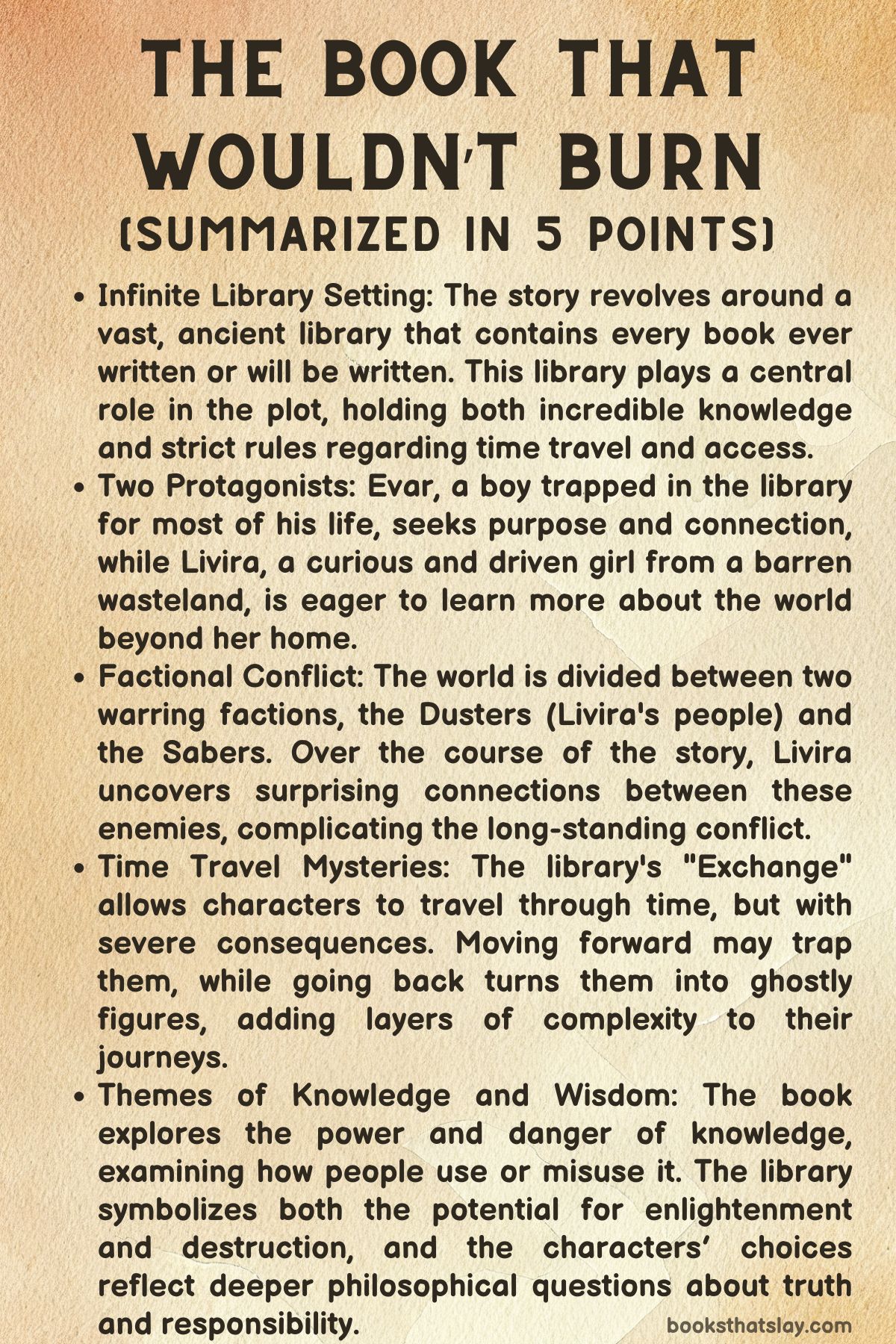
The Book That Wouldn’t Burn by Mark Lawrence is a fantasy novel that blends survival, memory, and the power of knowledge. At its heart, the novel follows two unlikely protagonists: Livira, a rebellious girl from the wastelands, and Evar, a young man trapped in a vast, mysterious library.
Their lives unfold in separate but interconnected worlds where books hold not just stories but reality itself. As both characters confront loss, monsters, and secrets hidden within the Mechanism of the library, they are drawn together across time and space. Lawrence creates a story about resilience, the cost of truth, and the enduring power of stories to connect lives. It is the first novel in Mark Lawrence’s Library Trilogy.
Summary
The story begins in the Dust, a desolate wasteland where survival is harsh and resources scarce. Livira, named after a stubborn weed that thrives in barren soil, is introduced as spirited and rebellious, unafraid of conflict and fiercely determined to resist despair.
Despite her struggles, she cherishes small treasures, such as a scrap of writing she cannot read and a ball of woven grass gifted by Ella, a wise old woman who hints at hidden talents within her. Livira dreams of leaving the Dust and reaching the distant city whose lights she has only glimpsed.
Her chance arrives under terrifying circumstances. Raiders known as sabbers attack her settlement, killing adults and capturing children.
Livira is bound and marched eastward with her companions Katrin, Neera, and even her rival Acmar. As they endure exhaustion and fear, Livira’s resilience shines, though anger and grief consume her when she recalls the destruction of her home.
During the journey, city soldiers ambush the raiders, rescuing the surviving children. Among the soldiers is Malar, a scarred veteran whose reputation rests on defeating a sabber in single combat.
Though coarse and brutal, he becomes their escort back to the city.
The trek westward is grueling. The children battle thirst, hunger, and despair, even encountering a monstrous dust-bear that nearly devours Malar.
Livira’s boldness in saving him from its maw earns his grudging respect. Finally, the group reaches the city, its glowing walls and abundance overwhelming for the children of the Dust.
They are told they will undergo “allocation,” where orphans are assigned roles within society. Most expect menial labor, but Livira clings to the hope of opportunity, especially when she learns of the city’s pride—the vast and ancient library.
Far away in another thread of the tale, a young man named Evar lives within that library, though not in freedom. He and four others—Clovis, Starval, Mayland, and Kerrol—were each swallowed by the library’s strange Mechanism and spat back into a massive chamber filled with towers of books.
The Mechanism has altered them, gifting strange powers drawn from the books they carried inside. Clovis is hardened, Starval deadly, Kerrol manipulative, while Evar appears unchanged, plagued by the sense that he has forgotten someone vital.
Unlike his siblings, who focus on survival and hunting escaped creatures spawned by the Mechanism, Evar is consumed with building a staircase of books, convinced he can escape and find the one he has lost.
Conflict grows as Evar faces both Escapes—nightmarish beings born of the Mechanism—and the scorn of his siblings. When he discovers a mysterious brown book written in a script he should not understand, he finds a message calling him by name, urging him to find someone.
This fuels his obsession to break free, even as the Mechanism grows increasingly unstable and Escapes multiply in number.
Meanwhile, Livira undergoes her allocation tests in the city. Though uneducated, she astonishes examiners with her mathematical aptitude and her ability to write in ancient scripts.
Some believe she is too raw and rebellious to refine, but Master Yute, a mysterious figure with striking pink eyes, defends her. He chooses to bypass the allocation process entirely, bringing her into the library itself, recognizing her potential where others saw only defiance.
Within the library, Livira begins her education, slowly mastering knowledge while navigating its treacherous politics. She grows from an outsider mocked as a “dust-rat” into a rising scholar under Yute’s mentorship.
Yet she cannot let go of her encounters with the strange pools and shifting chambers of the library. She meets Evar across fragmented realities, theorizing that they are separated not just by space but by time.
Her present may be his past, and his present her future. Despite this, their connection deepens, and they cling to the belief that their paths must eventually converge.
The Mechanism begins to fracture further, spilling Escapes and corruption into the library. Shadowed assistants turn hostile, and chaos spreads through its halls.
Livira finds herself pulled into greater dangers, including possession by an assistant’s body, which leaves her detached from her humanity. At times, she records her experiences secretly, writing herself into the margins of forgotten books, ensuring her story endures.
Years pass, and she rises in rank despite political opposition, eventually appointed junior librarian in a public ceremony that astonishes her detractors.
As crises outside the library grow—sabbers mass against the city walls, politics roil among nobles—Livira’s world becomes more precarious. She encounters visions, battles corrupted assistants, and remains obsessed with reuniting with Evar.
Their bond, though fragile and fragmented by time and memory, drives both forward. Evar, too, continues to fight Escapes, haunted by the betrayal of siblings and the dangers of the collapsing Mechanism.
His grief intensifies when he believes Livira has been lost, yet hints remain that her story is not yet finished.
The climax draws both threads together into the vast conflict of the Exchange, where books, memories, and lives intertwine. Livira, transformed yet still defiant, learns that her story is essential to the survival of the library.
She refuses to surrender her memories, declaring that she does not forget, even when confronted by forces trying to erase her. Evar, though burdened by loss, clings to the hope that Livira’s fate is not sealed, fighting onward through chaos and destruction.
In the end, the novel closes on uncertainty but not despair. Livira and Evar’s journeys reveal the cost of survival, the danger of unchecked knowledge, and the strange ways stories can preserve lives across time.
Their destinies remain linked, with the promise of reunion and the possibility of reshaping not just their own futures but the fate of the library and all it contains. The Book That Wouldnt Burn leaves its characters on the cusp of revelation, their stories unfinished, their struggles echoing in the endless chambers of memory and history.
Characters
Livira
Livira is one of the central figures in The Book That Wouldn’t Burn, introduced first as a child of the Dust, hardened by poverty and violence. Her character is marked by stubborn resilience and restless defiance, which sets her apart from her peers.
She is quick to fight, unwilling to yield, and deeply protective of those she cares about, even when fear and exhaustion gnaw at her. What defines her is not only her courage in surviving captivity by the sabbers but also her unshakable curiosity and hunger for something beyond mere survival.
Her journey into the city and eventual recruitment into the library reveals her natural brilliance: she has an uncanny aptitude for numbers, can understand languages she has never learned, and possesses an innate ability to navigate knowledge. Yet, her determination often makes her reckless, and her confidence sometimes alienates those in power.
Despite this, she never loses sight of her goals, whether in fighting for survival, protecting her friends, or later in carving a place for herself among the city’s intellectual elite. Her relationship with Evar becomes a tether of hope, but she remains fiercely independent, shaping her destiny through her intellect and sheer willpower.
Evar
Evar’s story begins within the confines of the Mechanism’s colossal library, where he is trapped with his siblings. Unlike his brothers and sisters, who emerge with remarkable abilities shaped by the books they carried in, Evar appears ordinary—without the deadly talents that define them.
This perceived inadequacy becomes central to his character, fueling feelings of inferiority and frustration. However, what he lacks in outward power, he compensates for with determination, creativity, and an unrelenting hope.
His obsession with escaping the library, symbolized by his fragile staircase of books, reflects both his vulnerability and his resilience. Evar is haunted by a sense of loss, believing he has forgotten someone important, which drives his pursuit of freedom.
When confronted with danger, particularly the monstrous Escapes, he proves himself capable of bravery and ingenuity, even when others dismiss him. His discovery of the mysterious brown book marks a turning point, giving him purpose and a tangible link to the outside world.
His connection with Livira is transformative, grounding him and strengthening his sense of identity. Unlike his siblings, who often embody cynicism, manipulation, or violence, Evar’s defining traits are loyalty, compassion, and the ability to hope against despair.
Clovis
Clovis emerges as a figure shaped by violence, a warrior honed into blunt efficiency. Her upbringing within the Mechanism made her fierce and direct, her worldview hardened by necessity.
Unlike Evar, she embraces the brutality of their existence, meeting threats like the Escapes with lethal skill. Her relationship with Evar is complex—protective at times but also harsh, often mocking his weaknesses and exploiting his vulnerability, as seen when she reveals he was used as bait.
Still, her actions show a pragmatic loyalty: she fights beside him and ensures his survival when it matters most. Her character represents strength forged through suffering, a person who embodies both resilience and ruthlessness.
Kerrol
Kerrol is the most manipulative of the siblings, embodying intellect sharpened into cunning. His mastery of psychology makes him calculating, willing to manipulate others to achieve his goals.
His treatment of Evar, particularly in using him as bait, highlights his cold pragmatism. To him, survival and efficiency outweigh sentiment.
This makes him a foil to Evar’s loyalty and idealism. Kerrol embodies the danger of intellect divorced from empathy, yet his presence is crucial in navigating the treacherous environment of the Mechanism.
Starval
Starval represents pure lethality among the siblings, shaped into a deadly assassin by the Mechanism. His character is quieter in the narrative compared to Clovis and Kerrol but equally defined by danger.
He is a shadow, a reminder of how the Mechanism molds individuals into tools of survival, stripping away innocence. His existence adds to the constant tension in Evar’s life, reinforcing the feeling that Evar alone lacks what the Mechanism demanded of its chosen.
Mayland
Mayland’s presence lingers as both memory and mystery. Though he dies before much of the central story unfolds, his death casts suspicion and unease, leaving questions about whether it was caused by an Escape or one of his own siblings.
He embodies the fragility of life within the Mechanism and stands as a reminder of the cost of their imprisonment. His scholarly inclinations, aligned with history, contrast with the violence of his siblings, hinting at a more thoughtful, reflective nature cut short too soon.
Malar
Malar is a fascinating secondary character whose development mirrors the world’s harshness. Initially presented as a scarred, foul-mouthed soldier with a reputation for killing a sabber, he embodies the brutality of survival.
His relationship with Livira evolves through mutual respect: he first dismisses her as a burden but later acknowledges her courage when she saves him from the dust-bear. Over time, his presence becomes that of a reluctant protector, a hardened survivor whose grudging loyalty provides Livira with both support and grounding in her early city life.
He is not softened by affection, but his respect for her strength allows him to play a pivotal role as both guardian and companion in her journey.
Master Yute
Master Yute is among the most enigmatic figures in the story. His pink eyes and strange perception set him apart immediately, and his role as Livira’s sponsor transforms her trajectory.
Unlike the other examiners who dismiss her raw talent, Yute sees beyond appearances, recognizing her defiance, survival instinct, and intelligence as markers of true potential. He does not test her for knowledge alone but for resilience and character.
His grief for his lost daughter adds a human depth to his stern exterior, hinting at both vulnerability and purpose. Through him, the library is revealed not just as a place of knowledge but as a center of political and spiritual power, and Yute becomes a mentor who challenges Livira to embrace her destiny while navigating dangerous currents of influence.
Themes
Survival and Resilience
In The Book That Wouldn’t Burn, survival is presented not only as a physical struggle against external threats but also as a test of inner strength and adaptability. Livira’s upbringing in the Dust exemplifies this theme most vividly.
She is introduced as someone forged by deprivation, forced to endure hunger, thirst, and the constant fear of violent raiders. Her resilience becomes evident in the way she clings to small tokens of hope—a scrap of paper, a wind-weed ball, or the distant image of the city.
These are not simply childish keepsakes but symbols of determination, showing how survival is as much about holding on to meaning as it is about enduring hardship. Evar, too, embodies resilience, though his struggle takes a different form.
Trapped within the Mechanism’s chamber, he is compelled to endure isolation, fear, and the dismissive superiority of his siblings. While they grow stronger through their acquired abilities, he sustains himself on a fragile belief in freedom and an unshakable sense of unfinished purpose.
Together, Livira and Evar highlight two facets of resilience: one forged in the external battle against environment and oppression, the other in the internal struggle against despair and hopelessness. Their survival is not passive but active, marked by stubborn defiance that transforms them into more than victims of their circumstances.
Knowledge and Power
The library in the novel stands as the most potent symbol of knowledge, and with it, the corrupting and liberating aspects of power. To the city, the library is a fortress of wisdom, a source of pride and control, yet access to its treasures is heavily restricted, revealing how knowledge is wielded to maintain hierarchies.
Livira’s journey from the Dust to the library underscores how knowledge is both a weapon and a tool of emancipation. Despite her lack of education, her instinctive ability to read ancient languages and solve complex problems challenges the elitist system that seeks to exclude her.
Power within the book often derives from who controls knowledge: the deputies manipulate political narratives, the Mechanism births both monsters and heroes from texts, and even the Escapes are formed by stories turned hostile. For Evar, the book addressed directly to him demonstrates knowledge’s most personal power—the ability to reshape destiny.
Yet the library is not presented as a neutral repository; it is alive, dangerous, and fragile, constantly burning and rebuilding. This cyclical destruction suggests that knowledge cannot ever be wholly controlled; it resists stagnation, breaking free in unpredictable ways.
Lawrence positions knowledge as an unstable but essential force, one that offers salvation only if it is shared rather than hoarded.
Oppression and Social Hierarchy
The novel paints a world fractured by divisions—between city and Dust, nobility and commoners, librarians and laborers. Livira’s introduction to Crath City exposes her to systemic prejudice where “dusters” are treated as lesser beings, destined for the most degrading work.
Allocation becomes a ritualized mechanism of oppression, cloaked in the guise of meritocracy but in reality designed to reinforce existing hierarchies. The disdain shown toward Livira during her examinations reveals how social identity matters more than ability, as her intelligence is overshadowed by the stigma of her origins.
Similarly, the rigid structures within the library mirror the broader politics of the city, with deputies and aristocrats entangling themselves in power plays that leave little room for outsiders. Even Evar’s confinement within the Mechanism reflects a form of oppression—his siblings, empowered by the books they carried, dismiss his worth and deny him equality.
This ongoing theme emphasizes how societal systems exploit fear and difference to preserve dominance, yet it also shows that resistance often comes from the margins. Livira’s rise to the rank of junior librarian, despite relentless opposition, becomes both a personal triumph and a symbolic act of defiance against institutional prejudice.
The book suggests that oppression is never absolute and that challenging hierarchies requires both courage and imagination.
Memory, Story, and Identity
One of the most compelling themes of The Book That Wouldn’t Burn is the link between memory, story, and the formation of identity. Both Livira and Evar are haunted by memories—Livira of her destroyed home and lost companions, Evar of a forgotten girl whose absence defines his existence.
The Mechanism complicates memory, creating distortions where past and future bleed into one another, producing ghostlike versions of characters who cannot interact with their own timelines. Story itself becomes a battleground: Escapes are stories turned monstrous, the Exchange is a space where narratives collide, and Livira takes to recording her life in coded margins, ensuring her voice survives beyond the control of the library.
In many ways, identity in the novel is inseparable from story. Evar’s sense of self is incomplete until he begins to grasp the story written for him, while Livira’s strength lies in her refusal to let others define her narrative—whether as a “duster,” a failed candidate, or an expendable child.
The book’s cyclical burning of the library further underscores the fragility of memory: every fire threatens to erase identity, and yet stories persist, reborn in fragments, whispers, and hidden books. Lawrence suggests that memory and story are not passive records but active forces shaping who people are and what futures they can imagine.
Fate, Free Will, and Connection
Underlying the novel is a constant tension between destiny and choice. The Mechanism, the Exchange, and the mysterious book addressed to Evar all seem to suggest that lives are scripted, that futures are already written.
Livira herself is marked by a fate she cannot entirely understand, seen as significant by figures like Master Yute long before she recognizes her potential. Yet both she and Evar resist the idea of inevitability, asserting their agency through choices that defy imposed paths.
Livira chooses the forbidden door at Allocation, refusing to accept the role her society expects. Evar, mocked for building his staircase of books, pursues escape despite repeated failure.
Their eventual encounters blur the boundaries between fate and free will, as visions show Livira declaring that Evar will always arrive too late, while he clings to the belief that he can change the outcome. The connection between them suggests that even in a universe bound by cycles of burning and rebuilding, human relationships introduce unpredictability.
The theme insists that fate may set the stage, but choice determines the performance. By centering their bond in a world collapsing under predestination and destruction, the novel argues that connection itself is an act of defiance against determinism, making love, loyalty, and sacrifice the most radical forms of freedom.