100 Cupboards Summary, Characters and Themes
100 Cupboards by N.D. Wilson is a middle-grade fantasy adventure set in ordinary Kansas, where the strange keeps brushing up against the everyday. Twelve-year-old Henry York arrives in a quiet small town after his parents vanish while traveling abroad.
He expects boredom, grief, and awkward new family routines. Instead, he finds a house with secrets—some hidden behind plaster, some hidden behind locked doors, and some hidden inside his own past. With sharp humor, eerie surprises, and a steady sense of wonder, the book that starts the 100 Cupboards series by the author turns one mysterious wall into a doorway toward dangerous worlds and bigger truths.
Summary
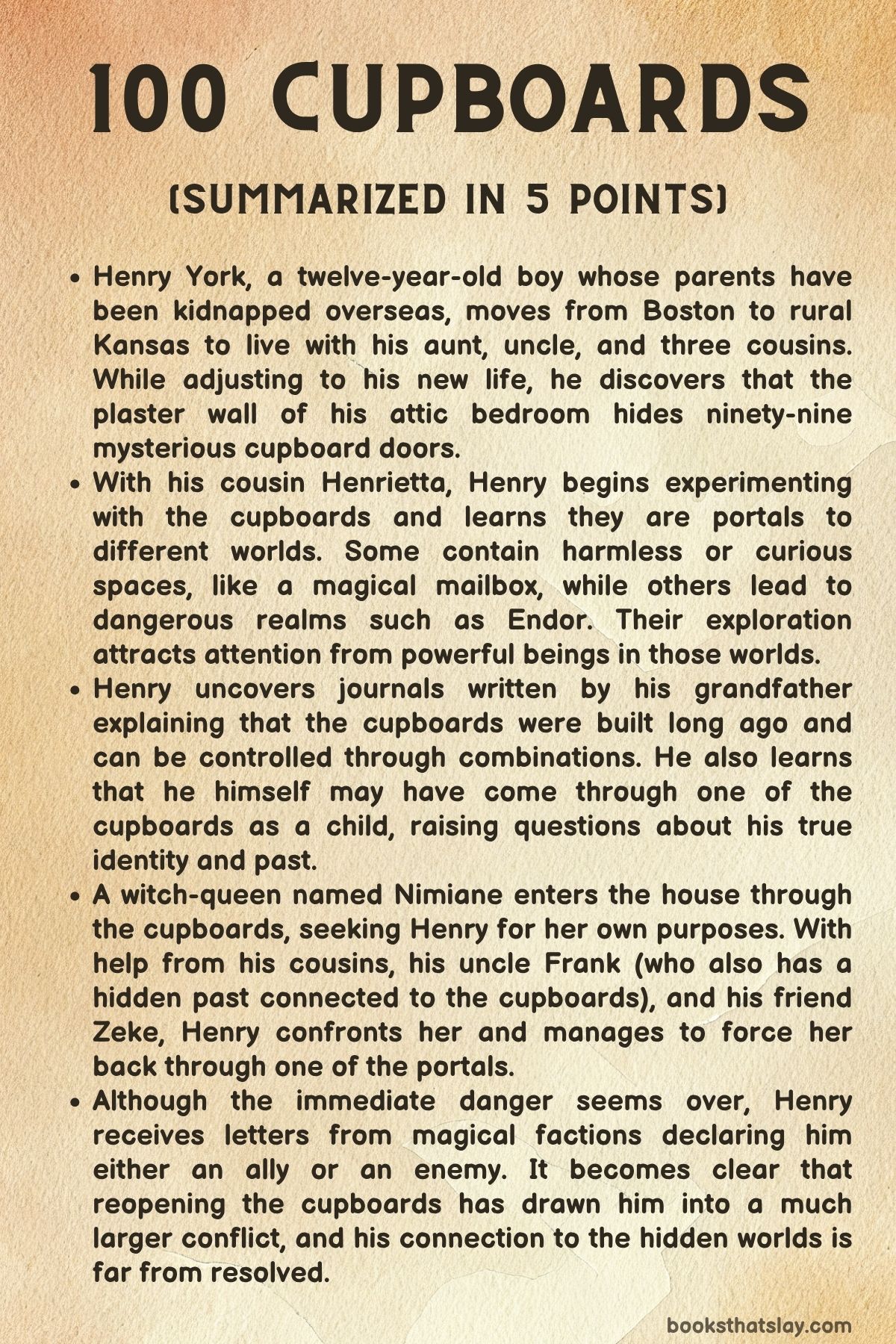
Henry York is dropped off in the tiny town of Henry, Kansas, to live with his aunt and uncle, Dotty and Frank Willis, after news arrives that his parents have been kidnapped during a bicycle trip in South America. The situation leaves Henry shaken and uncertain, and the move from Boston to the open fields of Kansas feels like exile.
Dotty’s warmth and Frank’s odd, playful energy help, but Henry still carries the quiet fear that his life has been cracked apart and won’t fit back together.
The Willis house is large and old, with a barn behind it and an attic bedroom prepared for Henry. His cousins—Penelope, Henrietta, and Anastasia—swarm him with curiosity and a kind of chaotic kindness.
Henrietta is especially intense, bright-eyed, and restless. The girls show Henry the house as if it’s an amusement park built from family habits and private jokes.
One room, though, stays off-limits: “Grandfather’s room,” locked since their grandfather died. Henry senses something strange about that door, like a memory that won’t form into words.
At night, Henry struggles to sleep. He hears unexplained thumps in the wall and, during one late bathroom trip, glimpses a short bald man in a robe moving through the house—an image so odd that it seems to slip away as soon as Henry tries to hold onto it.
The next day, Frank takes Henry on a rambling, dusty tour of town, full of small pleasures and strange errands, including Frank’s habit of collecting tumbleweeds to sell online. Henry is given a baseball glove and a pocketknife, and for the first time since his arrival, he starts to imagine he might actually be okay here.
That fragile comfort breaks when plaster begins falling from the curved wall of Henry’s attic room. As he clears it away, he discovers a small metal door with two turning knobs surrounded by strange markings.
Henry, practical by instinct, starts testing combinations like a puzzle he can beat through persistence. But when more plaster comes away, he realizes it isn’t just one door.
Behind the wall are dozens—eventually ninety-nine—small cupboard doors, each different, each waiting like a mouth that might open.
Henry and Henrietta become obsessed. They work in secret, cleaning dust, hiding evidence, and trying to understand what they’ve uncovered.
At first, it feels like a secret clubhouse discovery—until a cupboard opens and cold wind spills into the attic, carrying the sound of trees in a storm and the smell of rain. Henry reaches inside and pulls out a key, and moments later water pours into the room as if the cupboard is connected to a rain-soaked world on the other side.
The cupboards aren’t storage at all. They are passages.
While Henry and the girls wrestle with the wall of doors, Frank becomes determined to open Grandfather’s locked room. He tries tools, force, even a chainsaw, but the door refuses to yield.
The failure only sharpens the tension in the house: secrets are piling up, and Henry feels caught in the middle of mysteries he can’t name.
The cupboards begin delivering mail. Henry finds a postcard and then a threatening letter addressed to someone connected to the house’s past, warning that the cupboards have been reopened and demanding that an old figure be awakened.
Another letter arrives from a bureaucratic-sounding group that claims certain “gates” thought destroyed are active again—and that a “Whimpering Child” will be held responsible for whatever escapes. Henry realizes with a sick jolt that he is the one being named.
The message doesn’t treat him as a kid who stumbled onto a hidden wall. It treats him as a known problem.
Eventually, a key from one cupboard fits the lock of Grandfather’s room. When Henry and Henrietta enter, they find the room impossibly untouched: fresh flowers, a tidy bed, and shelves of books that look lived-in rather than abandoned.
Even more unsettling, Henry sees a purple robe that snaps the old nighttime image back into his mind—the bald man in the hallway wasn’t Grandfather. Something else has been in this house.
They discover a journal with a diagram labeling the cupboards, giving each a number and, for some, a destination name. Some doors lead to places with clear weather and towering trees; one is tied to a dark place called Endor.
The journal suggests rules, dangers, and limits, but doesn’t explain everything. Henrietta, excited and stubborn, wants to explore.
Henry is wary, sensing that these doors don’t care whether the person opening them is brave or foolish.
When Henrietta reaches into the Endor cupboard, something grabs her arm from the other side. Henry panics, attacks blindly with his knife, and manages to free her, but the moment scars them both.
Henrietta tries to shrug it off, but Henry can’t. The cupboards are not harmless.
Something inside them notices, reaches, and remembers.
Trying to escape the pressure, Henry spends time in town playing baseball with a local boy named Zeke. The game offers him a place where rules make sense and outcomes feel earned.
Yet even there, the cupboards follow him in his thoughts. Back at home, Endor pushes back more directly: Henry finds his knife returned through the dark cupboard, cleaned as if someone has handled it carefully.
Then he sees a mangy black cat, tethered by a string to the Endor door, as if it has been sent as a tool or a spy. Henry fights it off and slams the cupboard shut, shaken by the idea that the house is now on someone else’s map.
Henrietta, still hungry for answers, sneaks into Grandfather’s room and learns there are additional journals. Her curiosity triggers a worse disaster: she leaves the door open at the wrong time, and Henry crawls into a large cupboard within the room, discovering that it can connect to different destinations depending on the attic’s knob settings.
Henry begins using the journals to adjust the settings and search for Henrietta when she disappears into the system.
His search throws him into worlds that feel like fragments of different histories—one contains a boy named Richard Leeds, living in a protected, old-fashioned pocket of time. Another leads Henry into a stone chamber where an old robed man questions him and calls him the son of someone hated.
Henry escapes, but the danger is no longer hypothetical. People in these other places know about the cupboards, and some are ready to punish whoever reopened them.
Meanwhile, Henrietta, alone in the ruins of a grand hall, follows the bald man—Eli FitzFaeren—who blames her for damaging something precious. The hall flickers between beauty and ruin, as if memory itself can’t decide what it is.
Eli warns her not to eat, not to trust, and not to wait passively; the wrong delay could cost her a limb when the passage opens again.
Back at the house, Frank finally learns the truth and tells the girls a story from Dotty’s past: Frank himself came through the cupboards years ago as a talented boy with nowhere to go. Grandfather eventually sealed the wall behind plaster to stop the danger, but the cupboards never truly stopped being what they were.
The family’s history is tied to these doors, and so is Henry’s.
A woman arrives—beautiful at first glance, rotten beneath it. She is Nimiane, a witch-queen connected to Endor, hunting Henry by name and scent.
She uses glamour to trick, threaten, and isolate the children. The house becomes a battleground of locked doors, rattling hinges, and improvised defense.
Zeke, arriving for baseball practice, is dragged into the chaos and becomes unexpectedly crucial.
Henry finds Henrietta in the shifting ruins of the hall as armed figures and wolves appear, and fire and collapse close in. They race back toward the passage while the hall’s false elegance falls away.
At the same time, Nimiane breaks into Grandfather’s room, and when Henry and Henrietta finally spill back into the house, the fight becomes direct. Zeke swings his bat and strikes Nimiane, buying the family a moment to act.
They choose not to kill her in the house. Instead, they shove her through the large cupboard passage and send her away to a destination they hope will hold her.
In the aftermath, injuries are treated, excuses are made, and Frank insists the cupboard adventure is finished. But the final proof that nothing is finished comes quickly.
A strange small creature—a winged, rhino-like tracker called a raggant—appears, aimed toward Henry as if he is the target of a long search. Frank admits what he suspects: Henry was found in a cupboard years ago and placed into a normal life.
Even Henry’s “parents” may not be his by blood.
Two letters arrive that confirm the danger has spread. One faction thanks Henry for freeing Nimiane; another declares him an enemy and calls for his capture or death.
Henry ends the story not as a triumphant hero, but as a boy furious at being pulled into a war he never chose—standing in a quiet Kansas house with a wall of doors that now knows his name.
In the epilogue, Nimiane survives, regains power through a black cat, and arrives in a throne room to demand repayment of an old debt. Her next move is already forming, and Henry’s troubles are only beginning.
Characters
Henry York
Henry York stands at the center of 100 Cupboards as a boy caught between ordinary childhood and a destiny he neither understands nor wants. At the beginning, he is anxious, withdrawn, and shaped by fear for his kidnapped parents.
He arrives in Kansas uncertain of his place in the world, clinging to routines like baseball and logical thinking to steady himself. His instinct is to calculate, measure, and rationalize; when he first discovers the cupboard knobs, he responds with arithmetic rather than imagination.
This reliance on reason reflects both intelligence and emotional self-protection.
As the cupboards reveal their impossible nature, Henry’s identity begins to fracture and expand. He is labeled by others as a “Whimpering Child,” a “dream walker,” and the son of a hated man.
These titles threaten his sense of self, forcing him to confront the idea that he may not be who he believed. His nightmares and visions blur the line between waking and dreaming, suggesting that his connection to the other worlds runs deeper than simple curiosity.
Despite fear, he repeatedly chooses action, especially when Henrietta is in danger. His bravery is not loud or triumphant; it is reluctant and reactive, driven by loyalty more than ambition.
Henry also wrestles with guilt. When events spiral out of control, he insists that he did nothing, that he is only scenery in someone else’s story.
This denial reveals his desire for normalcy and his discomfort with power. Yet the cupboards respond to him, the raggant tracks him, and enemies name him.
By the end, Henry has not embraced heroism, but he has accepted responsibility. His growth lies not in confidence but in endurance—he keeps stepping forward even when he would rather step away.
Henrietta Willis
Henrietta serves as both catalyst and companion in the unfolding chaos. She is sharp, curious, and impatient with caution.
Where Henry calculates, Henrietta acts. Her boldness drives much of the exploration of the cupboards; she pushes open doors Henry hesitates to touch and refuses to let fear dictate her choices.
This makes her both admirable and reckless. She embodies the thrill of discovery without fully grasping its consequences.
Her stubborn streak often leads to conflict with Henry, particularly when she dismisses his warnings about dangerous cupboards like Endor. Yet beneath her daring exterior is vulnerability.
When she is grabbed by something inside a cupboard or stranded in the ruined hall, her fear surfaces, though she rarely admits it outright. Her laughter in dark places reveals resilience as much as denial.
Henrietta’s courage is raw and unfiltered, lacking Henry’s reflective restraint but matched by fierce loyalty.
She also represents the temptation of wonder. The magical worlds fascinate her; she sees possibility where Henry sees risk.
In many ways, she pushes Henry toward growth by refusing to let him retreat entirely. Without her, the cupboards might have remained half-explored.
Her character highlights the tension between curiosity and caution, showing that exploration requires both bravery and humility.
Frank Willis
Frank appears at first as eccentric comic relief, a man who sells tumbleweeds online and quotes epic poetry before attacking a stubborn door. His humor and theatrical personality soften the strangeness of the house, creating a sense of chaotic safety.
Yet beneath the quirks lies a complicated history. Frank himself once came through the cupboards as a displaced child from another world.
This revelation reframes his behavior: his fascination with oddities and his reluctance to fully explain the house’s secrets stem from lived experience.
Frank’s attempts to break into Grandfather’s room reflect both frustration and denial. He knows more than he initially reveals, but he hesitates to confront the past directly.
When the danger escalates, however, he steps into a protective role. He listens to Richard, coordinates with Dotty, and faces Nimiane with a knife despite clear risk.
His humor fades when the threat becomes real, revealing a man who understands the cost of magical interference.
As a father figure, Frank balances absurdity with courage. He wants normal life for his daughters and for Henry, yet he cannot escape the truth that the cupboards shaped him.
His character bridges worlds, embodying the long shadow of past choices and the responsibility of protecting the next generation from repeating them.
Dotty Willis
Dotty initially appears as warm and bustling, absorbed in cooking, family routines, and affectionate gestures. She seems grounded in domestic life, yet her backstory reveals surprising strength.
As a young girl, she once helped Frank navigate the cupboards, traveling between worlds before Grandfather sealed them. This history gives her quiet authority and a deeper awareness of the risks involved.
Dotty’s calm presence contrasts with the chaos around her. When confronted by Nimiane, she resists the witch’s influence despite physical weakness.
Her refusal to yield easily underscores her inner resilience. She carries knowledge without dramatizing it, stepping into explanation only when necessary.
Her storytelling about Frank’s origins reframes the adventure as something cyclical rather than accidental.
Dotty represents stability under pressure. She understands wonder but prioritizes family safety.
Her character grounds the narrative, reminding both Henry and the reader that magic does not erase the importance of loyalty and home.
Penelope Willis
Penelope, the oldest cousin, functions as a moderating force among the siblings. She is observant, cautious, and less impulsive than Henrietta.
Though not as centrally involved in exploring the cupboards, her reactions often reflect common sense and moral clarity. When violence becomes a possibility, she argues for restraint and practical solutions rather than revenge.
Her role becomes more pronounced during Nimiane’s invasion, when she helps defend the house and resists the witch’s deception. Penelope’s steadiness provides balance, preventing the group from descending into panic or cruelty.
She may not crave adventure, but when danger arrives, she stands firm.
Anastasia Willis
Anastasia, the youngest, is energetic, inquisitive, and perceptive beyond her years. She senses secrets quickly and refuses to be excluded.
Though often dismissed as too young, she proves brave during critical moments, particularly when confronting the black cat and resisting Nimiane’s manipulations.
Her curiosity mirrors Henrietta’s, but her smaller stature and youth add vulnerability. This combination heightens tension, as her involvement raises the stakes.
Anastasia’s insistence on inclusion reflects a theme of shared responsibility; the cupboards affect everyone in the house, not just the oldest children.
Richard Leeds
Richard is a boy from another world, living in a strange version of Britain suspended in time. His politeness and slightly formal demeanor set him apart from Henry and the Kansas setting.
At first sheltered and unsure, he gradually demonstrates loyalty and courage, especially when he guards the cupboard door and follows Henry into danger.
Richard represents innocence caught in political and magical conflict. He has grown up within systems of control, and stepping through the cupboard expands his perspective.
His admiration for landscapes like Badon Hill reveals a longing for beauty and freedom. Though not as central as Henry, Richard’s presence widens the story’s scope, emphasizing that the cupboards connect diverse lives and histories.
Nimiane
Nimiane is the primary antagonist, a witch-queen whose power relies on manipulation, illusion, and hunger for control. She shifts between forms—beautiful and hag-like—demonstrating the deceptive nature of her influence.
Her interest in Henry is strategic; she recognizes his unique position and seeks to capture or use him.
Her cruelty is calculated rather than chaotic. She employs glamour to infiltrate the house, turning perception into a weapon.
Even in defeat, she survives and plans revenge, revealing resilience and long memory. Nimiane embodies corruption within the magical realms, representing what happens when power detaches from restraint.
Eli FitzFaeren
Eli FitzFaeren is a tragic figure tied to the ruined hall. Bald, aging, and embittered, he once knew the place in its glory and now walks among its ashes.
He blames Henrietta for disturbing fragile balances, yet his anger masks regret and grief. Eli’s history with Grandfather connects past and present, suggesting that earlier generations also meddled with forces they did not fully master.
He serves as a warning about the long-term consequences of using the cupboards. His bitterness reflects loss, and his fragmented existence mirrors the damaged worlds the cupboards link.
Grandfather
Though absent in the present, Grandfather’s influence shapes the entire story. He inherited knowledge of the cupboards, documented their combinations, and ultimately sealed them behind plaster.
His journals reveal both curiosity and caution. He understood the dangers, including the distortion of time, and tried to manage rather than destroy the system.
Grandfather’s decision to close the cupboards suggests hard-earned wisdom. He represents an earlier attempt to control chaos through structure.
His legacy challenges Henry: knowledge alone is not enough; restraint matters.
Zeke Johnson
Zeke grounds the narrative in ordinary life. As a baseball-loving local boy, he provides Henry with connection outside the magical crisis.
His willingness to step into danger when Nimiane attacks shows straightforward bravery. Zeke does not understand the full scope of events, yet he acts decisively, striking the witch when others hesitate.
He symbolizes normal courage—strength drawn from loyalty rather than destiny. In a story filled with shifting worlds, Zeke reminds readers that heroism can arise from everyday decency.
Themes
Identity and Belonging
Questions of identity shape Henry’s journey from the moment he arrives in Kansas. He believes himself to be an ordinary boy displaced by tragedy, yet the cupboards gradually reveal that his past may be constructed on hidden decisions and secret rescues.
The discovery that he may not be the biological child of the parents he mourns destabilizes his sense of self. Instead of offering clarity, the magical revelations complicate his understanding of who he is.
Being labeled a “Whimpering Child,” a “dream walker,” and the son of a hated man forces him to confront identities imposed from outside. These titles clash with his own view of himself as cautious, reluctant, and largely powerless.
Belonging operates on multiple levels throughout 100 Cupboards. Henry must adapt to a new household, negotiate sibling-like tensions with his cousins, and attempt to form friendships in town.
The cupboards expand this struggle into a larger arena: entire worlds recognize him as significant, even dangerous. While Henry seeks stability and anonymity, other realms claim him as part of their history.
This tension between chosen belonging and inherited belonging drives much of his internal conflict.
The theme also extends to Frank, who once arrived through the cupboards as an outsider and built a life in Kansas. His marriage to Dotty represents an act of choosing home rather than being defined by origin.
Henry stands at a similar crossroads but resists embracing any grand destiny. The story suggests that identity is not solely determined by bloodline or prophecy.
It emerges from choices made in fear, loyalty, and love. Belonging, in this sense, becomes less about where one comes from and more about where one decides to stand when danger calls.
Curiosity and Consequence
The cupboards exist because someone once chose to experiment with boundaries between worlds. Henry’s discovery of the wall continues that pattern.
The thrill of uncovering hidden doors creates momentum, especially through Henrietta’s eagerness to explore. Curiosity here is not portrayed as foolish in itself; it is tied to intelligence, imagination, and the desire to understand what lies beyond the ordinary.
Yet each opened door carries risk, and the narrative refuses to separate discovery from responsibility.
When Henrietta reaches into Endor despite warnings, she learns that curiosity can provoke retaliation. The cupboards are not passive mechanisms; they connect to places inhabited by beings with intentions and grievances.
Opening them invites attention. Letters arrive, threats are made, and enemies appear because someone disturbed what was sealed.
The chain of events highlights how a single act of exploration can ripple outward in ways the explorer never predicted.
The journals left behind by Grandfather reveal an earlier attempt to manage curiosity through documentation and rules. He understood that knowledge without discipline leads to harm.
Henry slowly adopts this caution, insisting certain cupboards remain closed. The contrast between Henrietta’s impulse and Henry’s restraint underscores the delicate balance required when engaging with the unknown.
Curiosity fuels growth, but unexamined curiosity creates openings for danger. The theme suggests that discovery demands maturity; without it, wonder can transform into catastrophe.
The Burden of Inherited Conflict
The cupboards represent more than magical passageways; they are remnants of long-standing struggles between factions and figures like Nimiane and Darius. Henry becomes entangled in disputes that predate him, conflicts rooted in grievances he barely understands.
This inheritance of hostility shapes his journey. He did not choose to reopen the gates with malicious intent, yet he is held accountable by those on the other side.
Frank’s past reinforces this theme. As someone who once crossed through the cupboards and remained in Kansas, he is living proof that previous generations also participated in these exchanges.
Grandfather’s decision to seal the cupboards suggests an attempt to break the cycle, to prevent the next generation from bearing the consequences of earlier risks. Yet secrecy itself becomes part of the inheritance.
By not fully explaining the past, the adults leave Henry and his cousins vulnerable to repeating it.
Nimiane’s survival and vow of revenge illustrate how unresolved conflict persists. The magical realms operate according to memories and debts that outlast individual lifetimes.
Henry’s frustration at being drawn into such matters reflects the unfairness of inherited burdens. The narrative raises questions about accountability: how much responsibility does one carry for actions committed before one’s birth?
Through Henry’s resistance and eventual acceptance of partial responsibility, the story explores the complexity of stepping into a legacy shaped by others’ mistakes.
Illusion and Reality
Throughout the story, appearances shift and deceive. Nimiane’s transformation from a striking woman into a blind hag exposes how easily perception can be manipulated.
The ballroom that alternates between splendor and ruin suggests that reality in these connected worlds is unstable, dependent on perspective and circumstance. Even Henry’s dreams blur into waking experiences, hinting that the boundaries between states of consciousness are porous.
The cupboards themselves symbolize thresholds between what seems solid and what is hidden. A wall that appears ordinary conceals entire worlds.
A small mailbox door opens into a brightly lit room occupied by a stranger. This constant disruption of surface reality challenges characters to question what they see and trust.
Those who rely only on appearances, such as Zeke initially perceiving Nimiane as beautiful, risk being misled.
At the same time, illusion serves as both weapon and shield. Nimiane uses glamour to gain access to the house, but the children rely on their knowledge of the cupboards’ mechanics to counter her.
The tension between illusion and truth extends inward as well. Henry must confront the illusion of his past and reassess what is real about his family and origins.
The narrative suggests that clarity comes not from denying illusion but from recognizing its presence and learning to look beyond it.
Courage and Moral Choice
Danger escalates steadily, demanding decisions from characters who would prefer safety. Courage in this story is rarely glamorous.
Henry hesitates, doubts, and sometimes denies his significance, yet he still steps forward when Henrietta is trapped or when Nimiane invades the house. His bravery stems from loyalty rather than a desire for recognition.
He acts because someone he cares about needs help, not because he seeks glory.
Moral choice becomes particularly significant when the group considers killing Nimiane. Some argue for ending her life to eliminate the threat, while others insist on restraint.
This moment tests their values under pressure. Choosing not to execute a defeated enemy reflects an ethical boundary they refuse to cross, even after experiencing fear and harm.
It distinguishes them from antagonists who use power without hesitation or remorse.
Zeke’s intervention with a baseball bat demonstrates a simpler form of courage. Without full understanding, he reacts to protect others.
Frank, too, stands against Nimiane despite knowing her strength. These acts collectively frame courage as communal rather than solitary.
It emerges when individuals decide that protecting others outweighs personal safety. The story emphasizes that bravery is less about fearlessness and more about the willingness to act despite fear, guided by conscience rather than anger.
Home as Sanctuary and Portal
The Willis house embodies contradiction. It is a place of warmth, laughter, and shared meals, yet it contains doors to perilous realms.
The attic bedroom and Grandfather’s room illustrate how domestic spaces can conceal extraordinary secrets. This dual nature reinforces the idea that safety is never absolute.
Even familiar environments may hide unknown depths.
Despite the dangers, home remains the emotional anchor. The children retreat to Grandfather’s room for protection, locking themselves away from Nimiane.
The porch conversations between Frank and Henry provide grounding moments where truth is shared calmly. Baseball games in town offer Henry temporary escape from magical burdens.
These scenes affirm that home is defined not solely by walls but by relationships.
At the same time, the cupboards transform home into a crossroads. Visitors from other worlds step through, bringing conflict with them.
The invasion by Nimiane shatters the illusion that the house can remain untouched. Yet the family’s defense of the space reinforces its significance.
They fight not merely for survival but for the preservation of a shared life. In this tension between sanctuary and exposure, the narrative suggests that home is both refuge and responsibility.
Protecting it requires vigilance, honesty, and unity in the face of forces that seek to cross its thresholds.