And Then, Boom! Summary, Characters and Themes
And Then, Boom! is a middle-grade novel in verse by Lisa Fipps about Joey, a boy trying to survive poverty, abandonment, hunger, and grief while holding onto the hope he finds in comics, friends, and the love of his grandmother.
The story follows him through unstable housing, his mother’s disappearances, and the loss of the one adult who made him feel safe. Written through Joey’s eyes, the book shows how poverty can wear down a child’s body and spirit, but also how care from friends, teachers, neighbors, and foster family can help him begin again.
Summary
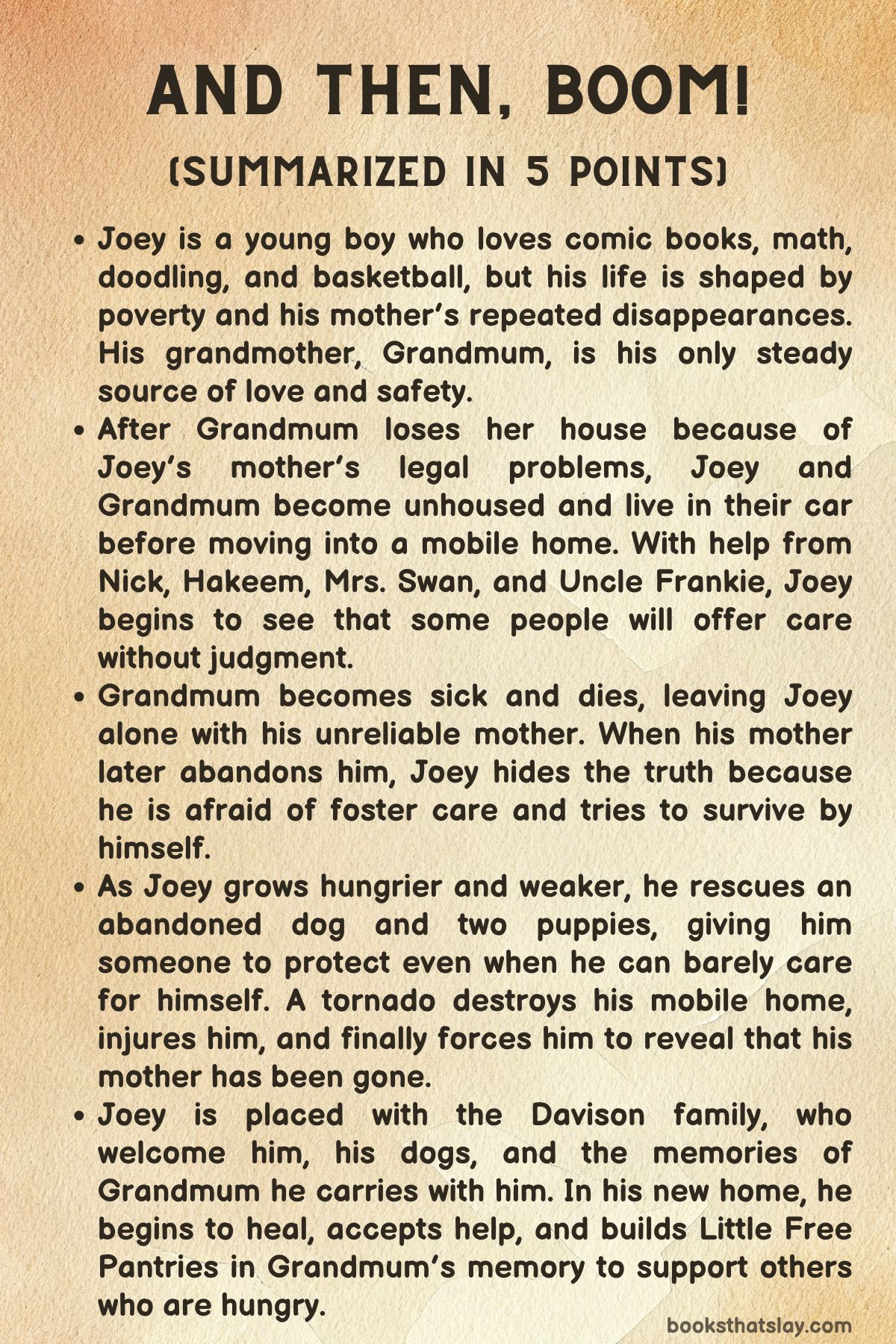
Joey sees life the way he sees comic books: full of ordinary moments that can suddenly change everything. He loves superheroes, doodling, math, basketball, and his grandmother, whom he calls Grandmum.
She is the steady person in his life, the one who cares for him, comforts him, and holds the family together. His mother is different.
She is unpredictable, angry, and often cruel. Sometimes she hurts Joey with words or actions.
Sometimes she leaves for weeks or months without warning. Joey both loves and fears her, and he waits for her returns with dread as much as hope.
Joey and Grandmum live close to poverty, and one crisis can push them into deeper trouble. His mother’s legal problems cost Grandmum her house, the place Joey loved and called the Gingerbread House.
After losing it, Joey and Grandmum are forced to stay with others and then live in Grandmum’s old car. Joey learns what it feels like to be unhoused: washing in public bathrooms, hiding the truth at school, feeling watched and ignored at the same time, and eating every crumb because there may not be another meal.
Help comes through Joey’s friend Nick, who finds out Joey is living in the car and tells him about a mobile home for rent near his own. Joey and Grandmum move in and feel relief at having walls, a bathroom, and a key.
Joey names the yellow mobile home the Overripe Banana. In the mobile home park, they meet Uncle Frankie, the owner, who helps people whenever he can.
He gives Joey and Grandmum furniture and a television from his barn, and Joey begins to understand that some adults really do help.
At school, Joey tries to hide how poor he is. He receives free meals but feels ashamed.
His math teacher, Mrs. Swan, notices how embarrassing the lunch system is for students like him and quietly changes it so they do not have to announce their need. She also creates a share table and a snack corner so hungry students can take food without shame.
Joey admires her because she sees problems and fixes them. He loves math because it gives clear answers in a life where so much feels uncertain.
Grandmum gets sick with stomach pain, but she cannot afford to miss work or go to the doctor. Joey worries, but he does not know how to help.
Their food runs low every month. Grandmum often gives Joey more than her share, and Joey tries to do the same for her.
They go to a soup kitchen, and Joey sees other families trying to survive with too little. Through all of this, Grandmum remains his anchor.
She dreams of returning to England, while Joey dreams of never being hungry and one day playing basketball professionally.
Then Joey’s world breaks. He comes home from school and learns that Grandmum is in the hospital.
His mother is there too, and she tells him Grandmum has died. Joey cannot believe it until he sees Grandmum’s body.
Her death leaves him with the very person he trusts least: his mother. At the funeral, Joey’s friends, their families, and the community surround him with care, but nothing can replace Grandmum.
After Grandmum’s death, Joey’s mother picks through her belongings and almost takes the quilt that means everything to him. Joey fights to keep it.
For a brief time, his mother seems almost kind. They eat food brought by neighbors, share a rare good day, get ice cream, and drive with the music on.
Joey begins to understand why his mother likes to run away from hard feelings. For one moment, he thinks they might connect.
But she cannot stay.
One morning, Joey wakes up and finds that his mother has left again. He texts her, but she does not answer.
He hides her absence because he is afraid of foster care and afraid his mother will get in trouble. Nick and Hakeem, his closest friends, begin to suspect the truth.
Joey grows thinner. The heat is shut off, then the phone stops working.
He keeps lying to Uncle Frankie and others, insisting he is fine.
When Joey rescues an abandoned dog and two puppies, Uncle Frankie helps him get them care and food. The dogs become Joey’s companions, but he can barely feed himself.
At school, Mrs. Swan gives him clothes and shoes when his old jeans tear. Hakeem and Nick try to help by bringing food and making meals, but summer is coming, and school food will soon be gone.
Joey sells some of Grandmum’s belongings to buy groceries, only to use the money for overdue rent. His mother’s phone is disconnected.
His own phone stops working. His friends leave for summer trips, and he is increasingly alone.
Then the electricity is shut off, ruining the food Nick and Hakeem had stocked in his fridge. Joey becomes desperate.
He eats vegetables from the garden, searches dumpsters for discarded food, and eventually tries to eat dog food, but he vomits it up. His body weakens from hunger, yet he keeps caring for the dogs.
He is trapped between fear of asking for help and the danger of trying to survive alone.
A tornado changes everything. During a violent storm, Joey realizes the mobile home is unsafe.
He tries to escape with the dogs but gets trapped inside, so he smashes a window with a baseball bat and climbs out. Injured and battered by hail, he still saves the dogs and tries to reach shelter.
When the tornado comes straight toward him, he ties himself to a huge oak tree, holding the dogs close. The storm tears through the mobile home park, destroys his home, and throws Joey through the air.
A photographer captures the moment, making it look as if Joey is flying like Superman.
Joey survives, but he is badly hurt. At the hospital, he finally tells the truth: his mother abandoned him nearly a month earlier.
Doctors discover that he is malnourished, injured, and suffering from an infected tooth. Child Protective Services gets involved.
Joey is terrified, but his social worker, Bashirah, listens to him and places him with the Davison family, who agree to take his dogs too and let him stay at the same school.
The Davisons live in the country in a blue house filled with people, animals, and food. Joey meets Iris, Mike, Phoenix, Olivia, and even a goat.
Bashirah also brings Grandmum’s rose bush, saved from the wreckage by Uncle Frankie. Joey is overwhelmed, but he begins to feel safe.
In his new home, there is breakfast, clean clothes, a dentist appointment, his own room, and adults who notice what he needs before things become emergencies.
Healing is not instant. Joey has anger, grief, and fear to face.
He starts therapy and learns that recovery is possible. Mike puts up a basketball hoop and calls Joey “my boy,” which moves Joey deeply because it gives him a sense of belonging.
Joey also thinks about all the people who helped him survive: Grandmum, Nick, Hakeem, Mrs. Swan, Uncle Frankie, Bashirah, and the Davisons. Wanting to help others, he builds Little Free Pantries in Grandmum’s memory so hungry people can get food without shame.
By the end of And Then, Boom!, Joey still carries loss. His mother has not been found, and he must accept that she may not want to care for him.
But he is no longer alone. He has friends, a foster family, his dogs, Grandmum’s quilt and rose bush, and a safer future.
Joey understands that even superheroes need help, and asking for it does not make him weak. It is part of surviving, healing, and becoming whole again.
Characters
Joey
Joey is the emotional center of And Then, Boom!, and his voice shapes the reader’s understanding of poverty, abandonment, hunger, grief, and recovery. He is a child who has been forced to know far too much about adult problems: bills, government benefits, homelessness, unpaid rent, empty refrigerators, and the fear of being taken away.
His love of comic books gives him a language for explaining things that are too painful to name directly. Heroes, villains, storms, shields, and flight become ways for him to process his mother’s behavior, Grandmum’s protection, and his own survival.
Joey is intelligent and observant, especially when it comes to math, but his intelligence does not protect him from shame or fear. He hides his poverty at school, lies to adults, and tries to appear fine because he believes silence might keep him safer than the truth.
Joey’s deepest conflict is his need for care set against his fear of asking for it. After Grandmum dies and his mother leaves, he chooses secrecy because foster care terrifies him.
This choice shows how trauma distorts his sense of danger: starvation, isolation, and illness seem less frightening to him than losing control over what happens next. Yet Joey is not passive.
He rescues abandoned dogs even when he cannot feed himself, protects Grandmum’s memories, watches over Nick’s mother, and later builds Little Free Pantries to help others. His growth comes from realizing that survival does not have to mean doing everything alone.
By the end, Joey begins to accept food, medical care, therapy, family, and love without feeling that he has failed.
Grandmum
Grandmum is Joey’s source of safety, dignity, and unconditional love. She is not wealthy and cannot shield him from every hardship, but she gives him the emotional stability his mother cannot provide.
Her quilt becomes one of the strongest symbols connected to her because it represents comfort, protection, family memory, and the effort she makes to hold things together. She gives Joey food even when there is not enough for both of them, works despite illness, and keeps trying to create a home even after losing the Gingerbread House.
Her rose bush shows her belief in continuity. Even when life uproots her, she carries something living forward.
Grandmum’s love is practical as well as emotional. She teaches Joey how to endure, how to value small comforts, and how to hold onto hope.
At the same time, her situation reveals the limits of love under poverty. She wants to protect Joey, but medical care costs money, work cannot be missed, and survival often depends on choosing between urgent needs.
Her death is devastating because she is not just Joey’s grandmother; she is his home. After she dies, Joey loses the person who translated the world into something bearable.
Yet her influence continues through the quilt, the rose bush, Joey’s memories, and the pantries he later builds in her honor. She remains the moral and emotional foundation of the story even after she is gone.
Mom
Joey’s mother is one of the most painful characters because she is both present and absent in damaging ways. She wants freedom, escape, and movement, but her desire to leave comes at the cost of Joey’s safety.
Her repeated disappearances teach Joey to live in a state of waiting, never knowing when she will leave again or what mood she will be in when she returns. She is emotionally abusive and unreliable, often treating Joey as a burden rather than as a child who needs care.
Her anger, silence, and abandonment create a home environment where Joey constantly monitors himself, trying not to say or do the wrong thing.
Yet she is not written as a simple villain. There are brief moments when Joey sees her longing and pain, especially during their rare good day together.
He begins to understand that running away may feel like relief to her because it lets her escape responsibility, grief, poverty, and reminders of failure. This understanding does not excuse her choices.
Instead, it makes them more tragic because Joey can see the human wound behind her behavior while still suffering from the harm she causes. Her final disappearance forces Joey to face a truth he has resisted: loving someone does not mean they are able or willing to care for you.
In And Then, Boom!, Mom represents the damage caused when an adult’s unresolved pain is passed on to a child who has no power to stop it.
Nick
Nick is Joey’s neighbor and one of his most important friends. He notices what others miss, including the truth that Joey and Grandmum are living in the car.
Rather than exposing Joey or humiliating him, Nick quietly helps by sharing information about the mobile home for rent. This early act defines Nick’s character: he is observant, loyal, and careful with other people’s shame.
His friendship gives Joey a rare space where he can be seen without being judged.
Nick also carries his own pain. His parents have separated, his mother struggles with depression, and he has experienced foster care.
Because of this, he understands Joey’s fear of the system in a way many others cannot. His memories of being moved between homes and having his belongings put in trash bags explain why he keeps a suitcase ready and why he is so protective of his mother.
Nick’s trauma makes him cautious, but it also makes him deeply empathetic. He does not pressure Joey from a place of superiority; he speaks as someone who knows what it means to feel powerless.
Through Nick, the story shows that children in crisis often become experts in reading danger, managing adults, and protecting one another. His friendship helps Joey move toward honesty, even when Joey is not ready to fully ask for help.
Hakeem
Hakeem is Joey’s other close friend, and he brings warmth, humor, directness, and practical care into Joey’s life. He has dreams of studying cooking in France, and his love of food becomes especially meaningful in a story shaped by hunger.
Unlike Joey, Hakeem has more stability at home, but he is not careless with that privilege. He pays for Joey’s snacks, brings him food, cooks for him, and later helps stock his refrigerator.
His care is active rather than sentimental; he does what needs to be done.
Hakeem is also more direct than Nick. When he suspects Joey’s mother has left, he confronts Joey because he can see that Joey’s body is changing and that the situation is becoming dangerous.
His honesty may feel sharp, but it comes from concern. He refuses to pretend everything is normal when Joey is clearly starving.
Hakeem’s character shows the importance of friends who are willing to risk discomfort in order to protect someone they love. He also connects Joey to dignity through food.
Cooking is not just about eating in his scenes; it is about care, culture, imagination, and the possibility of a future. Hakeem helps Joey feel less alone not by making grand promises, but by showing up with meals, questions, and loyalty.
Mrs. Swan
Mrs. Swan is Joey’s math teacher and one of the most compassionate adults in the story. She notices the hidden systems that shame poor children and quietly changes what she can.
Her adjustment to the school meal process protects students’ dignity, while her Share Table and classroom snack corner give hungry children access to food without forcing them to beg. She understands that help must be designed carefully.
A child who needs food also needs privacy, respect, and the chance to feel normal.
Her role is especially important because she connects care with intelligence. Joey admires math because it offers structure and solutions, and Mrs. Swan uses problem-solving in a deeply human way.
She does not only teach equations; she studies the real conditions around her students and responds. When Joey needs clothes and shoes, she provides them without turning his need into a spectacle.
For Joey, she becomes a kind of superhero because she uses her power as a teacher to reduce suffering. Mrs. Swan represents what schools can be for vulnerable children: not just places of learning, but lifelines.
Her presence also shows that adults do not have to solve every part of a child’s life to make a meaningful difference. Sometimes one changed system, one closet of clothes, or one stocked shelf can keep a child going.
Uncle Frankie
Uncle Frankie is the kind of adult Joey has not been taught to expect. He owns the mobile home park, but he behaves less like a distant landlord and more like a community caretaker.
He gives Joey and Grandmum furniture, helps with gas, offers rides, supports the dogs’ care, checks on Joey, and later salvages Grandmum’s rose bush after the tornado. His generosity is practical, steady, and rooted in community.
He does not help once and disappear; he keeps showing up.
What makes Uncle Frankie especially important is that he senses when something is wrong, even when Joey lies. He does not immediately force Joey to confess, but he keeps making himself available.
This matters because Joey has learned to fear adult intervention. Uncle Frankie’s patience gives Joey a model of adult care that is not controlling or punitive.
He also represents informal community support, the kind that exists outside official systems. Before social services enter Joey’s life, Uncle Frankie is one of the people trying to keep him connected to safety.
His emotional reaction after the tornado shows how deeply he cares for Joey. He is not just a helpful neighbor; he is part of the network that proves Joey has never been as alone as he believed.
Bashirah
Bashirah, Joey’s social worker, enters the story after Joey finally tells the truth about his mother’s abandonment. Her role is brief but crucial because she challenges Joey’s fear that asking for help will automatically lead to more harm.
She listens to his needs, keeps his dogs with him, allows him to remain at the same school, and places him with a family that can give him safety without stripping away everything familiar. Her decisions show sensitivity to trauma.
She understands that Joey has already lost his home, Grandmum, his mother, and many possessions; keeping his dogs and school connection helps preserve part of his identity.
Bashirah also represents the protective system working as it should. Joey’s fear of foster care is real and informed by Nick’s painful experience, so the story does not pretend that every placement is safe or easy.
However, Bashirah’s care shows that intervention can also save a child’s life. She treats Joey as a person with preferences, attachments, and history, not as a case to be processed.
By bringing Grandmum’s rose bush to the Davison home, she also honors Joey’s grief. That gesture tells Joey that his past is not being erased.
Bashirah helps create the conditions for Joey’s recovery by making safety feel less like a punishment and more like a beginning.
Iris and Mike Davison
Iris and Mike Davison become Joey’s foster parents, and their home gives him what he has been missing: food, medical care, space, patience, and dependable adult attention. They do not demand instant trust from him.
Mike encourages Olivia to give Joey time to adjust, which shows that the family understands care must move at the child’s pace. Their homestead, full of animals and food, feels almost unbelievable to Joey because hunger has shaped so much of his life.
In their house, food is not a crisis; it is part of daily life.
Iris provides warmth through ordinary acts such as baking, feeding Joey, and noticing his pain. Mike offers steadiness through carpentry, basketball, and emotional affirmation.
When he calls Joey “my boy,” the phrase carries enormous weight because Joey has longed for belonging without knowing whether he could trust it. The Davisons do not erase Joey’s grief, but they give him a place where grief can be held safely.
They also support his desire to help others by working with him on the Little Free Pantries. Through them, Joey learns that family can be built through care, consistency, and respect rather than biology alone.
Phoenix and Olivia
Phoenix and Olivia help show Joey what life inside a safer family can look like. Olivia is young, excited, and open, eager to welcome Joey and tell others about him.
Her innocence contrasts with Joey’s guardedness. She has not been trained by hunger and abandonment to hide every need.
Phoenix, on the other hand, understands more than Olivia does. When he notices how much Joey eats, he does not mock him.
Instead, he remembers feeling the same way and reassures Joey that he can learn to trust that there will be enough.
Phoenix’s response is especially meaningful because it suggests that healing is possible from lived experience, not just from adult promises. He gives Joey a peer model of someone who has also known insecurity and is now learning safety.
Olivia offers uncomplicated acceptance, while Phoenix offers recognition. Together, they help Joey enter the Davison family without feeling completely foreign.
They also show that foster families are not only made of adults caring for children; children in the home also shape whether a new child feels accepted, threatened, or welcomed.
Lucky, Dawg, and Duck
Lucky and her puppies, Dawg and Duck, are more than pets in Joey’s story. They are abandoned creatures he recognizes immediately because their situation mirrors his own.
When someone leaves them behind, Joey cannot ignore them, even though he has no money, little food, and no secure future. His decision to care for them shows both his compassion and his need to rescue someone when he himself needs rescue.
Protecting the dogs gives Joey purpose during one of the loneliest periods of his life.
The dogs also become emotional anchors. They comfort him when the electricity is shut off, stay close when he is starving, and survive the tornado with him.
During the storm, Joey risks his life to save them, repeating the kind of protection Grandmum once gave him. His bond with them shows that love can exist even in extreme deprivation, but it also reveals the danger of a child trying to carry too much responsibility alone.
When Bashirah finds a foster family that accepts the dogs, it matters because Joey is not forced to lose another source of love. The dogs represent loyalty, survival, and the healing power of being needed, while also showing why Joey himself needs to be cared for.
Themes
Poverty, Hunger, and Dignity
Poverty in And Then, Boom! is not shown as a background condition; it controls Joey’s choices, body, emotions, and sense of worth.
The story presents poverty as a chain of emergencies where one unpaid bill, one illness, one broken car, or one lost home can push a family into crisis. Joey knows the balance on benefit cards, the shame of free meals, the embarrassment of dirty clothes, and the fear of not knowing when he will eat again.
Hunger becomes physical pain, but it also becomes mental pressure. It narrows his world until food is almost all he can think about.
The theme becomes even more powerful because the story pays attention to dignity. Joey does not only need food; he needs to receive help without being humiliated.
Mrs. Swan understands this when she changes the school lunch system and creates quiet ways for students to access snacks. Hakeem understands it when he feeds Joey through friendship rather than pity.
The Little Free Pantries at the end answer this same need by giving people access to food without forcing them to explain their suffering. The story argues that poverty is not a personal failure.
It is a condition made worse when society ignores people’s needs or makes them feel ashamed for surviving.
Abandonment and the Fear of Being Unwanted
Joey’s mother leaves again and again, and each departure teaches him to question his own value. He tries to understand her restlessness, her anger, and her desire for freedom, but he is still the child left behind.
Her abandonment does not happen only when she physically disappears. It is also present when she treats him as a burden, refuses responsibility, sells or discards pieces of Grandmum’s life, and makes Joey feel that he must earn even basic care by being quiet, useful, and undemanding.
This creates a painful emotional pattern: Joey keeps hoping she will choose him while also preparing for her to leave.
His fear of being unwanted shapes many of his decisions after Grandmum dies. He hides the truth because foster care, in his mind, might confirm that nobody wants him.
Even when he is starving, he texts his mother offering to be better, as if her abandonment is his fault. The story carefully shows how children often blame themselves for adult failures.
Joey’s healing begins when other people repeatedly choose him: his friends bring food, Uncle Frankie checks on him, Bashirah listens to him, and the Davisons welcome him with his dogs and memories intact. The theme is not resolved by pretending his mother’s absence no longer hurts.
Instead, Joey begins to understand that her inability to care for him does not define his worth.
Community Care and Asking for Help
Joey spends much of the story believing that secrecy is safer than honesty. His experiences have taught him that adults can leave, hurt, judge, or separate families.
Because of this, he tries to survive alone long after it becomes dangerous. Yet the story surrounds him with people who keep offering forms of care: Nick gives him information and understanding, Hakeem feeds him and asks hard questions, Mrs. Swan creates systems of quiet support, Uncle Frankie helps with housing and the dogs, and Bashirah finds a placement that respects his attachments.
These acts show that care does not always arrive as one dramatic rescue. Often, it comes through repeated, practical gestures.
The theme becomes clearest when Joey finally admits that his mother is gone. That truth brings consequences he feared, but it also brings medical treatment, food, safety, and a home where he can begin healing.
The story does not present asking for help as easy. For Joey, it means risking shame, separation, and loss of control.
Still, it becomes necessary because no child should have to solve hunger, homelessness, illness, grief, and abandonment alone. By the end, Joey’s Little Free Pantries show how receiving help can grow into giving help.
Community care becomes a cycle: people save Joey in different ways, and Joey turns that care outward so others can survive with more dignity.
Grief, Memory, and Rebuilding a Life
Grandmum’s death leaves Joey emotionally unmoored because she was his safest person and his clearest connection to home. His grief is not limited to missing her presence.
He also grieves the house they lost, the meals she cooked, the car connected to Grampy, the quilt she made, the rose bush she carried with her, and the future she wanted but never fully received. Each object connected to Grandmum becomes precious because it holds a piece of the life Joey is afraid of losing.
When his mother tries to take or destroy those things, Joey experiences it as another form of loss.
Memory becomes a form of survival. Grandmum’s quilt comforts Joey when he is cold and alone.
Her rose bush survives the storm and is replanted at the Davison home, suggesting that love can be carried into new soil. Her teacup and recipes keep her present in ordinary moments.
Yet the story does not trap Joey in the past. Rebuilding means learning how to live with memory rather than being crushed by it.
The Little Free Pantries are important because they turn grief into action. Joey honors Grandmum not only by preserving her belongings, but by extending her care to others.
His new life does not replace her. It gives him a safer place from which to remember her and continue what she taught him.