And the Mountains Echoed Summary, Characters and Themes
And the Mountains Echoed by Khaled Hosseini is a novel about family, loss, guilt, memory, and the long reach of one painful choice. The story begins in an Afghan village, where poverty forces a father to make an unbearable decision that separates two devoted siblings, Abdullah and Pari.
From there, the book follows many lives shaped by that separation across Afghanistan, Paris, Greece, and the United States. Hosseini presents love as something powerful but often incomplete, damaged by fear, survival, and silence. The novel asks how people live with what they have done, what they have lost, and what they can never fully repair.
Summary
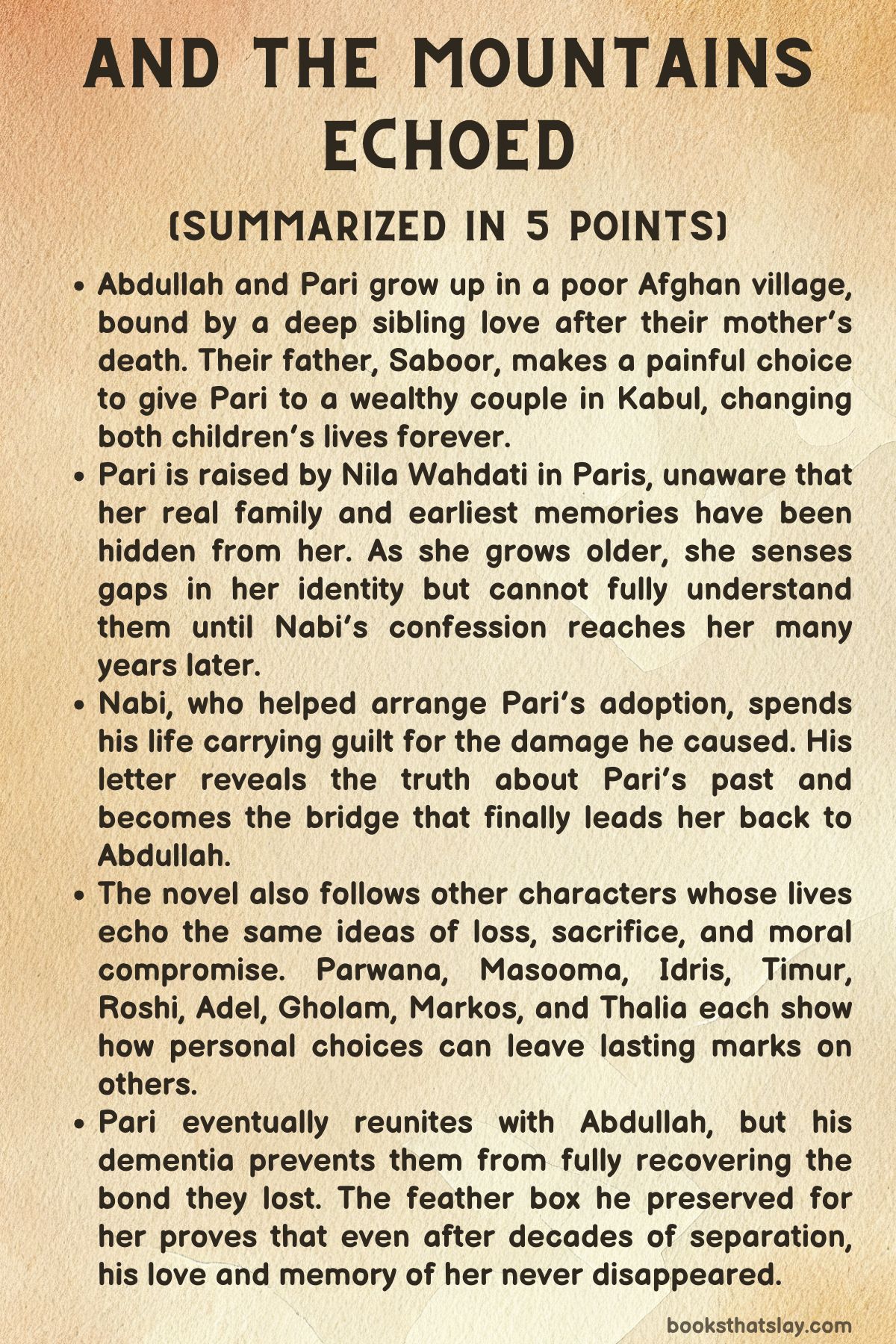
And the Mountains Echoed begins with Saboor, a poor Afghan father, telling his children Abdullah and Pari a story about Baba Ayub, a farmer forced to give up his beloved son to a monster. Baba Ayub later discovers that the child is alive and happy in a beautiful place, far better than the harsh life he could have given him.
He must choose between taking the boy back or letting him remain there. He leaves him behind, and his memory is erased, though a trace of sorrow remains.
This story prepares the reader for the real wound at the center of the novel: the separation of Abdullah and Pari.
Abdullah and Pari live in Shadbagh with their father Saboor and stepmother Parwana. Their mother died giving birth to Pari, and Abdullah has become more like a parent than a brother to the little girl.
He cares for her, comforts her, and gives her small treasures, including feathers she loves to collect. When Saboor takes Pari to Kabul, Abdullah insists on coming too, though he senses something is wrong.
In Kabul they visit the wealthy Wahdati household, where Uncle Nabi works. Abdullah realizes too late that Pari is being given to Nila and Suleiman Wahdati, a rich but unhappy couple who cannot have children.
Pari is taken from him, and Abdullah’s life loses its center. Back in Shadbagh, no one speaks openly of the loss.
Saboor cuts down the old oak tree, and Abdullah keeps Pari’s feather box, hoping one day to return it.
The novel then turns to Parwana, Saboor’s wife, and reveals the pain behind her own life. Before marrying Saboor, she cared for her paralyzed twin sister Masooma.
As girls, Parwana had envied Masooma’s beauty and the affection she received, especially from Saboor. During an incident in the old oak tree, Masooma fell and became paralyzed, and Parwana’s role in that fall remains morally unclear.
Years later, Masooma asks Parwana to take her toward Kabul but then urges her to abandon her in the desert, knowing that Parwana wants a life free of constant care. Parwana leaves her sister behind, carrying both guilt and the chance to marry Saboor.
Nabi, Parwana’s brother, later confesses his part in Pari’s removal through a letter to Markos, a doctor who comes to live in the Wahdati house. Nabi explains that he had once been fascinated by Nila Wahdati, a beautiful, restless, unconventional woman trapped in a cold marriage.
When Nila visited Shadbagh, she was drawn to Pari. Nabi, believing the adoption might help everyone, suggested that Pari be given to the Wahdatis.
Saboor needed money, Nila wanted a child, and Nabi hoped to gain Nila’s affection. Instead, the decision destroyed Abdullah and Pari’s bond and left Nabi with lifelong guilt.
After Pari joins the Wahdati household, Nila’s attention shifts entirely to the child. Suleiman later suffers a stroke, and Nila leaves for Paris with Pari, abandoning both her husband and Nabi.
Nabi remains behind to care for Suleiman for decades. While cleaning, he discovers that Suleiman had filled sketchbooks with drawings of him, revealing a love Nabi had not understood.
Nabi stays, first from duty and later from habit and attachment. During years of war, the Wahdati house decays along with Kabul.
When Suleiman becomes gravely ill, Nabi fulfills an old promise and ends his suffering. After Suleiman’s death, Nabi leaves his estate to Pari and asks Markos to find her.
The story also follows Idris and Timur, Afghan-American cousins who return to Kabul after years abroad. They claim they want to reconnect with their homeland, though their main concern is recovering family property.
While there, Idris meets Roshi, a young girl horribly injured after her uncle murdered much of her family over land. Idris feels deeply moved and promises to help arrange medical care for her in America.
At first, he visits her often and imagines changing her life. But once he returns to the United States, work, comfort, and routine pull him away.
He stops answering messages. Years later, he sees that Roshi has survived and written a book, helped by Amra and Timur.
Roshi recognizes his failure without anger, making clear that he was not part of her story.
In Paris, Pari grows up believing Nila is her biological mother. Their relationship is strained.
Nila is brilliant, unstable, lonely, and often cruel. Pari senses gaps in her own past but cannot explain them.
She studies mathematics, falls in love, marries Eric, and becomes a mother. For a time, family life quiets her need to search for origins.
After Eric dies and her children are grown, she receives Markos’s call. He reads Nabi’s letter, and the truth returns in fragments: a red wagon, a dog, a tree, a brother she cannot fully remember.
Pari realizes that her life began with a lie, and she resolves to go to Kabul.
Another thread follows Adel, the son of a powerful Afghan commander who presents himself as a builder and benefactor. Adel admires his father and believes in his goodness.
He befriends Gholam, a poor boy whose family once lived on the land now occupied by Adel’s father’s compound. Through Gholam, Adel learns that his father stole land, used violence, and hid behind public generosity.
When Gholam’s father protests, Adel sees enough to understand that his family’s comfort rests on injustice. He cannot escape this truth, but he also cannot escape his life.
Markos’s own past explains how he became the kind of person who could help Nabi and Pari. As a boy in Greece, he met Thalia, a girl whose face had been scarred by a dog attack.
At first he reacted with fear and disgust, but over time they became close. His mother, Odelia, treated Thalia with strength and dignity, refusing to let her hide behind a mask.
Markos later became a plastic surgeon and traveled widely, using his skills to help children affected by injury and poverty. His work eventually brought him to Kabul, where he met Nabi and became the keeper of his final confession.
The novel ends with the reunion of Pari and Abdullah, though it comes too late for the full restoration both deserved. Abdullah has built a life in America, married, had a daughter also named Pari, and carried the memory of his lost sister for decades.
But by the time Pari Wahdati finds him, he has dementia. He cannot truly understand who she is.
For a brief moment, when she sings a childhood song, something seems to stir in him, but it fades. Abdullah’s daughter, who has spent much of her life caring for him, forms a bond with her aunt and later visits her in France.
She brings a package Abdullah had prepared before his mind declined: Pari’s old feather collection, preserved all those years. Pari finally understands that Abdullah never forgot her.
Their reunion cannot undo the past, but it proves that love endured beneath silence, distance, and time.
Characters
Abdullah
Abdullah is the emotional center of And the Mountains Echoed, because his love for Pari gives the novel its deepest wound and its longest-lasting memory. As a child, he is forced into a role much larger than his age.
He becomes Pari’s protector, caretaker, and almost a parent after their mother dies. His love is shown through small acts rather than dramatic speeches: he comforts her, watches over her, carries her, and even trades his shoes for a feather because he knows how much she loves collecting them.
When Pari is taken from him, Abdullah loses more than a sister; he loses the person who gave meaning to his childhood. His silence afterward is not emotional weakness but the result of a grief too large for language.
Later in life, he carries that grief into adulthood, naming his daughter Pari and preserving his sister’s feather box. His dementia near the end is especially tragic because he finally comes close to reunion, but his mind can no longer hold the truth.
Still, the feather box proves that some part of him never released his sister.
Pari Wahdati
Pari’s life is shaped by absence, even before she understands what has been taken from her. As a little girl, she is loved completely by Abdullah, but once she is adopted by the Wahdatis and taken to Paris, her past becomes a set of broken images rather than a clear story.
She grows up with Nila, believing her to be her mother, yet she always senses that something in her identity does not fit. Pari is intelligent, observant, and drawn to mathematics, perhaps because numbers offer a kind of order that her personal history does not.
Her relationship with Nila leaves her emotionally uncertain, as she is made to feel responsible for her mother’s emptiness. Marriage and motherhood give her stability, but they do not erase the missing part of herself.
When she learns the truth from Nabi’s letter, her memories begin to return as sensations and fragments. Her reunion with Abdullah is painful because it gives her the truth but not the relationship she has spent a lifetime unknowingly missing.
Saboor
Saboor is a deeply tragic father because his cruelty is not born from lack of love but from poverty, fear, and helplessness. He makes the terrible decision to give Pari to the Wahdatis because he believes it may save the rest of his family from hunger and suffering.
His earlier story about Baba Ayub reveals his own attempt to understand and justify what he is about to do. He sees sacrifice as something brutal but necessary, a way to cut away one part of the family so the rest can survive.
Yet the aftermath shows that he is not at peace with his decision. His violent cutting down of the old oak tree reveals grief, shame, and anger that he cannot express directly.
Saboor is emotionally closed off, but his storytelling shows that beneath his hardness he has imagination, sorrow, and tenderness. He is not presented as a villain, but as a man crushed by conditions that make love and survival stand against each other.
Parwana
Parwana is one of the novel’s most morally complicated characters. Her life is marked by envy, guilt, duty, and the hunger to be chosen.
As a young woman, she lives in the shadow of Masooma, her beautiful twin sister, who receives admiration and attention without effort. Parwana’s love for Saboor sharpens this jealousy, especially when she believes Masooma may have won his affection.
The accident that paralyzes Masooma leaves Parwana trapped in years of caretaking, and the uncertainty around her role in the fall makes her guilt even heavier. When Masooma asks to be left behind, Parwana’s choice is both an abandonment and a release.
She wants freedom, but that freedom is stained by betrayal. As Saboor’s wife, she is not shown as warmly maternal toward Abdullah and Pari, yet she is not without feeling.
Her statement that Pari had to be sacrificed shows that she understands the family’s decision through the same harsh logic of survival that governs much of the novel.
Masooma
Masooma represents beauty, lost possibility, and the burden of dependency. Before her paralysis, she appears to possess everything Parwana lacks: charm, admiration, confidence, and the promise of a desirable future.
After her accident, her life becomes physically limited, and she depends on the sister who envies and resents her. Yet Masooma is not simply a victim.
She understands Parwana’s exhaustion and also understands that her own existence has become a prison for them both. Her request to be abandoned is disturbing because it combines self-sacrifice with despair.
She gives Parwana permission to pursue the life she wants, but the act also forces Parwana to live with a permanent moral scar. Masooma’s role is brief but powerful because she shows how love between siblings can be damaged by comparison, resentment, and unequal suffering.
Her fate also mirrors the larger pattern of the novel, where one person’s survival often depends on another person’s loss.
Nabi
Nabi is a man whose life is defined by longing, guilt, and delayed confession. His desire for Nila leads him to make the suggestion that changes Pari and Abdullah’s lives forever.
At the time, he convinces himself that giving Pari to the Wahdatis will help everyone: Nila will have a child, Saboor will receive money, and Pari will grow up with comfort. Beneath those reasons, however, lies Nabi’s hope that Nila will finally see him as important.
When this hope fails, he is left with the consequences of what he helped cause. His later devotion to Suleiman becomes a form of penance, though it also grows into companionship and habit.
Nabi’s letter is his final attempt to tell the truth and return something to Pari. He cannot undo the damage, but he can name it honestly.
In And the Mountains Echoed, Nabi stands as an example of how people often understand their worst choices only after the lives around them have already been changed.
Nila Wahdati
Nila is restless, wounded, brilliant, and destructive. She resists the expectations placed on Afghan women, but her rebellion does not bring her peace.
She wants freedom, attention, artistic recognition, and emotional fulfillment, yet she often wounds the people closest to her while trying to escape her own pain. Her infertility leaves her feeling hollow, and Pari becomes both a child she desires and a reminder of what she cannot naturally have.
As a mother, Nila is unstable and often cruel, especially because she asks Pari to fill emotional emptiness that no child could repair. Her poetry and public image suggest confidence, but privately she is lonely, bitter, and unable to sustain love without turning it into need.
Her move to Paris gives Pari a different life, but it also cuts her off from her origins. Nila is not easy to forgive, but she is not simple either.
Her sadness comes from trauma, repression, and a lifelong inability to feel whole.
Suleiman Wahdati
Suleiman Wahdati is quiet, isolated, and emotionally hidden. His marriage to Nila is empty, partly because they are mismatched and partly because his true desire is directed toward Nabi.
His love for Nabi is expressed silently through drawings, making his sketchbooks one of the most revealing details of his character. Suleiman’s stroke changes the balance of his life completely, leaving him dependent on the man he loves but cannot fully have.
His confession to Nabi late in life is sad because it comes after years of silence, shame, and restraint. Suleiman is privileged in wealth but poor in emotional freedom.
He has a grand house, servants, and status, yet his inner life is marked by loneliness. His relationship with Nabi becomes one of the novel’s quieter studies of devotion, dependency, and unspoken love.
He is also important because his will allows Nabi to leave something behind for Pari, turning his estate into part of the effort to repair the past.
Idris
Idris is a study in temporary compassion and moral failure. When he returns to Afghanistan, he wants to believe he is more thoughtful and sincere than Timur.
His encounter with Roshi awakens genuine pity, and for a while he imagines himself as someone who will change her life. He visits her, buys her gifts, and promises help.
Yet once he returns to the United States, his sense of responsibility weakens. Comfort, work, family, and distance make Roshi feel less real to him.
His failure is not loud or openly cruel; it is ordinary, which makes it more unsettling. He does not decide to betray Roshi in one dramatic moment.
Instead, he simply stops answering, stops acting, and allows his earlier emotion to fade. Idris exposes the gap between feeling moved by suffering and actually making sacrifices to address it.
His later meeting with Roshi shows that she has survived without him, and his silence becomes his judgment.
Timur
Timur appears boastful, loud, self-important, and often insensitive, yet the novel complicates him by showing that he acts where Idris does not. He embarrasses Idris with his performative concern and exaggerated manner, but he is also practical and generous in ways that matter.
He supports Idris financially in the past and later helps Roshi, becoming one of the people acknowledged in her recovery. Timur’s character challenges the reader’s assumptions about sincerity.
He may not speak with refinement, and his motives may not always seem pure, but he follows through. Idris, by contrast, possesses greater self-awareness and sensitivity but fails to act.
Timur therefore becomes an uncomfortable contrast between appearance and action. He suggests that moral worth is not always found in the person who says the right thing or feels the right emotion, but in the person who does something useful when help is needed.
Roshi
Roshi is a survivor of extreme violence, and her presence exposes both the brutality of Afghanistan’s conflicts and the limits of outsider sympathy. As a child, she suffers an attack that destroys her family and leaves her badly injured.
Yet she is never reduced only to her suffering. Her later success as an author shows strength, memory, and the ability to claim her own story.
Her relationship with Idris is especially important because it reveals how easily wounded people can become symbols for those who want to feel compassionate. Idris briefly turns Roshi into proof of his own goodness, but she outgrows his failed promise.
When she writes that he is not in her story, she strips him of the heroic role he once imagined for himself. Roshi’s character insists that survival belongs first to the survivor, not to those who briefly witness pain and then return to comfortable lives.
Adel
Adel begins as a sheltered child who believes in his father’s public image. He sees Baba-jan as a protector, builder, and generous leader.
Because Adel lives behind walls, both literal and emotional, he does not understand the violence and theft that support his family’s privilege. His friendship with Gholam opens his eyes to a reality he has been protected from.
Through Gholam, he learns that his father’s land and power came at the expense of families like Gholam’s. Adel’s awakening is painful because it does not give him a clear way out.
He cannot easily reject his father, his mother, or the life he has been given. His final understanding is not heroic rebellion but a darker acceptance that he will learn to live with the truth.
Adel represents the children of powerful people who inherit comfort built on injustice and must decide what to do with knowledge they did not ask for.
Gholam
Gholam is blunt, angry, proud, and wounded by dispossession. He has grown up in hardship, including refugee life in Pakistan, and he returns to Afghanistan only to find that his family’s land has been taken.
His friendship with Adel is tense because it crosses a sharp divide of class and power. Gholam enjoys playing with Adel, but he also refuses to let Adel remain innocent about the truth.
He tells him what Baba-jan has done, forcing Adel to see the violence hidden beneath his father’s polished reputation. Gholam’s anger is not childish rudeness; it is the voice of someone whose family has been erased from the land they once owned.
He serves as a moral witness, bringing buried injustice into the open. His character also shows how children inherit the consequences of adult greed, war, corruption, and displacement.
Markos
Markos is shaped by shame, growth, and service. As a boy, he reacts cruelly and fearfully to Thalia’s scarred face, but his relationship with her changes him.
Through Thalia and his mother Odelia, he learns that dignity requires courage, not pity. His later decision to become a plastic surgeon is tied to this early experience, though he also understands the limits of repair.
Surgery can alter a face, but it cannot erase abandonment, loneliness, or social cruelty. Markos’s work in Afghanistan places him at the edge of many other people’s stories.
He becomes the person Nabi trusts with his confession and the one who helps Pari recover her lost history. His role is less about dominating the narrative and more about carrying truth from one person to another.
Markos shows that witnessing pain can become meaningful when it leads to responsibility and action.
Thalia
Thalia is marked by visible injury, but her character is defined more by intelligence, honesty, and endurance than by her scar. At first she hides behind a mask because the world has taught her to expect disgust.
Markos’s first reaction confirms that fear. Yet Thalia does not become passive.
She is sharp, direct, and capable of forming a real bond with him. Her friendship with Markos helps shape his future, and her courage grows under Odelia’s protection.
When Odelia takes her to school without the mask, Thalia’s life changes because someone finally refuses to treat her face as a shameful secret. Later, Thalia becomes the caretaker of Odelia, reversing the pattern of care she once received.
Her character reflects the damage caused by abandonment, especially by her mother, but also the strength that can grow from being truly accepted by one person.
Odelia
Odelia is one of the novel’s strongest examples of practical love. She is not sentimental in the shallow sense; her care is firm, active, and brave.
She rescues Madaline from abuse in the past, takes in Thalia when Madaline abandons her, and teaches Markos that compassion must be expressed through action. Her treatment of Thalia is especially important because she refuses to hide the girl away.
Instead, she faces the cruelty of the community directly and demands that Thalia be treated with respect. Odelia’s love is disciplined and sometimes difficult, which may explain why Markos spends years longing for clearer praise from her.
When she finally tells him she is proud of him, the moment carries the ache of lost time. Odelia represents a form of motherhood based not on softness alone but on courage, duty, and moral clarity.
Pari, Abdullah’s Daughter
Abdullah’s daughter Pari inherits the emotional weight of a story that began before she was born. Named after her lost aunt, she grows up feeling connected to someone she has never met.
Her life is shaped by care: first for her mother, then for her father as dementia takes him away. She is often described by others as self-sacrificing, but her own thoughts are more honest and complicated.
She loves her father, yet she also feels trapped by his needs and by the life she gave up. Her abandoned dream of art school shows how family duty can quietly consume personal ambition.
When she meets Pari Wahdati, she becomes a bridge between the separated siblings. By delivering Abdullah’s feather box, she gives her aunt the proof of remembrance that Abdullah can no longer explain.
Her character shows that the effects of one family wound can pass into the next generation.
Themes
Family Separation and the Long Life of Loss
Separation in And the Mountains Echoed is not treated as a single event that ends when people move away from each other. It becomes a force that shapes identity, memory, love, and even the next generation.
Abdullah and Pari’s separation is the clearest example, but the novel shows many versions of the same wound. Parwana is separated from Masooma through abandonment.
Nila separates Pari from Afghanistan and from the truth of her birth. Adel is separated from innocence once he learns what his father has done.
Markos is separated emotionally from his mother for much of his life, even though they remain connected. Loss here is not always death; often it is the absence of a person who is still alive somewhere in the world.
This makes the pain more complicated because hope remains possible, but fulfillment may arrive too late. Abdullah and Pari do find each other, yet dementia prevents the reunion from becoming whole.
The novel suggests that love can survive distance, but survival is not the same as restoration. The feather box becomes powerful because it shows that memory can endure even when life has denied people the chance to live that love openly.
Sacrifice, Survival, and Moral Compromise
The novel repeatedly places characters in situations where survival demands a moral cost. Saboor gives up Pari because poverty has made ordinary fatherhood impossible.
Nabi helps arrange the adoption because he believes it may create a better future, though his private desire for Nila corrupts that reasoning. Parwana leaves Masooma in the desert because caring for her sister has consumed her life.
These choices are painful because they are neither fully defensible nor fully unforgivable. The novel does not offer easy moral categories.
It asks what people become when love exists inside hunger, social pressure, fear, and limited choices. Sacrifice is often described by the characters as necessary, but necessity does not erase guilt.
Saboor may believe he has saved his family, yet he is emotionally broken by the act. Nabi may claim good intentions, yet he spends the rest of his life trying to confess.
Parwana may gain freedom, yet that freedom begins with abandonment. The novel’s view of sacrifice is therefore deeply uneasy.
It recognizes that people may do terrible things for reasons that are human, even understandable, but it also insists that the consequences continue long after the decision has been made.
Memory, Identity, and the Need for Truth
Memory in the novel is fragile, incomplete, and often hidden by those who believe silence will protect others. Pari grows up with missing pieces in her mind: images, feelings, and sensations that do not form a clear past.
Her identity is unstable because the story of her life has been edited by adults. Nila gives her a false version of motherhood, while Nabi keeps the truth hidden until the end of his life.
Abdullah, by contrast, remembers Pari with painful clarity for decades, only to lose access to that memory through dementia just as she returns. This reversal gives the theme its greatest sadness.
The person who remembered everything can no longer explain it, while the person who forgot finally learns the truth. The novel shows that identity is not only made from personal experience but also from the stories families tell or refuse to tell.
When truth is withheld, people may still sense the absence. Pari’s later life in France is stable in many ways, but she carries a quiet incompleteness until Nabi’s letter gives shape to it.
Truth does not repair everything, but it gives her a name for the emptiness she has carried.
Wealth, Power, and Unequal Lives
The contrast between wealth and poverty drives many of the novel’s most painful events. Pari is taken from Abdullah because the Wahdatis have money and Saboor does not.
The rich can offer comfort, education, and safety, but they also have the power to absorb other people’s lives into their own desires. The Wahdati house, with its beauty and gardens, represents possibility to some characters and moral danger to others.
Later, Baba-jan’s compound shows an even harsher version of power. His public generosity hides violence, stolen land, and corruption.
Adel’s life of comfort is built on Gholam’s family’s displacement, making wealth inseparable from injustice. The novel also examines privilege through Idris, who can return to America and let Afghanistan become distant again.
Roshi cannot do that. Her suffering remains her daily reality, while Idris has the luxury of forgetting.
Across these stories, money does not simply create comfort; it creates the ability to decide whose pain matters and whose can be ignored. The novel is especially sharp in showing that charity and kindness can exist beside exploitation.
A powerful person may build schools or offer help, yet still benefit from systems that crush weaker people.