1493 by Charles C. Mann Summary and Analysis
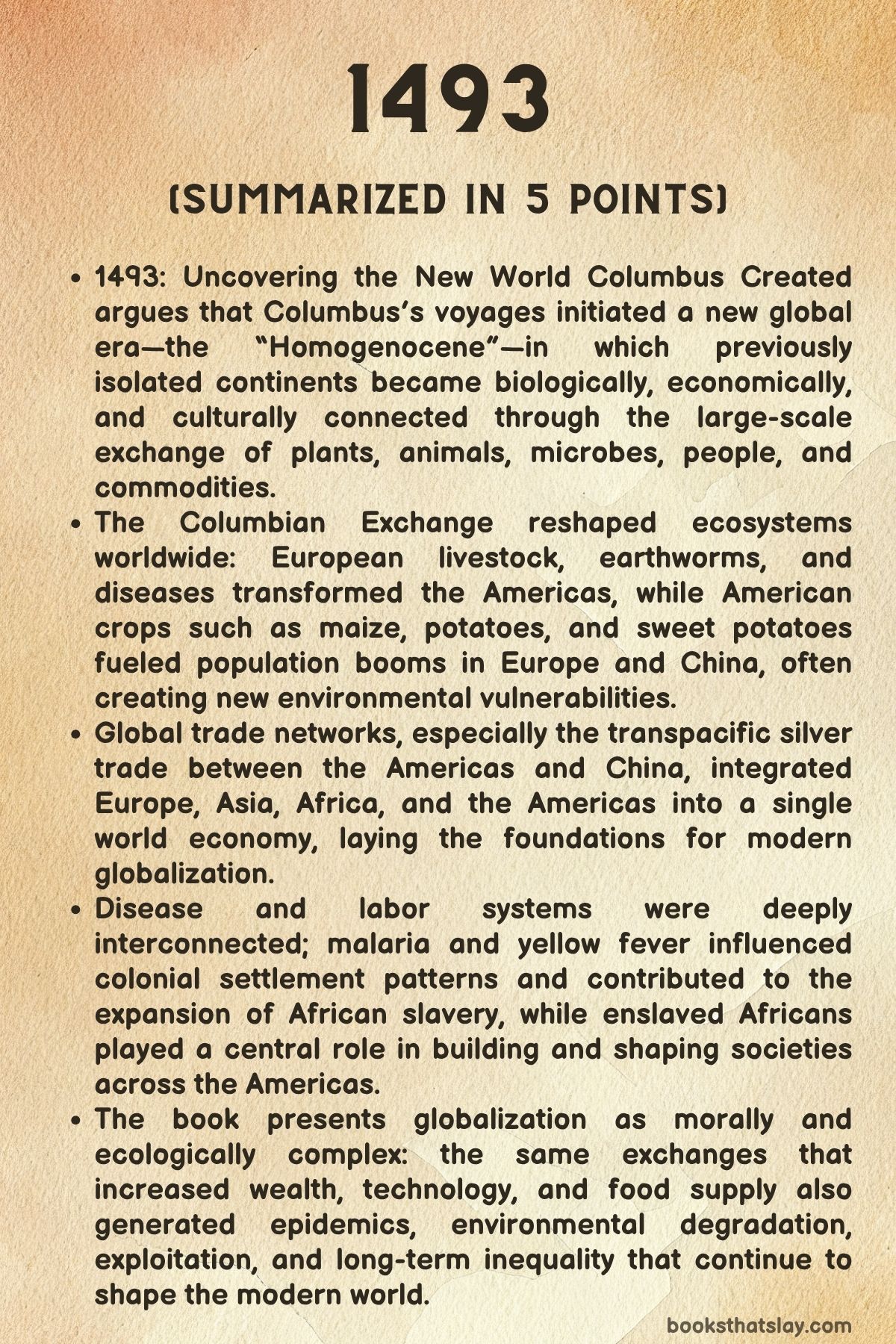
1493: Uncovering the New World Columbus Created by Charles C. Mann is a work of global history that examines the far-reaching consequences of Columbus’s voyages after 1492. Rather than retelling the story of discovery, Mann investigates what happened next: the vast exchange of plants, animals, microbes, people, and ideas that reshaped ecosystems, economies, and societies across continents.
He argues that these exchanges inaugurated a new era he calls the “Homogenocene,” in which once-separate worlds merged into a single, interconnected system. Through stories of trade, disease, agriculture, migration, and resistance, Mann shows how the modern globalized world emerged from these early encounters.
Summary
Charles C. Mann begins by proposing that the year 1492 marked the start of a new ecological and historical epoch. Before Columbus, the Americas, Europe, Africa, and Asia had evolved largely in isolation from one another.
After sustained contact began, species, commodities, and human populations moved across oceans in unprecedented ways. The result was a planetary mixing that steadily reduced biological and cultural differences between regions.
Mann calls this new age the Homogenocene, an era defined by the blending of ecosystems and societies.
He introduces this idea through two monuments. One is the Faro a Colón, a massive lighthouse built in the Dominican Republic to honor Columbus.
The other commemorates Miguel López de Legazpi and Andrés de Urdaneta, who established Spanish trade routes across the Pacific. These monuments represent two arcs of exchange: the Atlantic system that tied Europe, Africa, and the Americas together, and the Pacific system that connected the Americas to Asia.
Mann asks readers to consider how different the world might look had these voyages never occurred. He argues that their consequences went far beyond conquest; they reorganized the structure of life on Earth.
In North America, European settlement transformed both land and society. English colonists arrived in a region already shaped by complex Indigenous polities such as Tsenacomoco, led by Powhatan.
Contrary to the myth of untouched wilderness, the land was managed through farming, burning, and settlement. Early English survival depended on Indigenous knowledge and food supplies.
Yet relations deteriorated as colonists demanded more land and resources.
The introduction of tobacco changed everything. John Rolfe discovered that Caribbean tobacco thrived in Virginia’s climate.
European demand for the crop fueled expansion and reshaped the landscape. Forests were cleared for monoculture plantations.
Colonists imported earthworms, livestock, and honeybees, each of which altered soils and plant communities. Pigs destroyed Indigenous crops.
European farming methods replaced polycultural systems with large fields of single crops, increasing vulnerability to pests and soil depletion.
Disease proved even more transformative. Malaria and yellow fever traveled with Europeans and enslaved Africans, spreading through mosquito populations that flourished in plantation environments.
Indigenous populations, lacking immunity, suffered catastrophic mortality. European indentured servants also died in large numbers in malarial regions.
West and Central Africans, many of whom carried partial immunity to malaria, were more likely to survive. Although immunity alone did not cause the rise of racial slavery, it contributed to colonists’ preference for enslaved African labor.
Over time, plantation economies shifted decisively toward chattel slavery, binding the agricultural system of the Americas to the forced migration of millions.
Mann then turns to the Pacific world. Long before Columbus, Chinese fleets under Zheng He had demonstrated maritime power across the Indian Ocean.
Yet China withdrew from sustained overseas exploration. By the sixteenth century, however, global trade reconnected China to distant regions through a different mechanism: silver.
The Ming dynasty’s tax reforms required payments in silver, creating enormous demand. Spanish colonists extracted vast quantities of silver from mines in Potosí and Huancavelica in South America.
This bullion crossed the Pacific aboard Manila galleons, linking American mines to Chinese markets.
The silver trade made cities wealthy and destabilized empires. China’s appetite for silver drew European powers into Pacific commerce.
In Manila, Spanish authorities governed a colony dependent on Chinese merchants. Tensions flared as Spanish officials attempted to restrict Chinese communities, leading to violence and reprisals.
Meanwhile, the flood of silver contributed to inflation and political upheaval in Europe. Global commerce was no longer regional; it had become planetary.
Alongside silver traveled American crops. Maize and sweet potatoes reached China and thrived in marginal soils where traditional grains struggled.
These hardy crops supported rapid population growth during the Qing dynasty. Farmers expanded into upland regions, clearing forests to plant tobacco and maize.
As yields rose, so did population pressures. Thinkers such as Hong Liangji warned that continual agricultural expansion would eventually strain ecological limits.
Although increased productivity postponed crisis, environmental degradation and flooding revealed the costs of relentless growth.
In Europe, American crops also reshaped society. The potato, domesticated in the Andes, became a staple across northern Europe.
It matured quickly and yielded abundant calories in poor soils, helping populations grow during the cooler climate of the Little Ice Age. In Ireland, reliance on a few potato varieties enabled dramatic demographic expansion.
Yet monoculture carried risk. When potato blight arrived from the Americas in the 1840s, it devastated crops and triggered famine, emigration, and lasting social trauma.
European agriculture increasingly relied on external inputs. Guano from Peru’s Chincha Islands enriched depleted soils, launching a global fertilizer trade.
The extraction of guano involved brutal labor practices, including coercion of Chinese workers. Chemical fertilizers and insecticides later replaced natural inputs, embedding agriculture in industrial systems.
Each innovation boosted yields while introducing new ecological dependencies. Pests such as the Colorado potato beetle spread along trade routes, and farmers responded with escalating chemical controls, creating cycles of resistance and replacement.
Rubber offers another example of transformation. Indigenous Amazonians had long used latex from rubber trees.
In the nineteenth century, industrial demand for rubber surged. Extractive practices in the Amazon were harsh and destructive.
When British agents smuggled rubber seeds to Asia, plantations flourished in Southeast Asia and southern China. These monoculture forests displaced biodiverse ecosystems.
Rubber enabled modern transportation and manufacturing, yet its cultivation exemplified the environmental simplification characteristic of the Homogenocene.
Africa’s role in this new world was central. Between 1500 and 1840, millions of Africans were transported to the Americas through the Atlantic slave trade.
Enslaved Africans built plantations, cities, and infrastructure, profoundly shaping American societies. Individuals such as João Garrido participated in exploration and settlement, illustrating the complexity of African experiences beyond victimhood.
Africans introduced agricultural knowledge, crops, and cultural practices that became foundational in the Americas.
Mann also examines maroon communities formed by escaped enslaved people. In Brazil, quilombos such as Palmares united Africans, Indigenous people, and marginalized Europeans into autonomous settlements that resisted colonial authority.
Leaders like Aqualtune and Bayano organized resilient societies capable of military defense and political negotiation. These communities challenge narratives that depict enslaved Africans solely as passive subjects.
Even within oppressive systems, they exercised agency, formed alliances, and carved out spaces of freedom.
Throughout these histories, ideas about race and slavery evolved. Early modern societies did not conceptualize race as it is understood today.
Over time, economic interests and colonial hierarchies hardened into racial ideologies that justified permanent enslavement and discrimination. The merging of continents reshaped not only ecologies but also social categories and power structures.
In the closing chapter, Mann reflects on the Philippines, where Pacific trade once linked Spanish America and China. Crops listed in nostalgic songs—plants thought of as traditional—originated in distant lands.
Even cherished landscapes are products of exchange. The rice terraces of the Philippines face ecological threats partly caused by introduced species.
Modern efforts to preserve traditional agriculture are entangled in global markets. Mann recognizes that he, too, participates in the ongoing exchange through the plants he cultivates and the goods he consumes.
The book ends by emphasizing ambiguity. The Columbian Exchange generated immense suffering: epidemics, slavery, environmental destruction.
It also enabled population growth, technological innovation, and cultural creativity. The Homogenocene continues today as global trade, migration, and ecological transformation accelerate.
Mann invites readers to see the modern world not as inevitable, but as the cumulative result of historical encounters that fused once-separate worlds into a single, interdependent system.
Key People
Christopher Columbus (Cristóbal Colón)
In 1493, Christopher Columbus stands less as a traditional protagonist and more as a catalytic force whose actions reverberate across centuries. Mann presents him as a complex, contradictory figure driven by intense religious conviction, ambition, and a belief that he was chosen for a divine mission.
Columbus was persistent to the point of obsession, lobbying the Spanish monarchy for years before securing support for his westward voyage. His geographical calculations were flawed, and his understanding of the world was shaped by misinformation and theological interpretation rather than empirical science.
Yet his misjudgment led to sustained contact between previously isolated continents. Mann does not portray him simply as hero or villain; instead, he is depicted as an agent of transformation whose voyages triggered ecological collapse in the Caribbean, particularly among the Taíno, while simultaneously inaugurating a new era of global integration.
Columbus represents the beginning of the Homogenocene, embodying both destructive conquest and world-altering connectivity.
Miguel López de Legazpi
Miguel López de Legazpi symbolizes the extension of the Columbian Exchange into the Pacific world. Commissioned by the Spanish Crown to secure profitable trade routes, he helped establish Spanish presence in the Philippines and laid the groundwork for transpacific commerce.
Unlike Columbus, Legazpi operated in a world already aware of American wealth and Asian markets. His significance lies in institutionalizing global trade rather than discovering new territory.
Through Manila, he connected American silver to Chinese demand, effectively binding three continents into one economic circuit. Legazpi’s legacy is less about personal drama and more about structural transformation.
He represents the bureaucratic and commercial expansion of empire, where profit, trade, and geopolitical rivalry mattered as much as exploration. His role underscores how quickly European ventures evolved from tentative expeditions into organized systems of extraction and exchange.
Andrés de Urdaneta
Andrés de Urdaneta complements Legazpi as the navigator who solved the challenge of returning across the Pacific. His discovery of the eastward route enabled the Manila galleon trade to function reliably.
Urdaneta embodies scientific pragmatism and maritime expertise, contrasting with Columbus’s speculative geography. By charting dependable ocean currents, he made regular communication between the Americas and Asia possible.
His contribution illustrates that global transformation depended not only on bold voyages but also on technical mastery. Without navigational solutions, the silver-for-silk trade could not have become routine.
Urdaneta therefore represents the infrastructural intelligence behind empire, the quiet precision that turns ambition into durable systems.
Powhatan
Powhatan emerges as a central Indigenous leader whose authority and diplomacy shaped early English survival in Virginia. Far from presiding over untouched wilderness, he governed Tsenacomoco, a politically organized and agriculturally sophisticated society.
Powhatan’s interactions with English settlers reveal strategic calculation; he provided food when cooperation suited his interests and withdrew support when colonists became aggressive. His leadership demonstrates Indigenous agency at a moment often simplified into colonial myth.
Powhatan recognized both the potential benefits and dangers of English arrival. As tobacco expansion intensified land pressure, conflict became unavoidable.
He represents the Indigenous polities that initially accommodated Europeans but were eventually displaced by settler expansion and ecological transformation.
John Smith
John Smith appears as a self-promoting yet perceptive figure among the Jamestown colonists. Although many stories associated with him are exaggerated, he understood that English survival depended on maintaining workable relations with Powhatan’s people.
Smith’s pragmatism contrasted with other colonists’ expectations of immediate profit. He negotiated for food and imposed discipline within the struggling colony.
His departure weakened fragile alliances and contributed to escalating conflict. Smith symbolizes the precariousness of early colonization and the dependence of Europeans on Indigenous networks during initial settlement phases.
He also reflects how mythmaking later shaped national narratives about American origins.
John Rolfe
John Rolfe represents economic transformation through agriculture. By cultivating Caribbean tobacco in Virginia, he created a commodity that reshaped land use, labor systems, and transatlantic trade.
Rolfe’s experiments generated immense profit and entrenched plantation monoculture. His marriage to Pocahontas is often romanticized, yet Mann situates Rolfe within broader structural change rather than personal legend.
The success of tobacco intensified demand for land and labor, accelerating displacement of Indigenous communities and encouraging reliance on enslaved Africans. Rolfe’s legacy lies not in diplomacy but in commodification, as tobacco became the engine driving colonial persistence despite disease and mortality.
Opechancanough
Opechancanough, Powhatan’s brother, stands as a determined military leader who resisted English encroachment. After relations deteriorated, he organized coordinated attacks against colonists, demonstrating strategic resistance rather than passive acceptance.
His campaigns temporarily weakened English settlements and revealed the vulnerability of colonial enterprises. Opechancanough embodies Indigenous resilience and refusal to concede territory without struggle.
Although English expansion ultimately prevailed, his leadership highlights that colonization was contested and uncertain, not a foregone conclusion.
Zheng He
Zheng He represents an alternative trajectory of global power. As commander of vast Ming treasure fleets, he projected Chinese influence across the Indian Ocean decades before sustained European expansion.
His voyages displayed technological sophistication and maritime ambition. Yet China’s subsequent retreat from overseas exploration left space for European empires to dominate transoceanic trade.
Zheng He’s presence in the narrative underscores contingency in history. Global integration was not predetermined; different policy choices might have produced a world centered on Asian rather than European maritime networks.
Zhu Wan
Zhu Wan appears as a Ming official tasked with suppressing illicit maritime trade. His efforts to curb smuggling and foreign influence reveal internal tensions within China over engagement with global commerce.
Zhu’s campaigns disrupted coastal economies dependent on overseas exchange, illustrating that globalization often provokes domestic conflict. He represents state attempts to control flows of goods and people that increasingly exceeded bureaucratic limits.
His actions highlight the difficulty of containing economic forces once intercontinental trade became profitable and entrenched.
Hong Liangji
Hong Liangji serves as an early theorist of population pressure. Observing rapid demographic growth fueled by American crops, he warned that increasing food production would eventually generate unsustainable population expansion.
His insight anticipated later arguments associated with Malthus. Hong embodies intellectual response to ecological change, recognizing that agricultural success carried hidden risks.
Though overshadowed historically, his ideas reveal that concerns about environmental limits emerged alongside early globalization. He represents reflective awareness within societies undergoing transformation.
Thomas Malthus
Thomas Malthus appears as a comparative figure whose theory of population growth gained broader recognition than Hong’s earlier warnings. Malthus argued that population tends to outstrip food supply, leading to crisis.
In Mann’s account, Malthus symbolizes enduring anxiety about scarcity in an interconnected world. While technological advances have repeatedly expanded food production, ecological degradation continues to test those limits.
Malthus represents the intellectual framing of demographic and environmental tension that began in the wake of Columbian Exchange agriculture.
Charles Goodyear
Charles Goodyear embodies industrial persistence and personal sacrifice. Obsessed with stabilizing rubber against temperature extremes, he endured financial ruin while experimenting with vulcanization.
His breakthroughs made rubber indispensable to modern industry. Goodyear represents innovation emerging from global botanical exchange, as a plant native to the Amazon became central to transportation and manufacturing.
His story illustrates how scientific experimentation transforms raw materials into infrastructure. Yet his success also contributed to exploitative labor systems and ecological simplification in rubber-producing regions.
Henry Alexander Wickham
Henry Alexander Wickham plays a controversial role in transferring rubber seeds from Brazil to British-controlled territories. By exporting thousands of seeds, he enabled plantation cultivation in Asia, breaking Brazil’s monopoly.
Wickham symbolizes biopiracy and imperial opportunism. His actions reshaped global production patterns and devastated Amazonian dominance in rubber.
He reflects how individual decisions can redirect entire industries, reinforcing the book’s theme of interconnected ecological and economic systems.
João Garrido
João Garrido stands as a reminder that Africans were present from the earliest phases of American colonization. Enslaved and later free, Garrido participated in Spanish expeditions and helped establish wheat cultivation in Mexico.
His life challenges simplified narratives of conquest by revealing African involvement beyond plantation labor. Garrido represents mobility, adaptation, and complexity within the African diaspora.
He demonstrates that the Columbian Exchange involved multidirectional movement and contribution, not merely forced migration.
Esteban
Esteban, an African explorer in Spanish expeditions across North America, illustrates survival through negotiation and charisma. Captured and enslaved, he later guided expeditions and built influence among Indigenous groups by presenting himself as a healer.
His trajectory from captive to leader highlights adaptability within oppressive systems. Esteban symbolizes the unpredictable paths carved by individuals amid imperial ventures, showing that marginalized figures could exert considerable influence.
Aqualtune
Aqualtune, a captured Angolan princess who escaped enslavement in Brazil, emerges as a leader within maroon communities. She ruled over a settlement that rivaled colonial towns in size and organization.
Aqualtune represents resistance, political leadership, and the formation of autonomous societies beyond European control. Her story demonstrates that enslaved Africans did not simply endure oppression but actively constructed alternative social orders grounded in solidarity and defense.
Bayano
Bayano, a military leader among maroons in Panama, exemplifies organized resistance against Spanish authority. After escaping enslavement, he built fortified communities capable of negotiating treaties and defending territory.
Although betrayed and suppressed, his followers reestablished settlements, underscoring persistence in pursuit of freedom. Bayano represents the enduring struggle against colonial domination and the capacity of displaced peoples to forge collective power.
Charles C. Mann
Though primarily historian and narrator, Charles C. Mann functions as a reflective presence within the narrative. He connects past and present, acknowledging his own participation in global ecological exchange.
By visiting sites shaped by Columbian transformations and examining everyday commodities, he emphasizes that the Homogenocene is ongoing. Mann represents interpretive consciousness, guiding readers to see globalization not as abstraction but as lived reality embedded in food, landscapes, and cultural habits.
Themes
The Columbian Exchange and the Homogenocene
In 1493, the Columbian Exchange is presented not as a single historical event but as the beginning of a new planetary condition. Mann argues that after 1492, the long-separated ecosystems of the Americas, Europe, Africa, and Asia began to merge into a unified biological and economic system.
Crops such as maize, potatoes, and tobacco moved across oceans, while horses, cattle, earthworms, and pathogens traveled in the opposite direction. Over time, these transfers reduced regional distinctiveness.
Landscapes that once evolved independently began to resemble one another as similar species took root worldwide. Mann describes this condition as the Homogenocene, an era marked by increasing biological sameness.
This theme operates at multiple levels. Ecologically, the movement of species altered soil chemistry, forest composition, and wildlife patterns.
Economically, global demand for commodities such as silver and sugar tied distant regions together. Socially, migration and forced labor reshaped demographic compositions.
The Homogenocene suggests that globalization is not only cultural or economic but evolutionary. It changed how species interact and how humans organize production.
Mann’s argument reframes 1492 as a turning point that initiated a long-term transformation of the planet’s living systems. Rather than focusing solely on conquest or exploration, the book emphasizes how exchange reshaped the structure of everyday life, from diets to disease environments.
The modern globalized world, with its shared crops and interconnected markets, is portrayed as the direct descendant of these early exchanges.
Ecological Transformation and Environmental Consequences
Environmental change occupies a central place in Mann’s analysis. European settlers did not merely occupy American land; they reconstructed it.
The introduction of European livestock disrupted Indigenous agriculture, while imported earthworms altered forest floors in ways that eliminated native undergrowth. Honeybees promoted the spread of European plants, gradually replacing native species.
Plantation monoculture exhausted soils, prompting reliance on fertilizers such as guano and later synthetic chemicals. Each intervention created further dependencies and unintended effects.
The potato illustrates both benefit and vulnerability. Its high caloric yield supported dramatic population growth in Europe, especially in Ireland.
Yet reliance on a narrow genetic base made crops susceptible to blight, leading to catastrophic famine. Similarly, rubber plantations in Asia displaced biodiverse forests with single-species cultivation, increasing susceptibility to disease.
These examples highlight how efficiency and productivity often come at ecological cost.
Mann shows that environmental simplification is a recurring pattern. Diverse systems are replaced with uniform ones optimized for commercial output.
While this boosts short-term gains, it reduces resilience. The spread of pests and pathogens across trade routes demonstrates that ecological boundaries no longer function as barriers.
Human intervention repeatedly solves immediate problems while creating new vulnerabilities. The environmental consequences of the Columbian Exchange continue to unfold, reinforcing the idea that ecological change is cumulative and difficult to reverse.
Disease, Immunity, and the Reshaping of Power
Microbes traveled as effectively as merchants and explorers. Diseases such as malaria and yellow fever reshaped demographic patterns in the Americas.
Indigenous populations suffered massive mortality due to lack of immunity, destabilizing societies and facilitating European expansion. At the same time, European settlers encountered tropical diseases that limited their survival in certain regions.
Immunological differences influenced labor systems. Enslaved Africans, many of whom had partial resistance to malaria, were more likely to survive plantation conditions than European indentured servants.
While slavery was rooted in economic and political decisions, disease environments contributed to the entrenchment of racialized labor systems.
Disease also affected wealth and geopolitical power. Regions heavily burdened by endemic malaria often experienced long-term economic stagnation.
The interaction between pathogens and agricultural practices, such as standing water in tobacco plantations, demonstrates how environmental modification intensified disease transmission. Epidemics did not act randomly; they followed trade routes and labor systems created by human choices.
By placing microbes at the center of historical change, Mann challenges narratives that focus exclusively on military conquest or political leadership. Biological exchange becomes a decisive factor in the formation of empires.
Power shifts were influenced not only by weapons and strategy but also by invisible organisms that determined who lived, who died, and who could sustain labor-intensive economies.
Global Trade and the Birth of a World Economy
Silver extracted from American mines became the engine of a transpacific trade network linking Spanish colonies, the Philippines, and China. Chinese demand for silver, driven by tax reforms and monetary instability, transformed American mining centers into hubs of global finance.
The Manila galleon trade integrated continents into a single economic system in which commodities circulated continuously across oceans.
This theme emphasizes interdependence. Chinese silk and porcelain reached Europe through Spanish intermediaries.
American silver financed European wars and Asian commerce. Economic instability in one region reverberated elsewhere.
Inflation in Spain, civil unrest in Europe, and prosperity in parts of China were tied to the same metallic flows. Trade networks were not peripheral but foundational to early modern globalization.
Mann also highlights the fragility of these systems. Political restrictions, piracy, and demographic pressures could disrupt supply chains.
The silver trade demonstrates how quickly local economies can become dependent on distant markets. The modern global economy, with its complex supply chains and financial interconnections, has roots in these early exchanges.
By tracing silver’s journey, Mann shows how globalization evolved from maritime experimentation into structured intercontinental commerce.
Slavery, Diaspora, and Cultural Agency
The forced migration of millions of Africans stands as one of the most consequential outcomes of transatlantic exchange. Enslaved Africans built plantations, cultivated cash crops, and shaped urban and rural societies in the Americas.
Their labor underwrote global trade in sugar, tobacco, and other commodities. Yet Mann resists portraying Africans solely as passive victims.
He emphasizes their agency in forming maroon communities, negotiating survival, and influencing culture.
Quilombos in Brazil and maroon settlements elsewhere represent organized resistance. These communities often included Indigenous people and marginalized Europeans, forming diverse societies that challenged colonial authority.
African agricultural knowledge contributed to plantation efficiency, while cultural practices enriched the Americas’ social fabric. The African diaspora was not merely demographic relocation but cultural transformation.
Mann also addresses how racial ideologies hardened over time. Early modern societies accepted slavery as common practice, but economic dependence on plantation labor gradually produced racial hierarchies that justified permanent subjugation.
The theme underscores that globalization involved both exploitation and creativity. Enslaved peoples reshaped the very systems that oppressed them, leaving enduring legacies in language, religion, cuisine, and political resistance.
Population Growth and Ecological Limits
American crops such as maize and sweet potatoes enabled population expansion in China and Europe. Increased food supply supported urban growth and economic development.
Yet population growth generated new pressures on land and resources. Farmers expanded cultivation into marginal areas, clearing forests and increasing erosion.
Thinkers such as Hong Liangji recognized that rising productivity might encourage unsustainable demographic expansion.
This theme explores the tension between innovation and constraint. Technological advances repeatedly expand food production, postponing crisis.
However, ecological degradation accumulates over time. Flooding in China, soil exhaustion in tobacco fields, and dependence on fertilizers illustrate how growth can undermine its own foundations.
The concept later associated with Malthus highlights enduring anxiety about the balance between population and resources.
Mann does not present a deterministic outcome but suggests that continuous expansion requires constant adaptation. The Homogenocene intensifies this dynamic by spreading crops and farming techniques worldwide.
The question becomes whether innovation can indefinitely outpace environmental degradation. Population growth emerges not simply as demographic change but as a force that shapes policy, migration, and ecological transformation.
Modernity, Progress, and Moral Ambiguity
Throughout the book, progress appears inseparable from destruction. Potatoes reduced famine in parts of Europe yet contributed to vulnerability in Ireland.
Rubber enabled industrialization while fostering exploitative labor practices and ecological simplification. Silver enriched empires and destabilized economies.
The Columbian Exchange improved diets and increased life expectancy even as it produced epidemics and slavery.
Mann resists framing history as purely triumphant or tragic. Instead, he presents globalization as morally ambiguous.
Benefits and harms coexist within the same processes. The modern world, with its interconnected markets and shared crops, is both more prosperous and more ecologically fragile than its predecessors.
By acknowledging his own participation in global exchange, Mann suggests that contemporary consumers remain embedded in these historical currents.
The theme of moral complexity challenges simplistic narratives. Human advancement has often relied on systems that generate inequality and environmental strain.
Recognizing this duality does not require abandoning progress but demands awareness of its costs. The Homogenocene is ongoing, shaped by decisions that continue to merge ecosystems and societies.
Mann’s analysis invites reflection on how current choices will influence the next phase of planetary integration.