#MurderTrending Summary, Characters and Themes
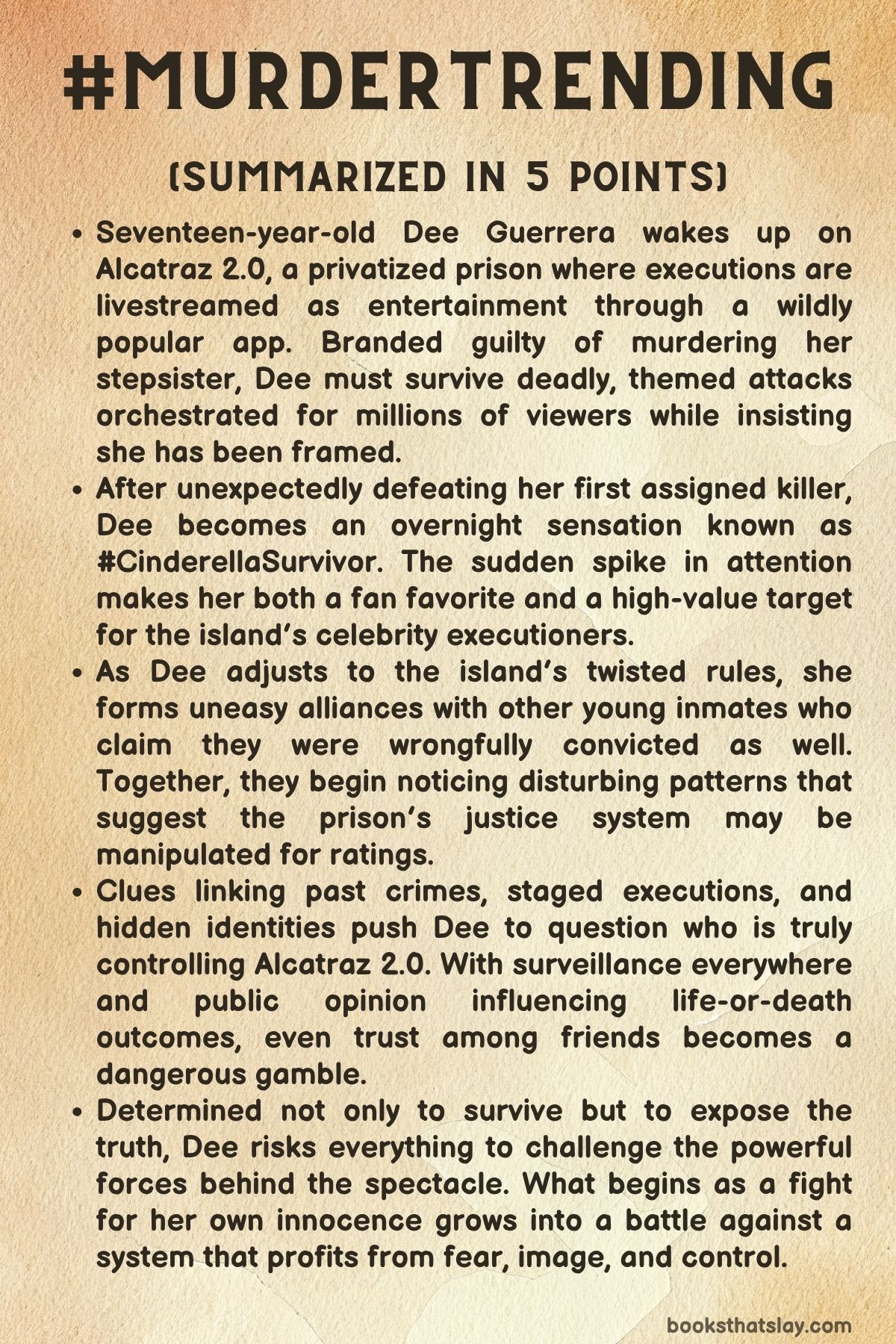
#MurderTrending by Gretchen McNeil is a sharp, high-concept YA thriller set in a near-future America where punishment has been turned into bingeable entertainment. Seventeen-year-old Dee Guerrera wakes up inside a staged “kill room” on Alcatraz 2.0, a privatized prison built to livestream executions for profit.
Dee insists she’s innocent—framed for her stepsister Monica’s murder—and she’s determined to survive long enough to expose the truth. But the island is engineered for spectacle: costumed celebrity killers, nonstop surveillance, and an audience that rewards bloodshed with likes and money. Dee’s fight becomes both a hunt for answers and a rebellion against a system designed to break her.
Summary
Dee Guerrera wakes up on Alcatraz 2.0—an island prison reborn as a nonstop livestream where convicted murderers are executed for public entertainment. She has been branded guilty of killing her stepsister, Monica, despite insisting she was framed.
The prison is run by the Postman, a shadowy media mastermind who built an app that broadcasts every moment of inmate life. A signature chime warns viewers that a killing is about to begin, and fans “spike” the footage to boost the killers’ fame and profits.
Dee already hates the app; it reminds her of the worst thing that ever happened to her as a child.
Dee’s first moments on the island are an immediate death sentence. She’s dressed as Cinderella for a themed hunt, targeted by Prince Slycer, a masked killer who stalks victims through a maze.
Instead of running, Dee uses the environment and her own nerve to fight back. She shatters Slycer’s advantage, forces a mistake, and he dies on his own knife.
The island’s audience explodes with reactions, and Dee is instantly branded with a viral nickname: #CinderellaSurvivor. It’s not protection—it’s a spotlight.
A boy named Nyles appears soon after, acting like a guide. He claims his conviction was a sham too, and that his case is still on appeal.
He explains the island’s twisted ecosystem: the celebrity executioners are “Painiacs,” their obsessed fans are “Postmantics,” and survival is a constant math problem of attention, fear, and timing. Dee doesn’t trust anyone, but she follows Nyles out of the industrial zone and into the eerily cheerful “Main Street,” where inmates work jobs, earn credits, and shop for food as cameras record everything.
Dee is assigned to an ice cream shop called I Scream.
At I Scream, Dee meets Griselda Sinclair, a striking and hostile coworker who already has a fanbase. Griselda makes it brutally clear that Dee’s popularity is dangerous: the more spikes she has, the more valuable her death becomes.
Their boss, Blair, lays out two sets of rules—official rules meant to keep the show running, and inmate rules meant to keep people alive. Don’t go out at night.
Don’t sleep during peak viewing hours. Don’t accept “help” too easily.
Watch your food seals. Above all, don’t draw the wrong kind of attention, because fan opinion influences who becomes a target.
Dee tries to harden herself, but the island keeps proving it has no bottom. She watches a man attempt to swim for freedom—only to be shot at by guards, filmed by drones, and torn apart by sharks drawn in by blood.
It’s punishment designed as content. Back in her assigned house, Dee realizes there is no privacy anywhere; cameras stare from every corner, even where no one should ever be watched.
The Postman forces her into glittery outfits to keep her “brand” alive. Dee refuses to play nicely.
She rigs crude alarms with sporks and string, stays awake through the worst hours, and tells herself that surviving isn’t enough—she needs proof that Monica’s killer is still out there.
Monica’s death haunts every decision. Monica loved the app, collected fan theories, and idolized certain Painiacs, especially Gucci Hangman.
Monica was found strangled, with a heart carved into her shoulder, and pink tweezers planted to frame Dee. Dee remembers flushing the tweezers, but it didn’t matter.
A psychiatrist, Dr. Farooq, used a single hypnosis session to push Dee into a false confession that destroyed her at trial. Dee’s father watched helplessly as the system swallowed her.
Then the island hits Dee where it hurts most. During a live execution, Gucci Hangman murders Blair in a lavish set piece, using designer scarves and a mechanical setup that ends in decapitation.
Afterward, Gucci carves the same heart into Blair’s shoulder and brandishes pink tweezers. Dee is shaken: the details match Monica’s murder too precisely to be random.
If she can prove who had access to that signature, she might prove her own innocence—and expose the machinery behind Alcatraz 2.0.
Dee begins forming shaky alliances with Nyles, Griselda, and Ethan, a movie-quoting gym rat who is loud, brave, and oddly sincere. They find a hidden camera-free naval yard and share their stories.
Their trials were rushed, their defenses gutted, and they all fit the same “marketable” profile: young, attractive, easy for viewers to obsess over. Dee suspects a broader conspiracy.
Nyles promises to send a message to Dee’s dad through his lawyers—one thin thread to the outside world.
Dee also encounters Mara, her quiet red-haired neighbor. At first Mara seems frightened and starving, but she offers Dee hardware to improve her traps and casually drops private details about a Painiac’s real identity.
Mara claims she has studied the killers closely and knows who they are and where they operate. Dee finds it unsettling, but the information is useful, especially as the island grows stranger: businesses close, supplies stop, and the usual rhythm of the “show” begins to fail.
The chaos escalates when the Hardy Girls abduct Nyles and Griselda and trap them in a rising water tank, giving Dee a countdown to save them. Dee and Ethan race to the kill site, dodge explosive devices, and fight in tight corridors under active cameras.
In a desperate final moment, Mara appears and kills one of the Hardy Girls, allowing Nyles and Griselda to survive. The unedited footage earns massive spikes and turns the group into a viral unit with its own nickname: #DeathRowBreakfastClub.
For the first time, Dee feels something like belonging—and immediately fears what it will cost.
Soon after, the island’s veneer collapses. Dee and her friends discover that nearly all the other inmates are dead, apparently killed off-camera by gas.
Then they find the guard station filled with dead guards too. The Postman has erased the supporting cast, leaving only a handful of “stars.” They search for a way to contact the outside world, but the network is blocked and phones are dead.
In the middle of this, Ethan is captured and executed by Cecil B. DeViolent in a staged scene based on a movie Ethan loves. Ethan dies trying to speak the truth aloud, and Griselda finally cracks—her sarcasm dissolving into grief and rage.
Dee decides they need to hijack the show itself. If they can get on a live feed and speak directly to viewers, maybe they can force attention onto what’s really happening.
They walk into known kill sites on purpose, dressed for maximum camera focus. But the plan goes wrong.
Mara is taken, and Dee enters a pavilion set up as a replica of Monica’s bedroom. Mara is dressed as Monica was on the day she died.
Poison gas floods the room. Dee tries to tear open the roof for air and a rescue route, but Mara dies in front of her.
Dee and the others scream their accusations into the cameras anyway—only to learn later that the feed carried no sound. The Postman let them think they had a voice, then quietly removed it.
That failure triggers Dee’s final shift. She realizes someone is manipulating them toward a specific outcome: forcing Dee to eliminate the Painiacs one by one.
Dee suspects betrayal in her inner circle and accuses Nyles and Griselda of being tied to her childhood kidnapper, Kimmi. The argument fractures the group—exactly the kind of meltdown the Postman would want.
Dee runs alone toward Slycer’s maze, convinced it’s the path to the Postman.
Inside the maze, Dee battles through a gauntlet of Painiacs and survives by outthinking their setups and turning their tools against them. Explosives, fire, boiling water, molten wax—each kill room is a staged trap built for spectacle.
Dee is battered and injured, but she keeps moving, driven by anger, guilt, and the need to end the system that profited from Monica’s death and Dee’s suffering.
After a final confrontation, the truth breaks open: “Mara” is not Mara at all. She is Kimmi—the girl from Dee’s childhood captivity—wearing Mara’s identity as a costume.
Kimmi reveals that the Postman is her father, and that she has been running the island. She murdered the guards and prisoners, set up the betrayals, and used Dee as a weapon to clear the Painiacs out.
Her obsession with Dee was never about revenge alone; it was about possession, about recreating a “sisterhood” under Kimmi’s control. She even tracked Dee down through Monica, then arranged Monica’s death to pull Dee into the machine.
But Dee has learned to read patterns and catch slips. With Griselda’s help, they broadcast Kimmi’s confession live.
The audience finally hears the truth. In the ensuing fight, Kimmi dies on her own blade, still insisting they could have been sisters.
Dee rejects the fantasy. When rescue and consequences begin rolling in, officials tied to Alcatraz 2.0 face arrest and impeachment.
Dee, Nyles, and Griselda stand at the shoreline, bruised and grieving, watching the world react. Dee mourns Ethan, fears what fame will do to her life, and clings to the fragile hope that survival can become something more than a trending tag—though the ever-turning camera reminds her the gaze may never fully disappear.
Characters
Dee Guerrera (Dolores Hernandez)
Dee is the story’s moral center and its most reliable engine of action, not because she is fearless but because she refuses to surrender her agency. She begins #MurderTrending as a teenager stripped of control—framed for Monica’s murder, dropped into a prison built to profit from her death, and forced into a degrading “princess” role for viewers.
What sets Dee apart is how quickly she reads systems: she understands that survival isn’t only physical, it is also about refusing to be shaped into content. Her trauma from childhood abduction makes her suspicious, hyper-alert, and sometimes emotionally blunt, yet it also gives her a hard-earned sense of how predators operate.
Dee’s greatest strength is adaptability—she makes traps, uses props as weapons, watches for pattern slips, and treats every “rule” as something meant to be exploited. At the same time, her biggest vulnerability is guilt.
When Blair, Ethan, and Mara die, she internalizes responsibility even when she lacks real power, which the antagonists repeatedly try to weaponize. Dee’s arc moves from pure survival to resistance: she stops thinking only about staying alive long enough to clear her name and starts aiming to collapse the structure that turns human suffering into entertainment.
By the end, she is still wounded and angry, but clearer about who she is: someone who can be damaged without becoming cruel, and who can fight without surrendering her basic humanity.
Nyles
Nyles functions as both Dee’s first lifeline and her most complicated test of trust. On the surface, he presents as calm, courteous, and surprisingly pragmatic for someone living inside a constant death show.
His “orientation guide” role gives him insider knowledge—how to move safely, when the island becomes most dangerous, how attention works, and which behaviors trigger retaliation. That competence makes him valuable, but also suspicious, because competence on Alcatraz 2.0 can look like collaboration.
Emotionally, Nyles is defined by restraint: he manages fear by staying composed and by converting chaos into plans. His flirtation with Dee, including the strategic use of kisses to block audio surveillance, shows how quickly he has learned to perform for cameras while still trying to protect privacy.
He is also the character most invested in proving innocence through external channels, which makes him the bridge between the island and the outside world. As Dee’s feelings grow, so does her fear that attachment will be punished, and Nyles becomes the focal point for that tension.
His loyalty is tested when the group starts fracturing under pressure, yet he repeatedly chooses to stand with Dee rather than take the safer route of emotional distance. In the end, Nyles represents the possibility of connection that isn’t purely transactional—someone who can strategize without losing empathy, and who can survive the show’s manipulation without fully becoming one of its performers.
Griselda Sinclair
Griselda is the story’s sharpest realist, and her edge is not a personality quirk so much as a survival method. She understands the island as an economy of attention: spikes keep you alive longer, fan dislike speeds up your death, and sentimentality can get you killed.
That worldview makes her seem cold when she first meets Dee, especially because Dee’s viral status increases danger for everyone nearby. Griselda’s hostility is also defensive; she has already learned that closeness is leverage the island can use against you.
Beneath the sarcasm, she is intelligent, observant, and technically skilled, capable of hacking and reading systems that others accept as fixed. Her backstory as someone railroaded through a psychiatric testimony aligns her with Dee, even if she resents Dee for becoming the lightning rod that draws catastrophe.
Griselda’s most revealing relationship is with Ethan: her refusal to label it doesn’t stop it from being real, and his death exposes how much she has been suppressing. After that, her cynicism becomes grief sharpened into anger, and she begins taking larger emotional risks, including committing to Dee’s broader goal of exposure rather than mere endurance.
Griselda’s arc is about the cost of constant self-protection: she starts by treating connection as weakness and ends by accepting that refusing connection is its own kind of trap.
Ethan
Ethan is outwardly the most playful member of the group, but his humor is a serious coping tool rather than shallow comic relief. He filters terror through movie quotes and action-movie fantasies, turning himself into the kind of hero he grew up watching because the alternative is helplessness.
Physically, he is prepared—strong, quick to arm himself, eager to confront danger—and that readiness makes him a stabilizing force when the group needs momentum. Yet Ethan’s defining trait is loyalty.
He commits to the group early, treats Dee’s survival as a team victory, and repeatedly chooses action over resignation. His confession that he did kill someone in self-defense adds complexity: he is not “purely innocent,” but he is also not what the system branded him as.
That moral gray makes him one of the most human characters—someone who can be flawed and still undeserving of the spectacle built to destroy him. His death is engineered to match his interests, which is both cruel and revealing: the island studies its victims closely enough to tailor their ends for maximum entertainment value.
Ethan dies trying to speak truth into the machine, and the aftermath shows his real impact—Griselda’s devastation and Dee’s hardening resolve. He becomes the emotional proof that their fight is not just about clearing names, but about refusing a world that turns a person’s last moments into content.
Blair
Blair is the adult presence who briefly makes survival feel teachable. She is practical, blunt, and protective in a way that doesn’t require softness.
By laying out the “inmates’ rules,” she exposes the island’s hidden logic: generosity can be a setup, sleep can be a liability, and public perception is lethal. Blair’s importance is not in how long she lasts but in what she represents—someone who once believed the app’s premise could be fair and later recognized how easily “justice” can be manufactured through testimony, branding, and fear.
Her murder is a turning point for Dee because it is targeted and symbolic: the heart carving and tweezers link Blair’s death to Monica’s, transforming Dee’s private grief into a pattern. Blair’s composure in her final moments also becomes a template for resistance—she cannot escape, but she refuses to beg, and that refusal denies the show a certain kind of satisfaction.
After she is gone, the group loses its anchor, and Dee inherits the burden Blair carried: staying alive while also staying awake to the bigger structure that wants them to accept cruelty as normal.
Mara
Mara enters as a quiet, starving neighbor and becomes, for a time, the most intriguing wildcard on the island. She appears isolated and fragile, which encourages Dee’s protective instincts and offers Dee a rare chance to choose kindness in a place designed to punish it.
Mara’s claimed expertise—knowing Painiac identities and kill sites—makes her valuable, but it also signals an obsessive attention that mirrors the fandom culture outside the prison. In that sense, Mara embodies the blurred line between victim and spectator: she is an inmate, yet she has studied the killers like a fan might, and that knowledge gives her power.
Her presence also hits Dee on a personal frequency; she reminds Dee of the “sister” concept that was twisted during Dee’s childhood captivity, which makes Dee emotionally receptive in a way she normally resists. When “Mara” is placed into a recreation of Monica’s death, the story weaponizes that bond, using staged familiarity to break Dee’s confidence and shove her toward rage.
The later reveal that Mara’s identity is a mask worn by Kimmi recontextualizes every tender moment as surveillance and manipulation, and it turns Mara into a symbol of how the prison corrupts even the possibility of friendship by making intimacy another costume for the camera.
Monica Guerrera
Monica is central even in absence because she is the catalyst for Dee’s imprisonment and the emotional wound Dee keeps reopening to stay motivated. She is portrayed as socially glossy and trend-aware, someone who engaged with the Postman app as entertainment while occasionally questioning its morality, which makes her neither villain nor saint—just a teenager shaped by the media environment around her.
Monica’s relationship with Dee starts with resentment and discomfort, then shifts into genuine closeness, making her death feel like both loss and theft: Dee lost a sister she did not expect to want, and the system stole the chance for their relationship to keep growing. Monica’s murder is also a message, not only to Dee but to the audience and the plot’s conspirators: the heart carving and planted tweezers are designed to control the narrative.
In practical terms, Monica becomes Dee’s compass—every clue, every risk, and every refusal to “normalize” island life traces back to the need to honor Monica by finding the truth. Monica’s online presence even after death, through her account being used to communicate, underlines one of the book’s ugliest ideas: in a world run by attention platforms, identity can be worn, borrowed, and weaponized long after the person is gone.
Kimmi
Kimmi is the story’s most personal antagonist because her cruelty is intimate rather than distant. As a teenager, she kidnapped Dee and forced “sisterhood” as a captivity game, blending emotional need with control until affection becomes indistinguishable from threat.
She is obsessed with resemblance and replacement—she wants Dee not as a friend but as a possession, and she experiences Dee’s later bonds as betrayal. Kimmi’s psychology is marked by entitlement and performance: she scripts roles, demands responses, and punishes deviation, which makes her a natural architect for Alcatraz 2.0’s staged violence.
Her ability to impersonate, manipulate, and plan shows a mind that treats people as props, while her fixation on Dee’s childhood poem reveals how she turns vulnerable longing into justification for harm. What makes Kimmi especially dangerous is that she can speak the language of closeness—family, loyalty, belonging—while meaning domination.
Even her final moments keep pushing the fantasy that they “could have been” sisters, framing her violence as misunderstood love. Dee’s rejection of that narrative is the real defeat Kimmi cannot survive: not just physical death, but the collapse of the story Kimmi tried to force onto Dee’s life.
The Postman
The Postman is the institutional villain, less a single person than a concentrated expression of profit, spectacle, and state-enabled cruelty. He treats justice as a product line and suffering as content to package, monetize, and optimize.
His power comes from control of cameras, scheduling, rules, and public narrative: he can make deaths happen, hide other deaths, mute audio, and steer fan attention with edits and trending tags. He also understands that viewers get bored, so he upgrades the cast by funneling young, attractive defendants into sham convictions, turning the legal system into a talent pipeline.
The Postman’s cruelty is methodical rather than emotional; he punishes Dee not only to hurt her, but to keep the show compelling and to remind everyone that resistance is also content. He is frightening because he represents a world where everyone—guards, inmates, viewers, even government officials—can be folded into the machine as long as the numbers go up.
Even when the operation begins to collapse, the core idea remains: the Postman proves how easily entertainment logic can infect institutions that claim to be about safety, justice, and order.
Prince Slycer
Prince Slycer is the first face of the island’s violence and the mechanism that makes Dee famous. His brand—fairy-tale glamour turned predation—shows how the prison converts familiar stories into cruelty designed for audience delight.
Slycer’s maze chase is meant to reduce victims to screaming objects, yet Dee’s refusal to follow the script breaks the illusion of his invincibility and introduces a key theme: the killers are powerful, but not untouchable. Slycer’s death also triggers consequences beyond the physical; it creates a narrative problem for the show, elevates Dee into a marketable “survivor,” and invites retaliation from other Painiacs who see their ecosystem threatened.
Later revelations about who wore the Slycer persona expose the deeper rot: the costumes are interchangeable, and the “characters” are often tools for whoever controls the system. Slycer is less a person than an emblem of how the island turns murder into branding.
Gucci Hangman
Gucci Hangman is the clearest example of the Painiacs as performers whose violence depends on taste, styling, and audience reaction. His persona is extravagant and theatrical, and his kills are built like fashion installations—props, logos, choreography, and camera-friendly shock.
That performative polish makes him a useful instrument for the show because he can deliver cruelty that looks “creative” rather than merely brutal. Gucci’s execution of Blair is also narratively important because it connects island spectacle to Dee’s off-island trauma: the heart carving and tweezers bridge Dee’s past and present, turning Gucci into a living clue.
He represents the way artfulness can be used to sanitize violence for consumption, encouraging viewers to evaluate murder like product design. Even when Gucci becomes vulnerable inside the maze’s collapsing power structure, he remains a symbol of the show’s logic: he is both executioner and disposable employee, kept alive only as long as his content performs.
Cecil B. DeViolent
Cecil B. DeViolent treats murder as cinema, staging executions as reenactments and casting victims into roles they didn’t choose. His persona shows how the island uses pop culture as a shared language to make killing feel like playacting, which helps both executioner and audience distance themselves from the human reality.
Cecil’s kill of Ethan is particularly revealing: it is fast, meticulously set, and timed in a way that suggests heavy coordination behind the scenes. That orchestration makes Cecil feel less like a lone killer and more like a node in a larger production pipeline.
He embodies the book’s critique of media consumption: when everything is referenced through movies, violence becomes familiar, even fun, and moral judgment gets replaced by whether the scene “lands.” Cecil is also a reminder that the Painiacs, no matter how famous, are ultimately controlled; their themes and moments are curated by forces above them.
Robin’s Hood
Robin’s Hood presents as theatrical and righteous, using an archer persona that suggests judgment, skill, and a kind of vigilante “fairness.” His execution of Dr. Farooq frames itself as punishment for wrongdoing, which mirrors how the entire Alcatraz 2.0 project sells itself: not cruelty, but justice with a wink. Yet the reality is still spectacle.
Robin’s choice of language and staging reveals a personal history tied to Farooq’s professional sphere, turning the kill into a vendetta dressed as entertainment. His presence also expands the conspiracy thread: Farooq’s death is less about fan service than about removing a liability.
Robin’s Hood shows how easily moral posturing can be used to make violence feel justified—especially when the system rewards whoever can tell the most satisfying story while doing it.
Hannah Ball
Hannah Ball’s cannibal-chef persona takes domestic familiarity—food, hospitality, cooking—and flips it into horror designed to provoke maximum viewer reaction. Her character underscores how the Painiacs rely on theme to make cruelty “distinct,” as if a signature style can turn murder into content categories.
Hannah’s performance voice and staged setting emphasize that she is acting for cameras as much as killing for control. When Dee confronts her in the maze, Hannah becomes a measure of Dee’s shifting mindset: Dee is fighting to survive, yet she also notices the thin line between self-defense and becoming numb to another person’s suffering, even when that person is monstrous.
Hannah exists to show the audience’s appetite for novelty and escalation—how quickly people stop reacting unless the violence becomes more extreme, more stylized, more “shareable.”
DIYnona
DIYnona is a dark parody of craft culture, turning harmless materials—glue, beads, wax—into instruments of torture. Her persona depends on the contrast between wholesome aesthetics and lethal intent, which is exactly the kind of irony the app’s audience would reward.
She also highlights the age and image politics of the show: older killers are less marketable, so a persona like hers must compensate with unusually “creative” brutality to stay relevant. In Dee’s maze run, DIYnona functions as a problem to solve rather than a pure brawl, emphasizing Dee’s ingenuity and willingness to use an opponent’s set against them.
The encounter also shows how the show’s obsession with themed environments creates predictable patterns; the more a killer relies on signature staging, the easier it is for a careful survivor to exploit the setup.
Molly Mauler
Molly Mauler’s animal-wrangler persona is built around outsourcing violence—letting beasts do the killing while she controls the conditions. That dynamic mirrors the larger system of Alcatraz 2.0, where the architects avoid “dirty hands” by building a machine that kills for them.
Molly’s clownish costume and use of cages foreground the showmanship: it’s not enough that someone dies, the death must be framed as a “scene.” Her kill site also emphasizes control through fear; animals are unpredictable, and the threat of being torn apart is designed to produce panic that reads well on camera. When Dee and Nyles defeat Molly by turning the environment against her, it reinforces a core message: the Painiacs’ power depends on their sets functioning as intended.
Disrupt the set, and the persona collapses into a frightened human with fewer advantages than they pretend to have.
Gassy Al
Gassy Al is the embodiment of invisible, impersonal murder—death by air, by atmosphere, by something you can’t punch. His executions reflect a colder kind of cruelty because the victim’s struggle becomes slow and desperate in a way that cameras can linger on.
The gas theme also links directly to the story’s wider mystery: mass gassing becomes the mechanism for off-camera exterminations that reshape the island’s cast. As a result, Gassy Al’s role extends beyond a single killer persona; it becomes a clue about how the system can shift from “content-first” murder to strategic cleanup.
The discovery that Gassy Al has been killed off-screen signals that the usual rules no longer apply, marking the point where the audience’s understanding and the characters’ understanding begin to diverge sharply.
Themes
The Commodification of Violence and Spectacle
In #MurderTrending, violence is not hidden behind prison walls; it is packaged, edited, branded, and sold. The island of Alcatraz 2.0 operates like a streaming platform where death functions as premium content.
Executions are choreographed with costumes, themed sets, and signature styles, turning killers into celebrities and victims into trending tags. The audience does not simply watch—they rate, comment, and financially reward the most dramatic deaths.
This participatory model exposes how spectacle transforms morality into consumer choice. A murder becomes “creative” or “boring” depending on presentation, not justice.
The system’s true horror lies in how it normalizes cruelty through aesthetics. When Gucci Hangman stages a lavish execution or Cecil B. DeViolent reenacts a film scene, the emphasis shifts from suffering to performance value.
The pain is real, but it is filtered through entertainment language. Even viewers who suspect something is wrong still engage with the platform, their outrage folded back into traffic and spikes.
The prison itself becomes a studio lot, and the inmates become unwilling actors whose survival depends on fan approval.
This commodification extends beyond the killers. The Postman recruits young, attractive inmates because they generate higher ratings, revealing how capitalism exploits image and desirability.
Justice becomes secondary to profitability. Even rebellion is absorbed into spectacle; when Dee fights back, her resistance boosts engagement.
The novel presents a chilling critique of media ecosystems that reward escalation. The audience’s appetite grows desensitized, requiring bigger shocks and fresher faces.
In such a world, human life is measured in metrics, and moral boundaries dissolve under the pressure of view counts.
Control, Surveillance, and Manufactured Reality
Alcatraz 2.0 is built on surveillance. Cameras exist in every corner of Dee’s house, in the streets, disguised as crows, embedded into the environment so completely that privacy becomes fiction.
The constant gaze shapes behavior; inmates calculate when to speak, when to move, when to sleep. Even intimacy is strategic.
Nyles kisses Dee not out of romance but to hide conversation from audio monitoring. The characters are forced to perform awareness of being watched at all times.
The Postman’s power rests not only on watching but on editing. He controls which deaths are televised, which are silenced, and which conversations lose sound entirely.
When Dee and her friends finally shout the truth into the cameras, the footage airs without audio. Reality exists only as curated by those in control.
The public believes they are seeing everything, yet entire massacres occur off-screen. The illusion of transparency becomes more dangerous than secrecy because viewers trust what they see.
This manufactured reality extends to the justice system. Trials are rushed, psychiatric testimony is manipulated, and legal oversight is surrendered.
The public is told the system is fair, while the Postman quietly engineers convictions to maintain ratings. Even identity becomes unstable under surveillance.
Kimmi hides in plain sight as Mara, and online accounts are repurposed to spread misinformation. Truth becomes fragile when narrative can be reshaped instantly.
The novel portrays surveillance not as passive observation but as active authorship, where those behind the cameras determine who is villain, hero, or disposable extra.
Trauma, Identity, and the Fight for Self-Definition
Dee’s past kidnapping is not a background detail; it shapes every decision she makes. Her childhood captivity taught her that survival depends on reading predators and recognizing manipulation.
Kimmi forced a version of “sisterhood” on her, turning affection into coercion. That distortion echoes in the present, where Alcatraz 2.0 imposes new roles on Dee—Cinderella, survivor, trending figure—none of which she chooses.
Both experiences revolve around someone else scripting her identity.
The island repeatedly tries to reduce Dee to a brand. Glittering princess outfits, viral hashtags, and curated footage attempt to lock her into a persona that audiences can consume.
Her refusal to comply is more than rebellion; it is an assertion of self-definition. She mixes up her wardrobe, sabotages props, and resists normalization.
The fight is not only for physical survival but for narrative control.
Kimmi’s obsession reveals the psychological stakes of identity theft. She interprets Dee’s childhood poem about wanting a sister as an invitation to claim her permanently.
Later, she steals Mara’s identity to stay close to Dee. Kimmi cannot tolerate Dee forming independent bonds because it contradicts the story she wants to tell about them.
Dee’s final rejection of Kimmi’s fantasy is a reclaiming of agency. She refuses to be a character in someone else’s script.
Through this lens, the novel argues that trauma can either trap someone in imposed narratives or push them to fight for authorship of their own story. Dee’s evolution shows that identity is not fixed by past victimization, but strengthened by confronting it.
Justice, Corruption, and Institutional Betrayal
The legal system in #MurderTrending is not merely flawed; it is deliberately manipulated. Innocent or ambiguously guilty defendants are funneled into Alcatraz 2.0 to boost ratings.
Psychiatric testimony is weaponized, appeals are ignored, and oversight is symbolic at best. The partnership between the Postman and high-ranking officials exposes how institutions can collaborate when profit and political advantage align.
Justice becomes a performance that reassures the public while concealing exploitation.
Dr. Farooq’s role demonstrates how authority can distort truth. Through hypnosis, she extracts a false confession from Dee, presenting it as clinical fact.
Her testimony legitimizes a wrongful conviction, showing how expertise can be misused to silence dissent. Later, Farooq herself becomes a victim, suggesting that even collaborators are expendable once they threaten the system’s stability.
The mass killing of prisoners and guards without broadcast reveals another layer of betrayal. The island markets itself as transparent punishment, yet it eliminates lives quietly when convenient.
Viewers believe they are witnessing accountability, but they are consuming a scripted version of it. The final exposure of the conspiracy, leading to arrests and impeachment, offers a partial restoration of justice.
However, the lingering presence of active cameras at the end suggests that systemic corruption does not vanish easily. The novel questions whether institutions built on spectacle can ever truly reform, or whether they simply adapt to preserve power.