24 Hours in Nowhere Summary, Characters and Themes
24 Hours in Nowhere by Dusti Bowling is a middle-grade adventure novel set in a dusty Arizona desert town that feels forgotten by everyone except the kids who are trying to outgrow it. The story follows Gus Foley, a 13-year-old who hides his fear behind big words and careful plans.
When a bully forces Gus into a deal that costs Rossi Scott her beloved dirt bike, Gus decides to fix what happened—no matter how reckless the solution. Over one long night, Gus, Rossi, and two other teens end up trapped in an abandoned mine, where survival tests their courage, their grudges, and what they think they know about their town’s past.
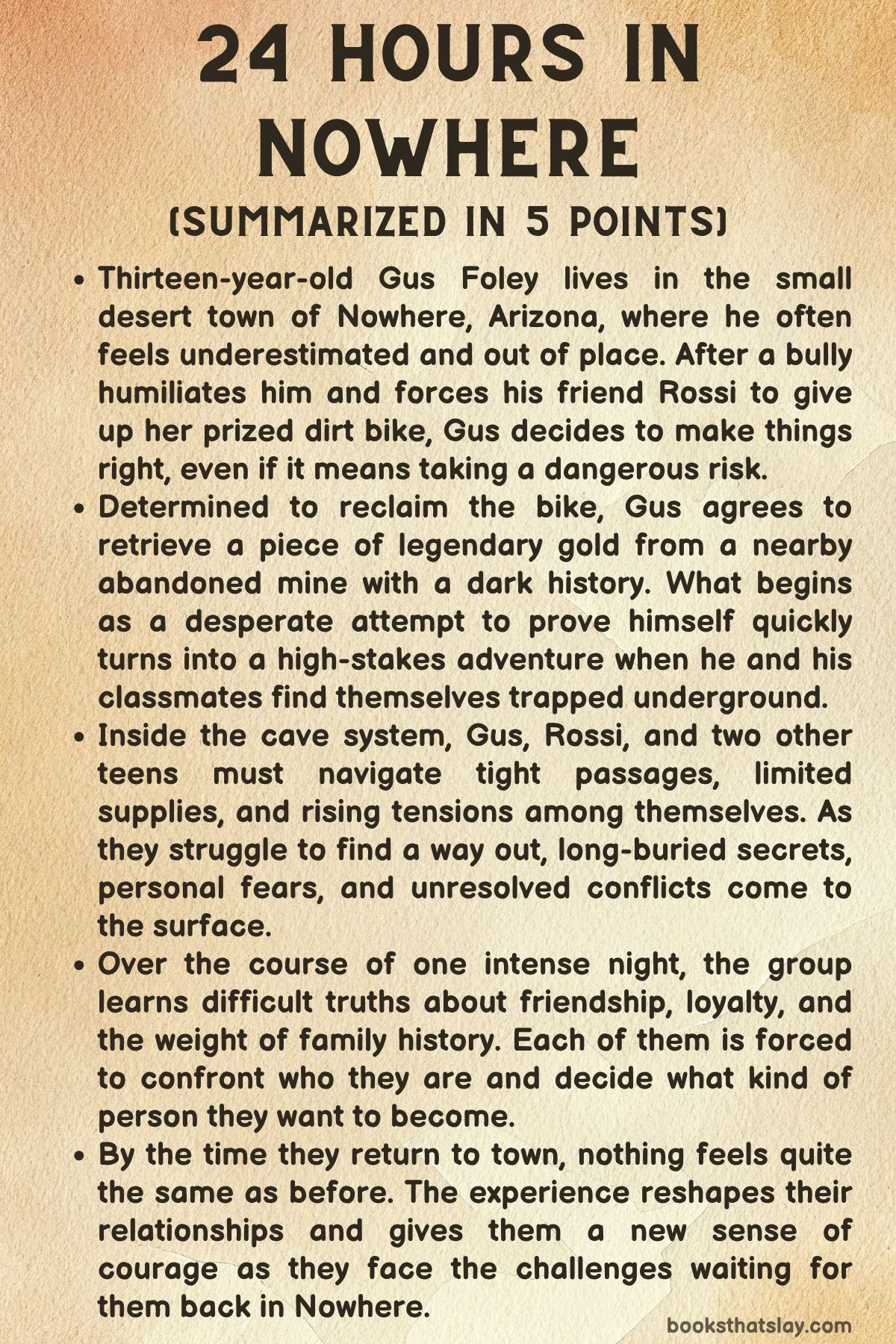
Summary
Thirteen-year-old Gus Foley lives with his grandmother in Nowhere, Arizona, a harsh desert town where most people scrape by and the future can feel sealed shut. Gus tries to act older than he is.
He loves vocabulary, studies obsessively, and tells himself he can think his way through anything. That confidence collapses when Bo Taylor, a kid with a mean streak and two hangers-on, corners Gus in the desert and decides to humiliate him.
Bo grabs Gus by the hair and demands he eat a piece of jumping cholla.
Before Gus can force himself to do it, Rossi Scott rolls up on her dirt bike and tells Bo to leave Gus alone. Gus has a crush on Rossi, partly because she’s fearless and partly because she refuses to act like Bo owns the town.
Bo refuses to back down. Instead, he pushes Rossi into a trade: her bike, Loretta, in exchange for Gus being let go.
Gus begs her not to do it, willing to take the pain himself, but Rossi gives in. Bo rides away with Loretta, smug that he has taken away Rossi’s edge right before the last race of the summer—the one that can win the champion a new bike and a spot at Breaker Bradley’s dirt-bike camp.
Gus can’t stand that Rossi lost her bike because of him. He decides to get it back.
He gathers what he can as bargaining chips: a few pathetic items from his room and seven dollars. He also considers a family heirloom—an old pocket watch marked with initials.
He hates the idea of using it, but he feels desperate. Gus walks through Nowhere, noticing the places that make up the whole town: a market, a gas station, a motorcycle shop, two rival bars, and schools that remind him of how little opportunity most kids have.
At Bo’s trailer, Gus tries to negotiate. Bo laughs at the money.
When Gus pulls out the pocket watch, Bo knocks it out of his hand and it falls between the porch slats. Bo then names his real price: a piece of gold from Dead Frenchman Mine, a notorious place tied to an old story about stolen gold, a man named William Dufort, and his partner José Navarro.
The mine’s legend is famous in Nowhere because it once drew national attention after two men died trying to explore it. Gus knows the mine is dangerous, but he agrees anyway.
He crawls under the porch to retrieve the watch and nearly gets bitten by a rattlesnake, which only confirms how foolish his plan is—yet he still goes forward.
Gus tries to convince himself he’s smart enough to handle it. He tells himself he’s prepared, that he’s studied hard, that he’s different from the kids who take risks without thinking.
But deep down he knows he’s doing this because he can’t accept feeling weak in front of Rossi. He stops by Nowhere Market and Ostrich Farm, owned by Mayor Handsome, and buys a hammer and chisel.
In the store he runs into Jessie Navarro, a boy who used to be Gus’s best friend. Their friendship faded when Jessie started spending time with other kids, and Gus felt pushed out.
Jessie immediately senses something wrong, and when Gus admits he’s heading to the mine, Jessie warns him it’s not worth it. Gus ignores the warning.
Back home, Gus packs water, snacks, and a flashlight. Then he nearly jumps out of his skin when Matthew Dufort, one of Bo’s followers, steps out of Gus’s closet.
Matthew says Bo sent him to make sure Gus goes through with it. Gus is annoyed, but he also remembers moments that hint Matthew isn’t as hard as he pretends to be.
With no better option, Gus lets Matthew tag along, gives him supplies, and the two sneak out.
They reach Dead Frenchman Mine under the full moon and step into the heat and darkness. The cave is tight, airless, and unnerving.
Gus tries to be careful, tapping along the wall with his tools, searching for something that might hide gold. Then voices echo toward them.
Matthew panics, convinced the mine is haunted. The “ghosts” turn out to be Rossi and Jessie, who came to stop Gus after Jessie warned her.
Rossi tries to talk sense into Gus, but when he refuses to turn back, she decides she will not leave him down there. Jessie stays too.
The group begins digging at a weak spot they notice, but their work destabilizes the mine. The support beams crack and the tunnel collapses.
They escape the falling rock by running back down the corridor, but when the rumbling ends, they realize they’re trapped. Rubble blocks their way, and their supplies are limited.
The air is thick with dust. Rossi suggests trying the hollow section they were digging toward, thinking it might have opened into another path.
Gus, being the smallest, crawls across the rubble through a narrow gap between the rocks and the ceiling. The others follow, scraping themselves up as they squeeze through.
On the other side, the wall has opened into a tunnel that leads away from the mine and into a cave system. The temperature shifts cooler, and the space widens into a chamber with stalagmites.
As they walk, they find bats hanging overhead and piles of guano on the ground. Matthew and Jessie argue constantly, each carrying family history like a weapon.
Jessie is descended from José Navarro and believes his family was robbed; Matthew is related to William Dufort and hates being blamed for a century-old crime. Their fighting startles the bats into flight and increases the chaos when one gets caught in Rossi’s hair, forcing Gus to help her.
They decide to follow the bats in hopes they’ll lead toward an exit. The crawl spaces are miserable, and Rossi admits she is claustrophobic.
Tension spikes when Matthew needles the others, mispronounces Jessie’s name on purpose, and tries to pry into Rossi’s past. He suggests she steals because her dad is poor and she has expensive gear.
Rossi refuses to explain herself, which leaves Gus uneasy but still loyal to her.
In the cave, Gus spots ancient drawings on the walls. Jessie believes they were made by Indigenous ancestors connected to Rossi’s heritage.
When Rossi pulls Gus aside, she shows him a strange detail: a newer arrow scratched into the older drawings, as if someone used them as a guide. The group keeps going, and after a calmer moment where Gus and Jessie finally talk honestly about their friendship, Matthew suddenly disappears.
He has fallen into a crevice and is pinned between rock walls above a steep drop.
They try to pull him out, but can’t. They share food to keep their strength up and sit together in the dark.
In that forced quiet, Matthew admits the reason he clings to Bo. He describes being humiliated as a younger kid and being beaten by his mother for stealing Valentine’s Day cards because he wanted to do something kind.
He says Bo’s cruelty comes from his own terrible home life. Jessie argues that hardship doesn’t excuse hurting people.
Gus privately feels torn—he hates Bo, but he recognizes the way pain can harden someone.
Matthew asks Gus about the worst day of his life. Gus tells them about his father in Reno: a surprise trip to Disneyland, a day that felt magical, and then waking up in Nowhere, abandoned at his grandmother’s trailer without warning.
Gus still has a bag of fake jewels he bought that day, and they have become a reminder of being left behind. The group uses Twinkie filling as lubrication to slide Matthew free from the crevice, a gross but effective solution that makes them laugh despite everything.
The pocket watch becomes a new problem. Rossi realizes Gus misread the initials: it says “W.A.D.” That connects it to William Dufort.
Matthew accuses Gus of stealing. Gus insists it was passed down through his family.
While inspecting it, Rossi finds a hidden note tucked inside the back. Before they can read it, a mountain lion appears, its eyes reflecting in the darkness.
The kids scramble to higher rocks, and Gus swings his backpack at the animal’s nose, forcing it back. In the aftermath, Rossi finds a draft and discovers a tiny tunnel leading to an opening.
The tunnel is too small for Jessie or Matthew, so Gus and Rossi crawl through to get help. They emerge onto a ledge high above the desert floor, unable to climb down safely in the dark.
They decide to wait until morning, talking while they recover. Rossi tells Gus about her dream of racing in Baja, about the race that matters to her because it’s about endurance, not prizes.
She shares pieces of her life: her mother’s death when she was young, her father working constantly, and the loneliness that pushed her toward Jessie’s family for warmth. Gus admits regret about drifting away from Jessie.
Rossi also tells Gus how riding makes her feel free, like the world can’t trap her for those seconds.
They fall asleep and wake at sunrise. In the daylight, Rossi can finally read the note: it’s a rough map of the cave system.
They crawl back in and reunite with Jessie and Matthew, who fled a stampede of javelinas inside the cave. Rossi’s lantern has burned out, leaving only Gus’s dying flashlight.
Studying the map, they fixate on markings tied to “A.L.” and a circled area. Jessie notices a carving on the watch—“A.L.’s nose”—and that matches the map.
They decide to follow it, hoping it will lead to an escape or something valuable.
They find a large carving of Abraham Lincoln and holes drilled into the nose. Inside, Jessie finds a box marked with “W.A.D.” and a wrapped pistol.
Jessie mishandles it and fires, shooting his toe. The injury forces the group to focus on escape rather than treasure.
Rossi identifies silt on the ground, reasoning they are on an old riverbed, and they follow it until the air changes and they reach the shaded area from the map: an underground lake.
To get out, they must cross. Wading in, they discover human remains and a flask labeled “W.A.D.” Gus finds a leather pouch containing real gold.
They piece together a new version of the legend: William Dufort likely mapped the caves and hid items in Lincoln’s carving, but he lost the watch—and with it, the map—then died in the cave system, possibly from injury or drowning. The group agrees to split the gold evenly and keep the cave secret so people won’t destroy it.
They swim across. Rossi struggles and goes under.
Gus pulls her out, and she stops breathing. Gus uses CPR, remembering health class, and Rossi coughs back to life.
On the far side they find a shaft leading up to daylight. Matthew climbs first, then Jessie, then Gus, with Rossi tearing clothes into a rope to help.
Outside, they face a pit—until they see a rope ladder on the other side. Mayor Handsome appears, having come to fish for shrimp.
He helps them climb out and agrees to keep their secret. He drives Jessie back toward town on his quad so Jessie can get medical care and maybe Rossi can still race.
The others follow a wash back to Nowhere under brutal heat. Near the market, they run into Bo and Jacob.
They give Bo a piece of gold and demand Loretta back. Bo demands more.
Matthew distracts him by claiming Gus has a bag of “jewels” from the mine. Bo falls for it and agrees to go to Gus’s trailer.
Gus swaps the gold for the fake jewels. Bo brings Loretta—but then slashes the tires with a pocketknife and rides off, leaving Rossi crushed.
Matthew offers his own bike so Rossi can race, sacrificing his chance to compete.
At Racetrack Basin, Rossi lines up to race on Matthew’s bike. She taunts Bo by revealing the gold and jewels are fake; Bo throws them away in anger.
Gus picks up the gold but chooses to leave the fake jewels behind, letting go of the object that tied him to his father’s abandonment. During the race, Bo tries to sabotage Rossi, grabbing her handlebars and forcing a crash.
Rossi fights back, and chaos erupts when Jacob wipes out in the silt. Rossi uses the silt strategically, surging past Bo and winning the race despite injuries.
Bo accuses her of cheating. Gus and Matthew stand up to him.
Gus even tries to punch Bo, misses, and gets his nose broken, but he refuses to back down. Jack, Bo’s older brother, arrives and humiliates Bo for losing, dragging him away.
Then a stranger congratulates Rossi—Breaker Bradley himself. He tells her he’ll see her at camp and that her new bike will be ready.
Mayor Handsome brings the kids to the hospital.
At the hospital, Rossi’s father arrives, shaken and relieved, and learns Rossi has real friends now. Gus’s nose is set, and the group checks on Jessie, who has lost his pinky toe.
They laugh through exhaustion and then crack emotionally under the weight of the day. Mrs. Navarro drives them back, and Mayor Handsome gives them popsicles at the market.
The friends promise to sit together at school, knowing Bo may come after them but trusting they’re stronger as a group.
In a quiet final moment, Rossi tells Gus she plans to give Matthew her old bike and teach Gus how to ride. She also reveals her real name is Loretta—the same as her bike—turning the name into something personal rather than just a machine.
Gus leans against her, feeling the wind shift and smelling rain coming, as if Nowhere might finally be changing, even if only a little.
Characters
Gus Foley
Gus Foley is the narrator and emotional center of 24 Hours in Nowhere. At 13, he sees himself as mature and intellectually superior to his peers, clinging to vocabulary and SAT prep books as proof that he is destined for something beyond Nowhere.
His intelligence, however, often masks deep insecurity. Gus fears humiliation, abandonment, and irrelevance, especially in comparison to kids who are physically braver or more socially confident.
His decision to enter the mine is not just about retrieving Rossi’s bike; it is about reclaiming his dignity and proving he is not weak.
Gus’s backstory shapes much of his inner life. His father’s sudden abandonment after a magical day at Disneyland leaves him with unresolved grief and trust issues.
The bag of fake jewels becomes a symbol of that broken promise—once magical, now hollow. Over the course of the novel, Gus grows from someone who overthinks and hides behind words into someone who acts decisively under pressure.
He performs CPR on Rossi, stands up to Bo, and ultimately lets go of the fake jewels, symbolically releasing the hold of his father’s betrayal. His arc is about courage that emerges not from intellect but from loyalty, empathy, and vulnerability.
Rossi Scott (Loretta Scott)
Rossi Scott is bold, skilled, and emotionally guarded. A gifted dirt-bike rider, she defines herself through motion and control, finding in racing a freedom she cannot find in her unstable home life.
Riding is not simply a hobby for her; it is identity, escape, and promise. Her dream of competing in the Baja One Thousand represents her longing to define her future on her own terms rather than remain trapped in Nowhere.
Despite her outward toughness, Rossi carries deep loneliness. Her mother died when she was young, and her father’s demanding, low-paying jobs leave her feeling neglected.
She resents Nowhere because it represents stalled dreams and isolation. Her secrecy—especially about how she earns money through scrap metal and even about her real name, Loretta—reveals a need to protect herself from judgment.
Yet she repeatedly chooses loyalty over pride: she gives up her bike for Gus, refuses to abandon him in the mine, and offers her race spot to Jessie when he needs help. By the end, Rossi’s victory in the race is not just athletic triumph but emotional validation.
Her revelation of her real name signals trust and intimacy, particularly with Gus.
Matthew Dufort
Matthew begins as a sidekick to Bo, seemingly cowardly and complicit in bullying. However, he is one of the most complex characters in the story.
His loyalty to Bo stems less from cruelty and more from fear and survival. His traumatic childhood, including physical abuse from his mother and public humiliation at school, pushes him toward aligning with someone powerful.
For Matthew, belonging to Bo’s circle offers protection from being targeted.
In the mine, Matthew’s layers peel back. He is anxious, impulsive, and sometimes antagonistic, especially toward Jessie, but he is also capable of reflection and remorse.
His admission about stealing Valentine’s cards because he wanted to do something kind exposes a sensitive child beneath the defensive exterior. He challenges the others to consider how environment shapes behavior, even arguing that Bo’s cruelty may be rooted in his own suffering.
Matthew’s most defining moment comes when he sacrifices his chance to race so Rossi can compete. This act of generosity marks his transition from follower to friend.
Receiving Gus’s pocket watch at the end symbolizes both trust and a fresh start.
Jessie Navarro
Jessie Navarro represents conscience and emotional honesty. Once Gus’s best friend, he feels hurt and confused by their drifting apart.
Unlike Gus, who internalizes misunderstandings, Jessie is willing to confront them directly. Their reconciliation in the cave is pivotal, demonstrating Jessie’s maturity and openness.
He clarifies that he never mocked Gus but admired him, revealing how insecurity distorted Gus’s perception.
Jessie also carries the weight of generational history. As a descendant of José Navarro, he feels anger toward William Dufort’s betrayal and, by extension, tension toward Matthew.
Jessie believes strongly in personal accountability, rejecting the idea that hardship excuses cruelty. His injury in the cave, which results in the loss of his pinky toe, reinforces his physical vulnerability but also highlights his emotional strength.
Even after missing the race, he prioritizes Rossi’s victory and expresses raw emotion when overwhelmed. Jessie’s character underscores themes of forgiveness, cultural identity, and chosen family.
Bo Taylor
Bo Taylor is the primary antagonist, embodying intimidation and entitlement. He thrives on dominance, targeting those he perceives as weaker.
His cruelty toward Gus and Rossi reflects both insecurity and a need to assert control in a life where he likely has little. Bo’s mother is deceased, and his father is incarcerated, leaving him under the harsh authority of his older brother, Jack.
This unstable home environment helps explain—but does not excuse—his aggression.
Bo’s obsession with winning, whether in dirt-bike racing or social hierarchy, defines him. He cannot tolerate losing, which is why he sabotages Rossi during the race and slashes her tires beforehand.
However, his bravado collapses when Jack appears, revealing that Bo himself is bullied at home. This mirroring dynamic highlights the cycle of power and fear.
Bo does not undergo redemption within the story, but the narrative complicates him enough to show he is shaped by forces beyond simple malice.
Mayor Handsome
Mayor Handsome serves as a steady, understated adult presence. An immigrant who genuinely loves Nowhere, he contrasts with many residents who feel trapped there.
His quiet generosity—donating school supplies, giving popsicles, rescuing the kids from the pit, and keeping their secret—demonstrates faith in the town’s youth. He acts without seeking recognition, embodying community support.
His involvement in dirt-bike culture and connection to Breaker Bradley show that Nowhere is not entirely cut off from opportunity. Through him, the novel suggests that transformation often comes from unexpected allies.
Mayor Handsome represents hope grounded in practical kindness rather than grand gestures.
Mr. Scott
Rossi’s father is a well-meaning but overextended parent. Working multiple jobs, including counseling troubled boys, he is devoted to helping others yet unintentionally neglectful of his daughter’s emotional needs.
His past as a rider who shared dreams of Baja with Rossi adds poignancy to their relationship. He once nurtured her passion, but financial and moral obligations redirected his life.
When he arrives at the hospital, his worry is palpable, and he seems genuinely surprised to learn Rossi has close friends. This moment hints that he underestimates her resilience and isolation.
Mr. Scott embodies the tension between responsibility and presence, showing how love can coexist with absence.
Jack Taylor
Jack Taylor, Bo’s older brother, exerts control through intimidation. With their father incarcerated and mother gone, Jack fills the parental vacuum with harsh authority.
His brief appearances reveal why Bo is so desperate to dominate others; Jack humiliates him publicly and expects perfection. Jack’s presence underscores the generational cycle of aggression and fear in the Taylor household.
Though not deeply explored, he functions as a shadow looming over Bo, reinforcing the theme that cruelty often flows downhill.
Mrs. Navarro
Mrs. Navarro represents warmth, accountability, and community. She welcomes Rossi into her home, creating a sense of belonging that Rossi lacks elsewhere.
She is practical and protective, confronting Gus gently but firmly about the hospital situation and medical bills. Her nurturing presence balances the chaos of the teens’ adventure.
Through her, the story highlights the importance of supportive adults who provide both honesty and compassion.
Grandma Foley
Gus’s grandmother is pragmatic and emotionally reserved. She provides shelter and routine but does not fully engage with Gus’s emotional struggles.
Her preoccupation with television and casual remedies underscores her practicality rather than tenderness. Yet she remains a stable anchor in Gus’s otherwise fractured family life.
While not deeply involved in the central adventure, she symbolizes endurance and continuity, quietly holding space for Gus even when she cannot fully understand him.
Themes
Courage and Moral Choice
Courage in 24 Hours in Nowhere is not presented as fearless heroism but as a series of imperfect, often frightening choices made under pressure. Each character faces moments where fear threatens to dictate their actions, yet growth occurs when they act despite that fear.
Gus begins the story believing that intelligence alone can protect him. However, the mine strips him of control and forces him into situations where thinking quickly is not enough; he must physically act, whether crawling through tight spaces, confronting a mountain lion, or performing CPR on Rossi.
His bravery emerges gradually, rooted in loyalty rather than pride.
Rossi’s courage is equally layered. She appears bold from the outset, confronting Bo and riding fearlessly.
Yet her admission of claustrophobia reveals that bravery does not mean the absence of fear. Choosing to return to the cave after briefly escaping shows moral courage—she refuses to abandon Jessie and Matthew even when she has a chance to save herself.
Matthew’s transformation also centers on moral choice. He begins by following Bo out of self-preservation, but over time he chooses to stand up for Rossi and even sacrifice his chance to race so she can compete.
These decisions represent a shift from fear-based survival to value-based action.
The novel also complicates courage by contrasting it with recklessness. Entering the mine initially feels impulsive and dangerous, driven by ego and shame.
True courage appears later, when characters confront uncomfortable truths about themselves and take responsibility for their actions. In this way, the story frames courage not as a dramatic gesture but as a steady willingness to protect others, admit mistakes, and resist cycles of harm.
Friendship, Loyalty, and Forgiveness
Friendship in 24 Hours in Nowhere is tested under extreme circumstances, revealing both its fragility and its resilience. Gus’s strained relationship with Jessie illustrates how insecurity can quietly erode bonds.
Gus assumes Jessie mocked him, allowing pride to replace communication. Only when trapped in the cave do they confront the misunderstanding.
Their reconciliation is grounded in honesty, showing that friendship requires vulnerability and the willingness to admit fault.
Rossi’s loyalty drives much of the plot. She gives up her bike for Gus without hesitation and later refuses to leave him in danger.
Yet loyalty is not blind. When Matthew accuses her of stealing, she remains composed, confident in her integrity rather than desperate for approval.
Over time, Matthew earns the group’s trust through actions rather than words. His decision to let Rossi use his bike for the race marks a turning point, transforming him from Bo’s follower into a true friend.
This gesture demonstrates that loyalty is defined by sacrifice and mutual respect, not shared intimidation.
Forgiveness also plays a quiet but powerful role. Jessie must confront his anger toward Matthew’s family history, recognizing that past injustices do not justify present hostility.
Gus must forgive himself for distancing from Jessie and eventually release the emotional hold of his father’s abandonment. Even the group’s handling of Bo reflects complexity.
While they oppose his cruelty, they also begin to understand the forces shaping him. The novel suggests that friendship thrives when individuals move beyond assumptions and resentment, choosing connection over pride.
Inheritance, History, and Breaking Cycles
The legend of William Dufort and José Navarro is more than local folklore; it mirrors the emotional inheritances carried by the children. The gold, the watch, and the map symbolize how the past lingers in physical objects and in identity.
Gus believes the watch is a treasured family heirloom, only to discover it connects to a darker history. This revelation forces him to reconsider what he has inherited.
Rather than clinging to romanticized narratives, he must confront the possibility that his lineage is tied to betrayal and misunderstanding.
Jessie feels the weight of generational injustice through his connection to Navarro. His anger toward Matthew is shaped by this legacy, showing how history can influence present relationships.
Matthew, in turn, struggles with the stigma of being related to Dufort. Their conflict demonstrates how children often inherit emotional burdens they did not choose.
The cave becomes a literal and symbolic space where these histories are uncovered and reassessed. When the group reconstructs a more nuanced theory of what happened in the past, they challenge simplified narratives of hero and villain.
The cycle of harm is also evident in Bo’s family dynamic. Jack’s dominance over Bo suggests that cruelty can be learned behavior passed down through instability and fear.
Yet the novel resists determinism. Matthew chooses to break from Bo’s influence.
Gus chooses to let go of the fake jewels that symbolize abandonment. Rossi chooses ambition rather than resignation.
By confronting inherited stories and deciding which parts to carry forward, the characters assert control over their futures rather than remaining bound to the past.
Identity, Freedom, and Escape
Nowhere, Arizona, functions as more than a setting; it represents limitation and entrapment. Many adults in town appear stuck, constrained by poverty and lack of opportunity.
For the young characters, identity is closely tied to whether they will remain in Nowhere or carve out a different path. Rossi’s dream of racing in Baja embodies a desire for freedom defined by endurance and self-reliance rather than material reward.
Riding allows her to experience temporary liberation from social and economic constraints.
Gus’s relationship to identity is more internal. He defines himself as intelligent and different, convinced he will escape through academics.
However, his journey reveals that identity is not solely constructed through ambition. It is also shaped by relationships and emotional resilience.
Letting go of the fake jewels marks a turning point in how he sees himself—not as a boy abandoned, but as someone capable of choosing his own direction.
Matthew’s identity shifts dramatically. Initially known as Bo’s follower, he struggles to assert individuality.
His confession about his childhood humiliation reveals how deeply he fears rejection. By standing up to Bo and offering his bike to Rossi, he redefines himself outside that shadow.
Even Jessie’s sense of identity evolves as he reconciles cultural pride with present friendships. The race at the end symbolizes more than competition; it represents movement forward.
Rossi’s victory affirms that escape is possible, but it is rooted in courage, solidarity, and self-belief rather than luck. Through each character, the novel argues that freedom begins with redefining who you are, even before you leave the place that confines you.