The 80/20 Principle Summary and Analysis
The 80/20 Principle: The Secret to Achieving More with Less by Richard Koch is a business and self-development book built around a simple but powerful idea: a small number of causes usually produce the majority of results. Drawing on economist Vilfredo Pareto’s observation that 20% of people owned 80% of wealth, Koch argues that this imbalance appears everywhere—from corporate profits to personal happiness.
The book blends management strategy, investment advice, psychology, and lifestyle design to show readers how to focus on the “vital few” inputs that create outsized returns. Its core promise is straightforward: achieve more by concentrating on what truly matters and eliminating the rest.
Summary
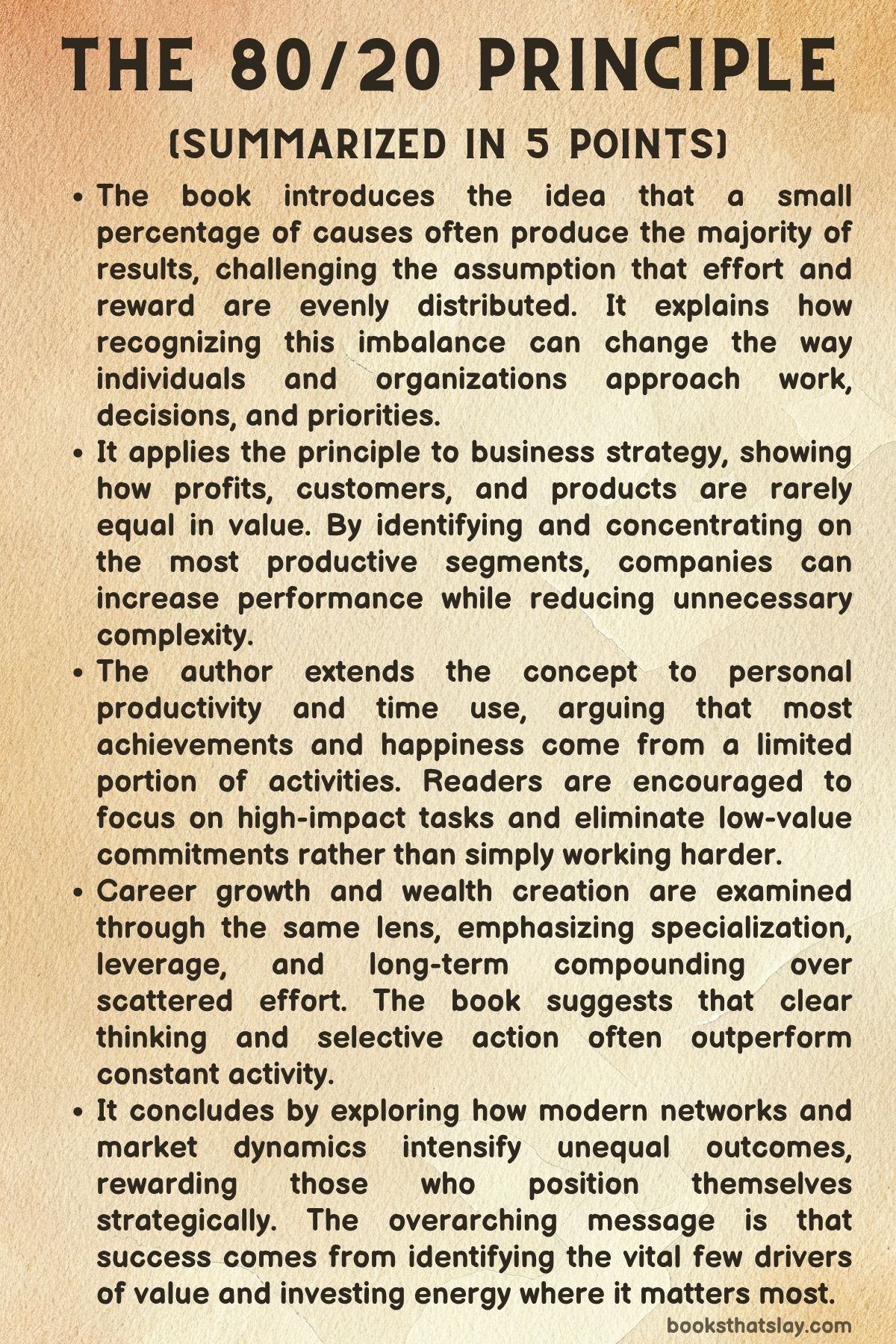
Richard Koch begins by introducing the central insight that shapes the entire book: most outcomes are not evenly distributed. Instead, a minority of efforts, customers, products, or decisions create the majority of value.
He traces this idea back to Vilfredo Pareto’s observation about wealth distribution and shows how similar patterns recur in business, education, traffic systems, entertainment, and even daily routines. Koch challenges what he calls the assumption of balance—the belief that inputs and outputs are roughly proportional.
In reality, he argues, life is marked by imbalance, and those who recognize this can gain a significant advantage.
He explains that the 80/20 ratio is not exact. It may appear as 70/30, 90/10, or even 99/1.
The precise numbers matter less than the underlying principle: a small share of causes produces a large share of results. Koch introduces two practical tools.
The first is 80/20 Analysis, a method of examining data to discover where value is really created. The second is 80/20 Thinking, a habit of intuitively focusing on high-impact actions in daily life.
Moving into corporate strategy, Koch argues that most businesses misunderstand where their profits come from. In many firms, a minority of customers generate nearly all profits, while a large portion barely breaks even or produces losses.
Similarly, a small number of products often sustain the entire enterprise. Managers, however, frequently spread resources evenly or defend underperforming segments out of habit or internal politics.
Koch insists that companies should redirect attention and capital toward their most profitable customers and offerings, even if it requires cutting long-standing lines or restructuring operations.
He supports this claim with examples from manufacturing, consulting, retail, and publishing. In each case, detailed profit analysis reveals dramatic imbalances.
Some clients are highly profitable and require little effort; others consume disproportionate time and produce minimal returns. Koch encourages firms to identify “competitive segments,” understand which areas offer real advantage, and concentrate resources there.
Strategy, he argues, should begin from the bottom up, examining actual profit patterns rather than relying on broad market theories.
Simplicity becomes a recurring theme. Koch claims that complexity is often the hidden enemy of profitability.
Large organizations accumulate product variations, administrative layers, and unnecessary processes that drain resources. By reducing product lines, narrowing focus, and eliminating low-volume offerings, firms can increase margins and reduce costs.
He presents simplicity not as aesthetic preference but as financial discipline.
Marketing and sales also follow the same logic. A minority of customers drive most revenue.
Instead of trying to satisfy everyone, companies should identify their most valuable clients and serve them exceptionally well. Koch suggests removing marginal products, focusing sales teams on high-return accounts, and aligning incentives with profitability rather than volume alone.
He highlights that top-performing salespeople often succeed not because they work harder, but because they target better.
Beyond strategy, Koch applies the principle to decision-making and management. He criticizes excessive analysis and argues that leaders should gather essential information, decide quickly, and adjust if necessary.
In project management, he advises clarifying the core objective and eliminating secondary tasks. In negotiation, he recommends focusing on key concessions while treating minor demands as flexible tools.
Across these applications, his message remains consistent: identify the few actions that truly matter.
As the book shifts toward personal life, Koch argues that the same imbalance governs time, relationships, career satisfaction, and happiness. Most people, he claims, spend too much energy on low-value tasks while neglecting activities that bring genuine fulfillment.
He challenges the culture of busyness and questions the assumption that constant effort leads to better outcomes. Instead, he proposes identifying “happiness islands” and “achievement islands”—the small portions of time that generate the most joy or accomplishment—and expanding them.
Koch encourages readers to rethink time management. Rather than trying to optimize every minute, individuals should concentrate on the hours that yield the highest returns.
He offers reflective exercises to help readers identify when they have been most productive or happiest in the past. The goal is to restructure life around these peak experiences.
Career strategy receives similar treatment. Koch argues that rewards in modern markets are highly concentrated.
A small number of performers capture most fame and wealth. He advises specializing in areas of strength, leveraging skills through delegation or capital, and seeking niches where one can dominate.
Strategic laziness—doing only what produces significant impact—becomes a virtue. Hard work alone, he suggests, is less effective than selective effort.
Money and investing form another major theme. Koch maintains that wealth accumulation follows unequal patterns.
A few investments typically generate most returns. He favors concentrated portfolios built around areas of knowledge or conviction, combined with long-term discipline and compounding.
While acknowledging risks, he emphasizes clarity and early action over diversification for its own sake.
Relationships also reflect the 80/20 pattern. Most personal fulfillment comes from a small circle of close connections.
Koch advises prioritizing depth over breadth, nurturing a handful of important relationships rather than spreading attention thinly across many acquaintances. Professional alliances, too, can multiply influence when built on trust and shared purpose.
He extends the discussion to happiness, arguing that emotional well-being is shaped by habits and mindset. Daily practices such as exercise, mental engagement, and optimism can produce disproportionate benefits.
By identifying the main sources of unhappiness and reducing exposure to them, individuals can improve their overall satisfaction.
In later chapters, Koch examines broader economic trends. He argues that modern network-based businesses intensify imbalance.
Platforms grow more valuable as more users join, leading to winner-take-all markets. In such systems, a few firms capture most profits.
He advises aligning careers and investments with high-growth networks early, as advantages compound rapidly.
Throughout the book, Koch distinguishes between two dimensions of the principle. The efficiency dimension focuses on completing necessary tasks with minimal effort.
The life-enhancing dimension emphasizes immersing oneself in activities that bring meaning or joy. He warns that overemphasizing efficiency alone can lead to a narrow life.
The true aim, he argues, is to eliminate trivial obligations so that time and energy can be invested fully in what matters most.
By the end, Koch presents the principle as both analytical tool and philosophy. It challenges conventional ideas about fairness, balance, and equal distribution of effort.
Instead of striving for symmetry, he urges readers to recognize asymmetry as a fundamental feature of reality. Success, in his view, comes from identifying the vital few factors that drive results, concentrating resources on them, and letting go of the trivial many.
Key People
Richard Koch
Richard Koch is both the author and the closest thing The 80/20 Principle has to a central “character.” He presents himself as a practical strategist shaped by consulting, entrepreneurship, and investing, and that background influences how he interprets the 80/20 idea. His voice is confident, directive, and often assumes the reader can choose, cut, outsource, or redesign systems—an assumption that reveals his worldview as much as his advice does.
He values leverage, clarity, and concentrated effort, and he tends to frame problems as solvable through sharper attention rather than through slow structural change. Across the book, he plays two roles at once: a guide who teaches a lens for spotting hidden value, and an advocate for a particular style of life—less busywork, more autonomy, and a deliberate focus on the few activities that generate the largest returns in money, satisfaction, or impact.
Vilfredo Pareto
Vilfredo Pareto appears as the origin figure whose observation gives the principle its name and legitimacy. He functions less as a fully developed personality and more as a symbolic founder: the economist who noticed an unequal distribution pattern and, by doing so, opened a doorway to seeing imbalance as normal rather than exceptional.
In Koch’s telling, Pareto represents the power of noticing what others overlook—an empirical mind catching a pattern that contradicts common assumptions about fairness and balance. Pareto’s role is also rhetorical: he anchors the argument in history and social science so the principle feels like a discovery about reality, not a motivational slogan.
Koch leans on Pareto to remind readers that unequal outcomes are not a modern glitch but a recurring feature of societies and systems.
Joseph M. Juran
Joseph M. Juran is portrayed as a key transmitter of the idea into the modern corporate world, especially through quality management. He represents the disciplined, methodical side of the principle: using data to isolate the biggest sources of defects and focusing improvement efforts there.
In the book’s logic, Juran matters because he shows how large organizational change can come from narrowing attention to a few high-impact causes rather than trying to fix everything at once. He also functions as evidence that the principle can be operational, not just descriptive.
Koch uses Juran to demonstrate that “focus on the vital few” is not simply a philosophy but a management practice that can reshape manufacturing outcomes and corporate performance.
W. Edwards Deming
W. Edwards Deming appears alongside Juran as a second pillar of the quality revolution and a figure whose ideas gained traction most dramatically in Japan. Deming symbolizes a blend of technical rigor and systemic thinking: the belief that performance improves when organizations measure what matters, reduce variation, and redesign processes rather than blaming individuals.
In Koch’s framing, Deming reinforces the argument that breakthroughs often come from concentrating on a small number of fundamental process drivers. He also serves as a cautionary example of how institutions can ignore transformative ideas when they are uncomfortable or inconvenient, which fits Koch’s broader claim that the 80/20 lens is often available but underused.
George Kingsley Zipf
George Kingsley Zipf is introduced as an intellectual cousin to Pareto, offering the “least effort” concept that supports Koch’s larger argument about human systems. Zipf functions as a theoretical character who helps Koch explain why uneven distributions arise naturally: people, organizations, and even languages tend to organize themselves around efficiency, repeating familiar choices and concentrating attention.
His presence expands the principle beyond economics into behavior and culture. In the narrative role he plays, Zipf helps Koch argue that imbalance is not only common but structurally produced, because systems evolve toward patterns that reduce effort for most participants while amplifying the rewards of a few dominant options.
Archimedes
Archimedes appears as a historical emblem of insight arriving through reflection rather than relentless labor. Koch uses him to challenge the cultural belief that effort is always the direct cause of achievement.
Archimedes represents the “thinker” model in the book: someone whose most valuable output comes from mental clarity, curiosity, and space to reason. As a character reference, he supports Koch’s claim that high-value moments are often rare and should be protected.
He also helps Koch argue for a personal redesign of work and time, where the goal is not to maximize hours but to maximize the quality and payoff of the few hours that matter most.
Isaac Newton
Isaac Newton plays a similar symbolic role to Archimedes, reinforcing the idea that major advances are not necessarily produced by constant strain. In Koch’s usage, Newton stands for the kind of concentrated breakthrough that can outweigh years of routine effort.
He is deployed to validate the claim that the mind performs best when it has freedom to wander, connect ideas, and return with solutions that disciplined grinding might not produce. Newton therefore supports Koch’s argument that the most valuable intellectual contributions are often disproportionate to the visible input, and that designing life to allow such contributions is both rational and desirable.
Warren Buffett
Warren Buffett is referenced as an example of calm, selective decision-making and the compounding power of focused investing. Within Koch’s framework, Buffett embodies the principle in personal form: prioritize a small number of high-quality decisions, ignore noise, and allow time to multiply results.
He represents restraint as strength—someone who does not confuse activity with progress. In the context of wealth creation, Buffett also serves as proof that performance can come from a consistent method applied patiently rather than from frequent trading or constant “optimization.” As a character figure, he reinforces Koch’s ideal of strategic simplicity.
Ronald Reagan
Ronald Reagan is used as an illustration of leadership that appears relaxed rather than frantic, supporting Koch’s critique of busyness as a false signal of productivity. Koch’s point is not to present a full political portrait but to highlight a style: delegating, prioritizing a few key outcomes, and conserving energy for decisions that matter.
Reagan functions as a symbol of the idea that effectiveness at the top often involves omission—choosing what not to do—rather than heroic involvement in everything. His presence helps Koch argue that high-impact roles reward selectivity and that the same logic can be applied at an individual level.
Erich von Manstein
Erich von Manstein enters the book as the source of a typology that Koch adapts into career advice. He represents a hard-edged strategic mindset: sorting people by combinations of intelligence and diligence, then elevating the “intelligent lazy” type as the most effective.
In Koch’s narrative, Manstein’s framework provides a provocative way to reframe ambition: effectiveness is not the same as effort, and disciplined selectivity beats exhaustive labor. His role is partly rhetorical—his military authority gives weight to a blunt classification—and partly structural, because it helps Koch build a memorable model for readers who equate success with overwork.
Emile Coué
Emile Coué appears as a gateway into the theme of subconscious influence and self-suggestion. In Koch’s presentation, Coué represents the idea that the mind can be trained indirectly, and that repeated internal cues can shape behavior and outcomes without constant conscious struggle.
He functions as a bridge character between classic self-help traditions and Koch’s more productivity-oriented use of psychology. Coué’s inclusion signals that the 80/20 logic applies not only to external actions but also to internal processes: small mental habits or suggestions may generate large downstream effects in confidence, calm, and performance.
Carl Jung
Carl Jung is introduced as a major figure associated with the unconscious and the symbolic depth of the mind. In Koch’s framing, Jung supports the argument that the subconscious can generate insights, solve problems, and guide personal development in ways the conscious mind cannot easily force.
Jung’s role is to lend intellectual and psychological credibility to Koch’s claim that valuable output often arrives when effort relaxes. He also widens the scope of the book from management tactics to inner life, suggesting that the “vital few” may include mental patterns, recurring images, and deep preferences that shape a person’s choices more than they realize.
Joseph LeDoux
Joseph LeDoux appears as a modern scientific reference point in the discussion of emotion, brain pathways, and how automatic responses influence behavior. In the book’s character roster, he represents neuroscience as a support structure for Koch’s claims about the power of the nonconscious mind.
Rather than being treated as a narrative personality, LeDoux functions as validation: a reminder that emotional systems are fast, influential, and often outside deliberate control. His inclusion strengthens Koch’s case that changing outcomes may require working with underlying mental machinery instead of relying solely on willpower and linear planning.
Anne Scheiber
Anne Scheiber is presented as a compelling example of long-term wealth accumulation through patience, discipline, and compounding. In Koch’s story, she represents the ordinary individual who achieves extraordinary results by following a few high-impact practices consistently.
Her role matters because she counters the assumption that wealth is only for insiders or high earners. She illustrates one of Koch’s favorite themes: a small number of correct actions, repeated over time, can outperform a wide range of scattered efforts.
Scheiber’s character function is inspirational but also instructional, showing how concentration and time can outperform complexity.
Benjamin Graham
Benjamin Graham appears as a foundational influence in investing philosophy, representing careful thinking about value and the discipline of buying based on fundamentals rather than emotion. In Koch’s framework, Graham supports the argument that markets are shaped by uneven outcomes and irrational swings, which create opportunities for those who focus on a few strong principles.
Graham’s presence emphasizes method over hype: selectivity, patience, and a focus on intrinsic value. As a character reference, he strengthens Koch’s investment argument by tying it to a recognized tradition of rational, principle-driven decision-making.
Paul MacLean
Paul MacLean is used to frame the brain in layers and to explain why the subconscious can be powerful, automatic, and productive in ways conscious thought is not. He appears as a conceptual character whose model helps Koch describe different mental systems without requiring technical depth.
In the book’s logic, MacLean’s framework supports the broader message that the highest returns sometimes come from indirect routes: rest, imagination, repetition, and emotional alignment. He also helps Koch connect personal change to biology, suggesting that working with the mind’s structure can be more effective than simply demanding more effort from oneself.
J. K. Rowling
J. K. Rowling is cited as an example of extreme concentration of rewards in modern markets, where a small number of creators capture a very large share of attention and wealth. Within Koch’s argument, she represents scalable success: a person whose work can reach millions with limited additional cost after creation.
Her inclusion reinforces the claim that the economy increasingly rewards those who dominate a narrow space rather than those who remain broadly average. As a character symbol, she supports Koch’s career advice about specialization, leverage, and finding high-impact arenas where results can multiply.
Oprah Winfrey
Oprah Winfrey appears as another example of outsized influence and reward, used to show that performance and visibility often concentrate around a few standout figures. In Koch’s framing, she represents a mix of talent, positioning, and amplification through media networks—factors that can turn a single individual into a dominant node in a larger system.
Her role supports the book’s argument that modern platforms intensify imbalances and that aligning with such amplification mechanisms can produce exceptional outcomes. She also serves as a reminder that the “vital few” can be people as well as actions: one powerful communicator can shape culture at a scale that dwarfs typical effort-to-impact ratios.
Roger Federer
Roger Federer is used to illustrate the concentration of recognition and reward in elite performance domains, where small differences in skill can produce massive differences in outcomes. In the book’s logic, he represents the idea that being slightly better than peers can translate into a much larger share of wins, income, and reputation.
Federer’s presence supports Koch’s claim that modern systems—especially those with global audiences—magnify top performers. As a character example, he helps make the point emotionally intuitive: most spectators and sponsors focus on a handful of stars, not the large pool of competent professionals.
Vladimir Lenin
Vladimir Lenin is referenced primarily to support Koch’s argument about alliances and networks rather than individual heroism. In this context, Lenin represents the strategist who understood the power of organized relationships, coordinated effort, and focused groups.
Koch’s use of Lenin is not about ideology but about mechanics: historical change is often driven by small, committed networks that concentrate energy and direction. Lenin functions as evidence that influence is rarely distributed evenly across movements; a minority of organizers and alliances can determine outcomes for much larger populations.
Winston Churchill
Winston Churchill appears in the same alliances discussion as an example of leadership dependent on relationships, coalitions, and the ability to mobilize key partners. In Koch’s framing, Churchill represents the public-facing figure whose effectiveness relies on behind-the-scenes support systems.
His role reinforces the claim that major achievements are seldom solitary and that a small number of strong alliances can outweigh a large number of casual connections. Churchill also illustrates Koch’s broader point that results are produced by concentrated forces—key decisions, key people, key moments—rather than by evenly spread effort.
Franklin D. Roosevelt
Franklin D. Roosevelt is used similarly to highlight the networked nature of influence and the importance of choosing the right collaborators. In the logic of the book, Roosevelt represents a leader operating within complex systems who still achieved large outcomes by focusing on central priorities and maintaining strong alliances.
He supports Koch’s argument that even when circumstances are complicated, effectiveness often comes from identifying the few relationships and actions that move the largest levers. Roosevelt’s inclusion expands the alliances theme beyond business into history and governance, reinforcing the idea that concentrated influence is a general rule.
Boris Yeltsin
Boris Yeltsin appears as another example used to show how alliances and concentrated support can determine political success and historical impact. In Koch’s framing, Yeltsin represents the leader whose rise and ability to act depended on the right network at the right time.
He is included to emphasize that structural moments—periods of rapid change—can amplify the effects of a few key relationships and decisions. Yeltsin’s role strengthens Koch’s claim that in unstable environments, concentrated support and fast alignment often matter more than broad, diffuse popularity.
Jesus
Jesus is discussed primarily as an example of how a small, dedicated group can multiply influence far beyond what one individual could do alone. Koch highlights the importance of selecting a core group and building trust, shared purpose, and continuity.
In this context, Jesus represents the origin figure whose impact expanded through relationships rather than through scale at the beginning. The example is used to emphasize that a few committed allies can carry, translate, and distribute an idea much more effectively than a large, loose crowd.
Paul
Paul is presented as the key amplifier in the spread of early Christianity, representing the person who transforms a message into a movement through communication, organization, and outreach. In Koch’s argument, Paul is the clear example of a “vital few” contributor: one individual whose role disproportionately shapes outcomes.
Paul’s function in the book is to demonstrate leverage through skill and positioning. While Jesus initiates the mission, Paul expands its reach, showing how one effective ally can multiply impact far beyond the originator’s direct efforts.
John the Baptist
John the Baptist appears as an example of how influence often depends on predecessors and connectors, not just on the central figure. In Koch’s network logic, John the Baptist represents early legitimacy, audience preparation, and the social groundwork that makes later expansion possible.
His role in the book is to reinforce that major results frequently depend on prior relationships and established trust. He functions as a reminder that the “vital few” can include not only the most visible contributor but also the early enablers who create the conditions for impact.
Themes
Imbalance as the Hidden Structure of Reality
At the core of The 80/20 Principle lies the claim that imbalance is not an exception but the normal operating condition of the world. Outcomes are rarely distributed in proportion to effort, time, or resources.
Instead, a minority of inputs consistently generate a majority of results. This pattern appears in wealth distribution, corporate profits, academic performance, creative industries, and even personal happiness.
The theme challenges the deeply rooted assumption that systems are fair, linear, and symmetrical. Koch positions this belief in proportionality as misleading, arguing that it blinds individuals and organizations to where real leverage exists.
By presenting imbalance as structural rather than accidental, Koch reframes inefficiency and inequality as informational signals. If 20% of customers produce most profits, that disparity is not merely an accounting quirk but a clue about value creation.
If a small portion of time produces most satisfaction, that insight should influence how life is structured. The theme therefore functions both descriptively and prescriptively.
It describes how systems behave and instructs readers to align themselves with that behavior.
This focus on asymmetry also carries philosophical weight. It suggests that striving for balance in every domain may be misguided.
Equal distribution of attention or resources can dilute impact. Instead of spreading effort thinly across many activities, Koch urges concentration on high-yield areas.
The idea disrupts egalitarian instincts and managerial habits that treat all tasks or people as equally valuable. By highlighting persistent patterns of concentration, the book pushes readers to abandon the comfort of averages and to look for the few drivers that disproportionately shape outcomes.
Imbalance becomes not a flaw to correct but a force to understand and harness.
Strategic Simplicity and the Rejection of Complexity
Complexity, in Koch’s framework, often conceals waste rather than sophistication. Businesses accumulate products, procedures, and layers of management in the name of growth or customer satisfaction, yet much of this expansion produces marginal returns.
The principle of selective focus becomes a tool for stripping away low-value elements. By identifying which customers, products, or services truly generate profit, organizations can eliminate distractions and reduce operational burden.
This theme extends beyond corporate restructuring. It challenges cultural norms that equate busyness with importance and variety with strength.
In many workplaces, activity is rewarded even when it lacks measurable impact. Koch argues that genuine productivity arises from clarity about priorities.
Removing unprofitable segments, narrowing product lines, or declining low-value projects is not a retreat but a strategic advance. Simplicity becomes a deliberate design choice rather than a constraint imposed by scarcity.
The same reasoning applies to personal life. People often fill schedules with obligations that provide minimal fulfillment.
Time management systems attempt to organize these tasks more efficiently, but Koch questions the premise. If most value arises from a small portion of activity, then optimizing every minute misses the point.
The deeper task is deciding what deserves attention at all. Strategic simplicity means concentrating on essential commitments and discarding the rest.
This theme carries practical and psychological implications. Practically, it can improve margins, reduce stress, and sharpen focus.
Psychologically, it invites a shift from defensive accumulation to confident elimination. Letting go of excess becomes an act of discipline and self-trust.
By redefining simplicity as a path to greater impact rather than limitation, Koch elevates subtraction to the same status as addition in the pursuit of success.
Autonomy, Selectivity, and Personal Redesign
A central thread running through the book is the belief that individuals can redesign their lives by identifying the few elements that generate the greatest return. Career dissatisfaction, financial stagnation, and burnout are often portrayed as symptoms of misplaced effort.
People invest energy in roles, relationships, or habits that deliver minimal satisfaction because they follow conventional expectations rather than examining outcomes. Koch encourages a reassessment of these defaults.
Selectivity becomes the primary mechanism for change. Rather than increasing effort, individuals are urged to increase discrimination.
Which projects lead to recognition or income? Which hours of the day feel most productive?
Which relationships provide support and meaning? By isolating these high-impact areas, a person can amplify them and reduce exposure to draining environments.
The theme suggests that freedom is less about escaping responsibility and more about choosing responsibilities wisely.
Autonomy plays a significant role in this vision. Koch assumes that readers can adjust their schedules, shift careers, or redirect investments.
This assumption reflects a certain socioeconomic perspective, yet it reinforces the theme’s emphasis on personal agency. Success is framed as the result of deliberate alignment between strengths and opportunities rather than compliance with inherited structures.
The idea extends to mental life as well. The subconscious mind is presented as a powerful ally capable of producing insights and guiding behavior when properly engaged.
Relaxation, reflection, and suggestion are portrayed as higher-leverage strategies than constant conscious effort. Personal redesign, therefore, involves both external decisions and internal reorientation.
By trusting selective focus and aligning with strengths, individuals can transform their trajectory without multiplying exertion. The message is consistent: change comes from narrowing attention, not expanding it indiscriminately.
Networks, Concentration, and the Acceleration of Inequality
As the discussion moves toward modern economic systems, the principle of imbalance intensifies. Network-based businesses amplify concentration because their value increases as more users participate.
Platforms that connect buyers and sellers, creators and audiences, or drivers and passengers tend to produce winner-take-all dynamics. Once a company gains early momentum, positive feedback loops can drive its dominance.
The shift from 80/20 distributions to 90/10 or even more extreme ratios illustrates how technological environments magnify asymmetry.
This theme highlights the structural forces shaping contemporary opportunity. Traditional pipeline businesses expand by producing more goods.
Network businesses expand by orchestrating interactions. In such systems, a small number of firms capture a disproportionate share of profits.
For individuals, aligning early with these growing networks can generate exceptional returns. For those outside them, opportunities may shrink as concentration deepens.
The theme also carries social implications that extend beyond personal gain. As value clusters around a few platforms or performers, inequality increases.
Koch focuses primarily on how to benefit from this pattern rather than on its ethical consequences, but the dynamic is unmistakable. Creative professionals, athletes, and entrepreneurs operate in markets where small performance differences translate into massive reward gaps.
Scale and visibility amplify slight advantages into commanding leads.
Understanding networks becomes essential for navigating this landscape. The principle suggests that success depends not only on skill but also on positioning within high-growth ecosystems.
By recognizing where feedback loops are forming and attaching oneself to them early, an individual can participate in compounding advantage. The acceleration of imbalance is portrayed as both a challenge and an opportunity.
Rather than resisting concentration, the strategy is to anticipate it and act accordingly.