Zero Day Summary, Characters and Themes | David Baldacci
Zero Day is a military thriller set in a struggling West Virginia coal town where a brutal family murder opens the door to something far more dangerous. David Baldacci builds the story around John Puller, a tough Army investigator shaped by war, family pressure, and a strict sense of duty.
What begins as a homicide case soon expands into a wider conspiracy involving corruption, buried secrets, and a threat with national consequences. The novel combines crime investigation, military intelligence, and personal loss, while also paying close attention to the damage done to a community by greed, environmental ruin, and power. It’s the 1st book of the John Puller series.
Summary
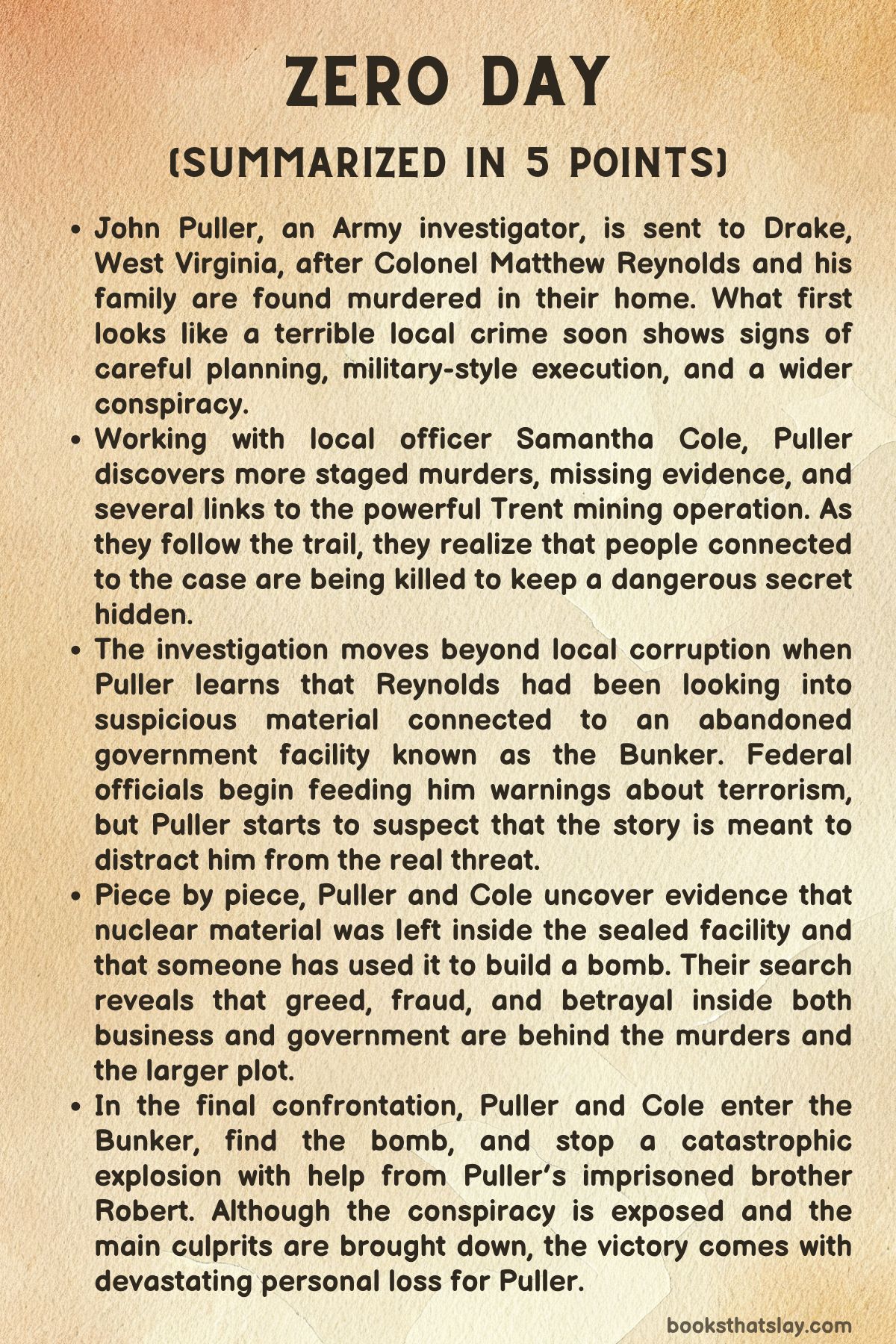
Army investigator John Puller is sent to the town of Drake, West Virginia, after Colonel Matthew Reynolds of the Defense Intelligence Agency is found murdered along with his wife and two children. The killings are brutal and carefully staged, which immediately suggests planning, discipline, and a message meant for someone to see.
Puller is assigned to the case under unusual circumstances. He is sent alone, without his usual support, which tells him from the start that powerful people want the investigation handled quietly.
When Puller arrives in Drake, he quickly sees that the town is worn down by the coal industry. The land is scarred, people are sick, and nearly everything revolves around the local mining empire run by Roger Trent.
Puller connects with Sergeant Samantha Cole, the local police officer leading the case. Their first meetings are professional and tense, but they quickly learn to respect each other.
Cole knows the town and its people. Puller brings discipline, forensic attention, and years of military experience.
At the murder scene, Puller notices that the family members were posed after death. There are signs they were questioned before being killed, and there are indications that the murders may have been recorded.
The case becomes even more alarming when Puller finds that a police officer assigned to guard the house has also been murdered. Someone returned to the crime scene, killed the officer, and escaped again.
This tells Puller and Cole that the killers are bold, organized, and determined to remove evidence.
The investigation soon expands when another pair of bodies is found in a house across the street. These victims, Eric Treadwell and Molly Bitner, are also arranged in a deliberate way.
Puller recognizes the precision of the execution style as consistent with military training. The house also contains a meth lab, which at first seems like it might explain the violence, but Puller senses that the drug operation is only one piece of a much larger picture.
As Puller and Cole begin tracing links among the victims, they find that Molly Bitner worked for Trent Exploration, Roger Trent’s mining company. That creates a possible connection between the murders and the mine, though in Drake almost everything leads back to Trent in one way or another.
Puller also learns that a package was delivered to the Reynolds home shortly before the murders. The killers appear to have returned to the house specifically to retrieve it.
This missing package becomes one of the earliest clues that the murders were not random and that Reynolds had obtained something important shortly before he died.
The package turns out to be related to a soil analysis report. Puller and Cole begin to suspect that Reynolds had been looking into possible environmental contamination tied to Trent Exploration.
At first, this seems plausible. The region has been damaged by mining, people have grown sick, and Trent is widely resented.
But Puller is not satisfied. Pollution fines and local corruption do not seem like enough to explain the number of murders, the military methods used, and the intense pressure coming from federal agencies.
While following leads in town, Puller begins to understand the people around Cole. Her younger brother Randy is angry, reckless, and unwell, suffering from chronic headaches.
Her sister Jean is married to Roger Trent, creating a painful divide in the family because the Coles blame Trent’s mining operations for their parents’ deaths. Cole herself is caught between loyalty to her town, frustration with its decay, and the burden of trying to protect people who often distrust her.
Puller also faces his own private burdens. He visits and speaks with his father, a once-famous military man now lost in dementia, and he continues to struggle with the shadow of his brother Robert, a brilliant scientist imprisoned for treason.
These family relationships add pressure to the investigation and reveal how deeply duty and emotional restraint define Puller’s life. Over time, Cole’s warmth and honesty begin to break through some of that isolation.
As the case grows, Puller receives information from Washington that changes its scale. Homeland Security, through a man named Joe Mason, claims that intelligence chatter points to a terrorist plot centered on Drake.
According to this theory, terrorists plan to attack a gas pipeline and then strike a nuclear plant during the chaos. Puller is told to stay focused and not alert the town, because any evacuation might scare the attackers away.
The warning is alarming, but Puller gradually becomes uneasy. Too much about the explanation feels convenient, and the evidence on the ground does not fit cleanly with the terrorism scenario.
Back in Drake, Puller and Cole continue working the local angle. Witness descriptions point toward Dickie Strauss, son of Bill Strauss, Trent Exploration’s chief operating officer.
Dickie is a troubled former soldier with ties to the meth operation, but when Puller corners him, Dickie denies involvement in the murders and explains that his Army discharge resulted from being exposed as gay under the old policy rather than from criminal conduct. Puller believes Dickie is hiding something, but not that he is the mastermind.
He recruits Dickie to quietly gather information, hoping to give him a chance to do something worthwhile.
Before Dickie can help much, he is shot dead by a sniper. Puller kills the attackers, only to find that they are American and military-trained, not foreign terrorists.
This is a turning point. It confirms that the story Mason told him is false or incomplete.
Someone is staging events and directing the investigation away from the truth.
The real breakthrough comes through a series of overlooked clues: old blueprints, an unposted blasting notice, a warning that mining blasts must never occur within a certain distance of the old concrete dome outside town, and mysterious references to numbers matching the atomic numbers of uranium and plutonium. Puller and Cole realize that the abandoned government facility known as the Bunker was once involved in nuclear weapons work.
Worse, it appears radioactive material was never fully removed. Reynolds must have learned something about the site, probably through Bitner and Treadwell, and that discovery got all of them killed.
Randy then reveals that he once found a way into the Bunker through an old mine passage and saw barrels stored inside. He had casually mentioned this to Dickie Strauss, which allowed the information to spread.
Puller contacts his imprisoned brother Robert, whose scientific knowledge becomes essential. Robert confirms that the materials and forensic traces point toward construction of a nuclear device.
Puller also speaks with a retired officer who once supervised work at the Bunker and learns that the site contained dangerous nuclear material linked to a powerful weapon design. The threat is now clear: someone has used the hidden material to build a bomb.
Puller and Cole enter the Bunker through an old ventilation route beneath the firehouse. Wearing protective gear, they move through the sealed underground structure and discover that plutonium is missing.
They also find Roger Trent tied up inside, along with company records, suggesting that he was being framed or discarded as part of the conspiracy. Nearby sits the bomb itself, already counting down.
With almost no time left, Puller turns again to Robert for guidance. Robert talks him through a desperate plan to disrupt the bomb’s detonation sequence.
Puller sets explosives as instructed while Cole refuses to abandon him. They drag Trent out through the shaft and barely escape before the device goes off.
The plan succeeds in preventing a full nuclear blast, but the explosion still destroys much of the dome. Trent dies in the escape, and then tragedy strikes harder: Sam Cole is killed by falling debris.
For Puller, who has spent much of his life holding emotion in check, her death breaks something open. He finally cries for a fallen comrade and for the woman who had changed him.
In the aftermath, Puller tracks Bill Strauss to South America and forces him to cooperate. Strauss reveals the broader plot.
He had been the real power behind Trent Exploration and had been stealing money. Joe Mason, the Homeland Security official, was his partner.
Together they planned to profit from stolen nuclear materials while disguising their actions as terrorism. Bitner and Treadwell discovered too much.
Reynolds was brought in and then silenced. The Reynolds family, the neighbors, the police officer, and Dickie all died because they were connected to pieces of the truth.
Back in Washington, Puller confronts Mason. Mason confirms enough through his rage and threats, but Puller has already prepared.
Army forces arrive, Mason’s men are taken down, and the conspiracy is finally exposed.
The novel ends on a quieter note. Puller attends Cole’s funeral and learns that Randy’s headaches come from a brain tumor.
Jean considers leaving for Italy to begin a new life. Puller visits Robert, who helped save the country but remains in prison.
Puller then leaves with no fixed destination, carrying grief, hard-earned clarity, and the knowledge that Sam Cole made him stronger, more human, and more willing to feel what he had spent years forcing down.
Characters
John Puller
John Puller stands at the center of Zero Day as a man shaped by discipline, war, and emotional restraint. He is highly observant, methodical, and relentless, and these traits make him effective as an investigator from the moment he enters Drake.
He notices details others miss, reads physical evidence with military precision, and refuses to let local politics or federal pressure dictate his judgment. His combat background gives him practical skills, but it also leaves him carrying deep psychological damage.
He measures people carefully, controls his reactions, and moves through danger with the hard focus of someone who has already survived too much. What makes him compelling is that his competence is never presented as ease.
Every success seems to come with an emotional cost.
His inner life is defined by suppression. He comes from a family that has trained him to value toughness above vulnerability, and he has absorbed that code so completely that he struggles to express grief, affection, or uncertainty.
His father’s decline and his brother’s imprisonment have left him cut off from the two most powerful relationships in his life, and his response has been to become even more controlled. Yet the case in Drake slowly changes him.
Through Sam Cole, he is drawn back toward feeling, responsibility beyond duty, and the possibility of connection. By the end, he is still the same strong investigator, but no longer emotionally sealed off.
His grief becomes the clearest sign of growth.
Sam Cole
Sam Cole is one of the most grounded and human characters in the novel. As the local law officer in Drake, she carries the weight of a town that is economically damaged, socially tense, and deeply compromised by the influence of wealth and industry.
She is capable, proud, and committed to doing her job well, even when she lacks resources and works among men who do not always respect her authority. Her professionalism shows in how quickly she steadies herself after moments of emotion, but that same control should not be mistaken for coldness.
She feels deeply, especially when violence touches people she knows, and that combination of strength and feeling makes her morally impressive.
Cole also gives the story its strongest connection to place. Through her, the town becomes more than a setting; it becomes a damaged community with memory, resentment, and buried pain.
Her family history ties her personally to the destruction caused by mining, and that history explains both her anger and her loyalty. She understands what power has done to Drake, but she has chosen not to leave.
Her growing bond with Puller is convincing because it is based on recognition. She sees his burdens even when he hides them, and he sees her courage without reducing her to sentiment.
Her death is devastating because she represents integrity, emotional openness, and the possibility of a better future.
Robert Puller
Robert Puller functions as both an absence and a powerful presence. He is physically confined in prison after a conviction for treason, yet he remains central to John Puller’s emotional life and to the story’s intellectual resolution.
His silence about his guilt or innocence creates tension from the beginning. He refuses to answer his brother directly, not because he is evasive by nature, but because he understands the ethical and emotional complications such an answer would create.
This makes him a frustrating figure, but also a disciplined one. He is not merely a fallen genius; he is someone who still thinks carefully, guards others even from inside a prison cell, and remains aware of the consequences of every word.
What defines Robert most strongly is his intellect. When the investigation turns toward nuclear materials and weapon design, he becomes indispensable.
His scientific expertise helps Puller understand the true scale of the threat, and ultimately helps prevent catastrophe. That role gives him a complicated dignity.
He is a disgraced man in the eyes of the system, yet at the decisive moment he contributes more to national safety than many of those still in uniform. His relationship with John is marked by pain, loyalty, and unfinished questions.
Their bond survives disappointment, shame, and distance, suggesting that family in this story is rarely simple but never entirely broken.
John Puller Sr.
John Puller Sr. embodies the destructive side of military idealism. Once a celebrated officer, he now lives in mental decline, his dementia trapping him in fragments of past commands and imagined conversations.
He is still powerful in his son’s mind, but that power is mixed with bitterness. He represents the old code of masculine hardness that shaped John and Robert, a worldview built on command, emotional denial, and impossible standards.
Even in illness, he remains imposing because his presence continues to define how his sons think about duty, failure, and love.
What makes him significant is the contrast between public greatness and private damage. John remembers him as brilliant in war but harsh, self-justifying, and emotionally punishing at home.
He cannot fully stop loving him, but he also cannot avoid seeing the selfishness and cruelty that were always there. The father’s collapse strips away any heroic myth and leaves behind a man who contributed to the emotional wounds of his family.
Through him, the novel examines how strength can become tyranny inside a household. He is tragic, but not idealized.
His decline hurts John because it takes away the chance for repair while leaving the old injuries untouched.
Roger Trent
Roger Trent is the public face of wealth and power in Drake. He presents himself as a self-made success, a man who believes he has earned everything and owes nothing beyond the jobs his company provides.
He is arrogant, dismissive, and deeply insulated from the suffering around him. The environmental ruin, illness, and resentment caused by his mining empire do not alter his self-image.
He interprets criticism as envy and sees inequality as proof of natural hierarchy. That worldview makes him more than an ordinary rich antagonist; he becomes the human expression of a system that excuses exploitation by calling it progress.
At the same time, Roger is not the novel’s final mastermind, and that matters. His moral ugliness is real, but he is also vain, limited, and less in control than he appears.
He has profited from the destruction of the region and ignored the human cost, but he is also manipulated and eventually discarded by those close to him. This shift makes him a useful study in corrupt power.
He is dangerous because he normalizes damage, not because he is the cleverest man in the room. His end is fittingly bleak.
He becomes just another casualty of the greed and secrecy that his world helped create.
Jean Trent
Jean Trent is one of the most layered supporting characters because she exists between worlds. She is Sam Cole’s sister and Roger Trent’s wife, which places her between family loyalty and social elevation.
She has access to comfort and status, yet she is never fully at ease in that role. Her sharpness, flirtation, and social confidence can initially make her seem superficial or manipulative, but over time she reveals more complexity.
She is aware of the moral rot around her, though not always strong enough to confront it directly. Her independence shows in her dream of building a life separate from Roger’s money and identity.
Jean’s importance lies in her ambiguity. She keeps the reader and Puller uncertain for much of the story, which reflects her uncertain position within the town itself.
She is not innocent in a pure sense, because she has benefited from power, but neither is she fully corrupted by it. Her loyalty to Sam remains real even when their lives have taken opposite paths.
By the end, she becomes one of the few surviving figures capable of choosing a different future. That possibility gives her character a quiet redemptive force.
Randy Cole
Randy Cole appears unstable, reckless, and abrasive, but those qualities hide a more tragic reality. He is a damaged man carrying grief, resentment, illness, and class anger.
He has grown up in the shadow of environmental destruction and personal loss, and his bitterness toward Roger Trent is rooted in real injury rather than simple jealousy. His chronic headaches, erratic behavior, and taste for provocation make him easy to dismiss, and the novel uses that impression to keep him under suspicion.
Yet he turns out to be less a villain than a wounded product of his environment.
Randy’s significance increases when his knowledge of the Bunker becomes clear. He has stumbled onto the truth without understanding its scale, and his casual sharing of that knowledge helps set larger events in motion.
That detail captures something important about his character: he is not powerful enough to shape the system, but his life is deeply entangled in its consequences. His eventual diagnosis casts his earlier behavior in a more painful light.
What first looks like carelessness is partly the result of severe illness. He becomes a figure of wasted possibility, someone whose anger is justified but whose life has been eroded by forces much larger than himself.
Bill Strauss
Bill Strauss is the most coldly calculating figure in the story. While Roger Trent represents visible power, Strauss represents hidden control.
He is calm, managerial, and outwardly respectable, which allows him to move through the town’s structures without attracting the same resentment as Trent. That surface makes him more dangerous.
He is not driven by pride in the way Roger is; he is driven by opportunity. He understands systems, finances, and the weaknesses of other people, and he uses that knowledge to manipulate events for personal gain.
His treatment of his son reveals the emptiness at his core. Dickie is not a person to him but an embarrassment, a failed project, and eventually a disposable risk.
That absence of paternal feeling mirrors his wider lack of moral boundaries. He can embezzle, betray partners, frame others, and become part of a scheme involving nuclear material because he sees human relationships only through usefulness.
Even his eventual cooperation is not repentance but self-preservation. He is a study in the ordinary face of evil: polished, rational, and entirely without conscience.
Dickie Strauss
Dickie Strauss begins as a suspicious and physically threatening figure, but he develops into one of the more sympathetic casualties of the story. His rough exterior, association with drugs, and tense behavior encourage assumptions about guilt, yet his history reveals a more complicated man.
His military discharge for being gay under an unjust policy adds a painful social dimension to his character. He was not rejected because he lacked courage or loyalty, but because the institution chose prejudice over fairness.
That history helps explain both his defensive aggression and his sense of wasted identity.
What makes Dickie memorable is the possibility of redemption that appears just before his death. Puller recognizes that Dickie is not beyond saving and gives him a role in the investigation, offering him a chance to serve with purpose again.
That choice briefly lifts the character out of suspicion and into moral complexity. His murder is effective because it cuts off transformation.
He dies before he can prove what he might have become. His story exposes the cruelty of both his father and the wider systems that failed him.
Joe Mason
Joe Mason is the face of corrupted federal authority. Unlike Roger Trent or Bill Strauss, he operates from inside the national security structure, which makes his betrayal especially dangerous.
He uses fear, secrecy, and the language of counterterrorism to misdirect Puller and manipulate the investigation. By inventing or distorting a terrorist threat, he turns patriotism into cover for profit.
That deception gives the plot much of its political edge. The danger does not come only from hostile outsiders; it also comes from insiders willing to exploit national institutions for personal gain.
Mason is arrogant, but his arrogance differs from Trent’s. He believes his position shields him, and he acts with the confidence of someone who assumes the system can be bent without consequence.
He has no real loyalty to country, only to access and advantage. His role broadens the moral field of Zero Day by showing that corruption is not local only.
The poisoned town and the hidden bunker connect to a national failure of accountability. Mason is the clearest symbol of that larger rot.
Matthew Reynolds
Colonel Matthew Reynolds is dead before the main investigation begins, yet his character matters because his actions set the story in motion. He appears to have been responsible, intelligent, and willing to pursue something troubling even when he did not fully understand it.
He did not ignore the warning signs he encountered in Drake, and his attempt to investigate them suggests moral seriousness. He becomes important partly through contrast: where others in the system avoid risk, conceal facts, or protect themselves, Reynolds moved toward the truth.
His murder alongside his family also gives the story much of its emotional and ethical force. He is not only a victim but a reminder that the conspiracy destroys decent people first.
Because he was connected to national defense, his death carries institutional weight, but the inclusion of his wife and children prevents the case from becoming abstract. The crime is not just strategic; it is intimate and cruel.
Reynolds remains a measure of what honest service should look like.
Molly Bitner
Molly Bitner at first seems like a minor victim, but she becomes central to understanding how truth began leaking out. As an employee with access to office materials and routines, she occupies an in-between position: not powerful enough to control information, but close enough to notice irregularities.
Her likely discovery of suspicious documents or activity makes her dangerous to those in control. That role reflects a recurring pattern in the story, where people on the margins of power often see more than those at the top.
Her death also highlights the vulnerability of ordinary workers caught in criminal systems they did not create. She is not a soldier, investigator, or executive.
She is someone whose access and curiosity appear to have pushed her into a deadly conspiracy. The staging of her body strips away individuality in death, which is precisely why remembering her role matters.
She becomes one of the clearest examples of how greed and secrecy consume people with the least protection.
Eric Treadwell
Eric Treadwell is linked to the meth world and initially seems easier to dismiss, but his importance grows as the investigation progresses. He appears to have been technically useful to the conspirators, likely helping manufacture specialized parts without fully understanding their purpose.
His skills made him valuable, but his social position made him expendable. Once he and Molly Bitner began to suspect the larger truth, he became a liability.
Treadwell represents misused labor and compromised intelligence. He is neither fully innocent nor truly in control.
His involvement in drugs and crime does not erase the fact that others manipulated his abilities for far darker purposes. He is a reminder that moral categories in the novel are often mixed.
People can be flawed, compromised, and still become victims of something far worse than their own mistakes.
Julie Carson
General Julie Carson represents institutional weakness rather than outright villainy. She is ambitious, intelligent, and clearly aware of military expectations, yet when confronted with uncertain but alarming information from Reynolds, she hesitates and then conceals.
Her failure is not born of malice but of self-protection. She sees the potential consequences for her career and chooses silence.
That choice costs lives, even if indirectly.
What makes her interesting is that the novel does not reduce her to a simple coward. She is ashamed, emotionally shaken, and aware that she failed her duty.
Puller’s decision not to destroy her career completely reflects his understanding that institutions are made up of imperfect people who sometimes fail under pressure. Carson stands as a portrait of compromised honor.
She is not corrupt in the same way Mason is, but her weakness creates space for corruption to thrive.
Howard Reed
Howard Reed, the rural mailman who discovers the first murders, represents the ordinary local resident crushed by the conditions of the region. His body has been damaged by the same environment that sustains the local economy, and even his private complaints are restrained by fear of appearing disloyal to the only industry keeping the town alive.
He is not central to solving the case, but he is central to understanding the world in which the case occurs.
His brief role captures the social paralysis of Drake. He sees horror, carries information, and tries to help, yet he remains a vulnerable man in a system far beyond him.
Through him, the story shows how entire populations can be made dependent on structures that are also destroying them. He gives the setting moral texture and grounds the larger conspiracy in everyday suffering.
Louisa
Louisa, the motel owner, appears only briefly, but she has symbolic value. Puller saves her when she suffers a medical emergency, and her later death affects him more than might be expected from such a short acquaintance.
She becomes one more person he could not ultimately protect, linking the case to his lingering wartime guilt. Her presence also adds a note of local fragility.
She is part of the dwindling human infrastructure of the town, an older resident carrying on in hard conditions.
Her death matters because it triggers reflection in Puller. He is forced again to confront the limits of skill and effort.
Not every life can be saved by competence. That truth runs throughout the novel and becomes devastating by the end.
Kristin Craig
Kristin Craig serves as a supporting figure from the forensic side of the investigation. She is efficient, intelligent, and useful in translating physical traces into meaningful leads.
Her role helps establish Puller’s connection to a larger professional network beyond Drake, and she provides crucial technical findings that move the case forward, especially when microscopic evidence begins pointing toward sophisticated weapon components.
Though she is not deeply developed emotionally, her importance lies in reliability. In a story filled with deception, compromised authority, and concealed motives, she represents professional clarity.
She helps keep the investigation tethered to evidence rather than speculation.
David Larrimore
David Larrimore enters late, but he is essential in unlocking the truth of the Bunker. As a retired officer and engineer connected to the original facility, he brings historical memory that the present-day authorities either ignored or buried.
He confirms that the danger is real and that the government failed to fully clean up what it left behind. His role turns rumor and suspicion into confirmed reality.
Larrimore represents the afterlife of secret government work. He is a witness from an earlier era whose knowledge becomes urgent again because institutions failed to take responsibility for their past.
Through him, the story connects present disaster to historical negligence.
Themes
Power Without Accountability
In Zero Day, power is shown less as open domination than as the ability to act without consequences for a very long time. Roger Trent damages land, shapes the local economy, and influences public life because wealth allows him to define what counts as acceptable harm.
Bill Strauss turns corporate authority into a private weapon, hiding theft and directing violence from behind a respectable title. Joe Mason pushes this pattern further by using national security language to protect criminal ambition.
The theme becomes especially strong because these figures do not begin as obvious monsters. They work inside institutions that are supposed to create order: business, law enforcement, government, defense.
The danger lies in how easily these institutions can be bent when no one is willing to challenge them. The town of Drake lives with the accumulated result of that imbalance.
People get sick, evidence disappears, fear spreads, and truth becomes difficult to separate from manufactured stories. Accountability arrives only through extraordinary persistence and personal risk, which suggests that systems alone are not enough to restrain abuse once power stops recognizing moral limits.
Duty and Moral Choice
Duty appears throughout the novel, but it is never presented as a simple matter of obeying orders. John Puller is trained to follow structure, keep control, and complete the mission, yet the story repeatedly places him in situations where official instructions conflict with what is right.
He is told to stay quiet, to narrow his focus, and to trust federal judgment, but evidence forces him toward independent moral decisions. Sam Cole faces a similar struggle.
She is responsible to the law, to her town, and to her own conscience, and those obligations do not always align. What gives this theme force is the contrast between formal duty and ethical duty.
Some characters serve institutions while betraying the values those institutions claim to defend. Others break rank or take personal risks in order to protect innocent lives.
The story suggests that true service is not blind loyalty but the willingness to choose principle over convenience. That idea also shapes Puller’s relationships with his father and brother.
One inherited a hard code of service, the other fell from official honor, yet both force Puller to reconsider what loyalty actually means.
The Human Cost of Extraction and Neglect
The damaged landscape of Drake is not background decoration. It reflects the long-term cost of treating land and people as resources to be consumed.
Mining has scarred the mountains, polluted water and air, and left illness behind, but the social damage is just as severe. People remain tied to the industry because it provides jobs, even as it destroys the conditions of a livable future.
This produces a painful moral trap in which survival depends on the same forces causing decline. The deaths, sickness, addiction, and bitterness seen throughout the town grow from that environment.
Even family relationships are warped by it, as shown in the Cole family’s grief and anger toward Roger Trent. The abandoned government facility extends the same logic from private industry into the state: dangerous material was hidden, sealed away, and forgotten rather than responsibly handled.
The result is a world where damage accumulates quietly until it becomes catastrophic. The theme works because it refuses to separate environmental ruin from emotional and social ruin.
The poisoned land mirrors poisoned institutions, and both leave ordinary people carrying consequences they did not choose.
Emotional Repression and the Need for Connection
Much of the story’s emotional weight comes from characters trying to survive by hardening themselves. John Puller has been trained by family culture and military life to remain calm, silent, and self-contained.
He treats feeling as a weakness because that is how he was taught to endure. Yet the narrative steadily reveals the cost of this strategy.
His father’s emotional brutality, his brother’s distance, and the losses from war have left him capable but isolated. Sam Cole becomes important not simply as a partner in the case but as someone who allows him to re-enter emotional life without losing strength.
She is competent and resilient, yet she does not pretend that grief and fear can be erased through discipline alone. Their growing connection shows that vulnerability is not the opposite of courage.
It is part of what makes courage meaningful. This theme reaches its fullest expression at the end, when Puller finally breaks through his long-trained restraint and openly grieves.
That moment matters because it does not weaken him. It makes him more complete.
The novel argues that endurance without feeling turns into emptiness, while connection gives duty a human purpose.