Zorro Summary, Characters and Themes
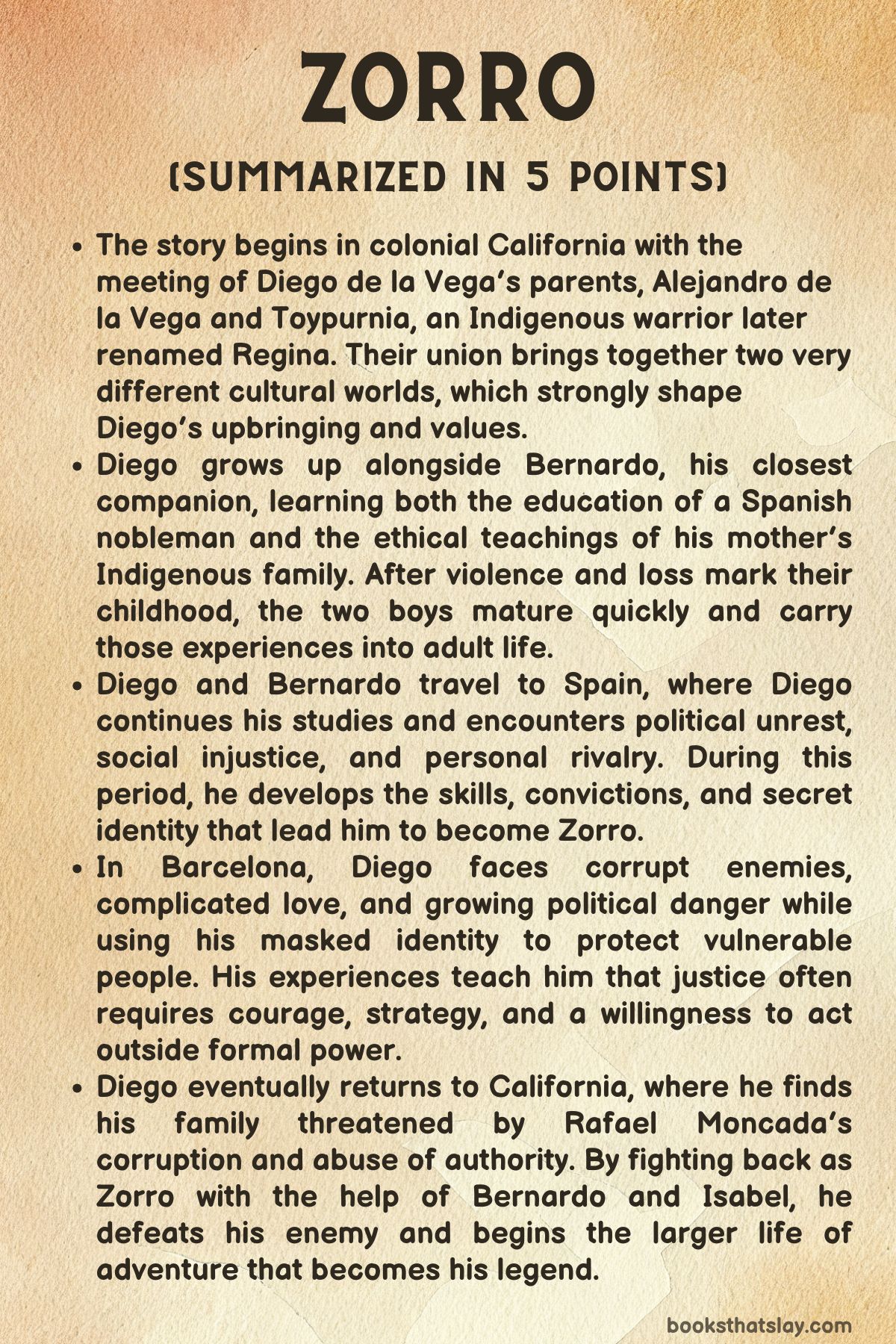
Zorro by Isabel Allende is a historical adventure novel that reimagines the origin of one of fiction’s most famous masked heroes. Set across colonial California, Barcelona during the Napoleonic era, and the wider Spanish world, the novel follows Diego de la Vega from birth to the moment he becomes Zorro.
Allende gives the legend a fuller human background by showing Diego as the child of two cultures, shaped by both Spanish aristocratic training and Indigenous wisdom. The result is a story about identity, injustice, loyalty, and courage, where the famous hero’s mask grows naturally out of his family history, friendships, losses, and moral awakening. The original title of the book is El Zorro: comienza la leyenda.
Summary
The story is presented as a true account written by Isabel de Romeu, who wants to preserve the life of Diego de la Vega from rumor and distortion. Before Diego is born, the novel explains how his parents came together in California at the end of the eighteenth century.
Padre Mendoza oversees the San Gabriel mission and tries to maintain order as conflict grows between Spanish authorities and Indigenous communities. A rebellion rises under a leader known as Chief Gray Wolf.
After a fierce confrontation, the Spanish discover that this feared leader is actually a young woman named Toypurnia, also called Daughter-of-Wolf, the daughter of an Indigenous healer and a Spanish deserter. Her mixed heritage saves her from execution.
Alejandro de la Vega, a military officer, becomes captivated by her beauty and spirit, and after she is granted clemency, she is baptized and renamed Regina María. In time, Alejandro proposes to her, and they marry.
They settle in Los Angeles, where Alejandro becomes a landowner and public official. Their marriage joins two different worlds but does not fully erase the distance between them.
Regina never abandons the deeper parts of her Indigenous identity, even while living as the wife of a Spanish gentleman. When their son Diego is born, another child, Bernardo, is born the same day to Ana, Regina’s friend.
The boys are raised almost as brothers from infancy and share a bond that shapes both their lives.
Diego grows up between cultures. His father gives him the education of a Spanish nobleman, teaching him manners, discipline, and the expectations of rank.
His mother and her family introduce him to Indigenous traditions, spiritual teachings, and a code of honor rooted in justice, dignity, and courage. White Owl, Regina’s mother, becomes an especially strong influence.
Diego and Bernardo explore the natural world together, learn secret places near the hacienda, and absorb lessons that teach them to value more than power or status. Diego is lively, curious, and drawn to risk from an early age, and Bernardo matches him in loyalty and daring.
Childhood gives way to tragedy when pirates attack the hacienda. The assault leaves lasting damage.
Regina and Diego are wounded, and Ana is brutally killed after hiding Bernardo. The event deeply shocks the household and changes Bernardo forever.
After witnessing his mother’s death, he stops speaking. Though he never regains his voice, he develops other forms of communication and becomes even more observant and inwardly strong.
His silence does not weaken his bond with Diego; it deepens it.
As the boys enter adolescence, they continue their education while becoming more aware of the world’s cruelty. Diego sees the injustice inflicted on Indigenous people and learns that legal authority does not necessarily protect the weak.
During a demanding rite of passage guided by White Owl, both boys experience visions that reveal something essential about themselves. Bernardo sees a horse as his guiding spirit.
Diego sees a fox, zorro in Spanish. The image foreshadows the identity that will later define him.
By the time he is fifteen, his father decides he should complete his education in Spain, and Bernardo goes with him.
In Barcelona, Diego enters a larger and more troubled world. Spain is under French occupation, and politics are unstable and violent.
Diego lives with Tomás de Romeu and meets his daughters, Juliana and Isabel. He quickly becomes infatuated with Juliana, whose beauty and poise seem to embody all his romantic hopes.
Isabel, however, forms a more natural and enduring connection with him and Bernardo. Intelligent, spirited, and perceptive, she becomes one of the most important people in Diego’s life, though he does not fully recognize this at first.
Diego studies at school and trains seriously in fencing under Manuel Escalante. He also begins to confront political complexity.
In Spain, there is no simple division between good and evil. The French occupiers commit abuses, but the Spanish resistance is also capable of cruelty.
Diego learns that loyalty to justice cannot always be the same as loyalty to a flag or faction. He also meets powerful figures such as Rafael Moncada, Juliana’s wealthy and arrogant suitor, and Le Chevalier, a leading French official.
Diego dislikes Moncada immediately and sees in him vanity, ambition, and moral weakness.
His rivalry with Moncada intensifies after Moncada insults Bernardo. Diego challenges him to a duel and humiliates him rather than killing him, showing both his pride and his sense of restraint.
Around the same time, Diego becomes involved with the Romani community in Barcelona and forms a relationship with a young woman named Amalia. Through these experiences, his sympathy for outsiders and oppressed people grows stronger.
The turning point in Diego’s life comes through Manuel Escalante, who reveals that he belongs to a secret organization called La Justicia, dedicated to fighting oppression. Diego is tested, accepted into the group, and given the name Zorro.
The fox from his vision now becomes a deliberate identity. When Romani prisoners are condemned by French authorities, Diego acts for the first time in disguise, using a black costume, a mask, speed, and cunning to force their release.
He leaves behind the mark of the letter Z, and stories begin to spread. Zorro is no longer just an idea.
He has entered the world.
As events in Spain move forward, Moncada continues plotting to marry Juliana by manipulation rather than love. He stages a false rescue to make himself appear heroic, but the deception is exposed.
Later, when he plans a crackdown against the Romani, Diego as Zorro helps them escape. Bernardo, meanwhile, receives word from California that Light-in-the-Night, the young woman he loved, may have borne his child.
He returns home, but before leaving he warns Diego not to let Zorro consume the person beneath the mask. This warning becomes one of the novel’s key insights: the hero must remain human.
Political changes then make Spain even more dangerous. Ferdinand VII returns to power, repression increases, and Tomás de Romeu is arrested for treason.
Juliana and Isabel are left vulnerable. Diego tries to save their father, but cannot prevent his execution.
Before dying, de Romeu reveals that Moncada betrayed him as part of a scheme to force Juliana into dependence. Moncada’s corruption becomes unmistakable.
When he later attempts to force himself on Juliana, Diego and Isabel intervene. With Nuria’s help, they trap him long enough to flee the city.
Diego escapes Spain with Juliana, Isabel, and Nuria, traveling in disguise. On the journey they reconnect with the Romani and receive help from old allies.
Diego acquires a new sword, which he names Justine because he wants it to serve righteous causes. They eventually secure passage across the Atlantic, but the voyage goes badly.
Storms batter the ship, and then pirates led by Jean Lafitte capture it. Diego and his companions are taken to Lafitte’s base near Louisiana.
Captivity turns unexpectedly complicated. Lafitte treats them less like prisoners than honored hostages.
Juliana becomes drawn to him, and the emotional balance among the group shifts. Diego is hurt by her growing attachment to the pirate, especially because he still loves her.
When enslaved Africans are brought to the island, Juliana and Isabel insist on using their hidden jewels to purchase freedom for them. Their action moves Lafitte, who releases everyone.
Yet Juliana chooses to remain with Lafitte and eventually marry him, ending Diego’s long devotion to her.
Diego, Isabel, and Nuria continue on to California, where Bernardo rejoins them. They learn that the situation at home has become dire.
Regina has returned to her Indigenous roots. Alejandro de la Vega has been imprisoned on false charges.
Moncada has arrived in California as a royal representative and is using power for personal gain, including an illegal pearl operation worked by enslaved Indigenous laborers. Once again Diego faces the same enemy, now with even greater authority.
Back in the sacred caves of his childhood, Diego fully joins his past to his present. He asks Bernardo to become his partner, and they prepare to fight together.
Bernardo introduces him to Tornado, the horse that fulfills the vision from his initiation. Diego then begins a campaign against Moncada and his allies.
Disguised as a priest, he enters the prison where his father is held. As Zorro, he stages an escape, frees prisoners, exposes corruption, and recovers the stolen pearls.
He also brings the wealth to Padre Mendoza so some justice can be restored to what Moncada has damaged.
Moncada suspects Diego, arrests him, and tries to force the truth from him. But the Zorro identity now belongs not only to Diego.
Another masked figure appears and helps him escape. Later it is revealed that Isabel has discovered his secret and even taken up the disguise herself.
Diego defeats Moncada, forces him to sign a confession, and drives him out of California. At the end, Diego, Bernardo, and Isabel commit themselves to continue the fight against injustice together.
In the epilogue, Isabel reveals what happened in the years that followed. Diego’s life includes more adventures, marriages, and losses, but the legend endures because the values behind it endure.
Zorro is not only a masked avenger. He is the result of Diego’s upbringing, his divided inheritance, his friendship with Bernardo, and his decision to use privilege, skill, and imagination in defense of those denied power.
Characters
Diego de la Vega / Zorro
Diego stands at the center of Zorro as a character shaped by contradiction, discipline, imagination, and moral growth. He is born into privilege as the son of Alejandro de la Vega, yet his deepest lessons come not from rank or inheritance but from the Indigenous world of his mother and grandmother.
This dual formation is what gives him unusual depth. From his father, he learns refinement, swordsmanship, and the social confidence of a young aristocrat.
From his mother’s side, he learns honor as a living principle rather than a social ornament. Justice, respect, courage, and dignity become part of his inner code long before he adopts a mask.
As a boy, he is restless, theatrical, and drawn to adventure, but these traits gradually develop into strategic intelligence. His talent is not only physical bravery but performance: he knows how to read fear, manipulate appearances, and use style as a weapon.
What makes Diego compelling is that his transformation into Zorro is not sudden. It grows out of wounds, political awakening, and increasing awareness of cruelty.
He sees violence against Indigenous communities, the limitations of official law, the abuse of power in Spain, and the vulnerability of people without protection. He does not become heroic because he is flawless; he becomes heroic because he refuses passivity.
At the same time, he is not presented as pure virtue. He can be vain, impulsive, romantic, and occasionally blinded by desire, especially in his attachment to Juliana.
His duel with Moncada shows both his pride and his need to dominate morally as well as physically. Even after he becomes Zorro, he risks letting the role overtake the person beneath it.
Bernardo’s warning matters because Diego enjoys the freedom, force, and symbolism of the mask. The disguise lets him act on ideals that ordinary social life cannot contain.
His development therefore involves learning balance. He must remain a man with human ties rather than becoming only a legend.
By the end, Diego is more mature because he has learned that justice is collective, not solitary. He needs Bernardo, Isabel, his mother, and others.
He also learns that love does not always fulfill fantasy, that power often hides behind legality, and that identity can be chosen as much as inherited. Zorro becomes the outward form of Diego’s inner synthesis: Spanish and Indigenous, noble and outlaw, theatrical and disciplined, personal and political.
The character endures because he joins action with conscience.
Bernardo
Bernardo is one of the novel’s most important moral presences, and his silence gives him unusual narrative force. Born on the same day as Diego and raised beside him, he begins as a companion in childhood adventure, but he grows into something more profound: witness, protector, strategist, and emotional anchor.
His muteness, caused by the trauma of seeing his mother murdered, changes the direction of his life without reducing his strength. Instead of becoming a figure defined by loss alone, he develops heightened perception and self-command.
He listens more deeply than others, notices danger early, and often understands motives with a clarity that speech would only slow down. The world may treat him as socially inferior because of his birth and status, yet the novel quietly reverses that hierarchy by showing his steadiness, loyalty, and intelligence.
Bernardo’s relationship with Diego is central because it is built on affection but also marked by inequality. They are bound like brothers, yet society insists on casting Bernardo as servant and subordinate.
This tension matters because it exposes the injustice built into the colonial order. Bernardo loves Diego, but he is never merely an extension of him.
He has his own pain, desires, and future. His connection to Light-in-the-Night and later to his son gives him an emotional life independent of Diego’s story.
He also serves as an ethical counterweight. Where Diego is dramatic and impulsive, Bernardo is measured.
Where Diego risks identifying too fully with the heroic role, Bernardo reminds him that the mask is useful only if the self behind it remains whole.
His silence also has symbolic power. Bernardo represents those whom history often forces into quietness: the colonized, the socially marginal, the traumatized.
Yet the novel refuses to treat silence as absence. Bernardo acts, chooses, loves, warns, rescues, and participates in shaping events.
When he joins Diego in the Zorro mission, he confirms that justice is not the work of one charismatic man but of shared courage. He gives the legend durability because he provides its discipline.
Without him, Diego might remain only a brilliant performer. With Bernardo beside him, the mission gains loyalty, memory, and emotional truth.
Regina / Toypurnia
Regina, originally Toypurnia, is one of the richest embodiments of divided identity in the novel. She begins as the feared leader of an Indigenous uprising, carrying both spiritual authority and political force, and later becomes a baptized Christian wife within Spanish colonial society.
Yet this movement is never presented as a full surrender of self. Even when renamed and absorbed into elite domestic life, she remains inwardly tied to her people, their rituals, and their values.
Her life is marked by adaptation rather than assimilation. She learns how to survive within a system built on conquest, but she never entirely belongs to it.
That inner distance eventually becomes one of the defining truths of her marriage and her motherhood.
As Diego’s mother, she plays a decisive role in his formation. She is the channel through which he receives an alternative moral vocabulary, one not based simply on law, church, or social rank.
Through her, he enters a world where courage has spiritual meaning and where community, memory, and respect are inseparable. Regina’s commitment to taking Diego and Bernardo to her mother’s village shows quiet resistance.
She refuses to let her son grow up with only the worldview of his father’s class. That act alone gives Diego the moral complexity that later becomes essential to his identity as Zorro.
Her marriage to Alejandro is tender at first but gradually reveals the strain of crossing cultures under unequal conditions. Alejandro loves her, but he cannot fully understand what her origins mean or what she has lost.
Regina’s life in the hacienda is therefore marked by emotional dislocation. She is admired, desired, and protected, yet also constrained.
After years of compromise, she returns to her Indigenous identity more openly, reclaiming Toypurnia. This return is not regression but recovery.
It shows that the self imposed by colonial institutions cannot erase the earlier one. As a character, she gives the story historical and emotional gravity.
She embodies loss, endurance, and cultural continuity, and she ensures that Diego’s heroism grows from a lineage broader than aristocratic romance.
Alejandro de la Vega
Alejandro is proud, capable, ambitious, and deeply shaped by the colonial order he serves. As a soldier and later a landowner and local authority, he represents Spanish power in California, yet he is not reduced to caricature.
He can be brave, affectionate, and sincere, and his love for Regina is genuine even if it is mixed with idealization. He saves her from death, marries her impulsively, and wants to build a stable, prosperous household.
He also gives Diego discipline, education, and confidence. These qualities make him an important paternal force rather than a simple obstacle.
At the same time, Alejandro’s limitations are central to his characterization. He believes in order, hierarchy, and legal authority, but the novel repeatedly shows that these structures are tied to injustice.
His position prevents him from acting decisively against the exploitation of Indigenous people, and this failure becomes formative for Diego. Alejandro is not cruel in the manner of Moncada, yet he benefits from and upholds a system that normalizes dispossession.
His inability to see beyond the framework of his class creates distance between him and Regina, whose inner allegiance to her people never disappears. Their marriage therefore carries the tension of affection without true equality.
His later persecution by Moncada gives his character another dimension. Once a representative of official power, he becomes one of its victims.
His imprisonment exposes how fragile status can be when corruption controls the law. This reversal deepens the political meaning of the novel.
Alejandro’s suffering forces Diego to confront the fact that institutions his father trusted can become instruments of tyranny. In that sense, Alejandro is essential to Diego’s evolution.
He gives Diego the world of rank and discipline, but his downfall also teaches Diego that justice cannot depend on office alone. Alejandro is thus both inheritance and warning.
White Owl
White Owl is one of the strongest spiritual and ethical influences in the novel. As healer, elder, and guardian of cultural knowledge, she represents continuity with an older order that colonial rule has not destroyed.
Her power is never framed as decorative mysticism. It is practical, intellectual, and moral.
She heals bodies, reads character, protects memory, and guides rites of passage. In a narrative full of soldiers, officials, priests, and political conspirators, White Owl offers another kind of authority, one grounded in wisdom rather than rank.
She is one of the few characters who sees Diego clearly from the beginning, understanding his gifts without romanticizing them.
Her importance lies partly in what she teaches the younger generation. Through her, Diego and Bernardo are introduced to a code that values honor and justice as lived commitments.
She helps shape not only what Diego can do, but what he believes power should be used for. The spiritual trial she oversees is especially significant because it frames identity as revelation and responsibility.
Diego’s vision of the fox gains meaning because White Owl provides the interpretive world in which such a vision matters. She gives his later transformation symbolic depth.
White Owl also serves as a corrective to colonial assumptions. Characters like Mendoza may imagine themselves as educators and civilizers, but White Owl embodies a knowledge system older, subtler, and in many ways more humane than theirs.
She quietly resists the erasure of Indigenous values by preserving them in family, ritual, and memory. Even when history grows harsher, her presence suggests that cultural endurance is itself a form of resistance.
She is not loud, but her influence extends across the whole narrative through Diego, Regina, Bernardo, and the moral direction of the story itself.
Padre Mendoza
Padre Mendoza is a layered figure because he combines paternal concern, institutional authority, religious certainty, and practical decency. He is introduced as a mission supervisor who believes he is bringing civilization and justice to Indigenous people, and that belief reveals both his sincerity and his blindness.
He is not malicious; he wants order, prosperity, and moral stability. Yet his framework remains deeply paternalistic.
He cannot fully understand the people he claims to help because he sees them through the assumptions of colonial Christianity. This makes him both admirable and limited.
His relationship with Diego is important because he becomes one of the boy’s teachers, helping shape his formal education and discipline. Mendoza is part of the world of structure and responsibility that surrounds Diego’s childhood.
He is also one of the adults who tries to preserve life amid violence. After the pirate attack, he assists the wounded and works to restore some measure of order.
These actions show his courage and compassion. He is not merely a representative of an oppressive institution; he is also a man capable of sacrifice and care.
What gives his character depth is the way the novel places him inside history rather than above it. He serves a mission system tied to conquest, and although he may personally oppose excess and corruption, he still belongs to that machinery.
Later, when Moncada’s abuses ruin the mission, Mendoza becomes another witness to how power can corrupt even officially sacred structures. His moral seriousness remains intact, but the world around him exposes the weakness of good intentions unsupported by justice.
He emerges as a tragic but dignified figure: a man who tries to do right within a flawed system and cannot entirely escape its contradictions.
Isabel de Romeu
Isabel is one of the most intelligent and quietly transformative characters in Zorro. She begins as an observant young woman in the de Romeu household, less immediately dazzling than her sister Juliana in Diego’s eyes but far more substantial in the long run.
Her value lies in perception, courage, and emotional resilience. She notices what others miss, adapts quickly, and shows a practical strength that becomes increasingly important as political conditions worsen.
While Diego first imagines romantic fulfillment in Juliana, Isabel becomes the person who actually shares his world of risk, secrecy, and moral action.
She also functions as the narrator, and that fact deepens her role. By telling Diego’s story years later, she claims interpretive authority over the legend.
She is not only participant but chronicler, which means the history of Zorro is shaped through a female voice often excluded from heroic traditions. Her narration suggests intelligence mixed with emotional restraint.
She has loved Diego for years, but her storytelling does not collapse into self-pity or sentimental complaint. Instead, she presents events with clarity and quiet wit, preserving both admiration and independence.
As a character within the action, Isabel repeatedly shows nerve. She survives political collapse, family loss, exile, and danger without becoming passive.
Her rescue of Diego while disguised as Zorro proves that the heroic role is not biologically or socially fixed. She understands the symbolic power of the mask and is willing to act within that space herself.
This moment also reframes her place in the story: she is not simply an onlooker to male heroism but one of its active inheritors. By the end, she stands as Diego’s equal in courage and perhaps his true emotional counterpart, because she loves him without illusion and joins him in purpose rather than fantasy.
Juliana de Romeu
Juliana is often positioned as an object of desire, but her character is more revealing than that role first suggests. She is graceful, affectionate, and deeply shaped by the expectations placed on women of her class.
Diego’s fascination with her says as much about him as it does about her: he sees in her beauty, refinement, and romantic possibility. For much of the story she appears distant not out of cruelty but because she lives within a narrow field of acceptable choices.
Marriage, protection, family honor, and dependence on male power structure much of her reality.
Her responses to Moncada expose both vulnerability and moral instinct. She does not immediately perceive his manipulations, partly because society trains women to value male protection and performance.
When she discovers that his heroism was staged, her disgust is genuine and decisive. That moment matters because it shows ethical clarity beneath social polish.
Later, when her father is arrested and executed, Juliana becomes even more exposed to coercion. Her agreement to marry Moncada in exchange for help is not weakness in a moral sense but evidence of desperation within a violent system.
She tries to use the limited tools available to her in order to save her family.
Her eventual attachment to Jean Lafitte surprises Diego and redefines her character. Rather than fulfilling the romantic destiny he projected onto her, she chooses a different life altogether.
This decision may appear abrupt, but it fits her need for emotional intensity, security, and reinvention after trauma. Juliana is therefore important not because she becomes Diego’s beloved, but because she does not.
She reveals the limits of idealized love and the instability of fantasy. Through her, the story shows that people do not exist to complete another person’s dream.
They move according to their own desires, needs, and circumstances, sometimes in ways that unsettle heroic expectation.
Rafael Moncada
Moncada is the clearest embodiment of corruption driven by vanity, entitlement, and appetite for control. He is handsome, wealthy, socially polished, and deeply hollow.
His charm is performative, existing mainly as a tool to secure admiration and obedience. He cannot bear humiliation, rejection, or equality, which makes him especially dangerous.
Unlike Diego, who uses performance in defense of justice, Moncada uses performance to disguise selfishness. His staged rescue of Juliana and his false attempts to help her father reveal a mind that treats people as pieces in a private game of domination.
What makes him an effective antagonist is that his evil is not abstract. He understands social institutions and manipulates them with calculation.
He knows how to convert status into influence, influence into coercion, and coercion into apparent legitimacy. This is why he remains threatening across continents.
He is not simply Diego’s rival in love; he is Diego’s moral opposite. Both men are intelligent, theatrical, and skilled at presentation, but Diego’s imagination serves the vulnerable while Moncada’s serves his ego.
Even his sexual aggression is tied to the same structure of possession. He wants not mutual love but conquest.
His move to California reveals the full scale of his character. There he uses royal authority to imprison Alejandro, exploit Indigenous labor, and enrich himself through illegal trade.
He becomes the face of colonial abuse stripped of pretense. Yet even in his power, he remains psychologically weak.
Fear, resentment, and insecurity govern him. Diego’s repeated humiliations matter because Moncada’s selfhood depends on superiority.
Once exposed, he cannot recover dignity. In narrative terms, he is crucial because he forces Diego’s ideals into action.
Moncada makes visible the kind of power Zorro must exist to oppose.
Tomás de Romeu
Tomás de Romeu represents liberal intelligence caught in a brutal political age. He is cultured, thoughtful, and sympathetic to new ideas associated with reform, reason, and openness.
His support for French liberalism is not presented as simple betrayal but as evidence of his complexity. He wants a better political order, yet he underestimates the danger of living publicly according to conviction when regimes are unstable and vengeance is near.
As Diego’s host in Barcelona, he offers a household shaped by education, conversation, and a broader vision of society than Diego has previously known. In this way, he helps enlarge Diego’s mind.
His importance becomes more tragic as politics harden. Once Ferdinand VII returns and repressive rule takes hold, de Romeu’s past sympathies turn him into a target.
His arrest and execution show how quickly intellect and moderation can be crushed by authoritarian power. He is not a man of violence, schemes, or heroic disguise; he belongs to the world of civic life and rational discourse.
That world proves painfully fragile. His death therefore marks one of the novel’s sharpest transitions from youthful movement to adult reckoning.
As a father, he is also central. He entrusts his daughters to Diego in a moment of final clarity and exposes Moncada’s strategy before he dies.
This act reveals both insight and helplessness. He can still understand the truth, but he can no longer protect his family directly.
De Romeu thus becomes one of the story’s moral casualties, a reminder that decent intelligence alone cannot survive tyranny without allies willing to act. His fall helps explain why Diego’s path must move beyond charm, education, and private honor into active resistance.
Manuel Escalante
Manuel Escalante is more than a fencing master; he is one of the architects of Diego’s moral and physical transformation. On the surface, he trains Diego in technique, discipline, precision, and control.
His lessons sharpen Diego’s natural talent and teach him that elegance in combat comes from restraint as much as force. Yet his deeper role emerges when he reveals his connection to La Justicia.
At that point, fencing becomes something larger than sport or aristocratic accomplishment. It becomes preparation for ethical action.
Escalante matters because he recognizes in Diego the qualities needed for resistance: nerve, imagination, agility, and moral dissatisfaction with injustice. But he does not simply flatter these traits.
He tests Diego, requiring proof that skill can be governed by principle. This mentorship shapes Diego’s movement from adventurous youth to purposeful actor.
Escalante helps him understand that justice requires organization, secrecy, and disciplined commitment, not only personal outrage. Through him, Diego enters a wider struggle and receives the identity that will define his life.
His arrest under the restored monarchy also highlights the cost of principled opposition. Escalante is not protected by mastery or intelligence; he too becomes vulnerable when oppressive systems tighten control.
Diego’s rescue of him is therefore emotionally and politically significant. It is an act of gratitude, loyalty, and inheritance.
Escalante’s influence continues even when he is not physically present because he teaches Diego how to turn talent into service. Without him, Diego might have remained a charming swordsman.
With him, he becomes a fighter with purpose.
Eulalia de Callís
Eulalia de Callís is one of the most formidable examples of worldly intelligence in the novel. Once part of the Californian past connected to Regina, she later emerges in Barcelona as a wealthy entrepreneur who has built enormous success through business.
She understands money, social influence, and survival in a male-dominated world. Unlike more romantic characters, Eulalia sees people and systems with practical clarity.
Her affection, generosity, and loyalty are real, but they are filtered through experience rather than innocence.
Her connection to Moncada is especially revealing. She favors him as a nephew, supports him materially, and perhaps indulges him too much, yet she is not morally identical to him.
She appears capable of compassion even while remaining entangled with his ambitions. When Juliana and Isabel need financial help after their father’s arrest, Eulalia acts.
She cannot overturn the state, but she can offer resources, facilitate a prison visit, and provide a route toward escape. These gestures show the limits and the usefulness of social power.
She cannot create justice, but she can soften disaster.
Eulalia also adds a strong female presence outside the usual roles of mother, beloved, or victim. She is neither saint nor villain.
She survives by mastering the economic and social rules of her world, and that mastery gives her authority. Her character suggests that influence can take forms other than open heroism.
At the same time, her partial blindness regarding Moncada reminds us that intelligence in one sphere does not guarantee moral clarity in another. She remains a vivid, pragmatic figure whose presence broadens the novel’s understanding of power.
Amalia
Amalia introduces Diego to a world outside polite society and deepens his connection to the persecuted communities of Barcelona. As a Romani woman, she occupies a marginal social position, and the prejudice directed toward her people is part of the larger pattern of oppression Diego comes to recognize.
Her relationship with him is sensual and immediate, but it also carries political significance. Through Amalia and her community, Diego encounters lives shaped by surveillance, vulnerability, and displacement.
She helps move his conscience from abstract sympathy to lived solidarity.
Amalia is important because she is not treated merely as a temporary romantic diversion. Her danger is real, and Diego’s efforts to save imprisoned Romani people become one of the first major occasions on which he acts as Zorro.
In that sense, she is tied directly to the birth of his public legend. She also represents a kind of freedom that differs from Juliana’s refinement.
With Amalia, Diego experiences a less idealized and more bodily form of attachment, one rooted in the present rather than fantasy.
Yet her place in Diego’s life is necessarily limited. Their paths diverge because the circumstances that bring them together are unstable and violent.
Even so, Amalia’s role remains significant. She broadens Diego’s emotional education and strengthens his awareness that injustice targets those whom society labels foreign, improper, or disposable.
Her presence therefore helps sharpen the ethical scope of his mission.
Jean Lafitte
Jean Lafitte complicates the moral landscape because he is both pirate and charismatic alternative to official hypocrisy. He lives outside the law, profits from violence and smuggling, and yet often appears more generous or emotionally direct than many respectable men in the novel.
His treatment of Diego and the women is shaped by self-interest, but it is not crudely sadistic. He admires courage, responds to emotional force, and can be moved by acts of conscience, as seen when Juliana and Isabel seek freedom for enslaved Africans.
This does not make him innocent, but it does make him less predictable than a conventional villain.
For Diego, Lafitte is a painful rival because he wins Juliana’s affection in a way Diego never could. That outcome matters because it finally breaks Diego’s long attachment to an ideal.
Juliana’s choice reveals that the emotional world cannot be ordered by merit, sincerity, or heroic suffering. Lafitte also embodies another model of masculinity: daring, commanding, lawless, and emotionally potent.
His appeal suggests that freedom can attract people even when it comes wrapped in danger and moral compromise.
As a character, Lafitte stands at the edge of the heroic world without entering it fully. He is capable of generosity, but he is not governed by the same code as Diego.
He represents freedom without justice as a central principle. This contrast helps define Diego more sharply.
Both men are adventurous and magnetic, yet Diego’s path is ultimately tied to service rather than appetite or opportunity.
Nuria
Nuria may seem secondary beside more dramatic characters, but she plays an important stabilizing role. As chaperone and caretaker in the de Romeu household, she belongs to the domestic structure that protects and disciplines young women, yet she proves far more resourceful than that title might suggest.
During moments of danger and upheaval, she remains practical, steady, and inventive. Her idea of locking Moncada away to buy time for escape is one of the clearest examples of her usefulness under pressure.
She also represents loyalty that survives class hierarchy. Nuria serves the family, but her care is not mechanical.
She stays with Juliana and Isabel through loss, exile, and uncertainty, showing how emotional bonds can emerge inside social arrangements that are formally unequal. In a narrative full of duels, disguises, and political danger, Nuria reminds the reader that endurance often depends on people who maintain continuity, guard the vulnerable, and think clearly in crisis.
Her later old age in the epilogue further reinforces her place within the emotional architecture of the story. She is part of the long memory of events, one of the figures who carries history forward in lived experience rather than public legend.
Though she does not dominate the action, she contributes significantly to the survival of those who do.
Light-in-the-Night
Light-in-the-Night appears less often than many others, yet her presence matters greatly for Bernardo’s development and for the continuity of Indigenous life beyond Diego’s heroic arc. She is connected to Bernardo through love, patience, and rootedness.
In contrast to the unstable, war-torn, and politically charged environments of Spain and the Atlantic world, her world carries the possibility of return, family, and cultural endurance. Bernardo’s bond with her reminds the reader that his life is not defined only by service to Diego.
Her role also gives emotional shape to Bernardo’s future. The news that she may have borne his child helps draw him back to California, linking personal love with ancestral belonging.
Through her, the narrative shows that resistance is not only dramatic action against enemies. It is also the preservation of kinship, memory, and next generations.
Light-in-the-Night therefore represents continuity and the quiet strength of a life rooted in place.
Because Bernardo is often marked by trauma and silence, his connection to her is especially moving. She reflects the part of him that remains open to tenderness and renewal.
Even with limited page presence, she contributes to the novel’s broader moral world by reminding us that survival must include love and lineage, not merely combat.
Carlos Alcázar
Carlos Alcázar is a brutal functionary of corrupt power. As the governor of the prison and partner in Moncada’s illegal pearl trade, he stands for the kind of violence that thrives under administrative cover.
He is not grandly ideological. His evil is transactional, practical, and therefore especially chilling.
He treats human beings as exploitable labor and uses confinement as an instrument of profit and fear. Through him, the novel shows how cruelty can become routine when institutions reward it.
His role in the pearl operation reveals another dimension of colonial exploitation. Indigenous people are not only displaced or controlled; they are turned into a labor force under conditions close to slavery.
Alcázar profits from this arrangement without any visible moral hesitation. That makes him a fitting opponent for Zorro, whose idea of justice is inseparable from defending those reduced to property or tools.
Though Alcázar does not possess Moncada’s elegance or psychological complexity, he is still important because he represents the machinery that allows men like Moncada to rule. He is the hard edge of oppression, the man who makes abuse operational.
Diego’s confrontation with him therefore has symbolic weight: it is not only a personal victory but an attack on a system that hides greed beneath official administration.
García
García begins as a figure from Diego’s childhood and later returns in a smaller but meaningful way. In youth he is one of the boys around whom Diego’s adventurous energy takes shape, especially during the famous bear episode.
He helps establish the tone of mischief, daring, and community in Diego’s early years. These early relationships matter because they show that Diego’s confidence and theatrical instincts develop in a social world rather than isolation.
When García later appears among Moncada’s servants, his reaction to Diego carries a note of continuity and emotional recognition. He is not a major force in the political conflict, but his presence reminds the reader that time has passed and childhood has been absorbed into a harsher world.
He is one of the links between innocence and adulthood, between playful bravado and dangerous action.
Characters like García enrich the social texture of the novel. He represents the ordinary people orbiting larger figures, and his friendliness toward Diego suggests that charisma and kindness leave long impressions.
Even limited appearances can therefore deepen the sense of remembered life around the central legend.
Themes
Identity as Inheritance and Choice
Diego’s life is shaped by the fact that he belongs to more than one world, and the tension between those worlds becomes the basis of his character. He inherits Spanish privilege, education, and social rank from his father, while receiving a moral and spiritual framework from his mother and grandmother that comes from Indigenous memory and resistance.
The novel refuses to simplify this mixed inheritance into harmony. Instead, identity is shown as something lived through tension, conflict, and decision.
Diego cannot simply be one thing without betraying another part of himself. That is why the figure of Zorro matters so deeply.
The mask is not an escape from identity but a constructed form through which Diego reconciles his divided inheritance and turns it into action.
The same theme appears in other characters as well. Regina becomes Regina without ever ceasing to be Toypurnia.
Bernardo is forced into silence but builds a powerful self within that condition. Isabel moves from daughter and observer to participant and narrator.
Identity in Zorro is therefore never fixed by birth alone. Names, costumes, languages, and social roles all matter, but none are final.
People become themselves through what they protect, resist, and choose to serve. The novel treats identity as moral work rather than static essence, and this is what gives its characters their depth.
Justice Beyond Official Power
Law, church, military authority, and royal administration all claim legitimacy in the story, yet again and again these institutions fail to protect the vulnerable. Officials imprison the innocent, colonial systems dispossess Indigenous people, and political regimes punish dissent while rewarding treachery.
The gap between legality and justice becomes one of the novel’s central concerns. Diego’s transformation into Zorro grows from the realization that moral action often requires stepping outside formal structures.
The mask appears not because order is absent, but because order has been captured by power without conscience.
This theme is developed through contrast. Alejandro believes in office and procedure, but his own imprisonment shows how fragile official respectability can be.
Padre Mendoza sincerely values fairness, yet he serves a mission system bound to colonial domination. Moncada thrives precisely because he can manipulate legal authority for private gain.
Against this backdrop, justice becomes something that must be enacted through courage, improvisation, solidarity, and risk. The novel does not celebrate chaos; it values disciplined resistance.
Zorro fights not to destroy the idea of justice, but to rescue it from those who use institutions as masks for cruelty. In that sense, the heroic life is political because it insists that morality cannot be outsourced to titles, uniforms, or courts.
Power, Class, and Colonial Violence
Social hierarchy is not presented as background decoration but as a structure that shapes every relationship in the novel. Diego and Bernardo may love each other like brothers, but society marks one as heir and the other as servant.
Regina may marry into Spanish respectability, yet her origins remain part of a conquered people’s history. Women are dependent on marriage and male protection in ways that expose them to manipulation.
Indigenous communities are dispossessed, exploited, and punished by systems that call themselves civilizing. Through these patterns, the novel examines how class and colonialism organize daily life, determining who is heard, who is believed, and who is considered expendable.
Violence in the narrative is therefore not only spectacular. It also appears as routine inequality.
Land seizure, sexual coercion, racial prejudice, and forced labor reveal power operating through custom as much as force. Moncada and Alcázar become especially dangerous because they exploit structures already tilted in their favor.
Even well-meaning figures often remain trapped inside this world, unable or unwilling to challenge its foundation. The story’s moral energy comes from exposing these arrangements and refusing to normalize them.
Diego’s heroism matters not simply because he is brave, but because he uses the privileges of his birth against the very systems that produced them. Resistance becomes meaningful when it interrupts the ordinary functioning of domination.
Performance, Legend, and the Making of Heroism
Heroism in the novel depends not only on courage but on performance. Diego understands that appearances shape fear, hope, and memory.
The black costume, the mask, the signature mark, the sudden entrances and disappearances all help create Zorro as a figure larger than one man. This theatrical dimension is not superficial.
It allows justice to travel through story, rumor, and symbol. People may not know Diego, but they know what Zorro means.
The legend therefore becomes a weapon, one capable of unsettling tyrants and inspiring the powerless.
At the same time, the novel treats performance with caution. Moncada also performs, staging rescues and presenting himself as noble while hiding corruption.
Public identity can conceal as well as reveal. That is why Bernardo’s warning to Diego matters so much: the created figure must not consume the human being behind it.
A legend can serve justice, but it can also become intoxicating. The narrative stays alive to that danger by grounding Zorro in friendship, grief, family history, and moral discipline.
Heroism is not the costume alone. It is the inner code that gives the costume meaning.
The result is a portrait of legend as something deliberately made, sustained by narrative, and always dependent on the character of the person who wears it.