Ain’t Burned All the Bright Summary, Characters and Themes
Ain’t Burned All the Bright by Jason Reynolds is a visual and lyrical account of one Black family living through the early COVID-19 pandemic while America faces the pain and anger sparked by police violence. Told through the voice of an unnamed boy, the book captures the feeling of being trapped indoors while fear, sickness, news, protest, and family tension fill the house.
It is not a traditional novel with a long chain of events; instead, it is a compressed emotional portrait of one household trying to breathe. Through sharp language and powerful images, Reynolds shows how survival can come from family, memory, humor, and small signs of life.
Summary
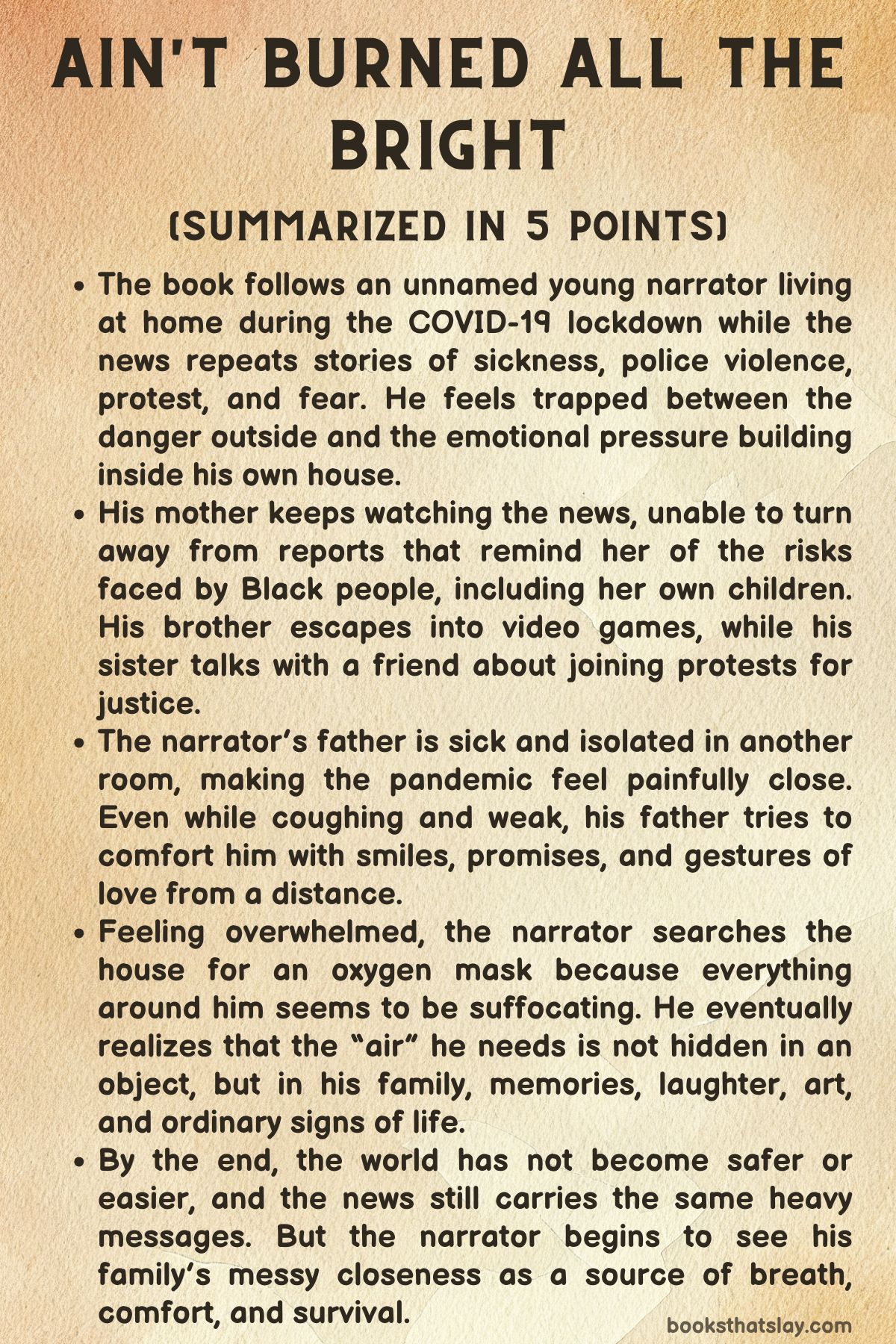
Ain’t Burned All the Bright follows an unnamed young narrator during a time when the world outside and the world inside his home both feel heavy, unsafe, and hard to understand. He is living through the COVID-19 pandemic, stuck at home with his family during lockdown, while television news repeats stories of sickness, death, protest, and police violence.
The house becomes a place of protection, but also a place where fear gathers. The narrator watches his family members respond to this pressure in different ways, and he tries to make sense of what it means to breathe when so many people around him, literally and symbolically, are struggling for air.
The story opens with the narrator observing his mother, who sits in front of the television and refuses to change the channel. The news keeps showing painful images and repeating grim messages about the state of the country.
It speaks of violence, loss, and a world that seems unable or unwilling to change. The narrator cannot understand why his mother keeps watching when the news only seems to hurt her.
To him, the broadcast feels like fire and smoke entering their home. The danger outside is not staying outside; it is pouring into the living room through the screen.
His brother reacts in a completely different way. Instead of watching the news, he fixes his attention on a video game.
His eyes stay locked on the screen, and his hands keep moving. The narrator tries to get his attention by elbowing him, but his brother does not respond at first.
This refusal to look away from the game feels like another kind of escape. While their mother stares at the world’s pain, his brother avoids it.
The narrator sits between these two responses, caught between looking and not looking, feeling too much and trying not to feel at all.
The news reminds the family of the police killings that have led to protests across the country. The narrator hears reports about a woman and a young man being killed, and about a child his own age who could not breathe.
These reports blur together with the images of George Floyd, Breonna Taylor, and other Black people whose deaths have become part of the public grief and anger of the moment. For the narrator, these are not distant stories.
He wonders whether his mother sees him, his brother, and his sister in the victims on the screen. He understands that the people being harmed could look like him, live like him, or be loved by families like his.
His sister is also pulled into the world beyond their home. She talks with a friend on a video call about going to a protest.
Their conversation is practical: they discuss what they will need to bring, including masks. But beneath the practical details is the larger reason for going.
They want to stand with others who are demanding the freedom to breathe, walk, shout, cry, pray, post, and simply exist. The narrator sees protest as an expression of a fight that includes him.
The raised fist, the masks, the smoke, and the faces of young people all become part of the same question: how can Black people keep living fully in a country where their breath is constantly threatened?
At the same time, the pandemic is also present inside the house in a more personal way. The narrator’s father is sick and isolated in another room.
He has a cough that sounds frightening, as if something inside him is fighting to live and dying at the same time. The father’s illness changes the emotional shape of the home.
The narrator wants to check on him, but his mother warns him not to go inside the room. He can only look through the crack in the door.
When the narrator peeks in, his father smiles at him. That smile matters.
Even while sick, sweating, and alone, his father tries to reassure him. He says things will return to normal soon, and that they will be able to hug and joke again.
For a moment, the narrator feels relief. The space beyond the door seems lighter, almost peaceful.
His father’s smile offers a brief sense that everything might still be repaired.
But that comfort does not last without strain. The father is also watching the news, and the same smoke and fire that filled the living room seem to follow the narrator into this room too.
The television keeps repeating stories about sickness, people refusing to wear masks, people refusing to protect one another, and the fear that no cure will come quickly enough. The narrator becomes frustrated by the sameness of it all.
He wonders why no one changes the channel and why the news itself never changes its story.
His father keeps trying to seem strong. He raises his arms as if he wants to hug the narrator from across the room.
Because they cannot touch, this gesture has to stand in for closeness. The narrator senses that his father is trying to hold him together, even from a distance.
Yet he also notices the effort behind the smile. His father is holding back a cough, and the corners of his mouth seem ready to give way.
The narrator understands that adults can offer comfort even when they are afraid. His father’s strength is real, but so is his sickness.
As the pressure builds, the narrator begins to feel as if the whole house is underwater. The world seems to be wheezing.
The news, the pandemic, the protests, the fear for his father, and the silence or distraction of his family all create a feeling of suffocation. He feels tired enough to lie down, but restless enough to get up and search for an oxygen mask.
The search is both literal and symbolic. He believes there must be something in the house that can help him breathe.
Since his parents keep so many things, he imagines an oxygen mask might be hidden somewhere.
He searches through drawers, under the couch, inside closets and cabinets, and in odd household places where small useful things are kept. He looks in the spaces where family life has collected over time.
But he does not find a mask. The house contains many objects, but none of them offers the kind of rescue he thinks he needs.
After giving up, he returns to the couch. The television is still on the same channel.
Then something small happens: the news cuts to a commercial, and his mother’s face shifts. The movement is barely there, but the narrator sees the beginning of a laugh.
It does not fully become laughter, but it is enough. That tiny sign changes how he understands his search.
He realizes that he had been looking in the wrong places. The oxygen mask is not hidden in a drawer or a box.
It is in his family.
He begins to notice sources of breath all around him. His mother’s almost-smile, his brother’s video game sounds, his sister’s handwriting, the family photo hanging crookedly, the refrigerator full of leftovers, the messy microwave, and calls with relatives all become signs that life is still present.
These ordinary details become a kind of air. They do not erase the pain outside or the fear inside, but they help him survive it.
The narrator also finds breath in art and sensation: a new movie, a new book, the smell of new sneakers, and the comfort of worn denim. These small experiences remind him that life is more than crisis.
Joy does not have to be huge to matter. Familiar objects, shared memories, and everyday pleasures can help a person keep going when the world feels unbearable.
Near the end, the narrator elbows his brother again, and this time his brother responds. The two begin to wrestle and bother each other like siblings do.
Their sister steps in, their mother tells them to stop, and their father calls out too, now without the cough dominating his voice. The family’s noise, touch, irritation, and laughter become signs of connection.
Their messiness becomes relief. They are still together.
They can still annoy one another, hear one another, and share space.
When the news returns, it continues to repeat its bleak message. The world has not suddenly changed.
The problems outside remain real. But the narrator’s way of seeing has shifted.
The imagery around the family becomes brighter and more open. He sees their faces lift.
The couch itself seems to become part of a smile. He understands that breathing may come from recognizing the people beside him.
The book ends not with a solution to the world’s suffering, but with a small act of possibility. The narrator asks whether anyone has seen the remote.
After so much watching, waiting, coughing, worrying, and searching, this question suggests that the family may finally be ready to change the channel, or at least to choose where they place their attention. Ain’t Burned All the Bright closes on the idea that breath can be found in family, memory, art, laughter, and the stubborn presence of life, even when the world feels filled with smoke.
Characters
The Unnamed Narrator
The unnamed narrator is the emotional center of Ain’t Burned All the Bright, and the entire experience of the book is filtered through his fear, confusion, anger, and need for relief. He is young, but he is not unaware.
He understands enough about the world to know that the news is not just background noise. It is speaking about people who look like him, people who could be him, and people whose suffering echoes inside his own home.
His repeated concern with breathing shows how deeply he feels the pressure of the moment. COVID threatens breath through sickness, police violence threatens breath through brutality, and the constant flow of bad news threatens breath through anxiety.
The narrator is not simply scared; he is trying to name a feeling that is too large for him. His search for an oxygen mask becomes a symbol of his search for safety, comfort, and meaning.
At first, he looks for something physical that can save him, but he slowly realizes that survival is also emotional. His growth comes from recognizing small forms of life around him: his mother’s almost-laugh, his brother’s presence, his sister’s voice, his father’s smile, and the messy details of family life.
By the end, he has not solved the world’s problems, but he has learned where to look for air.
The Mother
The mother is a figure of silent endurance, and her stillness carries much of the book’s emotional weight. She sits in front of the television, unable or unwilling to change the channel, even though the news is painful and repetitive.
To the narrator, this seems almost impossible to understand. He wonders why she keeps watching something that only brings fear and sorrow into the house.
But her behavior suggests that she is not watching because she enjoys the news; she is watching because she cannot look away from the danger facing her children, her family, and Black people across the country. The deaths on the screen are not abstract to her.
They may remind her of her own children and of the constant fear that the world may not protect them. Her silence is not emptiness.
It is a form of shock, grief, attention, and perhaps helplessness. She represents the burden carried by parents who must raise children in a society where ordinary life can become dangerous because of race, illness, and public neglect.
Her smallest facial movement, the beginning of a laugh, becomes powerful because she has been so still for so long. That almost-laugh gives the narrator hope.
It shows that even under pressure, she has not been completely consumed by fear. Her humanity is still present, and that tiny sign becomes a source of breath for her child.
The Father
The father’s role is shaped by distance, illness, and protection. He is physically separated from the rest of the family because he is sick, and that separation makes his presence even more painful for the narrator.
The father is near, but unreachable. He is inside the home, yet behind a door.
His coughing gives the pandemic a direct and frightening form. It is no longer only something on the news or outside the house; it is inside his body.
Even so, the father tries to remain reassuring. When the narrator looks in on him, the father smiles and promises that things will return to normal.
This response shows his instinct to protect his child emotionally, even when he cannot protect him physically. His raised arms, offered like a hug from across the room, reveal the sadness of love during isolation.
He wants to comfort his son, but he cannot touch him. He wants to appear strong, but his body is struggling.
This tension makes him deeply human. He is not a simple symbol of strength; he is a person trying to be strong while afraid and unwell.
In Ain’t Burned All the Bright, the father shows how care can exist even through a closed door, a cracked smile, and a body fighting to recover.
The Brother
The brother represents avoidance, distraction, and another way of surviving pressure. While the mother watches the news and absorbs the pain of the outside world, the brother turns toward his video game and refuses to look away.
His focus may seem careless at first, especially to the narrator, who keeps trying to get his attention. But his behavior can also be read as a defense.
The world is overwhelming, and the game gives him a space where rules are clearer, actions have immediate results, and he can control something. Unlike the news, which repeats suffering without offering solutions, the game allows him to act.
His silence does not mean he feels nothing. It may mean he does not know how to process what is happening.
The narrator’s attempts to elbow him are attempts to break through that emotional wall and bring him back into the shared family space. When the brother finally reacts and the two begin to tussle, the moment becomes more than sibling play.
It proves that he is still reachable. His body, noise, irritation, and attention return to the family.
Through him, the book shows that withdrawal can be a coping mechanism, but connection is still possible. His eventual response helps the narrator recognize family messiness as a form of life.
The Sister
The sister is more outward-facing than the narrator’s brother and more openly connected to the political moment. Through her video call with her friend, she discusses joining a protest and preparing for it.
Her attention is not fixed on escape but on action. She understands that the violence shown on the news demands a response, and she wants to be part of that response.
At the same time, her planning is shaped by the pandemic. Even protest requires masks, caution, and concern for breath.
This makes her position especially meaningful: she is living at the meeting point of two crises, racial injustice and public health danger. Her desire to protest suggests courage, but it also shows how young people are forced to grow up quickly when the world around them becomes unsafe.
She is not portrayed as reckless; she is thoughtful enough to prepare. Her conversation gives the narrator a wider view of what breathing means.
It is not only about avoiding sickness. It is also about having the freedom to live, speak, move, and demand justice.
Later, when she breaks up the tussle between her brothers, she returns to the role of family member, not only protester. She belongs to both worlds: the urgent public world outside and the noisy private world of home.
The Sister’s Friend
The sister’s friend appears through the video call, but her presence expands the book beyond the narrator’s household. She shows that the sister’s feelings are shared by others her age and that the protests are not isolated events but part of a larger youth response to injustice.
Even though she is not physically present in the home, she brings the outside world into it in a different way than the television does. The news brings fear, repetition, and helplessness.
The friend brings conversation, planning, and action. Her role also emphasizes how technology shapes connection during lockdown.
People are separated, but they are still speaking, organizing, and supporting one another. Through her, the sister is not alone in her anger or purpose.
The friend helps show that protest begins not only in streets but also in private conversations between young people trying to decide what they can do. She may be a minor character, but she matters because she reflects collective energy.
Her presence suggests that the desire for justice is moving through many homes at once, carried by voices on screens, plans made from bedrooms, and young people preparing to step outside despite fear.
The Family as a Whole
The family functions almost like a single living body struggling for breath. Each person responds differently to the same atmosphere of fear.
The mother watches, the father coughs, the brother escapes into a game, the sister prepares to protest, and the narrator tries to understand why everything feels so hard to survive. Their home is not peaceful in a simple way; it is crowded with worry, illness, noise, silence, distance, and love.
What makes the family important is not that they have perfect communication or easy comfort. In fact, much of the book depends on their inability to fully explain what they feel.
The narrator has to read small signs: a smile, a cough, a video game sound, a raised voice, a half-laugh, a sibling’s reaction. These details become proof that the family is still alive together.
By the end, their ordinary closeness becomes the narrator’s answer to suffocation. The family does not erase racism, the pandemic, or public grief, but it gives him a place to breathe.
Their shared mess becomes a kind of shelter.
Themes
Breath, Survival, and the Need for Air
Breath becomes the central image through which fear, injustice, sickness, and hope are understood. The narrator lives in a moment when breath is threatened from multiple directions.
COVID makes breathing physically dangerous and uncertain, especially through his father’s illness. Police violence gives breath a political and racial meaning, as the news reminds the family of Black people whose lives were taken and whose final struggle became a national cry.
Inside the house, the narrator experiences these pressures as emotional suffocation. He feels as though the home is filling with smoke or water, and he begins searching for an oxygen mask because he needs some form of rescue.
That search shows how a child tries to respond to problems that are too large for him to fix. He wants an object, a tool, something practical.
But the book gradually changes the meaning of oxygen. Breath is found in family sounds, small gestures, laughter, memory, art, and touch.
This does not make survival easy or simple. Instead, it shows that people often stay alive through small forms of comfort when larger systems fail them.
The act of breathing becomes both a physical need and a claim to dignity.
The Weight of the News
The news is more than a television program in Ain’t Burned All the Bright; it becomes an atmosphere inside the home. It fills rooms with images of death, sickness, protest, fire, and fear.
The narrator cannot understand why his mother keeps watching when the broadcast seems to repeat the same hopeless message. Yet the news also represents the painful need to witness.
For the mother, looking away may feel like a betrayal of the people being harmed or a denial of the dangers facing her own children. For the narrator, however, constant watching becomes unbearable.
The repetition makes the world feel trapped in a cycle where nothing improves and every story confirms the same fear. This theme captures a specific experience of crisis: the feeling of being stuck indoors while disaster arrives through screens.
The family is physically safe inside the house, but mentally and emotionally exposed to every public wound. The television removes distance.
A killing elsewhere, a protest elsewhere, or a hospital crisis elsewhere becomes part of the living room. The book asks what happens when people are expected to stay informed but the act of staying informed begins to harm them.
The need to find the remote near the end suggests a desire to reclaim attention, not by denying reality, but by refusing to let despair control the entire home.
Family as a Source of Oxygen
The narrator’s understanding of family changes as he searches for relief. At first, each family member seems locked in a separate response to crisis.
His mother is fixed on the news, his brother is absorbed in his game, his sister is focused on protest, and his father is isolated because of illness. The narrator feels alone among them because no one seems to be reacting in the way he needs.
But as he looks more closely, he begins to see that each person offers proof of life. His mother’s almost-laugh, his father’s strained smile, his brother’s eventual reaction, and his sister’s presence all become forms of oxygen.
Family is not presented as perfect comfort. It is loud, messy, tense, and sometimes frustrating.
The siblings bother one another. The parents raise their voices.
The house contains leftovers, clutter, awkward photos, and ordinary signs of use. Yet these imperfections are exactly what make the family feel real and sustaining.
The narrator does not find peace by escaping his household; he finds breath by noticing it more carefully. The theme suggests that love often appears in small, imperfect ways during crisis.
A family may not have answers to national suffering or illness, but it can still create moments where a child feels held, seen, and alive.
Black Life Under Pressure
Black life in the book is shown under the pressure of public violence, media repetition, illness, and inherited fear, but it is not reduced to suffering. The narrator’s family is deeply affected by the police killings and protests happening across the country.
The mother’s silence, the sister’s desire to protest, and the narrator’s identification with the victims all show how anti-Black violence reaches beyond the immediate event. It enters homes, shapes parental fear, and forces young people to understand danger early.
The narrator recognizes that the people on the news are not strangers in any easy sense. They resemble him, and that resemblance makes the violence intimate.
At the same time, the book insists on the fullness of Black life. The family is not only watching tragedy; they are also joking, arguing, playing, calling relatives, eating leftovers, reading, watching movies, and remembering.
This matters because the demand for breath is also a demand to live completely. Protest is not only about survival in the narrowest sense.
It is about the freedom to walk, speak, cry, laugh, rest, and be ordinary without threat. The book’s power comes from holding both realities at once: the danger pressing in and the life that continues anyway.