Alabama Moon Summary, Characters and Themes
Alabama Moon by Watt Key is a survival novel about Moon Blake, a ten-year-old boy raised in the Alabama wilderness by a father who distrusts society and the government. Moon knows how to trap food, build shelters, read the forest, and stay hidden, but he knows almost nothing about ordinary life, friendship, school, or family beyond his father.
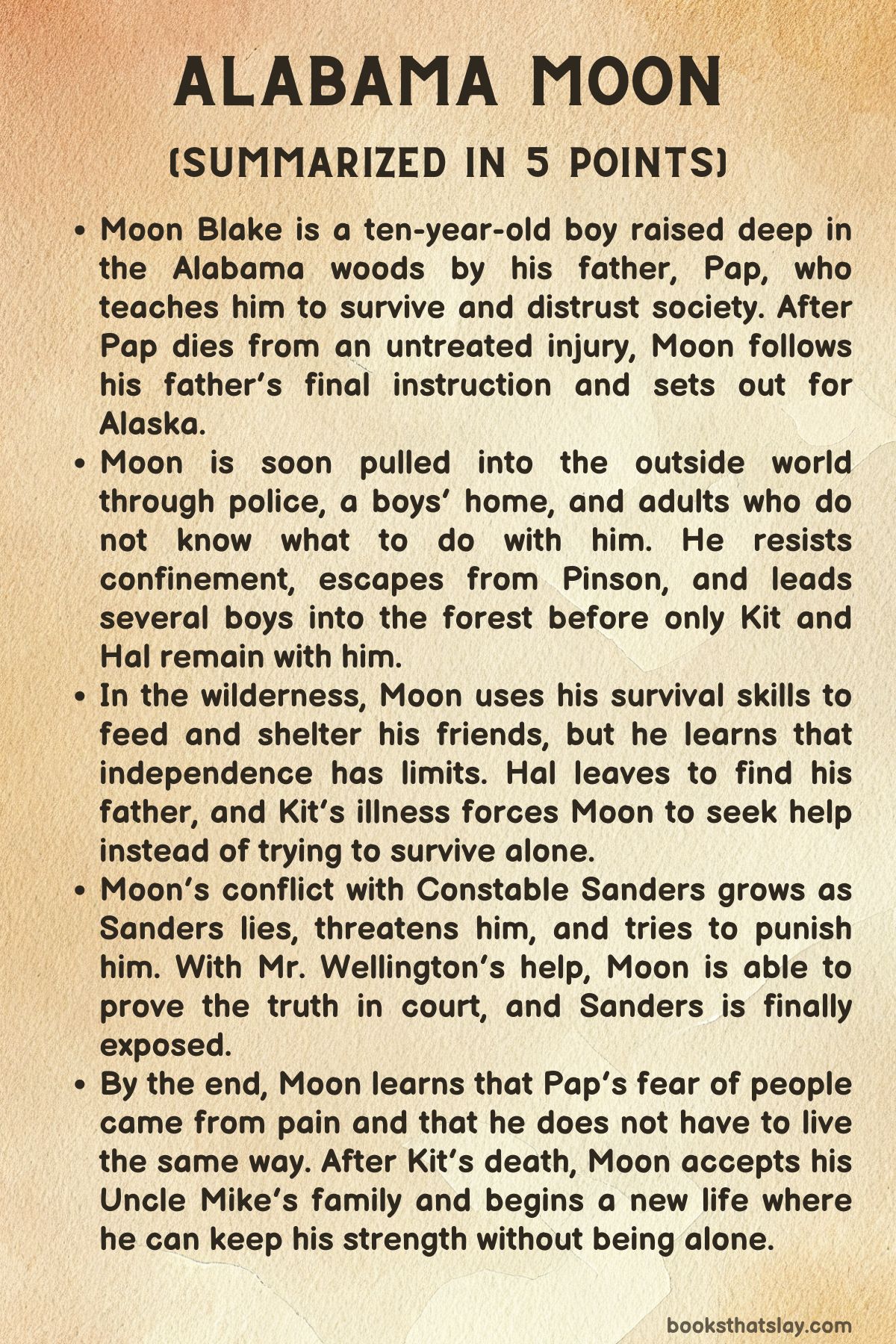
After his father dies, Moon tries to follow his final instruction: go to Alaska and live free. Instead, he is forced into a world of boys’ homes, police, courts, kindness, danger, and loss, where he slowly learns that freedom without people can become its own kind of prison. It’s the first book in the Alabama Moon series.
Summary
Moon Blake has spent almost his whole life in the deep woods of Alabama, living with his father, whom he calls Pap. Their home is a rough shelter hidden in the forest, with no electricity, plumbing, or comforts.
Pap has raised Moon to believe that the government is dangerous and that people outside the woods cannot be trusted. He teaches Moon how to hunt, trap, fish, sew, grow food, build shelter, and stay invisible.
Moon grows up skilled, tough, and independent, but also isolated from the rest of the world.
Moon’s mother died when he was very young, so Pap is the only parent Moon has truly known. When Pap breaks his leg badly after falling from a beaver dam, infection sets in.
Pap refuses to let Moon seek help. Before dying, he tells Moon to go to Alaska, where he believes people still live freely off the land.
Moon buries Pap beside his mother and, though he tries to be strong, he is overcome by loneliness. He writes letters to Pap and burns them, believing the smoke will carry his words to him.
Moon goes to Mr. Abroscotto’s store to sell Pap’s watch and ask about Alaska. Mr. Abroscotto is worried and tries to tell Moon that Pap’s way of life was unreasonable.
Moon reacts with anger when he feels Pap is being insulted. After leaving the store, he realizes Mr. Abroscotto may call the authorities.
Moon returns to the shelter, but his loneliness becomes unbearable. He wanders to a nearby hunting lodge owned by Mr. Wellington, a lawyer whose land now includes the area where Moon and Pap had lived.
Mr. Wellington treats Moon kindly at first, but he calls for help. Moon is taken by Mr. Gene, who runs a boys’ home, but he escapes during the ride.
Soon after, Moon begins his journey toward Alaska with Pap’s belongings. Constable Davy Sanders stops him, arrests him, and treats him with cruelty.
Sanders mocks Pap, takes Moon’s possessions, and uses force against him. Moon is eventually taken to Pinson, a boys’ home run by Mr. Gene.
At Pinson, Moon struggles with rules, uniforms, showers, school, and other boys. He fights Hal, the strongest boy there, and earns the admiration of the others.
He also meets Kit, a sickly but kind boy who is fascinated by Moon’s stories of life in the woods. Kit becomes Moon’s closest friend.
Moon cannot stand being confined and plans an escape. With Kit’s help and Hal’s driving ability, Moon breaks out.
Instead of leaving alone, he frees all the boys, and they escape in a bus.
Most of the boys quickly lose their excitement once they reach the forest, but Hal and Kit stay with Moon. Moon leads them deeper into the woods.
He finds food, makes tools, catches fish, and teaches them survival skills. They are followed by Sanders’s bloodhounds, but the dogs are friendly and join the boys instead of capturing them.
Moon names the dogs as companions rather than threats. Hal, however, is not suited to life in the woods.
After cold, hunger, rain, and exhaustion wear him down, he decides to leave and find his father. Moon lets him go and helps him choose a path to the road.
Moon and Kit remain together. They build a shelter, cook wild food, make tools, and talk about going to Alaska someday.
Kit loves the woods and looks up to Moon, but his health begins to fail without medicine. Moon tries natural remedies, but Kit becomes dangerously ill.
For the first time, Moon understands that his skills are not enough. He realizes he cares more about saving Kit than reaching Alaska.
He drags Kit through the forest on a makeshift sled until they reach a road, then lets an older couple take Kit for medical help while Moon hides.
Moon later learns from a news report that people are calling him Alabama Moon. He also hears that Sanders is accusing him of violent crimes.
Hal returns with his father, Mr. Mitchell, and invites Moon to stay with them. Moon is relieved to see Hal again and goes to the Mitchell trailer.
There, Moon experiences a different kind of rough freedom: trucks, mudding, tools, and the easy companionship of Hal and his father. Moon begins to question Pap’s beliefs.
He realizes Pap may have been wrong about many things, especially about people.
Moon visits Mr. Abroscotto again and learns more about Pap’s past. Mr. Abroscotto explains that Pap changed after the Vietnam War.
Moon begins to understand that Pap’s fear and isolation may have come from pain, not truth. Mr. Mitchell, who also served in Vietnam, helps Moon see how the war affected many men differently.
Moon starts to accept that he does not want to live alone anymore. His dream changes from Alaska to a life in the woods with people he loves nearby.
Moon later visits Kit in the hospital. Kit is happy to see him and remembers their time in the forest as joyful.
Moon cries and tells Kit he wanted them to be like brothers. After leaving Kit’s room, Sanders captures Moon.
He handcuffs him, threatens him, and tries to force him to reveal where Sanders’s pistol is hidden. Sanders takes Moon into the woods on a leash, but Mr. Wellington appears and confronts him.
Moon escapes, then returns to Mr. Wellington’s lodge, tired and hopeless.
Mr. Wellington decides to help Moon legally. He records Moon’s story, gathers evidence from the forest, retrieves the pistol, and proves that Sanders lied about Moon trying to shoot him.
In court, Sanders claims Moon killed his dogs and fired at him, but Mr. Wellington exposes the lies. Moon’s shooting skill also proves that if he had truly aimed at Sanders, he would not have missed.
Hal arrives with the missing dogs, showing they are alive. The judge orders Sanders arrested for perjury and other likely charges.
Mr. Wellington then reveals that he has found Moon’s uncle in Mobile. Moon’s uncle, Mike, is Pap’s brother and wants to adopt him.
Before leaving, Moon says goodbye to Hal and tries to see Kit again. Kit has been moved to intensive care, and Moon waits at the hospital, but Kit dies.
Moon is devastated. He writes a long letter to Kit, describing everything Kit would have wanted to know about the forest, Pap, and survival.
Hal comforts Moon by telling him Kit had the best time of his life with him in the woods.
Before leaving for Mobile, Moon returns to his old shelter. He leaves Pap’s rifle there and hangs up the deerskin hats he made for himself and Kit.
He visits his parents’ graves and senses that this part of his life is ending. When Uncle Mike arrives, Moon notices that he smells like pine sap and has Pap’s eyes, but with more gentleness.
On the drive, Uncle Mike explains that Pap changed after Vietnam and that Moon does not have to carry the same fear or loneliness. Moon thanks him for taking him in and admits that he no longer wants to be alone.
In Mobile, Moon meets Aunt Sara and his cousins, David and Alice. They welcome him warmly.
Moon begins adjusting to family life, food at a table, kindness, and ordinary routines. Though he carries grief for Pap and Kit, he also finds a new chance at belonging.
Alabama Moon ends with Moon no longer running from people, but learning how to live among them while still holding on to the strength the forest gave him.
Characters
Moon Blake
Moon Blake is the central character of Alabama Moon, and his growth drives the entire story. At the beginning, he is a ten-year-old boy who has been raised almost completely outside ordinary society.
His father has taught him how to survive in the wilderness, so Moon is unusually capable for his age. He can hunt, trap, fish, build shelters, make tools, cook wild food, read animal signs, and move through the forest with confidence.
These abilities make him strong, resourceful, and brave, but they also separate him from other children. Moon has been taught to distrust people, especially anyone connected to the law or the government, so his first reaction to help is often fear or violence.
He does not know how to accept kindness because Pap has trained him to see dependence as weakness.
Moon’s personality is shaped by contradiction. He is fierce and stubborn, but he is also deeply lonely.
He attacks people when he feels cornered, yet he cries for Pap, clings to Kit’s friendship, and later admits that he does not want to be alone anymore. His dream of Alaska begins as obedience to Pap, but it slowly changes as Moon gains experience with people outside the forest.
Through Kit, Hal, Mr. Wellington, and Uncle Mike, Moon learns that freedom is not only about escaping rules. It is also about having the chance to choose love, trust, and belonging.
His journey is not a simple rejection of Pap, because Moon still loves him and values the skills he gave him. Instead, Moon learns to separate Pap’s useful wisdom from Pap’s fear.
By the end, Moon remains independent and connected to the wilderness, but he is no longer willing to live without human closeness.
Pap
Pap is Moon’s father, and although he dies early in the story, his influence remains powerful throughout the novel. He is a survivalist who has withdrawn from society after being changed by the Vietnam War.
His distrust of government, institutions, and modern life becomes the foundation of Moon’s upbringing. Pap teaches Moon discipline, toughness, silence, patience, and self-reliance.
He gives Moon a deep knowledge of the natural world, and many of Moon’s best qualities come from Pap’s training. Moon’s skill, courage, and ability to survive under harsh conditions are all part of Pap’s legacy.
At the same time, Pap’s love is mixed with fear and damage. He isolates Moon from school, family, medicine, friendship, and help.
He refuses treatment for his own fatal injury and leaves Moon with the dangerous instruction to travel alone to Alaska. Pap’s worldview is built on the belief that asking for help creates debt and weakness.
This idea harms Moon because it makes him suspicious of care and unable to understand ordinary social trust. Pap is not shown as a simple villain; he clearly loves Moon and prepares him for the only life he believes is safe.
Yet his trauma limits his ability to give Moon a full childhood. His tragedy is that he passes both strength and fear to his son.
Moon’s maturity comes when he can love Pap without accepting every belief Pap taught him.
Kit Slip
Kit Slip is Moon’s closest friend and one of the most emotionally important characters in the story. Physically, Kit is fragile.
He is pale, thin, and dependent on medicine because of a serious illness. In contrast to Moon, who has been trained for physical survival, Kit has spent much of his life in hospitals and institutions.
Yet Kit has a strong spirit. He is curious, loyal, imaginative, and open to wonder.
Moon’s stories of the forest fill him with excitement, and he sees in Moon’s world a freedom he has never had.
Kit’s friendship changes Moon in a lasting way. Before Kit, Moon thinks mostly in terms of survival, escape, and obedience to Pap’s plan.
With Kit, he begins to think about companionship. Moon invites Kit into his dream of Alaska, and Kit’s trust gives Moon someone to protect and care for.
When Kit becomes sick in the woods, Moon faces the painful truth that wilderness knowledge has limits. He cannot cure Kit with bark tea, shelter, fire, or determination.
Moon’s decision to carry Kit toward help shows one of his greatest moments of growth: he chooses another person’s life over his own freedom. Kit’s death is devastating because he represents brotherhood, innocence, and the possibility of shared dreams.
His time in the forest is brief, but it gives him joy, and his memory helps Moon understand that love is worth the pain of loss.
Hal Mitchell
Hal Mitchell begins as Moon’s rival at Pinson, but he becomes an important friend. At first, Hal is the dominant boy among the others, using size and reputation to hold power.
When Moon defeats him, their relationship changes. Hal is proud and sometimes impatient, but he is not cruel at heart.
He helps Moon and Kit escape, drives the bus, and stays with them in the forest longer than most of the boys. His presence gives Moon a different kind of companionship from Kit.
Where Kit admires Moon’s wilderness life, Hal challenges it.
Hal’s decision to leave the forest is important because it shows the limits of Moon’s fantasy. Hal does not want to live on roots, snakes, rainwater, and hardship.
He wants his father, a home, and a life that, while rough, still includes human connection. Moon initially believes everyone should want the freedom he wants, but Hal shows him that freedom means different things to different people.
Hal also helps Moon after Kit is taken to the hospital, bringing him into his father’s home and giving him temporary safety. His loyalty is practical rather than sentimental.
He may joke, complain, or resist, but he returns when Moon needs him. Through Hal, Moon sees that friendship can survive disagreement.
Hal is one of the people who helps Moon move away from loneliness and toward trust.
Constable Davy Sanders
Constable Davy Sanders is the story’s main human antagonist. He represents the abusive side of authority and becomes the figure who seems to confirm everything Pap warned Moon about.
Sanders is cruel, arrogant, violent, and obsessed with controlling Moon. He insults Moon and Pap, mistreats prisoners, lies about events, and uses his badge to intimidate weaker people.
His treatment of Moon is especially disturbing because Moon is a child, yet Sanders responds to him with humiliation and force rather than protection.
Sanders is not simply strict; he is personally vindictive. Moon embarrasses him several times by escaping, outsmarting his dogs, and refusing to submit.
This makes Sanders more determined to break him. He lies in court, accuses Moon of attempting to kill him, and even threatens Kit to pressure Moon.
Sanders’s behavior exposes the danger of authority without accountability. However, his downfall also matters.
Mr. Wellington gathers evidence, the judge sees through his lies, and Hal arrives with the living dogs. Sanders’s arrest proves that institutions are not all the same.
The law can be abused by people like Sanders, but it can also be used to stop them. For Moon, this distinction is crucial because it helps him understand that Pap’s total distrust of society was incomplete.
Mr. Wellington
Mr. Wellington is one of the most important adult figures in Moon’s transition from isolation to society. At first, his role is morally complicated.
He finds Moon outside his lodge, gives him food, and seems kind, but he also calls Mr. Gene, leading to Moon being taken away. From Moon’s perspective, this feels like betrayal.
Later, however, Mr. Wellington recognizes that he failed to understand Moon’s situation fully and decides to help him in a more serious way.
Mr. Wellington’s strength lies in his patience, intelligence, and willingness to take responsibility. He listens to Moon’s story, records evidence, investigates Sanders’s lies, and presents a clear legal defense.
Unlike Sanders, he uses his knowledge of the law to protect rather than dominate. He also finds Moon’s uncle, giving Moon a path toward family rather than institutional life.
Mr. Wellington becomes a bridge between Moon’s wild upbringing and the structured world. He does not try to erase Moon’s identity or shame him for being different.
Instead, he helps others see Moon as a child shaped by unusual circumstances, not as a criminal or monster. His role shows that compassion becomes powerful when joined with action.
Mr. Abroscotto
Mr. Abroscotto is the store owner who knew Moon and Pap from their rare trips into town. He is one of the first adults to show concern for Moon after Pap’s death.
He tries to explain that Moon should not travel alone to Alaska and that he needs a family or proper care. His concern is genuine, but his approach clashes with Moon’s loyalty to Pap.
When Mr. Abroscotto calls Pap unreasonable, Moon feels attacked and responds violently.
Mr. Abroscotto represents ordinary human concern filtered through misunderstanding. He knows enough to worry about Moon but not enough to reach him emotionally.
He also gives Moon important information about Pap’s past, especially the way Pap changed after Vietnam. This helps Moon begin to see his father not only as a teacher and protector, but also as a wounded man.
Mr. Abroscotto’s fear of Moon later, when he panics at the sight of the rifle, hurts Moon because Moon believes he has been misunderstood again. Even so, Mr. Abroscotto is not an enemy.
He is a flawed but caring adult who cannot fully overcome the distance between Moon’s world and the town’s world.
Mr. Gene
Mr. Gene runs Pinson, the boys’ home where Moon is taken. He is part of the system that Moon fears, but he is not as cruel as Sanders.
Mr. Gene believes that Moon must be placed somewhere safe and controlled, especially because Moon has no parent or known relative at first. From his point of view, the boys’ home is a necessary solution.
From Moon’s point of view, it is confinement.
Mr. Gene’s character shows the limits of institutional care. Pinson gives Moon food, shelter, clothing, showers, and schooling, but it cannot understand his emotional condition.
It treats him as a child to be managed rather than a person whose whole life has been shaped by survivalist isolation. Mr. Gene is not malicious, but the place he runs is too rigid for someone like Moon.
His role helps explain why Moon resists the system so strongly. The problem is not only Moon’s fear; it is also that the system has few good answers for a child who does not fit its usual categories.
Mr. Carter
Mr. Carter works at Pinson and is one of the more humane authority figures Moon meets there. He is firm, physically imposing, and responsible for maintaining order among the boys.
He gives Moon instructions, warns him against trouble, and tries to keep the environment controlled. Unlike Sanders, however, Mr. Carter does not seem to enjoy power for its own sake.
He notices Moon’s bruises, gives practical advice, and treats him with a degree of fairness.
Mr. Carter’s importance comes from the contrast he creates. He shows that authority does not always have to be abusive.
Moon may not fully trust him, but readers can see that Mr. Carter is trying to keep Moon safe within the limits of his job. He understands that Pinson can be difficult, but he also knows that the boys need structure.
His fairness makes him a quieter figure, yet he contributes to the book’s wider view of adults: some harm, some misunderstand, some help, and some do their best inside imperfect systems.
Mrs. Broomstead
Mrs. Broomstead is the kitchen worker and cook at Pinson. Her role is smaller than many others, but she is connected to Moon’s early experience of institutional life.
Food matters deeply to Moon because he has grown up with scarcity and effort. Meals at Pinson amaze him, and Mrs. Broomstead is part of that world of regular cooked food, routine, and order.
She also cuts Moon’s hair, making her part of the process by which the institution tries to make him look and behave like the other boys.
Mrs. Broomstead represents domestic order rather than emotional intimacy. She is not a mother figure, but her kitchen gives Moon a glimpse of abundance and routine.
For a boy used to catching or growing nearly everything he eats, the idea of plentiful meals prepared every day is astonishing. Her presence helps show how strange ordinary life feels to Moon.
Simple things such as haircuts, meals, kitchens, and scheduled days become signs of a world he has never known.
Mrs. Crutcher
Mrs. Crutcher is Moon’s teacher at Pinson. She assesses what Moon knows and discovers that he can read and write but is limited in math.
Her role reveals that Moon is not ignorant, even though he has never had a normal education. Pap has taught him some academic basics, but Moon’s real education has been practical and wilderness-based.
Mrs. Crutcher’s classroom places Moon in a setting where his survival skills do not automatically make him powerful.
Through Mrs. Crutcher, the story raises questions about what counts as knowledge. Moon may struggle with formal schooling, but he knows many things that most adults and children around him do not.
He can survive where they cannot. At the same time, his lack of schooling leaves him vulnerable in society.
He does not understand courts, police, hospitals, or legal guardianship. Mrs. Crutcher’s role is brief, but it helps show that Moon needs more than forest knowledge if he is going to live among people.
Mr. Mitchell
Mr. Mitchell is Hal’s father and one of the adults who gives Moon temporary refuge. He lives a rough life, drinks, owns weapons, and carries his own history from Vietnam.
He is not presented as a perfect guardian, but he is warm toward Moon and treats him with casual generosity. He lets Moon stay, feeds him, talks with him, and helps him think about Pap’s past.
Because Mr. Mitchell also experienced war, he can explain Pap’s damage in a way Moon begins to understand.
Mr. Mitchell’s home is disorderly but emotionally important. With Hal and Mr. Mitchell, Moon experiences a version of freedom that includes companionship.
The truck rides, tools, mudding, and conversations give Moon pleasure without requiring him to be alone in the forest. Mr. Mitchell also tells Moon to reach out if he ever needs anything, which matters because it offers Moon adult support without control.
He helps Moon see that men can be hurt by war and still choose connection. This insight prepares Moon to understand both Pap and Uncle Mike more clearly.
Uncle Mike
Uncle Mike is Pap’s brother and the person who offers Moon a permanent family at the end of the novel. His arrival changes Moon’s future.
He looks like Pap in some ways, especially in his eyes, but he has a gentler and calmer presence. This similarity matters because Uncle Mike allows Moon to feel a connection to Pap without returning to Pap’s isolation.
He becomes a living link to Moon’s family history.
Uncle Mike answers one of Moon’s painful questions: why no one came to find them. He explains that he did search but could not locate Pap, Moon, and Moon’s mother after they disappeared into the woods.
He also helps Moon understand that Pap was not always the fearful man Moon knew. Vietnam changed him, but Moon does not have to inherit that same loneliness.
Uncle Mike’s kindness gives Moon a new model of manhood. He works with trees, smells like pine sap, and belongs partly to the natural world Moon loves, but he also has a wife, children, and a home.
This makes him the right guardian for Moon because he does not force Moon to choose completely between wilderness and family.
Aunt Sara
Aunt Sara is Uncle Mike’s wife and Moon’s new aunt. Her role is brief but significant because she welcomes Moon into the household with warmth and practical care.
Her promise to feed him several times a day speaks directly to one of Moon’s most basic needs. For Moon, food is tied to survival, comfort, and trust.
Aunt Sara’s welcome helps make the home in Mobile feel less threatening.
Aunt Sara represents the nurturing side of family life that Moon has largely missed since his mother’s death. She does not need a long speech to show acceptance.
Her kindness appears through ordinary domestic gestures: food, welcome, and a place at the table. For a child who has spent years hiding from people, these simple acts carry emotional weight.
She helps create the sense that Moon is not just being placed somewhere; he is being received.
David and Alice
David and Alice are Moon’s cousins in Mobile. They appear near the end, but their presence is meaningful because they offer Moon the possibility of growing up with other children in a family setting.
David immediately interests Moon by mentioning climbing spikes, which connects family life with Moon’s love of trees and physical skill. This detail suggests that Moon may not have to abandon everything he values in order to belong.
David and Alice represent a future Moon has never had: cousins, shared meals, ordinary childhood, and companionship inside a home. Their role is not deeply developed, but they matter as signs of continuity.
Moon has lost Pap and Kit, and Hal will be separated from him for a time. David and Alice show that new bonds may still form.
They are part of the hopeful ending, where Moon’s life is not fixed by loss but opened to family.
Judge Mackin
Judge Mackin begins with skepticism toward Moon, partly because of the stories surrounding him. However, he proves capable of listening, observing, and changing his view.
When Mr. Wellington presents evidence against Sanders, the judge does not ignore it. He agrees to test the facts and eventually orders Sanders’s arrest.
This makes Judge Mackin an important contrast to the corrupt influence Sanders tries to rely on.
The judge also recognizes that Moon may not survive emotionally in an institution. His statement that some children cannot simply be made property of the state shows a rare willingness to think beyond procedure.
He understands that Moon’s case requires judgment, not just rule-following. Judge Mackin represents the possibility that authority can become humane when it is willing to see the person behind the case.
His decision helps open the path to Moon’s adoption by Uncle Mike.
Officer Pete
Officer Pete is a minor but useful contrast to Sanders. He works within law enforcement, yet he does not show the same cruelty or personal hatred.
He transports Moon, answers what he can, and behaves with basic decency. His presence helps separate the idea of law from Sanders’s abuse of it.
Officer Pete’s role matters because Moon has been taught to see all government-connected people as enemies. Sanders seems to prove Pap right, but Officer Pete complicates that belief.
He is not a rescuer like Mr. Wellington, but he is not a threat either. In a story where Moon must learn to tell the difference between danger and help, even minor decent adults matter.
Moon’s Mother
Moon’s mother, Caroline, is mostly present through memory and absence. Moon barely remembers her, but her death shapes the loneliness of his childhood.
Without her, Pap becomes Moon’s entire world, and there is no balancing influence to soften Pap’s fear or connect Moon to relatives. Her absence helps explain why Moon’s bond with Pap is so intense and why losing him leaves Moon emotionally unmoored.
Caroline also connects Moon to a life before total isolation. Mr. Abroscotto remembers Moon’s parents coming to the store when Moon was very young, suggesting that the family once had at least some contact with others.
Her memory hints at the life Moon might have had if grief, war trauma, and fear had not pushed Pap deeper into the woods. She is not an active character, but her absence is one of the quiet forces behind the story.
Snapper and Sawbone
Snapper and Sawbone are Sanders’s bloodhounds, but they become comic and affectionate companions to Moon, Kit, and Hal. Instead of acting as frightening tools of capture, they turn out to be friendly dogs who want attention and company.
Their behavior undercuts Sanders’s image of control. Even his own dogs would rather follow the boys than obey his anger.
The dogs also bring warmth to the forest sections. Hal finds them annoying at first, but they become part of the group’s strange little family.
Their survival and later appearance in court are important because they expose Sanders’s lies. In that sense, they are more than comic relief.
They help reveal the truth. In Alabama Moon, the dogs show that loyalty cannot always be forced by ownership or authority; sometimes it follows kindness and companionship instead.
Themes
Freedom and Belonging
Moon is raised to believe that freedom means living away from people, laws, schools, roads, and government control. Pap teaches him that independence is the highest value, and Moon begins the story accepting that belief almost completely.
The forest feels like safety because it is the only home he knows, while towns, police cars, boys’ homes, and courtrooms feel like traps. Yet the story gradually questions whether isolation is true freedom.
Moon can feed himself, hide from adults, and survive cold nights, but he cannot escape grief, loneliness, illness, or the need for love. His dream of Alaska sounds free at first, but it is also a dream of continuing Pap’s solitude.
When Moon meets Kit and Hal, his idea of freedom changes. He wants not only open land but someone beside him.
Kit’s illness teaches him that complete self-reliance can become dangerous when help is needed. Hal’s choice to leave the forest shows that one person’s freedom may feel like suffering to another.
By the end, Moon does not reject the wilderness, but he rejects loneliness. His movement toward Uncle Mike’s family suggests that real freedom includes safety, choice, love, and the ability to depend on others without shame.
The Damage Passed from Parents to Children
Pap’s love for Moon is real, but it is shaped by fear, trauma, and distrust. His experiences after war change the way he sees society, and he builds Moon’s childhood around that damaged worldview.
Moon inherits not only Pap’s survival skills but also Pap’s suspicion of people. He is taught to hide, fight, and expect betrayal.
This inheritance is complicated because Pap gives Moon tools that save his life many times. Moon’s courage, patience, practical intelligence, and closeness to nature all come from his father’s teaching.
Still, Pap also denies him school, medical care, relatives, friendship, and a wider understanding of the world. The theme becomes especially powerful because Moon does not simply stop loving Pap once he learns Pap was wrong.
He continues to honor him, write to him, and remember what he taught. The emotional challenge is learning that love does not require obedience to every belief a parent leaves behind.
Uncle Mike helps Moon see that Pap was once different and that pain changed him. This gives Moon a chance to break the pattern.
He can carry Pap’s strengths forward without repeating Pap’s fear, proving that inherited damage can be understood without being continued.
Friendship as a Form of Rescue
Moon survives physically because of his wilderness knowledge, but he survives emotionally because of friendship. Kit and Hal enter his life at a time when he has lost Pap and has no real idea how to belong anywhere.
At first, Moon thinks of others in practical terms: Kit can help him escape, Hal can drive, the boys can follow him into the forest. But friendship changes those calculations.
Kit’s trust gives Moon someone to care for, and Hal’s honesty challenges Moon’s assumptions. Kit admires Moon, but he also reveals Moon’s need for tenderness.
With Kit, Moon talks about dreams, brotherhood, and a future that includes another person. Hal, on the other hand, gives Moon loyalty without worship.
He complains, argues, leaves the woods, and still returns when Moon needs help. These two friendships teach Moon that people can disagree with him and still care about him.
Kit’s death makes this theme painful rather than simple. Friendship does not protect Moon from loss; in fact, it makes loss sharper.
But it also gives meaning to his choices. Moon’s grief for Kit proves how deeply he has changed.
In Alabama Moon, friendship rescues Moon not by solving every problem, but by making him willing to live connected to others.
Authority, Justice, and Misjudgment
Moon’s fear of authority is partly learned from Pap, but his experience with Sanders gives that fear a real and frightening basis. Sanders uses his badge to humiliate, threaten, and harm.
He treats Moon as a problem to crush rather than a child to protect. His lies about Moon show how easily authority can become dangerous when joined with pride and cruelty.
Because Sanders is a constable, Moon’s distrust of the law seems justified for much of the story. Yet the novel does not present all authority as the same.
Mr. Carter is firm but not abusive. Officer Pete is decent.
Judge Mackin begins with prejudice but responds to evidence. Mr. Wellington uses legal knowledge to defend Moon rather than control him.
This range matters because Moon must learn to make distinctions. Pap’s worldview divides people into the free and the dangerous, the woods and the government, the self-reliant and the dependent.
The story challenges that simplicity. Institutions can fail children, as Pinson does when it cannot understand Moon’s needs.
The legal system can also correct injustice when people act with courage and honesty. Moon’s hearing becomes a turning point because truth defeats Sanders’s false story.
Justice is imperfect, but it becomes possible when someone sees Moon as a child deserving protection, not a wild threat to be contained.