That’s Not My Name Summary, Characters and Themes
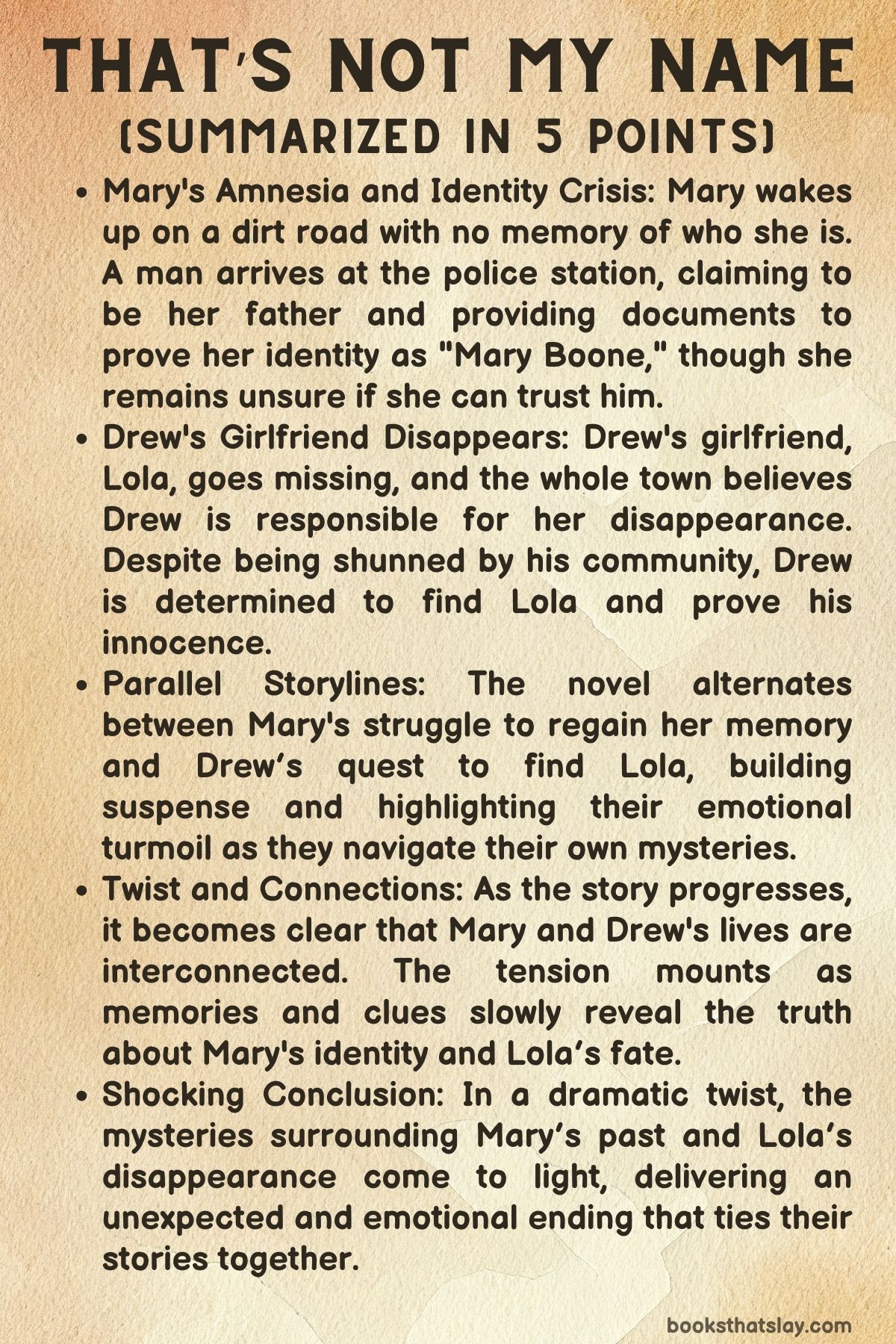
That’s Not My Name by Megan Lally is a young adult thriller that blends psychological suspense with an emotional exploration of memory, loss, and survival. It begins with a girl waking in the middle of nowhere, battered and terrified, with no memory of her own name.
As she tries to piece together her identity, she meets people who claim to know her, but nothing feels familiar. Meanwhile, another storyline follows Drew, a boy shunned by his town and haunted by the disappearance of his girlfriend, Lola. Their paths gradually converge in a chilling narrative about trust, identity, and uncovering terrifying truths hidden in plain sight.
Summary
A teenage girl wakes up in a ditch at night, covered in injuries and unable to recall who she is. She stumbles onto a road where Officer Bowman finds her.
At the police station, Bowman tries to help her regain her sense of self, but every question—her name, her family, her school—meets with confusion. Just when she fears she may never know who she is, a man named Wayne Boone arrives, claiming she is his daughter, Mary.
He shows photographs and identification to prove it. Though she feels no recognition, the evidence convinces Bowman, and the girl begins to accept this identity.
Wayne insists on taking her home, and Bowman escorts them to a secluded cabin where Wayne provides documents confirming her supposed life as Mary Boone.
At the cabin, Wayne acts caring, cooking breakfast and supplying clothes, yet inconsistencies emerge. She discovers allergies and fragmented memories that clash with Wayne’s explanations.
His controlling behavior—commenting on her clothing, monitoring her choices—heightens her unease. Small details, like a recalled memory of a cat Wayne denies ever existed, plant seeds of doubt.
She begins to question whether Wayne is telling the truth about who she is and what happened to her.
In a separate narrative, Drew is consumed by the disappearance of his girlfriend, Lola. The community suspects him, and even Lola’s parents and best friend, Autumn, blame him.
Despite the hostility, Drew persists in searching, plastering missing posters and piecing together her last movements. His hope is crushed when his fathers inform him a body has been discovered, though no one confirms it belongs to Lola.
Sheriff Roane intensifies pressure on Drew, seizing his car and implying incriminating evidence will surface. Drew remains resolute in proclaiming his innocence, yet his isolation grows.
With only his cousin Max and Autumn wavering between skepticism and reluctant help, Drew pursues leads on his own. He eventually finds a tip from a woman named Meredith Hoyt, who claims to have seen Lola alive, wearing her distinctive floral-sleeved jacket, with a middle-aged man in a gray van.
Excited, Drew brings the tip to the sheriff, but since the information came from stolen police recordings, Roane dismisses it outright. Frustrated, Drew decides to act independently with Max and Autumn, arranging a meeting with Meredith, who confirms her sighting and describes Lola in distress, suffering from hives as the man gave her Benadryl before driving away.
Meanwhile, at the cabin, the girl known as Mary uncovers more troubling signs. She remembers her real mother, contradicting Wayne’s story that her mother is dead.
She discovers evidence Wayne lied about a missing neighbor, Ben Hooper. Bowman unknowingly feeds her details that further expose Wayne’s dishonesty.
Terrified, she begins to realize Wayne may have abducted her and is keeping her under false pretenses.
Drew, desperate for proof, follows a lead to Ridge Road, near the Boone cabin. There he sees a man carrying a limp girl in Lola’s jacket into a basement.
Drew investigates and discovers the girl chained inside is not Lola but Madison Perkins, another victim of Wayne Boone. Madison has been pretending to be Mary to survive Wayne’s delusion that his dead daughter still lives.
The basement walls reveal chilling evidence: names of other girls scratched into the concrete, proof Wayne has abducted and killed multiple victims.
Drew tries to free Madison but is caught by Wayne, leading to a violent struggle. Wayne attacks Drew, nearly killing him, but Madison intervenes, using whatever she can find—tools, a cot, even a car battery—to fight back.
Together, Drew and Madison manage to escape into the house, only to discover Wayne has sabotaged the gas lines to blow the cabin up. In a final desperate confrontation, Madison fights Wayne with a fireplace shovel and poker, ultimately sending him tumbling down the basement stairs to his death.
Authorities arrive, and Bowman rescues the teens. Madison learns she was never Mary Boone; Wayne’s real daughter died years ago, and he had been abducting lookalikes to replace her.
Investigators uncover nine murdered girls connected to him, including his own daughter’s body hidden under concrete. Lola, tragically, had already been killed before Drew began his search, but his persistence led to Madison’s rescue and the end of Wayne’s killing spree.
Months later, Drew continues to grieve Lola. On her birthday, he visits the river with a cupcake to honor her.
Madison, now with grown and dyed hair, finds him there. She reminds him he saved her and that Wayne had chosen his next victim immediately after taking Lola—meaning no one could have saved her in time.
Together they honor Lola’s memory, acknowledging the loss but also recognizing the lives spared because Drew refused to stop searching. Drew, with Max and Autumn at his side, begins to heal, carrying both the sorrow of Lola’s absence and the relief of stopping a predator.
Characters
Madison Perkins (initially believed to be Mary Boone)
Madison is the central figure of That’s Not My Name, a girl who awakens in a ditch with no memory of who she is or where she belongs. Her disorientation and panic establish her as both a victim and a mystery from the very beginning.
Initially introduced under the mistaken identity of “Mary Boone,” she struggles to reconcile the life Wayne Boone insists is hers with the fragmented, inconsistent flashes of memory she experiences. Madison’s characterization rests heavily on her vulnerability—her fear of being alone, her desperate need for truth, and her attempts to cling to any anchor of identity.
Yet beneath this fragility lies an inner strength. Despite being manipulated, gaslit, and controlled, Madison slowly learns to trust her instincts.
The inconsistencies in Wayne’s stories fuel her determination to question and resist, and even when fear dictates compliance, her will to survive emerges again and again. By the climax, Madison transforms from a confused and terrified girl into an active fighter for her life, reclaiming her name and rejecting the false identity forced upon her.
She embodies resilience, survival, and the reclamation of one’s voice against those who try to erase it.
Wayne Boone
Wayne Boone is one of the most chilling characters in the novel, a man whose calm demeanor masks the reality of his violent obsessions. To the outside world, he presents himself as a grieving father desperate to reclaim his lost daughter, but in reality, he is a predator who abducts young women resembling his murdered child, forcing them into the role of “Mary.” Wayne’s character reveals the depth of manipulation and control an abuser can exert, from dictating what Madison eats and wears to rewriting her memories and history.
His strict “rules” and the facade of fatherly concern conceal a delusional and dangerous psyche. Boone is not just a liar—he is a man consumed by grief twisted into obsession, unable to let go of his real daughter and instead perpetuating a cycle of violence through surrogates.
His duplicity makes him both terrifying and compelling; he can cook breakfast one moment and enforce captivity the next. Wayne embodies the horror of someone who convinces himself his abuse is love, making him one of the most complex villains in the narrative.
Drew Scott
Drew is the second emotional anchor of the story, a teenage boy caught in the crushing weight of grief, suspicion, and guilt. As Lola’s boyfriend, his devotion to her becomes his defining trait, but it is also what isolates him from the rest of his community.
He is haunted by their final fight and wracked with guilt for letting her walk away, feelings that are compounded by the town’s suspicions and the sheriff’s constant scrutiny. Despite being cornered and ostracized, Drew refuses to abandon his search for Lola, clinging desperately to hope.
His characterization reveals the toll of grief and suspicion on a young man who is both victim and scapegoat. Drew’s makeshift investigation board, his obsession with following leads, and his volatile emotional state demonstrate how trauma can consume and shape someone.
Yet, when he discovers Madison instead of Lola, Drew’s courage emerges most clearly. His insistence on helping Madison escape, despite his own heartbreak, elevates him from desperate lover to reluctant hero.
By the end, Drew becomes a symbol of perseverance and sacrifice, though his grief for Lola never fully releases him.
Lola Scott
Lola, though absent for much of the narrative, remains a constant presence through memories, rumors, and suspicions. She is the emotional core around which Drew’s grief and the town’s suspicions revolve.
Her floral-sleeved jacket, handmade by Autumn, becomes an emblem of her individuality and eventually the marker of her tragic fate. Lola’s story is pieced together through others’ recollections: a girl with normal teenage desires, like wanting her own car, yet trapped between the expectations of her parents and her relationship with Drew.
Her disappearance not only catalyzes Drew’s downward spiral but also underscores Wayne Boone’s predatory pattern, as she becomes another of his victims. Lola embodies the fragility of youth in the face of predation and misfortune, her absence haunting the narrative until the truth of her death is revealed.
Officer Bowman
Officer Bowman represents a figure of authority who oscillates between compassion and procedure. He is the first person to encounter Madison in her disoriented state and responds with empathy, offering her warmth, safety, and dignity in the form of socks, hot chocolate, and reassurance.
His insistence on verification, however, shows his responsibility as an officer, creating tension between kindness and bureaucracy. Bowman’s role highlights the importance of vigilance and protocol in cases of missing or vulnerable individuals; though he initially believes Wayne’s narrative, his care for Madison plants seeds of safety that prove crucial later.
In the broader thematic sense, Bowman represents the contrast between protective authority and corrupt authority figures like Sheriff Roane, who fail Drew.
Autumn and Max
Autumn and Max, Drew’s closest allies, function as supporting characters who demonstrate loyalty, determination, and contrasting emotional responses to grief. Autumn, Lola’s best friend, is initially hostile toward Drew, fueled by her own grief and suspicion, but her eventual willingness to investigate alongside him reveals both courage and devotion to Lola’s memory.
Her sharpness and resourcefulness—such as impersonating a secretary to gather information—make her a practical and daring companion. Max, Drew’s cousin, serves as a stabilizing presence, providing support and encouragement when Drew spirals into despair.
Together, the two form a counterbalance to Drew’s isolation, showing that even amid suspicion and loss, bonds of friendship and family can endure.
Sheriff Roane
Sheriff Roane personifies institutional failure in the narrative. From the outset, he views Drew as the prime suspect, his skepticism bordering on antagonism.
His dismissive treatment of Drew’s discoveries, especially the credible lead about Lola’s sighting, shows how entrenched biases can hinder justice. Roane embodies a system more interested in confirming suspicion than pursuing truth, and his role magnifies Drew’s isolation and frustration.
His eventual portrayal as a figure who capitalizes on the tragedy for public posturing underscores the novel’s critique of self-serving authority figures.
Themes
Identity and Memory
The crisis of identity lies at the heart of Thats Not My Name. The girl who wakes up without any recollection of her past embodies the fragile link between memory and selfhood.
Without her name, her history, or even basic knowledge such as her allergies, she becomes a blank slate onto which others project their versions of who she is. Wayne insists she is Mary Boone, presenting documents and photos as proof, but her internal sense of disconnection illustrates how identity is more than external validation—it is lived experience.
The tension between what Wayne claims and what she slowly remembers creates a profound unease, emphasizing how memory functions as both a safeguard and a vulnerability. Her fleeting recollections, like the image of a cat, challenge the imposed narrative and remind the reader that truth cannot be entirely erased.
This theme underscores how memory anchors identity, and how the absence of it leaves one dangerously open to manipulation. The girl’s journey is not merely about regaining factual knowledge but about reclaiming ownership of her life, her choices, and her truth from someone who tries to rewrite it for his own distorted purposes.
Control and Manipulation
Wayne Boone’s relationship with the protagonist is a chilling study in control disguised as protection. He supplies food, clothing, and shelter, which initially read as kindness but are quickly revealed as tools of dominance.
His disapproval of her clothing choices, insistence on “the rules,” and staged narratives about her mother’s death and their supposed history establish a prison built on dependency. Even simple comforts such as breakfast or a jacket become symbols of his power to shape her world.
By controlling what she wears, eats, and remembers, Wayne attempts to strip her of autonomy. This manipulation extends beyond direct orders to psychological coercion, making her doubt her instincts and memories.
The imbalance between what he claims to know and what she is allowed to discover emphasizes the dangers of authority unchecked by truth. This theme reveals how abusers weaponize care, twisting it into a method of captivity, and how survival sometimes depends on the victim’s ability to play along until they can resist.
The girl’s gradual realization of these dynamics highlights the resilience required to break free from control disguised as love.
Grief and Guilt
Drew’s story is dominated by grief that borders on obsession. The disappearance of Lola consumes him, and with every look of contempt or suspicion from townspeople, his sense of guilt intensifies.
He did not harm Lola, yet his choice to let her storm off alone weighs on him as though he had. This personal torment is compounded by the community’s suspicion, which isolates him further.
His investigation board and refusal to stop searching illustrate the way grief distorts time and perspective, trapping him in cycles of what-ifs and maybes. His grief is not passive mourning; it is restless and compulsive, driven by the need to prove both Lola’s survival and his own innocence.
When news of a body surfaces, his guilt manifests physically, reinforcing the consuming nature of his anguish. This theme underscores how grief is not only about loss but about the corrosive self-blame that can accompany it, especially when closure is denied or deferred.
Drew’s experience reflects the dangerous overlap of grief and guilt, where mourning is compounded by isolation and the crushing suspicion of others.
Truth and Perception
Throughout Thats Not My Name, the question of truth is filtered through conflicting perceptions. To Wayne, the protagonist is his daughter; to Bowman, she may be a missing girl from official records; to herself, she is someone still lost in the fog of amnesia.
Drew faces a similar clash of perceptions: he knows he is innocent, but to the sheriff, Lola’s parents, and Autumn, he is a suspect. Truth is not immediately accessible but mediated through memory, documentation, suspicion, and rumor.
The novel highlights how fragile truth can seem when external evidence contradicts internal conviction. For Mary/Madison, the photographs and documents present an official truth, yet her own unease and memories suggest a deeper reality.
For Drew, the townspeople’s perception becomes its own truth, shaping how others treat him regardless of facts. This theme captures the instability of truth in human lives, showing how perception, when widely shared or powerfully asserted, can obscure or even overwrite reality.
Ultimately, the novel affirms that truth, though contested, must be pursued with persistence, even when it means resisting the authority of both individuals and institutions.
Survival and Resilience
Survival in the novel is not only about physical endurance but about maintaining a sense of self under duress. The protagonist learns to survive Wayne’s delusion by feigning compliance, while internally plotting to uncover reality and retain fragments of her own voice.
Drew, too, must survive, though his threat is less immediate danger and more the psychological strain of grief, suspicion, and alienation. Both narratives show survival as an active process requiring courage, adaptability, and resourcefulness.
In the climactic scenes, Madison’s fight against Wayne is a raw demonstration of resilience—her ability to seize tools, exploit opportunities, and refuse to let fear paralyze her. Drew’s resilience, meanwhile, is tested in his choice to continue seeking truth despite ridicule and dismissal from the sheriff and community.
The theme emphasizes that resilience is not an innate trait but a hard-earned response to trauma, one that grows in moments of crisis. The story suggests that survival is as much about mental and emotional strength as about physical escape, and that resilience often arises from holding onto even the smallest fragments of truth and hope.