Alive by Piers Paul Read Summary and Analysis
Alive by Piers Paul Read is a nonfiction account of the 1972 Andes plane crash involving a Uruguayan rugby team, their friends, and family members. The book examines how ordinary young men, raised in comfort and shaped by Catholic faith and team discipline, faced hunger, cold, injury, grief, and moral terror after their aircraft went down in the mountains.
Read presents the disaster not only as a survival story, but also as a study of leadership, loyalty, faith, shame, endurance, and the painful choices people make when every familiar rule has been stripped away.
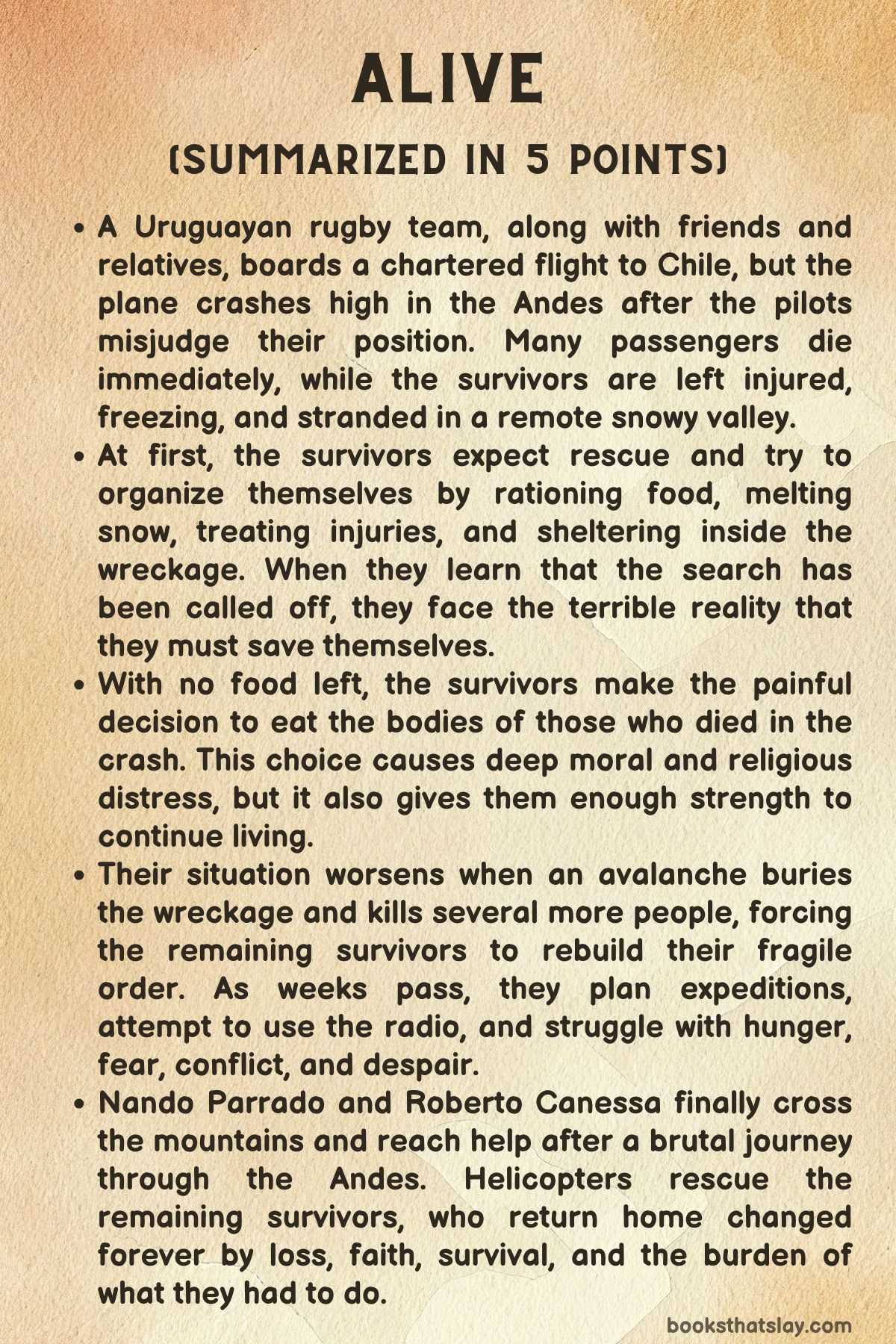
Summary
Alive begins by setting the disaster within the world the passengers came from. Uruguay, a small South American country between Brazil and Argentina, had once enjoyed prosperity but was under political and economic strain by the early 1970s.
Many of the young men on the flight came from privileged Catholic families in Montevideo. They had been educated by Irish priests, who brought rugby into their school culture as a sport that demanded toughness, discipline, and teamwork.
Former students formed the Old Christians’ Club, a rugby team that played matches in Uruguay and abroad.
In October 1972, the team arranged a charter flight to Chile for a match. Players, relatives, and friends joined the trip.
Among them were team captain Marcelo Perez, Nando Parrado, his mother and sister, Roberto Canessa, Gustavo Zerbino, Carlitos Paez, the Strauch cousins, and others. The flight began with jokes and youthful excitement, but bad weather over the Andes forced the plane to stop overnight in Argentina.
The next day, the pilots decided to continue. While crossing the mountains, they misjudged their position.
The aircraft hit the Andes, broke apart, and slid down a snowy slope before stopping in an isolated valley.
The crash killed many passengers immediately and left others badly injured. The survivors were stranded in freezing conditions without proper clothing, food, medical equipment, or clear knowledge of where they were.
The pilots were dead or dying, the radio was useless, and the wrecked fuselage became their only shelter. Canessa and Zerbino, first-year medical students, tried to treat the wounded with little training and few supplies.
Marcelo Perez tried to organize the group, ration the small amount of food, and keep hope alive. The survivors believed search planes would soon find them.
At first, they survived on chocolates, jam, wine, and other scraps from the luggage. They melted snow for water and created rough systems for sleeping, caring for the wounded, and keeping the cabin clean.
Search planes passed overhead, and one seemed to signal that they had been seen. The group celebrated, but no rescue came.
Their hope weakened as days passed, injuries worsened, and more people died, including Nando Parrado’s sister Susana.
Outside the mountains, families in Uruguay and Chile fought desperately to keep the search going. Official rescue teams searched difficult terrain in dangerous weather, but the white wreckage was almost invisible in the snow.
After repeated failure, authorities called off the search. Families refused to give up.
Some hired private help, consulted people who claimed supernatural insight, and organized their own efforts, but they had no reliable location.
On the mountain, the survivors eventually heard by radio that the search had ended. This news changed everything.
Their remaining food was nearly gone, and their bodies were weakening. Some had already begun to understand the terrible choice before them: the dead bodies, preserved by snow and cold, were the only source of nourishment.
After painful discussion, several survivors accepted that eating the dead was necessary if anyone was to live. Canessa helped begin the process.
At first many resisted, but hunger and the need to survive forced most of them to take part. They framed the act through necessity, faith, and loyalty, seeing the bodies of their friends as a final gift that allowed the living to continue.
The group began to build a harsh routine around survival. They cut and dried meat, melted snow, organized labor, and planned possible expeditions.
Some men grew stronger after eating; others struggled physically or morally. Leadership shifted after Marcelo’s confidence failed.
The Strauch cousins, Daniel Fernandez, Carlitos, Zerbino, and others helped maintain order. The survivors argued often, but their conflicts rarely destroyed the fragile cooperation they needed.
Disaster struck again when an avalanche buried the fuselage. Several survivors, including Marcelo Perez and Liliana Methol, were killed.
Those who remained were trapped under snow in the wreckage, wet, crowded, and nearly out of air. They carved an air hole and eventually dug their way out, but the avalanche reduced their number and deepened their fear.
Now they knew the fuselage was not only a shelter but also a possible tomb.
As the weather slowly improved, they focused more seriously on escape. Nando Parrado became one of the most determined figures.
Once shy and withdrawn, he was transformed by loss and by the will to reach his father. Roberto Canessa was intelligent and medically useful, though often difficult.
Numa Turcatti was admired but weakened because he struggled to eat enough. Roy Harley, traumatized by failure and death, became fragile.
Others carried injuries, despair, resentment, or guilt, yet most tried to contribute in some way.
The survivors first attempted to use the plane’s radio by carrying equipment toward the tail section, where they found batteries, clothes, and supplies. The effort failed; the radio could not contact anyone.
The attempt nevertheless confirmed that waiting was too dangerous. Food was running low, the bodies were thawing, and rescue searches might never reach them.
A final expedition became essential.
On December 12, Parrado, Canessa, and Antonio Vizintin set out with food and a sleeping bag made from insulation. They believed Chile lay close beyond the nearest peaks.
After days of climbing, Parrado reached a summit and saw not civilization, but more mountains. The sight was devastating.
Still, he and Canessa decided to continue. Vizintin returned to the crash site so the two others could stretch the supplies.
Parrado and Canessa crossed mountains, descended into a valley, and followed signs of life: running water, flowers, birds, cow dung, a horseshoe, and finally cattle. Exhausted and starving, they reached a river where they saw men on the far side.
Because the river was too loud and dangerous to cross, Parrado wrote a message explaining that they were survivors of a plane crash and needed help. A Chilean man, Sergio Catalan, received the message and went for assistance.
After seventy days, Parrado and Canessa were safe.
News that survivors had been found shocked Chile, Uruguay, and the families who had continued searching. Parrado helped guide helicopters back to the crash site.
The remaining survivors, who had almost given up hope, heard the news by radio and prepared themselves. Helicopters finally appeared over the mountains.
Because of altitude and weather, only some survivors could be removed at first; the rest waited one more night with rescuers before being flown out.
In hospitals, doctors found the men weak, thin, injured, and emotionally shaken, but many were in better physical condition than expected. The survivors slowly admitted that they had eaten human flesh to stay alive.
A priest reassured them that their actions, taken under extreme necessity, were not sinful. Families reacted with relief, shock, grief, and sometimes revulsion, especially those whose loved ones had died, but many defended the survivors as people who had honored the dead by living.
When the men returned to Uruguay, the press focused intensely on the cannibalism. At a public conference, the survivors explained their ordeal with dignity.
They described fear, hunger, prayer, friendship, and the moral burden of their choice. Over time, they tried to return to ordinary life, though none of them could be the same.
Some became public figures, some leaned on faith, and others struggled privately with memory and loss.
The investigation later concluded that pilot error caused the crash. Of the people who left Montevideo, twenty-nine died and sixteen survived.
The remains of the dead were eventually buried near the crash site beneath a cross, and the wreckage was burned. Alive ends as an account of survival bought at terrible cost, shaped by courage, conflict, faith, and the bond between the living and the dead.
Key People
Nando Parrado
Nando Parrado is one of the central figures in Alive, and his development is among the strongest in the narrative. Before the crash, he is presented as quiet, timid, and emotionally dependent on familiar relationships, especially his close friendship with Panchito Abal and his bond with his family.
The crash destroys that earlier version of him. He loses his mother, then watches his sister Susana die after days of suffering, and this grief becomes the force that drives him forward rather than breaking him completely.
Nando’s desire to return to his father gives him a clear purpose when many others are losing hope. He is impatient, sometimes harsh, and often frustrated by weakness in others, but these traits come from his fierce refusal to accept death on the mountain.
His climb across the Andes with Canessa reveals his courage, stamina, and growing self-belief. After the rescue, he briefly accepts the role of hero, but the deeper reality of his losses eventually overtakes public admiration.
Nando represents survival powered by love, grief, and an almost stubborn commitment to action.
Roberto Canessa
Roberto Canessa is intelligent, practical, and essential to the group’s survival, though he is not always easy for the others to like. As a medical student, he becomes one of the first people to care for the injured, even though his training is limited and the conditions are almost impossible.
He is also one of the first to take the practical step of eating human flesh, not because he is emotionless, but because he understands the biological reality of starvation. Canessa often appears abrasive, argumentative, and self-protective, especially when survival decisions place him under pressure.
Yet he repeatedly proves his value through action. He helps with medical care, participates in expeditions, works on the radio attempt, and finally joins Nando in the journey that saves the remaining survivors.
His weakness during the final trek makes him more human; he is not an effortless hero but a frightened, exhausted young man who continues despite fear and physical collapse. Canessa represents intelligence under pressure, moral realism, and the painful difference between being necessary and being loved.
Marcelo Perez
Marcelo Perez begins as the captain of the rugby team and naturally assumes responsibility after the crash. His leadership is rooted in his position within the group, his discipline, and his sense of duty.
At first, he tries to impose order by rationing food, organizing the survivors, and maintaining confidence that rescue will come. His role is emotionally heavy because he helped organize the trip, and he feels responsible for the people trapped in the mountains.
Marcelo’s decline is one of the most tragic emotional movements in the story. When the survivors learn that the search has been called off, his faith in rescue collapses, and with it his ability to lead.
He is not weak in a simple sense; rather, he is a man crushed by responsibility, guilt, and the failure of the world outside to find them. His death in the avalanche marks the end of the first phase of the group’s life on the mountain.
Marcelo represents formal leadership, duty, and the limits of authority when hope has no evidence to support it.
Gustavo Zerbino
Gustavo Zerbino is one of the most active and disciplined survivors. As a medical student, he joins Canessa in caring for the wounded and dealing with the physical consequences of the crash.
Unlike some of the more passive figures, Zerbino often becomes a force of order. He helps enforce rules, watches for theft, and takes responsibility for maintaining discipline within the group.
This makes him respected, but it can also make him severe. His role as a kind of policeman shows how survival requires more than courage; it requires social control, fairness, and sometimes suspicion.
Zerbino also carries the burden of confronting the truth about the bodies and later explaining the cannibalism to rescuers. His actions show a man who survives by keeping busy, making himself useful, and refusing to let the group fall into chaos.
He represents discipline, responsibility, and the uneasy authority that emerges when normal society has disappeared.
Carlitos Paez
Carlitos Paez brings humor, emotional energy, and resilience to the group. At first, he is deeply affected by fear and uncertainty, but over time he becomes one of the survivors who helps others endure the emotional strain of the mountain.
His humor is not shallow; it becomes a survival tool, a way of releasing tension and reminding the group that they are still human. Carlitos grows after the failed expedition and becomes more responsible, working harder and accepting a larger role in the community.
His father’s desperate search outside the mountains gives his story additional emotional weight, because the reader sees both the son struggling to survive and the father refusing to give up. Carlitos also has moments of intuition, especially when he senses that Nando and Canessa may have succeeded.
His reunion with his father is one of the most moving moments after the rescue. Carlitos represents emotional endurance, humor under pressure, and the bond between family hope and personal survival.
Fito Strauch
Fito Strauch is one of the practical minds among the survivors. Early on, he helps develop a method for melting snow into drinking water, which becomes one of the most important survival systems at the crash site.
Later, he joins his cousins in assuming a greater leadership role after Marcelo’s authority fades. Fito is steady, capable, and often willing to perform unpleasant tasks that others cannot face.
His ability to think clearly in physical crisis makes him valuable not only as a worker but also as a stabilizing presence. He helps maintain order when the group must ration food, recover bodies, and prepare expeditions.
Fito’s strength lies in his practicality rather than public heroism. He is not defined by speeches or dramatic gestures, but by repeated acts of usefulness.
He represents the quiet labor behind survival, the kind of intelligence that turns wreckage, snow, and scraps into systems that keep people alive.
Eduardo Strauch
Eduardo Strauch, along with his cousins, becomes part of the informal leadership that replaces the earlier structure of the rugby team. His role is especially important because the Strauch cousins take charge of some of the most difficult and morally painful work: cutting, preparing, and rationing the flesh of the dead.
Eduardo’s importance lies in his willingness to confront what others cannot bear to do. He helps create a structure in which the survivors can continue eating without descending into disorder or panic.
This work isolates the Strauch cousins in a certain way, because they must manage both the physical task and the moral weight attached to it. Eduardo represents controlled practicality.
He shows that survival often depends on people who can do necessary work without demanding recognition for it. His contribution is not glamorous, but it is central to the group’s continued existence.
Daniel Fernandez
Daniel Fernandez is another important figure in the practical leadership that develops after the first phase of the disaster. He helps maintain the social order of the survivors and shares responsibility for rationing and difficult decisions.
Daniel is also emotionally significant near the end, when he expresses faith that the expedition has succeeded. His confidence helps prepare the group for the possibility of rescue at a time when despair is again growing.
After the rescue, he is one of the men who must speak to the families of those who died, including delivering painful news about Gustavo Nicolich. Daniel’s character reflects both discipline and emotional burden.
He is part organizer, part witness, and part messenger between the living and the families of the dead. His role shows how survival does not end when rescue arrives; the survivors must also carry news, memory, and responsibility back into the world.
Numa Turcatti
Numa Turcatti is one of the most admired survivors, loved for his character, courage, and generosity. Unlike some others, he struggles deeply with eating human flesh, and this moral and physical resistance weakens him over time.
His body declines because he cannot fully accept the only available source of nourishment. Numa’s injury, which turns septic, removes him from the final expedition, even though he desperately wants to go.
His frustration at being left behind shows both his courage and his helplessness. He wants to contribute in the most direct way possible, but his body fails him.
Numa represents moral sensitivity in a world where survival demands brutal compromise. His goodness makes him beloved, but it also makes survival harder for him.
Through Numa, the story shows that virtue alone cannot protect a person in extreme conditions, and that the demands of the body can come into painful conflict with conscience.
Antonio Vizintin
Antonio Vizintin is strong enough to be chosen for the final expedition, but his character is not idealized. He can be quarrelsome and self-centered, and his relationships with others are strained at times.
Yet his physical strength makes him important to the group’s plans for escape. During the final expedition, he accepts the difficult decision to return to the wreckage so that Nando and Canessa can continue with a larger share of supplies.
This moment reveals a self-sacrificing side that complicates earlier impressions of him. By turning back, he gives the other two a better chance of reaching help, and therefore contributes directly to the rescue.
Vizintin represents the complexity of human character under pressure: a person can be difficult, flawed, and still capable of a decisive act that helps save others.
Roy Harley
Roy Harley is one of the most psychologically fragile survivors. He has some technical knowledge, which makes the others look to him during the radio attempt, but he lacks confidence in his abilities and is deeply affected by failure.
Trauma weakens him, and he often weeps or withdraws instead of helping. This causes frustration among the stronger or more active survivors, especially Nando, who despises visible helplessness.
Yet Roy’s breakdown is not simple cowardice. He shows the mental cost of the disaster in a way that more heroic figures can sometimes hide.
He survives, but he does so with great emotional difficulty. His character reminds the reader that endurance is uneven.
Some people become stronger in crisis, while others become damaged by every new disappointment. Roy represents trauma, fear, and the shame that can attach to mental collapse in a group that depends on action.
Liliana Methol
Liliana Methol is one of the few women among the survivors and becomes a maternal presence within the wreckage. Her experience caring for her husband Javier gives her practical nursing ability, but her deeper value is emotional.
She comforts the injured and brings warmth to a group made mostly of young men far from home. Her hope persists even after others begin to despair, and her reluctance to eat human flesh reflects both moral resistance and spiritual struggle.
When she finally accepts the necessity, it shows how completely the mountain has changed the terms of life. Her death in the avalanche is especially devastating because it removes one of the gentlest and most stabilizing figures from the group.
Liliana represents care, maternal strength, and the emotional shelter that human beings need even when physical shelter is barely available.
Javier Methol
Javier Methol is older than many of the young survivors and is closely tied to Liliana, his wife. Their marriage provides one of the few images of adult companionship at the crash site.
Javier initially refuses to eat human flesh, but as he weakens, he eventually accepts the necessity, followed by Liliana. His grief after the avalanche is deeply painful because he wants the others to save his wife, but she is already dead.
After losing her, Javier must continue surviving without the person who gave his ordeal emotional meaning. His survival is quieter than that of the expedition members, but it carries great sadness.
Javier represents endurance after intimate loss. His character shows that survival is not only a physical achievement; sometimes it is the unbearable act of continuing after the person closest to you is gone.
Pancho Delgado
Pancho Delgado becomes one of the more controversial survivors. He is resented for his optimism, which others see as shallow or unearned, especially when they believe he is not contributing enough.
His injury and unwillingness to push through pain make him a target for anger. Later, when food theft becomes a concern, he is suspected and caught in a trap, becoming a scapegoat for broader tensions within the group.
Yet Delgado also plays an important role after the rescue, when he speaks publicly and explains the survivors’ actions with dignity and eloquence. His ability to communicate gives the group a moral voice before the outside world.
Delgado represents the gap between how a person is judged inside a crisis and how they may serve the group afterward. He is flawed, resented, and still capable of helping shape public understanding.
Jose Algorta
Jose Algorta is described as an unlikely hero because he does not fully fit the social and political background of many of the others. His more socialist views mark him as different from the mostly privileged young men around him.
He also suffers from amnesia, which separates him from the full emotional context of the crash. Yet he works hard and earns respect through contribution.
His usefulness becomes more important than social difference. In the stripped-down world of the mountain, class, politics, and personality matter less than whether someone helps the group survive.
Algorta’s character is important because he complicates the idea that the survivors are a single uniform brotherhood. They have differences, tensions, and judgments, but crisis forces them to recognize value in unexpected places.
Algorta represents practical worth beyond social identity.
Arturo Nogueira
Arturo Nogueira is one of the severely injured survivors whose physical suffering leads to emotional collapse. His injury worsens, and his isolation from the group becomes dangerous.
Nando recognizes that loneliness is killing him and tries to restore his hope. Nogueira’s prayer near the end of his life is one of the most spiritually intense moments in the story.
His sincerity moves the others to tears, showing that even a dying man can give strength to those around him. His letter to his loved ones also reveals his need to leave behind meaning, memory, and affection.
Nogueira represents the connection between hope and survival. His body is badly damaged, but it is his despair and isolation that seem to hasten his decline.
His death reminds the group that emotional abandonment can be as deadly as cold or hunger.
Rafael Echavarren
Rafael Echavarren is another severely injured survivor whose condition places him outside the main working structure of the group. His infected, gangrenous leg marks the horror of untreated injury in the mountains.
Because he cannot contribute like the healthier survivors, he becomes part of the painful division between workers and dependents. His presence shows the moral difficulty of survival communities: compassion remains necessary, but resentment grows when every task, ration, and movement matters.
Echavarren’s decline is not defined by dramatic action but by helpless suffering. He represents the fate of those whose bodies cannot adapt to the brutal demands of the mountain.
His death reinforces the urgency of escape, because the crash site is not a stable refuge but a place where injuries, infection, starvation, and despair slowly consume the weak.
Bobby Francois
Bobby Francois is one of the most passive and pessimistic survivors. He refuses to work, seems convinced that survival is impossible, and frustrates those who are trying to organize labor and maintain hope.
His laziness or resignation makes him a symbol of the internal threat posed by despair. In a normal setting, passivity might be merely irritating; on the mountain, it becomes dangerous because the group depends on shared effort.
Yet Bobby’s behavior also shows another response to trauma. Some people fight, some organize, some pray, and some emotionally shut down.
Bobby is not admirable in the same way as Nando or Canessa, but his presence adds realism to Alive. Not everyone becomes noble in crisis.
Some survive while doing little, and that uncomfortable truth is part of the group’s social strain.
Carlos Paez Vilaro
Carlos Paez Vilaro, Carlitos’s father, is one of the most determined family members outside the mountains. While the survivors endure hunger and cold, he embodies the refusal of the families to accept official defeat.
He searches, asks questions, seeks help from people who know the mountains, and continues when authorities have lost hope. His efforts show the emotional suffering of those left behind: they are not physically trapped, but they are imprisoned by uncertainty.
His search is driven by love, desperation, and the need to do something rather than wait passively. His reunion with Carlitos gives emotional release to both sides of the story.
Carlos represents parental devotion and the stubborn power of hope from outside the disaster.
Sergio Catalan
Sergio Catalan is the Chilean man who receives Nando Parrado’s message across the river and carries news of the survivors to the authorities. His role is brief but crucial.
He appears at the exact point where endurance has brought Canessa and Nando as far as they can go, but survival now depends on the compassion and action of a stranger. Catalan’s kindness is practical rather than grand.
He throws bread across the river, understands enough to seek help, and becomes the link between the lost men and civilization. His poverty makes his generosity more meaningful, because he gives what he can without hesitation.
Catalan represents human decency beyond nationality, class, or personal connection. Without him, the heroic journey might still have failed at the edge of rescue.
Themes
Survival and the Rewriting of Moral Boundaries
Survival in Alive is not presented as a clean triumph of courage over danger. It is shown as a process that strips life down to the body’s most basic demands: warmth, water, food, shelter, and movement.
The survivors begin with ordinary moral assumptions, shaped by Catholic upbringing, family values, and social comfort. The mountain destroys the conditions that made those assumptions easy to maintain.
Eating the dead becomes the central moral crisis because it violates a deeply held human taboo, yet refusing to do so means almost certain death. The book does not treat this decision casually.
The survivors discuss it, resist it, rationalize it, pray over it, and live with its consequences. Their choice changes the meaning of the bodies around them.
The dead are no longer only reminders of loss; they become the reason the living can continue. This theme asks whether morality is fixed in all circumstances or whether extreme necessity creates new obligations.
The survivors do not abandon ethics. Instead, they build a new ethical code based on consent, reverence, rationing, and the belief that living can honor the dead.
Faith, Guilt, and the Search for Meaning
Faith is not shown as a simple source of comfort. It is tested, reshaped, and sometimes made more urgent by suffering.
Many of the survivors are Catholic, and prayer becomes part of their nightly routine, but religion does not remove hunger, fear, or conflict. Instead, it gives them language for experiences that feel beyond ordinary explanation.
The act of eating human flesh creates intense guilt and spiritual anxiety, so the survivors try to understand it through sacrifice, communion, and divine permission. Their faith allows some of them to see the bodies of the dead not as objects of horror but as gifts that preserve life.
This interpretation does not erase the trauma, but it helps them continue without seeing themselves as monsters. After the rescue, the priest’s reassurance is crucial because it gives religious confirmation to what necessity had already forced them to do.
Faith also appears in moments of despair, such as prayers led by the dying and expressions of gratitude after rescue. The book presents belief as a fragile but powerful structure that helps people carry unbearable memory.
Leadership, Order, and Group Survival
The survivors remain alive partly because they create a society inside the wreckage. At first, leadership comes from existing roles: Marcelo Perez is the rugby captain, so he naturally tries to organize the group.
As conditions worsen, authority shifts from formal position to practical usefulness. The people who can melt snow, cut meat, treat wounds, enforce rules, build equipment, or plan expeditions gain influence.
This change shows how crisis redefines status. Wealth, popularity, and social background matter less than contribution.
Yet the group does not become perfectly united. There are resentments over labor, food, cigarettes, optimism, weakness, and privilege.
Some are seen as workers, others as burdens. The strongest expedition members need extra rations, but that creates tension because everyone is starving.
The Strauch cousins, Canessa, Nando, Zerbino, Carlitos, and others all hold different kinds of power, and the balance between them prevents any single person from dominating. The group survives because it develops rules, routines, punishments, rituals, and shared hopes.
The mountain becomes a brutal test of community: no one can live entirely alone, but living together under extreme pressure demands constant negotiation.
The Distance Between Public Heroism and Private Trauma
Rescue transforms the survivors into public figures before they have had time to understand what happened to them. To the outside world, their story seems miraculous, dramatic, and sensational.
Reporters want clear heroes, shocking details, and emotional statements. Families want their sons back, but they also need to process the deaths of those who will never return.
The survivors themselves are caught between relief and psychological damage. They eat too much, quarrel with loved ones, fear being alone, and struggle to explain the choices that kept them alive.
Public admiration focuses especially on figures like Nando, yet heroism does not cancel grief. His success in crossing the mountains cannot restore his mother, sister, or friends.
The media’s obsession with cannibalism also shows how outsiders can judge an experience they did not endure. Inside the mountains, eating the dead became a solemn necessity; outside, it becomes a scandal.
This theme examines the gap between what survival looks like from a distance and what it feels like from within. The survivors return alive, but they do not return unchanged, innocent, or free from the mountain’s memory.