All Souls: A Family Story From Southie Summary and Analysis
All Souls: A Family Story From Southie is Michael Patrick MacDonald’s memoir about growing up in South Boston, a neighborhood known for pride, loyalty, poverty, racial conflict, and silence around its own suffering. The book follows MacDonald’s large Irish American family, led by his fierce mother, through welfare life, housing projects, anti-busing riots, addiction, organized crime, and repeated loss.
It is not only a family history but also a portrait of a community that saw itself as forgotten, even while it was judged from the outside. MacDonald writes about love, denial, survival, and the long work of telling the truth.
Summary
All Souls begins with Michael Patrick MacDonald returning to South Boston in the 1990s after years away. He visits the cemetery and remembers the many friends, neighbors, and family members who died because of drugs, violence, suicide, and crime.
Southie, especially the Lower End where he grew up, had long been known from the outside as a fiercely white, working-class Irish neighborhood. To Michael, that image left out another truth: the poverty, addiction, family breakdown, and organized crime that hurt the people inside the community.
Michael has been working in anti-violence activism when a reporter asks him to discuss Southie as a poor white urban neighborhood. At first, Michael is nervous about exposing the community’s secrets.
Southie valued loyalty and silence, and outsiders were treated with suspicion. Yet once the article appears, people begin approaching him with stories they had kept quiet for years.
Michael realizes that many residents are ready to speak about what happened to their children and families. This leads him toward organizing a public vigil for young people lost to violence and addiction.
The memoir then returns to Michael’s childhood. His mother, called Ma, is the center of the family.
She is strong, funny, proud, and often chaotic. She has many children, survives abusive men, lives on welfare, and plays music in Irish pubs for extra money.
Michael’s earliest memories are shaped by grief. A baby brother died after a hospital refused treatment because the family was poor.
Michael is born afterward and grows up feeling that he must protect his mother from further pain.
The family moves through poor Boston neighborhoods before settling in the Old Colony Housing Project in Southie. Life there is rough but exciting for the children.
The neighborhood has its own rules. A family must prove itself, and the MacDonalds quickly gain a reputation for being wild and fearless.
Ma, at one point, walks the street with a shotgun after a local criminal threatens the family. That act earns the family respect.
Michael, as the youngest child, benefits from the family reputation and is mostly spared from fighting.
Southie is also full of racial fear and anger. When court-ordered busing begins, white families in Southie protest the mixing of Black and white students in Boston schools.
Michael, still a child, joins his family and neighbors in throwing rocks and shouting at buses and police. At first he feels powerful, part of something larger than himself.
But as the protests grow more openly racist and violent, he becomes disturbed. He sees a Black man dragged from his car and beaten by a mob.
The sight changes him. He begins to understand that the anger around him is harming innocent people.
At home, the family is also struggling. Michael’s oldest brother, Davey, has serious mental health problems after years of family trauma and institutionalization.
Davey is diagnosed with schizophrenia and receives harsh treatment in a mental hospital. Michael watches his brother suffer and becomes frightened by how little help is available.
Later, Davey dies after falling or jumping from a roof. Michael comes to believe it was suicide and feels guilt that he could not save him.
Meanwhile, Michael’s siblings are drawn in different directions by Southie’s pressures. Kevin, charming and clever, begins selling drugs as a young teenager.
He becomes connected to the criminal world surrounding Whitey Bulger, the powerful gangster many in Southie treat as a protector. To the MacDonalds and their neighbors, Whitey seems like someone who stands up for them against judges, police, and outsiders.
Over time, Michael sees the darker reality: Whitey’s influence helps spread drugs, violence, and fear through the same neighborhood that worships him.
Kathy, Michael’s sister, becomes involved with drugs and dangerous men. She falls from a roof after an argument and ends up in a coma.
The family keeps vigil at her hospital bed. Their grandfather brings holy water and, despite the nurses trying to stop him, pours it over Kathy while praying.
Kathy eventually wakes, but her body and mind are permanently changed. She learns to walk again but continues to struggle with addiction and confusion.
Frankie, another brother, seems for a time to be the family’s hope. He is handsome, disciplined, and a talented boxer.
Young people in the neighborhood admire him, and he stays away from crime for much of his life. Yet he is still surrounded by gangsters, drugs, and pressure from the streets.
After Kevin tries to leave crime behind because he has become a father, Frankie takes Kevin’s place in a planned armored car robbery. During the robbery, Frankie is shot.
Instead of taking him to the hospital, his partners kill him to avoid exposure. His death devastates Ma and the family.
Not long afterward, Kevin is arrested after another robbery. He is sent to Bridgewater State Hospital after trying to hang himself in jail.
From there, he writes Michael a religious letter expressing remorse and hope. Soon after, Kevin dies by suicide.
The family has now lost Davey, Frankie, and Kevin in a short span of years. Michael becomes numb, unable to process so much death.
After these losses, Ma wants to escape Southie. She attends hairdressing school and begins helping people in shelters, but she continues to attend wake after wake for young people killed by crime, drugs, or suicide.
Michael earns his GED and begins to recover his interest in learning. Still, the neighborhood keeps pulling the family back into its pain.
Kathy disappears for months and returns pregnant. After Kathy tries to sell the baby, Ma takes custody and raises the child herself.
Southie begins to change when minority families are moved into the housing projects. Many white residents expect violent conflict, but the children often play together without trouble.
This surprises the MacDonalds and challenges what they had been taught. Around the same time, rumors grow that Whitey Bulger has been protected by the FBI.
Michael is furious when he realizes that federal authorities may have allowed the neighborhood to be damaged by crime while using Whitey as an informant.
Michael’s younger brother Stevie is later accused of killing his friend Tommy, who dies from a gunshot wound in the family apartment. The police pressure Stevie and treat him as an easy target.
A 911 transcript appears to show Stevie confessing, but the actual recording proves that the transcript was false. Michael is shaken by the corruption and briefly considers suicide, but he chooses to fight.
He studies forensic evidence, works with lawyers, and becomes more committed to activism. Stevie is convicted of manslaughter, but the conviction is later overturned because of police misconduct.
Through Citizens for Safety, Michael works with activists from other Boston neighborhoods, including Black communities that have also suffered from police abuse and gun violence. He begins to see connections across racial lines that Southie had long denied.
The same systems that failed poor Black neighborhoods also failed poor white Southie, though the communities were often encouraged to blame one another.
In the end, Michael returns to Southie to organize a vigil for families who lost children to violence, addiction, and suicide. The event gives people permission to speak names that had been buried under shame and silence.
Standing before the crowd, Michael names his dead brothers and faces the full weight of his family’s past. All Souls closes with Michael recognizing that he can love his family and Southie without denying the harm, racism, crime, and grief that shaped them.
The act of remembering becomes his way of seeking justice and healing.
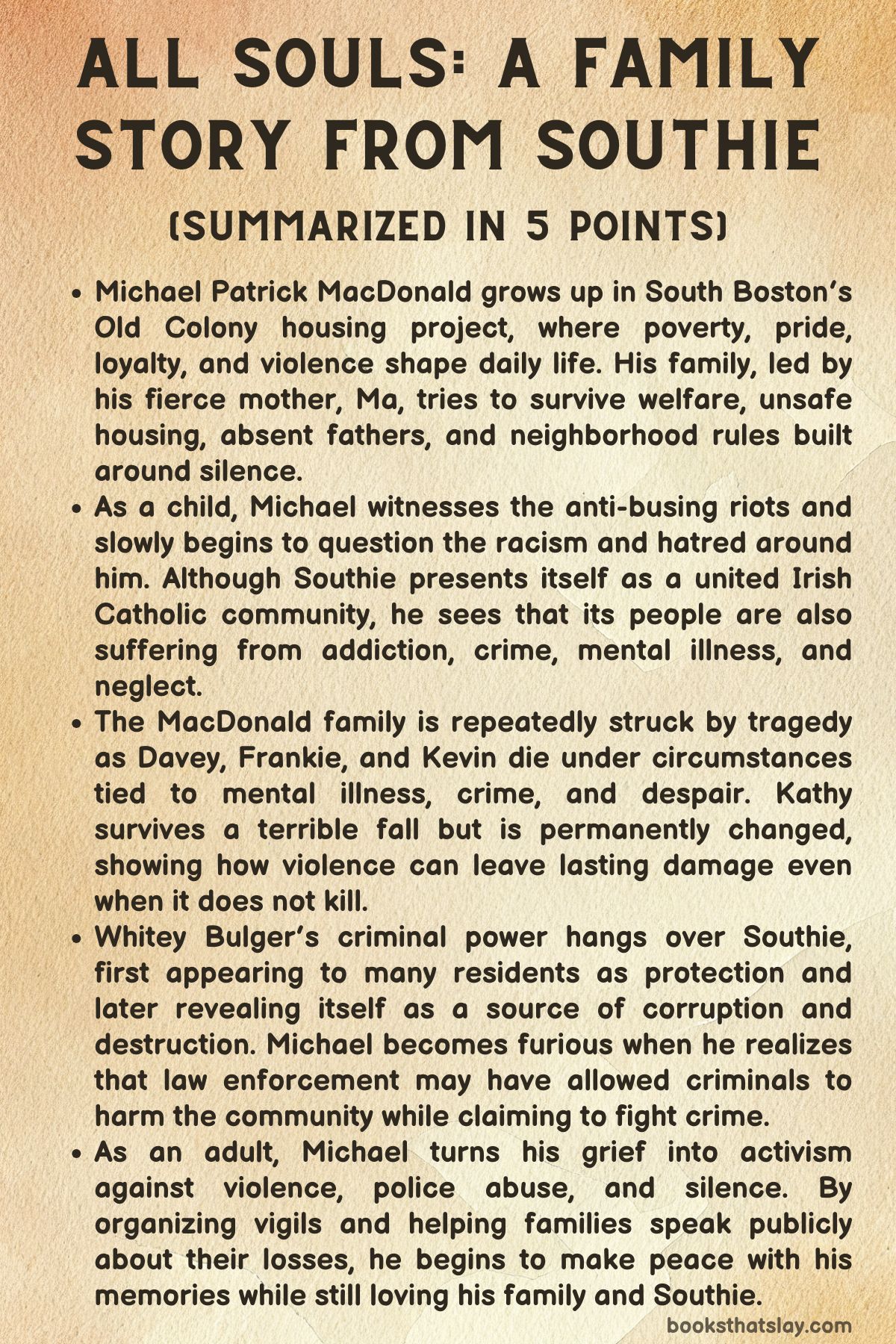
Key People
Michael Patrick MacDonald
Michael Patrick MacDonald is both the narrator and the emotional center of the memoir. As a child, he watches Southie with a mixture of wonder, fear, pride, and confusion.
He wants to belong to his family and neighborhood, yet he also senses that many of their beliefs and customs are damaging. His childhood is shaped by poverty, racial conflict, loyalty codes, drugs, organized crime, and repeated family tragedy.
Because he is the youngest for much of the story, he often observes more than he acts, which gives him the role of witness. He sees the busing riots, the power of Whitey Bulger, the silence around drug dealing, the failures of police and hospitals, and the private suffering inside his own home.
As Michael grows older, his view of Southie becomes more complex. He loves the neighborhood’s closeness, humor, toughness, and loyalty, but he also recognizes how those same qualities can protect violence and denial.
His development depends on learning how to tell the truth without rejecting where he came from. By the end of All Souls, Michael becomes an activist who works against gun violence and police abuse.
His personal grief becomes public action. He changes from a boy trying to survive Southie’s rules into an adult trying to break the silence that allowed so much damage to continue.
Ma
Ma is one of the strongest and most memorable figures in the memoir. She is fierce, funny, theatrical, loving, reckless, and deeply wounded.
She raises her children almost entirely on her own while surviving poverty, abusive men, welfare inspections, public judgment, and the deaths or suffering of several of her children. Her strength is often physical and confrontational.
She fights men, threatens criminals, stands up to authorities, and refuses to appear weak. In a neighborhood where power is often measured by fearlessness, Ma earns respect by showing that she will not be intimidated.
At the same time, Ma’s strength does not always protect her children from harm. She gives them freedom because freedom feels like survival, but that freedom also leaves them exposed to drugs, crime, and danger.
She is not a simple heroic mother or a careless parent; she is a woman doing whatever she can with limited resources and deep emotional scars. Her grief after the deaths of her sons is devastating, yet she continues to move, work, argue, care for children, and seek answers.
Her love is intense and sometimes chaotic, but it is the force that keeps the family connected even when everything around them breaks.
Davey
Davey represents the hidden damage caused by abuse, poverty, institutional failure, and untreated mental illness. As the oldest son, he carries much of the violence connected to the family’s absent and abusive father.
His suffering begins before Michael can fully understand it, but Michael grows up watching Davey become increasingly unstable. After Davey is sent to a mental institution, the family hopes that treatment will help him, but the institution becomes another place of trauma.
Shock therapy, confinement, and isolation do not heal him. They make his pain seem even more unreachable.
Davey’s death becomes one of the first major signs that the family’s suffering cannot be explained away as ordinary neighborhood hardship. His possible suicide forces Michael to confront helplessness.
The family wants to believe he fell by accident because that version is less painful, but Michael eventually understands that Davey wanted to die. Davey’s story shows how easily a damaged person can be pushed aside by systems that are supposed to help.
He is not only a tragic brother; he is also a symbol of what happens when emotional pain is treated as shame, danger, or inconvenience instead of as a human crisis.
Kevin
Kevin is charming, clever, restless, and drawn early to the excitement and money of street crime. As a child, he is already skilled at scams and small cons, and his intelligence could have led him in many directions if he had grown up with better opportunities.
In Southie, however, the criminal world offers status, cash, and belonging. Kevin enters drug dealing as a teenager and becomes connected to Whitey Bulger’s network.
His choices are dangerous, but they also reflect the distorted values around him. Crime is not only tolerated in the neighborhood; it is often admired when it brings money and power.
Kevin’s life becomes tragic because he is never only a criminal figure. He is also a brother, son, husband, and father who briefly wants to leave that world behind.
His attempt to go straight after the birth of his daughter shows that he is capable of change, but the consequences of his past remain. Frankie’s death is tied to Kevin’s unfinished obligations in crime, and Kevin is crushed by guilt.
His later suicide reveals the emotional cost behind the image of toughness. Kevin’s downfall shows how Southie’s criminal culture seduces young men, uses them, and then leaves them with grief they cannot survive.
Frankie
Frankie is presented as one of the family’s great hopes. He is disciplined, physically strong, handsome, admired, and talented as a boxer.
Unlike Kevin, he tries to stay away from drugs and crime for much of his life. Younger kids look up to him, and his success in boxing gives the family and neighborhood something to celebrate.
Frankie’s body and ambition seem to offer a way out of Southie’s destruction. He works, saves money, helps Kathy with therapy, and dreams of giving the family moments of happiness.
His death is especially painful because he appears so close to escaping the forces that destroy others. Yet Frankie is still surrounded by the same environment: gangsters, drugs, loyalty, and pressure to protect family.
When he takes Kevin’s place in the robbery, his decision grows out of love and loyalty, but also out of the dangerous belief that toughness can overcome any risk. His cocaine use and sense of invincibility make him vulnerable.
Frankie’s murder exposes the cruelty of the criminal world Southie often romanticizes. He is not killed by outsiders but by people connected to the world that claimed to protect the neighborhood.
Kathy
Kathy’s character shows how young women in Southie are also damaged by the neighborhood’s violence, though often in different ways from the boys. As a girl, she gains a reputation for toughness and becomes involved with dangerous boys, gangs, shoplifting, drugs, and unstable relationships.
Her behavior can look rebellious, but beneath it is insecurity and a desire to be seen as strong, attractive, and important in a place that offers few safe paths for girls. Michael’s search through her room after her fall reveals that she is still, in many ways, a vulnerable teenager trying to build an identity.
Kathy’s fall from the roof leaves her permanently changed. Her physical recovery is difficult, and her mental state declines over time.
She becomes one of the living casualties of Southie’s drug culture and violence. Unlike Davey, Frankie, and Kevin, Kathy survives, but survival itself is painful.
Her life after the fall shows that trauma does not end simply because a person remains alive. She continues to struggle with addiction, confusion, motherhood, and dependence on Ma.
Kathy’s character represents the long aftermath of violence, the kind that does not fit neatly into a funeral or headline.
Joe
Joe is one of the quieter but important members of the MacDonald family. He is practical, mechanically skilled, hardworking, and less drawn to dramatic conflict than some of his siblings.
His ability to fix cars and help neighbors gives him a useful place in the community. He also attends school outside the narrow boundaries of Southie and forms friendships with Black students, which puts him in a difficult position during the busing crisis.
His friendships challenge the racist assumptions around him, but the threat of violence forces him to protect himself by moving closer to Irish peers.
Joe’s character reveals how social pressure can limit moral courage, especially for young people trying to survive. He is not portrayed as hateful in the way some others become, but he is still trapped by the rules of the neighborhood.
Later, he works hard and remains connected to the family through practical support. Joe’s role is less tragic than that of some siblings, but he helps show the range of responses within the same household.
Not every MacDonald child takes the same path, yet all of them are shaped by the same environment of fear, poverty, pride, and loss.
Stevie
Stevie’s story focuses on innocence, injustice, and police corruption. As one of the younger children, he is part of the generation that Ma tries to protect by leaving Southie.
Yet even after the family moves away, Southie’s dangers follow him. When his friend Tommy dies from a gunshot wound, Stevie becomes a convenient suspect.
The police treat him less like a frightened child and more like someone they can use to close a case quickly. The forged 911 transcript becomes a powerful example of how authority can manufacture guilt.
Stevie’s refusal to accept a plea deal shows courage and moral clarity. Even when the legal system pressures him, he insists that he did not shoot Tommy.
His conviction is devastating, but the later reversal proves that the case against him was built through misconduct. Stevie’s character helps push Michael toward activism because his suffering is not random street violence; it is institutional injustice.
Through Stevie, the memoir shows that poor children are vulnerable not only to criminals but also to the very systems meant to protect them.
Seamus
Seamus represents innocence and renewal when he is born during a time of exhaustion and conflict. Michael loves him deeply and sees him as something pure amid the riots, hatred, and family struggles.
Taking Seamus for walks gives Michael a sense of purpose and tenderness. In a household filled with older siblings already marked by violence, addiction, and instability, Seamus gives Michael someone to protect.
His birth briefly shifts Michael’s attention away from public conflict and toward private love.
As Seamus grows older, he becomes part of the younger group that Ma takes to Colorado in an effort to escape Southie. His response to Colorado is mixed because, like many of the children, he misses the intensity and familiarity of the neighborhood even though it is dangerous.
Seamus helps show how deeply Southie’s identity attaches itself to those raised there. Even escape can feel like loss.
His later education suggests the possibility of another future, one not entirely controlled by the neighborhood’s old patterns.
Whitey Bulger
Whitey Bulger is less a direct personal presence than a powerful force hanging over Southie. To many residents, he appears as a protector, a local champion, and proof that someone from their world can hold power.
The MacDonalds and their neighbors create stories around him, and Kevin especially treats his connection to Whitey as a source of status. This myth matters because Southie feels abandoned by politicians, police, liberals, and institutions.
Whitey fills that emotional gap by becoming a false symbol of neighborhood protection.
The reality is far darker. His criminal network spreads drugs, fear, corruption, and violence.
Bars, liquor stores, robberies, and drug dealing become part of his influence. The later revelation that he may have been protected as an FBI informant destroys the idea that he stood apart from official power.
Instead, he becomes evidence that crime and government corruption can support each other while ordinary families pay the price. In All Souls, Whitey represents the danger of mistaking local pride for safety and confusing fear with leadership.
Tommy Viens
Tommy Viens is important because his death becomes the center of Stevie’s legal nightmare. He is a young boy caught in the same careless access to guns that defines much of the neighborhood’s danger.
His death is tragic on its own, but it also exposes how quickly grief can turn into accusation when police want a simple answer. Tommy’s father believes Stevie is responsible, which adds another layer of pain to an already broken situation.
Tommy is not developed as fully as the MacDonald siblings, but his role is crucial. He represents the children who become casualties of the adult world’s negligence: unsecured weapons, fear of police, unstable homes, and a culture where guns are too available.
His death also shows how one tragedy can create another. Instead of a careful search for truth, the system produces a false narrative that nearly destroys Stevie’s life.
Tommy’s story reminds the reader that every death in the memoir leaves damage beyond the person who dies.
Grandpa
Grandpa represents old-world Catholic faith, family loyalty, and denial. He appears most memorably when he brings holy water to Kathy’s hospital room and insists on pouring it over her while praying.
This moment is strange, desperate, comic, and moving at once. It shows the family’s reliance on ritual when medicine and reason seem powerless.
Grandpa’s faith is not polished or quiet; it is physical, urgent, and stubborn.
He also shows the family’s tendency to soften unbearable truths. After Davey dies, Grandpa refuses to accept suicide as the explanation and insists that Davey fell.
His denial is not simply ignorance; it is a form of emotional protection. Some truths are too painful for the family to name.
When Grandpa dies naturally of old age, Michael experiences the funeral differently from the others he has attended. For once, death arrives without violence, shame, suspicion, or unfinished questions.
Grandpa’s death shows Michael what a normal ending can look like, which makes the family’s other losses seem even more unnatural.
George
George, Michael’s biological father, is a small but painful presence in the memoir. For young Michael, learning that he has a different father briefly feels special.
He imagines that this fact may give him a separate identity or even a better origin story than the rest of his siblings. Because fatherhood is mostly absent or harmful in his life, he fills the silence with fantasy.
He wants his father to mean something.
The phone call on Michael’s tenth birthday destroys that fantasy. George’s rejection is cold and humiliating.
He does not offer love, curiosity, or responsibility. Instead, he treats Michael as a problem created by Ma.
This moment wounds Michael because it confirms that his imagined father is not a hidden source of protection. George’s character matters because he shows the emptiness behind Michael’s longing.
His absence also reinforces Ma’s role as the family’s real parent, even with all her flaws.
Dave MacDonald
Dave MacDonald, Ma’s former husband and the father of several of the children, is defined by absence, abuse, and abandonment. He is a musician, like Ma, but any romantic image attached to that background is destroyed by his violence and failure to support the family.
He beats Ma, drinks, has affairs, avoids responsibility, and disappears from the children’s daily lives. His refusal to attend the funeral of the baby Patrick Michael becomes the final break in the marriage.
Even though he is mostly absent from the main action, his impact remains. Davey, especially, carries the damage of his father’s abuse.
Ma’s later relationships with unreliable men also reflect a pattern of emotional harm that began before Michael’s birth. Dave MacDonald’s character represents the kind of father whose disappearance does not erase his influence.
He leaves behind poverty, trauma, anger, and a family forced to survive without dependable adult support.
Mary
Mary is one of the MacDonald siblings who remains comparatively stable and responsible. She does not dominate the memoir in the way Frankie, Kevin, Kathy, or Davey do, but her presence matters because she helps show that not every child responds to Southie’s pressure in the same visible way.
She works at the hospital, contributes to family efforts, and helps gather bail money for Stevie. When she sees the aftermath of Tommy’s death in the apartment, her horror captures the exhaustion many family members feel after years of violence.
Mary’s role is grounded in care and endurance. She is part of the family network that keeps functioning even after repeated tragedy.
Her stability does not mean she is untouched; rather, she carries the burden more quietly. Through Mary, the memoir shows that survival can look ordinary from the outside while still requiring great strength.
Themes
Silence, Shame, and the Need to Speak
Silence controls much of Southie’s emotional and social life. People are taught not to report crime, not to expose family problems, not to challenge gangsters, and not to let outsiders see weakness.
This silence is often described as loyalty, but it protects the people causing harm more than the people suffering from it. Families lose children to drugs, suicide, murder, and addiction, yet many of these losses remain private, surrounded by shame or vague explanations.
The neighborhood’s code against being a snitch turns truth-telling into betrayal, even when silence allows violence to continue. Michael’s growth depends on rejecting that code without rejecting his people.
When he returns as an adult, he discovers that many residents are ready to speak because grief has become too heavy to carry alone. The vigil becomes a public answer to years of denial.
Naming the dead gives families a way to claim their losses openly. In All Souls, speech becomes a form of justice because it breaks the isolation that allowed suffering to appear normal.
Poverty, Class, and Being Forgotten
Southie’s poverty is central to the memoir, but it is complicated by the neighborhood’s whiteness. The residents are poor, dependent on welfare, exposed to crime, and trapped in failing institutions, yet public discussion often reduces them to racist villains or ignores them altogether.
Michael does not excuse Southie’s racism, but he argues that the neighborhood’s suffering was also real. The Lower End has high rates of fatherlessness, addiction, violence, and death, but politicians often deny these problems in order to preserve an image of proud white stability.
This leaves poor white families in a strange position: they are privileged in racial terms but neglected in class terms. The MacDonalds’ welfare life shows how poverty shapes housing, food, education, health care, and self-worth.
Michael lies about living in the projects because he feels ashamed. Ma hides possessions from welfare inspectors because survival requires bending rules.
The book shows that poverty is not only lack of money; it is also exposure to danger, dependence on unreliable systems, and the constant need to appear stronger than one feels.
Racism, Fear, and False Belonging
Racism in the memoir is shown not as an abstract belief but as a social force that gives frightened people a sense of unity. During the busing crisis, Southie residents feel attacked by courts, police, politicians, and outsiders.
Instead of directing their anger only at unequal schools or government decisions, many turn it toward Black families and children. Michael is young enough to be swept into the excitement of protest, but he is also sensitive enough to feel disturbed by its cruelty.
The beating of the Haitian man becomes a turning point because it reveals the human cost of mob hatred. Southie’s racism is strengthened by fear: fear of losing territory, status, safety, and identity.
Yet the later arrival of minority families into the projects complicates the neighborhood’s assumptions. Children from different backgrounds are able to play together, and the expected war does not occur.
This contrast shows that much of the hatred was taught and maintained by adults, rumors, politicians, and neighborhood mythology. Racism gives Southie a false form of belonging, but it cannot heal the deeper wounds of poverty, addiction, and abandonment.
Family Love, Trauma, and Survival
The MacDonald family is held together by fierce love, but that love exists inside constant trauma. Ma loves her children intensely, and the siblings remain tied to one another through loyalty, memory, humor, and shared hardship.
Yet love does not prevent damage. Davey’s mental illness, Kathy’s addiction and injury, Frankie’s murder, Kevin’s suicide, and Stevie’s wrongful conviction all show a family repeatedly pushed beyond ordinary endurance.
One of the memoir’s hardest truths is that survival does not always look clean or noble. Ma fights, lies to welfare inspectors, threatens people, makes mistakes, and still remains the family’s strongest source of protection.
Michael loves his family not because they are perfect but because they are his first world. His adult task is to understand them without romanticizing their suffering.
The repeated funerals and hospital visits create a sense that the family is always waiting for the next disaster. Still, they keep showing up for one another.
Survival here means continuing after grief, remembering the dead honestly, and turning private pain into action that may protect others.