Almost American Girl Summary, Characters and Themes
Almost American Girl by Robin Ha is a graphic memoir about being uprooted, starting over, and learning how identity can change without disappearing. It follows Robin, a teenage girl from Seoul, whose mother brings her to the United States and suddenly announces that they will not be going back.
Robin must face a new family, a new school, racism, loneliness, and the struggle to learn English. At the same time, she slowly finds comfort through comics, art, friendship, and her bond with her mother. The book is both a coming-of-age story and a daughter’s growing understanding of her mother’s difficult choices.
Summary
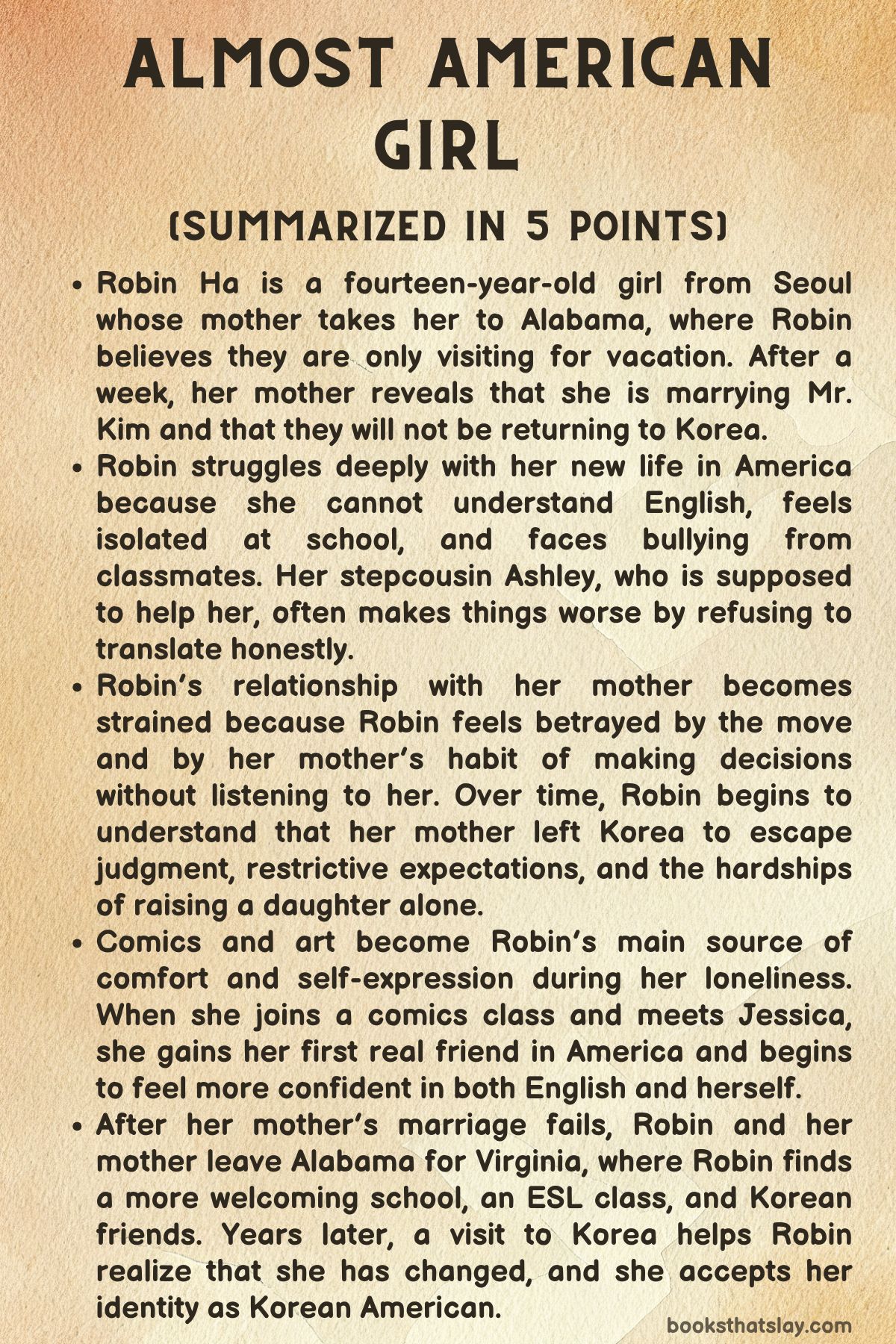
Almost American Girl begins in 1995, when fourteen-year-old Robin is living in Seoul, South Korea, with her mother. Their life is familiar, busy, and secure.
Robin’s mother runs a hair salon, and Robin has friends, favorite comics, and a sense of belonging. Every summer, mother and daughter travel somewhere new together, so when her mother announces a trip to Alabama, Robin assumes it is just another vacation.
She does not understand why they are going so far, and her mother gives only partial explanations.
In Alabama, they meet Mr. Kim, a Korean man whom Robin’s mother knows, along with his relatives. Robin and her mother stay with Mr. Kim’s extended family.
The house is crowded, and most of the children are busy with school and activities. Robin spends her days alone, watching television she cannot understand and spending time with the family dog, Barry.
After a week, her mother tells her the truth: she is marrying Mr. Kim, and they are not returning to Korea.
The news devastates Robin. Her whole life has been changed without her consent.
She thinks back to an earlier childhood betrayal, when her mother gave away her beloved parakeets without warning. Robin had loved those birds deeply, and losing them taught her how painful it felt when her mother made major decisions without including her.
Yet Robin also knows that her mother is the center of her life. Her mother raised her alone, worked long hours, and gave her as much care and opportunity as she could.
Even in her anger, Robin understands that her mother is the only parent she truly has.
Robin begins school in Alabama and chooses an American name for herself. She does not like her Korean name, which feels old-fashioned and embarrassing to her, so she chooses “Robin,” a name that feels more flexible and less girly.
She practices pronouncing it carefully because Korean does not have the same “r” sound. At school, however, having a new name does not make the transition easy.
She cannot understand her teachers, and her stepcousin Ashley, who is supposed to help translate, is often impatient and unkind.
School becomes a place of fear and humiliation. Robin struggles to follow lessons, though she recognizes some math from what she already learned in Korea.
She fills the time by drawing and thinking about the comics she loves. Some students mock her, especially a boy named Bryan, who tricks her into repeating swear words and uses racist language against her.
Robin does not fully understand the words at first, but she understands the laughter and cruelty. She feels ashamed, isolated, and powerless.
Her loneliness in America reminds her of the judgment she and her mother faced in Korea. Because Robin grew up without a father in the home, people whispered about them and treated her mother as if she had failed.
Robin tried to be a perfect child to protect herself from criticism. Her mother taught her perseverance by example, building her salon business through hard work and refusing to be defeated by gossip.
But in Alabama, Robin feels once again like an outsider, only this time she lacks the language to defend herself.
Robin’s English teacher, Mrs. Halls, becomes one of the few adults who helps her. Mrs. Halls gives Robin picture books and exchanges letters with her so Robin can practice reading and writing English at her own pace.
These letters give Robin a small sense of safety. Still, Ashley continues to make school harder by lying or refusing to explain important information.
When Robin misses her yearbook photo because Ashley misleads her, Robin finally tells her mother what has been happening.
Her mother stands up for her, just as she once did when a teacher in Korea treated Robin unfairly. Robin remembers how much it meant when her mother believed her back then.
In Alabama, that support matters again, but Robin also realizes she cannot depend on Ashley or anyone else to translate her life for her. She decides she must learn English if she wants freedom.
As time passes, Robin slowly becomes stronger. She tells Bryan to stop bothering her, and he backs off.
She notices students who might be kind, including Sarah, a girl who once defended her, but Robin is too nervous to reach out. She misses Korea badly.
When a package of comics arrives from her mother’s former salon assistant, Robin feels connected to home again. Comics are more than entertainment for her; they are a private language, a comfort, and a reminder of who she was before the move.
Robin tries to make friends through church when her step-aunt introduces her to Diane, a girl curious about meeting a “foreigner.” Diane invites Robin trick-or-treating. Robin goes, hoping for friendship, but Diane talks constantly and does not seem interested in Robin’s thoughts.
Because Robin’s English is still limited, she cannot participate equally. The experience leaves her feeling more alone rather than less.
At home, Robin’s new family life also becomes strained. Mr. Kim is distant and does not form a real bond with her.
His fish market fails, and he leaves Alabama to look for work in Los Angeles. His relatives remain involved in Robin and her mother’s daily life, but their traditional expectations clash with Robin’s mother’s independent personality.
They criticize her and expect her to behave like a quiet, obedient wife. Robin’s mother, who has survived too much to be submissive, does not fit their idea of a proper woman.
When Robin’s mother gets work at a salon, she uses her first paycheck to buy Robin a piano. Music had once been important to both of them: Robin’s mother had wanted to learn piano as a child but could not afford it, and Robin had grown to love playing alone.
However, her mother pushes her to perform in front of the stepfamily and enters her in a contest to toughen her up. Robin practices hard and places third, but the pressure adds to her resentment.
One day, after being forced to play and criticized again, Robin explodes. She tells her mother that she never listens, that she has ruined her life, and that she hates her.
The book then reveals more about Robin’s mother and why America seemed like a chance at freedom. Robin’s mother lost her parents young and later fell in love with Robin’s father, an older man who proved unreliable.
He was absent during her pregnancy and drunk when he came to the hospital after Robin’s premature birth. Their relationship ended after Robin’s mother discovered evidence of his involvement with another woman.
Later, she had a long relationship with Mr. An, who cared for Robin, but Korean society still judged their unmarried family. Robin’s mother disliked the pressure to conform, the judgment against single mothers, and the unfair systems that shaped children’s lives.
To take Robin to America, she even had to get permission from Robin’s father because Korean law limited her parental rights.
Robin’s life begins to change when her mother takes her to a comic bookstore that offers a comics class. There, Robin meets Jessica, a girl who loves many of the same comics and understands parts of Robin’s world.
Jessica compliments Robin’s drawings, and the two become close friends. Through Jessica and the comics class, Robin gains confidence, practices English more naturally, and begins creating her own comic panels instead of only copying favorite characters.
Art becomes the bridge between her old self and her new life.
Meanwhile, the marriage between Robin’s mother and Mr. Kim falls apart. Robin’s mother visits him in Los Angeles and finds him living in a small room, discouraged and lost.
She sees no future with him. His family believes they have done her a favor by accepting a single mother, but they also resent that she does not behave like the nurturing wife they expected.
Robin’s mother decides the marriage is over. She and Robin will move to Virginia, where she has relatives.
Because she fears the stepfamily will stop them, she asks Robin to keep the plan secret.
Before leaving Alabama, Robin experiences a strange ending to her school year. The family dog, Barry, dies, and Robin notices how the family mourns him only after neglecting him in life.
At school, classmates sign her yearbook with unexpectedly kind notes, though many of them ignored her while she was there. Their sudden warmth feels too late.
Robin and her mother pack quietly, leave in a U-Haul, and stay with a friend before driving to Virginia. Robin is frustrated by the secrecy and fear surrounding their exit, but when her mother apologizes, Robin begins to see her not only as a parent but as a woman trying to survive.
Virginia gives them a better chance. They settle near Koreatown in McLean, and Robin’s mother finds work at a Korean hair salon.
Robin starts high school in a more diverse area close to Washington, DC. For the first time in America, she is surrounded by many international students and joins an ESL class where other students understand what it means to learn English while building a new life.
She no longer feels like the only outsider.
Robin also meets Korean girls at school, including Minji and Soyoung. At first, she assumes they are ignoring her, while they assume she is Japanese or Chinese.
Once they realize she is Korean, they welcome her into their group, and the girls become close friends. Robin finally finds a place where her Korean identity and American life can exist together.
Years later, Robin returns to Korea with Minji and Soyoung. She visits her old neighborhood and sees how much it has changed.
She reconnects with childhood friends but realizes their expectations are different from hers. Many plan to marry young and follow paths shaped by family and social pressure.
Robin notices the strong emphasis on beauty, conformity, and women behaving modestly around men. Even her Korean American friends adjust their behavior while there.
During the visit, Robin understands more clearly why her mother wanted to leave Korea.
By the end of Almost American Girl, Robin does not feel fully at home in either country. Korea is her birthplace, but she has changed.
America gave her freedom, friendships, and artistic growth, but it also gave her pain, racism, and loneliness. Rather than choosing one identity over the other, Robin accepts being Korean American.
Her story becomes one of displacement, resilience, and self-definition, shaped by a mother’s bold decisions and a daughter’s gradual understanding of them.
Characters
Robin Ha
Robin is the emotional center of Almost American Girl, and her character is shaped by displacement, anger, loneliness, and gradual self-discovery. At the beginning, she is a fourteen-year-old girl with a stable life in Seoul, where she has friends, familiar routines, favorite comics, and a strong bond with her mother.
Her move to America is not presented as an adventure she chooses, but as a decision made for her. This lack of control defines much of her early struggle.
She feels betrayed because her mother hides the truth about the trip, and once Robin learns that they are staying in Alabama, her grief is not only homesickness but also the loss of trust in the person she depends on most.
Robin’s silence in America is both literal and emotional. Because she cannot speak English fluently, she cannot explain herself, defend herself, or ask for help in ordinary ways.
This makes school especially painful. Her classmates’ cruelty, Ashley’s unwillingness to translate, and the indifference of many people around her make Robin feel trapped inside herself.
Yet Robin is not weak. Her strength appears slowly, through small acts of resistance.
She decides to learn English not because she suddenly loves America, but because she understands that language is power. Standing up to Bryan is an important moment because it shows that Robin is beginning to reclaim her voice.
Art is central to Robin’s identity. Comics give her continuity when everything else changes.
They connect her to Korea, comfort her during loneliness, and eventually help her make friends in America. Through drawing, Robin can communicate before she has full confidence in English.
Her artistic life also marks her movement from imitation toward creation. At first, she draws characters she already loves; later, she begins making her own comic panels.
This mirrors her personal growth. She moves from trying to survive inside other people’s decisions to shaping her own sense of self.
Robin’s relationship with her mother is complicated and realistic. She loves her mother deeply but also resents her for making life-changing choices without including her.
Her anger is justified, especially because she loses her home, friends, language environment, and independence all at once. However, as Robin matures, she begins to see her mother not only as a parent but as a woman who has endured judgment, abandonment, and social pressure.
By the end, Robin’s identity is not limited to Korea or America. She accepts that she belongs to both and neither in a simple way.
Her growth lies in understanding that identity can be unsettled and still be whole.
Robin’s Mother
Robin’s mother is one of the most complex characters in the story because she is both Robin’s protector and the person who causes Robin’s deepest emotional wound. She is hardworking, independent, stubborn, loving, and flawed.
In Korea, she builds a life for herself and Robin despite social judgment. As a single mother, she faces gossip and suspicion, but she refuses to let that define her.
Her salon business shows her determination and skill. She works long hours, improves her circumstances, and becomes a respected figure in her professional community.
Her ambition is not selfish; it is tied to survival and dignity.
Her decision to move to America comes from a desire for freedom, but it also reveals her tendency to act alone. She wants a life where she is not punished for being unmarried, independent, and outspoken.
She believes America may offer more space for herself and her daughter. Yet she does not explain the full truth to Robin before taking her there.
This secrecy damages their relationship because Robin experiences the move as a betrayal. Robin’s mother wants to protect her daughter, but she also underestimates how much Robin needs honesty and agency.
Her relationship with Mr. Kim shows the risk in her search for stability. She hopes marriage may provide a fresh start, but the reality is disappointing.
Mr. Kim is emotionally distant, his family is controlling, and the traditional expectations placed on her are exactly the kind of restrictions she wanted to escape. Her refusal to become a submissive wife is important.
She does not stay in a situation that diminishes her simply because society expects endurance. Leaving the marriage and moving to Virginia shows courage, especially because she has to start over yet again.
As a mother, she can be demanding. Her insistence that Robin perform piano in front of the family, enter contests, and toughen up reveals both love and pressure.
She wants Robin to become strong enough to survive judgment, but she sometimes confuses strength with obedience. Still, her apology during their escape from Alabama is meaningful because it shows growth.
She recognizes Robin’s pain and accepts responsibility. By the end, the reader understands that her choices were imperfect but driven by fear, hope, and a fierce need to build a freer life for both of them.
Mr. Kim
Mr. Kim represents the failed promise of stability in America. At first, he seems to be part of the reason Robin and her mother come to Alabama, but he never becomes a true father figure to Robin.
His presence is strangely distant. He exists in the household, but he does not make a serious emotional effort to connect with Robin or help her adjust.
For a girl who has already grown up without a dependable father, his indifference reinforces her sense of being alone in a new country.
His move from Korea to Alabama appears to be motivated by opportunity, yet his life in America becomes marked by failure and uncertainty. His fish market closes, and his departure to Los Angeles shows his inability to provide the secure future that Robin’s mother may have hoped for.
When Robin’s mother visits him in Los Angeles, she sees not a strong partner building a new life, but a man who appears lost. This realization becomes a turning point because it makes clear that the marriage cannot give her or Robin the future they need.
Mr. Kim also reflects the weakness of a marriage built more on hope and practicality than real emotional connection. He is not portrayed as openly cruel in the way some other characters are, but his passivity is damaging.
He does not protect Robin from loneliness, does not support Robin’s mother against family pressure, and does not offer the partnership that marriage should provide. His character shows that absence can hurt as much as direct conflict.
He becomes another unreliable male figure in a story where women, especially Robin and her mother, must repeatedly save themselves.
Ashley
Ashley is one of the clearest examples of how cruelty can come from someone who should have been an ally. As Robin’s stepcousin, Ashley is in a position to help her.
She understands English, knows the school environment, and can translate when Robin is confused. Instead, she often withholds help, gives misleading information, or acts annoyed by Robin’s dependence.
Her behavior worsens Robin’s isolation because it teaches Robin that even someone from a Korean family may not protect her.
Ashley’s cruelty is especially painful because it takes place inside the family structure. Robin expects American school to be difficult, but Ashley’s behavior makes home and school feel equally unsafe.
When Ashley lies about the yearbook photo, the harm is not just practical embarrassment. It confirms Robin’s fear that she cannot trust the people around her.
Ashley understands the rules of Robin’s new world and uses that knowledge as power.
Her disrespect toward adults also shocks Robin because it contrasts with the expectations Robin grew up with in Korea. This moment helps show the cultural gap Robin is navigating.
Ashley is Korean by family background, but her behavior feels foreign to Robin. Through Ashley, the story shows that shared ethnicity does not automatically create kindness, belonging, or solidarity.
Ashley’s role is important because she pushes Robin toward self-reliance. Robin realizes that depending on Ashley will keep her powerless, so she commits more seriously to learning English.
Lena
Lena, Robin’s stepsister, functions as a quieter contrast to Ashley. She is someone Robin observes with a mixture of curiosity and jealousy.
Lena is petite, fashionable, and fluent in English, which makes her seem comfortable in the American world that Robin cannot yet enter. To Robin, Lena represents a version of girlhood that appears socially accepted and effortless.
This makes Robin more aware of her own awkwardness and outsider status.
Lena does not carry the same open hostility that Ashley does, but she is not a deep source of comfort either. Her presence reminds Robin of the social distance between them.
Robin sometimes turns to Lena for help understanding English expressions, but their relationship does not become intimate. Lena belongs more naturally to the household and to American teenage life, while Robin remains uncertain and displaced.
Lena’s importance lies in what she reveals about Robin’s insecurity. Robin compares herself to Lena because she wants to understand what it takes to belong.
Clothes, language, confidence, and social ease all seem to come naturally to Lena, while Robin must fight for each one. Lena therefore becomes less of an antagonist and more of a mirror.
Through Robin’s feelings toward her, the reader sees how immigration can make ordinary teenage comparison much sharper and more painful.
Bryan
Bryan represents the racism and casual cruelty Robin faces in school. He targets her because she is new, foreign, and unable to understand or answer him fully.
His behavior shows how language barriers can make immigrant children especially vulnerable. He tricks Robin into repeating offensive words and uses racist gestures and comments while other boys laugh.
Even when Robin does not fully understand the content of his insults, she understands the humiliation. That emotional understanding matters because harm does not depend on complete translation.
Bryan’s cruelty is not complex, but it is important. He shows how quickly a school environment can become hostile when teachers and students fail to protect someone who is visibly different.
He also exposes the social performance of bullying. Bryan humiliates Robin partly to entertain others, turning her confusion into a public joke.
His behavior makes Robin’s early American experience feel unsafe and dehumanizing.
Robin’s decision to stand up to him is a turning point. She does not defeat an entire system of racism, but she does interrupt one person’s power over her.
The moment matters because Robin uses the limited English she has to defend herself. Bryan’s role, then, is not only to represent cruelty but also to mark Robin’s early movement from silence toward self-protection.
He helps reveal how difficult and necessary it is for Robin to find her voice.
Mrs. Halls
Mrs. Halls is one of the few adults in Alabama who recognizes Robin’s vulnerability and responds with patience. As Robin’s English teacher, she does more than teach language in a formal way.
She gives Robin picture books, exchanges letters with her, and creates a method of communication that Robin can manage. This is important because Robin’s problem is not a lack of intelligence; it is lack of access.
Mrs. Halls understands that Robin needs time, tools, and compassion.
Her letters give Robin a safe space to express herself. Since spoken English is difficult for Robin, writing allows her to slow down, use a dictionary, and build meaning carefully.
Mrs. Halls also encourages Robin to stand up for herself, which helps Robin understand that she has a right to be treated fairly. Unlike the adults who become frustrated with Robin’s silence, Mrs. Halls sees the person behind the language barrier.
Mrs. Halls represents the difference one attentive teacher can make in the life of an immigrant student. She cannot solve all of Robin’s problems, and she cannot erase the racism or loneliness Robin faces, but she gives Robin dignity.
Her role shows that education is not only about instruction; it is also about noticing when a student is suffering and finding a way to reach them.
Jessica
Jessica becomes Robin’s first true friend in America and plays a major role in Robin’s emotional recovery. Their friendship begins through comics, which makes it especially meaningful.
Robin has spent much of her time in America unable to communicate fully, but Jessica approaches her through a shared interest rather than through pity. She compliments Robin’s drawings and recognizes the value of the art forms Robin loves.
This gives Robin something she has been missing: the feeling that her inner world can be understood by someone else.
Jessica’s mixed cultural background and knowledge of Japanese comics allow her to connect with Robin in a way many other American students cannot. She does not treat Robin as strange or inferior.
Instead, she meets Robin through imagination, art, and enthusiasm. This friendship helps Robin’s English improve because conversation becomes attached to joy rather than fear.
Robin can practice language with someone who is patient and genuinely interested in her.
Jessica’s importance goes beyond companionship. She helps Robin regain confidence in her creativity.
At the comics class, Robin begins to move from copying familiar characters to creating original work. Jessica’s encouragement helps Robin see that her drawings are not just private comfort but a possible future.
Through Jessica, friendship becomes a form of rescue, not because it fixes everything, but because it gives Robin a reason to participate in her new life.
Sarah
Sarah is a smaller but meaningful character because she represents the possibility of kindness in a place Robin has come to fear. When another student insults Robin by questioning whether she is deaf or unintelligent, Sarah defends her.
That moment stays with Robin because it shows that not everyone at school is cruel or indifferent. Sarah’s kindness is brief, but for someone as isolated as Robin, it carries real weight.
Robin wants to befriend Sarah but struggles to approach her. This hesitation reveals how deeply Robin’s confidence has been damaged.
She is not simply shy; she has learned to expect rejection, misunderstanding, or ridicule. Sarah becomes a symbol of the social life Robin wants but does not yet know how to enter.
The fact that Robin later gains enough confidence to ask Sarah if she can sit with her at lunch shows Robin’s growth.
Sarah’s role also shows that kindness does not always need to be dramatic to matter. A single act of defense can change how an isolated person sees a room.
Sarah does not become the central friendship in Robin’s American life, but she helps create the possibility that school may not remain only a place of fear.
Diane
Diane appears as a possible friend but ultimately shows the limits of curiosity without real understanding. She is interested in Robin because she has never met a “foreigner” before, and this interest initially seems welcoming.
She invites Robin to go trick-or-treating and introduces her to a new American custom. For Robin, who is lonely and eager for connection, the invitation offers hope.
However, the outing reveals that Diane is more interested in the idea of Robin than in Robin herself. She talks constantly, does not ask much about Robin’s thoughts, and does not create space for equal conversation.
Robin’s limited English makes it even harder for her to respond, but Diane does little to bridge that gap. Instead of feeling included, Robin feels like a silent participant in someone else’s experience.
Diane’s role is important because she shows that friendliness and friendship are not the same. A person can appear welcoming while still failing to see another person fully.
Robin’s disappointment after Halloween reflects her growing awareness that belonging requires more than being invited somewhere. It requires being heard, respected, and allowed to exist as more than a novelty.
Minji
Minji becomes one of Robin’s close friends in Virginia and represents a healthier form of Korean connection in America. When Robin first sees the fashionable Korean students at school, she assumes they are ignoring her.
This assumption comes from her accumulated insecurity. After Alabama, Robin expects exclusion.
When Minji and the others realize Robin is Korean, they welcome her, and this creates a major shift in Robin’s social life.
Minji helps Robin experience Korean identity in a new way. In Korea, Robin’s life had been shaped by judgment surrounding her family structure.
In Alabama, being Korean made her feel foreign and isolated. In Virginia, through friends like Minji, Korean identity becomes a source of companionship and belonging.
Minji is part of a peer group that allows Robin to feel seen without having to explain everything from the beginning.
Her later trip to Korea with Robin also helps reveal how identity changes after immigration. Minji and the others may share Korean heritage, but their behavior shifts when they are in Korea.
Robin notices how Korean social expectations affect even Korean American girls. Minji’s presence helps Robin understand the tension between cultural origin and personal freedom.
Through this friendship, Robin gains both comfort and perspective.
Soyoung
Soyoung, like Minji, becomes part of Robin’s closest friendship circle in Virginia. She helps create the social belonging Robin has been missing since leaving Seoul.
Soyoung’s friendship matters because it comes at a time when Robin is rebuilding herself. In Virginia, Robin is no longer the only language learner or the only student with an international background.
Soyoung becomes part of the environment that allows Robin to feel less strange and more accepted.
Soyoung’s role becomes especially significant during the return to Korea. Staying with Soyoung’s family places Robin back inside Korean society, but now Robin sees it with changed eyes.
Soyoung’s choice to get cosmetic surgery as an investment in her future reveals the pressure Korean women face to meet beauty standards. This detail is not presented as vanity but as a social reality.
It shows how appearance can become tied to opportunity, employment, and marriage prospects.
Through Soyoung, Robin sees how even people she loves and respects may adapt to expectations she finds restrictive. Soyoung’s character helps Robin understand that cultural belonging can come with costs.
The friendship remains important, but it also becomes part of Robin’s larger recognition that she no longer fits easily into the country where she was born.
Mr. An
Mr. An is important because he represents the father figure Robin might have had. He is caring toward Robin and maintains a long relationship with her mother.
Unlike Robin’s biological father and Mr. Kim, Mr. An appears emotionally present and affectionate. Robin’s mother even asks Robin to call him “Daddy” in public, which shows both the closeness of the relationship and the social pressure surrounding their family.
However, Mr. An’s role also reveals the limits placed on Robin’s mother in Korean society. Even though he cares for Robin, he is not married to her mother, and their family arrangement remains socially vulnerable.
Robin slowly becomes aware that other people judge unmarried couples and single mothers. Mr. An may provide affection, but he cannot fully protect Robin and her mother from public criticism.
His character helps explain why Robin’s mother feels trapped in Korea. The problem is not simply the absence of love; it is the way society defines which families are acceptable.
Mr. An shows that emotional truth and social legitimacy are not always treated as the same thing. His presence in Robin’s past adds tenderness, but it also reinforces why her mother longed for a different life.
Barry
Barry, the family dog, is not human, but he plays a meaningful symbolic role in Robin’s Alabama life. During her early isolation, Barry is one of Robin’s only companions.
While the people around her are busy, indifferent, or cruel, Barry offers quiet presence. Robin spends time with him because he does not require English, explanations, or social performance.
In a world where Robin feels constantly judged or misunderstood, Barry gives her a simple form of comfort.
Barry’s treatment by the family also reflects Robin’s sense of confinement. He is kept outside and largely ignored, which parallels Robin’s feeling of being trapped in a place where she is not truly seen.
His life on a chain becomes a quiet image of neglect. Robin notices this because she understands what it means to be present in a household without being cared for in the way one needs.
His death near the end of Robin’s time in Alabama sharpens her criticism of the stepfamily. They mourn him after neglecting him, and Robin sees the hypocrisy in that response.
This also connects to her classmates’ late kindness in the yearbook. Barry’s role shows how people often recognize value too late.
For Robin, he becomes part of the emotional landscape of Alabama: loneliness, confinement, brief comfort, and delayed regret.
Themes
Immigration and the Loss of Control
Robin’s immigration experience is painful because it begins without informed choice. She does not move to America after a family discussion or a shared plan; she is taken there under the impression that it is a vacation, then told she will not return home.
This makes immigration feel less like opportunity and more like a sudden removal from everything that gave her identity structure. Her friends, school, language, neighborhood, and daily habits disappear at once.
The emotional force of the story comes from this loss of control. Robin is not only adjusting to a new country; she is trying to process the fact that the person she trusts most has made the decision for her.
The move also shows that immigration is not a single event but a long process of rebuilding. Robin has to learn how to speak, how to behave in school, how to understand social customs, and how to judge whom she can trust.
Alabama makes this process especially harsh because she enters an environment where she has little support outside her mother. Later, Virginia offers a different model of immigrant life, with ESL classes, Korean community, and international students.
Almost American Girl shows that place matters deeply in the immigrant experience. A country does not welcome everyone in the same way; belonging often depends on community, language support, and whether others are willing to see newcomers as full people.
Language, Silence, and Power
Robin’s limited English shapes nearly every part of her early American life. She is intelligent, observant, and emotionally aware, but without language access, others treat her as if she is helpless or less capable.
In school, she cannot understand instructions, defend herself from insults, or explain when she has been misled. This creates a painful gap between who she is inside and how others perceive her.
Her silence is not emptiness; it is enforced by circumstance. The reader understands that Robin has thoughts and feelings she cannot yet make visible to the people around her.
Language becomes power because it controls access to dignity. Ashley’s ability to translate gives her power over Robin, and she abuses it by withholding information or lying.
Bryan’s bullying also depends on Robin’s unfamiliarity with English; he uses her confusion as a tool for public humiliation. In contrast, Mrs. Halls uses language as a form of care.
By exchanging letters and giving Robin books she can understand, she helps Robin build confidence step by step. Robin’s decision to learn English is therefore not just academic.
It is an act of self-defense. As her English improves, she gains the ability to resist mistreatment, make friends, and participate more fully in her own life.
Language does not erase her pain, but it gives her a way to answer it.
Mother-Daughter Conflict and Understanding
The relationship between Robin and her mother is built on love, dependence, anger, and eventual understanding. Robin’s mother is her strongest protector, but she is also the person who uproots her life without warning.
This contradiction makes their bond emotionally rich. Robin’s anger is not childish ingratitude; it comes from a real betrayal.
She loses her home and friends because of a decision she did not get to question. Her mother’s secrecy leaves Robin feeling powerless, and that pain resurfaces whenever her mother pushes her into situations she does not want, such as performing piano in front of the stepfamily.
At the same time, the story gradually reveals the mother’s own wounds. She has survived abandonment, social judgment, financial pressure, and the restrictions placed on women in Korea.
Her choices are imperfect, but they come from a desire to escape a life that constantly punishes her for being independent. The conflict between mother and daughter is therefore also a conflict between protection and honesty.
Robin’s mother wants to create a better future, but she does not always recognize that Robin needs a voice in that future. Their relationship grows when Robin begins to see her mother as a person, not only as a parent.
The mother’s apology during their move to Virginia matters because it opens space for mutual recognition. Love becomes stronger when it includes accountability.
Identity Between Two Cultures
Robin’s identity changes because she is forced to live between cultures rather than inside one stable category. In Korea, she is marked by her family situation and by the social judgment attached to being raised by a single mother.
In Alabama, she is marked as foreign, Asian, and linguistically different. In both places, she experiences exclusion, but the reasons change.
This teaches her that identity is not only personal; it is shaped by how others classify, judge, and respond to her. She does not simply decide who she is in isolation.
She has to build herself while being misunderstood by different societies.
Her return to Korea years later deepens this theme. She expects some form of homecoming, but Korea no longer feels fully like home.
Her old neighborhood has changed, her childhood friends have different expectations, and the social pressure on women feels more visible to her than before. She notices beauty standards, conformity, and gender expectations with new discomfort.
At the same time, America is not a simple homeland either, because her early American life included racism and loneliness. Robin’s final acceptance of being Korean American is not a neat solution but a mature recognition.
She does not need to erase one side of herself to validate the other. Her identity exists in movement, memory, discomfort, and choice.