Almond by Won-pyung Sohn Summary, Characters and Themes
Almond by Won-pyung Sohn, translated by Joosun Lee, is a coming-of-age novel about Yunjae, a boy born with alexithymia, a condition that makes it difficult for him to recognize or express emotions. Because his amygdalae are unusually small, he cannot feel fear, grief, anger, or love the way others expect him to.
After a violent attack destroys his family, Yunjae is left to navigate school, loneliness, friendship, guilt, and first love with a mind that sees the world differently. The novel asks what it really means to be human and whether emotion can be learned through connection.
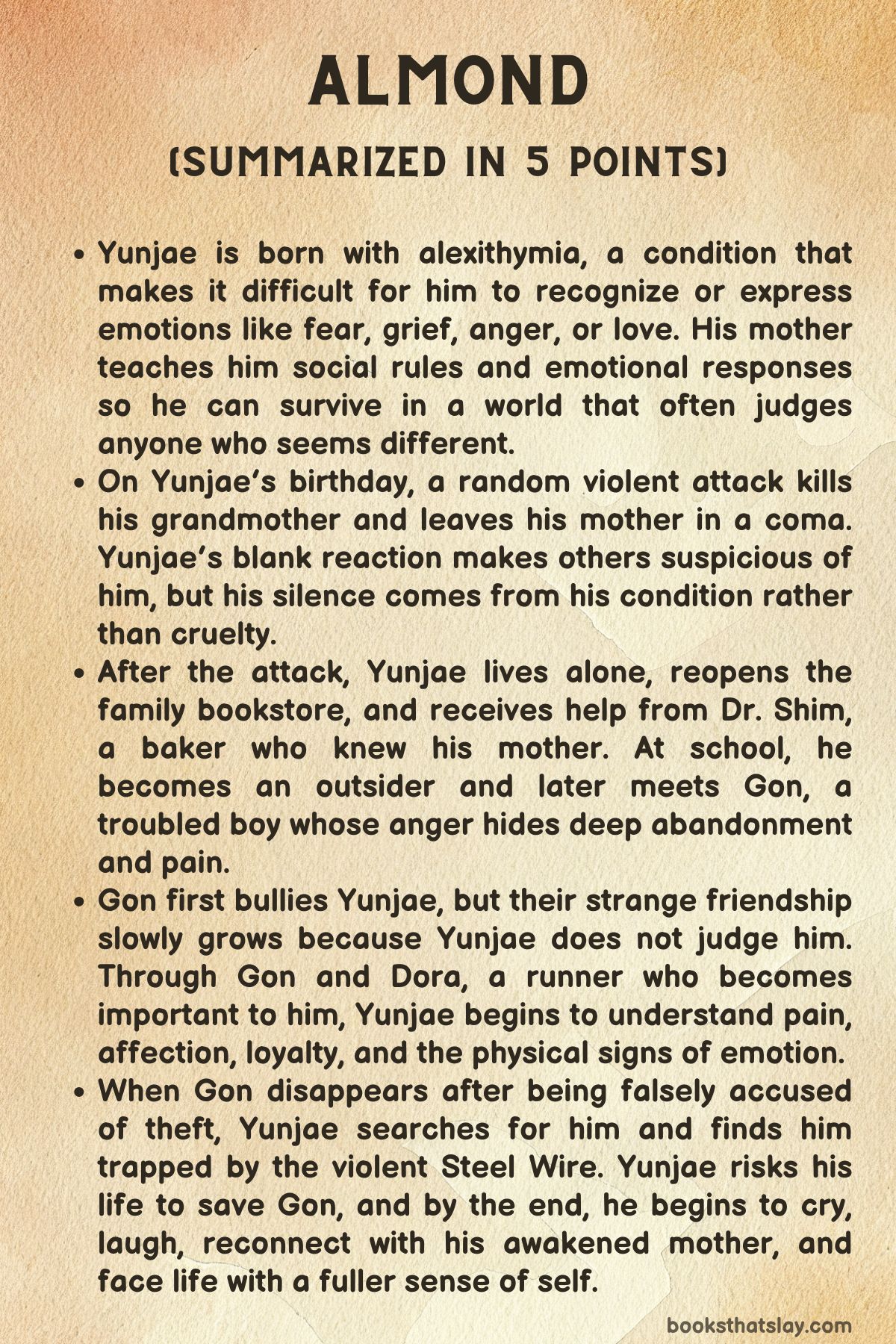
Summary
Yunjae begins his story by saying it is about a monster meeting another monster. He refuses to say whether the ending is happy or tragic, because those labels do not mean much to him.
From the beginning, his voice is calm and direct, even when describing terrible things. He remembers the day his grandmother was killed and his mother was left in a coma after a random attack by a man who had decided to murder smiling strangers before killing himself.
Yunjae watched everything without reacting in the way people expected. His blank face made others uncomfortable, but inside he was not hiding anything.
He simply did not feel what they thought he should feel.
The story then returns to Yunjae’s childhood. When he was six, his mother was late picking him up from kindergarten, and he wandered alone through the city.
He stood on a bridge without fear, then found a badly injured boy in an alley. Yunjae tried to tell a shopkeeper what had happened, but his expressionless face and flat way of speaking made the man ignore him.
Later, the dying boy turned out to be the shopkeeper’s son. The man blamed Yunjae for not showing urgency, and Yunjae’s mother began to understand that her son was different in a serious way.
Doctors eventually diagnosed Yunjae with alexithymia. His amygdalae, the almond-shaped parts of the brain linked to emotional response, did not work normally.
He could not recognize fear, read facial expressions, or understand emotional cues. His mother tried to help him survive in a world built around feelings.
She made him memorize proper reactions, pasted words for emotions around the house, and taught him scripts for daily life. She wanted him to appear normal so that others would not target him.
Yunjae learned to stay quiet, answer simply, and avoid drawing attention.
His family life was small but steady. His father had died before Yunjae was born, killed in an accident while selling accessories at a street stall.
His mother raised him alone until she became overwhelmed and called her own mother back into her life. Yunjae’s grandmother was loud, blunt, and affectionate in her own strange way.
She called Yunjae a monster, but she also loved him fiercely. His mother opened a used bookstore, and the three of them lived beside it.
Yunjae found comfort in books, even though many emotional words inside them remained difficult for him to understand.
On Yunjae’s birthday, which falls on Christmas Eve, his mother and grandmother take him out to celebrate. Their usual restaurant is closed, so they go somewhere else.
After dinner, Yunjae pauses to enjoy a plum-flavored candy. Outside, his mother and grandmother smile at the snow and music in the street.
A man suddenly attacks them with a knife and hammer. Yunjae’s mother is beaten and his grandmother is stabbed while protecting him.
His grandmother dies, and his mother survives only in a coma. At the funeral, Yunjae’s lack of visible grief shocks people.
He has questions about what happened, but no one can answer them. He accepts that he must now live alone.
After the attack, Yunjae continues visiting his mother in the hospital. He reopens the bookstore and tries to keep life simple.
Dr. Shim, a baker who owns the building, offers to help him financially. Dr. Shim had been close to Yunjae’s mother and becomes a quiet guardian figure.
Yunjae starts high school, where his teacher publicly announces his family tragedy to the class. Instead of sympathy, this makes him a target.
Students gossip about him, test him, and fear him because he does not react normally.
A man named Professor Yun then asks Yunjae for a strange favor. His missing son, Yun Leesu, was recently found after thirteen years, but the boy is nothing like the child his dying wife imagined.
Professor Yun wants Yunjae to pretend to be their son so his wife can die in peace. Yunjae agrees and visits the woman in the hospital.
She embraces him and apologizes, believing he is her lost child. Soon after, she dies.
At her funeral, Yunjae meets the real son, now called Gon.
Gon is a violent, angry boy who has grown up in foster homes and rough environments. He attends Yunjae’s school and quickly becomes known as a delinquent.
After learning that Yunjae pretended to be him, Gon begins tormenting him. He beats Yunjae, mocks him, and tries to force a reaction from him.
Yunjae cannot give him the fear or anger he wants. This frustrates Gon, but it also creates a strange bond between them.
Yunjae realizes that if he can understand Gon, he may understand something important about people.
Gon starts visiting the bookstore. At first, he comes to provoke Yunjae, but over time he keeps returning because Yunjae does not judge him.
Their conversations are awkward, harsh, and honest. Gon is full of pain from abandonment, and he hides it behind aggression.
Yunjae does not know how to comfort him, but he listens. When Gon injures a butterfly to test Yunjae’s empathy, Gon himself becomes upset by the cruelty.
Yunjae slowly sees that Gon is not empty or evil. He feels too much and does not know what to do with it.
During this time, Yunjae also meets Dora, a girl who loves running. She is focused, independent, and uninterested in living according to other people’s expectations.
Yunjae becomes fascinated by her. Around Dora, he experiences physical sensations he cannot explain: a racing heart, sleeplessness, and confusion.
Dr. Shim tells him he has a crush. Dora visits Yunjae’s mother in the hospital and speaks to her gently, teaching Yunjae that speaking to someone who cannot answer can still matter.
Yunjae begins to talk to his mother, too.
As Yunjae changes, Gon begins moving in a darker direction. He falls in with dangerous boys and talks about becoming tough like a feared criminal called Steel Wire.
Then Gon is falsely accused of stealing money during a school trip. The real thief framed him for amusement, but everyone believes Gon is guilty because they already see him as bad.
Gon is hurt by this but acts as though he expected it. He disappears soon after, leaving Yunjae with the sense that something terrible will happen.
Yunjae decides to find him. He tracks down one of Gon’s contacts and learns that Gon has gone to Steel Wire.
Dora tries to stop Yunjae, but he says he must go because Gon is his friend. When Yunjae finds Gon, he is badly beaten and trapped in Steel Wire’s hideout.
Steel Wire, a cruel adult with a beautiful face, forces Gon to prove himself by hurting Yunjae. Gon cannot truly do it.
Yunjae sees that beneath Gon’s rage is a frightened boy who wants to be saved but believes he is already ruined.
Steel Wire beats Yunjae brutally to test how far he will go for Gon. Gon begs him to stop.
Yunjae thinks about all the times people ignore pain because it is not their responsibility. He decides he does not want to live that way.
When Steel Wire tries to attack Gon with a knife, Yunjae takes the blow instead. As he loses consciousness, he hears Gon crying and apologizing.
Yunjae tells him to apologize to the butterfly and to everyone he has hurt.
Yunjae survives but spends months recovering. Dr. Shim later explains that Dora helped alert others, leading Professor Yun and the police to the scene.
Steel Wire is arrested, and Gon begins therapy. He and his father start repairing their relationship.
Dora transfers to a school with a better track program. Yunjae receives a short letter from Gon: “Sorry.
Thanks. Truly.” Then Dr. Shim brings Yunjae’s mother to him.
She has awakened. When she hugs him and cries, Yunjae realizes he is crying too.
He laughs and cries with her, feeling something he cannot fully name but can no longer deny.
In the end, Yunjae is eighteen and on his way to see Gon, who remains his friend. He still does not know what kind of person he will become or how the rest of his life will unfold.
But he is no longer only memorizing emotions from the outside. Through loss, friendship, love, and sacrifice, he has begun to experience life with his whole self.
Characters
Yunjae
Yunjae is the narrator and central figure of Almond, and his character is built around a condition that separates him from nearly everyone around him. Because he has alexithymia, he cannot easily recognize fear, grief, anger, affection, or pain in the emotional sense.
This makes him appear cold, strange, or even frightening to others, but the novel shows that his difference is not cruelty. Yunjae is not someone who lacks humanity; he lacks the usual tools people use to display it.
His calm voice, plain observations, and literal thinking create a sharp contrast with the violent and emotional world around him. When tragedy strikes his family, he does not respond with tears, but his questions reveal that he is trying to understand what has happened in the only way available to him.
Yunjae’s growth is gradual and quiet. As a child, he survives by memorizing rules for normal behavior, but those rules do not teach him real connection.
His mother trains him to blend in, yet her lessons often make emotion feel like a performance rather than an experience. After he loses his grandmother and his mother falls into a coma, Yunjae is forced to live without the people who protected him from the world.
This loneliness becomes the condition through which he starts changing. His friendship with Gon teaches him about pain that is too large to control, while Dora introduces him to attraction, tenderness, and the strange physical signs of feeling.
By the end, Yunjae is still not a conventional emotional person, but he has moved from observing life at a distance to choosing involvement. His decision to save Gon proves that morality and love do not always need to begin with ordinary emotion; sometimes they begin with attention, loyalty, and a refusal to abandon another person.
Gon
Gon is Yunjae’s opposite in temperament but also his mirror. Where Yunjae feels too little or cannot identify what he feels, Gon feels too much and has no safe way to express it.
His anger is not simple violence; it is the result of abandonment, foster care, neglect, shame, and a painful reunion with parents who cannot accept the boy he became. He was once Yun Leesu, a lost child mourned and idealized by his parents.
When he returns, he is no longer the innocent child they imagined, and this gap wounds him deeply. He becomes Gon because the name is shorter, harder, and easier to carry than the identity that was taken from him.
Gon’s cruelty often functions as a test. He torments Yunjae because Yunjae’s blankness frustrates him, but also because he wants proof that someone can see him without fear or judgment.
He tries to provoke reactions from Yunjae, yet he keeps returning to the bookstore because Yunjae does not condemn him. Gon’s pain is especially clear in the butterfly scene, where he tries to teach Yunjae empathy through harm but ends up revealing his own emotional fragility.
He cannot bear the damage he causes, even while he causes it. His attraction to Steel Wire shows his desperate wish to become untouchable, but his breakdown when Yunjae is hurt proves that he is not hardened beyond repair.
Gon is a boy trapped between the role society assigns him and the person he might still become. His apology near the end is short, but it carries the weight of someone who has finally begun to understand responsibility.
Yunjae’s Mother
Yunjae’s mother is loving, anxious, intelligent, and deeply afraid for her son. Her life is marked by loss before Yunjae is even born, since her husband dies in an accident while she is pregnant.
After raising Yunjae alone for years, she becomes both his protector and his teacher. Her love is practical and relentless.
She creates emotional scripts, labels the house with words, tests him on social responses, and trains him to appear normal. At times, her care becomes controlling, because she believes survival depends on hiding his difference.
She wants him to be accepted, but she also wants him to become someone the world will not hurt.
Her tragedy lies in the tension between love and fear. She understands Yunjae better than most people, but she is also frightened by what she cannot change.
Her attempt to teach him emotions sometimes reduces human feeling to correct answers, yet it comes from desperation rather than coldness. She knows how cruel society can be to anyone who does not behave as expected.
After the attack, her coma turns her into a silent presence, but she continues to shape Yunjae’s life. He visits her, speaks to her, and slowly learns that communication can matter even without response.
When she awakens and cries with him, she becomes part of Yunjae’s emotional arrival. Their reunion is not only a mother recovering; it is also the moment when Yunjae recognizes that feeling may exist in him even when he cannot name it.
Yunjae’s Grandmother
Yunjae’s grandmother is loud, blunt, comic, and fiercely protective. She enters Yunjae’s life when his mother can no longer manage alone, and her presence changes the atmosphere of the family.
Unlike Yunjae’s mother, who often worries about correcting him, Granny accepts his strangeness with a rough kind of affection. She calls him a monster, but the word does not carry hatred from her.
It becomes part insult, part joke, part recognition, and part love. Her language may seem harsh, but her actions show a deep attachment to Yunjae and his mother.
She also brings energy and ritual into the family. Her love of plum-flavored candy, sweet potatoes, Christmas decorations, and Buddha’s Birthday celebrations gives Yunjae’s childhood color and rhythm.
She is not polished or gentle in the usual way, but she is emotionally direct. Her death is one of the defining events of the novel because she dies protecting Yunjae.
At first, Yunjae cannot understand the emotional meaning of her final act. Later, as he begins to understand sacrifice, he wonders whether she was relieved that she was hurt instead of him.
This delayed understanding turns Granny from a vivid family figure into one of the clearest examples of love in the story. Her protection becomes something Yunjae carries long after he could not properly feel its meaning.
Dr. Shim
Dr. Shim is one of the novel’s quiet moral centers. He owns the bakery above the bookstore and steps into Yunjae’s life after the attack, not with dramatic speeches but with steady support.
His offer to help Yunjae financially is practical, respectful, and restrained. He does not try to replace Yunjae’s family, and he does not force affection onto him.
Instead, he becomes someone Yunjae can rely on, someone who gives advice while still allowing him to make his own choices.
His own past gives his kindness depth. Once a heart surgeon, he loses his wife to a heart attack and cannot save her despite his medical skill.
This failure breaks his old life and leads him to baking, which becomes his way of remembering her. Through Dr. Shim, the novel shows that grief does not always look like collapse.
Sometimes grief becomes routine, labor, care, and quiet service. He understands Yunjae’s difference without treating him as hopeless.
He encourages him to practice emotion but does not demand instant transformation. His role is important because he offers adult guidance without the panic that shaped Yunjae’s mother’s lessons.
He sees Yunjae not as a problem to fix, but as a person still growing.
Professor Yun
Professor Yun is a tragic and morally complicated father. He loses his son when Gon is very young, and the loss destroys much of his family’s life.
When Gon is found years later, Professor Yun cannot reconcile the real boy with the imagined child he has mourned for so long. His request that Yunjae impersonate his son for his dying wife is painful and ethically troubling, but it comes from desperation.
He wants to give his wife peace, yet the act also reveals his inability to face the truth of Gon as he is.
His relationship with Gon is marked by disappointment, guilt, and failure. He wants a son he can understand, a son he can be proud of, but Gon returns with anger, trauma, and a reputation for trouble.
Professor Yun’s shame sometimes turns into rejection, and his violence toward Gon widens the distance between them. Yet he is not portrayed as simply heartless.
He is a man overwhelmed by grief and expectation, unable to love the real child before him because he is still attached to the lost child in his memory. His tears when Yunjae calls Gon a good person show that he knows he has failed.
By the end, his attempt to repair his relationship with Gon suggests that parenthood requires accepting a damaged reality rather than worshipping an imagined past.
Dora
Dora brings movement, clarity, and possibility into Yunjae’s life. She is a runner, and her identity is tied to discipline, freedom, and self-direction.
Unlike many characters who are trapped by what others expect of them, Dora insists that her life belongs to her. Her parents may not support her dream, and her school may not give proper funding to track, but she continues running because it gives her purpose.
She does not need to be loud to be strong; her independence is calm and firm.
For Yunjae, Dora represents a new kind of emotional education. She does not treat him like a monster or a medical case.
She is curious about him, but she does not reduce him to his condition. Around her, Yunjae begins to experience attraction as something physical before he can understand it emotionally.
His racing heart, sleeplessness, and confusion show that feeling can arrive before language. Dora also teaches him tenderness through her visit to his mother.
By speaking to his mother gently, she shows Yunjae that care is not always about receiving an answer. Her kiss and her question about whether she can be part of his story push him toward a more personal understanding of connection.
Dora’s role is not limited to romance; she expands Yunjae’s sense of what it means to want, to hope, and to move toward another person.
Steel Wire
Steel Wire is the most dangerous figure in the novel because he represents violence without remorse. He is the image of toughness that attracts boys like Gon, who feel abandoned and powerless.
To Gon, Steel Wire seems fearless, free, and beyond ordinary weakness. But when Yunjae meets him, Steel Wire is revealed as cruel, manipulative, and empty in a far more frightening way than Yunjae has ever been.
His beauty makes him even more unsettling because it separates appearance from moral character. He looks almost angelic but behaves with calculated brutality.
Steel Wire functions as a false model of strength. He teaches that power means domination, that pain proves loyalty, and that emotional attachment is weakness.
He tries to force Gon to harm Yunjae because he wants to destroy the human bond between them. His violence is not impulsive like Gon’s; it is deliberate and theatrical.
This distinction matters because the novel does not treat all damaged people as the same. Gon hurts others because he is wounded and confused, but Steel Wire hurts others to control them.
Yunjae’s willingness to take the knife meant for Gon defeats Steel Wire’s logic. It proves that courage is not the absence of fear alone; it can also be the decision to protect someone when escape would be easier.
Mrs. Yun
Mrs. Yun is present for a short time, but her role carries great emotional force. She is a mother destroyed by the disappearance of her child.
For years, she lives with an image of the son she lost, and that imagined son becomes more real to her than the damaged teenager who eventually returns. Her illness and approaching death make Professor Yun’s deception possible, and Yunjae’s visit gives her the comfort of hearing what she longs to hear.
Her embrace of Yunjae is both moving and painful because it is based on a lie, yet the grief beneath it is real.
Through Mrs. Yun, the novel explores the danger of memory when it freezes a person in time. She loves her son, but she loves the child he was, not the boy he became.
This does not make her cruel; it makes her tragic. Her inability to accept Gon adds to his pain, even though she herself is a victim of loss.
She also becomes one of the reasons Yunjae and Gon are connected. Yunjae’s impersonation wounds Gon, but it also places Yunjae inside the Yun family’s grief.
Mrs. Yun’s brief presence shows how love can become distorted when it cannot adjust to reality.
Themes
Emotion, Difference, and the Meaning of Humanity
Yunjae’s condition forces the story to question common ideas about what makes someone human. People often assume that visible emotion is proof of goodness, grief, love, or innocence.
Yunjae challenges that assumption because he does not cry when expected, does not fear danger, and cannot respond to suffering with the expressions others recognize. Because of this, people call him strange, cold, or monstrous.
Yet the novel repeatedly shows that emotional expression and moral character are not the same thing. Yunjae may not feel in ordinary ways, but he observes carefully, asks honest questions, and eventually acts with deep loyalty.
In contrast, many supposedly normal people ignore pain, judge quickly, or enjoy cruelty from a distance. The students who gossip about Yunjae and Gon, the adults who reduce them to labels, and the attacker who murders strangers all complicate the idea of normal humanity.
Yunjae’s journey is not about becoming normal in a simple sense. It is about learning how to connect, choose, and care in a way that belongs to him.
His humanity emerges through action rather than performance. By the end, he proves that a person does not need to display emotion conventionally to be capable of sacrifice, attachment, and growth.
Loneliness, Abandonment, and the Need to Be Seen
Loneliness shapes both Yunjae and Gon, though in very different ways. Yunjae is isolated because his mind does not work the way others expect, while Gon is isolated because he has been abandoned, misunderstood, and judged before anyone tries to know him.
Yunjae’s loneliness is quiet and observational. He learns to survive by staying silent, blending in, and keeping distance.
Gon’s loneliness is loud, aggressive, and destructive. He attacks others before they can reject him, and he performs the role of delinquent because it seems easier than asking to be accepted.
Their friendship matters because each boy gives the other something rare. Yunjae gives Gon a gaze without immediate judgment.
Gon gives Yunjae access to emotions that cannot be reduced to labels on a wall. Both boys are treated as monsters, but their bond reveals that being seen honestly can interrupt that identity.
Gon keeps returning to the bookstore because Yunjae does not look away from him, and Yunjae searches for Gon because he recognizes that friendship creates responsibility. Almond suggests that loneliness becomes most dangerous when people are reduced to stories others have already written about them.
Healing begins when someone stays long enough to see the person beneath the label.
Violence, Responsibility, and Moral Choice
Violence appears in many forms throughout the novel: the public attack that destroys Yunjae’s family, school bullying, Gon’s outbursts, Professor Yun’s beating of his son, the butterfly’s torture, and Steel Wire’s calculated brutality. These acts are not treated as equal.
The story pays attention to motive, context, and consequence. Gon’s violence comes from pain and confusion, but that does not excuse it.
Steel Wire’s violence is different because it is controlled, manipulative, and designed to dominate. The attacker’s violence grows from resentment so extreme that he punishes strangers for appearing happy.
Through these contrasts, the novel asks when people become responsible for the harm they cause. Pain may explain violence, but it does not erase the need for accountability.
Yunjae’s moral growth is shown through his refusal to remain a passive witness. As a child, he could not save the dying boy in the alley because he did not know how to communicate urgency.
Later, he decides he does not want to live as someone who sees suffering and stays outside it. His rescue of Gon is not reckless heroism alone; it is a conscious rejection of indifference.
The novel argues that responsibility begins when a person recognizes another’s pain as something that matters, even when that pain is not convenient, safe, or easy to understand.
Love as Practice, Protection, and Recognition
Love in the novel is rarely simple or ideal. Yunjae’s mother loves him by teaching him how to survive, but her love is mixed with fear and pressure.
His grandmother loves him through blunt words, sweets, rituals, and finally the act of shielding him from death. Dr. Shim loves quietly through care, money, advice, and the daily labor of baking in memory of his wife.
Dora’s affection appears through curiosity, honesty, and her willingness to approach Yunjae’s silent mother with gentleness. Gon’s love is the hardest for him to express, but it appears in his panic at Yunjae’s injury, his tears, and his apology.
These forms of love are not always graceful, but they are active. They require people to show up, protect, listen, and recognize one another.
Yunjae’s development shows that love does not always begin as a clear feeling. Sometimes it begins as a repeated choice: visiting a hospital, keeping a store open, finding a missing friend, speaking to someone who cannot answer, or taking pain meant for someone else.
This makes love less mysterious and more demanding. It is not only an emotion to be named; it is a practice that reveals itself through what people are willing to do for one another.