All You Can Ever Know Summary and Analysis
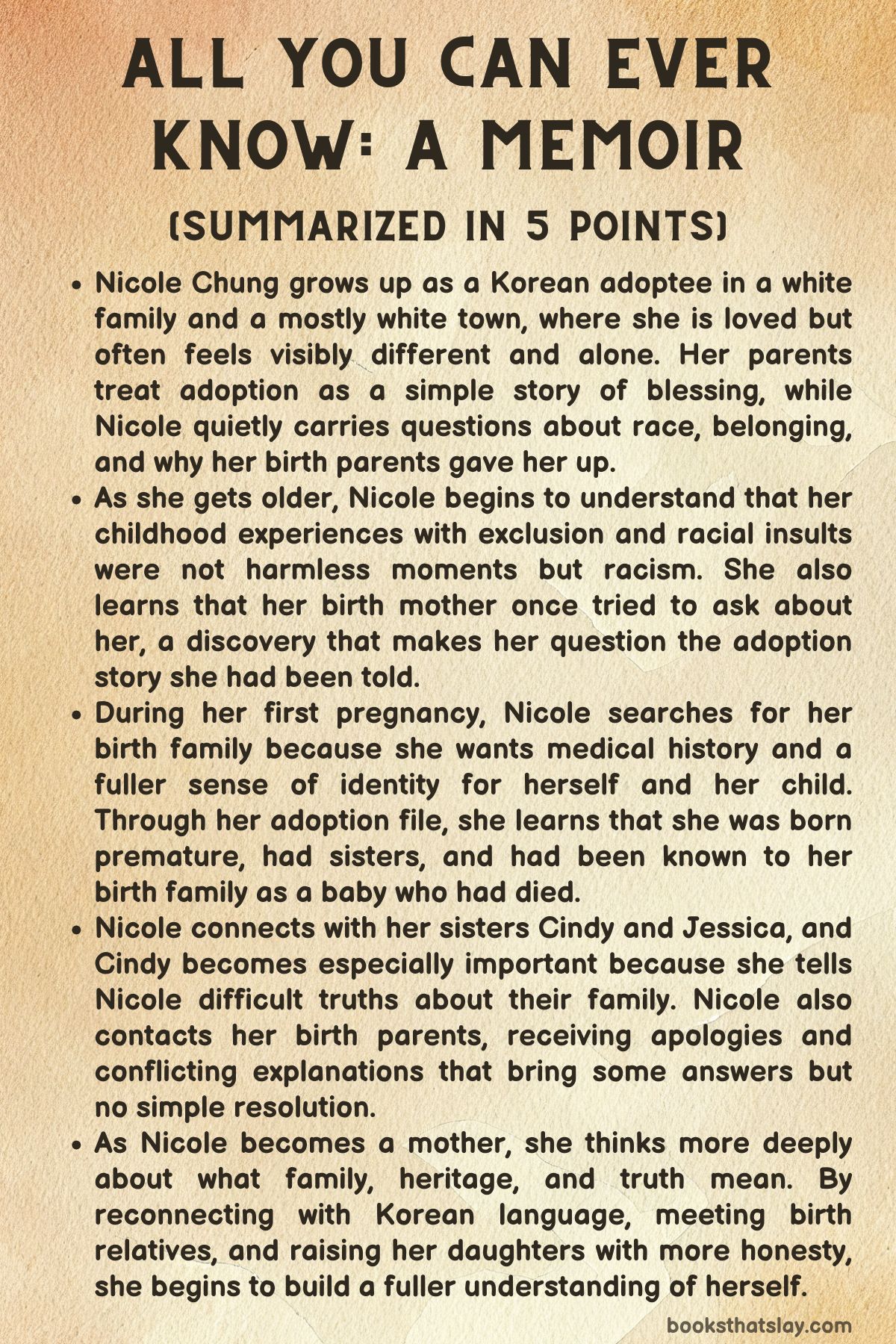
All You Can Ever Know by Nicole Chung is a memoir about adoption, race, family, and the long search for truth. Chung was born premature to Korean parents and adopted by a white couple in Oregon, who raised her with love but little understanding of what it meant for her to grow up Asian in a mostly white world.
As she becomes pregnant with her first child, she begins looking for her birth family, hoping for medical history and answers. What she finds is more complex than the comforting adoption story she was told as a child.
Summary
Nicole Chung grows up knowing two facts about herself: she is Korean, and she is adopted. Her white adoptive parents raise her in a small, mostly white town outside Seattle, where they love her deeply but try to treat race as unimportant.
They believe that love and family are enough to make difference disappear. For Nicole, however, difference is visible every day.
She looks nothing like her parents, is often the only Asian child in her classroom, and faces questions from classmates who ask about her “real” parents. Even worse, she hears racial slurs and insults that she does not fully understand as racism until adulthood.
Her parents tell her the story of her adoption as a story of blessing and rescue. They had wanted a child for years, and when they learned through their church community that a premature baby needed a family, they believed their prayers had been answered.
Nicole’s birth parents, Korean immigrants without health insurance, could not afford the medical care she needed. A lawyer handled the adoption quickly.
It was a closed adoption, with no exchange of identifying information and no planned contact between families. Nicole’s adoptive parents see this as the beginning of their family.
Nicole grows up loving them, but also carrying pain she feels she is not allowed to name.
As a child, Nicole often feels alone with her questions. She wonders why her birth parents gave her away and whether something about her made her unwanted.
She does not want to seem ungrateful, so she hides her hurt. Writing becomes her escape.
At first, the heroines in her stories are smart white girls, like the children around her. Later, after a trip to Seattle, she begins to notice Asian women in the city and imagines one of them might be her birth mother.
That trip helps her understand that she lost more than a biological family. She lost access to a culture, a language, and a community that might have helped her feel less alone.
In high school, Nicole learns something that changes her understanding of her past. Her birth mother once tried to ask about her, but Nicole’s adoptive parents refused further contact.
They had sent a brief message saying Nicole was healthy and happy, then closed the door. The letter from her birth mother is gone; Nicole’s adoptive mother threw it away.
Nicole is devastated. For years, she believed she had been forgotten.
Knowing that her birth mother had asked about her might have eased some of that pain.
As an adult, Nicole works for an adoption organization and meets other adoptees, especially transracial adoptees who share some of her questions. She begins to understand that adoption is not only a joyful family story.
It can also involve grief, loss, silence, and unanswered questions. Still, for a long time, she repeats the simple adoption story she was taught.
When she meets a couple hoping to adopt, she tells them adoption is not a big deal, even though she knows this is not fully true. Later, she recognizes that adoptive parents need to understand the emotional and racial realities their children may face.
After marrying Dan and becoming pregnant with their first child, Nicole feels a new urgency to find her birth family. Pregnancy brings practical concerns about medical history, but it also awakens deeper needs.
She wants to know where she comes from, and she wants her child to have answers she never had. She petitions for information through an intermediary.
Her adoptive parents know she wants medical details, but they do not realize she also hopes for contact.
Nicole receives pieces of her sealed adoption file. She learns that she has a sister and a half sister, that her birth parents later divorced, and that they now live in different states.
She also learns more about her birth: she was born two months early, spent weeks in intensive care, and had a frightening medical outlook. The file suggests that her birth parents may have wanted a son and that they feared judgment from their community if they brought home a sick infant.
Most painfully, Nicole learns that her family told others she had died at birth. She also discovers her original name: Susan.
Nicole writes to her birth mother, thanking her for giving her a chance at life and asking for contact. Her adoptive mother reacts with fear, warning Nicole not to forget who her real family is.
Nicole is hurt by this, but her search continues. Her letter reaches her birth mother, who cannot fully understand it because of language difficulties and asks Nicole’s half sister, Jessica, to translate it.
Jessica is shocked. She and Nicole’s sister Cindy had grown up believing the baby had died.
Cindy feels betrayed by the lie but wants to know the truth.
Jessica emails Nicole and tells her that their mother wants to speak with her. Nicole also learns about Cindy.
Cindy then contacts Nicole directly and sends a photograph. Nicole sees the resemblance at once.
Cindy is honest in a way Nicole needs. She tells Nicole that their parents’ marriage was troubled, that their father feels shame about the adoption, and that their mother was physically abusive toward Cindy.
This honesty complicates Nicole’s hopes. She has found family, but not the easy reunion she might have imagined.
As Nicole reaches the end of her pregnancy, she receives an email from her birth father asking forgiveness. Soon after, Nicole gives birth to a healthy daughter, Abigail.
Holding her baby and watching her sleep, Nicole thinks about her own birth and wonders whether her mother held her before giving her away, and whether her father saw her in the hospital.
Nicole’s birth mother eventually calls. Her first words are an apology.
She says she never wanted to give Nicole up and that Nicole’s father forced the decision. Nicole has wanted to hear that she was not abandoned, but the call does not resolve everything.
She is unsure what to believe, especially after learning about Cindy’s abuse. She chooses not to blame her mother directly, but she also does not promise visits or a close relationship.
Her birth father also begins writing. He apologizes, shares details about his life and faith, and asks for forgiveness.
Nicole’s birth parents offer different versions of what happened, and both present the adoption as something shaped by forces beyond their control. Nicole feels more drawn to her father’s version because she trusts Cindy, but she is not ready for an immediate bond with him.
He, too, seems hesitant to speak too much about the past.
Nicole’s strongest new relationship is with Cindy. The sisters email often, share stories, exchange photos, and imagine the childhood they might have had together.
Cindy visits Nicole with her husband, Rick, after suffering the loss of an ectopic pregnancy. When they meet, Nicole is struck by both resemblance and difference.
Cindy shares memories of growing up in Korea and later in Seattle, including the pain of her mother’s abuse. She gives Nicole family photographs and encourages her to meet their father.
Before Cindy leaves, Nicole tells her she wants them to be real sisters. Cindy says they already are.
Later, while pregnant with her second child, Nicole meets her birth father in Portland. He arrives with his wife and brings gifts, including books.
Nicole is surprised by their similarities, especially their shared love of writing. He tells her about his Korean family, his deceased parents, his siblings, and a family history stretching back centuries.
He also tells her that before birth she had been given a Korean name, Soo Jung. Nicole feels both connection and loss: she wishes she could read his Korean essays and understand the Korean conversations around her.
Her father speaks about the adoption and says he knew Nicole’s birth mother had abused Cindy. He believed adoption would protect Nicole from that home.
When he describes seeing Nicole in the neonatal intensive care unit, he cries. Nicole believes him when he says adoption may have been the best option, but she still cannot ask whether he wanted to keep her.
As Nicole raises her daughters, she thinks more deeply about race, family, and inheritance. Abigail asks questions about Nicole’s adoption, her white parents, and what it felt like not to know other Koreans while growing up.
Nicole answers as honestly as she can, though she protects her daughter from the harshest details. She understands that her own childhood silence about racism cannot continue now that she is raising children of color.
Reuniting with her birth family does not undo Nicole’s bond with her adoptive parents. She remains their daughter, and her place in that family is secure.
But the reunion changes how she sees the adoption story she was given. The old version was too simple.
The truth includes love, sacrifice, shame, poverty, racism, fear, damage, and survival.
By learning Korean and writing her Korean name in Hangul, Nicole begins reclaiming parts of herself that adoption separated from her. When Abigail finds her workbook and starts her own connection to Korean heritage, Nicole sees a new possibility: her daughters can inherit not only unanswered questions, but also language, history, and belonging.
All You Can Ever Know ends with Nicole accepting that no single family story can contain the whole truth, but that seeking the truth can still bring connection, clarity, and a fuller sense of self.
Key People
Nicole Chung
Nicole Chung is the central figure and narrator of All You Can Ever Know, and her character is shaped by the tension between being deeply loved and still feeling incomplete. She grows up as a Korean adoptee in a white family and a largely white community, which means her childhood is marked by visible difference that the adults around her do not fully recognize.
Her adoptive parents offer security, affection, and devotion, but their belief that race does not matter leaves Nicole alone with experiences they cannot explain or protect her from. As a child, she learns to silence her discomfort because she fears appearing ungrateful.
This silence becomes one of the major burdens of her life. She wants answers about her birth family, but she also worries that asking for those answers might hurt the parents who raised her.
Nicole is thoughtful, observant, and emotionally disciplined, but beneath that discipline is a long history of loneliness, racial confusion, and grief. Her pregnancy becomes a turning point because it forces her to confront questions she has delayed for years.
She wants medical history, but more than that, she wants her daughter to inherit a fuller sense of family than she had. Nicole’s search for her birth family shows her courage, but it also shows her restraint.
She does not rush into easy forgiveness or simple rejection. She learns to hold several truths at once: her adoptive parents loved her, her birth parents made painful and imperfect choices, and adoption gave her safety while also taking something from her.
By the end, Nicole becomes someone who can speak more honestly about race, adoption, motherhood, and belonging.
Nicole’s Adoptive Mother
Nicole’s adoptive mother is loving, protective, and deeply attached to the idea that Nicole was meant to be her child. She sees Nicole’s adoption through a religious and emotional lens, believing that Nicole came into her family as an answer to prayer.
This belief gives her comfort, but it also limits her ability to understand Nicole’s pain. She wants Nicole to feel secure, yet she sometimes treats Nicole’s desire for information about her birth family as a threat.
Her decision to throw away the birth mother’s letter is especially important because it shows how fear can hide beneath love. She may believe she is protecting the family, but the result is that Nicole loses access to knowledge that could have eased years of self-blame.
Nicole’s adoptive mother is not presented as cruel; rather, she is a parent who loves fiercely but struggles to accept that love does not erase loss. Her warning that Nicole should remember who her real family is reveals insecurity and a narrow understanding of adoption.
She wants to hold onto her role as Nicole’s mother, but she does not fully see that Nicole’s search is not a rejection of her. Over time, her character represents the limits of good intentions.
She gives Nicole a home, but she cannot give her racial belonging or biological history. Her love is real, but it is also shaped by denial, fear, and the comforting myth that adoption can be only joyful.
Nicole’s Adoptive Father
Nicole’s adoptive father is less prominent in the book, but he is still an important part of Nicole’s emotional foundation. Like Nicole’s adoptive mother, he views the adoption as a blessing and accepts the closed adoption arrangement as final.
He participates in the family story that presents Nicole’s arrival as a gift from God, and this belief helps create a stable home for her. At the same time, he shares in the family’s silence about race and the pain of separation.
His love for Nicole is not questioned, but he does not appear to understand how isolated she feels as a Korean child in a white family and white community. His role reflects a certain kind of parental devotion that provides safety without fully recognizing identity.
Nicole’s adoptive father represents the home she belongs to and the worldview she eventually has to question. He helps raise her, support her, and claim her as his daughter, but he also participates in a system of closed adoption that leaves Nicole without answers.
His character is important because he shows that harm in adoption stories does not always come from neglect or lack of love. Sometimes it comes from silence, from limited understanding, and from the belief that a child’s questions about origin can be set aside because the present family is loving.
Nicole’s Birth Mother
Nicole’s birth mother is one of the most complicated figures in All You Can Ever Know because she exists first as an absence, then as a mystery, and finally as a flawed human being. For much of Nicole’s life, she imagines her birth mother through the pain of abandonment.
Nicole wonders why she was given up and whether she had been unwanted. When she learns that her birth mother once asked about her, that knowledge changes the emotional meaning of her childhood.
It suggests that Nicole was not simply forgotten. Still, when Nicole finally reaches her, the reunion does not provide a clean resolution.
Her birth mother apologizes and says she did not want to give Nicole up, claiming that Nicole’s birth father forced the decision. These words are powerful because they are what Nicole has always wanted to hear, yet they are difficult to accept fully because Nicole has also learned that this same woman abused Cindy.
Her birth mother therefore cannot be reduced to a grieving parent or a villain. She is someone who suffered, lost a child, lacked power in certain circumstances, and also caused serious pain to another daughter.
Her limited English adds another layer of distance, showing how language can shape family separation even after reunion becomes possible. Nicole’s response to her birth mother is cautious.
She does not reject her completely, but she also does not rush into closeness. Through this character, the memoir shows that finding a birth parent does not always heal the wound of adoption.
Sometimes it reveals deeper wounds.
Nicole’s Birth Father
Nicole’s birth father is marked by shame, regret, distance, and restraint. When Nicole first learns about him, he is part of the painful mystery of her adoption.
Later, through Cindy and through his own messages, he becomes more human. He asks forgiveness and explains that Nicole’s adoption was connected to poverty, fear, and concern about the home environment she might have entered.
He says he knew Cindy was being abused and believed adoption would spare Nicole from a similar life. This explanation matters to Nicole because it gives moral complexity to a decision she had long experienced as abandonment.
He is not simply a parent who discarded a child; he is a father who appears to have made a painful decision under pressure, then lived with guilt. His meeting with Nicole is emotionally significant because it gives her a glimpse of inherited identity.
They share a love of writing, and he brings books and essays that reveal an intellectual and creative bond between them. He also introduces her to family history, Korean ancestry, and her Korean name, Soo Jung.
Yet he remains guarded. He does not want to discuss every part of the past, and Nicole cannot bring herself to ask whether he wanted to keep her.
This silence shows that reunion has limits. His character gives Nicole connection, but not complete certainty.
He offers history, resemblance, apology, and affection, but some answers remain unreachable.
Cindy
Cindy is Nicole’s sister and one of the most emotionally important people Nicole finds during her search. Unlike Nicole’s birth parents, Cindy offers honesty quickly and directly.
She does not protect Nicole with comforting half-truths, and this openness becomes the foundation of their relationship. Cindy grew up believing Nicole had died, so discovering that Nicole is alive changes her understanding of her own family history.
She feels betrayed by her parents’ lie, but she also chooses to reach toward Nicole rather than turn away from the shock. Cindy’s own childhood was painful.
She experienced abuse from her mother and carried the effects of family instability, distance, and secrecy. Her willingness to share these experiences with Nicole is an act of trust.
Cindy helps Nicole see that biological family does not automatically mean safety or closeness, but it can still offer recognition. Their resemblance matters, but their emotional connection matters more.
Through emails, photographs, visits, and conversations, Cindy gives Nicole something she never had: a sibling bond rooted in both blood and choice. Cindy also encourages Nicole to meet their father, acting as a bridge between Nicole and the family she lost.
Her statement that Nicole is already her real sister is one of the clearest signs of acceptance in the memoir. Cindy represents the possibility that reunion can create something meaningful even when the past cannot be repaired.
Jessica
Jessica, Nicole’s half sister, plays an important role as a messenger and translator. She is the one who helps bring Nicole’s letter into the family because their mother needs help understanding it.
Jessica’s position is delicate because she must process the shock of learning that the baby she thought had died is alive while also helping her mother respond. She informs Nicole that their mother wants to speak with her and tells her about Cindy.
Jessica’s language in her email, especially her references to God, reminds Nicole of her adoptive parents, which creates an unexpected link between Nicole’s two families. Jessica is less emotionally central than Cindy, but she matters because she helps open the door to contact.
She also reveals the fragmentation within Nicole’s birth family. The sisters are not all close, and different family members have different relationships with each parent.
Jessica’s presence shows that Nicole is entering not a stable family unit but a complicated set of damaged relationships. She tries to keep communication positive, encouraging Cindy to avoid overwhelming Nicole with painful truths too quickly.
This suggests that Jessica is careful, perhaps protective, and aware that reunion can be emotionally fragile. Her character helps show how family secrets affect everyone, not only the child who was adopted.
Dan
Dan, Nicole’s husband, is a steady and supportive presence during one of the most vulnerable periods of her life. He does not dominate the story, but his role is important because he provides Nicole with emotional safety as she searches for answers.
During her pregnancy, he supports her need for information and signs them up for a home birthing course when she wants to understand childbirth more fully. His actions show practical care rather than dramatic intervention.
He allows Nicole’s search to unfold without trying to control it, and this gives her room to face difficult truths. Dan’s support matters because Nicole is navigating several forms of uncertainty at once: impending motherhood, medical questions, contact with birth relatives, and the emotional response of her adoptive parents.
He is also part of the new family Nicole is building, a family in which she wants to handle adoption, race, and heritage more openly than they were handled in her childhood. Dan’s character represents partnership based on trust.
He cannot answer Nicole’s deepest questions about origin, but he can stand beside her as she asks them. His steadiness helps contrast with the instability and secrecy of Nicole’s birth family.
Abigail
Abigail, Nicole’s first daughter, changes the direction of Nicole’s life before she is even born. Nicole’s pregnancy with Abigail makes the search for her birth family feel urgent and necessary.
At one level, Abigail represents the need for medical history, but at a deeper level, she represents inheritance. Nicole does not want her child to grow up with the same absence of answers that shaped her own childhood.
After Abigail is born, Nicole sees herself in her daughter, which becomes a powerful experience because Nicole grew up without biological resemblance in her household. Abigail gives Nicole her first daily experience of looking at a family member and recognizing shared features.
As Abigail grows older and begins asking questions about Nicole’s adoption, she also becomes a sign of generational change. Her questions are direct, thoughtful, and sometimes painful.
She asks what it was like for Nicole to have white parents and to grow up without knowing other Koreans. Through Abigail, Nicole is forced to explain her past with honesty while also deciding how much pain a child should know.
Abigail’s discovery of Nicole’s Korean workbook is especially meaningful because it suggests that Nicole’s effort to reclaim language and heritage will not end with her. Abigail may inherit a fuller connection to Korean identity than Nicole had as a child.
Rick
Rick, Cindy’s husband, is a quieter supporting character, but he helps reveal Cindy’s emotional world. When Cindy learns that Nicole is alive, Rick encourages her to gather information before deciding how to respond.
This shows him as steady, practical, and protective without being controlling. He accompanies Cindy when she visits Nicole and Dan, becoming part of the first in-person meeting between the sisters.
His presence gives Cindy support during a period that is emotionally intense and physically difficult, especially after her ectopic pregnancy and surgery. Rick’s role also helps show that reunion affects more than the adoptee and birth relatives alone.
Spouses and children become part of the expanding family structure. He does not carry the central emotional conflict, but he helps make Cindy’s participation in the reunion possible.
His character adds a sense of groundedness to Cindy’s side of the story.
Nicole’s Birth Father’s Wife
Nicole’s birth father’s wife appears during Nicole’s first meeting with her birth father. Her role is limited, but her presence is meaningful because she shows that Nicole is entering a family life that continued without her.
She is part of the father’s present, not Nicole’s past, and this creates a subtle emotional distance. During the meeting, conversation moves between English and Korean, and Nicole often depends on translation.
The wife’s presence in those Korean exchanges reminds Nicole of what she has been separated from: language, cultural fluency, and everyday belonging within a Korean family. She does not need to do anything dramatic to affect the scene.
Her presence alone helps Nicole feel both included and outside at the same time. She represents the life Nicole’s birth father built after the adoption and the complicated reality that reunion does not return Nicole to the family as it once might have been.
Themes
Adoption, Loss, and the Limits of the Rescue Story
Adoption is often described as a story of love, gratitude, and rescue, but Nicole’s experience shows how incomplete that version can be. Her adoptive parents love her and give her a secure home, yet adoption also begins with separation.
Nicole grows up feeling that she should be thankful, and that expectation makes it difficult for her to admit grief. She is not unhappy in a simple sense, but she carries the pain of not knowing why she was given up, whether she was wanted, and what kind of life she might have had with her birth family.
The closed adoption deepens this pain because it removes information that could have helped her understand herself. When she later learns that her birth mother once asked about her, Nicole realizes that the story she lived with was not the whole truth.
This theme becomes especially complex because the truth does not destroy her adoptive family or replace them with her birth family. Instead, it shows that adoption can be both loving and painful, both protective and damaging.
All You Can Ever Know presents adoption as a life-long condition, not a single event. It shapes identity, family relationships, memory, and parenthood long after the legal process is complete.
Race, Belonging, and the Failure of Color-Blind Parenting
Nicole’s childhood shows that love cannot erase race. Her adoptive parents raise her with devotion, but their race-blind approach leaves her without the tools to understand racism or her Korean identity.
In her mostly white town, Nicole is visibly different from her family and classmates. She faces intrusive questions and racial insults, but because the adults around her do not name these experiences clearly, she learns to endure them in silence.
Her parents want her to feel like she belongs, yet they do not fully understand that belonging at home does not protect her from exclusion outside it. Nicole’s early writing, filled with white girl protagonists, reflects how much her imagination is shaped by the world around her.
Only later does she begin creating Asian American characters and recognizing the importance of seeing herself in stories. Race becomes not just a social category but a daily emotional reality.
Nicole’s later decision to learn Korean and teach her daughters a more open relationship to heritage shows her refusal to repeat the silence of her childhood. The theme criticizes the idea that children of color can thrive on love alone when their racial experiences are ignored.
Nicole needed love, but she also needed language, cultural connection, and honest preparation for the world.
Motherhood, Inheritance, and the Search for Answers
Pregnancy changes Nicole’s relationship to the past because becoming a mother makes absence feel urgent. Before she carries Abigail, Nicole can delay some questions about her birth family, even though they trouble her.
Once she is responsible for a child, those questions become practical, emotional, and ethical. She needs medical history, but she also wants to give her daughter a more complete inheritance.
Nicole knows what it is like to grow up with missing information, and she does not want Abigail to inherit only silence. Motherhood also changes how Nicole thinks about her birth mother.
Giving birth makes her imagine the circumstances of her own birth with new intensity. She wonders whether her mother held her, whether her father saw her, and what it meant for them to leave a premature baby behind.
At the same time, motherhood helps Nicole define the kind of parent she wants to be. She chooses greater honesty with her daughters, especially about race and adoption, while still protecting them from details they may not be ready to understand.
Her children become part of her healing, not because they fix the past, but because they give her a reason to build a different future. Through motherhood, Nicole transforms unanswered questions into a responsibility to tell fuller truths.
Truth, Family Secrets, and Emotional Complexity
The search for truth in the memoir does not lead to one clean answer. Instead, every discovery makes Nicole’s family history more complicated.
She learns that her sisters believed she had died, that her birth parents gave conflicting accounts of the adoption, and that her adoptive parents had hidden the fact that her birth mother once asked about her. These secrets do not simply belong to the past; they shape how everyone understands themselves.
Cindy feels betrayed when she learns Nicole is alive. Nicole feels grief over the years she spent believing she had been forgotten.
Her adoptive parents are forced to face the fact that the comforting story they believed was incomplete. Truth becomes necessary, but it is not always comforting.
Nicole’s birth mother apologizes but is also connected to Cindy’s abuse. Her birth father offers remorse and family history, but he avoids some painful questions.
Her adoptive parents provide love, but they also made choices that caused harm. This theme resists simple categories of good and bad family members.
People protect themselves with stories, but those stories can wound others. Nicole’s growth comes from accepting complexity without surrendering her right to know.
She learns that family truth may be painful, partial, and disputed, but it is still better than silence.