Almost a Woman Summary and Analysis
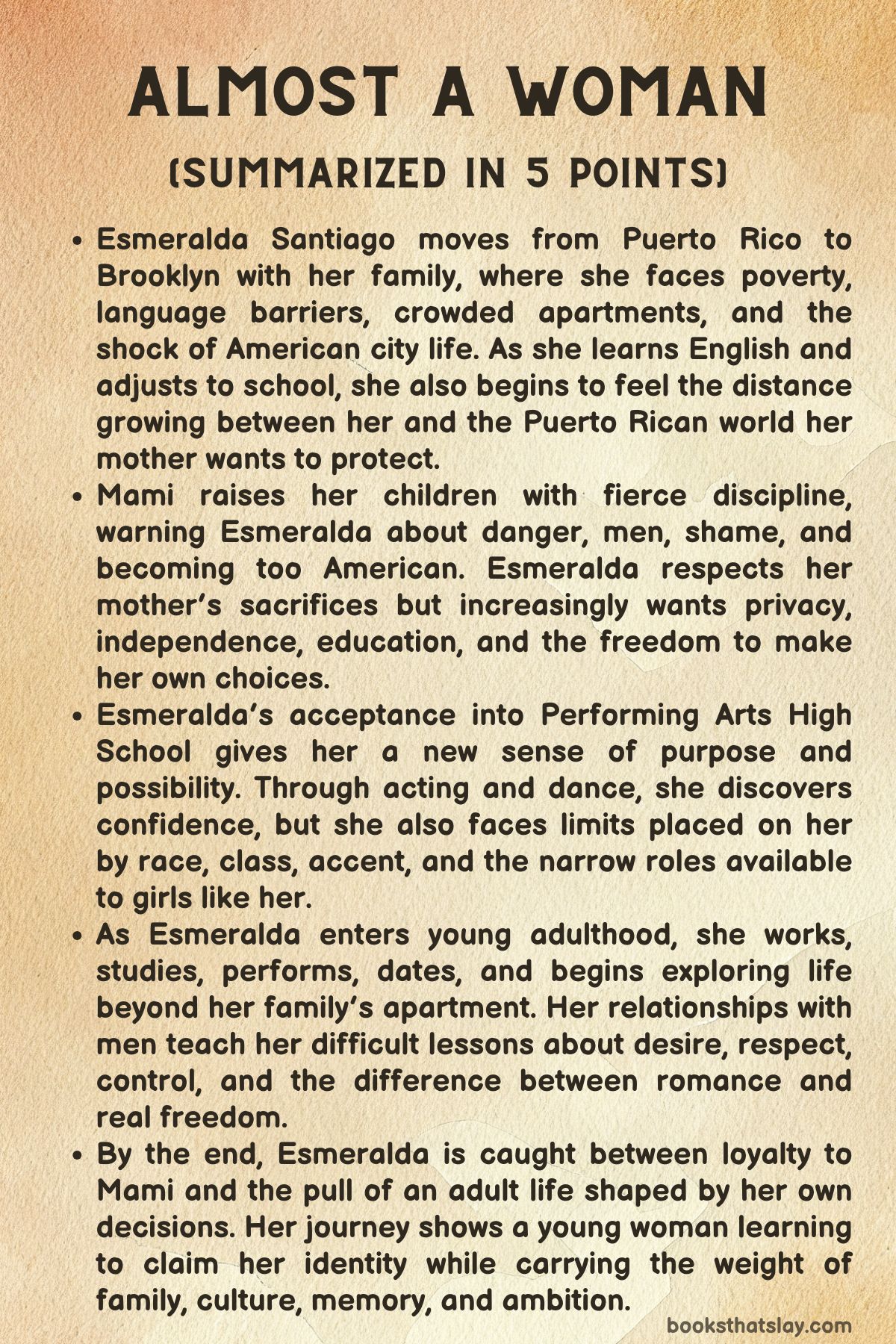
Almost a Woman is Esmeralda Santiago’s memoir about growing up between Puerto Rico and New York, between childhood and adulthood, and between the person her family expects her to be and the woman she slowly becomes. It follows Esmeralda after her family moves to Brooklyn, where she must learn English, adjust to city life, and carry adult responsibilities while still a girl.
The book explores poverty, culture, family pressure, ambition, desire, shame, and independence. Santiago writes with directness, humor, and emotional honesty, showing how identity can be shaped by displacement, love, fear, and the long struggle to choose one’s own life.
Summary
Almost a Woman begins with Esmeralda Santiago looking back on a childhood marked by constant movement. Her mother, Mami, moves the family again and again, searching for better rooms, safer neighborhoods, heat, privacy, work, or simply a new chance.
The family’s possessions become temporary, and home becomes less a place than a shifting arrangement of people. Esmeralda’s memories center on Mami, whose strength and fear define much of her daughter’s life.
Years later, when Esmeralda returns to the Puerto Rican barrio of Macún, she finds that the old house no longer feels like home. The past is vivid in memory, but the place itself gives her no simple answer about who she was or who she has become.
The main story follows Esmeralda after her family moves from Puerto Rico to Brooklyn in 1961 so her younger brother Raymond can receive treatment for an injured foot. New York shocks her.
Instead of the color and openness of Puerto Rico, she sees dark buildings, crowded streets, grayness, and danger. She also faces a new label: in the United States, she is not simply Puerto Rican but “Hispanic,” a word she does not fully understand.
Mami warns her constantly that something could happen to her, and those warnings become part of Esmeralda’s sense of the city.
At school, Esmeralda is placed in remedial classes because she does not speak English. She learns songs and pledges without understanding their meaning, and she feels trapped between languages.
Her desire to master English grows stronger when she has to translate for Mami at the welfare office. There, she realizes that not knowing the language well enough gives other people power over her family.
Books, television, school, and daily necessity become her teachers. Her English improves, but the process also begins to separate her from the Puerto Rican world Mami wants to preserve.
Life in Brooklyn is harsh. The family deals with cold apartments, cockroaches, illness, money troubles, and social workers.
Mami is strict, especially as Esmeralda enters adolescence. She warns her about men, American girls, makeup, short skirts, and any behavior that might lead to shame.
Esmeralda wants freedom, pretty clothes, books, friends, and the ease she imagines American girls possess. Mami sees these desires as signs that her daughter is becoming disrespectful and losing her roots.
Their bond remains deep, but a painful distance grows between them.
Esmeralda’s life changes when a school counselor notices her talent and encourages her to audition for the Performing Arts High School. Her family doubts that acting can offer a real future, especially for a Puerto Rican girl, but teachers help her prepare.
Although she believes she has failed the audition, she is accepted. This achievement gives her pride and hope, but also pressure.
Mami is proud, though the family rarely speaks openly about Esmeralda’s new path. At the same time, Esmeralda faces bullying and violence from girls who resent her ambition.
At Performing Arts, Esmeralda studies acting, dance, speech, and stagecraft. The school asks her to lose her accent, change how she carries herself, and imagine herself as someone marketable to the stage.
She loves dance because it gives her a freedom she rarely feels elsewhere. Acting is harder.
She senses that her whole life already requires performance: acting American at school, Puerto Rican at home, obedient for Mami, confident in public, and invisible when danger appears. She is often cast in exotic roles, especially Cleopatra, which both flatters and limits her.
Her teachers see promise, but the industry’s narrow ideas about race and beauty make her future uncertain.
Family life continues to shift. Mami falls in love with Francisco, becomes pregnant, and then loses him to cancer.
Later, she begins a relationship with Don Carlos, whose presence causes tension in the household. Esmeralda’s father remains mostly absent, and his remarriage makes her feel that the old family dream is gone.
Her half-sister Margie enters her life and offers another version of family, one with new manners, rules, and possibilities. Yet Esmeralda still feels pulled between loyalty to Mami and a desire to step outside the crowded apartment.
As Esmeralda grows older, she begins exploring dance halls, jobs, auditions, and Manhattan. Dancing gives her a new sense of beauty and control.
Work gives her money and a glimpse of independence. She becomes an usher at a Yiddish theater and is moved by performers whose language she does not understand but whose emotion she can feel.
She works in offices and mail rooms, learns from coworkers, and starts buying books of her own. She also sees how people judge Puerto Ricans, how casually they reduce her family to stereotypes, and how often she must explain or defend who she is.
Romance becomes another path toward self-discovery and confusion. Neftalí, a young man connected to her family’s apartment building, asks her to wait for him before he leaves for Vietnam, then later proposes marriage.
Esmeralda refuses because she does not want to become his wife simply because that is what a woman is expected to do. Sidney, Otto, Avery, Jurgen, and others each represent different possibilities: romance, escape, danger, class difference, and the fantasy of being chosen.
Avery wounds her deeply when he wants her as a mistress but says marrying a Puerto Rican woman would not suit his public ambitions. Jurgen charms her family and proposes quickly, but when she learns of his criminal life and imagines being trapped with him abroad, she breaks the engagement and feels she has saved herself.
Her closest friendship is with Shoshana, a bold Jewish girl who pushes her toward adventure, dating, and independence. Together they take classes, work, attend television tapings, talk about men, and test the limits of their families’ expectations.
Through Shoshana, Esmeralda experiences a wider social world, though she remains aware of her own difference. She continues to perform, including children’s theater roles that allow her to travel.
On tour, she faces the stares of white audiences and tries to educate people about Puerto Ricans, even when she is tired of carrying that burden.
The most important romantic relationship in the later part of the memoir is with Ulvi Dogan, a Turkish filmmaker. Esmeralda is drawn to him because he understands exile and the ache of living away from one’s homeland.
Their connection becomes sexual, intense, and consuming. At first, she feels awakened by him, but soon he begins shaping her life.
He criticizes her dancing, chooses her clothes, gives her expensive gifts, and expects her loyalty without showing much interest in the life she had before him. Esmeralda recognizes that his authority fills the space left by her absent father, and she allows herself to be led.
When Ulvi prepares to leave New York for Florida, he asks Esmeralda to come with him. To do so, she would have to leave Mami and the family.
This demand forces her to face the central conflict of her life: the need to belong to herself while still loving the mother who sacrificed so much for her. At home, surrounded by the familiar sounds of her crowded family, Esmeralda understands that she has already chosen.
The memoir ends with that choice unresolved in practical terms but clear in emotional truth. Esmeralda is no longer a child, not yet fully free, but aware that becoming a woman means deciding which ties to keep, which to loosen, and which parts of herself no one else can own.
Key People
Esmeralda Santiago
Esmeralda is the central figure and narrator, and her growth gives the memoir its emotional shape. In Almost a Woman, she begins as a displaced Puerto Rican girl trying to understand New York, English, American customs, and her mother’s rules all at once.
Her life is marked by movement, poverty, responsibility, and a constant sense that she must translate not only language but also culture, emotion, and expectation. She is intelligent and observant, but she is also often unsure of herself.
She wants to please Mami, protect her siblings, succeed in school, and remain connected to Puerto Rican identity, yet she also wants independence, privacy, romance, money, beauty, and artistic recognition.
Esmeralda’s character is shaped by contradiction. She wants to be seen, but she fears judgment.
She wants love, but she has been taught to distrust men. She wants to act, dance, and perform, yet she often feels that daily life already forces her to perform different versions of herself.
Her acceptance into Performing Arts High School becomes a turning point because it gives her a path beyond survival. Through acting, dance, school, jobs, and relationships, she tests who she might become.
Her romantic experiences are often tied to fantasy, escape, and danger, but each one teaches her something about power and self-worth. By the end, Esmeralda is still caught between family duty and personal freedom, but she has developed the inner strength to recognize when a choice is truly her own.
Mami
Mami is one of the most powerful figures in Esmeralda’s life. She is strict, protective, proud, exhausted, loving, fearful, and deeply shaped by hardship.
She carries the burden of raising many children with little money and inconsistent support from men. Her constant warnings about danger may seem harsh, but they come from a life in which danger is real: poverty, sexual exploitation, street violence, illness, racism, and abandonment all surround her family.
Mami’s control over Esmeralda is not simple cruelty. It is her way of trying to keep her daughter safe in a world that she knows can punish women severely.
At the same time, Mami’s protection often feels suffocating. She wants Esmeralda to dream, but only within limits she can understand.
She values education and is proud when Esmeralda enters Performing Arts, yet she also expects her to get a practical job after graduation. She wants her daughter to avoid dependence on men, but she herself repeatedly searches for love and companionship with men who bring instability into the household.
This makes Mami a complex character rather than a simple authority figure. She is both a barrier to Esmeralda’s freedom and the person whose sacrifices make that freedom possible.
Her relationship with Esmeralda is full of tension because both women love each other intensely, but each represents a different idea of survival.
Papi
Papi is mostly absent, but his absence has enormous emotional weight. For Esmeralda, he represents Puerto Rico, the broken family, and the possibility of a fatherly protection that never fully arrives.
She longs for him to return, reunite with Mami, and restore the life they had before New York. His remarriage forces Esmeralda to confront the fact that this fantasy will not come true.
The news wounds her because it feels like a final break from the family structure she still secretly wants.
Papi’s role in the memoir is less about what he does and more about what his absence creates. Esmeralda’s hunger for male approval, guidance, and recognition is partly connected to the space he leaves empty.
Later, when older men such as Ulvi take on powerful roles in her emotional life, the reader can see how her father’s distance has shaped her desires. Papi is not portrayed simply as a villain, but he is unreliable.
He belongs to Esmeralda’s emotional history more than to her daily life, and that makes him both powerful and unreachable.
Tata
Tata, Esmeralda’s grandmother, stands for tradition, caution, and old-world authority. She helps care for the children and remains a constant presence during the family’s unstable years.
Her judgments are sharp, especially toward Mami’s romantic choices, and she often disapproves of the men who enter the household. Tata’s criticism may sound severe, but it usually comes from experience and suspicion.
She knows how easily women can be hurt, abandoned, or left with children to support.
Tata also represents the pressure of custom. She believes in proper behavior, sexual caution, respectability, and social appearances.
Her warnings about pearls, dances, men, and young women living alone show how deeply she sees a girl’s reputation as fragile. At times, she can be funny and lively, especially in domestic scenes involving food, family, and neighborhood life.
Yet she also reinforces the very restrictions Esmeralda wants to escape. Tata’s character matters because she shows that female authority in the memoir is not gentle by default.
Women protect one another, but they also police one another.
Raymond
Raymond is important because his injured foot is the reason the family moves to New York. His medical need sets the story in motion, even though he is not one of the most developed figures.
Through Raymond, the memoir shows how one child’s vulnerability affects the entire family’s path. The move to Brooklyn is not an abstract search for opportunity; it begins with a practical need for treatment.
As Esmeralda’s younger brother, Raymond also belongs to the crowded world of siblings that both comforts and burdens her. The presence of so many children means Esmeralda rarely has privacy and often carries responsibilities beyond her age.
Raymond’s role reflects the family’s dependence on collective endurance. Everyone’s life is changed by everyone else’s needs, and Esmeralda’s personal ambitions are always measured against the demands of the household.
Edna
Edna is one of Esmeralda’s younger sisters and is part of the family group that makes the move from Puerto Rico to New York. Her presence helps show the chaos and closeness of the Santiago household.
Like the other children, she adapts to new schools, new streets, new foods, and new fears. The episode in which she goes missing at Coney Island reveals how quickly ordinary family outings can become moments of terror for Mami and the older children.
Edna also helps show the difference between Esmeralda’s interior life and the daily life of the family. While Esmeralda is often dreaming about school, performance, romance, or escape, she remains surrounded by siblings whose needs bring her back to domestic reality.
Edna’s character does not dominate the story, but she contributes to the sense of a large family in which no one grows up alone and no one can fully separate personal desire from family obligation.
Francisco
Francisco is Mami’s lover and the father of Franky. His arrival brings a period of emotional change into the household.
For Mami, he offers romance and companionship after years of struggle. For Esmeralda, his presence complicates her understanding of family, marriage, legitimacy, and male responsibility.
She knows Mami and Francisco will not marry, even though Mami wants her children to marry properly and receive the vows she never had.
Francisco’s illness and death deepen the family’s instability. His cancer forces Mami into mourning and leaves another child in a fatherless situation.
His death also increases Esmeralda’s resentment toward Papi, because she still imagines that her father should have been the man to keep the family whole. Francisco’s character is brief but significant because he shows Mami’s longing for love and the fragility of any happiness the family manages to build.
Franky
Franky, Mami and Francisco’s son, is born into a household already marked by grief, poverty, and uncertainty. His arrival should be a moment of joy, but it is shadowed by Francisco’s illness and death.
Through Franky, the memoir shows how new life and loss often exist side by side in Esmeralda’s family. He becomes another child Mami must support and another reminder that men may enter the family briefly while women remain to carry the consequences.
Franky’s importance lies in what his birth reveals about Mami’s vulnerability. Mami is strong, but she is not immune to desire, hope, or loneliness.
Franky also expands Esmeralda’s sense of responsibility. Each new sibling makes the family larger and Esmeralda’s dream of independence more complicated.
His presence reinforces the memoir’s picture of a household where children are loved, but where every new mouth to feed adds pressure.
Mr. Barone
Mr. Barone is one of the first adults outside the family to recognize Esmeralda’s potential. As her guidance counselor, he sees talent where others might see only a poor Puerto Rican girl struggling with English.
His encouragement to apply to Performing Arts High School changes the direction of her life. He gives her access to a world she did not know she could enter.
His role is important because he represents institutional support at its best. School is often difficult for Esmeralda, but Mr. Barone shows that education can also open doors.
He does not remove her struggles, but he gives her a chance to imagine a future beyond the limits of poverty and family expectation. His belief in her matters because Esmeralda is still learning to believe in herself.
In a life filled with warnings, his encouragement is a rare form of permission.
Yolanda
Yolanda is Esmeralda’s Puerto Rican school friend who speaks English well and introduces her to the library. She represents a slightly different version of girlhood: more settled, more Americanized, and less crowded by siblings.
Esmeralda notices Yolanda’s binders and collections, sensing that only a child with more time and space could organize a life that way. Through Yolanda, Esmeralda glimpses a form of childhood that seems more orderly than her own.
Yolanda’s biggest influence is leading Esmeralda toward books. The library becomes a place where Esmeralda can learn English and expand her imagination.
Although their friendship is limited by parental rules and suspicion, Yolanda helps connect Esmeralda to language as power. She is not a major character for long, but she plays a meaningful role in Esmeralda’s early adjustment to New York.
Natalia
Natalia is Esmeralda’s school friend and one of the first people to support her ambitions openly. She comforts Esmeralda when other girls mock her for wanting more from life.
Natalia believes in education and achievement, and Mami approves of her because she seems responsible and goal-oriented. For Esmeralda, Natalia is proof that ambition does not have to mean betrayal.
Natalia’s sudden move back to Puerto Rico leaves Esmeralda with sadness and longing. It reminds her how unstable immigrant life can be and how easily relationships disappear.
Natalia also represents an alternate future. She is another Puerto Rican girl with dreams, but circumstances pull her away before those dreams can unfold in the story.
Her absence reinforces Esmeralda’s fear that good things can vanish quickly.
Lulu
Lulu is the leader of the girls who bully Esmeralda. She represents resentment toward ambition and the social pressure that tries to keep Esmeralda in her expected place.
Lulu and her friends attack Esmeralda not simply because of personal dislike, but because Esmeralda’s success threatens the limits they have accepted or been forced to accept. Her acceptance into Performing Arts makes her visible, and visibility invites punishment.
Lulu’s violence shows that Esmeralda’s struggles do not come only from adults, racism, or poverty. Other young people also enforce narrow ideas of what someone from their background should want.
The beating Esmeralda receives is physically painful, but it is also symbolic. It shows the cost of standing apart.
Lulu functions as a reminder that ambition can isolate a girl from her own peer group.
Tío Chico
Tío Chico is one of the darkest figures in Esmeralda’s family circle. His sexual violation of Esmeralda destroys any simple idea that home and relatives are always safe.
Mami warns Esmeralda about danger outside, but Tío Chico proves that danger can also come from within the family. His act leaves Esmeralda confused by shame, secrecy, and self-blame.
What makes this moment so painful is Esmeralda’s uncertainty about responsibility. She knows he has done something wrong, but because she accepts the dollar and stays silent, she begins to wonder whether the shame belongs partly to her.
This is a child’s misunderstanding of abuse, but it reflects how girls are often taught to carry guilt for male behavior. Tío Chico’s character reveals the hidden risks faced by young women, especially in crowded households where privacy and protection are limited.
Provi
Provi is Papi’s earlier partner, and her visit with Margie exposes the complicated emotional history of Esmeralda’s family. She and Mami remain connected through their relationships with the same man, and their conversation carries unspoken rivalry.
Provi’s presence reminds Esmeralda that her family story is not neat or singular. There are other women, other children, and other claims on Papi.
Provi also pushes Mami into a subtle competition over motherhood and femininity. After Provi appears, Mami allows Esmeralda to try makeup, partly because she does not want to seem less generous or modern than another mother.
Provi’s role is brief, but she helps Esmeralda understand womanhood as something shaped by pride, comparison, and wounded history.
Margie
Margie, Esmeralda’s half-sister, offers Esmeralda a different model of young womanhood. She is connected to Papi but raised in another household, so she belongs to Esmeralda’s family and yet feels somewhat separate from it.
Esmeralda is drawn to her because Margie represents a sisterly bond outside the crowded life of Mami’s apartment.
Margie teaches Esmeralda things that are practical, social, and intimate, such as household manners and aspects of female adulthood. Esmeralda sometimes feels embarrassed by what she does not know, but Margie is kind rather than cruel.
Their relationship gives Esmeralda a glimpse of a calmer, more instructive form of female companionship. Margie’s move to Miami hurts because Esmeralda knows distance will weaken the connection.
Like many relationships in the memoir, theirs is meaningful but fragile.
Don Carlos
Don Carlos enters the family as Mami’s later boyfriend and eventually the father of Charlie. At first, he brings attention and romance into Mami’s life, but his presence quickly creates discomfort.
Esmeralda and her sisters dislike the way he changes the atmosphere at dances, and Tata distrusts him. His evasiveness about his other family and his reluctance to contribute financially make him suspect.
Don Carlos represents another version of male instability. He is not as absent as Papi or as briefly tragic as Francisco, but he still fails to provide the security Mami needs.
His discovery as a married man deepens the children’s bitterness toward him. Still, Mami takes him back, showing how loneliness and hope can complicate judgment.
Don Carlos’s character reveals the emotional risks Mami takes and the resentment those risks create in her children.
Charlie
Charlie is Mami and Don Carlos’s son, and like Franky, he is born into a family already under strain. His birth shows Mami continuing to build a family despite uncertain romantic circumstances.
For Esmeralda, Charlie’s arrival means the household remains tied to cycles of pregnancy, childcare, financial need, and dependence on unreliable men.
Charlie’s role is less individual than symbolic. He represents how Mami’s choices affect all her children, especially Esmeralda, who wants a different life but cannot detach herself emotionally from the family.
His presence also deepens Tata’s anger at Don Carlos and Mami. Charlie is loved, but his birth intensifies the pressures that make Esmeralda long for independence.
Neftalí
Neftalí is Esmeralda’s first serious romantic fantasy connected to marriage. He is handsome and nearby, and Esmeralda projects onto him many ideas drawn from romantic stories, songs, and radio dramas.
When he is drafted, she imagines herself in the role of the loyal heroine waiting for a soldier. Yet when he asks her to wait for him and later proposes, the reality disappoints her.
He does not match the romance she has imagined.
Esmeralda’s refusal of Neftalí is a major sign of growth. She realizes that marriage cannot be accepted simply because a man asks.
She does not want to step into a role that would reduce her life to someone else’s expectation. His later death from addiction shocks her and complicates her memories of him.
Neftalí becomes a figure of lost possibility, but also one who helps Esmeralda learn that fantasy and commitment are not the same thing.
Sheila
Sheila is Esmeralda’s coworker at the photographic developing company. As a Black woman supporting herself and her children, she gives Esmeralda a grounded example of female endurance outside the family.
Sheila encourages Esmeralda to stay in school, which matters because she understands how hard adult responsibility can be without education.
Sheila’s presence expands Esmeralda’s view of working women. She is not protected by romance or wealth, but she survives through labor and practicality.
She speaks from experience rather than theory. For Esmeralda, Sheila represents the kind of adult woman who sees the world clearly and urges younger women not to waste their chances.
Ilsa Gold
Ilsa Gold, Esmeralda’s supervisor in the mail room, is stern, intelligent, and marked by historical trauma. As a survivor of the Holocaust, she carries grief and anger that shape her judgments, especially toward Germans.
Her reaction to Otto is not personal prejudice in a shallow sense; it comes from the murder of her family and the destruction she witnessed.
Ilsa also becomes part of Esmeralda’s education in adult complexity. Through her, Esmeralda learns that people carry histories that are not visible at first glance.
Ilsa’s office becomes a place where Esmeralda hears gossip, observes workplace power, and becomes more aware of how others interpret her family and background. Ilsa is not warm in a conventional way, but her presence adds moral seriousness to Esmeralda’s working life.
Sidney
Sidney is one of Esmeralda’s early dates from work. He is important because he introduces her to the awkward social boundaries of dating across cultural and religious lines.
Esmeralda enjoys the date, but Sidney admits that his mother would not approve of him dating a non-Jewish girl. This moment teaches Esmeralda that prejudice and family expectations are not limited to Puerto Rican households.
Sidney also reveals Esmeralda’s insecurity about how outsiders will see her family. She worries before bringing him home, and after he leaves, her relatives mock him.
The date becomes less a romance than a lesson in mutual judgment. Sidney’s character shows how dating can expose hidden barriers of class, religion, culture, and family pride.
Otto
Otto is a German coworker who briefly becomes an object of desire for Esmeralda. He rescues her from being hit by a truck, though she initially mistakes him for a threat.
This comic and tense beginning reflects Esmeralda’s training to see danger in male attention. Otto’s attraction to her excites her because he treats her with gentleness and desire, and his kiss makes her feel newly adult.
Yet Otto’s character is complicated by history. Ilsa’s hatred of Germans places him within a moral shadow that Esmeralda cannot ignore.
Otto himself is not shown as cruel, but his nationality carries meaning for someone like Ilsa. His role in Esmeralda’s life is transitional.
He awakens romantic and sexual feeling, but he does not become the defining relationship. Instead, he helps Esmeralda understand the power and confusion of desire.
Regina
Regina is Esmeralda’s Brazilian coworker and friend. She offers companionship, advice, and practical help, especially around dating and clothing.
Her gift of pearls before Esmeralda’s date with Sidney shows intimacy and trust, though Tata’s superstition turns the gift into a warning. Regina belongs to the world outside Esmeralda’s family, where young women talk more openly about romance and appearance.
Regina’s importance lies in her role as a confidant. Esmeralda often has to hide parts of herself from Mami, but with friends like Regina she can experiment with being a young adult.
Regina is not as central as Shoshana, but she helps Esmeralda move beyond the boundaries of home and imagine herself as socially independent.
Shoshana
Shoshana is one of Esmeralda’s most important friends. She is beautiful, bold, Jewish, adventurous, and far more open about romance than Esmeralda.
Their friendship gives Esmeralda space to talk, laugh, take risks, and imagine a life beyond family surveillance. Shoshana pushes Esmeralda toward dating, jobs, television studios, classes, modeling, and social freedom.
She often serves as a contrast to Mami’s caution.
What makes Shoshana so valuable is that she knows parts of Esmeralda that Mami cannot know. She understands Esmeralda’s longing for adventure and her confusion about men.
She also challenges Esmeralda’s fears, sometimes playfully and sometimes recklessly. Her departure for Israel is painful because it removes one of the few people who sees Esmeralda as a full young woman rather than a daughter, sister, student, or worker.
In Almost a Woman, Shoshana represents friendship as a form of escape, education, and self-recognition.
Andy
Andy is a page at the Johnny Carson show and one of the young men Esmeralda spends time with during her widening social life in Manhattan. Their relationship is platonic, which surprises Shoshana, who assumes that male attention should lead toward romance or sex.
Andy’s role shows that Esmeralda’s relationships with men are not all defined by seduction, danger, or marriage.
Through Andy, Esmeralda experiences a lighter kind of companionship. He belongs to the world of television studios and public entertainment, a world that fascinates her.
His presence helps show Esmeralda’s gradual movement into spaces far removed from the crowded apartment. He does not transform her life, but he contributes to her sense that Manhattan contains many possible versions of adulthood.
Mr. Grunwald
Mr. Grunwald is Esmeralda’s math teacher, and her fascination with him blends admiration, attraction, and fantasy. She struggles in his class, but tutoring sessions give her a reason to be near him.
Her interest in him shows her growing romantic imagination, especially her attraction to older men who seem educated, composed, and separate from her family world.
His most important action is telling Esmeralda about an audition for a Broadway children’s play needing an Indian dancer. This opportunity leads to one of her meaningful artistic successes.
Mr. Grunwald therefore becomes both a romantic fantasy and a practical helper in her career. He does not return her feelings, but he helps move her toward the stage, where she feels most alive.
Shanti
Shanti is a photography student who becomes interested in photographing Esmeralda. He sees beauty and visual possibility in her, which flatters her and supports her growing sense of herself as someone who can be looked at artistically rather than merely judged socially.
Their photo sessions around Manhattan allow her to inhabit a more glamorous version of herself.
However, Shanti’s role is limited because Esmeralda’s attention shifts toward Mr. Grunwald. Shanti represents one of several men who offer her admiration without becoming central to her emotional development.
Through him, Esmeralda explores modeling, image, and the question of how others see her body and face. His photographs contribute to her changing relationship with visibility.
Allan
Allan is Esmeralda’s fellow actor in the children’s play. Their bond is friendly and artistic rather than romantic, though Shoshana doubts that such a friendship can remain purely platonic.
Allan’s presence matters because he belongs to a professional world where Esmeralda can be valued for her talent and discipline.
With Allan and the rest of the cast, Esmeralda experiences a working theater environment that feels more equal and supportive than many other areas of her life. He helps represent the community she finds through performance.
In that setting, she is not only Mami’s daughter or a poor Puerto Rican girl; she is a performer with a role, a schedule, and colleagues.
Matteo
Matteo is the teacher who introduces Esmeralda more seriously to Indian classical dance. He recognizes something in her physical presence and encourages her to audition for a role that suits her abilities.
His instruction gives Esmeralda access to a form of movement that frees her from the limits of language, accent, and social category.
Through Matteo’s teaching, Esmeralda discovers a way to express power without needing to explain herself. Dance becomes a form of transformation.
It allows her to feel capable, beautiful, and commanding. Matteo’s role is important because he helps her find one of the few spaces where her body is not only watched or policed, but trained and celebrated.
Jaime
Jaime is a Puerto Rican actor who challenges Esmeralda’s distance from political and cultural activism. He believes she should be more involved in defending Puerto Rican identity and rights.
His criticism unsettles her because she already feels burdened by responsibility to her actual family. She does not reject Puerto Rican identity, but she resists being told how to represent it.
Jaime’s role introduces an important conflict between personal survival and collective duty. Esmeralda is trying to work, support herself, manage family pressure, and build an artistic life.
Jaime asks her to think beyond herself and her household, but she is not ready to take on that larger public role. His character helps show that identity is not only private; it can also become political, whether Esmeralda wants it to or not.
Avery Lee
Avery Lee is a wealthy young man from Texas who briefly offers Esmeralda romance, attention, and access to a more privileged world. He takes her around New York, buys her clothes, and seems fascinated by her.
At first, he appears to offer a glamorous escape from her ordinary life. However, his prejudice becomes clear when he asks her to become his mistress rather than his wife.
Avery’s explanation that marrying a Puerto Rican woman would damage his political future devastates Esmeralda. He separates desire from respect, making her feel valued as an exotic body but not as a public partner.
His character exposes the cruelty of class and racial hierarchy. He is charming, but his charm hides a belief that Esmeralda is good enough for private pleasure but not public honor.
Her hurt after this encounter marks a serious lesson in how admiration can still be degrading.
Jurgen
Jurgen is impulsive, charming, wealthy-seeming, and dangerous. He proposes marriage almost immediately, wins over Esmeralda’s family, and offers a fantasy of travel, luxury, and escape.
His sudden appearance after Avery’s rejection makes him especially tempting because he seems to offer the public commitment Avery refused. For a moment, he appears to confirm Esmeralda’s worth.
Yet Jurgen’s life is built on theft and risk. When he admits that he steals planes and luxury cars, the romance turns frightening.
Esmeralda’s decision to break off the engagement is one of her clearest acts of self-protection. She recognizes that charm, money, and adventure are not enough if they threaten her freedom and safety.
Jurgen is important because he tests Esmeralda’s fantasy of escape and teaches her that saying no can be an act of maturity.
Ulvi Dogan
Ulvi Dogan is the most influential romantic figure in Esmeralda’s young adulthood. As a Turkish filmmaker, he shares with her the experience of displacement and longing for a homeland.
This creates an immediate emotional bond. He is older, artistic, worldly, and authoritative, and Esmeralda is drawn to the seriousness with which he seems to understand exile, art, and desire.
As their relationship deepens, Ulvi becomes increasingly controlling. He criticizes her choices, dismisses her dancing, gives her expensive gifts, and shapes how she dresses, speaks, eats, and moves.
Esmeralda recognizes that he fills the empty space left by her father’s absence, and this recognition makes the relationship both intimate and troubling. She wants guidance, and he wants devotion.
When he asks her to leave Mami and go with him to Florida, he forces her to choose between romantic submission and family loyalty. Ulvi’s character is not merely a lover; he is a test of Esmeralda’s identity.
Through him, she learns how easily love can become control when one person is searching for direction and the other wants power.
Themes
Identity Between Cultures
Esmeralda’s identity is shaped by the pressure of living between Puerto Rican memory and American expectation. In New York, she is told she is “Hispanic,” a label that feels less personal than being Puerto Rican.
At school, she must learn English, recite American patriotic language, adjust to new social rules, and eventually train her voice to sound less foreign. At home, Mami fears that these changes will make her daughter too American and therefore disrespectful, unsafe, or ashamed of her roots.
This tension creates one of the central struggles of Almost a Woman: Esmeralda is not allowed to belong easily anywhere. In Puerto Rican spaces, her ambition and changing behavior make her seem different.
In American spaces, her accent, poverty, and background mark her as an outsider. Performance school intensifies this struggle because she is asked to become adaptable, polished, and marketable, even when those demands erase parts of her.
Her identity does not settle into one clean category. It grows through conflict, translation, embarrassment, pride, and invention.
Esmeralda’s coming-of-age depends on learning that identity is not something handed to her by family, school, men, or society. It is something she must build from all the worlds that have claimed her.
Motherhood, Control, and Sacrifice
Mami’s love is inseparable from control because she sees the world as dangerous, especially for girls. Her warnings, rules, and anger often frustrate Esmeralda, but they are rooted in lived experience.
Mami knows that poverty leaves women exposed, that men can abandon them, that reputation can affect survival, and that one mistake can change a girl’s life. She pushes Esmeralda to be careful, obedient, modest, and practical because she believes protection requires discipline.
Yet this protection can also feel like imprisonment. Esmeralda wants privacy, romance, artistic freedom, and the right to make mistakes, while Mami sees those desires as threats.
Their relationship becomes painful because both are right in different ways. Mami has sacrificed enormously for her children and wants Esmeralda to have more than she had.
At the same time, she struggles to accept that her daughter’s future may require distance from her. The memoir presents motherhood not as pure tenderness, but as labor, fear, pride, resentment, and fierce attachment.
Mami gives Esmeralda the foundation to grow, but Esmeralda must eventually decide where gratitude ends and self-possession begins.
Gender, Sexuality, and Female Respectability
Esmeralda grows up surrounded by strict messages about what girls must avoid, how they must behave, and what can happen if they trust men too easily. Her body becomes a source of anxiety before she fully understands desire.
Mami warns her about male attention, school becomes a place where appearance is judged, strangers harass her, and even a male relative violates her trust. These experiences teach Esmeralda that becoming a woman involves danger as well as possibility.
At the same time, she wants to feel beautiful, wanted, and adult. Dance halls, makeup, costumes, dating, and sexual awakening all allow her to explore power in her body, but that power is never free from fear.
Men often try to define what she is worth: Avery wants her privately but not publicly, Jurgen offers marriage as escape, and Ulvi turns desire into control. Esmeralda’s struggle is not simply whether to accept or reject sexuality.
It is about learning how to separate desire from submission and attention from respect. The memoir shows how female respectability can be used to protect women, but also to silence and limit them.
Esmeralda’s growth comes from learning to trust her own judgment in a world that constantly tells women to distrust themselves.
Art, Performance, and Self-Invention
Performance gives Esmeralda a way to imagine a life beyond poverty, domestic crowding, and cultural limitation. Acting and dance open doors into schools, theaters, auditions, and professional spaces that would otherwise seem unreachable.
Yet performance also exposes the pressure to become someone acceptable to others. Teachers ask her to reduce her accent, casting repeatedly places her in exotic roles, and producers judge whether she looks “Puerto Rican” enough for a part.
Art offers freedom, but it also reflects social prejudice. Esmeralda is drawn most strongly to dance because movement lets her express power without being trapped by language.
Onstage, she can become regal, sensual, divine, or fearless. Offstage, however, she is still navigating family rules, financial need, racism, and gender expectations.
This makes performance both escape and mirror. It shows her what she might become while reminding her of the roles already imposed on her.
Her daily life is itself a performance: she acts obedient at home, confident at school, American in public, and untouched when she is afraid. Art helps her understand this condition and slowly turn performance into self-invention rather than disguise.