All Quiet on the Western Front Summary, Characters and Themes
All Quiet on the Western Front by Erich Maria Remarque is a World War I novel about German soldiers whose youth, ideals, and futures are destroyed by combat. Told mainly through Paul Baumer, a young man who joins the army after patriotic pressure from his teacher, the book rejects heroic ideas of war and shows its daily reality: hunger, fear, injury, death, and emotional numbness.
It focuses not on politics or strategy but on ordinary soldiers trapped in a conflict they did not truly understand. The novel is a powerful anti-war work about lost innocence, survival, friendship, and the damage war leaves behind.
Summary
All Quiet on the Western Front follows Paul Baumer, a young German soldier fighting in World War I. At the start, Paul and his company have just been relieved from the front. For a brief time, they are away from immediate danger, and their concerns turn to food, rest, and small comforts.
This opening calm is misleading, because it soon becomes clear that the men live under constant threat and have been changed by the war in ways that cannot be undone.
Paul introduces several of his closest comrades, including Tjaden, Muller, Kropp, and Katczinsky, known as Kat. Kat is older than many of them and has a gift for finding food, supplies, and practical solutions in difficult situations.
These men have formed a bond built on shared danger rather than ordinary friendship. They understand one another because they have endured the same fear, hunger, exhaustion, and violence.
Paul thinks back to how he and his classmates joined the army. Their teacher, Kantorek, filled them with patriotic speeches and urged them to serve their country.
At the time, Paul and the others believed they were doing something honorable and meaningful. Once they reached the army, however, their illusions began to disappear.
Training under Corporal Himmelstoss was harsh and humiliating. He treated the recruits cruelly, breaking down their resistance and teaching them obedience.
Paul hates him, but later recognizes that this harsh discipline helped prepare them for the brutality of the front.
The death of Kemmerich, one of Paul’s school friends, shows how war strips away innocence and tenderness. Kemmerich has been badly wounded and has had his foot amputated.
He is dying, though he does not fully accept it. Paul stays with him and tries to comfort him, but he knows that his friend will not survive.
Around them, the hospital is overcrowded, and the orderlies are eager to clear the bed for the next wounded man. Muller notices Kemmerich’s fine boots and wants them after he dies.
This may seem cold, but in the world of the soldiers, useful objects are too valuable to ignore. When Kemmerich dies, grief has little room to exist.
The war demands practical action immediately.
As new recruits arrive, Paul and his friends see how inexperienced and vulnerable they are. The older soldiers, though still young, have learned how to survive.
They know when to duck, how to find food, how to read danger, and how little official speeches mean. They also begin to understand that Germany may be losing the war.
Their conversations are full of bitterness toward authority figures who promote war but do not suffer its consequences. Their anger toward Himmelstoss eventually leads them to attack him secretly, giving him a beating as revenge for his cruelty during training.
When the men return to the front, the novel shows the full horror of trench warfare. A quiet night can become a nightmare within moments.
Bombardments tear apart the land, the dead, and the living. Paul describes how instinct takes over during shelling.
The body reacts before the mind can think. In one terrible scene, wounded horses scream in pain after an attack, and the soldiers are deeply disturbed by their suffering.
The men also take shelter in a graveyard, where exploding shells throw coffins and corpses into the air. Paul hides in shell holes and graves, surrounded by death in every form.
When gas is used, survival depends on getting a mask on in time.
Between battles, the soldiers return to temporary safety, where they fight lice, talk about the future, and try to imagine life after the war. Yet they struggle to picture anything clearly.
The war has consumed their youth and cut them off from normal dreams. Some imagine work, some joke, but none can truly believe in a peaceful future.
Paul and Kat share a stolen goose one night after a risky search for food. Their meal becomes more than physical relief.
It represents trust, companionship, and the deep brotherhood that has formed between men who may die at any moment.
The front grows worse. Paul’s company is sent back to the trenches, passing coffins stacked near a schoolhouse, a sign of the deaths to come.
In the trenches, they fight rats, endure hunger, and wait under growing enemy fire. A bombardment lasts for days, pushing the men toward mental collapse.
New recruits panic easily, and Paul sees how unprepared they are for war. Many are killed before they understand what is happening.
Attacks and counterattacks follow, with grenades, machine guns, and hand-to-hand violence. By the end of one period at the front, Paul’s company has been reduced from 150 men to only 32.
Paul receives leave and goes home, but his return is painful rather than comforting. His hometown appears unchanged, but he no longer belongs there.
His mother is ill, likely with cancer, and his family is struggling. Paul cannot explain what the war is truly like, and civilians cannot understand him.
He tries to reconnect with his old books and memories, but they no longer offer comfort. He visits Kemmerich’s mother and lies to her, saying her son died quickly and without pain.
He does this to spare her, though the lie adds to his burden. By the time Paul leaves home, he feels that returning has only made his suffering worse.
Before going back to the front, Paul spends time at a training camp near Russian prisoners of war. He sees that these prisoners are starving, miserable men much like himself.
They are supposed to be his enemies, yet he recognizes their humanity. Many are poor peasants who have been caught in the same machinery of war.
Paul feels pity for them and gives them some food, but he also knows that sympathy can be dangerous for a soldier. To survive, he has been taught to see the enemy as a threat, not as a person.
Back with his company, Paul and the others discuss war, power, and responsibility. They wonder who decides that nations must fight and why ordinary men must kill one another because rulers and officials declare them enemies.
Their thoughts do not lead to easy answers, but they reveal how little faith they have left in patriotic explanations.
During a patrol, Paul becomes trapped in No Man’s Land. A French soldier falls into the same shell hole where Paul is hiding, and Paul stabs him in panic.
The man does not die immediately. Paul is forced to remain beside him for hours as he suffers.
He gives him water and tries to help, but the man dies. Paul then discovers his name and personal details, realizing fully that he has killed a real human being with a life, family, and history.
This close killing shakes him deeply. Later, when he returns to his comrades, they try to help him accept it as part of war, but the experience remains one of his deepest wounds.
Paul, Kat, Kropp, Muller, Tjaden, and others are later assigned to guard an abandoned village. For a short time, they enjoy rare comfort, finding food and shelter.
They even catch pigs and prepare a feast while under threat of enemy fire. The strange mix of danger and pleasure shows how soldiers cling to any chance for relief.
Soon after, Paul and Kropp are wounded while helping evacuate a town. They are taken to a hospital, where Paul recovers but Kropp loses a leg.
The hospital is filled with suffering men, and even away from the front, the war’s damage is everywhere. Paul eventually returns to battle.
As the war nears its end, Paul watches his friends disappear one by one. Detering, broken by longing for home, deserts and is never heard from again.
Muller is killed, and Paul receives the boots that once belonged to Kemmerich. The German army is weakening.
Supplies are poor, the men are hungry, and morale is gone. They know defeat is coming, though they must continue fighting.
Kat’s death is the final blow for Paul. Kat is wounded in the leg, and Paul carries him to safety with desperate care.
He believes he can save him. When he reaches the medical station, he learns that Kat has been killed by a small splinter wound to the head during the journey.
Paul is stunned. Kat had been his closest friend, guide, and emotional anchor.
With him gone, Paul is almost completely alone.
In the final section of All Quiet on the Western Front, Paul reflects on the ruin of his generation. Even if some soldiers survive, he believes they will return as damaged men, cut off from ordinary life and emptied of hope.
They were too young to have built lives before the war, and now the war has taken away their ability to imagine a future. Paul is killed shortly before the armistice, on a day so quiet that the army report says only that all is quiet on the Western Front.
His death is presented with terrible simplicity, showing how one more young life disappears into the vast silence of war.
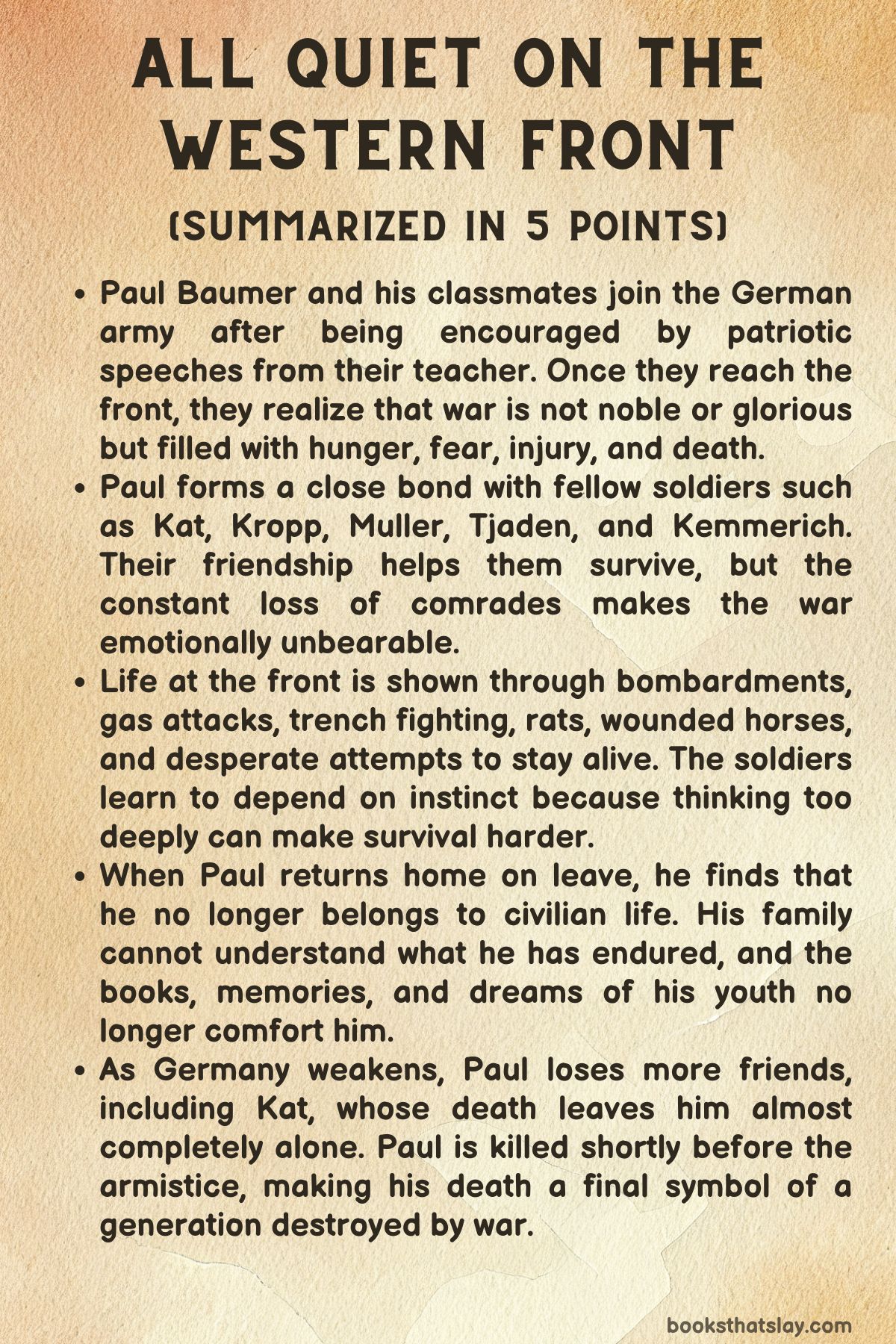
Characters
Paul Baumer
Paul Baumer is the central consciousness of All Quiet on the Western Front, and his character represents a young generation forced to grow old before it has had the chance to live. Before the war, Paul is sensitive, thoughtful, and imaginative.
He writes poetry, loves books, and carries the ordinary hopes of a schoolboy who expects life to open before him. War destroys that earlier self.
As a soldier, he becomes alert, practical, hardened, and emotionally guarded, yet he never loses his ability to think deeply about what is happening to him and his comrades. His narration shows the split inside him: one part of him has adapted to violence in order to survive, while another part still recognizes beauty, pity, fear, and moral pain.
This is especially clear when he returns home and finds that civilian life no longer feels real to him. He cannot explain himself to his family, cannot reconnect with his old books, and cannot belong to the world he once knew.
Paul’s greatest tragedy is that he is not naturally cruel. He becomes a killer because the war demands it, not because he desires violence.
His encounter with the French soldier in the shell hole exposes the deepest wound in his conscience. When he kills the man at close range, the enemy stops being an abstract target and becomes a person with a name, a family, and a life.
Paul’s guilt shows that his humanity has survived, but it also shows why survival itself becomes painful. By the end, Paul has lost nearly everyone who gave his life meaning at the front.
His death shortly before the armistice captures the bitter waste at the center of the novel: a young man who might have become a writer, thinker, or loving son is reduced to a brief military report.
Stanislaus Katczinsky
Stanislaus Katczinsky, usually called Kat, is one of the most important figures in Paul’s life. He is older than many of the soldiers, experienced, resourceful, and gifted with a kind of practical intelligence that makes him essential to the group.
Kat knows how to find food, read danger, repair situations, and make life bearable in small ways. He is not educated in a formal sense, but he understands survival better than anyone around him.
His abilities make him almost a father figure to the younger men, especially Paul, who relies on him not only for food and guidance but also for emotional stability.
Kat’s friendship with Paul is one of the deepest relationships in the novel. Their bond is not sentimental or heavily spoken; it is built through shared danger, quiet loyalty, and mutual dependence.
The scene in which they steal and cook the goose shows the warmth between them. In the middle of a brutal war, their shared meal becomes a rare moment of peace and companionship.
Kat represents the kind of wisdom that war creates among ordinary soldiers: not philosophical speeches, but the ability to keep others alive for one more day. His death devastates Paul because Kat is more than a comrade.
He is Paul’s closest source of comfort in a world that has become almost empty. When Paul carries him to safety and then learns that he has died from a small wound to the head, the randomness of war becomes unbearable.
Kat’s death leaves Paul emotionally isolated and signals the final collapse of his remaining attachments.
Albert Kropp
Albert Kropp is one of Paul’s closest school friends and one of the more intelligent and questioning members of the group. He often thinks critically about the war and the systems that created it.
Unlike those who accept patriotic slogans without thought, Kropp sees the absurdity of ordinary men being forced to kill one another because leaders, teachers, and officials have defined them as enemies. His conversations with Paul and the others show a mind that is sharp, skeptical, and unwilling to accept easy explanations.
Kropp’s importance lies in the way he represents the intellectual disappointment of the young soldiers. He entered the war with the same general pressures as his classmates, but experience has stripped away any belief in glory.
He understands that the men at the front have little control over their own lives. His later injury and amputation are especially tragic because they turn the cost of war into a permanent physical condition.
When he loses his leg, his despair becomes intense, and he briefly loses the will to live. Through Kropp, the novel shows that survival does not mean restoration.
A soldier may leave the battlefield alive, yet still carry a future broken by the war. His body becomes a record of violence, and his despair reflects the fear that life after war may be only another form of suffering.
Muller
Muller is practical, direct, and often emotionally blunt. He is best remembered for his interest in Kemmerich’s boots, which might appear heartless at first but is actually a sign of how war changes moral priorities.
Muller does not want the boots because he lacks feeling; he wants them because good boots can help a soldier survive. In the world of the front, useful possessions pass quickly from the dead to the living.
This habit reveals the brutal economy of war, where grief must often give way to necessity.
Muller also represents the soldier who still thinks in terms of ordinary ambition, though that ambition has been narrowed by war. He once had academic goals and practical plans, but the front has reduced his focus to immediate needs.
His attitude toward Kemmerich’s boots is not villainous. It shows how constant exposure to death forces the men to accept realities that would seem cruel in civilian life.
When Muller later dies and Paul inherits the same boots, the object becomes a symbol of repeated loss. The boots outlast their owners, moving from one dead or doomed soldier to another.
Muller’s character helps show how war reduces human life to replaceable bodies while material things continue to circulate.
Tjaden
Tjaden is sharp-tongued, rebellious, and full of resentment toward military authority, especially toward Himmelstoss. His personality adds humor and energy to the group, but his anger also reveals the deep humiliation the soldiers have suffered under men who misuse power.
Tjaden does not hide his contempt for those who treat soldiers cruelly while remaining distant from real danger. His hatred of Himmelstoss is intense because he has personally endured his bullying during training.
Tjaden’s rebelliousness is important because it shows that obedience in war does not erase resentment. The army demands discipline, but the men know the difference between necessary order and pointless cruelty.
Tjaden’s confrontation with Himmelstoss and his punishment show how military hierarchy protects authority even when that authority is morally undeserving. Yet Tjaden is not simply a comic or angry figure.
He is part of the brotherhood that sustains Paul and the others. His appetite, jokes, defiance, and emotional honesty make him one of the more vivid soldiers in the company.
Through him, the novel exposes the bitterness of men who are asked to risk their lives while being treated as disposable by their superiors.
Franz Kemmerich
Franz Kemmerich is one of the earliest and most painful examples of youth destroyed by war. He is Paul’s boyhood friend, and his death marks the transition from schoolboy innocence to the harsh truth of the front.
Kemmerich’s condition after his injury is pitiful. His foot has been amputated, he is dying, and yet he cannot fully grasp the truth of his situation.
Paul tries to comfort him, but both the reader and Paul understand that hope is nearly gone.
Kemmerich’s death is important because it reveals the emotional rules of war. In an ordinary world, a dying young man would be surrounded by grief, attention, and ceremony.
Here, his bed is needed for another wounded soldier, his belongings are quickly claimed, and his death becomes one more event in an endless chain. The desire for his boots shows how war forces the living to benefit from the dead.
Kemmerich is not developed through long action, but his role is central because his suffering destroys any remaining romantic idea of combat. His mother’s later grief also shows the gap between the home front and the battlefield.
She wants meaning, comfort, and truth, while Paul can only give her a merciful lie.
Kantorek
Kantorek is Paul’s former teacher and one of the clearest representatives of empty patriotic authority. He encourages his students to join the army by presenting war as noble, honorable, and necessary.
To young boys who respect him, his words carry great influence. Yet he does not understand the reality he is urging them toward.
He speaks from the safety of the classroom, where sacrifice is an idea rather than a torn body in a trench.
Kantorek is not physically present for much of the action, but his influence hangs over the entire story. He represents the older generation that sends the young to war using language of duty and glory.
His failure is moral because he confuses rhetoric with truth. Paul and his classmates trusted him, but their experience proves that he was dangerously ignorant.
Through Kantorek, All Quiet on the Western Front criticizes the social forces that turn boys into soldiers before they understand what they are surrendering. He is not a battlefield enemy, but in some ways his influence is more damaging because he helps lead the young men into the machinery of war.
Corporal Himmelstoss
Corporal Himmelstoss is a petty, harsh, and abusive training officer who uses his authority to humiliate recruits. Before the war, he had a lower-status civilian job, and military rank gives him power he clearly enjoys.
He forces the young men through exhausting drills and punishments, breaking down their independence and teaching them obedience through fear. Paul and his friends hate him because his cruelty feels personal and unnecessary.
Yet Himmelstoss is not a simple figure. Paul later admits that the brutal training helped prepare the men for the front.
This does not excuse Himmelstoss, but it complicates his role. His cruelty becomes part of the larger cruelty of the military system.
When Himmelstoss finally experiences the front himself, his confidence weakens. He is exposed as far less brave than he appeared when he was safely commanding recruits.
His later attempt to improve his treatment of the men shows that direct exposure to war can alter even those who once abused power. Himmelstoss represents the danger of authority without wisdom, and his character shows how military systems can reward the wrong qualities in men.
Paul’s Mother
Paul’s mother represents love, suffering, and the helplessness of those waiting at home. She is ill, probably with cancer, when Paul visits her on leave, and her physical weakness mirrors the emotional pain of families affected by war.
She loves Paul deeply, but she cannot fully reach him. Their conversations are short and restrained, filled with what neither of them can say.
Paul does not want to burden her with the truth of the front, and she cannot protect him from returning to it.
Her character is important because she connects Paul to the life he has lost. In her presence, he becomes a son again, but only briefly and painfully.
The home that should comfort him instead reveals how changed he has become. His mother’s illness also highlights class hardship.
Medical treatment costs money, and Paul’s family must worry about expenses even while facing possible death. Through her, the novel shows that war’s suffering is not limited to soldiers.
It enters homes, sickrooms, and family silences. Her love is real, but it cannot save Paul from the war or restore the boy he used to be.
Paul’s Father
Paul’s father represents the civilian world’s curiosity and distance from the actual experience of war. He wants to hear about Paul’s life at the front, but his questions show that he does not understand what such memories cost.
Like many civilians, he treats war as something that can be discussed, described, and made understandable. For Paul, however, the truth is too painful and too far removed from ordinary language.
He is not portrayed as cruel. Rather, he is limited by his position outside the battlefield.
He also reveals the economic strain faced by Paul’s family, especially in relation to Paul’s mother’s illness. His worries about the cost of medical care show how working-class families suffer both from war and from poverty.
Paul’s father helps expose the gap between soldiers and civilians. Even within the same family, war creates a separation that love alone cannot cross.
Paul’s Sister
Paul’s sister has a smaller role, but she helps show the emotional shock of Paul’s return home. She is the first to notice him when he arrives, and Paul’s inability to speak in that moment reveals how deeply the war has damaged him.
Her presence reminds him of ordinary family life, but instead of comfort, it brings a sudden release of grief.
She also serves as part of the domestic world that Paul can no longer fully enter. Like his mother and father, she belongs to a life that has continued while Paul has been transformed by violence.
Her role is quiet, but it strengthens the contrast between home and front. Through her, Paul’s return becomes not a reunion of ease but a painful reminder that the person who left home no longer exists in the same way.
Detering
Detering is a farmer at heart, and his connection to the land is central to his character. He is not driven by ideology or ambition.
His deepest longing is to return to his farm, his animals, and the natural rhythms of rural life. This makes the war especially painful for him because it removes him from the world that gives his life meaning.
He is most human when he reacts emotionally to reminders of home and farming.
His breakdown and desertion show how war destroys men psychologically as well as physically. Detering does not desert because he is morally weak.
He deserts because his longing for home becomes stronger than his ability to endure the front. His disappearance afterward suggests the brutal punishment awaiting those who cannot continue.
Detering represents the ordinary man pulled away from a simple, meaningful life and crushed by a conflict that has nothing to do with his personal hopes.
Berger
Berger is a soldier whose actions show both courage and the irrational pressure created by war. During intense fighting, he helps provide cover so Paul and others can escape danger.
This makes him brave and useful to his comrades. Yet he later risks himself for a wounded messenger dog, either to save it or end its suffering.
In that moment, compassion and instinct overcome caution.
Berger’s decision is tragic because it shows how war distorts judgment. The suffering of the dog becomes unbearable to him, just as the wounded horses earlier disturb the soldiers deeply.
Animals in the novel often reveal the innocence destroyed by human violence. Berger’s attempt to respond to that suffering leads to his own injury, and even the man sent to retrieve him is wounded.
His character shows that mercy can become dangerous in a world where any movement may bring death.
The French Soldier
The French soldier whom Paul kills in the shell hole is one of the most important minor characters because he changes Paul’s understanding of killing. At first, he is simply a threat.
Paul reacts in panic and stabs him because survival has trained him to act before thinking. But when the man does not die immediately, Paul is forced to remain with him, hear him suffer, and face what he has done.
Once Paul sees the man as an individual, the idea of the enemy collapses. The soldier has a name, a family, and a life beyond the battlefield.
He is not a symbol of France or a faceless opponent. He is another human being trapped in the same war.
Paul’s guilt after killing him reveals the moral injury caused by combat. The French soldier’s role is brief, but his death becomes one of the clearest moments in which the novel shows that war depends on making men forget the humanity of those they are ordered to kill.
The Russian Prisoners
The Russian prisoners are not developed as individual characters, but they are important as a collective presence. Paul observes their hunger, weakness, and misery near the training camp.
They are supposed to be enemies, yet he sees them as poor, suffering men much like himself and his comrades. Their condition awakens his pity and forces him to question the logic of hatred.
These prisoners reveal the artificial nature of enemy identity. Paul understands that if circumstances were different, he might have had no reason to hate them.
They are peasants, soldiers, and victims of political decisions made far above them. His act of giving them food shows that his compassion has not been completely destroyed.
At the same time, he recognizes that too much sympathy can weaken the emotional defenses needed for survival. The Russian prisoners therefore represent both shared humanity and the tragic way war trains men to deny it.
The Kaiser
The Kaiser appears less as a fully developed person and more as a symbol of distant power. His inspection of the troops highlights the gap between rulers and soldiers.
The men prepare for his visit, but his presence does not change their suffering, improve their conditions, or explain the purpose of the war. To the soldiers, such authority feels remote and almost unreal.
The conversations surrounding the Kaiser lead the men to question who is responsible for war. They wonder why ordinary people must fight when leaders and officials are the ones who make decisions.
The Kaiser’s symbolic role is important because he stands for a political order that demands sacrifice from men who have little say in national conflict. He is powerful, but he is not the one living in trenches, starving, or dying under shells.
Themes
The Destruction of Youth
The young soldiers enter the war at an age when they should be preparing for adulthood, love, work, education, and personal growth. Instead, they are trained to obey, endure, kill, and survive.
Paul’s memories of writing poetry and collecting books show that he once had an inner life shaped by imagination and possibility. The war does not simply interrupt that life; it makes it feel unreachable.
When Paul returns home, the books that once meant so much to him no longer speak to him. This loss is not only personal but generational.
He and his classmates have been removed from normal development before they have had time to form stable adult identities. Older soldiers may have memories of careers, marriages, or homes, but Paul’s generation has little behind it except school and military training.
That is why survival offers no simple hope. Even those who live may not know how to return to ordinary existence.
Their youth has not matured naturally; it has been consumed by fear, discipline, hunger, and death. The tragedy is that the war takes not only lives but also futures, talents, and the ability to believe in life beyond violence.
The False Glory of War
Patriotic language in the novel is shown as dangerously removed from reality. Teachers, officials, and public voices present war as honorable and heroic, but the soldiers experience it as filth, terror, boredom, mutilation, and loss.
Kantorek’s speeches encourage boys to enlist, yet he has no real understanding of what he is asking them to face. His version of war depends on grand words, while Paul’s version is made of lice, rats, shell holes, amputations, and dying friends.
This contrast exposes the dishonesty of romantic war ideals. The men do not become noble heroes in the way civilians imagine.
They become exhausted survivors whose main concerns are food, boots, shelter, and staying alive. Even bravery is complicated.
Soldiers may act courageously, but often because there is no choice, or because instinct takes over before thought can interfere. All Quiet on the Western Front rejects the idea that war gives young men purpose.
Instead, it shows how public ideals can be used to send ordinary people into suffering that the speakers themselves will never experience. The novel’s anger is directed not only at battle but at the social language that makes battle seem meaningful from a safe distance.
Comradeship as Survival
Friendship among the soldiers is not presented as a pleasant addition to life at the front; it is one of the few things that makes survival possible. Paul and his comrades depend on one another for food, warning, comfort, and emotional endurance.
Their relationships are shaped by shared danger, which creates a bond stronger than ordinary social connection. Kat’s role in Paul’s life shows this most clearly.
He finds food, understands danger, and offers a form of guidance that helps Paul continue. Their bond is quiet but profound because it is proven through action rather than speeches.
The stolen goose, the shared meals, and the care soldiers show one another during bombardments reveal a human closeness that exists in direct opposition to the violence around them. Yet this comradeship is also painful because every friendship becomes another possible loss.
Kemmerich’s death wounds Paul early, and Kat’s death nearly empties him. The same bonds that help the men survive also deepen their suffering when comrades die.
In this sense, brotherhood at the front is both protection and vulnerability. It gives the soldiers meaning in a world stripped of meaning, but it also ensures that grief will be constant.
The Shared Humanity of the Enemy
The novel repeatedly challenges the idea that enemy soldiers are fundamentally different from Paul and his comrades. Officially, the French, Russians, and other opposing forces are threats to be killed or feared.
Personally, Paul sees signs that they are ordinary men trapped in the same machinery of war. The Russian prisoners are hungry, poor, and helpless, and Paul recognizes that they resemble German peasants more than they resemble the monstrous enemy imagined by propaganda.
His pity for them reveals that national hatred has to be taught and maintained; it does not arise naturally when one suffering person looks closely at another. The most powerful example comes when Paul kills the French soldier in the shell hole.
At a distance, killing can feel like a military act. Up close, it becomes personal and unbearable.
When Paul sees the man’s face, hears his suffering, and learns details of his life, the category of enemy breaks down. He understands that the man had loved ones and hopes just as he did.
This recognition does not stop the war, but it exposes its moral horror. Soldiers are made to kill men who, under different conditions, might have been friends, neighbors, or simply strangers passing without hatred.