All Over but the Shoutin Summary and Analysis
All Over but the Shoutin is Rick Bragg’s memoir about poverty, family, survival, and the long debt a son feels toward his mother. Set mainly in rural Alabama, the book looks back on Bragg’s childhood under the shadow of an alcoholic, violent father and a mother who endured hardship so her sons could have a chance at a better life.
It is also the story of Bragg’s rise from a poor Southern boy to a Pulitzer Prize-winning journalist. Above all, All Over but the Shoutin is a tribute to a woman whose love, work, and sacrifice shaped everything her son became. It’s the first book of the Family Trilogy by the author.
Summary
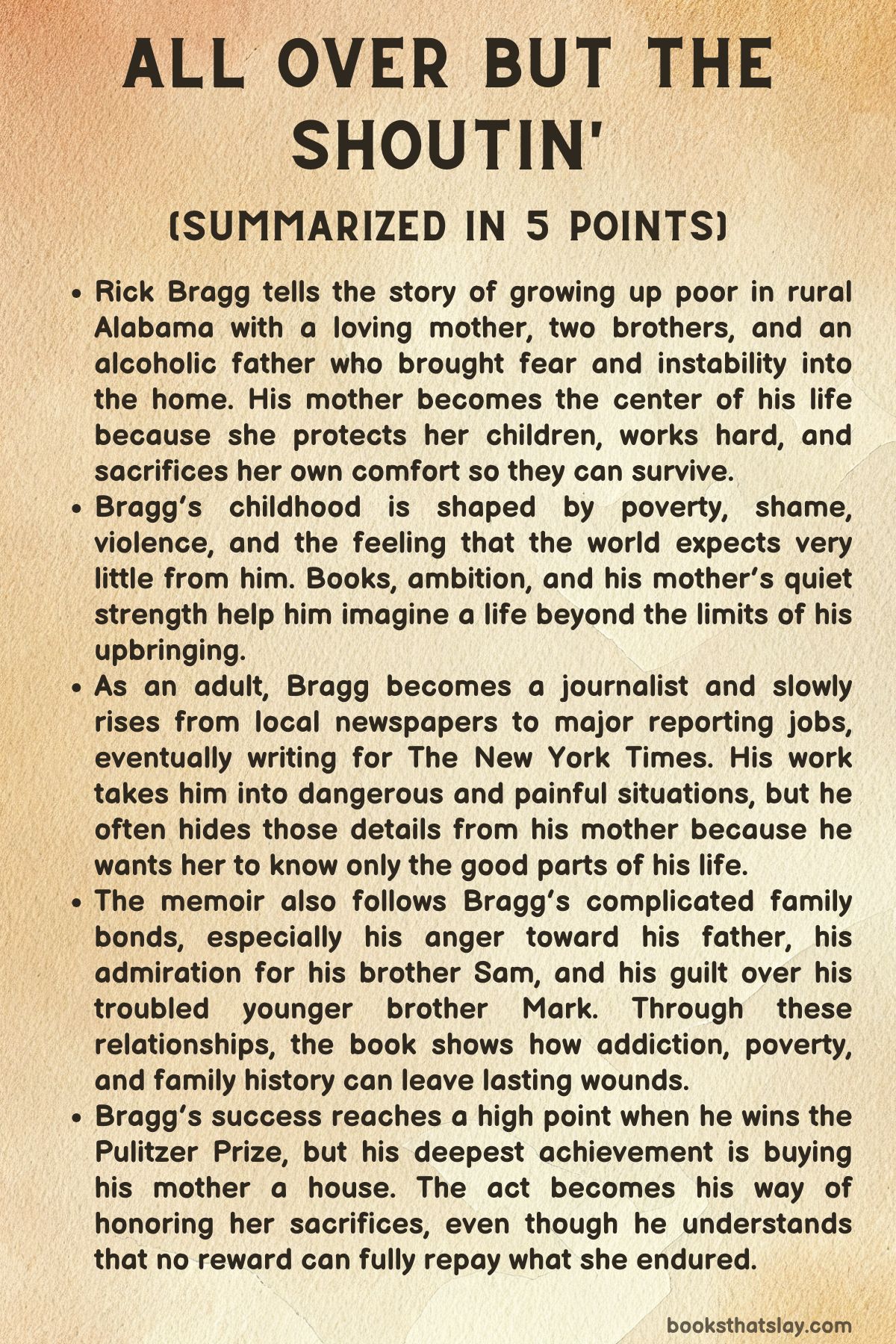
The book begins with Rick Bragg explaining why he chose to tell his family’s story. He does not present it as a grand or historically important account.
Instead, he frames it as the story of a poor family from northeastern Alabama: a strong mother, a damaged father, and three sons raised in a world of cotton fields, hunger, shame, violence, and pride. Bragg writes with the knowledge that his life was made possible by his mother’s sacrifices.
She stood between her sons and their father’s drunken rages, worked when work was cruel and poorly paid, and gave up almost everything so her children might have more than she did.
The memoir roots itself in the Appalachian foothills along the Alabama-Georgia line, a place Bragg describes as beautiful but harsh. His parents came from that world, where people had little money but strong codes of family, toughness, and reputation.
His father, Charles Bragg, was a man broken by alcohol and perhaps by war. Near the end of his life, Charles gave Rick a strange inheritance: fine-looking books and a rifle.
The gift briefly suggests the ordinary bond between father and son, but it also carries the weight of all that was missing between them. Charles had never been the steady father Rick needed.
Bragg looks back at Charles’s time in the Korean War as one possible source of his ruin. His father had known terrible cold, fear, and death.
One memory stands out: Charles chased an enemy soldier onto a frozen lake and held him under the water until he drowned. Bragg never uses this story to excuse his father’s cruelty, but he does suggest that war may have left wounds Charles could not name.
Those wounds later came out as drinking, absence, and violence at home.
Against Charles stands Bragg’s mother, Margaret, the moral center of the book. She comes from a family marked by toughness and survival.
Her father was known for wit, generosity, fighting skill, and illegal whiskey. Margaret married Charles with hope that he would become a good husband and father.
Again and again, she believed he might straighten out, find work, and care for his family. Again and again, he failed her.
He disappeared for long stretches, returned with promises, drank heavily, and frightened the household. Rick’s early memories are shaped by that cycle of hope and collapse.
The family’s poverty is constant. They live in poor houses, depend on relatives, and survive on whatever work Margaret can find.
She picks cotton by hand until machines take that work away. She raises her boys with almost no help from Charles.
A baby dies in childbirth and is barely given a place in the world. Religion offers Margaret some comfort.
She watches television preachers and believes in redemption, while young Rick tries to find faith but cannot fully reach it.
As Rick grows older, he becomes aware not only of poverty but of the shame attached to it. He reads books, chases small freedoms, plays basketball, dates girls, and wants to be seen as more than poor white trash from a broken home.
Yet reminders of his status keep arriving. A girlfriend sees the way he and his mother live and decides they are too different.
Police investigating a nearby murder treat poor people, Black people, disabled people, and those with criminal records as natural suspects. Rick learns that poverty is not only a lack of money; it is also a mark others use to judge your worth.
Charles dies young from the effects of alcoholism. Rick feels no grief and does not attend the funeral.
His father’s death does not erase the damage he caused, but it leaves Rick with questions he will carry for years. He hates Charles for hurting his mother and abandoning his sons, yet he also wonders whether the man was destroyed by forces he never understood.
Rick’s escape comes through journalism. He begins by writing about football, a subject that matters deeply in Alabama and offers people a break from hard lives.
He gradually moves into more serious reporting. His career takes him from local papers to the Birmingham News, then to the St. Petersburg Times, Harvard as a Nieman Fellow, and finally The New York Times.
Each step brings success, but it also deepens his guilt. He has left home, while his mother remains tied to the place and the pain he escaped.
His work exposes him to violence and suffering far beyond Alabama. In Miami, he covers riots and nearly gets killed when rocks smash into the car he is riding in.
In Haiti, he reports on political violence, poverty, and murder after the fall of Jean-Bertrand Aristide. He sees cruelty so extreme that professional distance becomes impossible.
In New York, he writes about small-store owners killed in robberies and learns that the city can throw endless stories at a reporter willing to catch them. He also returns South for major assignments, including a tornado that destroys a church in Alabama, the Susan Smith case in South Carolina, and the Oklahoma City bombing.
Through all of this, Bragg lies to his mother by omission. He tells her the proud parts: the jobs, the bylines, the honors.
He hides the danger, the fear, and the emotional cost of the work. He wants her to have peace.
He wants her to believe that the son she raised is safe and successful. His career becomes not only a personal achievement but a way of proving that her suffering was not wasted.
The memoir also follows Rick’s brothers. Sam, the older brother, becomes the kind of good man Bragg respects: hardworking, dependable, and protective.
In childhood, Sam often rescued Rick, fought for him, fixed his cars, and served as the fatherly presence their own father never was. Mark, the younger brother, inherits the family curse of alcohol.
His drinking leads to trouble and prison, and Margaret suffers through his decline. Rick admits his own failure toward Mark.
At a time when he was trying to rise in the world, he felt ashamed of having a brother in prison and stayed away. That confession shows how ambition can carry its own forms of betrayal.
Rick’s professional validation comes when he wins the Pulitzer Prize. The award matters because it tells him he has truly succeeded, but its deepest value is in what it means to his mother.
Her pride gives him the recognition he most wanted. Still, the prize is not enough to repay her.
The real repayment comes when he buys her a house on 1.3 acres, the first valuable thing she has ever owned. For Rick, the house is more than property.
It is shelter, dignity, and a promise kept. It gives his mother something solid after a life of rented rooms, hard labor, and disappointment.
Yet the new house does not magically heal the family. Old patterns remain.
His brothers fight in the yard, and Margaret leaves for a week, hurt by the violence returning even there. Rick understands that success cannot completely free them from who they are or where they came from.
The scars of poverty, drinking, pride, and family history remain.
The book ends with a memory from Rick’s childhood. As a boy, he would sleepwalk, and his mother would always find him and guide him back to safety.
That image gathers the meaning of the memoir. Margaret Bragg spent her life finding her children in danger, confusion, and darkness, then bringing them back as best she could.
All Over but the Shoutin is Rick Bragg’s act of gratitude: a son’s attempt to honor the mother who carried him until he could stand on his own.
Key People
Rick Bragg
Rick Bragg is both the narrator and the central figure of the memoir. His character is shaped by contradiction: he is proud of where he comes from, yet deeply wounded by the shame that poverty placed on him as a child.
He grows up in rural Alabama surrounded by hardship, violence, social judgment, and family instability, but he also grows up with a strong sense of language, memory, humor, and loyalty. As a boy, he is watchful and sensitive, noticing not only what happens in his family but also what those events mean.
His father’s absence and cruelty leave him angry, while his mother’s suffering leaves him with a lifelong feeling of debt. That emotional debt becomes one of the main forces behind his ambition.
As Rick becomes a journalist, he carries his childhood with him. His success does not make him detached from poor people or suffering people; instead, it gives him a sharper eye for them.
He understands shame, hunger, fear, and family damage because he has lived with them. This makes him a powerful reporter, but it also makes his work emotionally costly.
He is not a cold observer. He often feels the pain of the people he writes about, especially when he reports on death, violence, and injustice.
His rise to professional success is therefore not only a career story but also a personal escape from the limits others expected for him.
Rick is also honest about his flaws. He admits that he sometimes avoided his family’s problems once he began succeeding.
His guilt over Mark, his complicated hatred for his father, and his desire to protect his mother from painful truths all reveal a man still wrestling with his past. In All Over but the Shoutin, Rick’s character is not presented as a simple success story.
He is a son trying to repay love, a writer trying to turn memory into meaning, and a man who knows that escaping poverty does not mean escaping its emotional marks.
Margaret Bragg
Margaret Bragg is the emotional and moral center of the memoir. She is Rick’s mother, and her life is defined by sacrifice, endurance, and fierce love for her children.
She suffers through poverty, abandonment, hard labor, and an abusive marriage, yet she keeps protecting her sons even when she has almost nothing to give them materially. Her strength is not loud or dramatic.
It appears in the daily acts of survival: working in cotton fields, going without so her children can have more, standing between them and their father’s violence, and continuing to hope even after life repeatedly disappoints her.
Margaret’s character represents a kind of love that is practical rather than sentimental. She does not save her sons through speeches or grand gestures.
She saves them through labor, patience, and self-denial. She absorbs pain that should never have been hers to carry, and she does so because she believes her children deserve a chance.
Her life also shows the cruel limitations placed on poor women in her world. She has little money, little security, and few choices, but she still becomes the person who holds the family together.
Her relationship with Rick is especially important because it gives the memoir its deepest emotional purpose. Rick’s success means little to him unless it brings honor or comfort to her.
Buying her a house becomes his way of giving her dignity after a life spent making do with less. Yet Margaret is not portrayed as perfect or simple.
She worries, suffers, withdraws when hurt, and carries emotional exhaustion from years of hardship. Her greatness lies in her humanity.
She is tired, poor, and often sad, but she never stops being a mother.
Charles Bragg
Charles Bragg, Rick’s father, is one of the most troubling figures in the memoir. He is violent, unreliable, alcoholic, and largely absent from his sons’ lives.
As a husband, he fails Margaret repeatedly. As a father, he gives his children fear and confusion more often than protection.
His drunken rages turn the home into a place of danger, and his disappearances leave the family without stability. Rick’s anger toward him is understandable because Charles causes wounds that last long after his death.
At the same time, the memoir does not reduce Charles to a monster. Rick tries to understand him, especially through the memory of his service in the Korean War.
The war exposes Charles to cold, killing, fear, and trauma, and Rick suggests that these experiences may have damaged him deeply. This does not excuse his behavior, but it complicates the reader’s view of him.
Charles becomes a man who has suffered and then makes others suffer. He is both victim and source of harm.
His final gift to Rick, a set of beautiful books and a rifle, captures this complexity. The books hint at beauty, aspiration, and something tender that Charles cannot properly express.
The rifle belongs to the masculine culture of the region, where fathers and sons often bond through guns, hunting, and toughness. For a brief moment, Charles almost becomes an ordinary father giving something meaningful to his son.
But that moment cannot repair years of neglect. In All Over but the Shoutin, Charles remains a shadow over the family, representing the damage caused by addiction, war, failed manhood, and emotional absence.
Sam Bragg
Sam Bragg, Rick’s older brother, represents steadiness, responsibility, and protective masculinity. In a family where the father is often missing or dangerous, Sam becomes a substitute source of safety for Rick.
He rescues him in childhood fights, helps him when cars break down, and offers the kind of practical loyalty that matters deeply in their world. Sam’s goodness is not abstract.
It is shown through work, dependability, and physical presence. He is there when people need him.
Sam’s character also reflects the values Rick respects most in working-class Southern men. A good man, in Rick’s view, is not necessarily polished or wealthy.
He is someone who works hard, provides for his family, keeps his word, and stands by his people. Sam grows into that kind of man.
He does not escape the family’s world in the same way Rick does, but he survives it with dignity. His strength is rooted in ordinary duty.
At the same time, Sam is still part of a family marked by anger and violence. His fight with Mark near their mother’s new house shows that even the more responsible brother cannot fully step outside the patterns they inherited.
Sam’s protectiveness can turn physical, and his sense of family honor is tied to confrontation. This makes him realistic rather than idealized.
He is good, but he is still shaped by the same hard world that shaped Rick and Mark.
Mark Bragg
Mark Bragg, Rick’s younger brother, is the clearest example of how family damage can repeat itself. He inherits, or at least falls into, the alcoholism that destroyed their father.
His drinking leads him into trouble, instability, and prison, causing deep worry for Margaret and deep guilt for Rick. Mark’s character is painful because he shows what Rick might have become under different circumstances.
While Rick escapes through journalism and Sam builds a stable life through work, Mark remains caught in the family’s most destructive pattern.
Mark is not presented only as a problem. He is also a brother, a son, and a wounded person.
His struggles expose the limits of love within a damaged family. Margaret loves him fiercely and suffers over him, but she cannot save him from addiction.
Rick cares about him, but he admits that he often kept his distance because Mark’s life embarrassed him during the years when Rick was trying to become successful. This confession makes Mark’s role especially important.
Through him, the memoir examines not only addiction but also shame, avoidance, and the moral cost of social ambition.
Mark’s character also reveals the uneven nature of survival. The same childhood produces three brothers with different paths.
One becomes a prize-winning journalist, one becomes a hardworking family man, and one becomes trapped by drinking and legal trouble. Mark’s life reminds the reader that escape is never guaranteed.
Talent, luck, temperament, and opportunity all matter, and some people are left carrying the heaviest parts of the family burden.
Charlie Bundrum
Charlie Bundrum, Margaret’s father, is a vivid figure from the older Southern world that shaped the family. He is remembered for his humor, generosity, toughness, and reputation as a dangerous fighter.
He also makes illegal liquor, placing him within a local culture where survival often depends on bending or breaking the law. Charlie is not respectable in a conventional middle-class sense, but he has a strong presence, and people recognize his power.
His character helps explain Margaret’s background. She comes from a family where toughness is necessary and weakness can be dangerous.
Charlie’s wit and generosity make him appealing, but his violence and illegal work also show the roughness of that world. He represents a kind of local authority built outside formal institutions.
In poor rural communities, men like him can become important because they have nerve, skill, and the ability to command respect.
Charlie also adds depth to the memoir’s treatment of class. Poverty does not mean a lack of character, personality, or pride.
People in Margaret’s family may lack money, but they have stories, reputations, codes, and forms of power. Charlie Bundrum stands as one of those larger-than-life figures who help make Rick’s family history feel rich even when the material conditions are harsh.
Bobby Bragg
Bobby Bragg, Rick’s paternal grandfather, belongs to the strange and memorable world of Charles Bragg’s family. He is described as eccentric, still using a horse and wagon long after such habits have disappeared from ordinary life.
His character gives the memoir a sense of old rural customs surviving into modern times. He seems partly removed from the changing world, attached to ways of living that others have left behind.
Bobby’s role is not as emotionally central as Margaret’s or Charles’s, but he helps build the atmosphere of Rick’s childhood. Through him, the reader sees the older generation’s habits, poverty, and odd dignity.
He is connected to the family line that produces Charles, and his presence helps explain the kind of world Charles came from. That world is rural, poor, proud, and sometimes closed off from modern comforts.
Bobby also contrasts with the chaos of Charles’s behavior. While Charles is destructive and unpredictable, Bobby appears more as a figure of local color and family memory.
He adds texture to the Bragg family history, reminding the reader that Rick’s identity comes from several branches of complicated people, not only from the pain caused by his father.
Velma Bragg
Velma Bragg, Rick’s paternal grandmother, is a quiet but revealing figure. She is remembered as sweet-natured and sad-eyed, a woman who hovers around men while they drink.
Her character suggests another version of female endurance in the memoir. Like Margaret, she lives in a world shaped by male behavior, alcohol, poverty, and silence.
Unlike Margaret, she is not developed as a central heroic figure, but her brief presence carries emotional weight.
Velma’s sadness reflects the cost of living around men who drink and dominate the household. She seems gentle, but her gentleness exists in an environment where women often have little control.
Her part-Cherokee appearance and quiet manner also add to the memoir’s sense of regional identity, where family histories include mixed ancestry, hardship, and memory passed through description rather than formal record.
Her importance lies in what she reveals about the pattern surrounding Charles. He did not emerge from nowhere.
He came from a family and culture where drinking, male authority, and female patience were familiar. Velma’s presence helps the reader see how Margaret’s suffering may be part of a larger generational pattern, not an isolated tragedy.
Bill Kovach
Bill Kovach is an important mentor in Rick Bragg’s professional life. He appears during Rick’s application to the Nieman Fellowship at Harvard and becomes a guiding figure who recognizes Rick’s talent.
As a former newspaper editor and reporter from Tennessee, Kovach understands something of Rick’s Southern background and does not dismiss him as out of place. This recognition matters deeply because Rick enters elite spaces carrying the insecurity of poverty and regional difference.
Kovach helps Rick believe that he belongs in serious journalism. He does not erase Rick’s background or ask him to become someone else.
Instead, he helps him refine the voice and skill that already exist. His mentorship shows how one person’s faith can change the direction of another person’s life.
Rick has talent and drive, but Kovach offers access, encouragement, and professional wisdom.
Kovach’s role also highlights the contrast between institutions and individuals. Harvard could have been a place where Rick felt like an outsider, but Kovach makes it a place of growth.
Through him, Rick learns that his questions, his ignorance of elite manners, and his Southern voice are not weaknesses if he uses them honestly. Kovach becomes one of the people who help Rick turn raw experience into disciplined craft.
Susan Smith
Susan Smith appears not as a family member but as the subject of one of Rick’s major reporting assignments. Her crime, the drowning of her two children after falsely claiming they had been abducted, confronts Rick with a form of evil that is difficult to understand.
As a character in the memoir, she represents deception, public performance, and the horror that can hide behind ordinary appearances.
Rick first encounters the story as the rest of the country does: through the supposed search for missing children. The emotional force of the case changes when the truth comes out.
Smith’s lie also exposes how quickly public fear can attach itself to race, since her false story blames a Black man. This makes her role larger than one criminal act.
She becomes part of a national story about motherhood, racism, media attention, and the public hunger for explanation.
For Rick, covering Susan Smith is professionally important but emotionally disturbing. Her presence in the memoir shows the kind of stories that build his career while also damaging his peace of mind.
She stands at the far edge of the suffering he reports on: not poverty endured, but innocence destroyed by someone entrusted with love.
Gangaram Mahes
Gangaram Mahes is one of the unusual people Rick writes about during his career. He is a mostly homeless man who eats in restaurants without money and then goes to jail for not paying.
His character is memorable because he does not fit the usual image of a criminal. His offense is small, almost absurd, but it reveals serious truths about poverty, hunger, law, and human dignity.
Rick is drawn to people like Mahes because they exist in the overlooked corners of society. Mahes’s story is not as publicly dramatic as riots, bombings, or murder cases, but it carries the kind of human oddity and sadness that Rick values as a reporter.
He sees in Mahes not simply a man breaking the law, but a person whose life exposes the strange cruelty of systems that punish the poor for trying to eat.
Mahes also reflects Rick’s gift for finding meaning in marginal lives. Rather than treating him as a joke, Rick recognizes him as a full human being with a story worth telling.
His inclusion shows that Rick’s journalism is not only about major events. It is also about the small, strange, painful stories that reveal how people survive when they have almost nothing.
Themes
Poverty, Shame, and Social Judgment
Poverty in All Over but the Shoutin is not treated as a simple lack of money. It is a condition that shapes how people see themselves and how others treat them.
Rick grows up in a world where poor families live in bad houses, wear the marks of need, and depend on work that can vanish without warning. His mother’s life shows the physical cost of poverty, especially through field labor, insecurity, and constant sacrifice.
But the memoir is just as concerned with the emotional cost. Rick learns early that poverty invites judgment.
A girlfriend’s rejection after seeing his home wounds him because it confirms what he fears others believe: that his background makes him lesser. The police questioning after a nearby murder shows the same reality in a harsher form.
Poor people are treated as suspicious because they are poor. Poverty becomes a public label, one that reduces a person’s dignity before anyone knows the truth about them.
Rick’s later ambition is partly a refusal to remain trapped under that label. Yet even after success, he carries the shame with him.
The memoir shows that poverty can be escaped materially while still remaining alive in memory, fear, anger, and pride.
Motherhood, Sacrifice, and Unpaid Debt
Margaret Bragg’s motherhood is built from labor, protection, and surrender. She does not have the power to give her sons an easy life, but she gives them everything available to her.
Her sacrifices are not romanticized as painless acts of love. They are exhausting, unfair, and often lonely.
She works in fields, endures abandonment, faces her husband’s violence, and repeatedly places her children’s needs ahead of her own comfort. Her love is shown through action rather than language.
She becomes the barrier between danger and her sons, especially when Charles is drunk and violent. This creates the emotional debt that drives Rick’s adult life.
He does not simply want to succeed for himself; he wants to prove that her suffering produced something worthwhile. His career achievements matter, but they are not enough.
Buying her a house becomes a symbolic repayment, a way of giving her stability after years of having none. Yet the memoir also recognizes that such a debt can never be fully paid.
A house, a prize, or public success cannot return her youth or erase what she endured. The theme is powerful because it treats motherhood not as softness alone, but as endurance under pressure.
Fathers, Violence, and Damaged Masculinity
Masculinity in the memoir is often connected to fighting, drinking, pride, guns, silence, and emotional damage. Charles Bragg represents the most destructive version of this pattern.
He is a father who should provide safety but instead brings fear. His alcoholism turns family life into a cycle of promises, disappearances, and violence.
Yet Rick’s portrait of him is complicated by the memory of war. Charles’s experience in Korea suggests that some men are damaged by violence and then return home without the language or support needed to survive it.
The result is not healing but further harm. The sons inherit different pieces of this masculine world.
Sam becomes protective and hardworking, showing a better version of manhood rooted in duty. Mark falls toward the same alcoholic destruction that consumed Charles.
Rick escapes through words, but he still carries anger, shame, and the family’s instinct for pride. The memoir does not suggest that violence belongs only to one bad man.
It shows violence as a cultural pattern passed through families, communities, and ideas of what men are allowed to feel. The tragedy is that tenderness exists, but it is often hidden behind rage, drinking, or silence.
Memory, Storytelling, and the Search for Meaning
Rick Bragg’s life becomes understandable through storytelling. Memory allows him to return to painful scenes and give them shape, but it does not make them neat or easy.
The memoir moves through family history, childhood, work, guilt, and success as Rick tries to understand how a poor boy from Alabama became a celebrated journalist without losing the people who made him. Storytelling becomes an act of rescue.
It preserves his mother’s sacrifices, his brothers’ struggles, his father’s damage, and the world of poor rural families often ignored by public history. As a journalist, Rick learns to tell the stories of strangers, especially those marked by violence, poverty, or loss.
As a memoirist, he turns that same attention toward his own family. This creates a strong link between his profession and his personal life.
He writes because stories can grant dignity to people who were unseen or misunderstood. At the same time, memory is not always comforting.
It forces him to face his failures, including his distance from Mark and his unresolved feelings about Charles. The search for meaning does not erase pain, but it allows Rick to honor the truth of where he came from.