All Creatures Great and Small Summary, Characters and Themes
All Creatures Great and Small is James Herriot’s warm, comic account of his early years as a country veterinarian in the Yorkshire Dales. The book follows young James as he begins work under the brilliant but unpredictable Siegfried Farnon, learns to survive demanding farmers, unruly animals, freezing nights, and embarrassing mistakes, and slowly grows into both his profession and his new rural home.
First published in the UK as two books, it appeared in the US as a single 1972 volume titled after an Anglican hymn. Its warm stories of a country vet’s everyday joys and hardships became an unexpected bestseller, reaching the New York Times list in 1973. In this guide, “Herriot” refers to the author and “James” to the character.
Summary
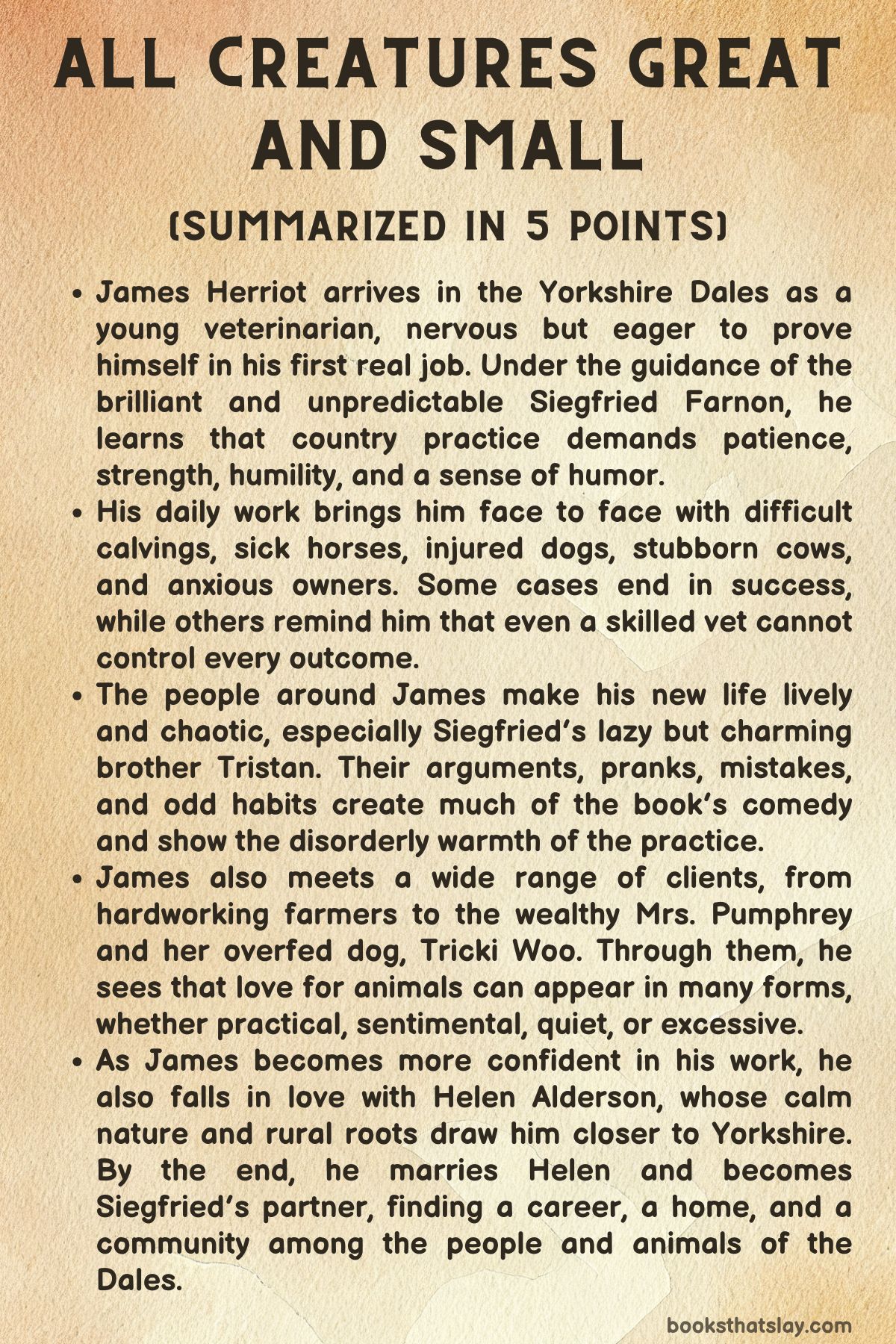
All Creatures Great and Small begins with James Herriot already in the thick of country veterinary work: exhausted, cold, and struggling through a difficult calving while a critical onlooker compares him unfavorably to a more experienced vet. He succeeds in delivering the calf alive, but the lack of appreciation teaches him an early lesson about the job.
A vet’s victories are often private, and praise is never guaranteed.
The story then moves back to James’s arrival in Darrowby, where he hopes to secure a position with Siegfried Farnon. Jobs are scarce for newly qualified vets, so James is anxious to make a good impression.
Siegfried forgets the interview, leaving James to wait and absorb the unfamiliar speech, habits, and humor of the Yorkshire people. When Siegfried finally appears, he takes James on visits and quietly tests his ability.
James endures rough handling from animals, awkward moments, and his own nerves, but he proves himself well enough to be hired.
From there, James is thrown into the unpredictable rhythm of rural practice. His first solo emergency involves a valuable horse with colic.
James decides the horse’s condition is hopeless and puts it down, despite pressure from the farm manager. When the postmortem proves him right, he gains confidence, but Siegfried warns him not to trust success too much.
In veterinary work, he explains, certainty is rare, and even good judgment can fail.
James’s professional life is shaped by Siegfried, a gifted vet whose generosity, brilliance, vanity, and contradictions make him both admirable and maddening. Siegfried gives James advice and then scolds him for following it.
He insists on discipline yet behaves impulsively himself. He demands care with the practice car, then drives it recklessly.
His younger brother Tristan adds another kind of chaos. Tristan is charming, lazy, fond of parties and women, and always looking for ways to avoid work.
His prank calls torment James until James finally gets revenge by tricking him into believing he must return to a miserable farm job involving a cow’s uterus.
The practice is full of comic disorder. Siegfried hires Miss Harbottle to impose order on the accounts, but her efficiency becomes a torment to him because he is the worst offender in keeping records.
Tristan loses the receipt book, causing paid clients to receive bills again. Attempts to keep hens and pigs at the practice collapse into farce: the hens refuse to lay while under Tristan’s care, then produce perfectly once removed, and the pigs escape into the marketplace.
Among the many clients, Mrs. Pumphrey stands out for her adoration of Tricki Woo, her spoiled Pekingese. She treats the dog like a refined gentleman with opinions and social obligations.
James becomes “Uncle Herriot” to Tricki and receives generous food hampers and gifts. When Tricki becomes dangerously overweight, James “hospitalizes” him at the surgery, where exercise with the other dogs restores his health.
The treatment works so well that James is tempted to keep him longer because Mrs. Pumphrey keeps sending rich supplies for Tricki’s supposed recovery.
Not all cases are comic. James often faces the emotional burden of treating beloved animals when little can be done.
He must put down an old man’s dog with cancer and feels unable to offer words equal to the man’s grief. Later, he comforts Miss Stubbs, an elderly woman whose animals are her greatest companions.
When she fears she may not meet them again after death, James assures her that wherever she is going, her animals will be there too. Moments like these show that his work is not only medical but also human.
James is repeatedly humbled by mistakes and surprises. He misdiagnoses a cow after mistaking the natural looseness of a recently calved animal’s pelvis for a fracture, only to watch the cow rise after an old country remedy is applied.
He learns that folk knowledge, though not always scientific, cannot be dismissed too easily. He also witnesses Siegfried successfully use old-fashioned bleeding on a pony with laminitis, leaving James puzzled because the method seems outdated yet appears to help.
The book also shows the physical demands and dangers of the profession. James is kicked, bitten, bruised, soaked, frozen, and humiliated.
He operates on large animals that could injure him badly, crawls through barns, wrestles with cows, faces angry dogs, and works through the night. Even the car becomes a source of risk, especially when its brakes fail and Siegfried forgets to repair them until he experiences the danger himself.
Yet James never seriously regrets his choice. Compared with an office job, the life of a country vet feels alive, varied, and meaningful.
A major turning point comes when James meets Helen Alderson at Heston Grange. She is practical, kind, and rooted in the Yorkshire countryside he has come to love.
James is immediately drawn to her, though his attempts at courtship are awkward. Their first grand date at an expensive hotel goes badly, leaving him embarrassed and discouraged.
A later outing also seems ruined by interruptions, villagers, and the wrong film, but Helen’s suggestion that they go walking “next time” reassures him that she still wants to see him.
James’s feelings for Helen grow alongside his acceptance into Darrowby life. He comes to understand the farmers better: their thrift, pride, humor, suspicion, tenderness, and stamina.
He sees poor families with deep affection and wealthy homes with emotional emptiness. He notices farmers who seem hard but show great love for retired animals.
He also meets clients who refuse veterinary help until it is too late, as well as others whose devotion saves animals against the odds, such as Terry, who spends all night treating a cow with mastitis until she recovers.
Siegfried, despite his many flaws, becomes a mentor and friend. He encourages James to marry Helen sooner than James had planned.
James proposes, and Helen accepts, but he still has to face her father. During a calving at the Alderson farm, James helps deliver the calf and then asks Mr. Alderson for permission to marry Helen.
Mr. Alderson is not overjoyed at the thought of a poor young vet as a son-in-law, but he invites James in for a drink and begins speaking about Helen’s mother. James understands this as his blessing.
The book ends with James and Helen married, though their honeymoon is far from luxurious. A wave of tuberculin testing work arrives just before the wedding, and James refuses to leave Siegfried overwhelmed.
He and Helen spend their first week of marriage in the Dales while James carries out testing. It is an unconventional honeymoon, but fitting for the life they are entering together.
As a wedding gift, Siegfried makes James a partner in the practice. By the end, James has found not only a profession but a home, a wife, and a place among the people and animals of Yorkshire.
Characters
James Herriot
James Herriot is the central figure and the emotional guide of All Creatures Great and Small. He begins as a newly qualified veterinarian who has knowledge, sincerity, and ambition, but not yet the calm authority that experience brings.
His early work in Yorkshire repeatedly exposes the gap between textbook learning and real practice. He is kicked, bitten, embarrassed, corrected, and surprised, yet these difficulties do not make him bitter.
Instead, they shape him into a more patient and observant vet. James’s humility is one of his strongest traits.
Even when he succeeds, he rarely presents himself as heroic; when he fails or misjudges a case, he remembers it deeply. His respect for animals is matched by his sensitivity toward their owners, especially the lonely, poor, elderly, or emotionally vulnerable.
He understands that veterinary work is not only about treating animals but also about helping people cope with worry, poverty, pride, grief, and hope. His romance with Helen also shows his shy, anxious, and tender side.
Around her, he is awkward and easily discouraged, but his sincerity gives him emotional depth. By the end, James has grown into a man who belongs to the Dales, not because he masters it completely, but because he accepts its hardships, humor, and people with affection.
Siegfried Farnon
Siegfried Farnon is James’s employer, mentor, and one of the book’s richest comic personalities. He is skilled, intelligent, energetic, and deeply committed to veterinary medicine, but he is also inconsistent, impulsive, forgetful, and often blind to his own contradictions.
Siegfried can give wise advice one moment and ignore it completely the next. He scolds James for actions that he himself encouraged, demands order while creating disorder, and insists on discipline while behaving in a wildly unpredictable manner.
Yet his contradictions do not reduce his importance; they make him human and memorable. Beneath his temper and vanity lies generosity.
He gives James a chance when work is difficult to find, trusts him with responsibility, supports him after mistakes, and eventually makes him a partner. Siegfried also represents the transition of veterinary medicine into a more modern profession.
He believes in better methods, cleaner surgery, and scientific progress, but he is still part of an older rural world where improvisation is often necessary. His relationship with James is not always easy, but it is built on respect.
His relationship with Tristan reveals another side of him: affectionate but exasperated, protective but overbearing, and often too quick to anger. Siegfried’s comic flaws are balanced by his professional seriousness and his capacity for loyalty.
Tristan Farnon
Tristan Farnon brings mischief, laziness, charm, and youthful irresponsibility into the practice. As Siegfried’s younger brother, he is constantly under pressure to work harder, study properly, and behave responsibly, but he usually prefers parties, women, jokes, and avoidance.
Tristan is not malicious; his faults come from immaturity and a love of comfort rather than cruelty. His failed exams and careless habits make him a source of frustration, especially for Siegfried, who wants him to become disciplined.
Yet Tristan’s humor and good nature make him difficult to dislike. He plays tricks on James, avoids unpleasant duties, and often ends up in ridiculous situations, but he also helps when needed.
His attempts to escape work usually collapse in comic ways, especially when animals, vehicles, or Siegfried’s temper are involved. Tristan’s character also helps soften the harder aspects of rural veterinary life.
After scenes of death, exhaustion, or professional anxiety, his antics restore lightness. He reflects the book’s understanding that human beings can be foolish and still lovable.
His repeated mistakes do not make him a failure in the reader’s eyes; instead, they show a young man still drifting toward responsibility, surrounded by people who complain about him but continue to care for him.
Helen Alderson
Helen Alderson represents steadiness, warmth, and a deep connection to the Yorkshire countryside. She is not presented as a decorative romantic figure but as someone practical, capable, and emotionally balanced.
James is attracted to her beauty, but what truly draws him in is her ease with rural life and her quiet confidence. She belongs naturally to the farms, fields, animals, and people that James is still learning to understand.
Her presence helps confirm James’s own growing attachment to Yorkshire. Around Helen, James becomes self-conscious and awkward, often imagining that his mistakes have ruined everything.
Helen’s patience cuts through that anxiety. She does not need grand gestures or polished manners; she values honesty, kindness, and shared feeling.
Her suggestion that they simply go for a walk after a difficult date shows her grounded nature. She prefers sincerity over display.
Helen’s acceptance of James also signals his acceptance into the life of the Dales. Their marriage is not framed as an escape from work but as part of that work-filled world.
Even their honeymoon becomes connected to veterinary duties, which shows that Helen is not entering a romantic fantasy but a demanding rural partnership. Her strength lies in her calm understanding of the life James has chosen.
Mrs. Pumphrey
Mrs. Pumphrey is a comic yet affectionate portrait of wealthy pet ownership. She treats Tricki Woo not as an ordinary dog but as a refined member of society with preferences, moods, correspondence, and emotional needs.
Her excesses are absurd, especially her overfeeding and her tendency to interpret Tricki’s behavior in elaborate human terms. However, she is never portrayed with cruelty.
Her devotion comes from love, loneliness, and a desire to care. James benefits from her generosity, receiving food, drink, and gifts, yet he also recognizes that her indulgence harms Tricki.
Mrs. Pumphrey’s role highlights one of the book’s recurring contrasts: rural farmers may be rough and practical, while wealthy pet owners may be sentimental and extravagant, but both can love animals deeply. She also brings James into a world of comfort and luxury far removed from cold farms, muddy yards, and late-night emergencies.
The humor surrounding her depends on contrast. Her refined language and lavish habits seem almost unreal beside James’s everyday work, but she remains sincere.
Through her, the story shows that animal care often requires managing the owner’s emotions as much as treating the animal’s body.
Tricki Woo
Tricki Woo is one of the most memorable animal characters in All Creatures Great and Small, largely because of the human world built around him. As Mrs. Pumphrey’s adored Pekingese, he is spoiled to the point of illness.
His weight gain, vomiting, and refusal of food are direct results of excessive affection. Tricki’s character is comic because he is described almost as if he participates in polite society, but his actual needs are simple: exercise, sensible food, and freedom from indulgence.
When James takes him into the surgery, Tricki’s recovery is quick and natural. Running with other dogs restores him in a way that rich food and anxious attention cannot.
Tricki therefore becomes a symbol of misplaced love. Mrs. Pumphrey’s care is genuine, but it must be corrected by practical knowledge.
Tricki also reveals James’s tact. He cannot simply mock Mrs. Pumphrey or reject her feelings; he must protect the dog while preserving the owner’s dignity.
Tricki’s episodes are funny, but they also show a serious truth about care: love must be guided by understanding, or it can become harmful.
Angus Grier
Angus Grier is a sharp, irritable, and comic contrast to James. He is an experienced Scottish vet whose rough manner and dry humor make him intimidating but entertaining.
Grier often behaves as though he knows exactly what every case will require, and his confidence can be misleading. His wrong guesses show that experience does not make a vet infallible.
In this way, he serves as another lesson for James: professional authority must be respected, but not followed blindly. Grier’s use of the stiff rubber calving suit also gives James one of his more humiliating comic experiences, turning him into a spectacle for both farmers and fellow vet.
Yet Grier is not merely a figure of ridicule. He belongs to the same demanding professional world as James and Siegfried, where vets must improvise, endure discomfort, and face difficult clients.
His gruffness is part of his survival. He also adds variety to the veterinary community, showing that each vet develops his own manner of coping with the same difficult life.
Through Grier, James sees both the value and the limits of hard-earned confidence.
Miss Harbottle
Miss Harbottle enters the practice as a force of order, and her presence exposes the chaos that Siegfried and Tristan have allowed to flourish. She is efficient, exacting, and determined to make the accounts function properly.
In another workplace, these qualities might make her ideal, but in Skeldale House they create tension because the men around her are used to disorder, excuses, and improvisation. Siegfried hires her because he wants efficiency, then finds himself irritated by the consequences of that efficiency.
Miss Harbottle’s importance lies in the way she reveals the gap between professional ambition and daily habit. The practice wants to appear organized, modern, and responsible, but its internal life is messy.
She is not comic because she is foolish; she is comic because she is right in an environment that resists being corrected. Her conflict with Siegfried is especially revealing.
He tries to defend himself, but his arguments often expose his own inconsistency. Miss Harbottle represents discipline, records, bills, and accountability, all the unglamorous work required to keep a medical practice alive.
Mr. Dean
Mr. Dean appears briefly, but his role carries emotional weight. As the owner of a beloved old dog with cancer, he represents the quiet grief that often sits behind veterinary work.
His relationship with his dog is not treated as sentimental exaggeration; it is real companionship. James cannot save the animal, and this helplessness affects him deeply.
Mr. Dean’s gratitude after the dog is put to sleep shows a kind of dignity that stays with the reader. He understands that James has ended suffering, even though the act is painful.
His gift of a long-saved cigar is small in material value but rich in meaning. It expresses trust, respect, and thanks when words are not enough.
Through Mr. Dean, the book shows that a vet’s hardest duty may not be dramatic surgery or dangerous farm work, but standing beside someone during loss.
Terry
Terry is a poor farmer whose devotion to his animals and family is shown through labor rather than speech. When his cow develops summer mastitis, the odds are poor, and James does not expect much improvement.
Terry, however, follows the instructions with extraordinary determination, stripping the infected teat through the night until the cow recovers. His exhaustion does not stop him from rising and returning to work.
Terry represents the endurance of small farmers who cannot afford to lose an animal and cannot afford to stop working. He also challenges any simple idea that farmers are emotionally detached from livestock.
His care is practical, tiring, and costly, but it is care nonetheless. James’s admiration for him reveals the book’s respect for working people whose love is expressed through responsibility.
Terry’s episode shows that recovery is sometimes made possible not only by medicine but by patience, effort, and refusal to give up.
Miss Stubbs
Miss Stubbs is one of the most touching human figures in the story. Elderly, weak, and confined to bed, she finds comfort in her animals, who have become her remaining family.
Her fear after the death of her dog Ben is not only fear of death but fear of separation. She worries that if animals do not have souls, she may lose forever the beings who gave her life meaning.
James’s response to her is important because he does not answer as a theologian or philosopher. He answers as a compassionate person who understands the emotional truth of her question.
His assurance that her animals will be with her gives her comfort, and it reveals his own moral instinct. Miss Stubbs shows how animals can become central to human survival, especially for people who are lonely or near the end of life.
Her scene deepens the book’s view of veterinary work by connecting animal care with spiritual and emotional comfort.
Mr. Alderson
Mr. Alderson is Helen’s father and a representative of the sturdy, cautious farming world James hopes to join through marriage. He is not immediately delighted by James as a prospective son-in-law, which is understandable because James is still financially uncertain and professionally young.
His hesitation is not cruelty; it is a father’s concern and a farmer’s practical judgment. He measures people by steadiness, usefulness, and character rather than romance.
When James asks to marry Helen after helping with a calving, Mr. Alderson’s response is understated. He does not give a grand declaration of approval.
Instead, he invites James in for a drink and speaks of Helen’s mother. That quiet gesture carries the blessing James needs.
Mr. Alderson’s character reflects the emotional restraint of the Dales. Deep feeling is present, but it is often shown indirectly.
His acceptance of James marks an important step in James’s movement from outsider to family member.
Mr. Cranford
Mr. Cranford represents the difficult client who wants professional authority only when it supports his own interests. His insistence that James diagnose a cow’s death as lightning-related, despite evidence to the contrary, shows how financial motives can pressure a vet’s judgment.
James’s refusal is significant because it shows professional integrity. He may be young and anxious, but he will not falsify a diagnosis to satisfy a client.
Mr. Cranford’s unpleasantness also reveals the social difficulty of veterinary work. A country vet depends on clients for livelihood, yet must sometimes oppose them.
Siegfried’s wish to be rid of Mr. Cranford adds humor, especially when Tristan’s mix-up with the tin of dung may solve the problem by accident. Mr. Cranford is not a complex emotional figure, but he serves an important function: he tests the boundary between service and dishonesty.
The Sidlows
The Sidlows embody the danger of stubborn distrust. They believe vets are useless and rely on bad home remedies until professional help comes too late.
Their treatment of the bull with a potato lodged in its throat is especially damaging because what might have been a manageable problem becomes fatal after their interference. They are frustrating because their ignorance is active, not passive.
They do not simply lack knowledge; they reject the knowledge that could save their animals. Through them, the book shows the limits of veterinary skill.
James cannot perform miracles after delay, pride, and harmful treatment have done too much damage. The Sidlows also represent a recurring rural challenge: tradition and self-reliance can be admirable, but when mixed with arrogance, they become dangerous.
Their presence reminds readers that not every animal tragedy is unavoidable; some are caused by human refusal to seek help in time.
Dick Rudd
Dick Rudd is a poor farmer whose hopes are bound closely to a valuable Dairy Shorthorn cow. For a small farmer, one good animal can represent progress, pride, and financial possibility.
When the cow develops a serious abscess, James feels the weight of the case because the animal means so much to its owner. His risky surgery succeeds, and the relief is not only medical but emotional and economic.
Dick Rudd’s gratitude, shown through inviting James to a family celebration, places James within the human circle of the farm. This relationship shows that veterinary work creates bonds beyond transactions.
Dick’s character also illustrates the precariousness of rural life. A single animal’s illness can threaten a family’s hopes.
His story gives James a chance to act not as a distant professional but as someone whose skill can protect a small household’s future.
Mr. Worley
Mr. Worley is a pub owner whose deepest affection seems reserved for his pigs. His concern for Marigold, the sow who cannot let down milk for her litter, reveals a tender side beneath the rougher world of after-hours drinking.
The comic contrast between his love for pigs and the disorder of his pub makes him memorable. James’s visit introduces him to a hidden nighttime community of drinkers who quickly take advantage of his innocence.
Mr. Worley’s later fine matters less to him than Marigold’s recovery, which shows where his priorities truly lie. He is humorous, earthy, and affectionate in an unsentimental way.
Through him, the book continues its pattern of showing that love for animals can appear in unexpected forms. It may be refined like Mrs. Pumphrey’s, exhausted like Terry’s, or rough and practical like Mr. Worley’s.
The Dales Farmers
The farmers of the Yorkshire Dales function almost as a collective character. They are practical, skeptical, humorous, stubborn, and deeply shaped by hard work.
Some are generous and kind; others are difficult, slow to pay, or impossible to satisfy. They test James constantly, not only through their animals but through their speech, customs, timing, and expectations.
Their world has its own rhythm, and James must learn it rather than impose his own. Their humor can be dry, their praise rare, and their criticism sharp, yet many of them possess deep loyalty and feeling.
They may seem unsentimental about animals, but the book repeatedly shows their attachment through action: caring for old horses, nursing sick cows, preserving small herds, or calling for help in the middle of the night. Through the farmers, James comes to understand Yorkshire not as a picturesque setting but as a demanding community built on labor, endurance, pride, and quiet affection.
Themes
Growth Through Humility
James’s development depends less on sudden success than on repeated correction. He arrives with formal training and good intentions, but rural veterinary work quickly teaches him that knowledge alone is not enough.
Animals refuse to behave like textbook examples, farmers challenge his judgment, and even successful treatments leave room for doubt. Each mistake reduces his vanity and increases his wisdom.
When he misreads a cow’s condition or finds that an old remedy has worked after his own diagnosis failed, he learns to respect experience outside formal education. This humility does not weaken him; it makes him better.
He becomes more observant, more cautious, and more humane. The profession demands confidence, because a vet must make decisions under pressure, but the book shows that confidence without humility is dangerous.
James’s growth comes from accepting that he will sometimes be wrong and that every case can teach him something. This theme gives the story its steady emotional movement.
James does not become a great vet by avoiding embarrassment. He becomes stronger because he survives embarrassment, learns from it, and keeps answering the next call.
The Bond Between Humans and Animals
The relationships between people and animals in All Creatures Great and Small range from comic excess to quiet devotion. Mrs. Pumphrey’s pampering of Tricki Woo is funny because she treats him like a wealthy child, yet her love is real.
Mr. Dean’s grief for his dying dog is restrained but deeply moving. Miss Stubbs’s fear of being separated from her animals after death shows that pets can become a person’s remaining family.
Farmers, too, are shown to care, though often in practical ways rather than emotional speeches. Terry’s sleepless work to save his cow, Mr. Skipton’s care for retired horses, and Mr. Worley’s concern for Marigold all challenge the idea that working animals are valued only for profit.
The book does not romanticize animal life; animals suffer, die, resist treatment, and create endless trouble. Yet it insists that the human connection to them is powerful and morally important.
James’s work matters because he treats more than bodies. He protects companionship, livelihood, memory, pride, and hope.
The animal cases reveal human character with unusual clarity.
Rural Life as Hardship and Comedy
Yorkshire rural life is presented as physically demanding, unpredictable, and often uncomfortable, but also rich in humor. James’s days and nights are filled with cold weather, mud, dangerous animals, broken cars, missed meals, awkward clients, and exhausting emergencies.
The work rarely allows dignity for long. A vet may attend a refined party one evening and later find himself half-dressed in a freezing farmyard dealing with a pig.
This contrast creates much of the book’s comedy. The humor does not erase the hardship; it helps make the hardship bearable.
Farmers speak dryly, disasters arrive at the worst possible moments, and even serious professional efforts can end in absurdity. Siegfried’s contradictions, Tristan’s evasions, and James’s humiliations all belong to a world where order is temporary and improvisation is essential.
Rural life is not treated as simple or idyllic. It is difficult, tiring, and sometimes cruel.
Yet the book finds pleasure in its strangeness and vitality. The comedy comes from accepting that life will not behave neatly, especially when animals are involved.
Professional Duty and Personal Life
James’s work constantly interrupts private comfort, romance, sleep, meals, and plans. Veterinary duty does not fit into convenient hours.
Calls arrive late at night, during social events, before dates, after parties, and even around his wedding. This creates tension between the life James wants and the life his profession demands.
Yet the book does not present duty only as a burden. Work is also the source of James’s identity, friendships, confidence, and place in the community.
His relationship with Helen develops not apart from this life but within it. She sees him as a working vet, and their marriage begins with the practical reality of tuberculin testing rather than a conventional honeymoon.
This theme shows that vocation is not separate from personal life; for James, it shapes everything. The same responsibilities that exhaust him also give his life meaning.
Siegfried’s decision to make him a partner confirms that James’s duty has earned trust. By accepting the demands of the practice, James accepts the full shape of the life he has chosen: inconvenient, tiring, funny, useful, and deeply connected to others.