All Boys Aren’t Blue Summary and Analysis
All Boys Aren’t Blue by George M. Johnson is a memoir-manifesto about growing up Black and queer in America. Written for young adults, it uses Johnson’s own life to speak to readers who may feel unseen, especially Black queer boys and nonconforming youth.
The book moves through childhood, family, school, friendship, trauma, sex, grief, and self-acceptance, showing how identity is shaped by love as much as pain. Johnson writes with directness, humor, anger, and care, turning personal memory into a guide for survival, pride, and chosen self-definition.
Summary
All Boys Aren’t Blue begins with George M. Johnson reflecting on the moment of their birth and the power of labels. Their family expected a girl, and for a brief moment after delivery, Johnson was identified that way.
Then, after their body was inspected, they were declared a boy. Johnson uses this memory to question how much meaning adults place on gender before a child can know themself.
Being called a boy shaped their childhood, but it never fully explained who they were. From the start, Johnson frames the memoir around two identities that cannot be separated: being Black and being queer.
As a child, Johnson grows up in a loving family, surrounded by support, humor, and care. Still, that love cannot shield them from racism, anti-queer bias, or violence.
In elementary school, Johnson already knows they are different from other boys. A violent incident involving cousins and other boys leaves Johnson with shattered teeth and a damaged relationship with their own smile.
That injury becomes more than physical. It represents the silence many Black boys are forced into when they experience fear, pain, or trauma.
Johnson argues that queer Black boys need room to speak, grieve, and heal instead of being expected to stay tough.
Johnson also explores identity through their name. They grow up being called Matthew, their middle name, and feel unsettled after learning that George is their first name.
At first, George seems more “real” because it appears on official documents, but their mother helps them understand that a name can be chosen. This lesson becomes part of Johnson’s larger understanding of identity.
A name can affirm a person, limit a person, or allow a person to claim power. Johnson imagines what it might have meant to choose a more feminine name and recognizes how much pressure children face when their choices challenge gender expectations.
At school, Johnson’s personality and speech make them stand out. They create the word “honeychild,” a playful phrase shared with girls, and it spreads among students.
Adults eventually trace the word back to Johnson and involve their mother, treating the expression as something that needs to be stopped. Johnson sees this as an early attempt to erase the parts of them that did not fit narrow ideas of boyhood.
Similar pressure appears during recess, when Johnson prefers jumping rope with girls. Boys mock them and use anti-gay slurs, so Johnson decides to play football to prove that queerness does not prevent strength or athletic ability.
Johnson plays well, surprising classmates and later their father. Sports then become a source of pride, especially track.
Johnson’s education also shapes their view of the world. In elementary school, where all their teachers are white, they learn a version of American history that praises the country and hides its violence.
Later, at a school with a largely Black administration, Johnson learns a fuller history, one that includes racism, slavery, and the harm erased from earlier lessons. This shift makes Johnson question institutions that claim to teach truth while protecting comforting myths.
Family remains central throughout the memoir. Johnson’s grandmother, Nanny, is one of the most important people in their life.
Her house, known as the Big House, becomes a place where grandchildren gather and are cared for while their parents work. Nanny notices when Johnson begins withdrawing because of shame and pressure, and she draws them close instead of pushing them away.
She becomes Johnson’s best friend and later accepts them when they come out as gay. Johnson credits her with helping them become who they are.
Johnson’s younger brother Garrett also represents love without judgment. Garrett is cisgender and heterosexual, yet he never makes Johnson feel divided between Blackness and queerness.
Their bond shows that anti-queer bias is learned, not natural. Johnson’s mother is another source of strength.
She builds a stable community around her children and faces serious brain surgery with courage. When Johnson later cares for her during recovery, they experience the act as a way to return some of the love she has given them.
Like Nanny, she accepts Johnson’s identity without hesitation.
Johnson’s father is more complicated. His side of the family holds traditional views about gender roles, and Johnson often clashes with him.
Their relationship improves when Johnson’s athletic ability gives them something to share. Johnson does not excuse patriarchy, but they also refuses to flatten their father into a villain.
Instead, they show that connection between queer Black people and straight Black men is possible when love is allowed to grow past fear and expectation.
Another major figure is Johnson’s cousin Hope, a transgender woman who becomes Johnson’s first close example of gender nonconformity. Hope comes out at a family gathering and transitions over time.
Johnson admires her but, as a young person, also feels embarrassed to be seen with her because they fear what others will think. Hope later becomes ill and dies young.
Looking back, Johnson regrets the distance they kept and honors Hope as a reason to fight for transgender rights and dignity.
As Johnson becomes a teenager, the memoir turns toward sexual trauma and secrecy. On Christmas night, Johnson has an involuntary sexual experience with their cousin Thomas.
Johnson is clear that harm occurred, but they also reflects on the pain and confusion surrounding Thomas, who later dies in an anti-gay hate crime. Johnson sees him as someone who may have carried his own wounds and then harmed someone else.
A second violation happens when a boy touches Johnson in a bathroom without consent. These experiences shape Johnson’s fear and confusion around intimacy, especially because they occur before Johnson has the language or safety to explore desire freely.
During high school, Johnson meets Zamis, another boy on the bus, and develops a crush. They become close friends and speak online, but both deny being gay when the question comes up.
Years later, they meet again at a Pride event and realize they had known the truth about each other all along. Johnson mourns the teenage experiences they were denied, imagining a world where they and Zamis could have been open, joyful, and celebrated.
College seems like it might offer freedom. After facing racism and microaggressions at a mostly white high school, Johnson chooses Virginia Union University, a Historically Black College/University.
They hope to live more openly there, but fear follows them. Johnson remains closeted during their early college years, worried about disappointing others and still facing jokes, slurs, and assumptions.
Music, especially Beyoncé, becomes a private comfort.
A turning point comes through Alpha Phi Alpha fraternity. At first, Johnson believes joining the fraternity might help them claim the kind of masculinity they felt they lacked.
The process is demanding, and at one point an older fraternity brother suspects Johnson is gay and insults them. Johnson denies it and breaks down afterward.
Their line brothers comfort them, creating a bond that begins to change Johnson’s understanding of manhood. When Johnson and the others officially join, surrounded by family, Johnson realizes that masculinity does not have to follow one model.
They can define it for themself.
In college, Johnson also begins having voluntary sexual experiences. These encounters are confusing and imperfect, partly because sex education never prepared them for queer intimacy.
Johnson describes a second adolescence that many queer people experience when they finally get to explore desire later than their straight peers. Rather than presenting these moments as simple triumphs, Johnson shows the awkwardness, uncertainty, and learning involved.
The death of Johnson’s line brother Kenny brings another major loss. Johnson senses something wrong while driving but does not call him.
Later, they learn Kenny has died. As chapter president, Johnson helps organize a ceremony and gives a speech but is overcome by grief.
The line brothers support one another and carry Kenny’s casket together. Kenny had accepted Johnson as they were, and his death teaches Johnson that time is not guaranteed.
The memoir ends with Johnson reflecting on the meaning of the title All Boys Aren’t Blue. Blue represents gender expectations placed on boys, police uniforms connected to Johnson’s father’s work, and the influence of Moonlight, a story about Black queer youth.
By the end, Johnson has not offered a simple story of pain turning into victory. Instead, they have shown a life shaped by family, harm, friendship, race, gender, desire, grief, and self-claiming.
The book becomes both testimony and offering: proof that Black queer stories matter, and that young people deserve language, safety, and love as they become themselves.
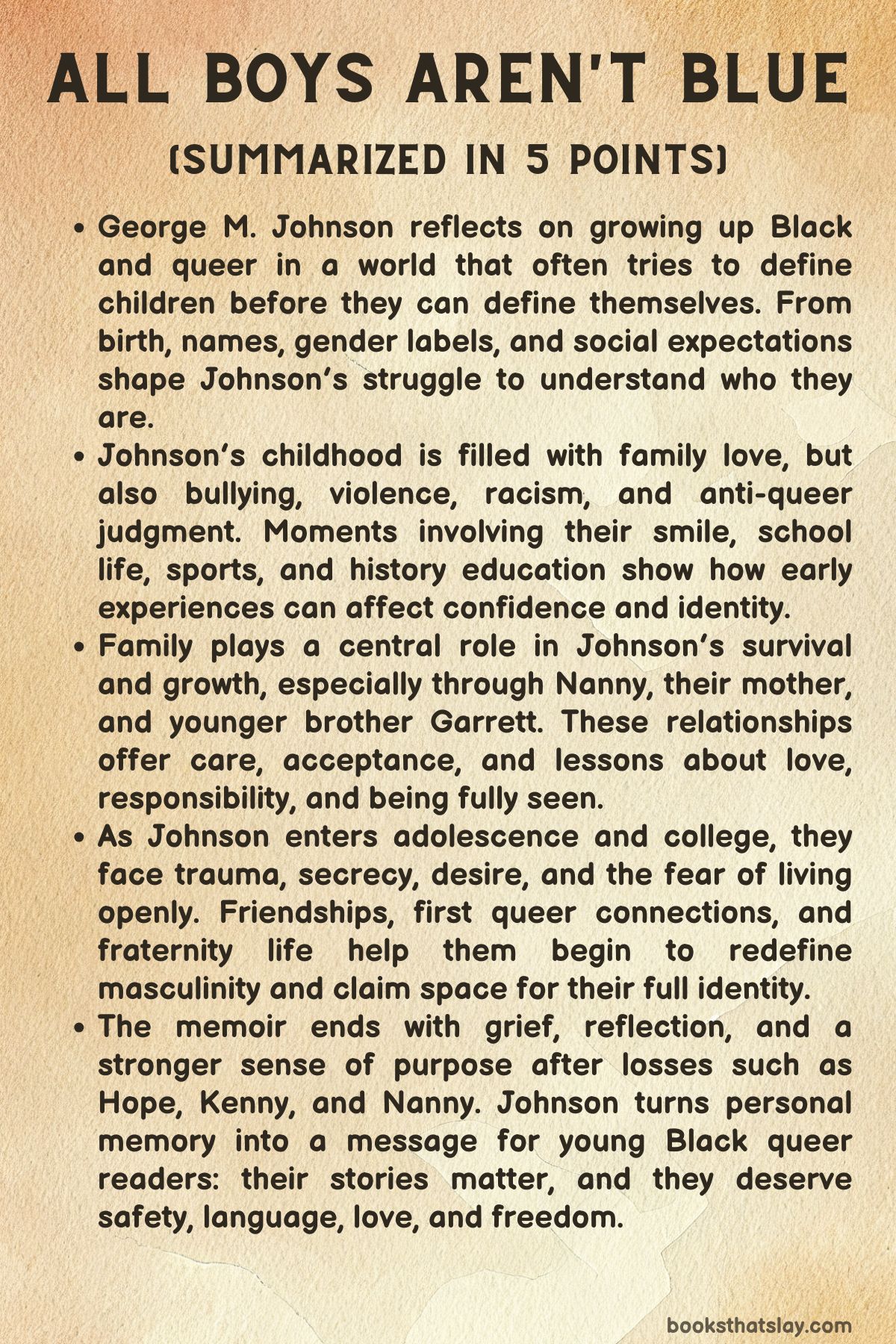
Key People
George M. Johnson
George M. Johnson is the narrator, central figure, and emotional guide of All Boys Aren’t Blue. Their character is built through memory, reflection, and self-questioning rather than through a single straight-line transformation.
As a child, Johnson is sensitive, observant, expressive, and aware that they do not fit the expectations placed on boys. Their love of jump rope, their use of playful language, their imagined connection to girlhood, and their discomfort with strict gender labels all show a young person trying to understand themself in a world that demands quick definitions.
Johnson’s journey is not only about coming out as queer but also about learning that identity can be self-defined instead of assigned by family, school, religion, or society.
Johnson is also marked by trauma, but the memoir does not reduce them to pain. Violence, bullying, sexual abuse, racism, and anti-queer bias shape their life, yet Johnson constantly searches for language that can turn survival into understanding.
They are honest about shame, fear, silence, and regret, especially in relation to Hope, Zamis, and their early sexual experiences. At the same time, they grow into someone who can speak openly about subjects that were once hidden.
Their strength comes from this willingness to name what happened without pretending that healing is simple. Johnson becomes both a witness and a teacher, using personal history to make space for young Black queer people who may not have role models.
Nanny
Nanny is one of the strongest and most loving figures in Johnson’s life. She represents care, stability, wisdom, and unconditional acceptance.
Her home is a gathering place for the family, and her presence creates a sense of safety that Johnson carries throughout life. Nanny is practical, humorous, direct, and deeply nurturing.
She takes care of her grandchildren not as a distant authority figure but as someone fully involved in their daily lives. Her care is physical, emotional, and spiritual, and Johnson presents her as a person whose love does not require explanation or performance.
Nanny’s importance grows even more when Johnson begins to withdraw because of shame and pressure. She notices what others might miss and responds by keeping Johnson close.
This makes her more than a grandmother; she becomes Johnson’s best friend and one of the first people who allows them to exist without fear. Her acceptance of Johnson’s queerness is not treated as a dramatic event but as a natural extension of her love.
Later, as Nanny ages and becomes ill, Johnson’s understanding of care changes. They learn that love also means returning care to those who once gave it freely.
Nanny’s character teaches that family love is not only about protection during childhood but also about responsibility, memory, and gratitude.
Johnson’s Mother
Johnson’s mother is portrayed as a figure of strength, emotional intelligence, and steady support. She is central to the foundation that allows Johnson to survive difficult experiences.
Her love is active rather than symbolic; she makes sure Johnson has family, community, and structure around them. She is not presented as flawless or distant but as deeply human, brave, and dependable.
Her serious brain surgery becomes one of the moments that reveals both her courage and Johnson’s devotion to her. Even when facing danger, she maintains hope and composure, giving Johnson an example of resilience that is rooted in love rather than hardness.
Her relationship with Johnson also matters because she respects their agency. When Johnson struggles with their name, she gives them permission to choose what feels right.
This becomes an early lesson in self-definition. Later, when Johnson comes out, her acceptance confirms that parental love does not have to be conditional.
She does not force Johnson to separate queerness from family belonging. Instead, she becomes part of the support system that allows Johnson to speak more honestly.
Through her, the memoir shows how a parent can protect a child not by controlling them but by allowing them to become fully themselves.
Johnson’s Father
Johnson’s father is a complex character because he represents both love and the limits of traditional masculinity. He comes from a family structure where gender roles are more rigid, and Johnson often feels tension between their own identity and their father’s expectations.
His patriarchal habits, especially his assumptions about women’s domestic labor, frustrate Johnson and reveal the generational ideas they are pushing against. At first, he seems to belong to a world where Johnson’s queerness and gender expression may not be easily understood.
Yet Johnson does not present their father as simply rejecting or cruel. Their relationship changes when sports become a bridge between them.
Johnson’s ability to play football and run track gives their father a way to connect with them through a form of masculinity he recognizes. This connection is limited, but it is still meaningful.
Johnson’s father shows care in his own way, even when that care is shaped by older ideas about manhood. His character helps explore the possibility that straight Black men and queer Black people can find connection when love is stronger than fear.
He also shows how masculinity can be learned, challenged, and expanded across generations.
Garrett
Garrett, Johnson’s younger brother, represents acceptance without performance. He is cisgender and heterosexual, but he never treats Johnson’s queerness as a reason for distance.
His presence is important because it challenges the idea that anti-queer attitudes are natural or unavoidable. Garrett’s bond with Johnson suggests that people are taught prejudice, and that love can remain simple when it is not poisoned by social expectations.
He does not require Johnson to explain or defend themself in order to be loved.
Garrett’s role may be quieter than that of Nanny or Johnson’s mother, but it carries emotional weight. He allows Johnson to exist as both Black and queer without asking them to divide those identities.
That matters because Johnson often faces pressure from the outside world to choose one part of themself over another. Garrett’s acceptance becomes a model of sibling love that is loyal, ordinary, and powerful.
His character reminds readers that support does not always need grand speeches; sometimes it appears as consistent presence and the refusal to make someone feel strange in their own family.
Hope
Hope is one of the most important figures in Johnson’s understanding of gender, courage, and regret. As Johnson’s transgender cousin, Hope gives Johnson an early example of someone living outside the gender rules their community often expects.
She is bold simply by existing openly, and her transition becomes a source of fascination, admiration, and fear for Johnson. Hope sees something in Johnson and tries to build closeness, but Johnson, still young and afraid of being judged, keeps distance from her in public.
This creates one of the memoir’s most painful reflections.
Hope’s character reveals how shame can separate people who might otherwise protect one another. Johnson does not excuse their own embarrassment but examines it with honesty.
Hope becomes a symbol of what it means to live visibly despite danger, loneliness, and social judgment. Her illness and early death add grief to Johnson’s memory of her, but she is not remembered only through tragedy.
She becomes a reason for Johnson to speak in support of transgender people and to recognize the harm caused when communities fail to protect their most vulnerable members. Hope’s life pushes Johnson to think beyond personal identity and toward collective responsibility.
Thomas
Thomas is one of the most difficult characters in the memoir because he is connected to both harm and loss. He is Johnson’s cousin, and his sexual violation of Johnson becomes a traumatic event that shapes Johnson’s later relationship with intimacy.
Johnson is careful not to soften the fact that abuse occurred. Thomas’s action causes confusion, fear, and lasting pain, especially because it happens within the family and during childhood.
His character represents how silence around sexuality, shame, and masculinity can create conditions where harm is hidden rather than addressed.
At the same time, Johnson reflects on Thomas with painful complexity. Thomas later dies because of anti-gay violence, and Johnson tries to understand him as someone who may also have been wounded by the same systems that harmed Johnson.
This does not excuse what Thomas did, but it makes the analysis of him more layered. He is both a person who caused trauma and a person destroyed by hatred.
Through Thomas, Johnson examines cycles of violence within queer communities, especially when young people are forced to hide desire, fear, and confusion. His character shows why silence is dangerous and why honest conversations about consent, sexuality, and masculinity are necessary.
Zamis
Zamis represents the possibility of queer companionship during adolescence, as well as the sadness of what fear can take away. Johnson develops a crush on him during school, and their friendship becomes a rare space where Johnson senses recognition.
The two boys communicate and bond, but when the question of being gay comes up, both deny the truth. Their denial is not simply personal dishonesty; it is a survival response to a world where being open could bring shame, bullying, or rejection.
When Johnson and Zamis meet again years later at a Pride event, the truth becomes clear: both had known, or at least sensed, who the other was. This later reunion turns Zamis into a figure of missed possibility.
Johnson imagines the teenage joy they might have shared if they had been free to be honest. Zamis is important because he shows that queer young people often find one another before they have the courage or safety to speak.
His character carries both sweetness and regret. He reflects the friendships, first crushes, and young love that many queer people are denied by fear and social pressure.
Kenny
Kenny is Johnson’s fraternity line brother and one of the most meaningful examples of acceptance outside Johnson’s family. He is remembered as kind, loyal, and open-hearted.
His acceptance matters because it comes from a cisgender heterosexual peer in a space associated with masculinity, brotherhood, and tradition. In college, Johnson is still learning how to live more openly, and Kenny’s support helps challenge the idea that queer identity must threaten male friendship.
He accepts Johnson without making their queerness a problem.
Kenny’s death has a major emotional effect on Johnson. Before learning he has died, Johnson feels an urge to call him but does not.
This missed call becomes a lasting regret and a lesson about time, love, and urgency. As Johnson and the other line brothers grieve, Kenny’s importance becomes even clearer.
He helped create a brotherhood where Johnson could feel seen and protected. His character shows that allyship is not abstract; it is found in how people treat one another every day.
Kenny’s life and death teach Johnson that love should not be postponed and that chosen bonds can become family.
Johnson’s Line Brothers
Johnson’s line brothers function as a collective character, representing brotherhood, masculinity, support, and emotional growth. When Johnson enters the fraternity process, they initially believe it may help them gain a more traditional masculine identity.
Over time, however, the experience teaches something different. Their line brothers do not force Johnson into a narrow version of manhood.
Instead, they become witnesses to Johnson’s vulnerability, especially after an older fraternity member uses an anti-gay slur and Johnson breaks down.
Their response is crucial. Rather than mocking Johnson or distancing themselves, they comfort them.
This moment changes Johnson’s understanding of male friendship. The line brothers become proof that men can care for one another tenderly without losing strength.
Their bond also helps Johnson recognize that many people carry hidden struggles, including possible struggles around sexuality and identity. Through this group, All Boys Aren’t Blue expands the idea of brotherhood beyond performance, dominance, or silence.
The line brothers show that chosen community can help a person rebuild their sense of self.
Lawrence
Lawrence introduces Johnson to the world of Alpha Phi Alpha and becomes part of the path that leads Johnson toward a new understanding of masculinity and belonging. His role is brief but important.
He represents an opening, a doorway into a community that Johnson initially sees as a possible answer to their insecurity about manhood. Through Lawrence, Johnson begins to imagine that fraternity life might offer structure, pride, and recognition.
Lawrence’s importance lies less in his personal development and more in what he makes possible for Johnson. He connects Johnson to a tradition of Black male excellence and brotherhood, but the memoir later complicates what that tradition means.
Johnson does not simply become more traditionally masculine through the fraternity; instead, they learn that manhood can be redefined. Lawrence is therefore a starting point in a larger transformation.
His presence helps move Johnson from isolation toward community, even if that community must still confront its own assumptions about sexuality and gender.
Charles
Charles appears as Johnson’s line brother and as one of the first people to draw Johnson into the formal process of joining the fraternity. His mysterious phone call signals the beginning of a new chapter in Johnson’s college life.
As part of the line brother group, Charles contributes to the sense of secrecy, discipline, anticipation, and shared effort that defines Johnson’s entrance into Alpha Phi Alpha. He helps form the group structure that eventually becomes a source of emotional support.
Charles’s role matters because he is part of the brotherhood that witnesses Johnson’s vulnerability. The fraternity process could have reinforced Johnson’s fear of not being masculine enough, but the line brothers create a more complicated and ultimately more supportive space.
Charles, along with the others, becomes part of the community that helps Johnson feel less alone. His character shows how belonging can begin in uncertainty and grow into something deeply protective.
Evan
Evan is a disturbing figure in Johnson’s early life because he is connected to a second experience of sexual violation. His action in the bathroom reinforces Johnson’s confusion and fear around intimacy.
Evan is not developed as fully as Thomas, but his role is significant because he shows that Johnson’s early encounters with sexuality were shaped by harm rather than safety, consent, or education. This leaves Johnson with anxiety that follows them into later relationships.
Evan’s character also points to a broader failure of guidance. Johnson grows up without meaningful conversations about queer desire, consent, or boundaries.
Because of that silence, harmful experiences become even harder to process. Evan represents the kind of violation that can be dismissed or hidden when young people are not given the language to describe what happened.
His role in the memoir is brief but serious, showing how early harm can affect a person’s ability to trust their own body and desires.
Rall and Rasul
Rall and Rasul are Johnson’s cousins, and they represent a form of rough but loving family care. During a family vacation, they push Johnson into the deep end of a pool, forcing them to learn how to swim.
On the surface, the act is risky and frightening, but they stay in the water with Johnson and make sure they do not sink. This scene reflects the complicated ways family members sometimes teach, protect, and challenge one another.
Their relationship with Johnson matters because they accept Johnson’s difference without turning it into rejection. Along with Nanny, they show Johnson a version of family love that allows room for individuality.
Johnson may stand out through clothing choices, personality, and gender expression, but Rall and Rasul remain close. They are not perfect caregivers, but they are present.
Their character function is to show that protection can come from cousins and siblings as much as from parents, and that family bonds can hold even when a child does not fit the expected mold.
G.G.
G.G., Johnson’s older half-brother, helps reveal the tensions within Johnson’s father’s side of the family. His estrangement from their shared father suggests that strict ideas about masculinity and family authority can damage relationships.
Though G.G. is not explored in as much depth as Johnson’s immediate caregivers, his presence matters because he shows that Johnson is not the only child affected by their father’s worldview.
G.G.’s character adds context to Johnson’s relationship with their father. The distance between G.G. and their father suggests that patriarchal expectations can create emotional breaks long before queerness is openly discussed.
In this way, G.G. helps broaden the memoir’s critique of masculinity. The issue is not only how straight men respond to queer children; it is also how rigid fatherhood can harm sons in general.
G.G. stands as evidence that love without emotional flexibility can lead to separation.
Themes
Identity and Self-Definition
Identity in All Boys Aren’t Blue is not treated as a fixed label handed down at birth. Johnson’s life shows that identity is shaped through names, bodies, family expectations, race, gender, sexuality, and personal choice.
From the opening reflection on being declared a boy, Johnson questions how much meaning society attaches to gender before a child can even speak. Their struggle with the names George and Matthew extends this question into language: if a name can be chosen, then perhaps other parts of the self can also be claimed rather than merely accepted from others.
Johnson’s queerness is not separate from their Blackness, and the memoir resists any demand that one identity be placed above the other. This matters because Johnson often moves through spaces that understand only part of them.
Some environments affirm Blackness but reject queerness, while others may recognize queerness without understanding Black experience. Johnson’s growth comes from refusing that division.
Self-definition becomes an act of survival, but also an act of freedom. By telling their own story, Johnson shows that identity is not confusion simply because it changes, expands, or resists easy categories.
It becomes truthful when a person has the power to name themself.
Family, Care, and Acceptance
Family in the memoir is both a source of protection and a place where difficult lessons are learned. Johnson’s family does not exist as a perfect safe haven, but it provides many of the relationships that help them survive.
Nanny’s care is especially important because she offers love that does not require Johnson to shrink. Her home becomes a center of warmth, humor, and belonging, and her acceptance gives Johnson a model of love that is steady rather than conditional.
Johnson’s mother offers another form of care through strength, emotional support, and respect for choice. Garrett’s acceptance shows that love between siblings can remain free of judgment when prejudice is not taught.
Even Johnson’s father, though shaped by traditional masculinity, is shown with complexity. Their relationship is strained by gender expectations, but it is not empty of love.
The memoir also understands care as something that must eventually be returned. As Nanny and Johnson’s mother face illness, Johnson learns that love is not only something children receive; it becomes a duty to protect and honor those who once protected them.
Family, then, is not simple comfort. It is a living structure of responsibility, memory, conflict, forgiveness, and chosen acceptance.
Masculinity and Gender Expectations
Masculinity appears throughout Johnson’s life as a set of rules they are expected to follow but rarely feel at home inside. As a child, Johnson learns that boys are supposed to move, speak, play, and desire in certain ways.
Jump rope, expressive language, feminine-coded behavior, and closeness with girls all become reasons for others to mock or police them. Johnson’s decision to play football shows the absurdity of these rules.
Their athletic success surprises others because people assume queerness and physical ability cannot coexist. This moment exposes how narrow and false those assumptions are.
Later, fraternity life becomes another test of masculinity. Johnson first sees Alpha Phi Alpha as a path toward the kind of manhood they believe they lack, but the experience teaches something more meaningful.
The support of their line brothers shows that manhood does not have to be built on silence, cruelty, or emotional distance. It can include tenderness, loyalty, grief, and vulnerability.
Johnson’s father also reflects the limitations of older masculine models, particularly through patriarchal expectations in the home. Across the memoir, masculinity is not rejected entirely; it is reimagined.
Johnson claims the right to define it in a way that can include queerness, softness, strength, and self-respect.
Trauma, Silence, and Healing
Trauma in the memoir is often intensified by silence. Johnson experiences physical violence, bullying, sexual violation, racism, and anti-queer hostility, but many of these wounds are made worse because there are few safe spaces to discuss them.
The injury to Johnson’s teeth affects their smile, but it also symbolizes how pain can alter a person’s relationship with joy and self-expression. The sexual violations Johnson experiences are even more complicated because they occur before Johnson has the language to fully process consent, queer desire, or abuse.
Johnson’s reflections on Thomas are especially difficult because they hold harm and empathy in the same frame. Thomas caused pain, yet he was also later killed by anti-gay violence.
This does not erase responsibility, but it shows how communities damaged by shame can reproduce harm when silence replaces care. Healing, for Johnson, does not mean forgetting or turning pain into a neat lesson.
It means naming what happened, understanding its effects, and refusing to let secrecy control the future. Grief over Hope, Kenny, and Nanny also becomes part of this process.
By speaking openly, Johnson creates the kind of testimony they needed when they were younger: honest, protective, and unwilling to hide what hurts.